
Job 9:7

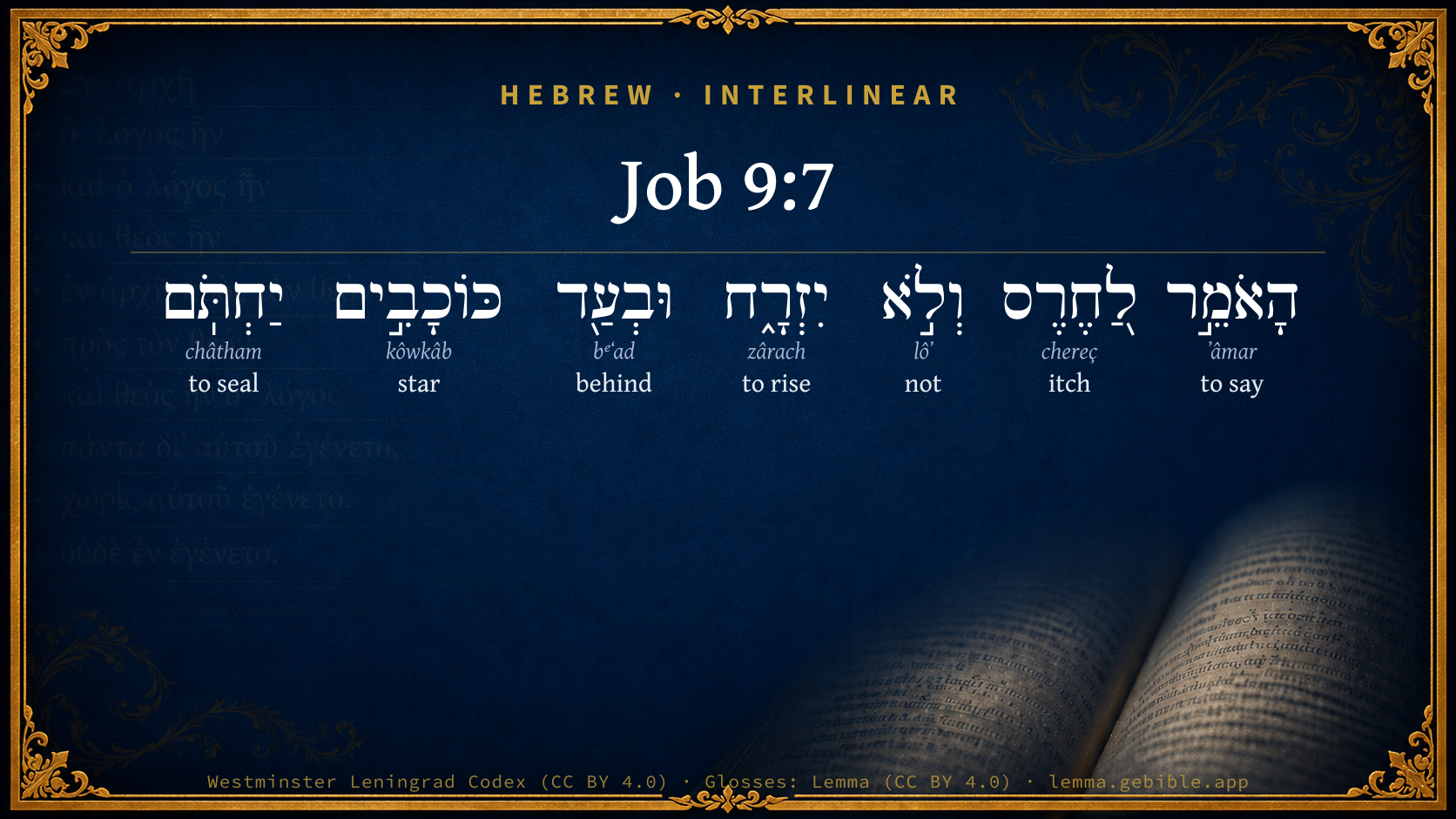
Hebrew (Westminster Leningrad Codex) Job 9:7 appears in the Hebrew Old Testament. The text above is from the Westminster Leningrad Codex. Each word links to its Strong’s number, a concise gloss, and parsing drawn from the Open Scriptures Hebrew Bible morphology. Click any word for its full Brown-Driver-Briggs (BDB) entry.
Download image
Cite this verse

Job 9:7 (World English Bible). Public Domain. Lemma interlinear Bible study tool, https://lemma.gebible.app/v/job/9/7.

Show BibTeX & RIS
BibTeX
RIS
English Translation
Who commands the sun, and it doesn't rise, And seals up the stars;
World English Bible · Public Domain
Download a study sheet

One document with this verse’s original text, its word-by-word gloss line, the meaning frame, cross-references with their text, attributed commentary, and full source and license credits — printable, and it pastes into notes with its structure intact.

This verse Autodidact and up

Study sheet (.html) Plain text (.txt)

A passage Seminary Student

Up to 50 verses in one chapter. A passage sheet keeps up to 6 commentary sources and 12 cross-references per verse, in the order this page ranks them, and says so on the sheet whenever that leaves anything out. Ask for a single verse and you get the Autodidact verse sheet above.

Everything on this page stays free to read, with no account — the sheet is a download of what is already on screen, not access to it.

Want to remove ads? Support Godless Engineer
Compare translations 3

The same verse in 3 English versions, stacked beneath the original-language interlinear above. Click any original word for its lexicon entry.

Each is an independent rendering of the whole verse — the interlinear is not word-aligned to these translations.

Highlighted words mark where these versions differ — a whole-verse word diff, not a word-by-word alignment.

  • World English Bible Public Domain
    Who commands the sun, and it doesn't rise, And seals up the stars;
  • King James Version Public Domain
    Which commandeth the sun, and it riseth not; and sealeth up the stars.
  • unfoldingWord Literal Text CC BY-SA 4.0
    the one speaking to the sun and it does not rise, and upon the stars he seals;

unfoldingWord Literal Text — © unfoldingWord, licensed CC BY-SA 4.0. Word-aligned USFM3 via Door43 (git.door43.org/unfoldingWord/en_ult).

Versions to compare (up to 4)

3 of 4 selected

Show all 18 translations

Every available English version of this verse, each an independent rendering of the whole verse.

  • World English Bible Public Domain
    Who commands the sun, and it doesn't rise, And seals up the stars;
  • Berean Standard Bible Public Domain
    He commands the sun not to shine; He seals off the stars.
  • Majority Standard Bible Public Domain
    He commands the sun not to shine; He seals off the stars.
  • King James Version Public Domain
    Which commandeth the sun, and it riseth not; and sealeth up the stars.
  • American Standard Version (1901) Public Domain
    That commandeth the sun, and it riseth not, And sealeth up the stars;
  • Revised Version (1885) Public Domain
    Which commandeth the sun, and it riseth not; and sealeth up the stars.
  • Geneva Bible (1599) Public Domain
    He commandeth the sunne, and it riseth not: hee closeth vp the starres, as vnder a signet.
  • Douay-Rheims (1899) Public Domain
    Who commandeth tile sun and it riseth not: and shutteth up the stars as it were under a seal:
  • Young's Literal Translation Public Domain
    Who is speaking to the sun, and it riseth not, And the stars He sealeth up.
  • Literal Standard Version CC BY-SA 4.0
    Who is commanding to the sun, and it does not rise, || And the stars He seals up.
  • Unlocked Literal Bible CC BY-SA 4.0
    It is the same God who tells the sun not to rise, and it does not, and who covers up the stars,
  • unfoldingWord Literal Text CC BY-SA 4.0
    the one speaking to the sun and it does not rise, and upon the stars he seals;
  • Darby Bible Public Domain
    Who commandeth the sun, and it riseth not, and he sealeth up the stars;
  • World Messianic Bible Public Domain
    He commands the sun and it doesn’t rise, and seals up the stars.
  • Webster's Bible Public Domain
    Who commandeth the sun, and it riseth not; and sealeth up the stars.
  • Free Bible Version CC BY-SA 4.0
    He is the one who can command the sun not to rise and the stars not to shine.
  • Bible in Basic English Public Domain
    Who gives orders to the sun, and it does not give its light; and who keeps the stars from shining.
  • JPS Tanakh (1917) Public Domain
    Who commandeth the sun, and it riseth not; and sealeth up the stars.

Literal Standard Version (2020), Covenant Press — licensed CC BY-SA 4.0. Text via the HelloAO Bible API (eBible.org). Unlocked Literal Bible (unfoldingWord) — licensed CC BY-SA 4.0. Text via the HelloAO Bible API (eBible.org). unfoldingWord Literal Text — © unfoldingWord, licensed CC BY-SA 4.0. Word-aligned USFM3 via Door43 (git.door43.org/unfoldingWord/en_ult). Free Bible Version, Dr. Jonathan Gallagher — licensed CC BY-SA 4.0. Text via the HelloAO Bible API (eBible.org).

Word by word

More ways to search: Search by grammar → Find every occurrence → Compare this word →

Practice this passage: Drill this verse → Learn its vocabulary →

About this verse

These counts appear in no published source. They are computed here, from the morphology-tagged text and Lemma’s own curated glosses. What Lemma adds →

7
words
7
distinct lemmas
Wisdom
section

Notable vocabulary

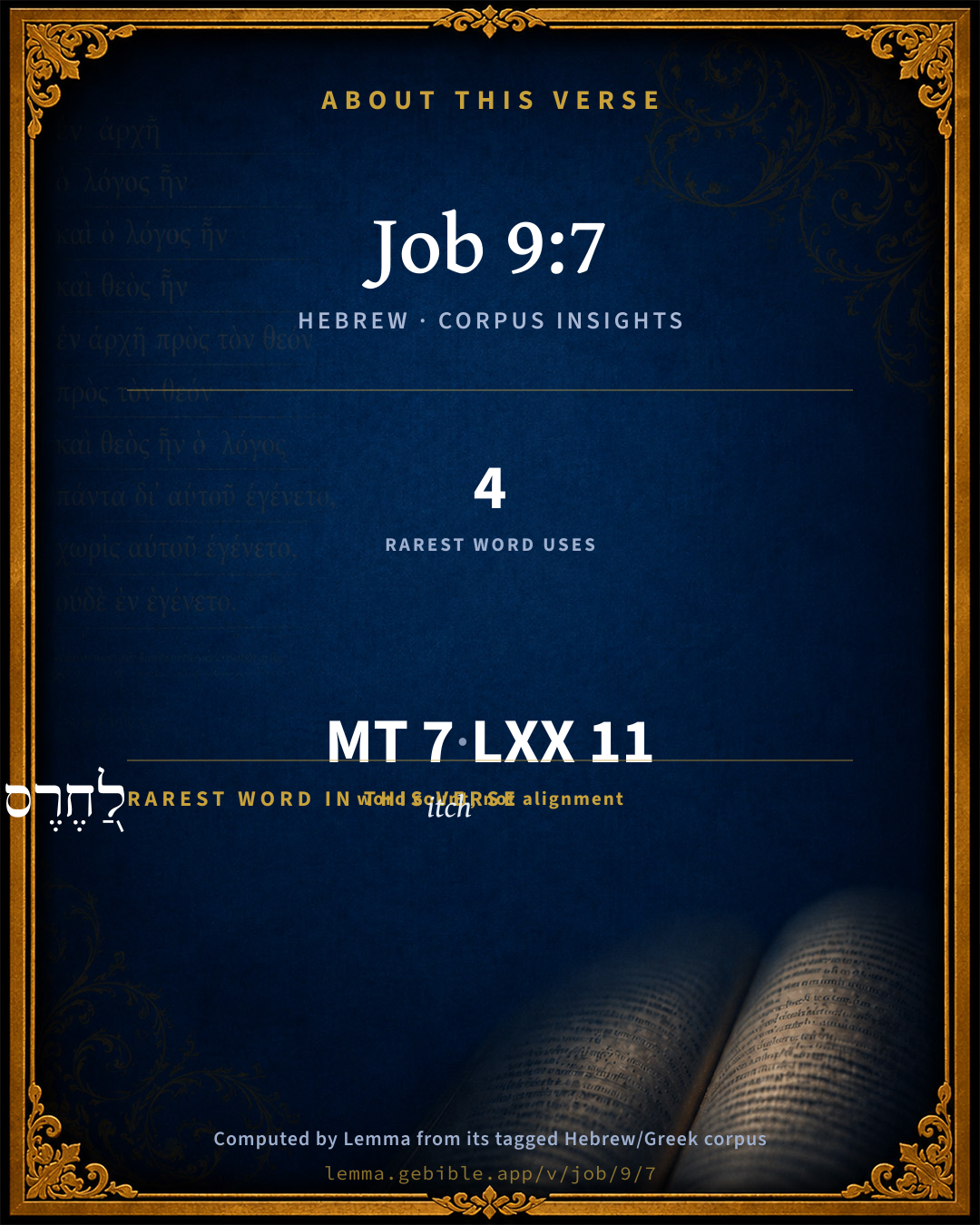
The rarest word here is לַ֭חֶרֶס itch H2775 — appearing just 4 times in the whole Hebrew Bible.

Shared distinctive vocabulary

לַ֭חֶרֶס itch H2775 occurs in 4 verses of the Hebrew Bible. Also found in:

Grammatical profile

  • 3 verbs
  • 2 nouns
  • 1 preposition
  • 1 particle

Verb forms

  • הָאֹמֵ֣ר Qal · Participle Active
  • יִזְרָ֑ח Qal · Imperfect
  • יַחְתֹּֽם Qal · Imperfect

Hebrew & Septuagint length

In English translation the verse runs 13 words from the Hebrew and 14 from the Septuagint (LXX English) — closely comparable.

A rough comparison of the two English renderings, which tokenize alike — not a word-level alignment.

Word counts can differ between the Hebrew and the Greek without any difference in meaning — e.g. the Hebrew direct-object marker אֵת has no separate Greek word, and Greek often adds the article ὁ.

In the original languages it is 7 Hebrew tokens and 11 Greek tokens — but the two are counted differently (Hebrew bundles its prefixes and suffixes into one token; the Greek is in lemma form), so that isn’t a like-for-like length.

Cross-references

12

Topical passages linked to Job 9:7 in the Treasury of Scripture Knowledge — connected by theme and wording, ordered by reader-vote popularity; previews shown in the World English Bible.

  • Isaiah 13:10 For the stars of the sky and the constellations of it shall not give their light; the sun shall be darkened in its going forth, and the moon shall not cause its light to shine.
  • Amos 8:9 "It will happen in that day," says the Lord Yahweh, "That I will cause the sun to go down at noon, And I will darken the earth in the clear day.
  • Luke 21:25–26 There will be signs in the sun, moon, and stars; and on the earth anxiety of nations, in perplexity for the roaring of the sea and the waves;
  • Exodus 10:21–22 Yahweh said to Moses, "Stretch out your hand toward the sky, that there may be darkness over the land of Egypt, even darkness which may be felt."
  • Joshua 10:12 Then spoke Joshua to Yahweh in the day when Yahweh delivered up the Amorites before the children of Israel; and he said in the sight of Israel, Sun, stand you still on Gibeon; You, Moon, in the valley of Aijalon.
  • Job 37:7 He seals up the hand of every man, That all men whom he has made may know it.
  • Job 38:19–20 "What is the way to the dwelling of light? As for darkness, where is the place of it,
  • Ezekiel 32:7–8 When I shall extinguish you, I will cover the heavens, and make the stars of it dark; I will cover the sun with a cloud, and the moon shall not give its light.
  • Daniel 4:35 All the inhabitants of the earth are reputed as nothing; and he does according to his will in the army of heaven, and among the inhabitants of the earth; and none can stay his hand, or tell him, What do you?
  • Amos 4:13 For, behold, he who forms the mountains, And creates the wind, And declares to man what is his thought; Who makes the morning darkness, And treads on the high places of the Earth: Yahweh, the God of hosts, is his name."
  • Matthew 24:29 But immediately after the oppression of those days, the sun will be darkened, the moon will not give its light, the stars will fall from the sky, and the powers of the heavens will be shaken;
  • Job 38:12–15 "Have you commanded the morning in your days, And caused the dawn to know its place;

Cross-references courtesy of OpenBible.info (CC BY 4.0).

Hebrew and Greek witnesses Masoretic Hebrew ↔ Greek Septuagint

The same verse in the two great witnesses to the Old Testament, shown verse-for-verse.

These are two independent witnesses, not word-aligned to each other, and the Septuagint is shown in lemma (dictionary) form.

Hebrew Job 9:7 Masoretic · Westminster Leningrad Codex

הָאֹמֵ֣ר לַ֭חֶרֶס וְלֹ֣א יִזְרָ֑ח וּבְעַ֖ד כּוֹכָבִ֣ים יַחְתֹּֽם

Who commands the sun, and it doesn't rise, And seals up the stars;

World English Bible · Public Domain

Greek LXX Job 9:7 Septuagint · lemma form

ὁ λέγω ὁ ἥλιος καί οὐ ἀνατέλλω κατά δέ ἄστρον κατασφραγίζω

Who commands the sun, and it rises not; and he seals up the stars.

LXX2012 (modern English Septuagint) · Public Domain

Hebrew: Westminster Leningrad Codex (CC BY 4.0). Greek: Septuagint (public domain); English from LXX2012 (modern English Septuagint) (Public Domain). How the Septuagint differs from the Hebrew →

Commentary

Notes on Job 9:7 from classic Christian and Jewish commentators (each source and its license shown beneath its notes). The classic Christian expositions comment on the surrounding passage and are grouped to its opening verse, so a note may address several verses; the Jewish commentaries on the Tanakh (Rashi and others) are per-verse, so they appear only where the commentator wrote on this verse.

Lemma curates 59 commentaries, every one of them public domain or Creative Commons licensed, each selected and text-cleaned for this edition rather than reprinted as found. About our sources →

Trapp's Complete Commentary

John Trapp

Job 9:7 Which commandeth the sun, and it riseth not; and sealeth up the stars.

Ver. 7. Which commandeth the sun, and it riseth not] God, in framing the world, began above, and wrought downward; but Job, in describing the great works of God here, began below; and now goes upward from earth to heaven. It is as natural to the heaven to move as to the earth to stand still. Copernicus’s opinion, that the earth turns round, and heaven stands still, is worthily exploded. Round the earth is, indeed, notwithstanding the hills and valleys (as an apple is round, notwithstanding some knots and bunches in it), and being round, it is naturally apt for motion (the Pythagoreans held that the earth was natura sua mobilis, as the heavens are), but God hath fixed and made it immoveable, while the heavenly bodies are restless in their courses. The sun (the glistering sun, as the word here signifieth) rejoiceth as a strong man to run his race, Psa 19:5. Bellarmine saith, that in the eighth part of an hour the sun runneth 700 miles (De ascens. mentis in Deum, grad. 7); but God, the sovereign of the sun, can speak to it, and it riseth not. If he do but give the word of command to the sun not to rise, the morning shall be made darkness, Amo 4:13, and the day dark with night, Amo 5:8. Was it not so in that three days’ darkness in Egypt? Exo 12:21, in that miraculous standing still of the sun in Joshua’s days, when the sun rose not with the antipodes one morning, and the stars were sealed up part of the night? Jos 10:13, in that dismal darkness (mentioned by Lavater upon this text), March 12, 1585, lasting for a quarter of an hour, and being so like the night, that the fowls went to roost at noon, and many fell to their prayers for pardon of their sins, as thinking verily that the day of judgment was come. {There was no solar eclipse for this date.} St Paul in the tempest at sea saw neither sun nor stars for many days, Act 27:20. And I have read of a foreigner, who having been in these parts in the deep of winter, and returning home again, desired one that was then bound for England to commend him to the sun when he next saw him, for I have not seen him there, said he, of a whole fortnight together, Eze 32:7. I will cover the sun with a cloud; and, in that sense, speak to it that it rise not.

And sealeth up the stars] Heb. Sets a seal upon the stars, making them hide their heads, and withdraw their influences: for stars are God’s storehouses, Deu 28:12, which he openeth or shutteth at his pleasure. Every star is like a purse of gold; out of which God can, when he will, throw down riches and plenty into the earth; but many of them never appear to us, though visible to the antipodes, Job 37:7.

John Trapp, A Commentary or Exposition upon All the Books of the Old and New Testament (1647–1656) — public domain. Text from a community e-Sword module.

Joseph Benson's Commentary

Job 9:7. Who commandeth the sun, and it riseth not — Nor are the heavens less subject to his power; for neither sun nor stars can shine if he forbid them. “Bishop Warburton supposes, that this alludes to the miraculous history of the people of God, such as the Egyptian darkness, and the stopping the sun’s course by Joshua. But surely there is no necessity, from the words themselves, to suppose any allusion of this kind, or, indeed, any thing miraculous, since God, by throwing a thick cloud over the sun and stars, can and does obscure them when he pleases.” — Dodd. And things in the Scriptures are often said to be or not to be, when they appear or disappear; of which some instances have been given in the former part of this work, and we shall have more hereafter in their proper places. Thus it is that the Chaldee Paraphrast understands the passage. And sealeth up the stars — That is, covereth and shutteth them up, that they may not shine, as in dark and dismal tempests, like that mentioned Act 27:20, when neither sun nor stars appeared for many days.

Joseph Benson's Commentary on the Old and New Testaments (1811–1818) — public domain. Text from a community e-Sword module.

Jamieson, Fausset & Brown

Robert Jamieson, A. R. Fausset & David Brown

The sun, at His command, does not rise; namely, in an eclipse, or the darkness that accompanies earthquakes (Job 9:6).

sealeth up the stars--that is, totally covers as one would seal up a room, that its contents may not be seen.

Jamieson, Fausset & Brown — Commentary Critical and Explanatory on the Whole Bible (1871) — public domain (CC PDM 1.0). Text via the HelloAO Bible API.

Adam Clarke's Commentary

Verse 7. Which commandeth the sun] Obscures it either with clouds, with thick darkness, or with an eclipse.

Sealeth up the stars.] Like the contents of a letter, wrapped up and sealed, so that it cannot be read. Sometimes the heavens become as black as ebony, and no star, figure, or character, in this great book of God can be read.

Adam Clarke's Commentary on the Bible (1810–1826) — public domain. Text from a community e-Sword/MySword module.

Ellicott's Commentary for English Readers

(7) And sealeth up the stars—Comp. Job_41:15. The idea of shutting up, taking away the power of, &c., is contained in the expression “sealing.”

A Bible Commentary for English Readers, edited by Charles John Ellicott (1878–1897) — public domain. Text from a community e-Sword module.

The Cambridge Bible for Schools and Colleges

gen. ed. J. J. S. Perowne

7. The reference may be to days when from storm and darkness the sun seems not to rise, or to eclipses and sudden obscurations of the heavenly bodies.

The Cambridge Bible for Schools and Colleges (gen. ed. J. J. S. Perowne; Cambridge University Press, 1878–1918) — public domain. Text from a community e-Sword module.

John Gill's Exposition

Which alone spreadeth out the heavens,.... The expanse, or what we commonly translate "firmament"; but has its name in the Hebrew language from its being expanded, spread, and stretched out, over the earth and all around it; and seems chiefly to design the ether or atmosphere, which is a fine thin matter and substance spread around us, and which is sometimes spread with clouds; this is said to be stretched out like a curtain and a tent to dwell in, tents being made of curtains spread out, Isa 40:21; and the allusion may be to a military tent, the pavilion of a general of an army, as Pineda observes, from whence Jehovah plays his artillery upon his enemies, thunder, lightning, hailstones, and coals of fire; see Psa 18:11; this respects not so much the first creation, or spreading of the air or the heavens, as the continuance thereof; God continues to spread them, or to keep them spread, that they may not be rolled up as a scroll; or folded up as a garment, as they will be, Heb 1:12; and this he does alone, without the help of any creature, angels or men; any piece of tapestry or carpet, that is large, is not easily spread alone; but what power must the vast expanse of the heavens require, to be spread alone and continued so? nothing less than infinite; see Isa 44:24; some render it, "which boweth the heavens" (c), as the same word is rendered in Psa 18:9; which he does when he fills them with clouds, so that they seem to hang low, and to be inclined towards the earth:

and treadeth upon the waves of the sea (d); which he did at the first creation, when the waters that covered the face of the earth were, by his order, collected into one place, and there shut up, and restrained from overflowing the earth; and which restraint, as it is an act of power over them, is designed by treading upon them, and a continued act may be the rather meant here; see Gen 1:8; and when the waves of it are lifted up as high as they sometimes are, by strong and stormy winds, the Lord on high is mightier than they, he treads upon them and represses them; he rules their raging, stills their noise, and makes them smooth, calm, and quiet, Psa 65:7; this none but God can do: the Egyptian hieroglyphic of doing a thing impossible was a man's walking upon water (e); the Heathens chose not to describe even their god of the sea, Neptune, by walking on it, as being too great for him, but by swimming (f); of Christ's walking upon the sea, see Mat 14:25; it may be rendered, "the high places of the sea": the waves of it, when mounted to a great height by the wind; so Mr. Broughton, "the high waves of the sea", see Psa 107:25; there is a copy, as the lesser Massorah observes, which reads, "upon the high places of the cloud" (g), see Isa 14:14; and Gersom interprets these high places, of the heavens, and of God's giving rain from thence.

(c) "inclinat coelum", Piscator. (d) "super excelsa maris", Pagninus, Montanus, &c. "summitates maris", Tigurine version; "celsos vertices maris", Schultens. (e) Orus Apollo, apud Bolduc. (f) Cicero de Natura Deorum, l. 2. (g) "Legitur et" "pro" i.e. "super excelsas nubes", Vatablus.

John Gill's Exposition of the Whole Bible (1746–1763) — public domain (CC PDM 1.0). Text via the HelloAO Bible API.

Albert Barnes' Notes on the Bible

Which commandeth the sun, and it riseth not - Schultens supposes that all this is a description of the deluge - when the mountains were removed, when the fountains of the deep were broken up, and when the sun was obscured and seemed not to rise. Others have supposed that it refers to the fact that the sun is darkened by clouds and tempests, and appears not to rise and shine upon the earth. Others suppose that the allusion is to an eclipse; and others, that it is to the power of God, and means that the rising of the sun depends on him, and that if he should choose to give the command, the heavenly bodies would rise and give light no more. It seems probable that the meaning is, that God has power to do this; that the rising of the sun depends on him; and that he could delay it, or prevent it, at his pleasure. His power over the sun was shown in the time of Joshua, when, at his command, it stood still; but it is not necessary to suppose that there is any reference to this fact here. The whole meaning of the language is met by the supposition that it refers to the power of God, and affirms what he could do, or if it refer to any fact that had been observed, that the allusion is to the darkening of the sun by an eclipse or a tempest. No argument can be derived, therefore, from the expression, in regard to the age of the book.

And sealeth up the stars - The word “seal” in the Scriptures (חתם châtham) is used with considerable latitude of signification. It is employed in the sense of shutting, closing, making fast - as when anything was sealed, it was shut up or made fast. The Hebrews often used a seal, where we would use a lock, and depended on the protection derived from the belief that one would not break open that which was sealed, where we are obliged to rely on the security of the lock against force. If there were honor and honesty among people everywhere, a seal would be as secure as a lock - as in a virtuous community a sealed letter is as secure as a merchant’s iron “safe.” To “seal up the stars,” means so to shut them up in the heavens, as to prevent their shining; to hide them from the view. They are concealed, hidden, made close - as the contents of a letter, a package, or a room are by a seal, indicating that no one is to examine them, and concealing them from the view. So God hides from our view the stars by the interposition of clouds.

Albert Barnes' Notes on the Bible (1834–1885) — public domain. Text from a community e-Sword/MySword module.

Haydock's Catholic Bible Commentary

Seal. So that they appear not. He alludes (Calmet) to masters confining their servants with seals, before locks were invented. (Macrobius vii. 3.) --- From these noble effects of God’s power, Job takes occasion to humble himself. (Calmet)

George Leo Haydock (1774–1849), Haydock's Catholic Family Bible and Commentary, 1859 edition — public domain. Excludes Psalms (Douay-Rheims chapter numbering differs from Protestant) and Deuterocanonical books (Catholic canon only).

Matthew Poole's English Annotations

He speaks either,

1. Of that which God can do; or rather, (as he doth in the foregoing and following instances,)

2. Of what God actually doth; and that either,

1. Ordinarily; and so he gives laws to the sun that it shall not rise, but at such times, and to such places, and in such manner as he hath appointed; as that it shall rise constantly at its set time, and never disorderly; that it shall not rise for divers months together in some parts of the world, &c. Or rather,

2. Extraordinarily; (for of such works of God he discourseth in this place;) and so it may note either some stop given to the sun for a small season, like that in Joshua’s time; which might have been, though it be not recorded; or some extraordinary tempest or dark season, wherein the morning is made darkness, as the phrase is, Amo 4:13; compare Amo 5:8; wherein the sun doth not at all appear, (as it was for many days together, Act 27:20) and consequently is to those places and persons as if he were not risen. For things in Scripture are oft said to be, or not to be, when they appear or disappear; of which some instances have been formerly given, and more we shall have hereafter, in their proper places. Sealeth up the stars, i.e. as it were, covereth and shutteth them up that they may not shine, as in dark and dismal tempests, like that now mentioned, Act 27:20, when neither sun nor stars appeared for many days.

Matthew Poole's English Annotations on the Holy Bible (1683–1685) — public domain. Text from a community e-Sword/MySword module.

Whedon's Commentary on the Bible

Daniel D. Whedon

7. Commandeth — Rather, speaketh. God has but to speak to the sun, and it shall cease to rise. The rising of the sun and the shining of the stars, day and night, alike depend upon Him.

Sealeth up the stars — An set expressive of their total covering; for who would dare to break the seal of God? (Umbreit.) Job may mean the disappearance of stars — an astronomical event that may have been noted at a very early day. Schultens explains the entire verse by the flood; Warburton by the plague of darkness in Egypt; and others by the staying of the sun in its course at the command of Joshua. The text, however, speaks of the general exercise of the power of God. God can, if he will, reverse the action of nature as easily as overrule it.

Daniel D. Whedon (gen. ed.), Commentary on the Old and New Testaments (1874–1909) — public domain. Text from a community e-Sword module.

The Pulpit Commentary

Which commandeth the sun, and it riseth not. A magnificent idea of God"s power, and, of course, quite true. All the movements of the earth and of the heavenly bodies are movements which God causes, and could at any moment suspend. The sun only rises upon the earth each day because God causes it to rise. If he were once to intermit his hand, the whole universe would fall into confusion. And sealeth up the stars. Either covers them with a thick darkness, which their rays cannot penetrate, or otherwise renders them invisible. The idea is that God, if he pleases, can remove the stars out of man"s sight, hide them away, seal them up.

The Pulpit Commentary (1880–1919), ed. H.D.M. Spence-Jones & Joseph S. Exell — public domain. Text from a community e-Sword module.

unfoldingWord translationNotes

Door43 World Missions Community

who covers up the stars

"who blocks the stars from view"

who by himself stretches out the heavens

God is spoken of as creating the heavens without any help, as if the heavens were fabric that he stretches out. (See: Reflexive Pronouns and Metaphor)

tramples down the waves of the sea

God is spoken of as calming the sea as if with his feet. AT: "puts his feet down on the waves of the sea" or "calms the waves of the sea" (See: Metaphor)

the Bear, Orion, the Pleiades

These are the names of constellations, which are groups of stars that seem like they form a particular shape in the sky. (See: Translate Unknowns)

Orion

a famous hunter in Greek mythology

Pleiades

several bright stars that look like they are close together in the sky

constellations

groups of stars that seem like they form a particular shape in the sky

translationWords

God

raise

heaven

unfoldingWord translationNotes — © Distant Shores Media and the Door43 World Missions Community, licensed CC BY-SA 4.0. Source: git.door43.org/Door43/en_tn.

Rashi

Rabbi Shlomo Yitzchaki (Rashi)

He Who spoke to the sun Heb. לחרס, to the sun, “Stand still.” and it kept the command of the King and did not shine.

and He settled up the stars He closed off the stars with a partition and they did not shine.

Rashi on the Tanakh — English translations: “The Judaica Press complete Tanach with Rashi, translated by A. J. Rosenberg” (CC BY 4.0); “Pentateuch with Rashi's commentary by M. Rosenbaum and A.M. Silbermann, 1929-1934” (public domain); “The Metsudah Tanach series, Lakewood, N.J” (CC BY 4.0); and “The Book of Joshua, Metsudah Publications, 1997” (CC BY 4.0). Text via Sefaria.

Lesson kit

Teaching starters — assembled from the data on this page, not authored interpretation. Every prompt links to the verse data it draws on. Edit before teaching.

Job, in the Wisdom, opens this verse with 7 words (7 distinct Hebrew lemmas). Its most distinctive word is chereç (“itch”). A historical commentator’s framing appears above. Read the whole chapter for the surrounding context.

Discussion questions

  1. How does “itch” (chereç) shape what this verse is saying?
  2. How does Deuteronomy 28:27, which shares the word «itch», read alongside this verse?
  3. These translations render this verse differently; the difference is in the English rendering, not the original. What questions does that raise?
  4. «הָאֹמֵ֣ר» is a Qal Participle Active verb. How does that grammatical form shape the action described?
  5. Compare how Trapp's Complete Commentary and Joseph Benson's Commentary read this verse. Where do they agree or differ?

Things to notice

Reading settings

Reading text

Shown beneath each verse's original-language words.

Old Testament
Old Testament edition

Read the OT as the Masoretic Hebrew (MT) or the Greek Septuagint (LXX).

English shown for the Greek Septuagint (in the Hebrew ↔ Greek comparison).

Comparing translations? Open the Compare panel on any verse page to stack up to four side by side.