
Psalms 111:4

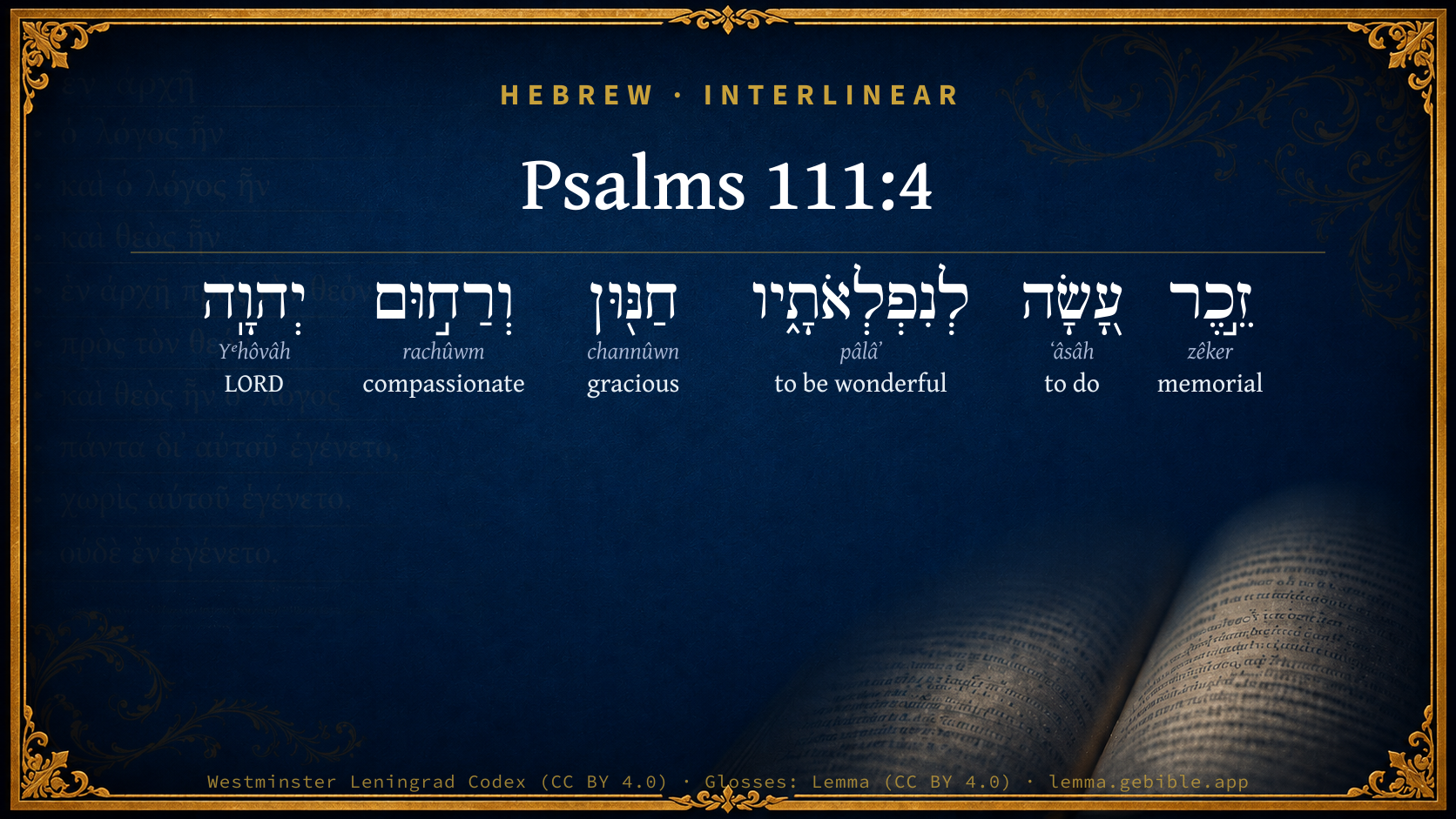
Hebrew (Westminster Leningrad Codex) Psalms 111:4 appears in the Hebrew Old Testament. The text above is from the Westminster Leningrad Codex. Each word links to its Strong’s number, a concise gloss, and parsing drawn from the Open Scriptures Hebrew Bible morphology. Click any word for its full Brown-Driver-Briggs (BDB) entry.
Download image
Cite this verse

Psalms 111:4 (World English Bible). Public Domain. Lemma interlinear Bible study tool, https://lemma.gebible.app/v/psalms/111/4.

Show BibTeX & RIS
BibTeX
RIS
English Translation
He has caused his wonderful works to be remembered. Yahweh is gracious and merciful.
World English Bible · Public Domain
Download a study sheet

One document with this verse’s original text, its word-by-word gloss line, the meaning frame, cross-references with their text, attributed commentary, and full source and license credits — printable, and it pastes into notes with its structure intact.

This verse Autodidact and up

Study sheet (.html) Plain text (.txt)

A passage Seminary Student

Up to 50 verses in one chapter. A passage sheet keeps up to 6 commentary sources and 12 cross-references per verse, in the order this page ranks them, and says so on the sheet whenever that leaves anything out. Ask for a single verse and you get the Autodidact verse sheet above.

Everything on this page stays free to read, with no account — the sheet is a download of what is already on screen, not access to it.

Want to remove ads? Support Godless Engineer
Compare translations 3

The same verse in 3 English versions, stacked beneath the original-language interlinear above. Click any original word for its lexicon entry.

Each is an independent rendering of the whole verse — the interlinear is not word-aligned to these translations.

Highlighted words mark where these versions differ — a whole-verse word diff, not a word-by-word alignment.

  • World English Bible Public Domain
    He has caused his wonderful works to be remembered. Yahweh is gracious and merciful.
  • King James Version Public Domain
    He hath made his wonderful works to be remembered: the LORD is gracious and full of compassion.
  • unfoldingWord Literal Text CC BY-SA 4.0
    He makes a remembrance for his wonders; Yahweh gracious and merciful.

unfoldingWord Literal Text — © unfoldingWord, licensed CC BY-SA 4.0. Word-aligned USFM3 via Door43 (git.door43.org/unfoldingWord/en_ult).

Versions to compare (up to 4)

3 of 4 selected

Show all 18 translations

Every available English version of this verse, each an independent rendering of the whole verse.

  • World English Bible Public Domain
    He has caused his wonderful works to be remembered. Yahweh is gracious and merciful.
  • Berean Standard Bible Public Domain
    He has caused His wonders to be remembered; the LORD is gracious and compassionate.
  • Majority Standard Bible Public Domain
    He has caused His wonders to be remembered; the LORD is gracious and compassionate.
  • King James Version Public Domain
    He hath made his wonderful works to be remembered: the LORD is gracious and full of compassion.
  • American Standard Version (1901) Public Domain
    He hath made his wonderful works to be remembered: Jehovah is gracious and merciful.
  • Revised Version (1885) Public Domain
    He hath made his wonderful works to be remembered: the LORD is gracious and full of compassion.
  • Geneva Bible (1599) Public Domain
    He hath made his wonderfull workes to be had in remembrance: the Lord is mercifull and full of compassion.
  • Douay-Rheims (1899) Public Domain
    He hath made a remembrance of his wonderful works, being a merciful and gracious Lord:
  • Young's Literal Translation Public Domain
    A memorial He hath made of His wonders, Gracious and merciful `is' Jehovah.
  • Literal Standard Version CC BY-SA 4.0
    He has made a memorial of His wonders, || YHWH [is] gracious and merciful.
  • Unlocked Literal Bible CC BY-SA 4.0
    He does wonderful things that will be remembered; Yahweh is gracious and merciful.
  • unfoldingWord Literal Text CC BY-SA 4.0
    He makes a remembrance for his wonders; Yahweh gracious and merciful.
  • Darby Bible Public Domain
    He hath made his wonders to be remembered: Jehovah is gracious and merciful.
  • World Messianic Bible Public Domain
    He has caused his wonderful works to be remembered. The LORD is gracious and merciful.
  • Webster's Bible Public Domain
    He hath made his wonderful works to be remembered: the LORD is gracious and full of compassion.
  • Free Bible Version CC BY-SA 4.0
    He wants the wonderful things he has done to be remembered; the Lord is gracious and kind.
  • Bible in Basic English Public Domain
    Certain for ever is the memory of his wonders: the Lord is full of pity and mercy.
  • JPS Tanakh (1917) Public Domain
    He hath made a memorial for His wonderful works; the LORD is gracious and full of compassion.

Literal Standard Version (2020), Covenant Press — licensed CC BY-SA 4.0. Text via the HelloAO Bible API (eBible.org). Unlocked Literal Bible (unfoldingWord) — licensed CC BY-SA 4.0. Text via the HelloAO Bible API (eBible.org). unfoldingWord Literal Text — © unfoldingWord, licensed CC BY-SA 4.0. Word-aligned USFM3 via Door43 (git.door43.org/unfoldingWord/en_ult). Free Bible Version, Dr. Jonathan Gallagher — licensed CC BY-SA 4.0. Text via the HelloAO Bible API (eBible.org).

Word by word

More ways to search: Search by grammar → Find every occurrence → Compare this word →

Practice this passage: Drill this verse → Learn its vocabulary →

About this verse

These counts appear in no published source. They are computed here, from the morphology-tagged text and Lemma’s own curated glosses. What Lemma adds →

6
words
6
distinct lemmas
Wisdom
section

Notable vocabulary

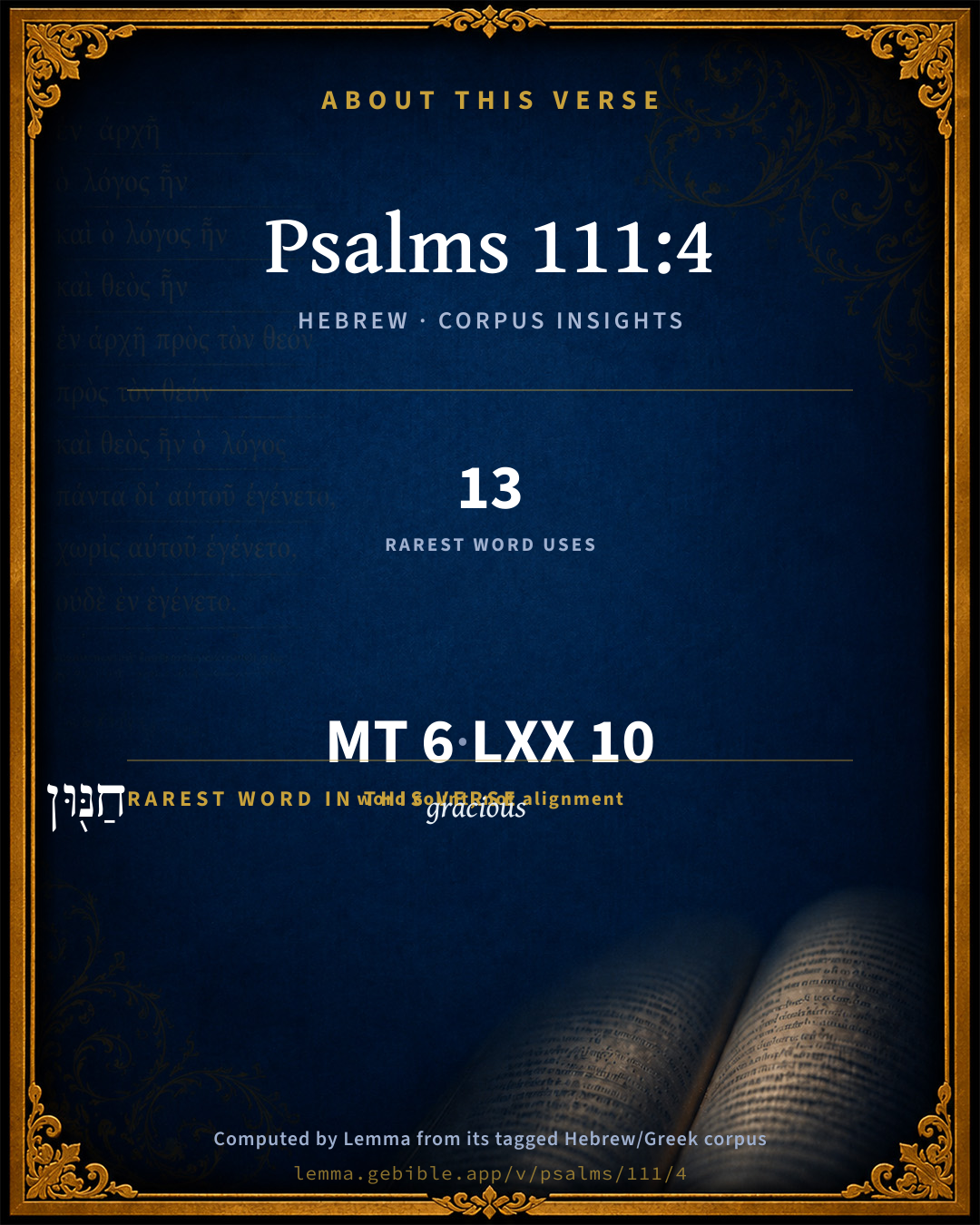
The rarest word here is חַנּ֖וּן gracious H2587 — appearing just 13 times in the whole Hebrew Bible.

Shared distinctive vocabulary

חַנּ֖וּן gracious H2587 occurs in 13 verses of the Hebrew Bible. Also found in:

Grammatical profile

  • 2 verbs
  • 2 nouns
  • 2 adjectives

Verb forms

  • עָ֭שָׂה Qal · Perfect
  • לְנִפְלְאֹתָ֑יו Niphal · Participle Active

Hebrew & Septuagint length

In English translation the verse runs 14 words from the Hebrew and 15 from the Septuagint (LXX English) — closely comparable.

A rough comparison of the two English renderings, which tokenize alike — not a word-level alignment.

Word counts can differ between the Hebrew and the Greek without any difference in meaning — e.g. the Hebrew direct-object marker אֵת has no separate Greek word, and Greek often adds the article ὁ.

In the original languages it is 6 Hebrew tokens and 10 Greek tokens — but the two are counted differently (Hebrew bundles its prefixes and suffixes into one token; the Greek is in lemma form), so that isn’t a like-for-like length.

Cross-references

20

Topical passages linked to Psalms 111:4 in the Treasury of Scripture Knowledge — connected by theme and wording, ordered by reader-vote popularity; previews shown in the World English Bible.

  • Psalms 103:8 Yahweh is merciful and gracious, Slow to anger, and abundant in loving kindness.
  • Isaiah 63:7 I will make mention of the loving kindnesses of Yahweh, [and] the praises of Yahweh, according to all that Yahweh has bestowed on us, and the great goodness toward the house of Israel, which he has bestowed on them according to his mercies, and according to the multitude of his loving kindnesses.
  • Psalms 86:5 For you, Lord, are good, and ready to forgive; Abundant in loving kindness to all those who call on you.
  • Psalms 145:8 Yahweh is gracious, merciful, Slow to anger, and of great loving kindness.
  • Ephesians 1:6–8 to the praise of the glory of his grace, by which he freely bestowed favor on us in the Beloved,
  • Deuteronomy 31:19–30 Now therefore write you this song for you, and teach you it the children of Israel: put it in their mouths, that this song may be a witness for me against the children of Israel.
  • Psalms 78:38 But he, being merciful, forgave iniquity, and didn't destroy them. Yes, many times he turned his anger away, And didn't stir up all his wrath.
  • Psalms 112:4 Light dawns in the darkness for the upright, Gracious, merciful, and righteous.
  • Romans 5:20–21 The law came in besides, that the trespass might abound; but where sin abounded, grace did abound more exceedingly;
  • 1 Corinthians 11:24–26 When he had given thanks, he broke it, and said, "Take, eat. This is my body, which is broken for you. Do this in memory of me."
  • Exodus 12:26–27 It will happen, when your children ask you, 'What do you mean by this service?'
  • Exodus 34:6–7 Yahweh passed by before him, and proclaimed, "Yahweh! Yahweh, a merciful and gracious God, slow to anger, and abundant in loving kindness and truth,
  • Joshua 4:6–7 that this may be a sign among you, that when your children ask in time to come, saying, What do you mean by these stones?
  • Joshua 4:21–24 He spoke to the children of Israel, saying, When your children shall ask their fathers in time to come, saying, What mean these stones?
  • Psalms 78:4–8 We will not hide them from their children, Telling to the generation to come the praises of Yahweh, His strength, and his wondrous works that he has done.
  • Psalms 86:15 But you, Lord, are a merciful and gracious God, Slow to anger, and abundant in loving kindness and truth.
  • Exodus 13:14–15 It shall be, when your son asks you in time to come, saying, 'What is this?' that you shall tell him, 'By strength of hand Yahweh brought us out from Egypt, from the house of bondage;
  • Deuteronomy 4:9 Only take heed to yourself, and keep your soul diligently, lest you forget the things which your eyes saw, and lest they depart from your heart all the days of your life; but make them known to your children and your children's children;
  • 1 Timothy 1:14 The grace of our Lord abounded exceedingly with faith and love which is in Christ Jesus.
  • Micah 7:18–19 Who is a God like you, who pardons iniquity, And passes over the disobedience of the remnant of his heritage? He doesn't retain his anger forever, Because he delights in loving kindness.

Cross-references courtesy of OpenBible.info (CC BY 4.0).

Hebrew and Greek witnesses Masoretic Hebrew ↔ Greek Septuagint

The same verse in the two great witnesses to the Old Testament, shown verse-for-verse.

You’re reading Greek Psalm 110 (Hebrew Psalm 111). The Septuagint counts the superscription, so verse numbers can differ from the Hebrew — chapter-level alignment, not verse-by-verse. Numbering follows Rahlfs.

These are two independent witnesses, not word-aligned to each other, and the Septuagint is shown in lemma (dictionary) form.

Hebrew Psalms 111:4 Masoretic · Westminster Leningrad Codex

זֵ֣כֶר עָ֭שָׂה לְנִפְלְאֹתָ֑יו חַנּ֖וּן וְרַח֣וּם יְהוָֽה

He has caused his wonderful works to be remembered. Yahweh is gracious and merciful.

World English Bible · Public Domain

Greek LXX Greek Psalm 110:4 Septuagint · lemma form

μνεία ποιέω ὁ θαυμάσιος αὐτός ἐλεήμων καί οἰκτίρμων ὁ κύριος

He has caused his wonderful works to be remembered: the Lord is merciful and compassionate.

LXX2012 (modern English Septuagint) · Public Domain

Hebrew: Westminster Leningrad Codex (CC BY 4.0). Greek: Septuagint (public domain); English from LXX2012 (modern English Septuagint) (Public Domain). How the Septuagint differs from the Hebrew →

Commentary

Notes on Psalms 111:4 from classic Christian and Jewish commentators (each source and its license shown beneath its notes). The classic Christian expositions comment on the surrounding passage and are grouped to its opening verse, so a note may address several verses; the Jewish commentaries on the Tanakh (Rashi and others) are per-verse, so they appear only where the commentator wrote on this verse.

Lemma curates 59 commentaries, every one of them public domain or Creative Commons licensed, each selected and text-cleaned for this edition rather than reprinted as found. About our sources →

Trapp's Complete Commentary

John Trapp

Psa 111:4 He hath made his wonderful works to be remembered: the LORD [is] gracious and full of compassion.

Ver. 4. He hath made his wonderful, &c.] Memorabilia reddidit mirabilia sua clemens et misericors Iehova.

John Trapp, A Commentary or Exposition upon All the Books of the Old and New Testament (1647–1656) — public domain. Text from a community e-Sword module.

The Biblical Illustrator

Joseph S. Exell

Psa_111:4

He hath made His wonderful works to be remembered.

The duty of remembering Gods wonderful works

1. In reference to any signal benefits, any extraordinary mercy received, it is necessary we should have a true sense and firm persuasion of the work of God in it, that we may learn to depend on His providence, which we find so vigilant over us, so beneficial to us; that we may attribute nothing to ourselves, or sacrifice to our own nets; that we may discern His hand in His own work, and say (Psa_52:9; Psa_75:1).

2. This design of God teacheth man to make a true estimate, and set a value upon the benefit received as coming from His hand.

3. This design of God ought to be embraced with all comfort and cheerfulness. For what greater honour can man receive, than that God should desire to be honoured by him? What greater advantage can we have, than that He should therefore bless us, that He may receive praise from us, and purchase His glory by the expense of His goodness?

4. The equity and excellency of the duty enforce the obligation. Here is not anything required, but what may be justly challenged, what cannot be with any pretence denied. There is a moral obligation between men, to render to every man his due, honour to whom honour: and this Divine acknowledgment is required upon no other terms (Psa_29:2). It is required in a due proportion (Psa_150:2), according to the manifestation of it. This is the exercise of the blessed saints and angels in the nearest view of His perfections: the language of heaven is Alleluia; and there is nothing more heavenly upon earth. (Bp. Pearson.)

The Biblical Illustrator, edited by Joseph S. Exell (c. 1880s–1900s) — public domain. Text from a community e-Sword module.

J. A. Alexander on Psalms

Joseph Addison Alexander

4. (Psa 111:4) A memory has he made for his wonderful works; gracious and compassionate (is) Jehovah. The first clause, though not exactly rendered, is correctly paraphrased in the English Bible, he hath made his wonderful works to be remembered, and still more freely in the Prayer-Book version. The last clause shews that the wonderful works of the first are not the wonders of creation, nor those of providence in general, but those wrought for the benefit of Israel. The terms of this clause are borrowed from Exo 34:6. See above, on Psa 103:8.

Joseph Addison Alexander, The Psalms Translated and Explained (1850) — public domain. Text from a community e-Sword module.

Adam Clarke's Commentary

Verse 4. He hath made his wonderful works] He who seeks them out will never forget them; and every thing of God's framing is done in such a way, as to strike the imagination, interest the senses, and charm and edify the intellect. But the psalmist may here intend principally the works of God in behalf of the Jewish people; and particularly in their deliverance from the Babylonish captivity, which this Psalm is supposed to celebrate.

Adam Clarke's Commentary on the Bible (1810–1826) — public domain. Text from a community e-Sword/MySword module.

Ellicott's Commentary for English Readers

(4) He hath made . . .—Literally, He hath made a memorial for His wonderful works, as in Jos_4:7, &c.

A Bible Commentary for English Readers, edited by Charles John Ellicott (1878–1897) — public domain. Text from a community e-Sword module.

The Cambridge Bible for Schools and Colleges

gen. ed. J. J. S. Perowne

4. He hath made his wonderful works to be remembered] Lit. made a memorial for his wonderful works, particularly the deliverance of His people from Egypt, by the continuous tradition which they were charged to hand on from one generation to another (Psa_78:3; Exo_12:26; &c.), and by the festivals and ordinances which commemorated that deliverance, especially the Passover (Exo_12:14). But the words may also be rendered, He hath made (himself) a memorial by his wonderful works, won for Himself honour by them[70]. Cp. Neh_9:10, “So thou didst get thee a name”; Exo_14:4; Exo_14:17.

[70] Zçker, ‘memorial,’ is nearly equivalent to ‘name’ (Psa_135:13, and often).

gracious and full of compassion] Cp. Psa_103:8. Fundamental attributes of Jehovah (Exo_34:6) illustrated in the Exodus, and in all His dealings with Israel (Neh_9:17; Neh_9:31).

The Cambridge Bible for Schools and Colleges (gen. ed. J. J. S. Perowne; Cambridge University Press, 1878–1918) — public domain. Text from a community e-Sword module.

John Gill's Exposition

He hath made his wonderful works to be remembered,.... All his works are marvellous ones; his works of creation, that they should rise out of nothing at a word of command; his works of providence, which have such a depth of wisdom and knowledge in them, are unsearchable and past finding out; and his works of redemption and grace; and these are so wrought by him, and such methods taken to continue the memory of them, that they cannot well be forgotten: all things in nature are as they were from the beginning; the sun, moon, and stars, keep their course and station; cold and heat, summer and winter, seedtime and harvest, are as they always were; remarkable providences have been carefully recorded, and memorials of them handed down to posterity. The deliverance of Israel out of Egypt was annually remembered in the passover; the feeding of them with manna in the wilderness was caused to be remembered by a pot of manna preserved in the tabernacle and temple; and the great work of our redemption by Christ is brought to remembrance in the ordinance of the Lord's supper, appointed for that purpose.

The Lord is gracious and full of compassion; so he was in eternity, and is in time; this appears in all his works, and especially in our salvation by Jesus Christ; see Psa 86:5.

John Gill's Exposition of the Whole Bible (1746–1763) — public domain (CC PDM 1.0). Text via the HelloAO Bible API.

Albert Barnes' Notes on the Bible

He hath made his wonderful works - In heaven and in earth.

To be remembered - literally, “Memory hath he made for his wonderful works.” “They” are so made, that man may remember them; the memory of man, also, is so made, that it may retain them. The highest and most appropriate exercise of memory is to retain the lessons which the works of God inculcate; to treasure up for gratitude and for use what he teaches his intelligent creation through those works. Memory can never be better employed than in treasuring up the truths which the Creator teaches in his providential dealings with us, and in his word. How much better would it be for man if he labored more to “remember” these things; if he sought to forget many of those things which he is so careful now to retain in his recollection.

The Lord is gracious ... - See the notes at Psa 86:5. This is stated here as the result of the careful study of the doings of God; as the conclusion to which all will come who carefully study his works. “Illustrations” of what God has done that deserves to be remembered occupy the remainder of the psalm, except the last verse.

Albert Barnes' Notes on the Bible (1834–1885) — public domain. Text from a community e-Sword/MySword module.

Matthew Poole's English Annotations

To be remembered; either,

1. By those memorials which he hath left of them in his word; or rather,

2. By their own wonderful nature, and the lasting effects and benefits flowing from them, which are such as cannot easily be forgotten.

Is gracious and full of compassion towards his people, as appears from his works and carriage towards us, in sparing, and pardoning, and restoring, and preserving us when we have deserved to be utterly destroyed.

Matthew Poole's English Annotations on the Holy Bible (1683–1685) — public domain. Text from a community e-Sword/MySword module.

The Treasury of David

Charles H. Spurgeon

Ver. 4. He hath made his wonderful works to be remembered. He meant them to remain in the recollection of his people, and they do so: partly because they are in themselves memorable, and because also he has taken care to record them by the pen of inspiration, and has written them upon the hearts of his people by his Holy Spirit. By the ordinances of the Mosaic law, the coming out of Egypt, the sojourn in the wilderness, and other memorabilia of Israel's history were constantly brought before the minds of the people, and their children were by such means instructed in the wonders which God had wrought in old time. Deeds such as God has wrought are not to be admired for an hour and then forgotten, they are meant to be perpetual signs and instructive tokens to all coming generations; and especially are they designed to confirm the faith of his people in the divine love, and to make them know that

the Lord is gracious and full of compassion. They need not fear to trust his grace for the future, for they remember it in the past. Grace is as conspicuous as righteousness in the great work of God, yea, a fulness of tender love is seen in all that he has done. He treats his people with great consideration for their weakness and infirmity; having the same pity for them as a father hath towards his children. Should we not praise him for this? A silver thread of lovingkindness runs through the entire fabric of God's work of salvation and providence, and never once is it left out in the whole piece. Let the memories of his saints bear witness to this fact with grateful joy.

Ver. 4. He hath made his wonderful works to be remembered. The memorials of the Divine benefits are always valued greatly by a grateful heart, as making present with us the things which transpired ages before: such under the Old Testament was the sacrament of the paschal Lamb; but now the sacred Supper under the New Testament. Therefore, whatever recalls the Divine works to the memory, e.g. the ministry of the church, also the Sacred Scriptures, are worthy of the highest reverence. Martin Geier.

Ver. 4. The sweet spices of divine works must be beaten to powder by meditation, and then laid up in the cabinet of our memories. Therefore, says the psalmist here, God hath made his wonderful works to be remembered; he gives us the jewels of deliverance, not (because of the commonness of them) to wear them on our shoes, as the Romans did their pearls; much less to tread them under our feet; but rather to tie them as a chain about our necks. The impression of God's marvellous acts upon us must not be like that which the stone makes in the water, raising circles, beating one wave on another, and for a time making a noise, but soon after it sinks down, and the water returneth to its former smoothness; and so we, while judgment is fresh, are apt to publish it from man to man, but soon after we let it sink into the depth of oblivion, and we return to our old sins. Abraham Wright.

Ver. 4. Made his wonderful works to be remembered. The most amazing perverseness in man is proven by the fact that he does not remember what God has so arranged that it would seem impossible that it should be forgotten. William S. Plumer.

Ver. 4.

For wonderful indeed are all his works,

Pleasant to know and worthiest to be all

Had in remembrance always with delight. John Milton.

Ver. 4. The compassion of the Lord as seen in aiding the memories of his people.

Ver. 4-5. God's marvels ought not to be nine day wonders.

1. It is God's design that his wonders should be remembered, therefore,

(a) He made them great.

(b) He wrought them for an undeserving people.

(c) He wrought them at memorable times.

(d) He put them on record.

(e) He instituted memorials.

(f) He bade them tell their children.

(g) He so dealt with them as to refresh their memories.

2. It is our wisdom to remember the Lord's wonders.

a. To assure us of his compassion: "The Lord is gracious."

b. To make us consider his bounty: "he hath given meat."

c. To certify us of his faithfulness: "he will ever be mindful of his covenant."

d. To arouse our praise: "Praise ye the Lord."

Psalms 111:5*

Charles H. Spurgeon's The Treasury of David (1869–1885) — public domain. Psalms only. Text from a community e-Sword/MySword module.

Whedon's Commentary on the Bible

Daniel D. Whedon

4. To be remembered—Literally, He made a memorial for his wondrous works. Thus feasts, fasts, and other institutions were monumental signs, appointed to keep in remembrance his doings. Num_16:4; Jos_4:6-7

Daniel D. Whedon (gen. ed.), Commentary on the Old and New Testaments (1874–1909) — public domain. Text from a community e-Sword module.

The Pulpit Commentary

He hath made his wonderful works to be remembered; literally, a memorial hath he made for his wonders; i.e. he has so done them that they cannot cease to be had in remembrance. Memorial institutions, like the Passover, are scarcely glanced at. The Lord is gracious and full of compassion; or, "compassionate". (comp. Psa_103:13)

The Pulpit Commentary (1880–1919), ed. H.D.M. Spence-Jones & Joseph S. Exell — public domain. Text from a community e-Sword module.

John Wesley's Explanatory Notes

Remembered - By their own nature, and the lasting benefits flowing from them, which are such as cannot easily be forgotten.

John Wesley, Explanatory Notes Upon the Whole Bible (1754–1765) — public domain. Text via the GEBible commentary corpus.

unfoldingWord translationNotes

Door43 World Missions Community

that will be remembered

This can be stated in active form. AT: "that people will always remember" (See: Active or Passive)

call to mind

This is an idiom that means to remember. AT: "remember" (See: Idiom)

his powerful works

"his works that demonstrated his power"

the inheritance of the nations

The writer speaks of the land that belonged to the nations in Canaan as if it were their inheritance. AT: "the land that belonged to other nations" (See: Metaphor)

translationWords

amazed

grace

mercy

faithful

covenant

power

people of God

inherit

nation

unfoldingWord translationNotes — © Distant Shores Media and the Door43 World Missions Community, licensed CC BY-SA 4.0. Source: git.door43.org/Door43/en_tn.

Rashi

Rabbi Shlomo Yitzchaki (Rashi)

He made a memorial He set down for Israel Sabbaths and festivals and commandments, of which was stated (Deut. 5:15): “And remember that you were a slave in the land of Egypt,” because He is gracious and merciful to His children, and He wishes to make them righteous.

Rashi on the Tanakh — English translations: “The Judaica Press complete Tanach with Rashi, translated by A. J. Rosenberg” (CC BY 4.0); “Pentateuch with Rashi's commentary by M. Rosenbaum and A.M. Silbermann, 1929-1934” (public domain); “The Metsudah Tanach series, Lakewood, N.J” (CC BY 4.0); and “The Book of Joshua, Metsudah Publications, 1997” (CC BY 4.0). Text via Sefaria.

Lesson kit

Teaching starters — assembled from the data on this page, not authored interpretation. Every prompt links to the verse data it draws on. Edit before teaching.

Psalms, in the Wisdom, opens this verse with 6 words (6 distinct Hebrew lemmas). Its most distinctive word is channûwn (“gracious”). A historical commentator’s framing appears above. Read the whole chapter for the surrounding context.

Discussion questions

  1. How does “gracious” (channûwn) shape what this verse is saying?
  2. How does Exodus 22:27, which shares the word «gracious», read alongside this verse?
  3. The translations on this page render this verse differently — a whole-verse word diff, not a word-by-word alignment. What might account for the different wordings?
  4. «עָ֭שָׂה» is a Qal Perfect verb. How does that grammatical form shape the action described?
  5. Compare how Trapp's Complete Commentary and The Biblical Illustrator read this verse. Where do they agree or differ?

Things to notice

Reading settings

Reading text

Shown beneath each verse's original-language words.

Old Testament
Old Testament edition

Read the OT as the Masoretic Hebrew (MT) or the Greek Septuagint (LXX).

English shown for the Greek Septuagint (in the Hebrew ↔ Greek comparison).

Comparing translations? Open the Compare panel on any verse page to stack up to four side by side.