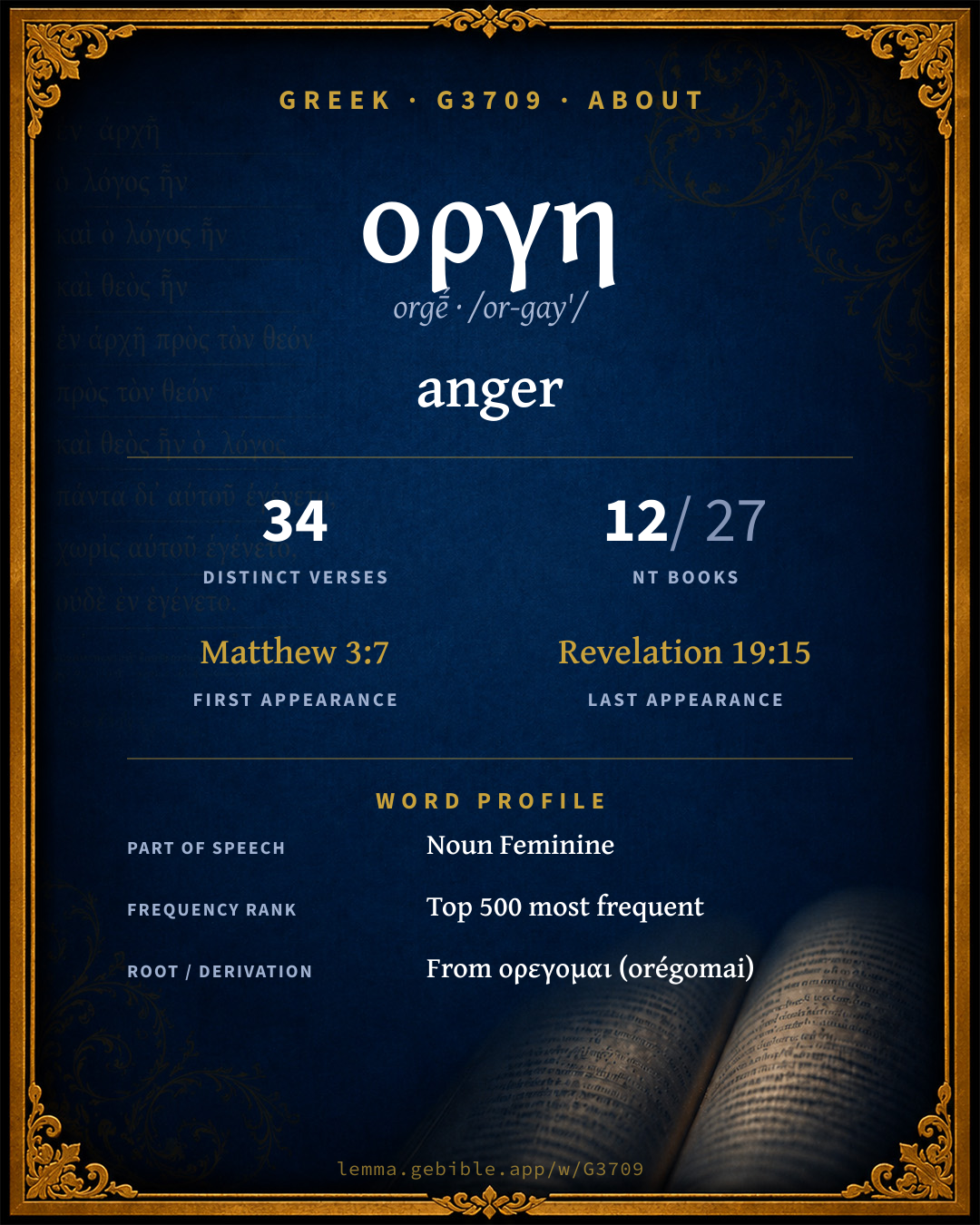
ὀργή
anger
also: the natural disposition, temper, character fuller range ↓
Full lexicon entry — Thayer's Greek Lexicon
From Thayer's Greek Lexicon
Where this word appears
See every Genitive-case word in the Greek New Testament →
Grammar key — what these labels mean
Part of speech
- Noun
- A naming word — a person, place, thing, or idea.
Case
- Genitive
- The case of source, possession, or “of” — answers “whose / from what.”
- Nominative
- The case of the subject (and the predicate nominative).
- Accusative
- The case of the direct object and of extent.
- Dative
- The case of the indirect object, means, or location — “to / for / with / in.”
Gender
- Feminine
- Grammatically feminine.
Number
- Singular
- One.
1 verse where G3709 appears in the Nominative case in the Book of Revelation. Filtered view — show all forms. Click any verse to open its interlinear word-by-word view. Verse text shown in the World English Bible for context — . Each verse’s Greek form is shown with its reference; the English is not keyword-highlighted, since the data carries no word-level English alignment. Use “Compare translations” on any verse to read it across multiple English versions. This concordance covers the Greek New Testament; Septuagint (Greek Old Testament) occurrences of this word are not indexed here.
Revelation
About this entry
At a glance — auto-summarized from this page’s data, not written by a person. Every figure links to its source below. This summary describes the numbers; it doesn’t interpret them.
At its core, οργη (orgḗ) means “anger.” Not a single-sense word, it carries 4 senses, among them “the natural disposition”, “temper”, and “character”. It turns up in 34 verses across 12 books, a moderately common footprint. The word gravitates to Romans (29%), then Revelation and Ephesians. Scripture first uses it in Matthew 3:7. Each statement above links to its evidence; the full detail follows below.
Gloss history
Strong's 1890 vs modern scholarship
About this word
Strong's G3709 catalogs a Greek word from the Greek New Testament.
These counts are not copied from any lexicon or concordance. They are computed here, from the morphology-tagged Greek New Testament. What Lemma adds →
- 34
- distinct verses
- The word appears in 34 distinct verses.
- 12 / 27
- NT books
- The word appears in 12 of 27 New Testament books.
- #406
- by frequency
- Top 500 most frequent Greek words (rank 406 of 5,347 Greek words by occurrence).
View all 34 occurrences in the concordance →
Most concentrated in
- Romans 10 verses 29%
- Revelation 6 verses 18%
- Ephesians 3 verses 9%
By section of the New Testament
By traditional corpus
Conventional, traditional groupings — biblical authorship is debated, so this is a traditional corpus grouping, not an authorship claim. Some books belong to more than one corpus (Luke is in both the Gospels and the Lukan corpus, and so on), so these shares overlap and need not total 100%. Each figure is a share of the word’s 34 distinct verses.
- Pauline corpus 19 verses · 56%
- Johannine 7 verses · 21%
- Revelation 6 verses · 18%
- Gospels 5 verses · 15%
- Lukan (Luke–Acts) 2 verses · 6%
- Hebrews 2 verses · 6%
- General (Catholic) Epistles 2 verses · 6%
How translations render this word
Counts come from each version’s own published word-to-Strong’s tagging or interlinear alignment — an approximate guide to how each version renders this word, not a word-level alignment the data otherwise carries. Because each total is that version’s own tagged count, the per-version totals vary from one another and need not match the appearance or distinct-verse counts above. These counts may also differ from a printed concordance because Lemma counts each distinctly tagged rendering and does not collapse phrase taggings into a single head-word total. This is a fixed set of word-tagged versions (KJV, ASV, BSB, ULT) and does not change with the reading translation you choose elsewhere. Each version’s license is shown beside its name below (and on Sources).
- King James Version: Wrath 30×, Anger 3×
- American Standard Version: Wrath 31×, Anger 4×
- Berean Standard Bible: Wrath 26×, Anger 8×
- unfoldingWord Literal Text: Wrath 27×, Anger 8×, Of 3×
King James Version Public Domain
Renders G3709 across 36 tagged occurrences — most commonly:
Plus 3 renderings that appear only once — usually multi-word phrases or single function words the recovered tagging swept in, not distinct renderings.
American Standard Version Public Domain
Renders G3709 across 36 tagged occurrences — most commonly:
Plus 1 rendering that appears only once — usually multi-word phrases or single function words the recovered tagging swept in, not distinct renderings.
Berean Standard Bible Public Domain
Renders G3709 across 36 tagged occurrences — most commonly:
Plus 2 renderings that appear only once — usually multi-word phrases or single function words the recovered tagging swept in, not distinct renderings.
unfoldingWord Literal Text CC BY-SA 4.0
Renders G3709 across 40 tagged occurrences — most commonly:
Plus 2 renderings that appear only once — usually multi-word phrases or single function words the recovered tagging swept in, not distinct renderings.
Senses in Thayer's
The 4 senses Thayer's distinguishes for this word, in lexicon order (not ranked by frequency or importance). The full entry — with sub-senses — is in the Lexicon Entry tab.
- anger, the natural disposition, temper, character
- movement or agitation of the soul, impulse, desire, any violent emotion, but esp. anger
- anger, wrath, indignation
- anger exhibited in punishment, hence used for punishment itself
Word origin
Derived from ορεγομαι (orégomai) (G3713) — to stretch out.
From G3713 ; properly desire (as a reaching forth or excitement of the mind) that is (by analogy) violent passion ( ire or [justifiable] abhorrence ); by implication punishment : - anger indignation vengeance wrath.
— Strong’s Exhaustive Concordance (1890), public domain.
Forms in the corpus
The 6 distinct written forms G3709 takes in the Greek New Testament, most frequent first — each parse links to that case’s occurrences in the concordance.
| Form | Parsing | Example | Uses |
|---|---|---|---|
| ὀργῆς orgē̂s | Noun, Genitive, Singular, Feminine | Matthew 3:7 | 14 |
| ὀργὴ orgḕ | Noun, Nominative, Singular, Feminine | Luke 21:23 | 9 |
| ὀργὴν orgḕn | Noun, Accusative, Singular, Feminine | Romans 2:5 | 6 |
| ὀργήν orgḗn | Noun, Accusative, Singular, Feminine | Romans 3:5 | 3 |
| ὀργῇ orgē̂ | Noun, Dative, Singular, Feminine | Romans 12:19 | 3 |
| ὀργή orgḗ | Noun, Nominative, Singular, Feminine | Revelation 11:18 | 1 |
Same root — word family
Other Thayer's entries built from the same root as G3709, grouped by Strong’s listed origin. These share a root / origin per the lexicon — not necessarily a shared meaning. Each links to that word’s own entry.
Derives from
Shares the same root
Derived from this word
Compare all same-root words → Showing 4 of 6 — not the complete family. They share a root, not necessarily a meaning.
Septuagint usage
The same Greek word οργη appears 231 times in the Greek Old Testament (Septuagint), across 219 verses in 27 books.
- 231
- LXX occurrences
- Tagged occurrences of this Greek word in the Septuagint.
- 219
- verses
- Distinct Septuagint verses containing this word.
- 27 / 39
- OT books
- The word appears in 27 of the 39 Old Testament books.
Sample Septuagint occurrences
- Genesis 27:45 ὀργή
- Exodus 4:14 ὀργή
- Numbers 11:1 ὀργή
- Deuteronomy 9:19 ὀργή
- Joshua 7:1 ὀργή
- 1 Samuel 11:6 ὀργή
- 2 Samuel 12:5 ὀργή
- 2 Kings 1:18 ὀργή
- 1 Chronicles 13:10 ὀργή
- 2 Chronicles 12:12 ὀργή
- Ezra 7:23 ὀργή
- Job 3:17 ὀργή
Septuagint occurrences (same lexeme)
Every verse where the same Strong’s number (G3709) appears in the Greek Septuagint — showing the first 50 of 219. Verse text shown in the World English Bible for context; the Greek form is the matched word — the English is not keyword-highlighted.
- Genesis 27:45 ὀργή until your brother's anger turn away from you, and he forgets what you have done to him. Then I will send, and get you from there. Why should I be bereaved of you both in one day?"
- Genesis 39:19 ὀργή It happened, when his master heard the words of his wife, which she spoke to him, saying, "This is what your servant did to me," that his wrath was kindled.
- Exodus 4:14 ὀργή The anger of Yahweh was kindled against Moses, and he said, "What about Aaron, your brother, the Levite? I know that he can speak well. Also, behold, he comes forth to meet you. When he sees you, he will be glad in his heart.
- Exodus 15:7 ὀργή In the greatness of your excellency, you overthrow those who rise up against you: You send forth your wrath. It consumes them as stubble.
- Exodus 32:10 ὀργή Now therefore leave me alone, that my wrath may burn hot against them, and that I may consume them; and I will make of you a great nation."
- Exodus 32:11 ὀργή Moses begged Yahweh his God, and said, "Yahweh, why does your wrath burn hot against your people, that you have brought forth out of the land of Egypt with great power and with a mighty hand?
- Exodus 32:12 ὀργή Why should the Egyptians speak, saying, 'He brought them forth for evil, to kill them in the mountains, and to consume them from the surface of the earth?' Turn from your fierce wrath, and repent of this evil against your people.
- Numbers 11:1 ὀργή The people were as murmurers, [speaking] evil in the ears of Yahweh: and when Yahweh heard it, his anger was kindled; and the fire of Yahweh burnt among them, and devoured in the uttermost part of the camp.
- Numbers 11:10 ὀργή Moses heard the people weeping throughout their families, every man at the door of his tent: and the anger of Yahweh was kindled greatly; and Moses was displeased.
- Numbers 12:9 ὀργή The anger of Yahweh was kindled against them; and he departed.
- Numbers 14:34 ὀργή After the number of the days in which you spied out the land, even forty days, for every day a year, shall you bear your iniquities, even forty years, and you shall know my alienation.
- Numbers 16:22 ὀργή They fell on their faces, and said, God, the God of the spirits of all flesh, shall one man sin, and will you be angry with all the congregation?
- Numbers 17:11 ὀργή Thus did Moses: as Yahweh commanded him, so did he.
- Numbers 25:4 ὀργή Yahweh said to Moses, Take all the chiefs of the people, and hang them up to Yahweh before the sun, that the fierce anger of Yahweh may turn away from Israel.
- Numbers 32:14 ὀργή Behold, you are risen up in your fathers' place, an increase of sinful men, to augment yet the fierce anger of Yahweh toward Israel.
- Deuteronomy 9:19 ὀργή For I was afraid of the anger and hot displeasure, with which Yahweh was angry against you to destroy you. But Yahweh listened to me that time also.
- Deuteronomy 11:17 ὀργή and the anger of Yahweh be kindled against you, and he shut up the sky, so that there shall be no rain, and the land shall not yield its fruit; and you perish quickly from off the good land which Yahweh gives you.
- Deuteronomy 13:18 ὀργή when you shall listen to the voice of Yahweh your God, to keep all his commandments which I command you this day, to do that which is right in the eyes of Yahweh your God.
- Deuteronomy 29:19 ὀργή and it happen, when he hears the words of this curse, that he bless himself in his heart, saying, I shall have peace, though I walk in the stubbornness of my heart, to destroy the moist with the dry.
- Deuteronomy 29:22 ὀργή The generation to come, your children who shall rise up after you, and the foreigner who shall come from a far land, shall say, when they see the plagues of that land, and the sicknesses with which Yahweh has made it sick;
- Deuteronomy 29:23 ὀργή [and that] the whole land of it is sulfur, and salt, [and] a burning, [that] it is not sown, nor bears, nor any grass grows therein, like the overthrow of Sodom and Gomorrah, Admah and Zeboiim, which Yahweh overthrew in his anger, and in his wrath:
- Deuteronomy 29:27 ὀργή therefore the anger of Yahweh was kindled against this land, to bring on it all the curse that is written in this book;
- Deuteronomy 32:19 ὀργή Yahweh saw [it], and abhorred [them], Because of the provocation of his sons and his daughters.
- Deuteronomy 32:27 ὀργή Were it not that I feared the provocation of the enemy, Lest their adversaries should judge wrongly, Lest they should say, Our hand is exalted, Yahweh has not done all this.
- Deuteronomy 33:10 ὀργή They shall teach Jacob your ordinances, Israel your law: They shall put incense before you, Whole burnt offering on your altar.
- Joshua 7:1 ὀργή But the children of Israel committed a trespass in the devoted thing; for Achan, the son of Carmi, the son of Zabdi, the son of Zerah, of the tribe of Judah, took of the devoted thing: and the anger of Yahweh was kindled against the children of Israel.
- Joshua 7:26 ὀργή They raised over him a great heap of stones, to this day; and Yahweh turned from the fierceness of his anger. Therefore the name of that place was called "The valley of Achor" to this day.
- Joshua 9:20 ὀργή This we will do to them, and let them live; lest wrath be on us, because of the oath which we swore to them.
- Joshua 22:18 ὀργή that you must turn away this day from following Yahweh? and it will be, seeing you rebel today against Yahweh, that tomorrow he will be angry with the whole congregation of Israel.
- Joshua 22:20 ὀργή Didn't Achan the son of Zerah commit a trespass in the devoted thing, and wrath fell on all the congregation of Israel? and that man didn't perish alone in his iniquity.
- 1 Samuel 11:6 ὀργή The Spirit of God came mightily on Saul when he heard those words, and his anger was kindled greatly.
- 1 Samuel 19:22 ὀργή Then went he also to Ramah, and came to the great well that is in Secu: and he asked and said, Where are Samuel and David? One said, Behold, they are at Naioth in Ramah.
- 1 Samuel 20:30 ὀργή Then Saul's anger was kindled against Jonathan, and he said to him, You son of a perverse rebellious woman, don't I know that you have chosen the son of Jesse to your own shame, and to the shame of your mother's nakedness?
- 1 Samuel 20:34 ὀργή So Jonathan arose from the table in fierce anger, and ate no food the second day of the month; for he was grieved for David, because his father had done him shame.
- 1 Samuel 28:18 ὀργή Because you didn't obey the voice of Yahweh, and didn't execute his fierce wrath on Amalek, therefore has Yahweh done this thing to you this day.
- 2 Samuel 12:5 ὀργή David's anger was greatly kindled against the man, and he said to Nathan, "As Yahweh lives, the man who has done this is worthy to die!
- 2 Samuel 22:9 ὀργή There went up a smoke out of his nostrils, Fire out of his mouth devoured: Coals were kindled by it.
- 2 Samuel 24:1 ὀργή Again the anger of Yahweh was kindled against Israel, and he moved David against them, saying, Go, number Israel and Judah.
- 2 Kings 1:18 ὀργή Now the rest of the acts of Ahaziah which he did, aren't they written in the book of the chronicles of the kings of Israel?
- 2 Kings 22:13 ὀργή Go you, inquire of Yahweh for me, and for the people, and for all Judah, concerning the words of this book that is found; for great is the wrath of Yahweh that is kindled against us, because our fathers have not listened to the words of this book, to do according to all that which is written concerning us.
- 2 Kings 23:26 ὀργή Notwithstanding, Yahweh didn't turn from the fierceness of his great wrath, with which his anger was kindled against Judah, because of all the provocation with which Manasseh had provoked him.
- 1 Chronicles 13:10 ὀργή The anger of Yahweh was kindled against Uzza, and he struck him, because he put forth his hand to the ark; and there he died before God.
- 1 Chronicles 27:24 ὀργή Joab the son of Zeruiah began to number, but didn't finish; and there came wrath for this on Israel; neither was the number put into the account in the chronicles of king David.
- 2 Chronicles 12:12 ὀργή When he humbled himself, the wrath of Yahweh turned from him, so as not to destroy him altogether: and moreover in Judah there were good things [found].
- 2 Chronicles 19:2 ὀργή Jehu the son of Hanani the seer went out to meet him, and said to king Jehoshaphat, Should you help the wicked, and love those who hate Yahweh? for this thing wrath is on you from before Yahweh.
- 2 Chronicles 19:10 ὀργή Whenever any controversy shall come to you from your brothers who dwell in their cities, between blood and blood, between law and commandment, statutes and ordinances, you shall warn them, that they not be guilty towards Yahweh, and so wrath come on you and on your brothers: this do, and you shall not be guilty.
- 2 Chronicles 24:18 ὀργή They forsook the house of Yahweh, the God of their fathers, and served the Asherim and the idols: and wrath came on Judah and Jerusalem for this their guiltiness.
- 2 Chronicles 25:10 ὀργή Then Amaziah separated them, [to wit], the army that had come to him out of Ephraim, to go home again: therefore their anger was greatly kindled against Judah, and they returned home in fierce anger.
- 2 Chronicles 25:15 ὀργή Therefore the anger of Yahweh was kindled against Amaziah, and he sent to him a prophet, who said to him, Why have you sought after the gods of the people, which have not delivered their own people out of your hand?
- 2 Chronicles 28:9 ὀργή But a prophet of Yahweh was there, whose name was Oded: and he went out to meet the host that came to Samaria, and said to them, Behold, because Yahweh, the God of your fathers, was angry with Judah, he has delivered them into your hand, and you have slain them in a rage which has reached up to heaven.
These are occurrences of the same Greek lexeme (G3709) in the Septuagint — not a translation of any one Hebrew word. The store carries no word-level Hebrew↔Greek alignment, so no Hebrew original is asserted here. Counts come from the recovered LXX Strong's tagging — high-frequency vocabulary is well covered, while rare or late forms may be untagged — so they reflect tagged occurrences and may slightly undercount.