Numbers 32:14

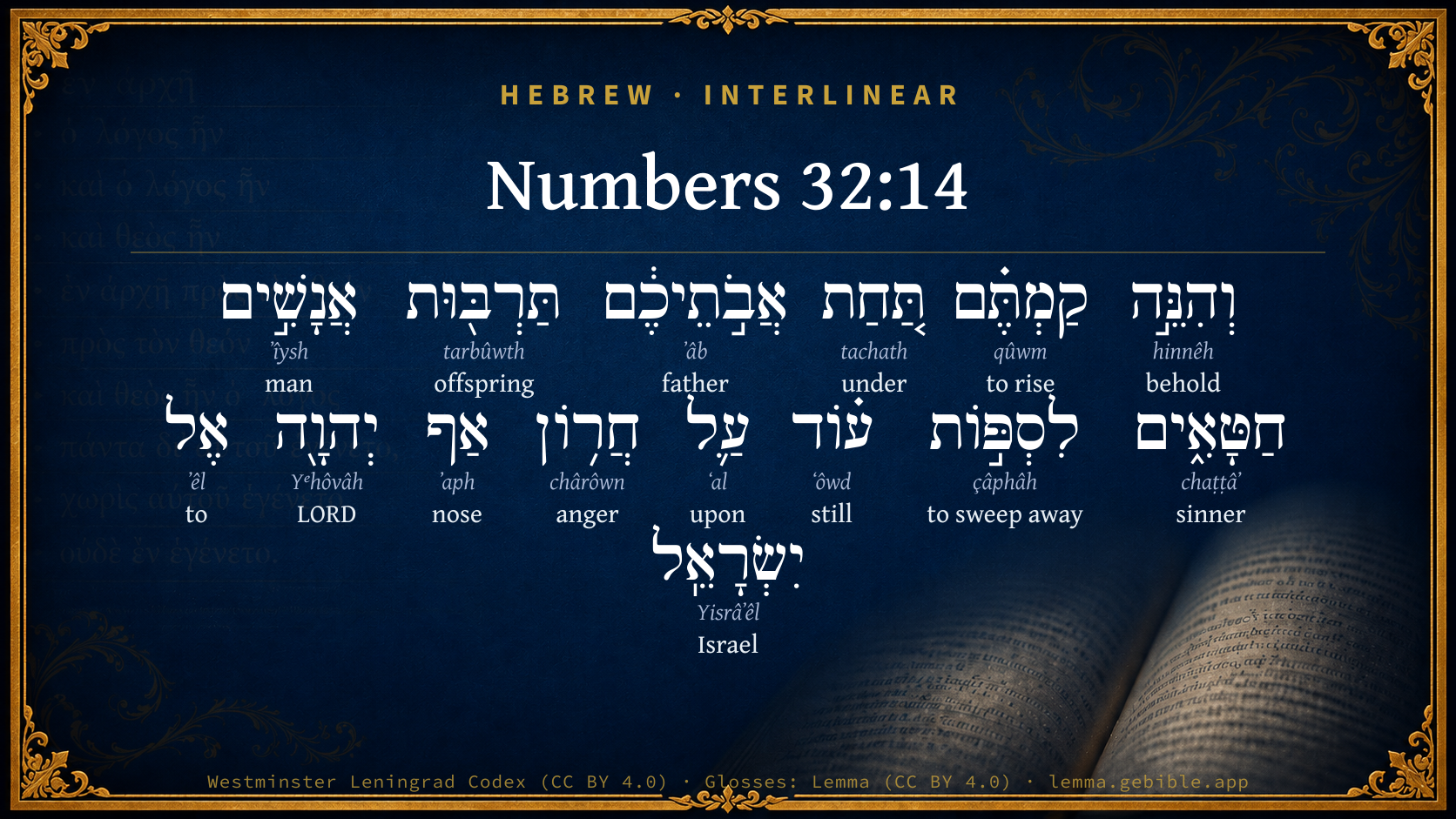
Hebrew (Westminster Leningrad Codex) Numbers 32:14 appears in the Hebrew Old Testament. The text above is from the Westminster Leningrad Codex. Each word links to its Strong’s number, a concise gloss, and parsing drawn from the Open Scriptures Hebrew Bible morphology. Click any word for its full Brown-Driver-Briggs (BDB) entry.
Download image
Cite this verse

Numbers 32:14 (World English Bible). Public Domain. Lemma interlinear Bible study tool, https://lemma.gebible.app/v/numbers/32/14.

Show BibTeX & RIS
BibTeX
RIS
English Translation
Behold, you are risen up in your fathers' place, an increase of sinful men, to augment yet the fierce anger of Yahweh toward Israel.
World English Bible · Public Domain
Highlights
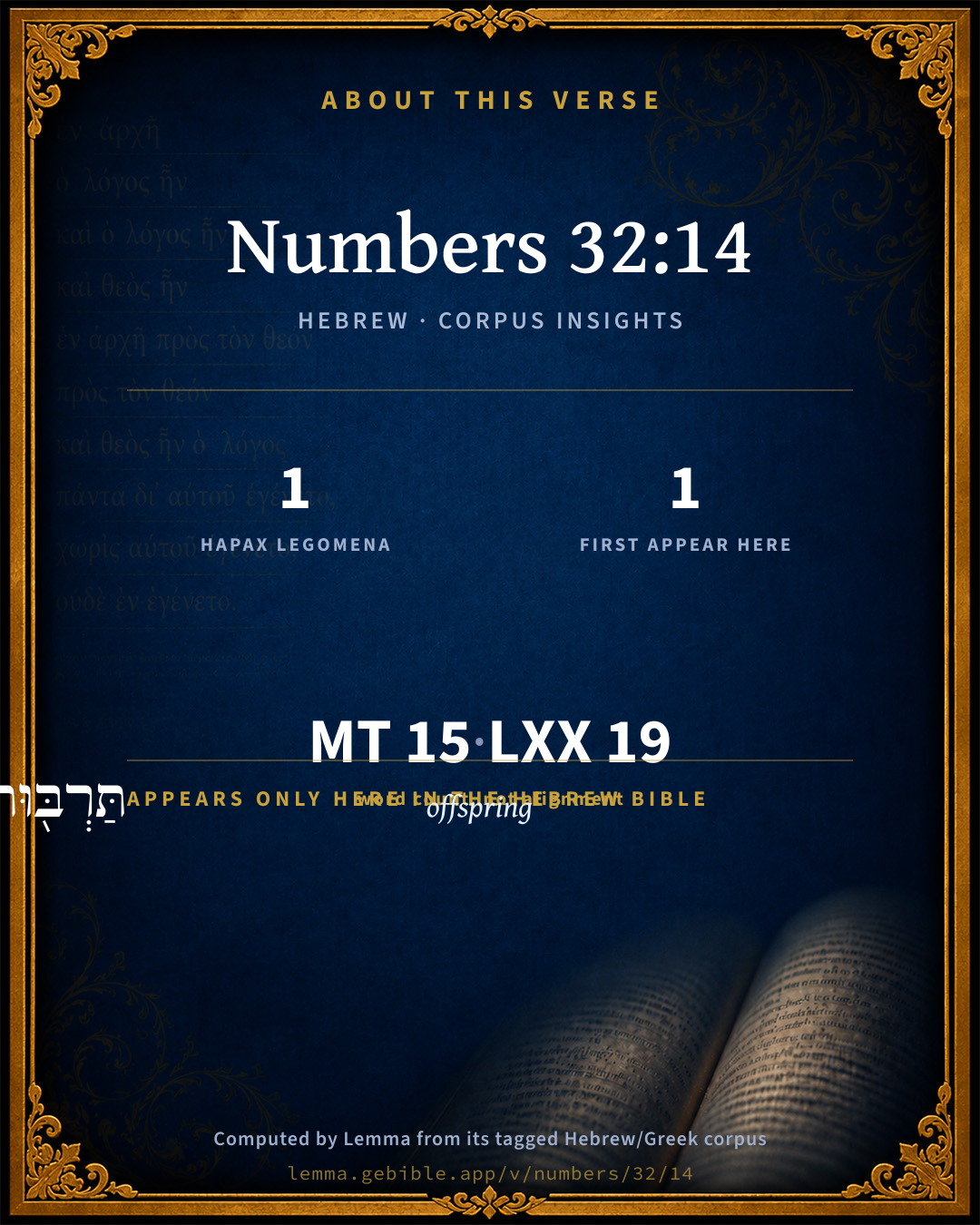
  • 1 hapax legomenon — only here in the Hebrew Bible
  • 1 first appearance in the Hebrew Bible
Full analysis ↓
Download a study sheet

One document with this verse’s original text, its word-by-word gloss line, the meaning frame, cross-references with their text, attributed commentary, and full source and license credits — printable, and it pastes into notes with its structure intact.

This verse Autodidact and up

Study sheet (.html) Plain text (.txt)

A passage Seminary Student

Up to 50 verses in one chapter. A passage sheet keeps up to 6 commentary sources and 12 cross-references per verse, in the order this page ranks them, and says so on the sheet whenever that leaves anything out. Ask for a single verse and you get the Autodidact verse sheet above.

Everything on this page stays free to read, with no account — the sheet is a download of what is already on screen, not access to it.

Want to remove ads? Support Godless Engineer
Compare translations 3

The same verse in 3 English versions, stacked beneath the original-language interlinear above. Click any original word for its lexicon entry.

Each is an independent rendering of the whole verse — the interlinear is not word-aligned to these translations.

Highlighted words mark where these versions differ — a whole-verse word diff, not a word-by-word alignment.

  • World English Bible Public Domain
    Behold, you are risen up in your fathers' place, an increase of sinful men, to augment yet the fierce anger of Yahweh toward Israel.
  • King James Version Public Domain
    And, behold, ye are risen up in your fathers' stead, an increase of sinful men, to augment yet the fierce anger of the LORD toward Israel.
  • unfoldingWord Literal Text CC BY-SA 4.0
    And behold, you have risen up in place of your fathers, a brood of sinful men, to add more to the burning of the nose of Yahweh toward Israel.

unfoldingWord Literal Text — © unfoldingWord, licensed CC BY-SA 4.0. Word-aligned USFM3 via Door43 (git.door43.org/unfoldingWord/en_ult).

Versions to compare (up to 4)

3 of 4 selected

Show all 18 translations

Every available English version of this verse, each an independent rendering of the whole verse.

  • World English Bible Public Domain
    Behold, you are risen up in your fathers' place, an increase of sinful men, to augment yet the fierce anger of Yahweh toward Israel.
  • Berean Standard Bible Public Domain
    Now behold, you, a brood of sinners, have risen up in place of your fathers to further stoke the burning anger of the LORD against Israel.
  • Majority Standard Bible Public Domain
    Now behold, you, a brood of sinners, have risen up in place of your fathers to further stoke the burning anger of the LORD against Israel.
  • King James Version Public Domain
    And, behold, ye are risen up in your fathers' stead, an increase of sinful men, to augment yet the fierce anger of the LORD toward Israel.
  • American Standard Version (1901) Public Domain
    And, behold, ye are risen up in your fathers' stead, an increase of sinful men, to augment yet the fierce anger of Jehovah toward Israel.
  • Revised Version (1885) Public Domain
    And, behold, ye are risen up in your fathers’ stead, an increase of sinful men, to augment yet the fierce anger of the LORD toward Israel.
  • Geneva Bible (1599) Public Domain
    And behold, ye are risen vp in your fathers steade as an encrease of sinfull men, still to augment the fierce wrath of the Lord, toward Israel.
  • Douay-Rheims (1899) Public Domain
    And behold, said he, you are risen up instead of your fathers, the increase and offspring of sinful men, to augment the fury of the Lord against Israel.
  • Young's Literal Translation Public Domain
    `And lo, ye have risen in the stead of your fathers, an increase of men -- sinners, to add yet to the fury of the anger of Jehovah toward Israel;
  • Literal Standard Version CC BY-SA 4.0
    And behold, you have risen in the stead of your fathers, an increase of sinful men, to add yet to the fury of the anger of YHWH toward Israel;
  • Unlocked Literal Bible CC BY-SA 4.0
    Look, you have risen up in your fathers' place, like just more sinful men, to add to Yahweh's burning anger toward Israel.
  • unfoldingWord Literal Text CC BY-SA 4.0
    And behold, you have risen up in place of your fathers, a brood of sinful men, to add more to the burning of the nose of Yahweh toward Israel.
  • Darby Bible Public Domain
    And behold, ye are risen up in your fathers' stead, a progeny of sinful men, to augment yet the fierce anger of Jehovah toward Israel.
  • World Messianic Bible Public Domain
    “Behold, you have risen up in your fathers’ place, an increase of sinful men, to increase the fierce anger of the LORD toward Israel.
  • Webster's Bible Public Domain
    And behold, ye have risen up in your fathers' stead, an increase of sinful men, to augment yet the fierce anger of the LORD towards Israel.
  • Free Bible Version CC BY-SA 4.0
    Now look at you, you brood of sinners who have come to take your fathers' place to make the Lord even angrier with Israel!
  • Bible in Basic English Public Domain
    And now you have come to take the place of your fathers, another generation of sinners, increasing the wrath of the Lord against Israel.
  • JPS Tanakh (1917) Public Domain
    And, behold, ye are risen up in your fathers' stead, a brood of sinful men, to augment yet the fierce anger of the LORD toward Israel.

Literal Standard Version (2020), Covenant Press — licensed CC BY-SA 4.0. Text via the HelloAO Bible API (eBible.org). Unlocked Literal Bible (unfoldingWord) — licensed CC BY-SA 4.0. Text via the HelloAO Bible API (eBible.org). unfoldingWord Literal Text — © unfoldingWord, licensed CC BY-SA 4.0. Word-aligned USFM3 via Door43 (git.door43.org/unfoldingWord/en_ult). Free Bible Version, Dr. Jonathan Gallagher — licensed CC BY-SA 4.0. Text via the HelloAO Bible API (eBible.org).

Word by word

More ways to search: Search by grammar → Find every occurrence → Compare this word →

Practice this passage: Drill this verse → Learn its vocabulary →

תַּרְבּ֖וּת
tarbûwth
H8635
“offspring of”
Noun, Common, Feminine, Singular, Construct
Part of Speech
Noun
Type
Common
Gender
Feminine
Number
Singular
State
Construct
Full BDB Definition

Origin: from H7235

TWOT: 2103e

increase, brood, progeny, offspring
  1. וְהִנֵּ֣ה hinnêh H2009 “and · behold” Conjunction + Particle, Demonstrative
  2. קַמְתֶּ֗ם qûwm H6965 “to rise” Verb, Qal, Perfect, 2nd Person, Masculine, Plural
  3. תַּ֚חַת tachath H8478 “under” Preposition
  4. אֲבֹ֣תֵיכֶ֔ם ʼâb H1 “fathers · your” Noun, Common, Masculine, Plural, Construct + Suffix, Personal, 2nd Person, Masculine, Plural
  5. אֲנָשִׁ֣ים ʼîysh H376 “men” Noun, Common, Masculine, Plural, Absolute
  6. חַטָּאִ֑ים chaṭṭâʼ H2400 “sinner” Adjective, Adjective, Masculine, Plural, Absolute
  7. לִסְפּ֣וֹת çâphâh H5595 “to sweep away” Preposition + Verb, Qal, Infinitive Construct
  8. ע֗וֹד ʻôwd H5750 “still” Adverb
  9. עַ֛ל ʻal H5921 “upon” Preposition
  10. חֲר֥וֹן chârôwn H2740 “anger of” Noun, Common, Masculine, Singular, Construct
  11. אַף ʼaph H639 “nose” Particle, Accusative
  12. יְהוָ֖ה Yᵉhôvâh H3068 “LORD” Noun, Proper
  13. אֶל ʼêl H413 “to” Preposition
  14. יִשְׂרָאֵֽל Yisrâʼêl H3478 “Israel” Noun, Proper

About this verse

These counts appear in no published source. They are computed here, from the morphology-tagged text and Lemma’s own curated glosses. What Lemma adds →

15
words
15
distinct lemmas
Pentateuch
section

Notable vocabulary

1 hapax legomenon — a word that appears only here in the entire Hebrew Bible:

  • תַּרְבּ֖וּת offspring H8635

First appearance in Scripture

This word makes its first canonical appearance in the Hebrew Bible here:

  • תַּרְבּ֖וּת offspring H8635

Shared distinctive vocabulary

חַטָּאִ֑ים sinner H2400 occurs in 19 verses of the Hebrew Bible. Also found in:

Grammatical profile

  • 2 verbs
  • 6 nouns
  • 1 adjective
  • 3 prepositions
  • 1 adverb
  • 2 particles

Verb forms

  • קַמְתֶּ֗ם Qal · Perfect
  • לִסְפּ֣וֹת Qal · Infinitive Construct

Hebrew & Septuagint length

In English translation the verse runs 24 words from the Hebrew and 28 from the Septuagint (LXX English) — closely comparable.

A rough comparison of the two English renderings, which tokenize alike — not a word-level alignment.

Word counts can differ between the Hebrew and the Greek without any difference in meaning — e.g. the Hebrew direct-object marker אֵת has no separate Greek word, and Greek often adds the article ὁ.

In the original languages it is 15 Hebrew tokens and 19 Greek tokens — but the two are counted differently (Hebrew bundles its prefixes and suffixes into one token; the Greek is in lemma form), so that isn’t a like-for-like length.

Cross-references

16

Topical passages linked to Numbers 32:14 in the Treasury of Scripture Knowledge — connected by theme and wording, ordered by reader-vote popularity; previews shown in the World English Bible.

  • Matthew 23:31–33 Therefore you testify to yourselves that you are children of those who killed the prophets.
  • Luke 11:48 So you testify and consent to the works of your fathers. For they killed them, and you build their tombs.
  • Acts 7:51–52 "You stiff-necked and uncircumcised in heart and ears, you always resist the Holy Spirit! As your fathers did, so you do.
  • Genesis 5:3 Adam lived one hundred thirty years, and became the father of a son in his own likeness, after his image, and named him Seth.
  • Genesis 8:21 Yahweh smelled the sweet savor. Yahweh said in his heart, "I will not again curse the ground any more for man's sake, because the imagination of man's heart is evil from his youth; neither will I ever again strike everything living, as I have done.
  • Deuteronomy 1:34–35 Yahweh heard the voice of your words, and was angry, and swore, saying,
  • Ezra 9:13–14 After all that is come on us for our evil deeds, and for our great guilt, seeing that you our God have punished us less than our iniquities deserve, and have given us such a remnant,
  • Ezra 10:10 Ezra the priest stood up, and said to them, You have trespassed, and have married foreign women, to increase the guilt of Israel.
  • Nehemiah 9:24–26 So the children went in and possessed the land, and you subdued before them the inhabitants of the land, the Canaanites, and gave them into their hands, with their kings, and the peoples of the land, that they might do with them as they would.
  • Nehemiah 13:18 Didn't your fathers do thus, and did not our God bring all this evil on us, and on this city? yet you bring more wrath on Israel by profaning the Sabbath.
  • Job 14:4 Who can bring a clean thing out of an unclean? Not one.
  • Psalms 78:57 But turned back, and dealt treacherously like their fathers. They were turned aside like a deceitful bow.
  • Isaiah 1:4 Ah sinful nation, A people loaded with iniquity, A seed of evil-doers, Children who deal corruptly! They have forsaken Yahweh. They have despised the Holy One of Israel. They are estranged and backward.
  • Isaiah 57:4 Against whom do you sport yourselves? against whom make you a wide mouth, and put out the tongue? Aren't you children of disobedience, a seed of falsehood,
  • Isaiah 65:6–7 Behold, it is written before me: I will not keep silence, but will recompense, yes, I will recompense into their bosom,
  • Ezekiel 20:21 But the children rebelled against me; they didn't walk in my statutes, neither kept my ordinances to do them, which if a man do, he shall live in them; they profaned my Sabbaths. Then I said I would pour out my wrath on them, to accomplish my anger against them in the wilderness.

Cross-references courtesy of OpenBible.info (CC BY 4.0).

Hebrew and Greek witnesses Masoretic Hebrew ↔ Greek Septuagint

The same verse in the two great witnesses to the Old Testament, shown verse-for-verse.

These are two independent witnesses, not word-aligned to each other, and the Septuagint is shown in lemma (dictionary) form.

Hebrew Numbers 32:14 Masoretic · Westminster Leningrad Codex

וְהִנֵּ֣ה קַמְתֶּ֗ם תַּ֚חַת אֲבֹ֣תֵיכֶ֔ם תַּרְבּ֖וּת אֲנָשִׁ֣ים חַטָּאִ֑ים לִסְפּ֣וֹת ע֗וֹד עַ֛ל חֲר֥וֹן אַף יְהוָ֖ה אֶל יִשְׂרָאֵֽל

Behold, you are risen up in your fathers' place, an increase of sinful men, to augment yet the fierce anger of Yahweh toward Israel.

World English Bible · Public Domain

Greek LXX Numbers 32:14 Septuagint · lemma form

ἰδού ἀναἵστημι ἀντί ὁ πατήρ σύ σύστρεμμα ἄνθρωπος ἁμαρτωλός προςτίθημι ἔτι ἐπί ὁ θυμός ὁ ὀργή κύριος ἐπί ἰσραήλ

Behold, you⌃ are risen up in the room of your fathers, a combination of sinful men, to increase yet farther the fierce wrath of the Lord against Israel.

LXX2012 (modern English Septuagint) · Public Domain

Hebrew: Westminster Leningrad Codex (CC BY 4.0). Greek: Septuagint (public domain); English from LXX2012 (modern English Septuagint) (Public Domain). How the Septuagint differs from the Hebrew →

Targum (Aramaic paraphrase)

2

The Targum is the ancient Jewish Aramaic paraphrase of the Hebrew Scriptures — an interpretive translation, not the Hebrew text itself. Onkelos (literal) and Pseudo-Jonathan (expansive) render the Torah, and Jonathan the Prophets. Coverage is partial: where no permissively-licensed English translation exists for a verse, only the Aramaic is shown. This is verse-level text, not a word-by-word alignment to the Hebrew.

  1. Targum Onkelos Torah (Genesis–Deuteronomy)
    וְהָא קַמְתּוּן חֲלַף אֲבָהַתְכוֹן תַּלְמִידֵי גֻבְרַיָא חַיָבַיָא לְאוֹסָפָא עוֹד עַל תְּקוֹף רוּגְזָא דַיְיָ לְיִשְׂרָאֵל

    (no public-domain English translation for this verse)

    Targum Onkelos — Aramaic: “Onkelos Genesis” (public domain); “Onkelos Exodus” (public domain); “Onkelos Leviticus” (public domain); “Onkelos Numbers” (public domain); “Onkelos Deuteronomy” (public domain). English: “Sefaria Community Translation” (CC0 1.0 (public-domain dedication)); “J.W. Etheridge. The Targums of Onkelos and Jonathan Ben Uzziel on the Pentateuch. London: Longmans, Green, 1862” (public domain). Text via Sefaria.

  2. Targum Pseudo-Jonathan Torah (Genesis–Deuteronomy)
    וְהָא קַמְתּוּן בָּתַר אַבְהַתְכוֹן תַּלְמִידֵי גוּבְרַיָא חַיָיבַיָא לְמוֹסְפָא תּוּב עַל תְּקוֹף רוּגְזָא דַיְיָ עַל יִשְרָאֵל

    And, behold, you are risen up after your fathers, disciples of wicked men, to increase yet the anger of the Lord against Israel.

    Targum Pseudo-Jonathan — Aramaic: “Targum Jonathan on Genesis” (public domain); “Targum Jonathan on Exodus” (public domain); “Targum Jonathan on Leviticus” (public domain); “Targum Jonathan on Numbers” (public domain); “Targum Jonathan on Deuteronomy” (public domain). English: “The Targum of Jonathan ben Uzziel, trans. J. W. Etheridge, London, 1862” (public domain). Text via Sefaria.

Commentary

Notes on Numbers 32:14 from classic Christian and Jewish commentators (each source and its license shown beneath its notes). The classic Christian expositions comment on the surrounding passage and are grouped to its opening verse, so a note may address several verses; the Jewish commentaries on the Tanakh (Rashi and others) are per-verse, so they appear only where the commentator wrote on this verse.

Lemma curates 59 commentaries, every one of them public domain or Creative Commons licensed, each selected and text-cleaned for this edition rather than reprinted as found. About our sources →

Trapp's Complete Commentary

John Trapp

Num 32:14 And, behold, ye are risen up in your fathers’ stead, an increase of sinful men, to augment yet the fierce anger of the LORD toward Israel.

Ver. 14. An increase of sinful men.] A race of rebels; neither good egg nor bird; sin runs in a blood many times; ye seed of serpents, "ye generation of vipers, ye fill up the measure of your fathers’ sins" {Mat 23:32} Domitius, the father of Nero, foretold the wickedness of his son; for it cannot be, said he, that of me and my wife, Agrippina, any good man should be born. {a} When one complained that never father had so undutiful a child, Yes, said his son, with less grace than truth, my grandfather had.

{a} Dio, in Vita Neron.

John Trapp, A Commentary or Exposition upon All the Books of the Old and New Testament (1647–1656) — public domain. Text from a community e-Sword module.

The Cambridge Bible for Schools and Colleges

gen. ed. J. J. S. Perowne

14. an increase of sinful men] a brood of sinful men. In angry rebuke Moses uses a contemptuous term. The subst. is not found elsewhere in the O.T.; but a similar word (R.V. ‘increase’) occurs in 1Sa_2:33.

The Cambridge Bible for Schools and Colleges (gen. ed. J. J. S. Perowne; Cambridge University Press, 1878–1918) — public domain. Text from a community e-Sword module.

John Gill's Exposition

For if ye turn away from after him,.... From following him in the way of his commandments, from attending his word, worship, and ordinances, and from walking after him, who went before them in a pillar of cloud and fire, as it is suggested they would, should they stop short here and not go over Jordan into the land of Canaan:

he will yet again leave them in the wilderness; as he did at the time of the affair of the spies, when they were ordered to turn and get into the wilderness by the way of the Red sea, and where they had been ever since unto this time, Num 14:25,

and ye shall destroy all this people; be the cause of their destruction, if the Lord should in such a manner resent this step of theirs, as to order them back into the wilderness again, though they were now as they were before, on the border of the land of Canaan.

John Gill's Exposition of the Whole Bible (1746–1763) — public domain (CC PDM 1.0). Text via the HelloAO Bible API.

Matthew Poole's English Annotations

Succeeding your fathers, as in their places and estates, so also in their sins.

Matthew Poole's English Annotations on the Holy Bible (1683–1685) — public domain. Text from a community e-Sword/MySword module.

Whedon's Commentary on the Bible

Daniel D. Whedon

14. An increase — A brood of sinners. Like begets like.

Fierce anger — Burning of the wrath of Jehovah. Heb_12:29, note.

Daniel D. Whedon (gen. ed.), Commentary on the Old and New Testaments (1874–1909) — public domain. Text from a community e-Sword module.

Keil & Delitzsch

C. F. Keil & F. Delitzsch

"Behold, ye rise up instead of your fathers," i.e., ye take their place, "an increase (תּרבּוּת, from רבה; equivalent to a brood) of sinners, to augment yet the burning of the wrath of Jehovah against Israel." על ספה, to add to, or increase.

Keil & Delitzsch — Biblical Commentary on the Old Testament (1861–1891) — public domain (CC PDM 1.0). Text via the HelloAO Bible API. (Old Testament only.)

Rashi

Rabbi Shlomo Yitzchaki (Rashi)

לספות is similar in meaning to the verbs in (Isaiah 29:1): “add (ספו) year to year”; ( 7:21): “add (ספו) your burnt-offerings” — an expression denoting adding (The translation is: to add even more to the Lord’s fierce anger against Israel).

Rashi on the Tanakh — English translations: “The Judaica Press complete Tanach with Rashi, translated by A. J. Rosenberg” (CC BY 4.0); “Pentateuch with Rashi's commentary by M. Rosenbaum and A.M. Silbermann, 1929-1934” (public domain); “The Metsudah Tanach series, Lakewood, N.J” (CC BY 4.0); and “The Book of Joshua, Metsudah Publications, 1997” (CC BY 4.0). Text via Sefaria.

Lesson kit

Teaching starters — assembled from the data on this page, not authored interpretation. Every prompt links to the verse data it draws on. Edit before teaching.

Numbers, in the Pentateuch, opens this verse with 15 words (15 distinct Hebrew lemmas). Its most distinctive word is tarbûwth (“offspring”). A historical commentator’s framing appears above. Read the whole chapter for the surrounding context.

Discussion questions

  1. What does “offspring” (tarbûwth) contribute to the verse as a whole?
  2. This verse holds 1 word here found nowhere else in the Hebrew Bible. What might the rare word draw attention to?
  3. The word “offspring” first appears here in Scripture. What is being introduced at this debut?
  4. Genesis 13:13 shares the word «sinner» with this verse. How do the two illuminate each other?
  5. These translations render this verse differently; the difference is in the English rendering, not the original. What questions does that raise?
  6. The verb «קַמְתֶּ֗ם» is Qal Perfect. How does its form color the action?
  7. Reading how Trapp's Complete Commentary and The Cambridge Bible for Schools and Colleges read this verse, where do the two commentators agree and where do they part?

Things to notice

Reading settings

Reading text

Shown beneath each verse's original-language words.

Old Testament
Old Testament edition

Read the OT as the Masoretic Hebrew (MT) or the Greek Septuagint (LXX).

English shown for the Greek Septuagint (in the Hebrew ↔ Greek comparison).

Comparing translations? Open the Compare panel on any verse page to stack up to four side by side.