
Numbers 25:4

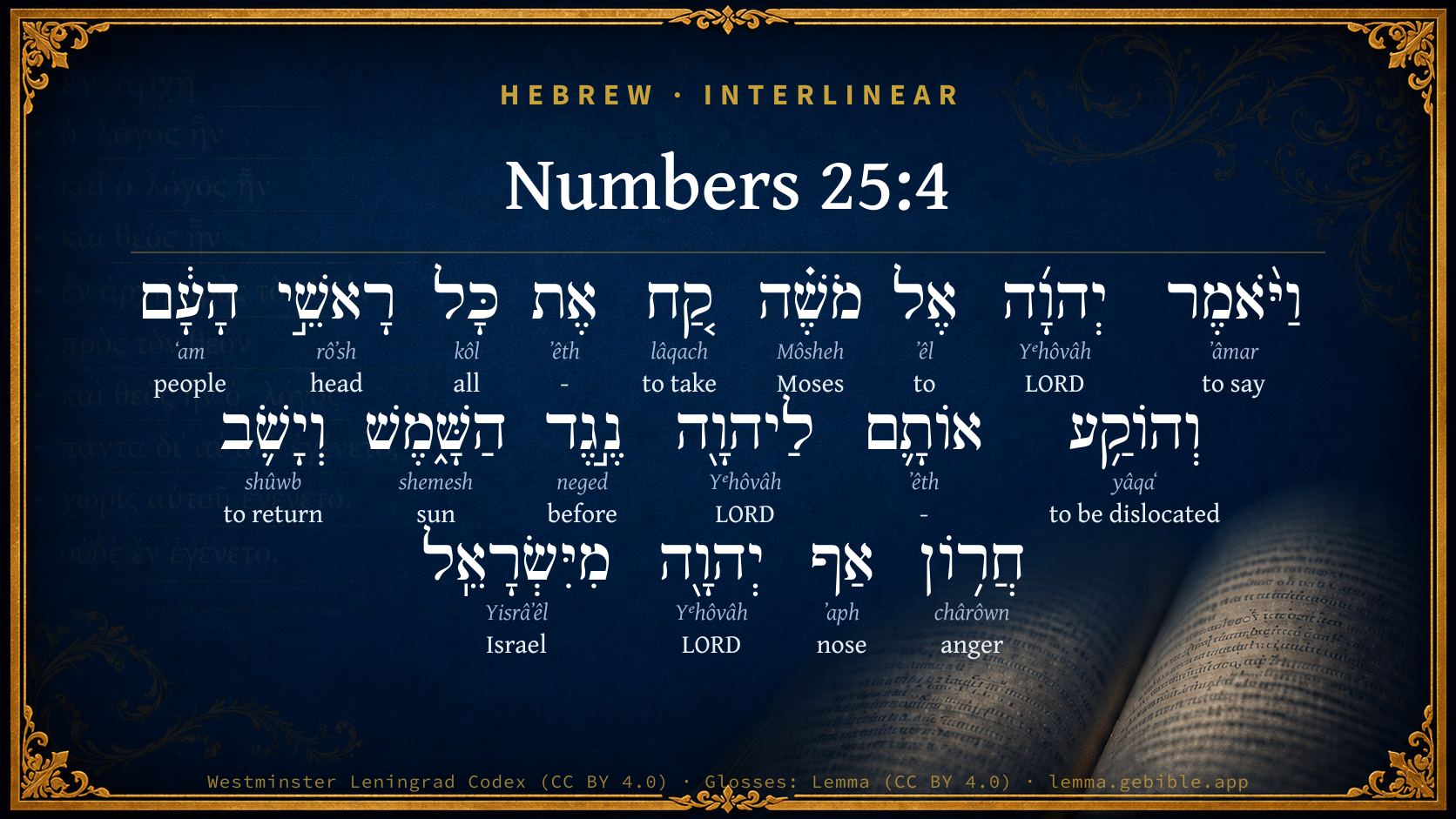
Hebrew (Westminster Leningrad Codex) Numbers 25:4 appears in the Hebrew Old Testament. The text above is from the Westminster Leningrad Codex. Each word links to its Strong’s number, a concise gloss, and parsing drawn from the Open Scriptures Hebrew Bible morphology. Click any word for its full Brown-Driver-Briggs (BDB) entry.
Download image
Cite this verse

Numbers 25:4 (World English Bible). Public Domain. Lemma interlinear Bible study tool, https://lemma.gebible.app/v/numbers/25/4.

Show BibTeX & RIS
BibTeX
RIS
English Translation
Yahweh said to Moses, Take all the chiefs of the people, and hang them up to Yahweh before the sun, that the fierce anger of Yahweh may turn away from Israel.
World English Bible · Public Domain
Download a study sheet

One document with this verse’s original text, its word-by-word gloss line, the meaning frame, cross-references with their text, attributed commentary, and full source and license credits — printable, and it pastes into notes with its structure intact.

This verse Autodidact and up

Study sheet (.html) Plain text (.txt)

A passage Seminary Student

Up to 50 verses in one chapter. A passage sheet keeps up to 6 commentary sources and 12 cross-references per verse, in the order this page ranks them, and says so on the sheet whenever that leaves anything out. Ask for a single verse and you get the Autodidact verse sheet above.

Everything on this page stays free to read, with no account — the sheet is a download of what is already on screen, not access to it.

Want to remove ads? Support Godless Engineer
Compare translations 3

The same verse in 3 English versions, stacked beneath the original-language interlinear above. Click any original word for its lexicon entry.

Each is an independent rendering of the whole verse — the interlinear is not word-aligned to these translations.

Highlighted words mark where these versions differ — a whole-verse word diff, not a word-by-word alignment.

  • World English Bible Public Domain
    Yahweh said to Moses, Take all the chiefs of the people, and hang them up to Yahweh before the sun, that the fierce anger of Yahweh may turn away from Israel.
  • King James Version Public Domain
    And the LORD said unto Moses, Take all the heads of the people, and hang them up before the LORD against the sun, that the fierce anger of the LORD may be turned away from Israel.
  • unfoldingWord Literal Text CC BY-SA 4.0
    And Yahweh said to Moses, “Take all the heads of the people and hang them up before Yahweh in front of the sun, and the burning of the nose of Yahweh may turn back from Israel.”

unfoldingWord Literal Text — © unfoldingWord, licensed CC BY-SA 4.0. Word-aligned USFM3 via Door43 (git.door43.org/unfoldingWord/en_ult).

Versions to compare (up to 4)

3 of 4 selected

Show all 18 translations

Every available English version of this verse, each an independent rendering of the whole verse.

  • World English Bible Public Domain
    Yahweh said to Moses, Take all the chiefs of the people, and hang them up to Yahweh before the sun, that the fierce anger of Yahweh may turn away from Israel.
  • Berean Standard Bible Public Domain
    Then the LORD said to Moses, “Take all the leaders of the people and execute them in broad daylight before the LORD, so that His fierce anger may turn away from Israel.”
  • Majority Standard Bible Public Domain
    Then the LORD said to Moses, “Take all the leaders of the people and execute them in broad daylight before the LORD, so that His fierce anger may turn away from Israel.”
  • King James Version Public Domain
    And the LORD said unto Moses, Take all the heads of the people, and hang them up before the LORD against the sun, that the fierce anger of the LORD may be turned away from Israel.
  • American Standard Version (1901) Public Domain
    And Jehovah said unto Moses, Take all the chiefs of the people, and hang them up unto Jehovah before the sun, that the fierce anger of Jehovah may turn away from Israel.
  • Revised Version (1885) Public Domain
    And the LORD said unto Moses, Take all the chiefs of the people, and hang them up unto the LORD before the sun, that the fierce anger of the LORD may turn away from Israel.
  • Geneva Bible (1599) Public Domain
    And the Lord sayde vnto Moses, Take all the heades of the people, and hang them vp before the Lord against ye sunne, that the indignation of the Lords wrath may be turned from Israel.
  • Douay-Rheims (1899) Public Domain
    Said to Moses: Take all the princes of the people, and hang them up on gibbets against the sun: that my fury may be turned away from Israel.
  • Young's Literal Translation Public Domain
    And Jehovah saith unto Moses, `Take all the chiefs of the people, and hang them before Jehovah -- over-against the sun; and the fierceness of the anger of Jehovah doth turn back from Israel.'
  • Literal Standard Version CC BY-SA 4.0
    And YHWH says to Moses, “Take all the chiefs of the people and hang them before YHWH in sight of the sun; and the fierceness of the anger of YHWH turns back from Israel.”
  • Unlocked Literal Bible CC BY-SA 4.0
    Yahweh said to Moses, “Kill all the leaders of the people and hang them up before me to expose them in the daylight, so that my fierce anger may turn away from Israel.”
  • unfoldingWord Literal Text CC BY-SA 4.0
    And Yahweh said to Moses, “Take all the heads of the people and hang them up before Yahweh in front of the sun, and the burning of the nose of Yahweh may turn back from Israel.”
  • Darby Bible Public Domain
    And Jehovah said to Moses, Take all the heads of the people, and hang them up to Jehovah before the sun, that the fierce anger of Jehovah may be turned away from Israel.
  • World Messianic Bible Public Domain
    The LORD said to Moses, “Take all the chiefs of the people, and hang them up to the LORD before the sun, that the fierce anger of the LORD may turn away from Israel.”
  • Webster's Bible Public Domain
    And the LORD said to Moses, Take all the heads of the people, and hang them up before the LORD against the sun, that the fierce anger of the LORD may be turned away from Israel.
  • Free Bible Version CC BY-SA 4.0
    The Lord told Moses, “Arrest all the Israelite leaders and kill them before the Lord where everyone can see in order to turn the Lord's furious anger away from the people.”
  • Bible in Basic English Public Domain
    Then the Lord said to Moses, Take all the chiefs of the people, hanging them up in the sun before the Lord, so that the wrath of the Lord may be turned from Israel.
  • JPS Tanakh (1917) Public Domain
    And the LORD said unto Moses: 'Take all the chiefs of the people, and hang them up unto the LORD in face of the sun, that the fierce anger of the LORD may turn away from Israel.'

Literal Standard Version (2020), Covenant Press — licensed CC BY-SA 4.0. Text via the HelloAO Bible API (eBible.org). Unlocked Literal Bible (unfoldingWord) — licensed CC BY-SA 4.0. Text via the HelloAO Bible API (eBible.org). unfoldingWord Literal Text — © unfoldingWord, licensed CC BY-SA 4.0. Word-aligned USFM3 via Door43 (git.door43.org/unfoldingWord/en_ult). Free Bible Version, Dr. Jonathan Gallagher — licensed CC BY-SA 4.0. Text via the HelloAO Bible API (eBible.org).

Word by word

More ways to search: Search by grammar → Find every occurrence → Compare this word →

Practice this passage: Drill this verse → Learn its vocabulary →

וְהוֹקַ֥ע
yâqaʻ
H3363
“and · be dislocated”
Conjunction + Verb, Hiphil, Imperative, 2nd Person, Masculine, Singular
Part of Speech
Conjunction + Verb
Stem
Hiphil
Form
Imperative
Person
2nd Person
Gender
Masculine
Number
Singular
Full BDB Definition

Origin: a primitive root

TWOT: 903

to be dislocated, be alienated - (Qal) to be dislocated, be torn away, be alienated - (Hiphil) - to execute slowly (by exposure or impalation) - to hang - (Hophal) to be executed
  1. וַיֹּ֨אמֶר ʼâmar H559 “and · to say” Conjunction + Verb, Qal, Sequential Imperfect, 3rd Person, Masculine, Singular
  2. יְהוָ֜ה Yᵉhôvâh H3068 “LORD” Noun, Proper
  3. אֶל ʼêl H413 “to” Preposition
  4. מֹשֶׁ֗ה Môsheh H4872 “Moses” Noun, Proper
  5. קַ֚ח lâqach H3947 “take” Verb, Qal, Imperative, 2nd Person, Masculine, Singular
  6. אֶת ʼêth H853 “-” Particle, Direct Object
  7. כָּל kôl H3605 “all of” Noun, Common, Masculine, Singular, Construct
  8. רָאשֵׁ֣י rôʼsh H7218 “heads of” Noun, Common, Masculine, Plural, Construct
  9. הָעָ֔ם ʻam H5971 “the · people” Particle, Definite Article + Noun, Common, Masculine, Singular, Absolute
  10. אוֹתָ֛ם ʼêth H853 “- · them” Particle, Direct Object + Suffix, Personal, 3rd Person, Masculine, Plural
  11. לַיהוָ֖ה Yᵉhôvâh H3068 “to/for · LORD” Preposition + Noun, Proper
  12. נֶ֣גֶד neged H5048 “before” Preposition
  13. הַשָּׁ֑מֶשׁ shemesh H8121 “the · sun” Particle, Definite Article + Noun, Common, Both, Singular, Absolute
  14. וְיָשֹׁ֛ב shûwb H7725 “and · to return” Conjunction + Verb, Qal, Jussive, 3rd Person, Masculine, Singular
  15. חֲר֥וֹן chârôwn H2740 “anger of” Noun, Common, Masculine, Singular, Construct
  16. אַף ʼaph H639 “nose” Particle, Accusative
  17. יְהוָ֖ה Yᵉhôvâh H3068 “LORD” Noun, Proper
  18. מִיִּשְׂרָאֵֽל Yisrâʼêl H3478 “from · Israel” Preposition + Noun, Proper

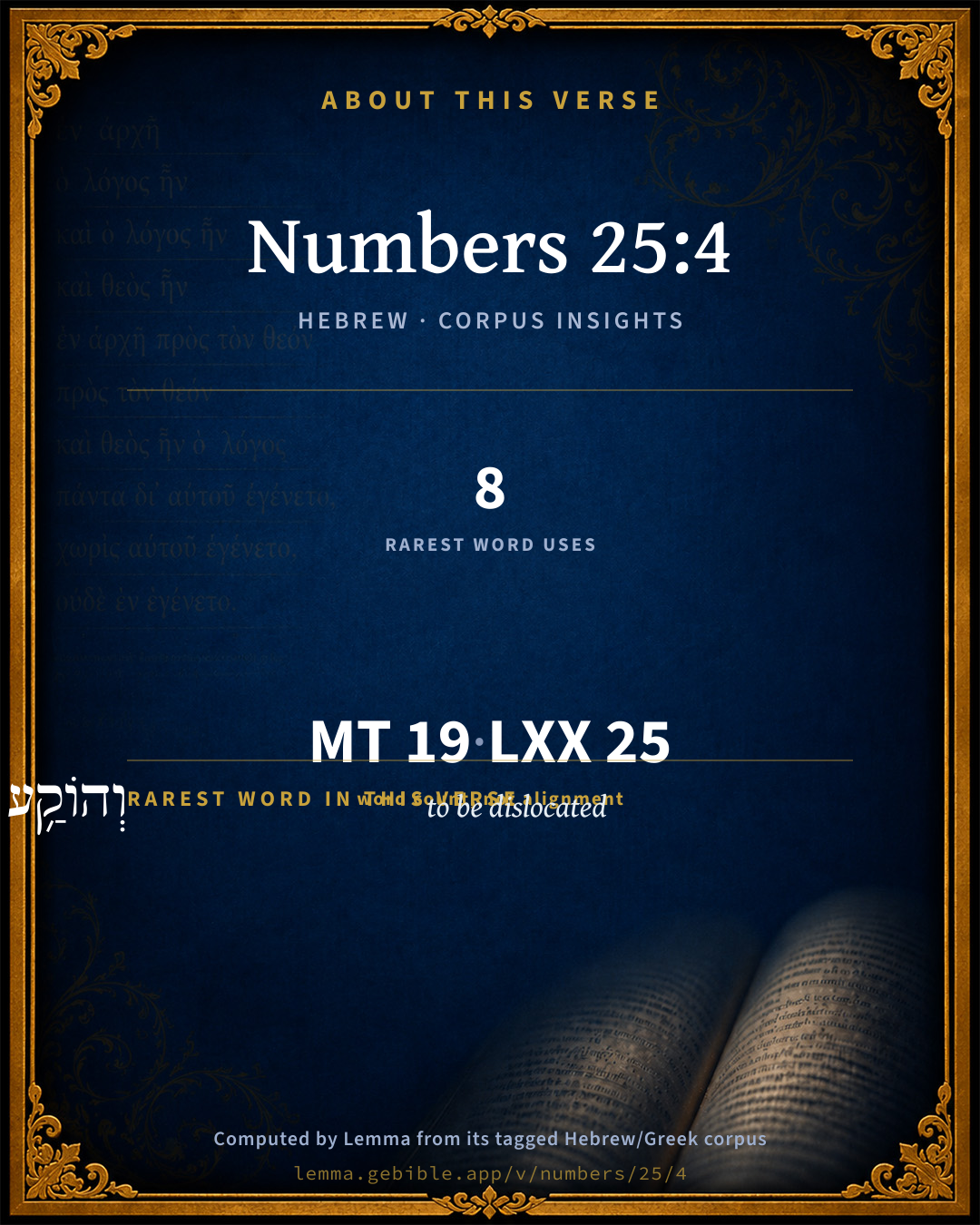
About this verse

These counts appear in no published source. They are computed here, from the morphology-tagged text and Lemma’s own curated glosses. What Lemma adds →

19
words
16
distinct lemmas
Pentateuch
section

Notable vocabulary

The rarest word here is וְהוֹקַ֥ע to be dislocated H3363 — appearing just 8 times in the whole Hebrew Bible.

Shared distinctive vocabulary

וְהוֹקַ֥ע to be dislocated H3363 occurs in 8 verses of the Hebrew Bible. Also found in:

Grammatical profile

  • 4 verbs
  • 10 nouns
  • 2 prepositions
  • 3 particles

Verb forms

  • וַיֹּ֨אמֶר Qal · Sequential Imperfect
  • קַ֚ח Qal · Imperative
  • וְהוֹקַ֥ע Hiphil · Imperative
  • וְיָשֹׁ֛ב Qal · Jussive

Repetition

A word recurs within this verse — often emphatic in Hebrew:

  • יְהוָ֜ה LORD H3068 ×3

Hebrew & Septuagint length

In English translation the verse runs 31 words from the Hebrew and 40 from the Septuagint (LXX English) — closely comparable.

A rough comparison of the two English renderings, which tokenize alike — not a word-level alignment.

Word counts can differ between the Hebrew and the Greek without any difference in meaning — e.g. the Hebrew direct-object marker אֵת has no separate Greek word, and Greek often adds the article ὁ.

In the original languages it is 19 Hebrew tokens and 25 Greek tokens — but the two are counted differently (Hebrew bundles its prefixes and suffixes into one token; the Greek is in lemma form), so that isn’t a like-for-like length.

Cross-references

18

Topical passages linked to Numbers 25:4 in the Treasury of Scripture Knowledge — connected by theme and wording, ordered by reader-vote popularity; previews shown in the World English Bible.

  • Deuteronomy 13:17 There shall cleave nothing of the devoted thing to your hand; that Yahweh may turn from the fierceness of his anger, and show you mercy, and have compassion on you, and multiply you, as he has sworn to your fathers;
  • Deuteronomy 4:3 Your eyes have seen what Yahweh did because of Baal Peor; for all the men who followed Baal Peor, Yahweh your God has destroyed them from the midst of you.
  • Numbers 25:11 Phinehas, the son of Eleazar, the son of Aaron the priest, has turned my wrath away from the children of Israel, in that he was jealous with my jealousy among them, so that I didn't consume the children of Israel in my jealousy.
  • Deuteronomy 21:23 his body shall not remain all night on the tree, but you shall surely bury him the same day; for he who is hanged is accursed of God; that you don't defile your land which Yahweh your God gives you for an inheritance.
  • 2 Samuel 21:6 let seven men of his sons be delivered to us, and we will hang them up to Yahweh in Gibeah of Saul, the chosen of Yahweh. The king said, I will give them.
  • Exodus 18:25 Moses chose able men out of all Israel, and made them heads over the people, rulers of thousands, rulers of hundreds, rulers of fifties, and rulers of tens.
  • Numbers 25:14–15 Now the name of the man of Israel that was slain, who was slain with the Midianite woman, was Zimri, the son of Salu, a prince of a fathers' house among the Simeonites.
  • Numbers 25:18 for they vex you with their wiles, with which they have deceived you in the matter of Peor, and in the matter of Cozbi, the daughter of the prince of Midian, their sister, who was slain on the day of the plague in the matter of Peor.
  • Deuteronomy 13:6–9 If your brother, the son of your mother, or your son, or your daughter, or the wife of your bosom, or your friend, who is as your own soul, entice you secretly, saying, Let us go and serve other gods, which you have not known, you, nor your fathers;
  • Deuteronomy 13:13 Certain base fellows are gone out from the midst of you, and have drawn away the inhabitants of their city, saying, Let us go and serve other gods, which you have not known;
  • Deuteronomy 13:15 you shall surely strike the inhabitants of that city with the edge of the sword, destroying it utterly, and all that is therein and the cattle of it, with the edge of the sword.
  • Joshua 7:25–26 Joshua said, Why have you troubled us? Yahweh shall trouble you this day. All Israel stoned him with stones; and they burned them with fire, and stoned them with stones.
  • Joshua 22:17 Is the iniquity of Peor too little for us, from which we have not cleansed ourselves to this day, although there came a plague on the congregation of Yahweh,
  • Joshua 23:2 that Joshua called for all Israel, for their elders and for their heads, and for their judges and for their officers, and said to them, I am old and well stricken in years:
  • 2 Samuel 21:9 He delivered them into the hands of the Gibeonites, and they hanged them in the mountain before Yahweh, and they fell [all] seven together. They were put to death in the days of harvest, in the first days, at the beginning of barley harvest.
  • Esther 7:9–10 Then said Harbonah, one of the chamberlains who were before the king, Behold also, the gallows fifty cubits high, which Haman has made for Mordecai, who spoke good for the king, stands in the house of Haman. The king said, Hang him thereon.
  • Psalms 85:3–4 You have taken away all your wrath. You have turned from the fierceness of your anger.
  • Jonah 3:9 Who knows whether God will not turn and repent, and turn away from his fierce anger, so that we might not perish?"

Cross-references courtesy of OpenBible.info (CC BY 4.0).

Hebrew and Greek witnesses Masoretic Hebrew ↔ Greek Septuagint

The same verse in the two great witnesses to the Old Testament, shown verse-for-verse.

These are two independent witnesses, not word-aligned to each other, and the Septuagint is shown in lemma (dictionary) form.

Hebrew Numbers 25:4 Masoretic · Westminster Leningrad Codex

וַיֹּ֨אמֶר יְהוָ֜ה אֶל מֹשֶׁ֗ה קַ֚ח אֶת כָּל רָאשֵׁ֣י הָעָ֔ם וְהוֹקַ֥ע אוֹתָ֛ם לַיהוָ֖ה נֶ֣גֶד הַשָּׁ֑מֶשׁ וְיָשֹׁ֛ב חֲר֥וֹן אַף יְהוָ֖ה מִיִּשְׂרָאֵֽל

Yahweh said to Moses, Take all the chiefs of the people, and hang them up to Yahweh before the sun, that the fierce anger of Yahweh may turn away from Israel.

World English Bible · Public Domain

Greek LXX Numbers 25:4 Septuagint · lemma form

καί εἶπον κύριος ὁ μωυσῆς λαμβάνω πᾶς ὁ ἀρχηγός ὁ λαός καί παραδειγματίζω αὐτός κύριος ἀπέναντι ὁ ἥλιος καί ἀποστρέφω ὀργή θυμός κύριος ἀπό ἰσραήλ

And the Lord said to Moses, Take all the princes of the people, and make them examples of judgment for the Lord in the face of the sun, and the anger of the Lord shall be turned away from Israel.

LXX2012 (modern English Septuagint) · Public Domain

On this verse, Ellicott's Commentary for English Readers discusses the Septuagint’s reading. Read the note in Commentary ↓

Hebrew: Westminster Leningrad Codex (CC BY 4.0). Greek: Septuagint (public domain); English from LXX2012 (modern English Septuagint) (Public Domain). How the Septuagint differs from the Hebrew →

Targum (Aramaic paraphrase)

2

The Targum is the ancient Jewish Aramaic paraphrase of the Hebrew Scriptures — an interpretive translation, not the Hebrew text itself. Onkelos (literal) and Pseudo-Jonathan (expansive) render the Torah, and Jonathan the Prophets. Coverage is partial: where no permissively-licensed English translation exists for a verse, only the Aramaic is shown. This is verse-level text, not a word-by-word alignment to the Hebrew.

  1. Targum Onkelos Torah (Genesis–Deuteronomy)
    וַאֲמַר יְיָ לְמשֶׁה דְבַר יַת כָּל רֵישֵׁי עַמָא וְדוּן וּקְטוֹל דְחַיָב קְטוֹל קֳדָם יְיָ לָקֳבֵל שִׁמְשָׁא וִיתוּב תְּקוֹף רוּגְזָא דַיְיָ מִיִשְׂרָאֵל

    (no public-domain English translation for this verse)

    Targum Onkelos — Aramaic: “Onkelos Genesis” (public domain); “Onkelos Exodus” (public domain); “Onkelos Leviticus” (public domain); “Onkelos Numbers” (public domain); “Onkelos Deuteronomy” (public domain). English: “Sefaria Community Translation” (CC0 1.0 (public-domain dedication)); “J.W. Etheridge. The Targums of Onkelos and Jonathan Ben Uzziel on the Pentateuch. London: Longmans, Green, 1862” (public domain). Text via Sefaria.

  2. Targum Pseudo-Jonathan Torah (Genesis–Deuteronomy)
    וַאֲמַר יְיָ לְמשֶׁה סַב יַת כָּל רֵישֵׁי עַמָא וּמַנֵי יַתְהוֹן דַיָינִין וִידוֹנוּן דִינִין דִקְטוֹלִין יַת עַמָא דְטָעוּ בָּתַר פְּעוֹר וְתִצְלוֹב יַתְהוֹן קֳדָם מֵימְרָא דַיְיָ עַל קִיסָא קֳבֵיל שִׁמְשָׁא בִּקְרִיצְתָּא וְעִם מִטְמוֹעַ שִׁמְשָׁא תָּחוֹת יַתְהוֹן וְתִקְבְּרִינוּן וִיתוּב תְּקוֹף רוּגְזָא דַיְיָ מִיִשְרָאֵל

    And the Lord said to Mosheh, Take all the chiefs of the people, and appoint them for judges, and let them give judgment to put to death the people who have gone astray after Peor, and hang them before the Word of the Lord upon the wood over against the morning sun, and at the departure of the sun take them down and bury them and turn away the strong anger of the Lord from Israel.

    Targum Pseudo-Jonathan — Aramaic: “Targum Jonathan on Genesis” (public domain); “Targum Jonathan on Exodus” (public domain); “Targum Jonathan on Leviticus” (public domain); “Targum Jonathan on Numbers” (public domain); “Targum Jonathan on Deuteronomy” (public domain). English: “The Targum of Jonathan ben Uzziel, trans. J. W. Etheridge, London, 1862” (public domain). Text via Sefaria.

Commentary

Notes on Numbers 25:4 from classic Christian and Jewish commentators (each source and its license shown beneath its notes). The classic Christian expositions comment on the surrounding passage and are grouped to its opening verse, so a note may address several verses; the Jewish commentaries on the Tanakh (Rashi and others) are per-verse, so they appear only where the commentator wrote on this verse.

Lemma curates 59 commentaries, every one of them public domain or Creative Commons licensed, each selected and text-cleaned for this edition rather than reprinted as found. About our sources →

Trapp's Complete Commentary

John Trapp

Num 25:4 And the LORD said unto Moses, Take all the heads of the people, and hang them up before the LORD against the sun, that the fierce anger of the LORD may be turned away from Israel.

Ver. 4. Take all the heads.] The chieftains: their greatness might not bear them out. Potentes potenter torquebuntur. Hell is paved, said one of old, with the bald pates of shavellings, and with the crests of great commanders, who had ever opposed with crest and breast whatsoever stood in the way of their sins and lusts.

John Trapp, A Commentary or Exposition upon All the Books of the Old and New Testament (1647–1656) — public domain. Text from a community e-Sword module.

Joseph Benson's Commentary

Num 25:4. Take — That is, apprehend; all the heads (or chief) of the people — Such as were chief in this transgression, and in place and power. These are singled out to this exemplary punishment for their concurrence with others in this wickedness, which was more odious, and of more pernicious tendency in them. Hang them up before the Lord — That is, either before the sanctuary, as men who had forsaken the worship of God, and were by his sentence adjudged to die; or, to the vindication of his honour and justice. Others interpret the words thus: Take unto thee, or to thine assistance, the heads, or judges of the people, and hang them up; that is, hang up such as have joined themselves to Baal-peor. This interpretation seems to be justified by the next verse, in which Moses directs the judges to do their duty by punishing the offenders. Against the sun — Publicly and openly, as their sin was public and scandalous, that all the people might see, and fear to sin; and speedily, before the sun went down. It was provided by the Jewish law, that the bodies of malefactors should hang no longer than till the evening of the day on which they suffered, Deu 21:22-23.

Joseph Benson's Commentary on the Old and New Testaments (1811–1818) — public domain. Text from a community e-Sword module.

Whedon's Commentary on the Bible

Daniel D. Whedon

THE IDOLATERS PUNISHED, Num_25:4-9.

4. Take all the heads of the people — This command is not only to put to death the guilty Israelites, but as a strong expression of loathing and a seeming aggravation of punishment, (note, Lev_20:14,) as well as a most impressive warning against future idolatry, their bodies were to be impaled and publicly exposed. Dr. Kennicott remarks that the Samaritan and the Hebrew texts united make the sense of this verse complete. Speak unto all the heads of the people; and let them slay the men that were joined to Baal-peor; and hang them up before the Lord, etc.

Before the Lord — Literally, for Jehovah, that is, to placate him.

Daniel D. Whedon (gen. ed.), Commentary on the Old and New Testaments (1874–1909) — public domain. Text from a community e-Sword module.

Tyndale Open Study Notes

Tyndale Open Resources

25:4 As he had at Sinai (Exod 32:27-28), the Lord required swift justice. • execute . . . in broad daylight: The guilty parties were perhaps impaled and left out in the sun (see 2 Sam 21:6, 9) so that everyone could see them and learn from their mistakes (cp. 2 Sam 12:12).

Tyndale Open Study Notes — © Tyndale Open Resources, licensed CC BY-SA 4.0. Text via the HelloAO Bible API.

Geneva Bible (1599)

Geneva Bible translators

Or, to the Lord.

Openly in the sight of all.

Geneva Bible (1599) marginal notes — public domain. Text via Bolls.life.

Jamieson, Fausset & Brown

Robert Jamieson, A. R. Fausset & David Brown

The Lord said unto Moses, Take all the heads of the people, and hang them up--Israelite criminals, who were capitally punished, were first stoned or slain, and then gibbeted. The persons ordered here for execution were the principal delinquents in the Baal-peor outrage--the subordinate officers, rulers of tens or hundreds.

before the Lord--for vindicating the honor of the true God.

against the sun--that is, as a mark of public ignominy; but they were to be removed towards sunset (Deu 21:23).

Jamieson, Fausset & Brown — Commentary Critical and Explanatory on the Whole Bible (1871) — public domain (CC PDM 1.0). Text via the HelloAO Bible API.

Adam Clarke's Commentary

Verse 4. Take all the heads of the people, c.] Meaning the chiefs of those who had transgressed as if he had said, "Assemble the chiefs and judges, institute an inquiry concerning the transgressors, and hang them who shall be found guilty before the Lord, as a matter required by his justice." Against the sun - in the most public manner, and in daylight.

Dr. Kennicott has remarked that the Samaritan and Hebrew texts must be both taken together, to make the sense here complete: And the Lord said unto Moses, SPEAK unto all the heads of the people; AND LET THEM SLAY THE MEN THAT WERE JOINED TO BAAL-PEOR; and hang them up before the Lord against the sun, &c.

Adam Clarke's Commentary on the Bible (1810–1826) — public domain. Text from a community e-Sword/MySword module.

Ellicott's Commentary for English Readers

(4) Take all the heads of the people.—The “heads” or “chiefs” of the people seem to be identical with the “judges” of the following verse. Some understand by “all the heads” those only who had been the chief offenders, whilst others understand the word “take” as equivalent to “assemble,” or “bring before thee,” and refer the word “them” to the offenders.

Hang them up . . . —It is obvious from Num_25:5 that the punishment of impaling or crucifying was not to be inflicted until after death. The LXX. renders the Hebrew verb which is here used (and which is found also in 2Sa_21:6; 2Sa_21:9) by the same word which occurs in Heb_6:6, and is there translated “to put to an open shame.”

A Bible Commentary for English Readers, edited by Charles John Ellicott (1878–1897) — public domain. Text from a community e-Sword module.

The Cambridge Bible for Schools and Colleges

gen. ed. J. J. S. Perowne

4. hang them up] i.e. the offenders, not the chiefs. The form of execution denoted by the Heb. word is uncertain. It is the causative (Hiphil) form of the verb used of the dislocation of Jacob’s thigh (Gen_32:25). Aquila understood it to mean ‘impale,’ Targ. ‘crucify’; others, from the analogy of an Arabic word, explain it as ‘to throw down,’ as from a high rock. It occurs elsewhere only of the execution of Saul’s sons (2Sa_21:6).

The Cambridge Bible for Schools and Colleges (gen. ed. J. J. S. Perowne; Cambridge University Press, 1878–1918) — public domain. Text from a community e-Sword module.

John Gill's Exposition

And the Lord said unto Moses,.... Being provoked with the sins of the people, he called to him out of the tabernacle, or out of the cloud:

take all the heads of the people, the princes of the tribes, not to hang them, but to judge those that worshipped Peor, as Jarchi interprets it; though some think that these having sinned, were ordered to be taken and hanged, and made public examples of; but it can hardly be thought, though there were some that might be guilty of the above sins, as Zimri, yet not all of them:

hang them up before the Lord against the sun; that is, those that were guilty of idolatry: the meaning is, and which all the Targums give into, that these heads of the people were to assemble at some proper place, the court of judicature, and order the delinquents to be brought before them, and try, judge, and condemn those they found guilty, and cause them to be hanged somewhere near the tabernacle, and before it, having neglected the worship of God there, and served an idol; and this was to be done openly in the daytime, that all might see and fear; and if it was the sun that was worshipped in this idol, as some think, they were hanged against the sun, to show that the idol they worshipped was not able to deliver them; but, in the face of it, and as it were in defiance of it, they were ordered to be hanged up; and this, according to the Targum of Jonathan, was in the morning against the rising sun, and where they hung all day, and were taken down at sun setting:

that the fierce anger of the Lord may be turned away from Israel; when justice had taken place, and proper punishment was inflicted upon the criminals, whereby a just resentment was made against sin, and God glorified.

John Gill's Exposition of the Whole Bible (1746–1763) — public domain (CC PDM 1.0). Text via the HelloAO Bible API.

Albert Barnes' Notes on the Bible

Take - i. e., assemble the chiefs of the people to thee (compare the phrase “took men,” in Num 16:1). The offenders were to be first; slain by the hands of “the judges of Israel” Num 25:5, and afterward hung up “against the sun” (i. e., publicly, openly; compare 2Sa 12:12) as an aggravation of their punishment. This would be done by impaling the body or fastening it to a cross. Compare Deu 21:23 note, and 2Sa 21:9.

Albert Barnes' Notes on the Bible (1834–1885) — public domain. Text from a community e-Sword/MySword module.

Haydock's Catholic Bible Commentary

People. Assemble the judges, and by their sentence, hang them who have been most guilty. (Onkelos) --- If any of the judges, or princes themselves, have gone astray, let them not be spared. (Haydock) --- The Jews assert, that the malefactor was always killed before his body was hung on a gibbet; and that crucifixion was not known among them. But the contrary is asserted by many. It is not clear whether these criminals were hung by the neck, or crucified, after they had been first stoned, as guilty of idolatry, or whether they were fastened to the gibbet alive, for greater torment and disgrace. (Calmet) --- Sun; publicly. See 2 Kings xii. 11. (Menochius)

George Leo Haydock (1774–1849), Haydock's Catholic Family Bible and Commentary, 1859 edition — public domain. Excludes Psalms (Douay-Rheims chapter numbering differs from Protestant) and Deuterocanonical books (Catholic canon only).

Matthew Poole's English Annotations

The sense is, either,

1. Take, to wit. to thyself and thy assistance,

all the heads, i.e. the judges, as they are called Num 25:5, or rulers,

of the people; and in their presence, and by their help,

hang them, i.e. the people, now mentioned, to wit, such of them as were guilty, as was said Num 25:1. And this sense seems to be favoured by the next verse, where the execution of this command is mentioned, Moses said unto the judges of Israel, whom he had taken to himself and called together, Slay ye every one his man, i.e. each. of you execute this command of God, and hang up the delinquents under your several jurisdictions. Or,

2. Take, i.e. apprehend,

all the heads, i.e. the chief, of the people, such as were chief, either in this transgression, or rather in place and power, who are singled out to this exemplary punishment either for their neglect in not preventing, restraining, or punishing the offenders according to their power and duty, or for their concurrence with others in this wickedness, which was more odious and mischievous in them than in others. And then this must be necessarily limited to such heads as were guilty, which is evident from the nature of the thing, and from the words of the verse. And so these

heads of the people differ, as in name and title, so in place and dignity, from the judges of the people, Num 25:5, which may seem to note the superior magistrates, even the seventy elders, which, being persons of great worth and piety, chosen by God, and endowed with his Spirit, most probably kept themselves from this contagion, and therefore were fitter to punish others; and the heads of the people seem to be the inferior magistrates, the rulers of tens or hundreds, or the like, who as they did many of them partake with the people in other rebellions, so probably were involved in this guilt. Now these are to be hanged up as other malefactors and condemned persons were, Deu 21:23; 2Sa 21:6.

Before the Lord; to the vindication of God’s honour and justice.

Against the sun, i.e. publicly, as their sin was public and scandalous; and speedily, before the sun go down. But withal this phrase may signify, that these also must be taken down about sun-setting, as other malefactors were, Deu 21:23.

Matthew Poole's English Annotations on the Holy Bible (1683–1685) — public domain. Text from a community e-Sword/MySword module.

The Pulpit Commentary

The Lord said unto Moses. It seems strange that so fearful an apostasy had gone so far without interference on the part of Moses. He may have been absent from the camp on account of the wars with the Amorite kings; or he may have trusted to the chiefs to see that due order and discipline was maintained in the camps. Take all the heads of the people, i.e., the chiefs, who ought to have prevented, and might have prevented, this monstrous irregularity, but who seem, if we may judge from the case of Zimri, to have countenanced it. The mere neglect of duty in so gross a case was reason enough for summary execution. Hang them up before the Lord. Either by way of impalement or by way of crucifixion, both of which were familiar modes of punishment. In this case the guilty persons were probably slain first, and exposed afterwards. The hanging up was not ordered on account of its cruelty, nor merely for the sake of publicity ("against the sun), but in order to show that the victims were devoted to the wrath of God against sin. (cf. Deu_21:23 2Sa_21:2-6) The Septuagint has here paradeigmatison autouv . Cf. Heb_6:6, where this word is coupled with "crucify." Them is no authority for referring the "them" ( to the guilty persons instead of to the heads of the people, as is done by the Targums and by many commentators.

The Pulpit Commentary (1880–1919), ed. H.D.M. Spence-Jones & Joseph S. Exell — public domain. Text from a community e-Sword module.

John Wesley's Explanatory Notes

Take all the heads - Take, that is, apprehend, all the heads, that is, the chief, of the people, such as were chief in this transgression, and in place and power, who are singled out to this exemplary punishment for their concurrence with others in this wickedness, which was more odious and mischievous in them. Hang them up before the Lord - To the vindication of God's honour and justice. Against the sun - Publickly, as their sin was publick and scandalous, and speedily, before the sun go down.

John Wesley, Explanatory Notes Upon the Whole Bible (1754–1765) — public domain. Text via the GEBible commentary corpus.

unfoldingWord translationNotes

Door43 World Missions Community

all the leaders of the people

It is implied that this refers to the leaders who were guilty of idolatry. The full meaning of this statement can be made clear. AT: "all the leaders of the people who are guilty of idolatry" (See: Assumed Knowledge and Implicit Information)

to expose them in the daylight

This means that the leaders of Israel will kill these people and leave their dead bodies out where all the people can see them.

to Israel's leaders

"to Israel's leaders who were not guilty of idolatry"

Peor

Peor was the name of a mountain. See how you translated this in Numbers 23:28.

translationWords

Moses

people group

hang

turn

unfoldingWord translationNotes — © Distant Shores Media and the Door43 World Missions Community, licensed CC BY-SA 4.0. Source: git.door43.org/Door43/en_tn.

Rashi

Rabbi Shlomo Yitzchaki (Rashi)

קח את כל ראשי העם TAKE ALL THE HEADS OF THE PEOPLE, to judge those who worshipped Peor (Sanhedrin 35a),

והוקע אותם AND HANG THEM — those who worshipped it (not the heads of the people).

והוקע — This is “hanging”, just as we find in the case of Saul’s sons, (II Samuel XXL 6) “And we will kill them by הוקעה unto the Lord”, and there (II Samuel vv. 12—13) hanging is distinctly mentioned (Sanhedrin 34b). It is true that idolatry (the sin committed here) is punishable by stoning, but all who were stoned were also hanged (Sanhedrin 45b).

נגד השמש AGAINST THE SUN — i.e., in the sight of everyone. A Midrashic statement is: the sun made known who were the sinners, for the cloud rolled itself up from in front of him (the sinner) so that the sun shone upon him (Midrash Tanchuma, Balak 19).

Rashi on the Tanakh — English translations: “The Judaica Press complete Tanach with Rashi, translated by A. J. Rosenberg” (CC BY 4.0); “Pentateuch with Rashi's commentary by M. Rosenbaum and A.M. Silbermann, 1929-1934” (public domain); “The Metsudah Tanach series, Lakewood, N.J” (CC BY 4.0); and “The Book of Joshua, Metsudah Publications, 1997” (CC BY 4.0). Text via Sefaria.

Sforno

Rabbi Ovadia Sforno

The people shall witness this without protesting. This shall atone for them for not having protested when the leaders sinned.

Sforno on the Tanakh — English translation: “Yalkut, Sifsei Chachomim Chumash, Metsudah Publications, 2009” (CC BY 4.0). Text via Sefaria.

Lesson kit

Teaching starters — assembled from the data on this page, not authored interpretation. Every prompt links to the verse data it draws on. Edit before teaching.

Numbers, in the Pentateuch, opens this verse with 19 words (16 distinct Hebrew lemmas). Its most distinctive word is yâqaʻ (“to be dislocated”). A historical commentator’s framing appears above. Read the whole chapter for the surrounding context.

Discussion questions

  1. The word yâqaʻ carries the sense “to be dislocated.” How does it shape the verse?
  2. How does Genesis 32:25, which shares the word «to be dislocated», read alongside this verse?
  3. What does the repetition of “LORD” (3× in this one verse) do in this verse?
  4. These translations render this verse differently; the difference is in the English rendering, not the original. What questions does that raise?
  5. «וַיֹּ֨אמֶר» is a Qal Sequential Imperfect verb. How does that grammatical form shape the action described?
  6. Compare how Trapp's Complete Commentary and Joseph Benson's Commentary read this verse. Where do they agree or differ?

Things to notice

Reading settings

Reading text

Shown beneath each verse's original-language words.

Old Testament
Old Testament edition

Read the OT as the Masoretic Hebrew (MT) or the Greek Septuagint (LXX).

English shown for the Greek Septuagint (in the Hebrew ↔ Greek comparison).

Comparing translations? Open the Compare panel on any verse page to stack up to four side by side.