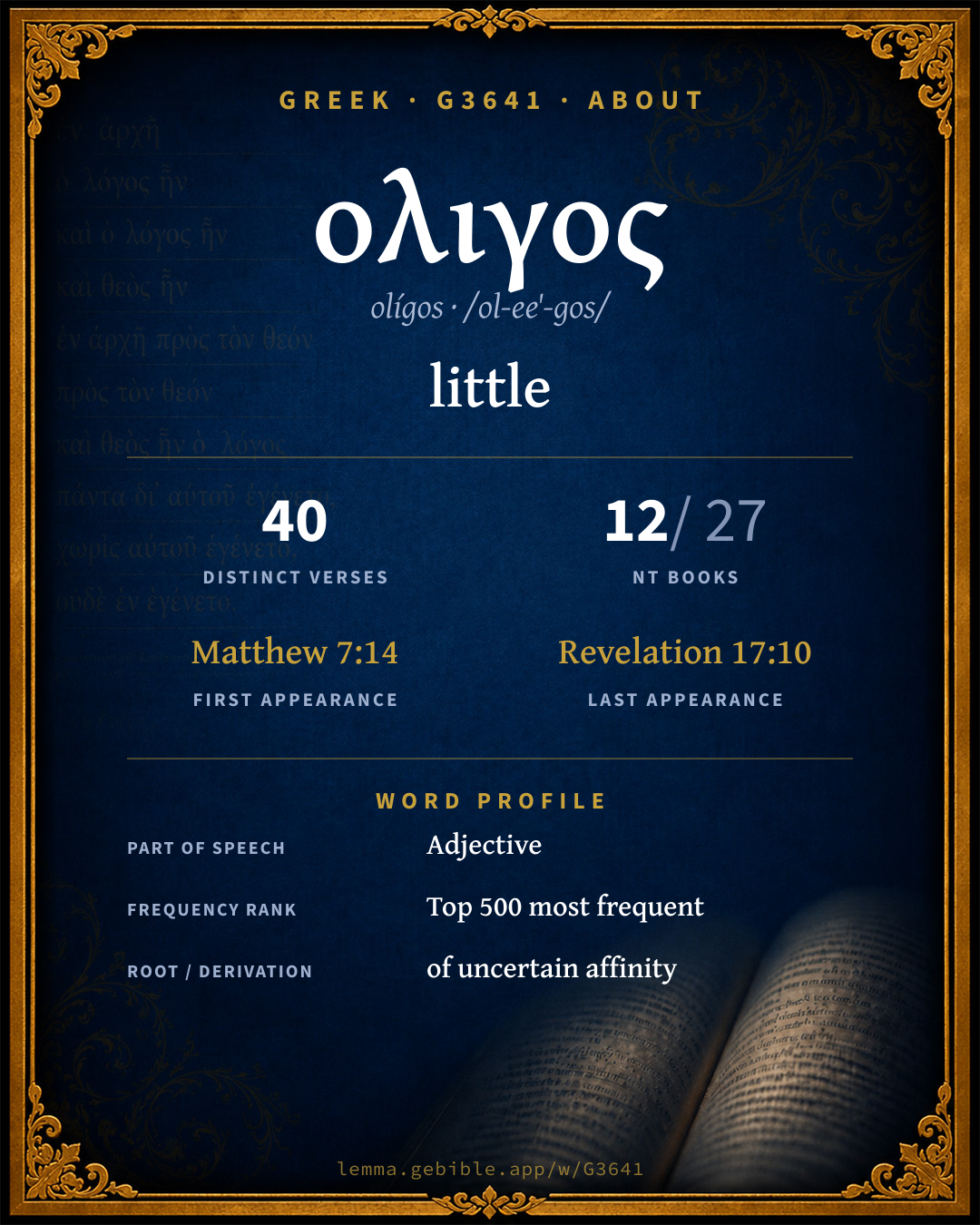
ὀλίγος
little
Full lexicon entry — Thayer's Greek Lexicon
From Thayer's Greek Lexicon
Where this word appears
See every Accusative-case word in the Greek New Testament →
Grammar key — what these labels mean
Part of speech
- Adjective
- A word that describes or qualifies a noun.
- Adverb
- A word that modifies a verb, adjective, or other adverb.
Case
- Nominative
- The case of the subject (and the predicate nominative).
- Accusative
- The case of the direct object and of extent.
- Dative
- The case of the indirect object, means, or location — “to / for / with / in.”
- Genitive
- The case of source, possession, or “of” — answers “whose / from what.”
Gender
- Masculine
- Grammatically masculine.
- Neuter
- Grammatically neuter.
- Feminine
- Grammatically feminine.
Number
- Plural
- More than one.
- Singular
- One.
Grammatical forms 16 distinct
- Adjective, Nominative, Plural, Masculine 7 times (17%)
- Adjective, Accusative, Plural, Neuter 6 times (15%)
- Adjective, Accusative, Singular, Neuter 5 times (12%)
- Adjective, Accusative, Singular, Masculine 4 times (10%)
- Adverb 4 times (10%)
- Adjective, Accusative, Plural, Feminine 2 times (5%)
- Adjective, Dative, Singular, Masculine 2 times (5%)
- Adjective, Dative, Singular, Neuter 2 times (5%)
+8 more forms (9 occurrences)
Parsed forms decoded from the imported morphology (Robinson–Tischendorf, public domain), counted across 41 parsed occurrences — not distinct verses.
Every verse where G3641 appears — 40 distinct verses across 12 books. Click any verse to open its interlinear word-by-word view. Verse text shown in the World English Bible for context — . Each verse’s Greek form is shown with its reference; the English is not keyword-highlighted, since the data carries no word-level English alignment. Use “Compare translations” on any verse to read it across multiple English versions. This concordance covers the Greek New Testament; Septuagint (Greek Old Testament) occurrences of this word are not indexed here.
Matthew 6 verses
- Matthew 7:14 ὀλίγοι adj nom pl masc How narrow is the gate, and restricted is the way that leads to life! Few are those who find it.
- Matthew 9:37 ὀλίγοι adj nom pl masc Then he said to his disciples, "The harvest indeed is plentiful, but the laborers are few.
- Matthew 15:34 ὀλίγα adj acc pl neut Jesus said to them, "How many loaves do you have?" They said, "Seven, and a few small fish."
- Matthew 22:14 ὀλίγοι adj nom pl masc For many are called, but few chosen."
- Matthew 25:21 ὀλίγα adj acc pl neut "His lord said to him, 'Well done, good and faithful servant. You have been faithful over a few things, I will set you over many things. Enter into the joy of your lord.'
- Matthew 25:23 ὀλίγα adj acc pl neut "His lord said to him, 'Well done, good and faithful servant. You have been faithful over a few things, I will set you over many things. Enter into the joy of your lord.'
Mark 4 verses
- Mark 1:19 ὀλίγον adv Going on a little further from there, he saw James the son of Zebedee, and John, his brother, who were also in the boat mending the nets.
- Mark 6:5 ὀλίγοις adj dat pl masc He could do no mighty work there, except that he laid his hands on a few sick people, and healed them.
- Mark 6:31 ὀλίγον adv He said to them, "You come apart into a deserted place, and rest awhile." For there were many coming and going, and they had no leisure so much as to eat.
- Mark 8:7 ὀλίγα adj acc pl neut They had a few small fish. Having blessed them, he said to serve these also.
Luke 5 verses
- Luke 5:3 ὀλίγον adj acc sg masc He entered into one of the boats, which was Simon's, and asked him to put out a little from the land. He sat down and taught the multitudes from the boat.
- Luke 7:47 ὀλίγον ὀλίγον adj nom sg neut adj acc sg neut Therefore I tell you, her sins, which are many, are forgiven, for she loved much. But to whom little is forgiven, the same loves little."
- Luke 10:2 ὀλίγοι adj nom pl masc Then he said to them, "The harvest is indeed plentiful, but the laborers are few. Pray therefore to the Lord of the harvest, that he may send out laborers into his harvest.
- Luke 12:48 ὀλίγας adj acc pl fem but he who didn't know, and did things worthy of stripes, will be beaten with few stripes. To whoever much is given, of him will much be required; and to whom much was entrusted, of him more will be asked.
- Luke 13:23 ὀλίγοι adj nom pl masc One said to him, "Lord, are they few who are saved?" He said to them,
Acts 10 verses
- Acts 12:18 ὀλίγος adj nom sg masc Now as soon as it was day, there was no small stir among the soldiers about what had become of Peter.
- Acts 14:28 ὀλίγον adj acc sg masc They stayed there with the disciples for a long time.
- Acts 15:2 ὀλίγης adj gen sg fem Therefore when Paul and Barnabas had no small discord and discussion with them, they appointed Paul and Barnabas, and some others of them, to go up to Jerusalem to the apostles and elders about this question.
- Acts 17:4 ὀλίγαι adj nom pl fem Some of them were persuaded, and joined Paul and Silas, of the devout Greeks a great multitude, and not a few of the chief women.
- Acts 17:12 ὀλίγοι adj nom pl masc Many of them therefore believed; also of the prominent Greek women, and not a few men.
- Acts 19:23 ὀλίγος adj nom sg masc About that time there arose no small stir concerning the Way.
- Acts 19:24 ὀλίγην adj acc sg fem For a certain man named Demetrius, a silversmith, who made silver shrines of Artemis, brought no little business to the craftsmen,
- Acts 26:28 ὀλίγῳ adj dat sg neut Agrippa said to Paul, "With a little persuasion are you trying to make me a Christian?"
- Acts 26:29 ὀλίγῳ adj dat sg neut Paul said, "I pray to God, that whether with little or with much, not only you, but also all that hear me this day, might become such as I am, except for these bonds."
- Acts 27:20 ὀλίγου adj gen sg masc When neither sun nor stars shone on us for many days, and no small tempest pressed on us, all hope that we would be saved was now taken away.
2 Corinthians 1 verse
Ephesians 1 verse
1 Timothy 2 verses
- 1 Timothy 4:8 ὀλίγον adj acc sg masc For bodily exercise has some value, but godliness has value for all things, having the promise of the life which is now, and of that which is to come.
- 1 Timothy 5:23 ὀλίγῳ adj dat sg masc Be no longer a drinker of water only, but use a little wine for your stomach's sake and your frequent infirmities.
Hebrews 1 verse
James 1 verse
1 Peter 4 verses
- 1 Peter 1:6 ὀλίγον adj acc sg neut Wherein you greatly rejoice, though now for a little while, if need be, you have been put to grief in various trials,
- 1 Peter 3:20 ὀλίγοι adj nom pl masc who before were disobedient, when God waited patiently in the days of Noah, while the ark was being built. In it, few, that is, eight souls, were saved through water.
- 1 Peter 5:10 ὀλίγον adv But may the God of all grace, who called you to his eternal glory by Christ Jesus, after you have suffered a little while, perfect, establish, strengthen, and settle you.
- 1 Peter 5:12 ὀλίγων adj gen pl neut Through Silvanus, our faithful brother, as I consider him, I have written to you briefly, exhorting, and testifying that this is the true grace of God in which you stand.
2 Peter 1 verse
Revelation 4 verses
- Revelation 2:14 ὀλίγα adj acc pl neut But I have a few things against you, because you have there some who hold the teaching of Balaam, who taught Balak to throw a stumbling block before the children of Israel, to eat things sacrificed to idols, and to commit sexual immorality.
- Revelation 3:4 ὀλίγα adj acc pl neut Nevertheless you have a few names in Sardis that did not defile their garments. They will walk with me in white, for they are worthy.
- Revelation 12:12 ὀλίγον adj acc sg masc Therefore rejoice, heavens, and you who dwell in them. Woe to the earth and to the sea, because the devil has gone down to you, having great wrath, knowing that he has but a short time."
- Revelation 17:10 ὀλίγον adj acc sg neut They are seven kings. Five have fallen, the one is, the other has not yet come. When he comes, he must continue a little while.
About this entry
At a glance — auto-summarized from this page’s data, not written by a person. Every figure links to its source below. This summary describes the numbers; it doesn’t interpret them.
“little” is the headline sense of the Greek adjective ολιγος (olígos). Its earliest occurrence is Matthew 7:14. The Greek New Testament uses it across 40 verses — moderately common. More than a quarter of its appearances fall in Acts. Related forms include ολιγοπιστος, ολιγοψυχος and ολιγωρεω. The sections below give every sense, occurrence, and version rendering.
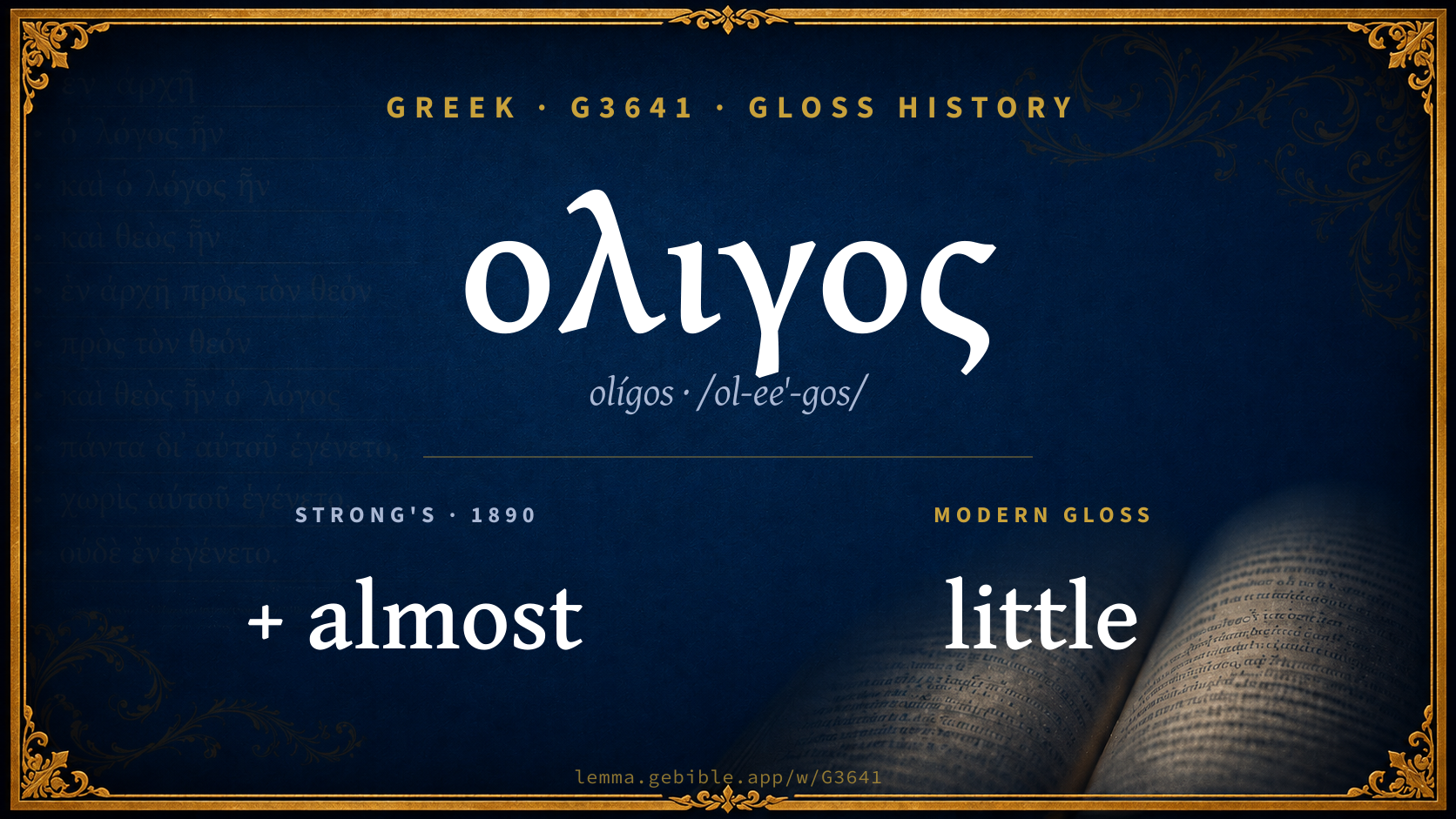
Gloss history
Strong's 1890 vs modern scholarship
About this word
Strong's G3641 catalogs a Greek word from the Greek New Testament.
These counts are not copied from any lexicon or concordance. They are computed here, from the morphology-tagged Greek New Testament. What Lemma adds →
- 40
- distinct verses
- The word appears in 40 distinct verses.
- 12 / 27
- NT books
- The word appears in 12 of 27 New Testament books.
- #364
- by frequency
- Top 500 most frequent Greek words (rank 364 of 5,347 Greek words by occurrence).
View all 40 occurrences in the concordance →
By section of the New Testament
By traditional corpus
Conventional, traditional groupings — biblical authorship is debated, so this is a traditional corpus grouping, not an authorship claim. Some books belong to more than one corpus (Luke is in both the Gospels and the Lukan corpus, and so on), so these shares overlap and need not total 100%. Each figure is a share of the word’s 40 distinct verses.
- Gospels 15 verses · 38%
- Lukan (Luke–Acts) 15 verses · 38%
- General (Catholic) Epistles 6 verses · 15%
- Johannine 4 verses · 10%
- Pauline corpus 4 verses · 10%
- Revelation 4 verses · 10%
- Hebrews 1 verse · 3%
How translations render this word
Counts come from each version’s own published word-to-Strong’s tagging or interlinear alignment — an approximate guide to how each version renders this word, not a word-level alignment the data otherwise carries. Because each total is that version’s own tagged count, the per-version totals vary from one another and need not match the appearance or distinct-verse counts above. These counts may also differ from a printed concordance because Lemma counts each distinctly tagged rendering and does not collapse phrase taggings into a single head-word total. This is a fixed set of word-tagged versions (KJV, ASV, BSB, ULT) and does not change with the reading translation you choose elsewhere. Each version’s license is shown beside its name below (and on Sources).
- King James Version: Few 12×, Little 7×, Small 5×
- American Standard Version: Few 11×, Little 8×, Small 4×
- Berean Standard Bible: Few 11×, Little 7×, Few things 3×
- unfoldingWord Literal Text: Few 10×, Little 10×, Are few 3×
King James Version Public Domain
Renders G3641 across 37 tagged occurrences — most commonly:
Plus 5 renderings that appear only once — usually multi-word phrases or single function words the recovered tagging swept in, not distinct renderings. Not rendered by a distinct English word in 6 further occurrences.
American Standard Version Public Domain
Renders G3641 across 42 tagged occurrences — most commonly:
Plus 11 renderings that appear only once — usually multi-word phrases or single function words the recovered tagging swept in, not distinct renderings.
Berean Standard Bible Public Domain
Renders G3641 across 41 tagged occurrences — most commonly:
Plus 11 renderings that appear only once — usually multi-word phrases or single function words the recovered tagging swept in, not distinct renderings. Not rendered by a distinct English word in 1 further occurrence.
unfoldingWord Literal Text CC BY-SA 4.0
Renders G3641 across 33 tagged occurrences — most commonly:
Plus 4 renderings that appear only once — usually multi-word phrases or single function words the recovered tagging swept in, not distinct renderings.
Senses in Thayer's
The 1 sense Thayer's distinguishes for this word, in lexicon order (not ranked by frequency or importance). The full entry — with sub-senses — is in the Lexicon Entry tab.
- little, small, few
Word origin
Origin: of uncertain affinity
Of uncertain affinity; puny (in extent degree number duration or value); especially neuter (adverbially) somewhat : - + almost brief [-ly] few (a) little + long a season short small a while.
— Strong’s Exhaustive Concordance (1890), public domain.
Forms in the corpus
The 13 distinct written forms G3641 takes in the Greek New Testament, most frequent first — each parse links to that case’s occurrences in the concordance.
| Form | Parsing | Example | Uses |
|---|---|---|---|
| ὀλίγον olígon | Adjective, Accusative, Singular, Neuter | Luke 7:47 | 13 |
| ὀλίγοι olígoi | Adjective, Nominative, Plural, Masculine | Matthew 7:14 | 7 |
| ὀλίγα olíga | Adjective, Accusative, Plural, Neuter | Matthew 15:34 | 6 |
| ὀλίγῳ olígō | Adjective, Dative, Singular, Masculine | Ephesians 3:3 | 4 |
| ὀλίγας olígas | Adjective, Accusative, Plural, Feminine | Luke 12:48 | 2 |
| ὀλίγος olígos | Adjective, Nominative, Singular, Masculine | Acts 12:18 | 2 |
| ὀλίγαι olígai | Adjective, Nominative, Plural, Feminine | Acts 17:4 | 1 |
| ὀλίγην olígēn | Adjective, Accusative, Singular, Feminine | Acts 19:24 | 1 |
| ὀλίγης olígēs | Adjective, Genitive, Singular, Feminine | Acts 15:2 | 1 |
| ὀλίγοις olígois | Adjective, Dative, Plural, Masculine | Mark 6:5 | 1 |
| ὀλίγου olígou | Adjective, Genitive, Singular, Masculine | Acts 27:20 | 1 |
| ὀλίγων olígōn | Adjective, Genitive, Plural, Neuter | 1 Peter 5:12 | 1 |
| ὀλίγως olígōs | Adverb | 2 Peter 2:18 | 1 |
Same root — word family
Other Thayer's entries built from the same root as G3641, grouped by Strong’s listed origin. These share a root / origin per the lexicon — not necessarily a shared meaning. Each links to that word’s own entry.
Derived from this word
- ολιγοπιστος oligópistos G3640 little faith
- ολιγοψυχος oligópsychos G3642 fainthearted
- ολιγωρεω oligōréō G3643 to disregard
Compare all same-root words → They share a root, not necessarily a meaning.
Septuagint usage
The same Greek word ολιγος appears 48 times in the Greek Old Testament (Septuagint), across 44 verses in 19 books.
- 48
- LXX occurrences
- Tagged occurrences of this Greek word in the Septuagint.
- 44
- verses
- Distinct Septuagint verses containing this word.
- 19 / 39
- OT books
- The word appears in 19 of the 39 Old Testament books.
Sample Septuagint occurrences
- Genesis 29:20 ὀλίγος
- Leviticus 25:52 ὀλίγος
- Numbers 11:32 ὀλίγος
- Deuteronomy 4:27 ὀλίγος
- Joshua 7:3 ὀλίγος
- 1 Samuel 14:6 ὀλίγος
- 1 Kings 17:10 ὀλίγος
- 2 Kings 10:18 ὀλίγος
- 2 Chronicles 14:10 ὀλίγος
- Ezra 12:12 ὀλίγος
- Job 8:7 ὀλίγος
- Psalms 16:14 ὀλίγος
Septuagint occurrences (same lexeme)
Every verse where the same Strong’s number (G3641) appears in the Greek Septuagint. Verse text shown in the World English Bible for context; the Greek form is the matched word — the English is not keyword-highlighted.
- Genesis 29:20 ὀλίγος Jacob served seven years for Rachel. They seemed to him but a few days, for the love he had for her.
- Leviticus 25:52 ὀλίγος If there remain but a few years to the year of jubilee, then he shall reckon with him; according to his years of service he shall give back the price of his redemption.
- Numbers 11:32 ὀλίγος The people rose up all that day, and all the night, and all the next day, and gathered the quails: he who gathered least gathered ten homers: and they spread them all abroad for themselves round about the camp.
- Numbers 13:18 ὀλίγος and see the land, what it is; and the people who dwell therein, whether they are strong or weak, whether they are few or many;
- Numbers 26:56 ὀλίγος According to the lot shall their inheritance be divided between the more and the fewer.
- Deuteronomy 4:27 ὀλίγος Yahweh will scatter you among the peoples, and you shall be left few in number among the nations, where Yahweh shall lead you away.
- Deuteronomy 28:38 ὀλίγος You shall carry much seed out into the field, and shall gather little in; for the locust shall consume it.
- Joshua 7:3 ὀλίγος They returned to Joshua, and said to him, Don't let all the people go up; but let about two or three thousand men go up and strike Ai; don't make all the people to toil there; for they are but few.
- 1 Samuel 14:6 ὀλίγος Jonathan said to the young man who bore his armor, Come, and let us go over to the garrison of these uncircumcised: it may be that Yahweh will work for us; for there is no restraint to Yahweh to save by many or by few.
- 1 Kings 17:10 ὀλίγος So he arose and went to Zarephath; and when he came to the gate of the city, behold, a widow was there gathering sticks: and he called to her, and said, Please get me a little water in a vessel, that I may drink.
- 1 Kings 17:12 ὀλίγος She said, As Yahweh your God lives, I don't have a cake, but a handful of meal in the jar, and a little oil in the jar: and, behold, I am gathering two sticks, that I may go in and bake it for me and my son, that we may eat it, and die.
- 2 Kings 10:18 ὀλίγος Jehu gathered all the people together, and said to them, Ahab served Baal a little; but Jehu will serve him much.
- 2 Chronicles 14:10 ὀλίγος Then Asa went out to meet him, and they set the battle in array in the valley of Zephathah at Mareshah.
- 2 Chronicles 24:24 ὀλίγος For the army of the Syrians came with a small company of men; and Yahweh delivered a very great host into their hand, because they had forsaken Yahweh, the God of their fathers. So they executed judgment on Joash.
- 2 Chronicles 29:34 ὀλίγος But the priests were too few, so that they could not flay all the burnt offerings: therefore their brothers the Levites helped them, until the work was ended, and until the priests had sanctified themselves; for the Levites were more upright in heart to sanctify themselves than the priests.
- Ezra 12:12 ὀλίγος
- Ezra 17:4 ὀλίγος
- Job 8:7 ὀλίγος Though your beginning was small, Yet your latter end would greatly increase.
- Job 10:20 ὀλίγος Aren't my days few? Cease then, Leave me alone, that I may find a little comfort,
- Job 14:21 ὀλίγος His sons come to honor, and he doesn't know it; They are brought low, but he doesn't perceive it of them.
- Job 15:11 ὀλίγος Are the consolations of God too small for you, Even the word that is gentle toward you?
- Psalms 16:14 ὀλίγος
- Psalms 36:10 ὀλίγος Oh continue your loving kindness to those who know you, Your righteousness to the upright in heart.
- Psalms 36:16 ὀλίγος
- Psalms 72:2 ὀλίγος He will judge your people with righteousness, And your poor with justice.
- Psalms 108:8 ὀλίγος Gilead is mine. Manasseh is mine. Ephraim also is my helmet. Judah is my scepter.
- Proverbs 5:14 ὀλίγος I have come to the brink of utter ruin, In the midst of the gathered assembly."
- Proverbs 6:10 ὀλίγος A little sleep, a little slumber, A little folding of the hands to sleep:
- Proverbs 15:29 ὀλίγος Yahweh is far from the wicked, But he hears the prayer of the righteous.
- Proverbs 24:33 ὀλίγος A little sleep, a little slumber, A little folding of the hands to sleep;
- Ecclesiastes 5:1 ὀλίγος Guard your steps when you go to God's house; for to draw near to listen is better than to give the sacrifice of fools, for they don't know that they do evil.
- Ecclesiastes 5:11 ὀλίγος When goods increase, those who eat them are increased; and what advantage is there to its owner, except to feast on them with his eyes?
- Ecclesiastes 9:14 ὀλίγος There was a little city, and few men within it; and a great king came against it, besieged it, and built great bulwarks against it.
- Ecclesiastes 10:1 ὀλίγος Dead flies cause the oil of the perfumer to send forth an evil odor; so does a little folly outweigh wisdom and honor.
- Isaiah 10:7 ὀλίγος However he doesn't mean so, neither does his heart think so; but it is in his heart to destroy, and to cut off not a few nations.
- Isaiah 21:17 ὀλίγος and the residue of the number of the archers, the mighty men of the children of Kedar, shall be few; for Yahweh, the God of Israel, has spoken it.
- Isaiah 24:6 ὀλίγος Therefore has the curse devoured the earth, and those who dwell therein are found guilty: therefore the inhabitants of the earth are burned, and few men left.
- Jeremiah 10:24 ὀλίγος Yahweh, correct me, but in measure: not in your anger, lest you bring me to nothing.
- Jeremiah 49:2 ὀλίγος Therefore, behold, the days come, says Yahweh, that I will cause an alarm of war to be heard against Rabbah of the children of Ammon; and it shall become a desolate heap, and her daughters shall be burned with fire: then shall Israel possess those who did possess him, says Yahweh.
- Jeremiah 51:28 ὀλίγος Prepare against her the nations, the kings of the Medes, the governors of it, and all the deputies of it, and all the land of their dominion.
- Ezekiel 5:3 ὀλίγος You shall take of it a few in number, and bind them in your skirts.
- Haggai 1:6 ὀλίγος You have sown much, and bring in little. You eat, but you don't have enough. You drink, but you aren't filled with drink. You clothe yourselves, but no one is warm, and he who earns wages earns wages to put them into a bag with holes in it."
- Haggai 1:9 ὀλίγος "You looked for much, and, behold, it came to little; and when you brought it home, I blew it away. Why?" says Yahweh of Hosts, "Because of my house that lies waste, while each of you is busy with his own house.
- Zechariah 1:15 ὀλίγος I am very angry with the nations that are at ease; for I was but a little displeased, but they added to the calamity."
These are occurrences of the same Greek lexeme (G3641) in the Septuagint — not a translation of any one Hebrew word. The store carries no word-level Hebrew↔Greek alignment, so no Hebrew original is asserted here. Counts come from the recovered LXX Strong's tagging — high-frequency vocabulary is well covered, while rare or late forms may be untagged — so they reflect tagged occurrences and may slightly undercount.