
Jeremiah 49:2

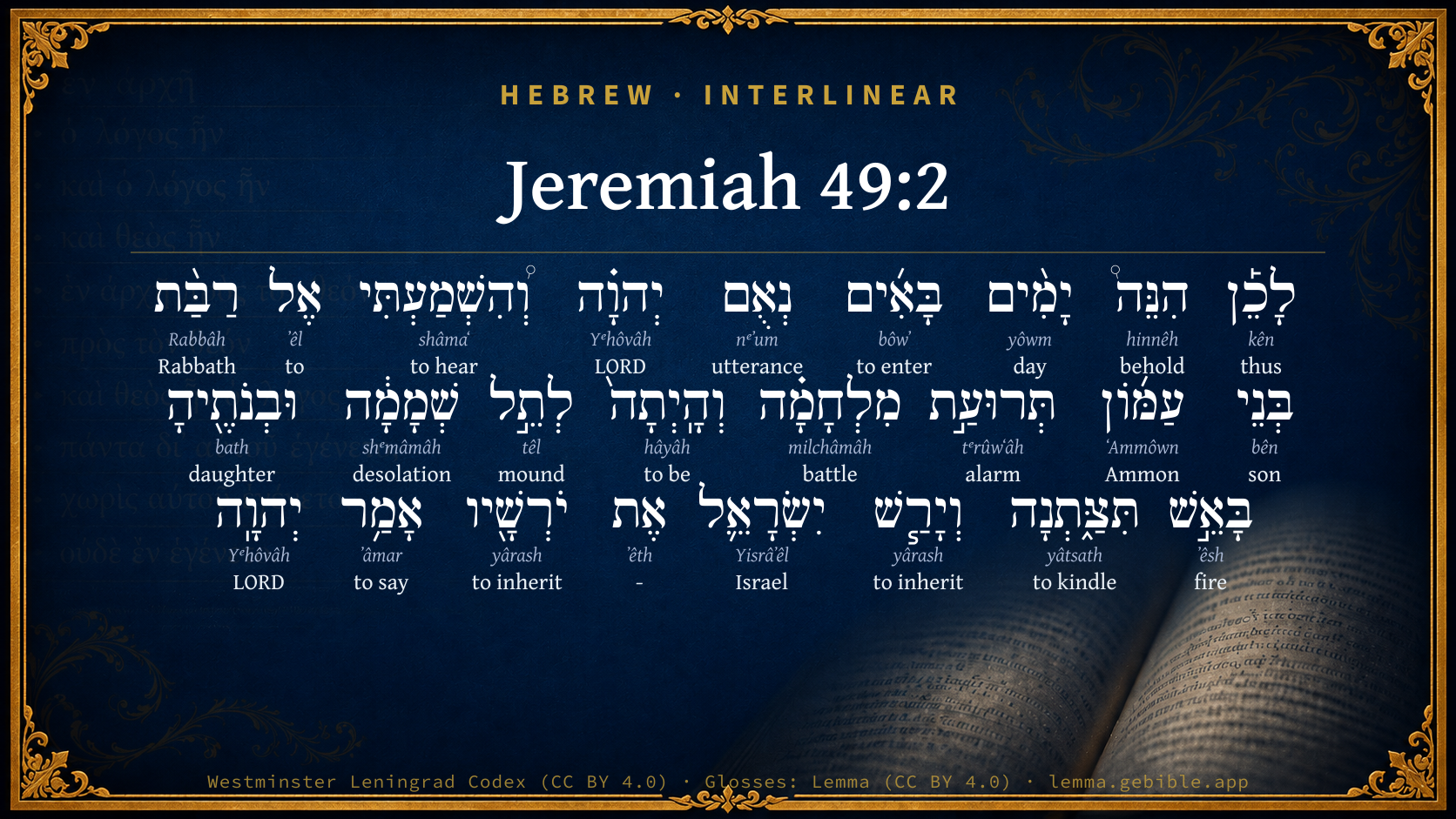
Hebrew (Westminster Leningrad Codex) Jeremiah 49:2 appears in the Hebrew Old Testament. The text above is from the Westminster Leningrad Codex. Each word links to its Strong’s number, a concise gloss, and parsing drawn from the Open Scriptures Hebrew Bible morphology. Click any word for its full Brown-Driver-Briggs (BDB) entry.
Download image
Cite this verse

Jeremiah 49:2 (World English Bible). Public Domain. Lemma interlinear Bible study tool, https://lemma.gebible.app/v/jeremiah/49/2.

Show BibTeX & RIS
BibTeX
RIS
English Translation
Therefore, behold, the days come, says Yahweh, that I will cause an alarm of war to be heard against Rabbah of the children of Ammon; and it shall become a desolate heap, and her daughters shall be burned with fire: then shall Israel possess those who did possess him, says Yahweh.
World English Bible · Public Domain
Download a study sheet

One document with this verse’s original text, its word-by-word gloss line, the meaning frame, cross-references with their text, attributed commentary, and full source and license credits — printable, and it pastes into notes with its structure intact.

This verse Autodidact and up

Study sheet (.html) Plain text (.txt)

A passage Seminary Student

Up to 50 verses in one chapter. A passage sheet keeps up to 6 commentary sources and 12 cross-references per verse, in the order this page ranks them, and says so on the sheet whenever that leaves anything out. Ask for a single verse and you get the Autodidact verse sheet above.

Everything on this page stays free to read, with no account — the sheet is a download of what is already on screen, not access to it.

Want to remove ads? Support Godless Engineer
Compare translations 3

The same verse in 3 English versions, stacked beneath the original-language interlinear above. Click any original word for its lexicon entry.

Each is an independent rendering of the whole verse — the interlinear is not word-aligned to these translations.

Highlighted words mark where these versions differ — a whole-verse word diff, not a word-by-word alignment.

  • World English Bible Public Domain
    Therefore, behold, the days come, says Yahweh, that I will cause an alarm of war to be heard against Rabbah of the children of Ammon; and it shall become a desolate heap, and her daughters shall be burned with fire: then shall Israel possess those who did possess him, says Yahweh.
  • King James Version Public Domain
    Therefore, behold, the days come, saith the LORD, that I will cause an alarm of war to be heard in Rabbah of the Ammonites; and it shall be a desolate heap, and her daughters shall be burned with fire: then shall Israel be heir unto them that were his heirs, saith the LORD.
  • unfoldingWord Literal Text CC BY-SA 4.0
    So look, the days are coming—this is Yahweh’s declaration—when I will sound the signal for battle against Rabbah among the people of Ammon, so it will become a deserted heap and its villages will be set on fire. For Israel will possess those who possessed him,” says Yahweh.

unfoldingWord Literal Text — © unfoldingWord, licensed CC BY-SA 4.0. Word-aligned USFM3 via Door43 (git.door43.org/unfoldingWord/en_ult).

Versions to compare (up to 4)

3 of 4 selected

Show all 18 translations

Every available English version of this verse, each an independent rendering of the whole verse.

  • World English Bible Public Domain
    Therefore, behold, the days come, says Yahweh, that I will cause an alarm of war to be heard against Rabbah of the children of Ammon; and it shall become a desolate heap, and her daughters shall be burned with fire: then shall Israel possess those who did possess him, says Yahweh.
  • Berean Standard Bible Public Domain
    Therefore, behold, the days are coming, declares the LORD, when I will sound the battle cry against Rabbah of the Ammonites. It will become a heap of ruins, and its villages will be burned. Then Israel will drive out their dispossessors, says the LORD.
  • Majority Standard Bible Public Domain
    Therefore, behold, the days are coming, declares the LORD, when I will sound the battle cry against Rabbah of the Ammonites. It will become a heap of ruins, and its villages will be burned. Then Israel will drive out their dispossessors, says the LORD.
  • King James Version Public Domain
    Therefore, behold, the days come, saith the LORD, that I will cause an alarm of war to be heard in Rabbah of the Ammonites; and it shall be a desolate heap, and her daughters shall be burned with fire: then shall Israel be heir unto them that were his heirs, saith the LORD.
  • American Standard Version (1901) Public Domain
    Therefore, behold, the days come, saith Jehovah, that I will cause an alarm of war to be heard against Rabbah of the children of Ammon; and it shall become a desolate heap, and her daughters shall be burned with fire: then shall Israel possess them that did possess him, saith Jehovah.
  • Revised Version (1885) Public Domain
    Therefore, behold, the days come, saith the LORD, that I will cause an alarm of war to be heard against Rabbah of the children of Ammon; and it shall become a desolate heap, and her daughters shall be burned with fire: then shall Israel possess them that did possess him, saith the LORD.
  • Geneva Bible (1599) Public Domain
    Therefore beholde the dayes come, sayeth the Lord, that I will cause a noyse of warre to be heard in Rabbah of the Ammonites, and it shall be a desolate heape, and her daughters shall be burnt with fire: then shall Israel possesse those that possessed him, sayeth the Lord.
  • Douay-Rheims (1899) Public Domain
    Therefore behold the days come, saith the Lord, and I will cause the noise of war to be heard in Rabbath of the children of Ammon, and it shall be destroyed into a heap, and her daughters shall be burnt with fire, and Israel shall possess them that have possessed him, saith the Lord.
  • Young's Literal Translation Public Domain
    Therefore, lo, days are coming, An affirmation of Jehovah, And I have sounded unto Rabbah of the sons of Ammon a shout of battle, And it hath been for a heap -- a desolation, And her daughters with fire are burnt, And Israel hath succeeded its heirs, Said hath Jehovah.
  • Literal Standard Version CC BY-SA 4.0
    Therefore, behold, days are coming, || A declaration of YHWH, || And I have sounded a shout of battle in Rabbah of the sons of Ammon, || And it has been for a heap—a desolation, || And her daughters are burned with fire, || And Israel has succeeded its heirs, said YHWH.
  • Unlocked Literal Bible CC BY-SA 4.0
    So look, the days are coming—this is Yahweh's declaration—when I will sound the signal for battle against Rabbah among the people of Ammon, so it will become a deserted heap and its villages will be set on fire. For Israel will possess those who possessed him,” says Yahweh.
  • unfoldingWord Literal Text CC BY-SA 4.0
    So look, the days are coming—this is Yahweh’s declaration—when I will sound the signal for battle against Rabbah among the people of Ammon, so it will become a deserted heap and its villages will be set on fire. For Israel will possess those who possessed him,” says Yahweh.
  • Darby Bible Public Domain
    Therefore behold, days come, saith Jehovah, that I will cause the clamour of war to be heard in Rabbah of the children of Ammon; and it shall be a desolate heap; and her towns shall be burned with fire; and Israel shall possess them that possessed him, saith Jehovah.
  • World Messianic Bible Public Domain
    Therefore behold, the days come,” says the LORD, “that I will cause an alarm of war to be heard against Rabbah of the children of Ammon, and it will become a desolate heap, and her daughters will be burned with fire; then Israel will possess those who possessed him,” says the LORD.
  • Webster's Bible Public Domain
    Therefore behold, the days come, saith the LORD, that I will cause an alarm of war to be heard in Rabbah of the Ammonites; and it shall be a desolate heap, and her daughters shall be burned with fire: then shall Israel be heir to them that were his heirs, saith the LORD.
  • Free Bible Version CC BY-SA 4.0
    Watch out! The time is coming, declares the Lord, when I will signal the attack on the Ammonite town of Rabbah. It will be turned into a pile of ruins, and its villages will be burned down. Then the Israelites will drive out the people who took over their land, says the Lord.
  • Bible in Basic English Public Domain
    Because of this, see, the days are coming when I will have a cry of war sounded against Rabbah, the town of the children of Ammon; it will become a waste of broken walls, and her daughter-towns will be burned with fire: then Israel will take the heritage of those who took his heritage, says the Lord.
  • JPS Tanakh (1917) Public Domain
    Therefore, behold, the days come, saith the LORD, that I will cause an alarm of war to be heard against Rabbah of the children of Ammon; and it shall become a desolate mound, and her daughters shall be burned with fire; then shall Israel dispossess them that did dispossess him, saith the LORD.

Literal Standard Version (2020), Covenant Press — licensed CC BY-SA 4.0. Text via the HelloAO Bible API (eBible.org). Unlocked Literal Bible (unfoldingWord) — licensed CC BY-SA 4.0. Text via the HelloAO Bible API (eBible.org). unfoldingWord Literal Text — © unfoldingWord, licensed CC BY-SA 4.0. Word-aligned USFM3 via Door43 (git.door43.org/unfoldingWord/en_ult). Free Bible Version, Dr. Jonathan Gallagher — licensed CC BY-SA 4.0. Text via the HelloAO Bible API (eBible.org).

Word by word

More ways to search: Search by grammar → Find every occurrence → Compare this word →

Practice this passage: Drill this verse → Learn its vocabulary →

לְתֵ֣ל
têl
H8510
“to/for · mound of”
Preposition + Noun, Common, Masculine, Singular, Construct
Part of Speech
Preposition + Noun
Type
Common
Gender
Masculine
Number
Singular
State
Construct
Full BDB Definition

Origin: by contraction from H8524

TWOT: 2513a

mound, heap, heap of ruins - mound (of ruin-heap of city) - mound, hill (of elevation on which city stood)
  1. לָכֵ֡ן kên H3651 “to/for · thus” Preposition + Adverb
  2. הִנֵּה֩ hinnêh H2009 “behold” Particle, Demonstrative
  3. יָמִ֨ים yôwm H3117 “days” Noun, Common, Masculine, Plural, Absolute
  4. בָּאִ֜ים bôwʼ H935 “entering” Verb, Qal, Participle Active, Masculine, Plural, Absolute
  5. נְאֻם nᵉʼum H5002 “utterance of” Noun, Common, Masculine, Singular, Construct
  6. יְהוָ֗ה Yᵉhôvâh H3068 “LORD” Noun, Proper
  7. וְ֠הִשְׁמַעְתִּי shâmaʻ H8085 “and · to hear” Conjunction + Verb, Hiphil, Sequential Perfect, 1st Person, Common, Singular
  8. אֶל ʼêl H413 “to” Preposition
  9. רַבַּ֨ת Rabbâh H7237 “Rabbath” Noun, Proper
  10. בְּנֵי bên H1121 “sons of” Noun, Common, Masculine, Plural, Construct
  11. עַמּ֜וֹן ʻAmmôwn H5983 “Ammon” Noun, Proper
  12. תְּרוּעַ֣ת tᵉrûwʻâh H8643 “alarm of” Noun, Common, Feminine, Singular, Construct
  13. מִלְחָמָ֗ה milchâmâh H4421 “battle” Noun, Common, Feminine, Singular, Absolute
  14. וְהָֽיְתָה֙ hâyâh H1961 “and · to be” Conjunction + Verb, Qal, Sequential Perfect, 3rd Person, Feminine, Singular
  15. שְׁמָמָ֔ה shᵉmâmâh H8077 “desolation” Noun, Common, Feminine, Singular, Absolute
  16. וּבְנֹתֶ֖יהָ bath H1323 “and · daughters · her” Conjunction + Noun, Common, Feminine, Plural, Construct + Suffix, Personal, 3rd Person, Feminine, Singular
  17. בָּאֵ֣שׁ ʼêsh H784 “in/at the · fire” Preposition, Determined + Noun, Common, Both, Singular, Absolute
  18. תִּצַּ֑תְנָה yâtsath H3341 “to kindle” Verb, Qal, Imperfect, 3rd Person, Feminine, Plural
  19. וְיָרַ֧שׁ yârash H3423 “and · to inherit” Conjunction + Verb, Qal, Sequential Perfect, 3rd Person, Masculine, Singular
  20. יִשְׂרָאֵ֛ל Yisrâʼêl H3478 “Israel” Noun, Proper
  21. אֶת ʼêth H853 “-” Particle, Direct Object
  22. יֹרְשָׁ֖יו yârash H3423 “inheriting · him” Verb, Qal, Participle Active, Masculine, Plural, Construct + Suffix, Personal, 3rd Person, Masculine, Singular
  23. אָמַ֥ר ʼâmar H559 “to say” Verb, Qal, Perfect, 3rd Person, Masculine, Singular
  24. יְהוָֽה Yᵉhôvâh H3068 “LORD” Noun, Proper

About this verse

These counts appear in no published source. They are computed here, from the morphology-tagged text and Lemma’s own curated glosses. What Lemma adds →

25
words
23
distinct lemmas
Prophets
section

Notable vocabulary

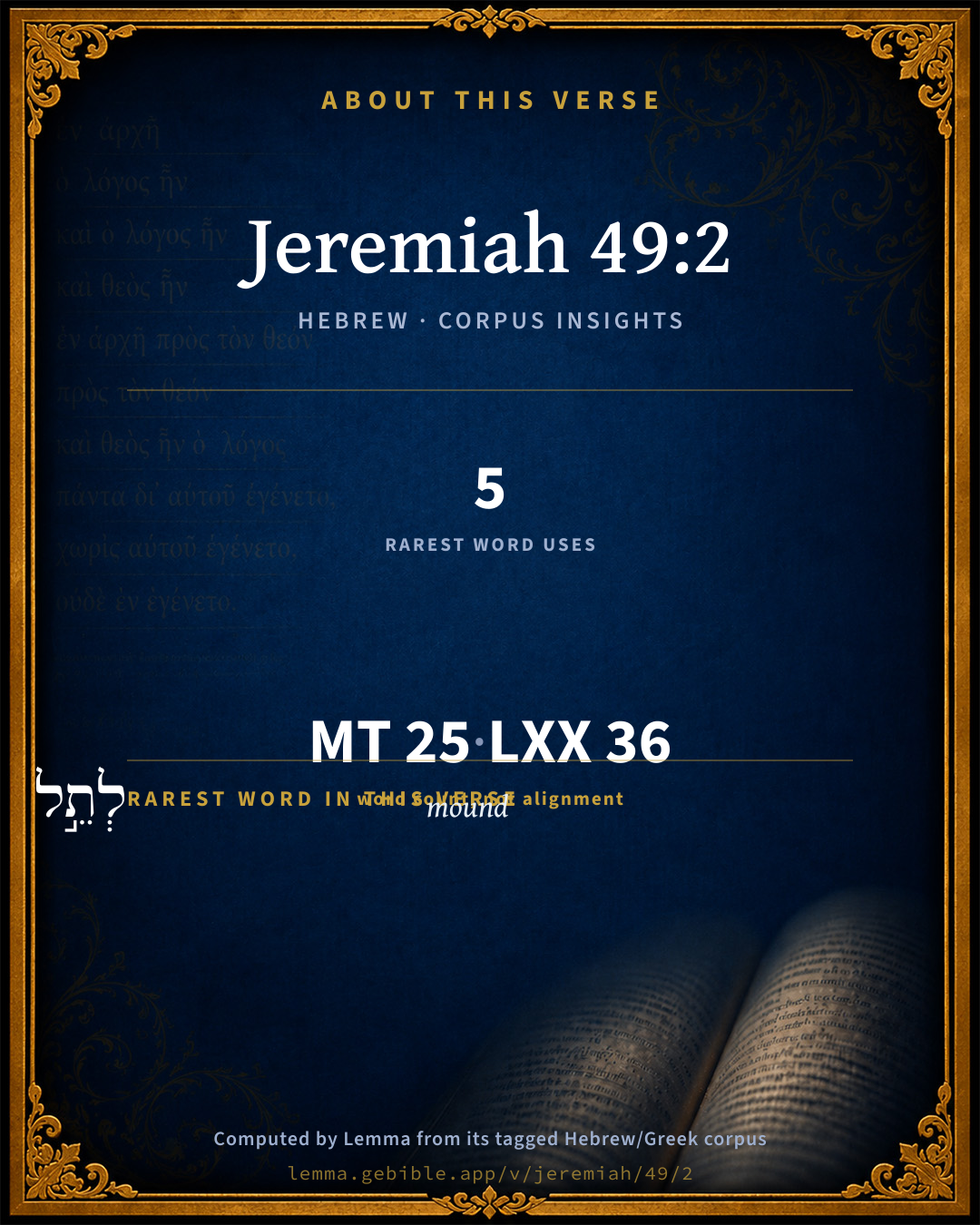
The rarest word here is לְתֵ֣ל mound H8510 — appearing just 5 times in the whole Hebrew Bible.

Shared distinctive vocabulary

לְתֵ֣ל mound H8510 occurs in 5 verses of the Hebrew Bible. Also found in:

Grammatical profile

  • 7 verbs
  • 14 nouns
  • 1 preposition
  • 1 adverb
  • 2 particles

Verb forms

  • בָּאִ֜ים Qal · Participle Active
  • וְ֠הִשְׁמַעְתִּי Hiphil · Sequential Perfect
  • וְהָֽיְתָה֙ Qal · Sequential Perfect
  • תִּצַּ֑תְנָה Qal · Imperfect
  • וְיָרַ֧שׁ Qal · Sequential Perfect
  • יֹרְשָׁ֖יו Qal · Participle Active
  • אָמַ֥ר Qal · Perfect

Repetition

Words recur within this verse — often emphatic in Hebrew:

  • יְהוָ֗ה LORD H3068 ×2
  • וְיָרַ֧שׁ to inherit H3423 ×2

Hebrew & Septuagint length

In the original languages it is 25 Hebrew tokens and 36 Greek tokens — but the two are counted differently (Hebrew bundles its prefixes and suffixes into one token; the Greek is in lemma form), so that isn’t a like-for-like length.

Cross-references

15

Topical passages linked to Jeremiah 49:2 in the Treasury of Scripture Knowledge — connected by theme and wording, ordered by reader-vote popularity; previews shown in the World English Bible.

  • Jeremiah 4:19 My anguish, my anguish! I am pained at my very heart; my heart is disquieted in me; I can't hold my peace; because you have heard, O my soul, the sound of the trumpet, the alarm of war.
  • Deuteronomy 3:11 (For only Og king of Bashan remained of the remnant of the Rephaim; behold, his bedstead was a bedstead of iron; isn't it in Rabbah of the children of Ammon? nine cubits was the length of it, and four cubits the breadth of it, after the cubit of a man.)
  • Ezekiel 21:20 You shall appoint a way for the sword to come to Rabbah of the children of Ammon, and to Judah in Jerusalem the fortified.
  • 2 Samuel 11:1 It happened, at the return of the year, at the time when kings go out [to battle], that David sent Joab, and his servants with him, and all Israel; and they destroyed the children of Ammon, and besieged Rabbah. But David stayed at Jerusalem.
  • Ezekiel 25:4–6 therefore, behold, I will deliver you to the children of the east for a possession, and they shall set their encampments in you, and make their dwellings in you; they shall eat your fruit, and they shall drink your milk.
  • Amos 1:14 But I will kindle a fire in the wall of Rabbah, And it will devour its palaces, With shouting in the day of battle, With a tempest in the day of the whirlwind;
  • Numbers 21:25 Israel took all these cities: and Israel lived in all the cities of the Amorites, in Heshbon, and in all the towns of it.
  • Joshua 13:24–25 Moses gave to the tribe of Gad, to the children of Gad, according to their families.
  • 2 Samuel 12:27–29 Joab sent messengers to David, and said, I have fought against Rabbah; yes, I have taken the city of waters.
  • Psalms 48:11 Let Mount Zion be glad! Let the daughters of Judah rejoice, Because of your judgments.
  • Psalms 97:8 Zion heard and was glad. The daughters of Judah rejoiced, Because of your judgments, Yahweh.
  • Isaiah 14:1–3 For Yahweh will have compassion on Jacob, and will yet choose Israel, and set them in their own land: and the foreigner shall join himself with them, and they shall cleave to the house of Jacob.
  • Jeremiah 49:1 Of the children of Ammon. Thus says Yahweh: Has Israel no sons? has he no heir? why then does Malcam possess Gad, and his people well in the cities of it?
  • Ezekiel 16:46–55 Your elder sister is Samaria, who dwells at your left hand, she and her daughters; and your younger sister, who dwells at your right hand, is Sodom and her daughters.
  • Obadiah 1:19 Those of the South will possess the mountain of Esau, and those of the lowland, the Philistines. They will possess the field of Ephraim, and the field of Samaria. Benjamin will possess Gilead.

Cross-references courtesy of OpenBible.info (CC BY 4.0).

Hebrew and Greek witnesses Masoretic Hebrew ↔ Greek Septuagint

The same verse in the two great witnesses to the Old Testament, shown verse-for-verse.

These are two independent witnesses, not word-aligned to each other, and the Septuagint is shown in lemma (dictionary) form.

Hebrew Jeremiah 49:2 Masoretic · Westminster Leningrad Codex

לָכֵ֡ן הִנֵּה֩ יָמִ֨ים בָּאִ֜ים נְאֻם יְהוָ֗ה וְ֠הִשְׁמַעְתִּי אֶל רַבַּ֨ת בְּנֵי עַמּ֜וֹן תְּרוּעַ֣ת מִלְחָמָ֗ה וְהָֽיְתָה֙ לְתֵ֣ל שְׁמָמָ֔ה וּבְנֹתֶ֖יהָ בָּאֵ֣שׁ תִּצַּ֑תְנָה וְיָרַ֧שׁ יִשְׂרָאֵ֛ל אֶת יֹרְשָׁ֖יו אָמַ֥ר יְהוָֽה

Therefore, behold, the days come, says Yahweh, that I will cause an alarm of war to be heard against Rabbah of the children of Ammon; and it shall become a desolate heap, and her daughters shall be burned with fire: then shall Israel possess those who did possess him, says Yahweh.

World English Bible · Public Domain

Greek LXX Structure differs

In the Septuagint, Jeremiah is about an eighth shorter than the Hebrew and arranges its material differently — the Oracles Against the Nations (Hebrew chapters 46–51) appear in the middle of the Greek book, after 25:13. Because the chapter and verse boundaries do not line up, a verse-for-verse comparison with the Hebrew is not shown.

A verse-for-verse comparison isn’t shown here because the chapters and verses don’t line up. Switch to the LXX edition with the MT / LXX toggle above to read the Greek directly.

Hebrew: Westminster Leningrad Codex (CC BY 4.0). Greek: Septuagint (public domain); English from a public-domain English Septuagint. How the Septuagint differs from the Hebrew →

Targum (Aramaic paraphrase)

1

The Targum is the ancient Jewish Aramaic paraphrase of the Hebrew Scriptures — an interpretive translation, not the Hebrew text itself. Onkelos (literal) and Pseudo-Jonathan (expansive) render the Torah, and Jonathan the Prophets. Coverage is partial: where no permissively-licensed English translation exists for a verse, only the Aramaic is shown. This is verse-level text, not a word-by-word alignment to the Hebrew.

  1. Targum Jonathan Prophets (Joshua–Malachi)
    בְּכֵן הָא יוֹמַיָא אָתָן אֲמַר יְיָ וְאַשְׁמַע לְרַבַּת בְּנֵי עַמוֹן יַבְּבוּת עָבְדֵי קְרָבָא וּתְהֵי לְתֵל צָדוּ וְיָתְבֵי כַפְרָנָהָא בְּנוּרָא יִתּוֹקְדוּן וְיַחְסְנוּן בְּנֵי יִשְׂרָאֵל נִכְסֵי עַמְמַיָא דַהֲווֹ מַחְסְנִין לְהוֹן אֲמַר יְיָ:

    (no public-domain English translation for this verse)

    Targum Jonathan — Aramaic: “Mikraot Gedolot” (public domain). English: “Sefaria Community Translation” (CC0 1.0 (public-domain dedication)); “London "Chaldee Paraphrase," 1871” (public domain). Text via Sefaria.

Commentary

Notes on Jeremiah 49:2 from classic Christian and Jewish commentators (each source and its license shown beneath its notes). The classic Christian expositions comment on the surrounding passage and are grouped to its opening verse, so a note may address several verses; the Jewish commentaries on the Tanakh (Rashi and others) are per-verse, so they appear only where the commentator wrote on this verse.

Lemma curates 59 commentaries, every one of them public domain or Creative Commons licensed, each selected and text-cleaned for this edition rather than reprinted as found. About our sources →

Trapp's Complete Commentary

John Trapp

Jer 49:2 Therefore, behold, the days come, saith the LORD, that I will cause an alarm of war to be heard in Rabbah of the Ammonites; and it shall be a desolate heap, and her daughters shall be burned with fire: then shall Israel be heir unto them that were his heirs, saith the LORD.

Ver. 2. Behold, the day is come, saith the Lord,] scil., After the subversion of the Jewish nation {Eze 21:25-27} For judgment commonly beginneth at the house of God.

And I will cause an alarm of war to be heard in Rabbah.] Megalopolis, the metropolis of the Ammonites; it was afterwards called Philadelphia, from Ptolemy Philadelph, who re-edified it.

And it shall be a desolate heap.] Hob., A hillock of desolation.

And her daughters.] The neighbour towns and villages.

Then shall Israel be heir unto them that were his heirs.] It hath been often observed, that God loveth to retaliate. How this was fulfilled, see /APC 1Ma 5:6, and Joseph., lib. xiii. cap. 21.

John Trapp, A Commentary or Exposition upon All the Books of the Old and New Testament (1647–1656) — public domain. Text from a community e-Sword module.

Joseph Benson's Commentary

Jer 49:2. Therefore I will cause the noise of war to be heard in Rabbah, &c. — The principal city of that country. Her daughters shall be burned with fire — That is, the lesser cities, which are reckoned so many daughters to the mother city. Then shall Israel be heir unto them that were his heirs — Hebrew, וירשׁ את ירשׁיו, Possidebit possessores suos, Vulgate, shall possess his possessors: or, as Blaney renders it, shall take to their possessions who have taken to his. “This is understood,” says he, “to have been fulfilled when Judas Maccabeus defeated the Ammonites, and took their towns, 1Ma 5:6, &c. Zephaniah speaks in like manner, Jer 2:9, The residue of my people shall spoil them, and the remnant of my people shall possess them. But both prophets may, perhaps, refer to still future times, when Israel shall be finally restored to their own land, as is frequently foretold of them, and not only recover their own ancient possessions, but succeed, likewise, to the vacant possessions of their once hostile neighbours, long since extinct and irrecoverably lost.”

Joseph Benson's Commentary on the Old and New Testaments (1811–1818) — public domain. Text from a community e-Sword module.

Tyndale Open Study Notes

Tyndale Open Resources

49:2 Rabbah, the capital of Ammon, was destroyed in 582 BC.

Tyndale Open Study Notes — © Tyndale Open Resources, licensed CC BY-SA 4.0. Text via the HelloAO Bible API.

Geneva Bible (1599)

Geneva Bible translators

Which was one of the chief cities of the Ammonites, as were Heshbon and Ai: there was also a city called Heshbon among the Moabites.

Geneva Bible (1599) marginal notes — public domain. Text via Bolls.life.

Jamieson, Fausset & Brown

Robert Jamieson, A. R. Fausset & David Brown

Rabbah--"the great," metropolis of Ammon (Sa2 12:26-30). Its destruction is foretold also in Eze 25:5; Amo 1:14-15.

her daughters--the towns and villages, dependencies of the metropolis (Jos 15:45).

shall . . . be heir--shall possess those who possessed him. The full accomplishment of this is still future; partially fulfilled under the Maccabees (1 Maccabees 5:6).

Jamieson, Fausset & Brown — Commentary Critical and Explanatory on the Whole Bible (1871) — public domain (CC PDM 1.0). Text via the HelloAO Bible API.

John Calvin's Commentaries

God testifies here plainly that he would not suffer the Ammonites for ever to enjoy their unjust plunder. He says that the days would come, in order to sustain with hope the minds of his children: for the Prophet announced his prediction at a time when the Ammonites were in a state of security; and then, some years elapsed while that people enjoyed their spoils. He therefore holds here the minds of the faithful in suspense, that they might learn patiently to wait until the fixed time of God’s vengeance came. For this reason, then, he says, that the days would come when God would cause the trumpet of war to resound in Rabbah He speaks as of a thing extraordinary, for the Ammonites thought, as we shall see, that they should never be in any danger. As, then, they proudly trusted in their own strength, the Prophet speaks here of the trumpet of war in Rabbah, which was the metropolis of the whole land. Some think that it was Philadelphia, a name given to it by Ptolemy. Interpreters, however, do not agree; but the opinion mostly received is, that it was Philadelphia. Now, as to the main thing, there is no doubt but that it was then the chief seat of government, and the capital of the kingdom, because the Prophet, stating a part for the whole, includes the whole land when he speaks of this city.

He says that she would become a heap of desolation But this was then wholly incredible, because Rabbah was so fortified that no one thought that it could be destroyed. But the Prophet now declares that the whole city would be demolished, so that neither walls nor private houses would remain, but that it would be a deformed mass of ruins. He adds, her daughters shall be burned with fire By daughters he no doubt understands towns and villages; and hence is confirmed what I have said, that Rabbah was then the chief city of the whole land of Ammon. At the end of the verse he says, Israel shall possess all who possess them By these words Jeremiah again confirms what I have slightly referred to, that the calamity of the Ammonites would be a testimony as to God’s paternal kindness towards his chosen people, because he resolved to avenge the wrongs done to them. As, then, God undertook the cause of the Israelites as his own, he sufficiently manifested the favor he had intended for his people, and for no other reason, but because he had gratuitously chosen them.

It may be asked, when was this prophecy fulfilled? God, indeed, under David, gave some indication of their future subjection, but Israel never possessed that land. Indeed, from that time Ammon had not been brought low until after the overthrow of Israel. It then follows that what Jeremiah predicted here, was not fully accomplished except under the kingdom of Christ. David humbled that nation, because he had received a great indignity from the king of Ammon; and he took also Rabbah, as it is evident front sacred history. (2 Samuel 12:29, etc.; 1 Chronicles 20:1, 2.) He was yet satisfied with making the people tributary. From that time they not only shook off the yoke, but exercised authority within the borders of Israel; and that the Israelites had recovered what they had lost, we nowhere read. Then Israel began to possess power over the Ammonites when the kingdom of Christ was established; by which all heathen nations were not only brought into subjection and under the yoke, but all unworthy of mercy were also reduced to nothing. What is added at the end of the verse is not superfluous; for the Prophet introduces God as the speaker, because he speaks of great things, and of which it was difficult to be fully convinced. It now follows —

John Calvin's Commentaries (1540-1563) — public domain. Text from the Calvin Translation Society English edition (1840s-50s) via the Christian Classics Ethereal Library (ccel.org). Calvin's coverage is partial (roughly two-thirds of the Bible); uncommented books and verses are honest gaps, never fabricated. The 19th-century editor's footnotes and remarks are omitted so the notes are faithfully Calvin's own voice.

Ellicott's Commentary for English Readers

(2) Rabbah of the Ammonites.—More fully, of the children of Ammon.—Rabbah, or Rabbath, the “city of waters” (the word signifies “Great,” and the city was, as it were, the Megalopolis of Ammon), was the capital, and this was its full and formal title (Deu_3:11; 2Sa_11:1; 2Sa_12:26). It had been captured by Joab after the siege made memorable by the death of Uriah the Hittite. Jeremiah now predicts its destruction as Amos (Jer_50:14) had done before him. Israel shall then re-enter on its occupation. Its site is now marked by ruins of a stately temple and theatres of the Syrian period (Tristram, Land of Israel, p. 540).

A Bible Commentary for English Readers, edited by Charles John Ellicott (1878–1897) — public domain. Text from a community e-Sword module.

The Cambridge Bible for Schools and Colleges

gen. ed. J. J. S. Perowne

2. Rabbah] now ‘Ammân, their capital city, on the river Jabbok, fourteen miles N.E. of Heshbon.

a desolate heap] See on Jer_30:18.

her daughters] the minor cities depending on her; so Jer_49:3.

The Cambridge Bible for Schools and Colleges (gen. ed. J. J. S. Perowne; Cambridge University Press, 1878–1918) — public domain. Text from a community e-Sword module.

John Gill's Exposition

Therefore, behold, the days come, saith the Lord,.... Or, "are coming" (y); as they did, in a very little time after this prophecy:

that I will cause an alarm of war to be heard in Rabbah of the Ammonites; the metropolis of the Ammonites; it was their royal city in the times of David, Kg1 11:1; called by Polybius (z) Rabbahamana; and by Ptolemy (a) Philadelphia, which name it had from Ptolemy Philadelphus, who rebuilt it; this the Lord threatens with the sound of the trumpet, the alarm of war, or the noise of warriors, as the Targum; the Chaldean army under Nebuchadnezzar, who, about five years after the destruction of Jerusalem, subdued the Ammonites, as Josephus (b) relates:

and it shall be a desolate heap; be utterly destroyed; its walls broken down, and houses demolished, and made a heap of rubbish: and

her daughters shall be burnt with fire: Rabbah was the mother city, and the other cities of the Ammonites were her daughters, which are threatened to be destroyed with fire by the enemy; or it may mean the villages round about Rabbah, it being usual in Scripture for villages to be called the daughters of cities; see Eze 16:46; so the Targum here paraphrases it,

"the inhabitants of her villages shall be burnt with fire:''

then shall Israel be heirs unto them that were his heirs, saith the Lord: that is, shall inherit their land again, which the Ammonites pretended to be the lawful heirs of; yea, not only possess their own land, but the land of Ammon too: this was fulfilled not immediately upon the destruction of Ammon, but in part upon the return of the Jews from the Babylonish captivity, when they repossessed their own country; and partly in the times of the Maccabees, when they subdued the Ammonites,

"Afterward he passed over to the children of Ammon, where he found a mighty power, and much people, with Timotheus their captain.'' (1 Maccabees 5:6)

and will more fully in the latter day, when the Jews shall be converted, and return to their own land, and the children of Ammon shall obey them, Isa 11:14; so Kimchi interprets it; and other Jewish writers understand it of the days of the Messiah, as Abarbinel observes.

(y) "sunt venientes", Montanus, Schmidt. (z) Hist. l. 5. p. 414. (a) Geograph. l. 5. c. 15. (b) Antiqu. l. 10. c. 9. sect. 7.

John Gill's Exposition of the Whole Bible (1746–1763) — public domain (CC PDM 1.0). Text via the HelloAO Bible API.

Albert Barnes' Notes on the Bible

Rabbah - i. e., the “great city.” See 2Sa 12:27 note for a distinction between Rabbah, the citadel, and the town itself, lying below upon the Jabbok.

Daughters - i. e., unwalled villages (and in Jer 49:3).

Shall Israel be heir ... - i. e., “shall be victor over his victors;” compare Mic 1:15.

Albert Barnes' Notes on the Bible (1834–1885) — public domain. Text from a community e-Sword/MySword module.

Haydock's Catholic Bible Commentary

Rabbath; called Amana, Astarte, and Philadelphia, by Stephanus. --- Possess; returning first from captivity, and subduing the cities of Ammon, under Hyrcan, 1 Machabees v. 6.

George Leo Haydock (1774–1849), Haydock's Catholic Family Bible and Commentary, 1859 edition — public domain. Excludes Psalms (Douay-Rheims chapter numbering differs from Protestant) and Deuterocanonical books (Catholic canon only).

Matthew Poole's English Annotations

Because the Ammonites had violently seized upon some part of the Jews’ land, and (as we have it, Amo 1:13,14) cruelly ripped up the women with child in Gilead, that they might enlarge their border, God threatens a war to Rabbah, Amo 1:14, calls it a fire, which should make Rabbah a heap. Of this Rabbah, as the head city of the Ammonites, we read Deu 3:11; Jos 13:25; 15:60. It was there where, in David’s time, Uriah was slain, 2Sa 11:1,17; 12:26. It is threatened by Jeremiah in this chapter, and Eze 25:5; Amo 1:13,14. We read not how or when this prophecy was fulfilled, whether by the Maccabees, 1Ma 5:6, or rather after the coming of Christ, when most of these nations were destroyed. God threatens not only their metropolis, which was Rabbah their mother city, but all the other cities belonging to the Ammonites, which were as it were daughters to Rabbah. But how the last clause of this prophecy was ever fulfilled, if it were not in the time of the Maccabees, I cannot understand; for though they were swallowed up afterward by the Roman empire, yet Israel being also subdued by them, and scattered into all parts, it is not likely that many of them were suffered to, abide in any considerable numbers in a country so near their own.

Matthew Poole's English Annotations on the Holy Bible (1683–1685) — public domain. Text from a community e-Sword/MySword module.

Whedon's Commentary on the Bible

Daniel D. Whedon

2. Rabbah — Its full name was”The great city of the sons of Ammon,” though it was usually called simply Rabbah — the Great. Later it was called Philadelphia, after Ptolemy Philadelphus. It was situated on or near the brook Jabbok.

Her daughters — The unwalled villages dependent on her.

Be heir — The tables will be turned. The Ammonites have taken possession of the Israelites’ territory, but shall be driven from it.

Daniel D. Whedon (gen. ed.), Commentary on the Old and New Testaments (1874–1909) — public domain. Text from a community e-Sword module.

The Pulpit Commentary

The punishment of Ammon. Its capital, Rabbah, (see 2Sa_12:26, 2Sa_12:27) and the "daughter" cities, (comp. Num_21:25, margin; Jos_15:45 and Jos_17:11 in the Hebrew) shall be laid waste. The alarm of war ("alarm" equivalent to "shout"), as in Jer_4:19. A desolate heap. Fortified towns were built on "heaps, or slight elevations, (comp. on Jer_30:18) the Hebrew name for which (in the singular) is tel. The "heap" and the ruins of the town together are aptly called a "heap of desolation." Then shall Israel be heir, etc.; rather, then shall Israel dispossess those who dispossessed him (comp. ver. 1). The form of the phrase reminds us of Isa_14:2.

The Pulpit Commentary (1880–1919), ed. H.D.M. Spence-Jones & Joseph S. Exell — public domain. Text from a community e-Sword module.

Lesson kit

Teaching starters — assembled from the data on this page, not authored interpretation. Every prompt links to the verse data it draws on. Edit before teaching.

Jeremiah, in the Prophets, opens this verse with 25 words (23 distinct Hebrew lemmas). Its most distinctive word is têl (“mound”). A historical commentator’s framing appears above. Read the whole chapter for the surrounding context.

Discussion questions

  1. What does “mound” (têl) contribute to the verse as a whole?
  2. Deuteronomy 13:16 shares the word «mound» with this verse. How do the two illuminate each other?
  3. “LORD” occurs 2× in this one verse. What is the effect of the repetition?
  4. These translations render this verse differently. What is at stake in choosing one wording over another?
  5. The verb «בָּאִ֜ים» is Qal Participle Active. How does its form color the action?
  6. Reading how Trapp's Complete Commentary and Joseph Benson's Commentary read this verse, where do the two commentators agree and where do they part?

Things to notice

Reading settings

Reading text

Shown beneath each verse's original-language words.

Old Testament
Old Testament edition

Read the OT as the Masoretic Hebrew (MT) or the Greek Septuagint (LXX).

English shown for the Greek Septuagint (in the Hebrew ↔ Greek comparison).

Comparing translations? Open the Compare panel on any verse page to stack up to four side by side.