
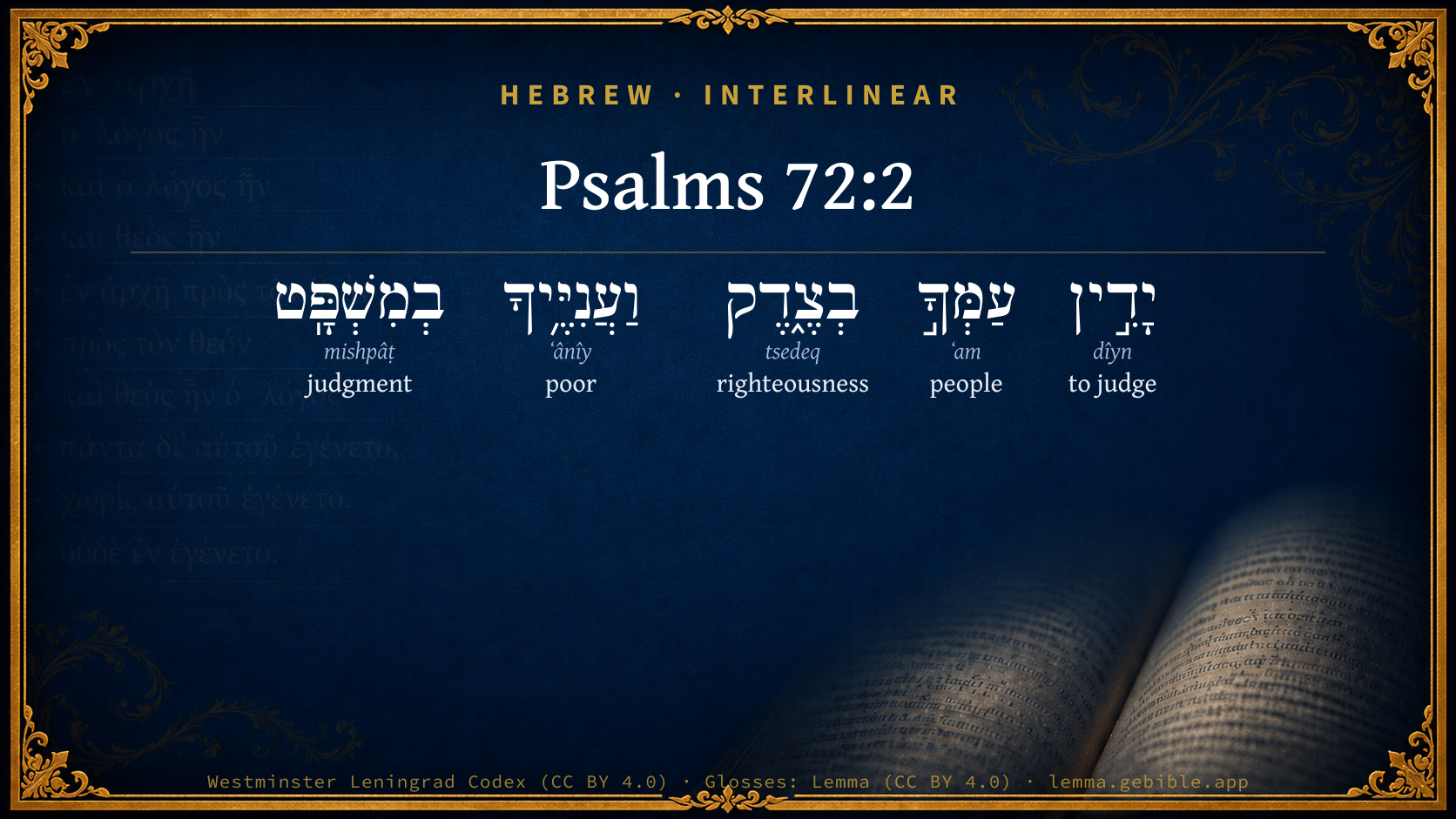
Psalms 72:2

Hebrew (Westminster Leningrad Codex) Psalms 72:2 appears in the Hebrew Old Testament. The text above is from the Westminster Leningrad Codex. Each word links to its Strong’s number, a concise gloss, and parsing drawn from the Open Scriptures Hebrew Bible morphology. Click any word for its full Brown-Driver-Briggs (BDB) entry.
Download image
Cite this verse

Psalms 72:2 (World English Bible). Public Domain. Lemma interlinear Bible study tool, https://lemma.gebible.app/v/psalms/72/2.

Show BibTeX & RIS
BibTeX
RIS
English Translation
He will judge your people with righteousness, And your poor with justice.
World English Bible · Public Domain
Download a study sheet

One document with this verse’s original text, its word-by-word gloss line, the meaning frame, cross-references with their text, attributed commentary, and full source and license credits — printable, and it pastes into notes with its structure intact.

This verse Autodidact and up

Study sheet (.html) Plain text (.txt)

A passage Seminary Student

Up to 50 verses in one chapter. A passage sheet keeps up to 6 commentary sources and 12 cross-references per verse, in the order this page ranks them, and says so on the sheet whenever that leaves anything out. Ask for a single verse and you get the Autodidact verse sheet above.

Everything on this page stays free to read, with no account — the sheet is a download of what is already on screen, not access to it.

Want to remove ads? Support Godless Engineer
Compare translations 3

The same verse in 3 English versions, stacked beneath the original-language interlinear above. Click any original word for its lexicon entry.

Each is an independent rendering of the whole verse — the interlinear is not word-aligned to these translations.

Highlighted words mark where these versions differ — a whole-verse word diff, not a word-by-word alignment.

  • World English Bible Public Domain
    He will judge your people with righteousness, And your poor with justice.
  • King James Version Public Domain
    He shall judge thy people with righteousness, and thy poor with judgment.
  • unfoldingWord Literal Text CC BY-SA 4.0
    May he judge your people with righteousness and your poor with justice.

unfoldingWord Literal Text — © unfoldingWord, licensed CC BY-SA 4.0. Word-aligned USFM3 via Door43 (git.door43.org/unfoldingWord/en_ult).

Versions to compare (up to 4)

3 of 4 selected

Show all 18 translations

Every available English version of this verse, each an independent rendering of the whole verse.

  • World English Bible Public Domain
    He will judge your people with righteousness, And your poor with justice.
  • Berean Standard Bible Public Domain
    May he judge Your people with righteousness and Your afflicted with justice.
  • Majority Standard Bible Public Domain
    May he judge Your people with righteousness and Your afflicted with justice.
  • King James Version Public Domain
    He shall judge thy people with righteousness, and thy poor with judgment.
  • American Standard Version (1901) Public Domain
    He will judge thy people with righteousness, And thy poor with justice.
  • Revised Version (1885) Public Domain
    He shall judge thy people with righteousness, and thy poor with judgment.
  • Geneva Bible (1599) Public Domain
    Then shall he iudge thy people in righteousnesse, and thy poore with equitie.
  • Douay-Rheims (1899) Public Domain
    Give to the king thy judgment, O God: and to the king's son thy justice: To judge thy people with justice, and thy poor with judgment.
  • Young's Literal Translation Public Domain
    He judgeth Thy people with righteousness, And Thy poor with judgment.
  • Literal Standard Version CC BY-SA 4.0
    He judges Your people with righteousness, || And Your poor with judgment.
  • Unlocked Literal Bible CC BY-SA 4.0
    May he judge your people with righteousness and your poor with justice.
  • unfoldingWord Literal Text CC BY-SA 4.0
    May he judge your people with righteousness and your poor with justice.
  • Darby Bible Public Domain
    He will judge thy people with righteousness, and thine afflicted with judgment.
  • World Messianic Bible Public Domain
    He will judge your people with righteousness, and your poor with justice.
  • Webster's Bible Public Domain
    He shall judge thy people with righteousness, and thy poor with judgment.
  • Free Bible Version CC BY-SA 4.0
    May he rightly judge your people, and may he be fair to the poor.
  • Bible in Basic English Public Domain
    May he be a judge of your people in righteousness, and make true decisions for the poor.
  • JPS Tanakh (1917) Public Domain
    That he may judge Thy people with righteousness, and Thy poor with justice.

Literal Standard Version (2020), Covenant Press — licensed CC BY-SA 4.0. Text via the HelloAO Bible API (eBible.org). Unlocked Literal Bible (unfoldingWord) — licensed CC BY-SA 4.0. Text via the HelloAO Bible API (eBible.org). unfoldingWord Literal Text — © unfoldingWord, licensed CC BY-SA 4.0. Word-aligned USFM3 via Door43 (git.door43.org/unfoldingWord/en_ult). Free Bible Version, Dr. Jonathan Gallagher — licensed CC BY-SA 4.0. Text via the HelloAO Bible API (eBible.org).

Word by word

More ways to search: Search by grammar → Find every occurrence → Compare this word →

Practice this passage: Drill this verse → Learn its vocabulary →

About this verse

These counts appear in no published source. They are computed here, from the morphology-tagged text and Lemma’s own curated glosses. What Lemma adds →

5
words
5
distinct lemmas
Wisdom
section

Notable vocabulary

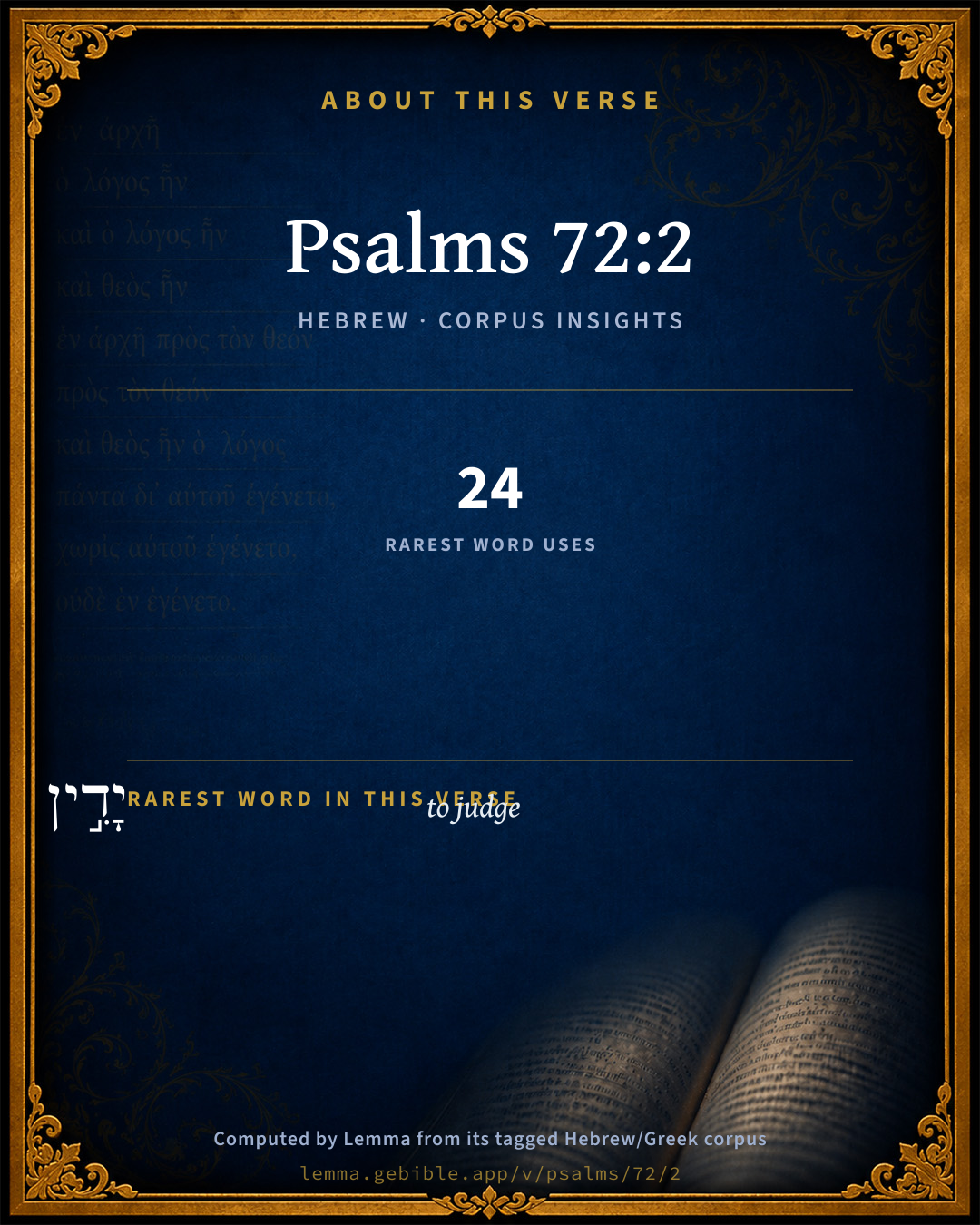
The rarest word here is יָדִ֣ין to judge H1777 — appearing just 24 times in the whole Hebrew Bible.

Shared distinctive vocabulary

יָדִ֣ין to judge H1777 occurs in 24 verses of the Hebrew Bible. Also found in:

Grammatical profile

  • 1 verb
  • 3 nouns
  • 1 adjective

Verb forms

  • יָדִ֣ין Qal · Imperfect

Hebrew & Septuagint length

In English translation the verse runs 12 words from the Hebrew and 13 from the Septuagint (LXX English) — closely comparable.

A rough comparison of the two English renderings, which tokenize alike — not a word-level alignment.

Word counts can differ between the Hebrew and the Greek without any difference in meaning — e.g. the Hebrew direct-object marker אֵת has no separate Greek word, and Greek often adds the article ὁ.

Cross-references

12

Topical passages linked to Psalms 72:2 in the Treasury of Scripture Knowledge — connected by theme and wording, ordered by reader-vote popularity; previews shown in the World English Bible.

  • Isaiah 32:1 Behold, a king shall reign in righteousness, and princes shall rule in justice.
  • Psalms 72:12–14 For he will deliver the needy when he cries; The poor, who has no helper.
  • Isaiah 32:17 The work of righteousness shall be peace; and the effect of righteousness, quietness and confidence forever.
  • 1 Kings 3:5–10 In Gibeon Yahweh appeared to Solomon in a dream by night; and God said, Ask what I shall give you.
  • Job 34:19 Who doesn't respect the persons of princes, Nor regards the rich more than the poor; For they all are the work of his hands.
  • Psalms 12:5 "Because of the oppression of the weak and because of the groaning of the needy, I will now arise," says Yahweh; "I will set him in safety from those who malign him."
  • Psalms 45:6–7 Your throne, God, is forever and ever. A scepter of equity is the scepter of your kingdom.
  • Psalms 82:3–4 "Defend the weak, the poor, and the fatherless. Maintain the rights of the poor and oppressed.
  • Isaiah 9:7 Of the increase of his government and of peace there shall be no end, on the throne of David, and on his kingdom, to establish it, and to uphold it with justice and with righteousness from henceforth even forever. The zeal of Yahweh of Hosts will perform this.
  • Isaiah 11:2–5 The Spirit of Yahweh shall rest on him, the spirit of wisdom and understanding, the spirit of counsel and might, the spirit of knowledge and of the fear of Yahweh.
  • Revelation 19:11 I saw the heaven opened, and behold, a white horse, and he who sat on it is called Faithful and True. In righteousness he judges and makes war.
  • Jeremiah 33:15 In those days, and at that time, will I cause a Branch of righteousness to grow up to David; and he shall execute justice and righteousness in the land.

Cross-references courtesy of OpenBible.info (CC BY 4.0).

Hebrew and Greek witnesses Masoretic Hebrew ↔ Greek Septuagint

The same verse in the two great witnesses to the Old Testament, shown verse-for-verse.

You’re reading Greek Psalm 71 (Hebrew Psalm 72). The Septuagint counts the superscription, so verse numbers can differ from the Hebrew — chapter-level alignment, not verse-by-verse. Numbering follows Rahlfs.

These are two independent witnesses, not word-aligned to each other, and the Septuagint is shown in lemma (dictionary) form.

Hebrew Psalms 72:2 Masoretic · Westminster Leningrad Codex

יָדִ֣ין עַמְּךָ֣ בְצֶ֑דֶק וַעֲנִיֶּ֥יךָ בְמִשְׁפָּֽט

He will judge your people with righteousness, And your poor with justice.

World English Bible · Public Domain

Greek LXX Greek Psalm 71:2 Septuagint · lemma form

κρίνω ὁ λαός σύ ἐν δικαιοσύνη καί ὁ πτωχός σύ ἐν κρίσις

that he may judge your people with righteousness, and your poor with judgment.

LXX2012 (modern English Septuagint) · Public Domain

Hebrew: Westminster Leningrad Codex (CC BY 4.0). Greek: Septuagint (public domain); English from LXX2012 (modern English Septuagint) (Public Domain). How the Septuagint differs from the Hebrew →

Commentary

Notes on Psalms 72:2 from classic Christian and Jewish commentators (each source and its license shown beneath its notes). The classic Christian expositions comment on the surrounding passage and are grouped to its opening verse, so a note may address several verses; the Jewish commentaries on the Tanakh (Rashi and others) are per-verse, so they appear only where the commentator wrote on this verse.

Lemma curates 59 commentaries, every one of them public domain or Creative Commons licensed, each selected and text-cleaned for this edition rather than reprinted as found. About our sources →

The Cambridge Bible for Schools and Colleges

gen. ed. J. J. S. Perowne

2. He shall give sentence to thy people with righteousness,

And to thine afflicted ones with Judgement.

Many commentators render the verbs throughout the Ps. as optatives, Let him give sentence, and so forth. In Psa_72:8 ff. this rendering is required by the form of the verb; but here the form is a simple future. The administration of the king endowed with divine capacities for ruling is described (Psa_72:2; Psa_72:4; Psa_72:6), together with the resultant blessings (3, 5, 7). The rendering give sentence is adopted to indicate that the Heb. word is different from that in Psa_72:4.

It has been argued that ‘thine afflicted ones’ implies that the nation was at the time in a state of depression and humiliation: but the term is not necessarily coextensive with ‘thy people’; it denotes, as frequently in the prophets, the poorer classes, who especially needed the protection of good government. See Isa_3:14-15; Isa_10:2; Jer_22:16; Amo_8:4.

The Cambridge Bible for Schools and Colleges (gen. ed. J. J. S. Perowne; Cambridge University Press, 1878–1918) — public domain. Text from a community e-Sword module.

Trapp's Complete Commentary

John Trapp

Psa 72:2 He shall judge thy people with righteousness, and thy poor with judgment.

Ver. 2. He shall judge thy people with righteousness] sc. If thou please to remember thy promise to me, and to answer this my prayer of faith founded thereupon.

And thy poor] Or, thine afflicted. The people (the poor afflicted especially) are the Lord’s and therefore not to be tyrannized over and trampled on by their governors.

John Trapp, A Commentary or Exposition upon All the Books of the Old and New Testament (1647–1656) — public domain. Text from a community e-Sword module.

Joseph Benson's Commentary

Psa 72:2. He shall judge thy people with righteousness — Namely, if thou givest him what I have desired. And by this prediction he tacitly admonishes him of, and obliges him to, the performance of his duty. Or the words may be rendered, Let him judge, the future being put for the imperative, as is often the case; and so it is a prayer. And thy poor — Or, thy afflicted, or oppressed ones; for such are thine in a special manner; thou art their judge and patron, Psa 68:5, and hast commanded all thy people, and especially kings and magistrates, to take a singular care of them, because they have few or no friends.

Joseph Benson's Commentary on the Old and New Testaments (1811–1818) — public domain. Text from a community e-Sword module.

J. A. Alexander on Psalms

Joseph Addison Alexander

Psa 72:2. He shall judge thy people with righteousness, and thy afflicted (ones) with judgment. This is stated as the necessary consequence of the granting of the prayer in the preceding verse. "Give him thy righteousness, and then he shall judge," etc. There is no need, therefore, of putting an optative sense upon the future, "Let them judge," etc., especially as it would then be necessary to extend the same construction to the verses following, and so long a series of optative expressions is without example.

Joseph Addison Alexander, The Psalms Translated and Explained (1850) — public domain. Text from a community e-Sword module.

Adam Clarke's Commentary

Verse 2. He shall judge thy people with righteousness] With justice and mercy mixed, or according to equity.

And thy poor with judgment.] Every one according to the law which thou hast appointed; but with especial tenderness to the poor and afflicted.

Adam Clarke's Commentary on the Bible (1810–1826) — public domain. Text from a community e-Sword/MySword module.

John Calvin's Commentaries

2. He shall judge thy people in righteousness. Some read this in the form of a wish — O that he may judge, etc. Others retain the future tense; and thus it is a prophecy. But we will come nearer the correct interpretation by understanding something intermediate, as implied. All that is afterwards spoken, concerning the king, flows from the supposition, that the blessing prayed for in the first verse is conferred upon him — from the supposition that he is adorned with righteousness and judgment. The prayer, then, should be explained thus: Govern our king, O God! that he may judge. Or in this way, When thou shalt have bestowed upon the king thy righteousness, then he will judge uprightly. To govern a nation well, is an endowment far too excellent to grow out of the earth; but the spiritual government of Christ, by which all things are restored to perfect order, ought much more to be considered a gift of heaven. In the first clause of the verse, David speaks of the whole people in general. In the second clause, he expressly mentions the poor, who, on account of their poverty and weakness, have need of the help of others, and for whose sake kings are armed with the sword to grant them redress when unjustly oppressed. Hence, also, proceeds peace, of which mention is made in the third verse. The term peace being employed among the Hebrews to denote not only rest and tranquillity, but also prosperity, David teaches us that the people would enjoy prosperity and happiness, when the affairs of the nation were administered according to the principles of righteousness. The bringing forth of peace is a figurative expression taken from the fertility of the earth. And when it is said that the mountains and hills shall bring forth peace, the meaning is, that no corner would be found in the country in which it did not prevail, not even the most unpromising parts, indicated by the mountains, which are commonly barren, or at least do not produce so great an abundance of fruits as the valleys. Besides, both the word peace and the word righteousness are connected with each clause of the verse, and must be twice repeated, the idea intended to be conveyed being, that peace by righteousness should be diffused through every part of the world. Some read simply righteousness, instead of In righteousness, supposing the letter ב, beth, to be here redundant, which does not, however, appear to be the case.

John Calvin's Commentaries (1540-1563) — public domain. Text from the Calvin Translation Society English edition (1840s-50s) via the Christian Classics Ethereal Library (ccel.org). Calvin's coverage is partial (roughly two-thirds of the Bible); uncommented books and verses are honest gaps, never fabricated. The 19th-century editor's footnotes and remarks are omitted so the notes are faithfully Calvin's own voice.

John Gill's Exposition

He shall judge thy people with righteousness,.... Or, "so shall he judge"; or, "that he may judge" (n), as the Syriac and Arabic versions; having the judgments and righteousness of God given him, he will be thereby qualified to judge the people of God; such as are so, not by creation, but by special grace; his chosen and covenant people, the redeemed and purchased people of God, and who in the effectual calling appear to be so, and are made his willing people. These Christ judges, rules, and governs, protects and defends, in a righteous manner; pleads their cause, vindicates their right, and avenges them on their enemies, as well as justifies them with his own righteousness;

and thy poor with judgment; justice and equity. Such who are literally poor, and are the Lord's poor, whom he has chosen, and makes rich in faith, and heirs of a kingdom; and with whom Christ, when here on earth, was chiefly concerned, and now is; and not with the great men and rulers of the earth: or such who are poor in spirit, sensible of their spiritual poverty; that find themselves hungry and thirsty, and destitute of righteousness, and without money, or anything to procure either. Or, "thine afflicted ones" (o); such as are distressed in body or mind, with respect to things temporal or spiritual; oppressed by sin, Satan, and the world, These Christ regards, and administers justice to in his own time and way; see Isa 11:4.

(n) "ut jus dicat", Tigurine version; so Ainsworth. (o) "afflictos tuos", Montanus, Vatablus, Musculus, Piscator, Gejerus, Michaelis, Tiguriue version.

John Gill's Exposition of the Whole Bible (1746–1763) — public domain (CC PDM 1.0). Text via the HelloAO Bible API.

Albert Barnes' Notes on the Bible

He shall judge thy people with righteousness - On this verse see the notes at Isa 11:3-4. The fact that this so entirely accords with the description in Isa. 11, which undoubtedly refers to the Messiah, has been alluded to above as confirming the opinion that the psalm has a similar reference.

Albert Barnes' Notes on the Bible (1834–1885) — public domain. Text from a community e-Sword/MySword module.

Matthew Poole's English Annotations

He shall judge, to wit, if thou givest him what I have desired. And by this prediction he doth tacitly admonish him of, and oblige him to, the performance of his duty herein. Or, Let him judge; the future being put for the imperative, as hath been oft observed. So it is a prayer.

Thy people; for they are thine more than his; and therefore he must not govern them according to his own will and pleasure, but according to the rules of thy word, and for thy service and glory.

Thy poor; or, thy afflicted or oppressed ones, for such are thine in a special manner; thou art their Judge and Patron, Psa 68:5, and hast commanded all thy people, and especially kings and magistrates, to take a singular care of them, because they have few or no friends.

Matthew Poole's English Annotations on the Holy Bible (1683–1685) — public domain. Text from a community e-Sword/MySword module.

The Treasury of David

Charles H. Spurgeon

Ver. 2. He shall judge thy people with righteousness. Clothed with divine authority, he shall use it on the behalf of the favoured nation, for whom he shall show himself strong, that they be not misjudged, slandered, or in any way treated maliciously. His sentence shall put their accusers to silence, and award the saints their true position as the accepted of the Lord. What a consolation to feel that none can suffer wrong in Christ's kingdom: he sits upon the great white throne, unspotted by a single deed of injustice, or even mistake of judgment: reputations are safe enough with him. And thy poor with judgment. True wisdom is manifest in all the decisions of Zion's King. We do not always understand his doings, but they are always right. Partiality has been too often shown to rich and great men, but the King of the last and best of monarchies deals out even handed justice, to the delight of the poor and despised. Here we have the poor mentioned side by side with the king. The sovereignty of God is a delightful theme to the poor in spirit; they love to see the Lord exalted, and have no quarrel with him for exercising the prerogatives of his crown. It is the fictitious wealth which labours to conceal real poverty, which makes men cavil at the reigning Lord, but a deep sense of spiritual need prepares the heart loyally to worship the Redeemer King. On the other hand, the King has a special delight in the humbled hearts of his contrite ones, and exercises all his power and wisdom on their behalf, even as Joseph in Egypt ruled for the welfare of his brethren.

Ver. 2. Thy judgments. From whom does he seek these? O God, he says, give them. Therefore is it the gift of God that kings should judge righteously and observe justice. Moreover, he does not simply say, O God, give judgment to the king, and righteousness to the king's son; but thy judgments and thy righteousness. Grant them this grace, that what is just in thy sight they may judge. The world has its own judgments and its own righteousness, but deals in such a way that true righteousness is more oppressed than approved. Not such are the judgments and righteousness of God. Musculus.

Ver. 2. The rule of Christ in his church.

I. The subjects.

1. Thy people, the elect, called, etc.

2. Thy poor, through conviction and consciousness of sin. II. The ruler. He, only, truly, constantly, etc. III. The rule. --Righteous, impartial, gentle, prudent, etc. Lesson. Desire this rule.

Psalms 72:3*

Charles H. Spurgeon's The Treasury of David (1869–1885) — public domain. Psalms only. Text from a community e-Sword/MySword module.

The Pulpit Commentary

He shall judge thy people with righteousness, and thy poor with judgment. Then will he have wisdom to judge thy people aright. The wish is in the closest possible agreement with the prayer in 1Ki_3:6-9.

The Pulpit Commentary (1880–1919), ed. H.D.M. Spence-Jones & Joseph S. Exell — public domain. Text from a community e-Sword module.

John Wesley's Explanatory Notes

Thy afflicted ones - For such are thine in a special manner, thou art their judge and patron.

John Wesley, Explanatory Notes Upon the Whole Bible (1754–1765) — public domain. Text via the GEBible commentary corpus.

Lesson kit

Teaching starters — assembled from the data on this page, not authored interpretation. Every prompt links to the verse data it draws on. Edit before teaching.

Psalms, in the Wisdom, opens this verse with 5 words (5 distinct Hebrew lemmas). Its most distinctive word is dîyn (“to judge”). A historical commentator’s framing appears above. Read the whole chapter for the surrounding context.

Discussion questions

  1. How does “to judge” (dîyn) shape what this verse is saying?
  2. How does Genesis 6:3, which shares the word «to judge», read alongside this verse?
  3. The translations on this page render this verse differently — a whole-verse word diff, not a word-by-word alignment. What might account for the different wordings?
  4. «יָדִ֣ין» is a Qal Imperfect verb. How does that grammatical form shape the action described?
  5. Compare how The Cambridge Bible for Schools and Colleges and Trapp's Complete Commentary read this verse. Where do they agree or differ?

Things to notice

Reading settings

Reading text

Shown beneath each verse's original-language words.

Old Testament
Old Testament edition

Read the OT as the Masoretic Hebrew (MT) or the Greek Septuagint (LXX).

English shown for the Greek Septuagint (in the Hebrew ↔ Greek comparison).

Comparing translations? Open the Compare panel on any verse page to stack up to four side by side.