Jeremiah 51:28

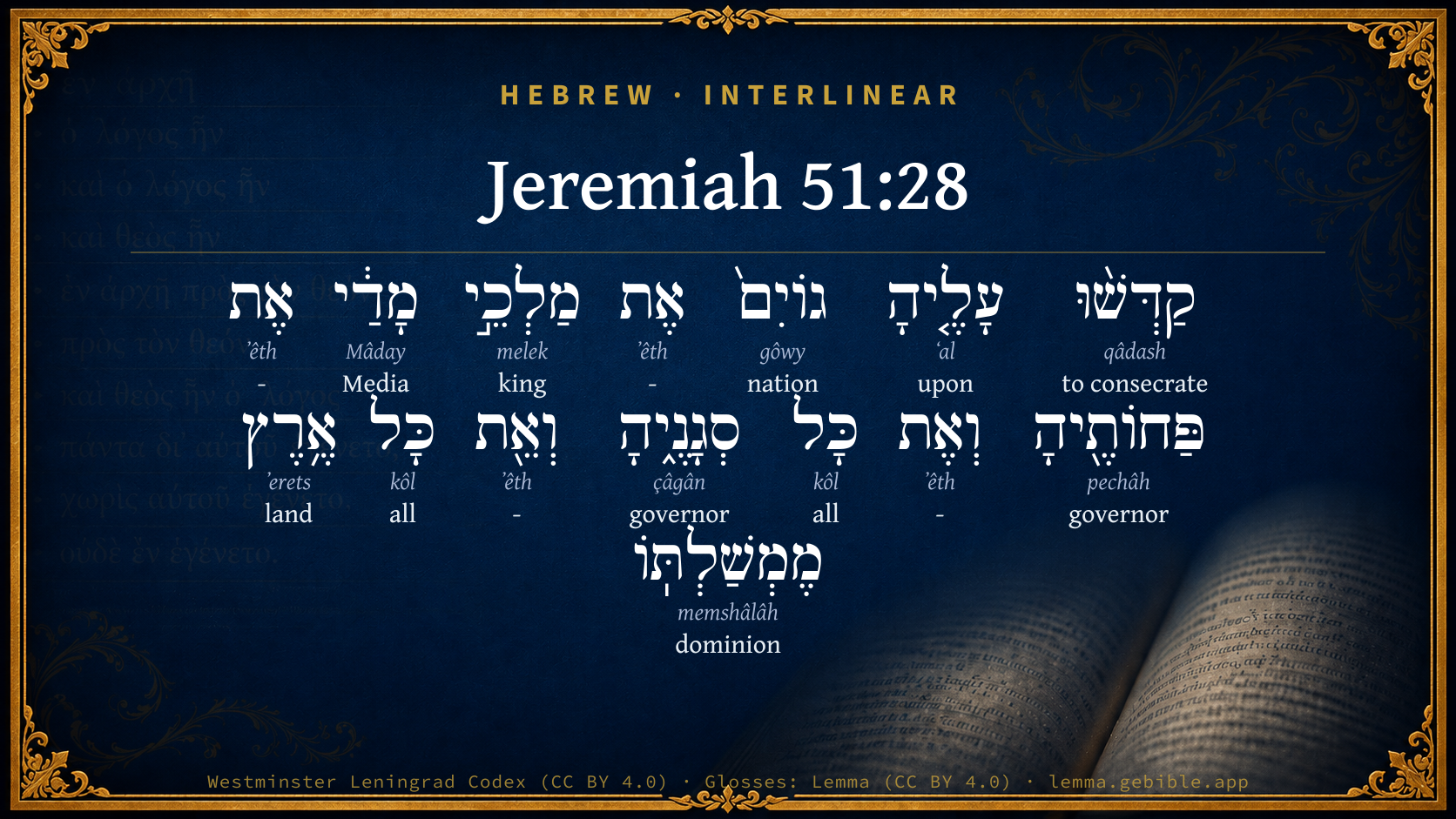
Hebrew (Westminster Leningrad Codex) Jeremiah 51:28 appears in the Hebrew Old Testament. The text above is from the Westminster Leningrad Codex. Each word links to its Strong’s number, a concise gloss, and parsing drawn from the Open Scriptures Hebrew Bible morphology. Click any word for its full Brown-Driver-Briggs (BDB) entry.
Download image
Cite this verse

Jeremiah 51:28 (World English Bible). Public Domain. Lemma interlinear Bible study tool, https://lemma.gebible.app/v/jeremiah/51/28.

Show BibTeX & RIS
BibTeX
RIS
English Translation
Prepare against her the nations, the kings of the Medes, the governors of it, and all the deputies of it, and all the land of their dominion.
World English Bible · Public Domain
Download a study sheet

One document with this verse’s original text, its word-by-word gloss line, the meaning frame, cross-references with their text, attributed commentary, and full source and license credits — printable, and it pastes into notes with its structure intact.

This verse Autodidact and up

Study sheet (.html) Plain text (.txt)

A passage Seminary Student

Up to 50 verses in one chapter. A passage sheet keeps up to 6 commentary sources and 12 cross-references per verse, in the order this page ranks them, and says so on the sheet whenever that leaves anything out. Ask for a single verse and you get the Autodidact verse sheet above.

Everything on this page stays free to read, with no account — the sheet is a download of what is already on screen, not access to it.

Want to remove ads? Support Godless Engineer
Compare translations 3

The same verse in 3 English versions, stacked beneath the original-language interlinear above. Click any original word for its lexicon entry.

Each is an independent rendering of the whole verse — the interlinear is not word-aligned to these translations.

Highlighted words mark where these versions differ — a whole-verse word diff, not a word-by-word alignment.

  • World English Bible Public Domain
    Prepare against her the nations, the kings of the Medes, the governors of it, and all the deputies of it, and all the land of their dominion.
  • King James Version Public Domain
    Prepare against her the nations with the kings of the Medes, the captains thereof, and all the rulers thereof, and all the land of his dominion.
  • unfoldingWord Literal Text CC BY-SA 4.0
    Prepare the nations to attack her: The kings of the Medes and his governors, all of his officials and all the lands under his rule.

unfoldingWord Literal Text — © unfoldingWord, licensed CC BY-SA 4.0. Word-aligned USFM3 via Door43 (git.door43.org/unfoldingWord/en_ult).

Versions to compare (up to 4)

3 of 4 selected

Show all 18 translations

Every available English version of this verse, each an independent rendering of the whole verse.

  • World English Bible Public Domain
    Prepare against her the nations, the kings of the Medes, the governors of it, and all the deputies of it, and all the land of their dominion.
  • Berean Standard Bible Public Domain
    Prepare the nations for battle against her—the kings of the Medes, their governors and all their officials, and all the lands they rule.
  • Majority Standard Bible Public Domain
    Prepare the nations for battle against her—the kings of the Medes, their governors and all their officials, and all the lands they rule.
  • King James Version Public Domain
    Prepare against her the nations with the kings of the Medes, the captains thereof, and all the rulers thereof, and all the land of his dominion.
  • American Standard Version (1901) Public Domain
    Prepare against her the nations, the kings of the Medes, the governors thereof, and all the deputies thereof, and all the land of their dominion.
  • Revised Version (1885) Public Domain
    Prepare against her the nations, the kings of the Medes, the governors thereof, and all the deputies thereof, and all the land of his dominion.
  • Geneva Bible (1599) Public Domain
    Prepare against her the nations with the Kings of the Medes, the dukes thereof, and the princes thereof, and all the land of his dominion.
  • Douay-Rheims (1899) Public Domain
    Prepare the nations against her, the kings of Media, their captains, and all their rulers, and all the land of their dominion.
  • Young's Literal Translation Public Domain
    Sanctify against it the nations with the kings of Media, Its governors and all its prefects, And all the land of its dominion.
  • Literal Standard Version CC BY-SA 4.0
    Sanctify against it the nations with the kings of Media, || Its governors and all its prefects, || And all the land of its dominion.
  • Unlocked Literal Bible CC BY-SA 4.0
    Prepare the nations to attack her: The kings of the Medes and his governors, all of his officials and all the lands under his rule.
  • unfoldingWord Literal Text CC BY-SA 4.0
    Prepare the nations to attack her: The kings of the Medes and his governors, all of his officials and all the lands under his rule.
  • Darby Bible Public Domain
    Prepare nations against her, the kings of the Medes, their governors and all their rulers, yea, all the land of their dominion.
  • World Messianic Bible Public Domain
    Prepare against her the nations, the kings of the Medes, its governors, and all its deputies, and all the land of their dominion!
  • Webster's Bible Public Domain
    Prepare against her the nations with the kings of Media, her captains, and all her rulers, and all the land of his dominion.
  • Free Bible Version CC BY-SA 4.0
    Have the armies of the nations prepare for battle against her. This applies to the kings of the Medes, their leaders and all their officers, and every country they rule.
  • Bible in Basic English Public Domain
    Make the nations ready for war against her, the king of the Medes and his rulers and all his captains, and all the land under his rule.
  • JPS Tanakh (1917) Public Domain
    Prepare against her the nations, the kings of the Medes, the governors thereof, and all the deputies thereof, and all the land of his dominion.

Literal Standard Version (2020), Covenant Press — licensed CC BY-SA 4.0. Text via the HelloAO Bible API (eBible.org). Unlocked Literal Bible (unfoldingWord) — licensed CC BY-SA 4.0. Text via the HelloAO Bible API (eBible.org). unfoldingWord Literal Text — © unfoldingWord, licensed CC BY-SA 4.0. Word-aligned USFM3 via Door43 (git.door43.org/unfoldingWord/en_ult). Free Bible Version, Dr. Jonathan Gallagher — licensed CC BY-SA 4.0. Text via the HelloAO Bible API (eBible.org).

Word by word

More ways to search: Search by grammar → Find every occurrence → Compare this word →

Practice this passage: Drill this verse → Learn its vocabulary →

מֶמְשַׁלְתּֽוֹ
memshâlâh
H4475
“dominion · his”
Noun, Common, Both, Singular, Construct + Suffix, Personal, 3rd Person, Masculine, Singular
Part of Speech
Noun
Type
Common
Gender
Both
Number
Singular
State
Construct
Full BDB Definition

Origin: from H4474

TWOT: 1259c

rule, dominion, realm - rule, dominion, realm, domain - rule - rule, dominion (of God)
  1. קַדְּשׁ֨וּ qâdash H6942 “consecrate” Verb, Piel, Imperative, 2nd Person, Masculine, Plural
  2. עָלֶ֤יהָ ʻal H5921 “upon · her” Preposition + Suffix, Personal, 3rd Person, Feminine, Singular
  3. גוֹיִם֙ gôwy H1471 “nations” Noun, Common, Masculine, Plural, Absolute
  4. אֶת ʼêth H853 “-” Particle, Direct Object
  5. מַלְכֵ֣י melek H4428 “kings of” Noun, Common, Masculine, Plural, Construct
  6. מָדַ֔י Mâday H4074 “Media” Noun, Proper
  7. אֶת ʼêth H853 “-” Particle, Direct Object
  8. פַּחוֹתֶ֖יהָ pechâh H6346 “governors · her” Noun, Common, Masculine, Plural, Construct + Suffix, Personal, 3rd Person, Feminine, Singular
  9. וְאֶת ʼêth H853 “and · -” Conjunction + Particle, Direct Object
  10. כָּל kôl H3605 “all of” Noun, Common, Masculine, Singular, Construct
  11. סְגָנֶ֑יהָ çâgân H5461 “governors · her” Noun, Common, Masculine, Plural, Construct + Suffix, Personal, 3rd Person, Feminine, Singular
  12. וְאֵ֖ת ʼêth H853 “and · -” Conjunction + Particle, Direct Object
  13. כָּל kôl H3605 “all of” Noun, Common, Masculine, Singular, Construct
  14. אֶ֥רֶץ ʼerets H776 “land of” Noun, Common, Both, Singular, Construct

About this verse

These counts appear in no published source. They are computed here, from the morphology-tagged text and Lemma’s own curated glosses. What Lemma adds →

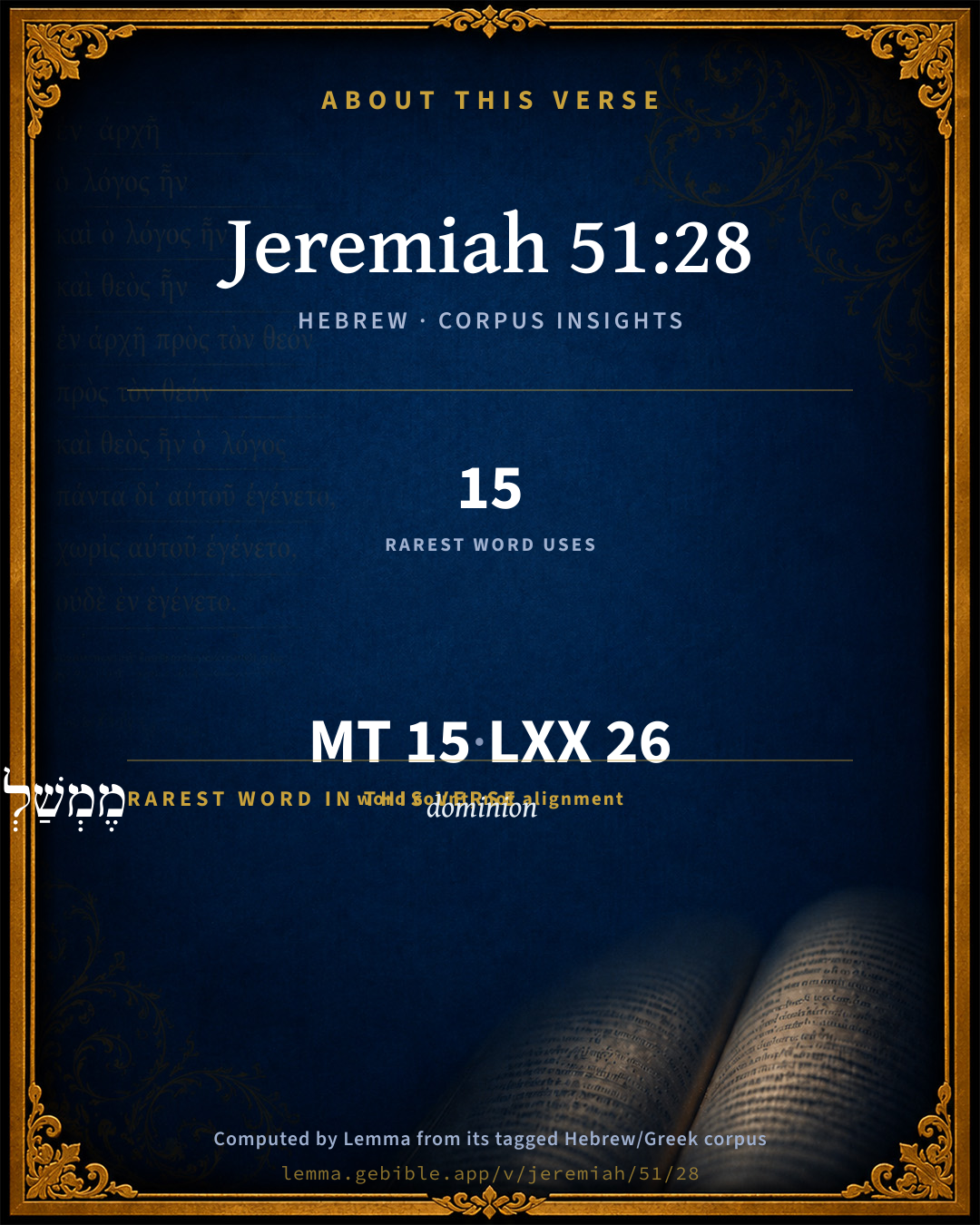
15
words
11
distinct lemmas
Prophets
section

Notable vocabulary

The rarest word here is מֶמְשַׁלְתּֽוֹ dominion H4475 — appearing just 15 times in the whole Hebrew Bible.

Shared distinctive vocabulary

מֶמְשַׁלְתּֽוֹ dominion H4475 occurs in 14 verses of the Hebrew Bible. Also found in:

Grammatical profile

  • 1 verb
  • 9 nouns
  • 1 preposition
  • 4 particles

Verb forms

  • קַדְּשׁ֨וּ Piel · Imperative

Repetition

A word recurs within this verse — often emphatic in Hebrew:

Hebrew & Septuagint length

In the original languages it is 15 Hebrew tokens and 26 Greek tokens — but the two are counted differently (Hebrew bundles its prefixes and suffixes into one token; the Greek is in lemma form), so that isn’t a like-for-like length.

Cross-references

14

Topical passages linked to Jeremiah 51:28 in the Treasury of Scripture Knowledge — connected by theme and wording, ordered by reader-vote popularity; previews shown in the World English Bible.

  • Jeremiah 51:11 Make sharp the arrows; hold firm the shields: Yahweh has stirred up the spirit of the kings of the Medes; because his purpose is against Babylon, to destroy it: for it is the vengeance of Yahweh, the vengeance of his temple.
  • Jeremiah 25:25 and all the kings of Zimri, and all the kings of Elam, and all the kings of the Medes;
  • Genesis 10:2 The sons of Japheth: Gomer, Magog, Madai, Javan, Tubal, Meshech, and Tiras.
  • 1 Chronicles 1:5 The sons of Japheth: Gomer, and Magog, and Madai, and Javan, and Tubal, and Meshech, and Tiras.
  • Esther 1:3 in the third year of his reign, he made a feast to all his princes and his servants; the power of Persia and Media, the nobles and princes of the provinces, being before him;
  • Esther 10:2 All the acts of his power and of his might, and the full account of the greatness of Mordecai, whereunto the king advanced him, aren't they written in the book of the chronicles of the kings of Media and Persia?
  • Isaiah 13:17 Behold, I will stir up the Medes against them, who shall not regard silver, and as for gold, they shall not delight in it.
  • Isaiah 21:2 A grievous vision is declared to me; the treacherous man deals treacherously, and the destroyer destroys. Go up, Elam; besiege, Media; all the sighing of it have I made to cease.
  • Jeremiah 51:27 Set up a standard in the land, blow the trumpet among the nations, prepare the nations against her, call together against her the kingdoms of Ararat, Minni, and Ashkenaz: appoint a marshal against her; cause the horses to come up as the rough canker-worm.
  • Daniel 5:28–30 PERES; your kingdom is divided, and given to the Medes and Persians.
  • Daniel 6:8 Now, O king, establish the interdict, and sign the writing, that it not be changed, according to the law of the Medes and Persians, which doesn't alter.
  • Daniel 8:3–4 Then I lifted up my eyes, and saw, and, behold, there stood before the river a ram which had two horns: and the two horns were high; but one was higher than the other, and the higher came up last.
  • Daniel 8:20 The ram which you saw, that had the two horns, they are the kings of Media and Persia.
  • Daniel 9:1 In the first year of Darius the son of Ahasuerus, of the seed of the Medes, who was made king over the realm of the Chaldeans,

Cross-references courtesy of OpenBible.info (CC BY 4.0).

Hebrew and Greek witnesses Masoretic Hebrew ↔ Greek Septuagint

The same verse in the two great witnesses to the Old Testament, shown verse-for-verse.

These are two independent witnesses, not word-aligned to each other, and the Septuagint is shown in lemma (dictionary) form.

Hebrew Jeremiah 51:28 Masoretic · Westminster Leningrad Codex

קַדְּשׁ֨וּ עָלֶ֤יהָ גוֹיִם֙ אֶת מַלְכֵ֣י מָדַ֔י אֶת פַּחוֹתֶ֖יהָ וְאֶת כָּל סְגָנֶ֑יהָ וְאֵ֖ת כָּל אֶ֥רֶץ מֶמְשַׁלְתּֽוֹ

Prepare against her the nations, the kings of the Medes, the governors of it, and all the deputies of it, and all the land of their dominion.

World English Bible · Public Domain

Greek LXX Structure differs

In the Septuagint, Jeremiah is about an eighth shorter than the Hebrew and arranges its material differently — the Oracles Against the Nations (Hebrew chapters 46–51) appear in the middle of the Greek book, after 25:13. Because the chapter and verse boundaries do not line up, a verse-for-verse comparison with the Hebrew is not shown.

A verse-for-verse comparison isn’t shown here because the chapters and verses don’t line up. Switch to the LXX edition with the MT / LXX toggle above to read the Greek directly.

On this verse, The Cambridge Bible for Schools and Colleges discusses the Septuagint’s reading. Read the note in Commentary ↓

Hebrew: Westminster Leningrad Codex (CC BY 4.0). Greek: Septuagint (public domain); English from a public-domain English Septuagint. How the Septuagint differs from the Hebrew →

Targum (Aramaic paraphrase)

1

The Targum is the ancient Jewish Aramaic paraphrase of the Hebrew Scriptures — an interpretive translation, not the Hebrew text itself. Onkelos (literal) and Pseudo-Jonathan (expansive) render the Torah, and Jonathan the Prophets. Coverage is partial: where no permissively-licensed English translation exists for a verse, only the Aramaic is shown. This is verse-level text, not a word-by-word alignment to the Hebrew.

  1. Targum Jonathan Prophets (Joshua–Malachi)
    זַמִינוּ עֲלָהּ עַמְמַיָא יַת מַלְכֵי מָדָי יַת שִׁלְטוֹנָהָא וְיַת כָּל טוּרְנָהָא וְיַת כָּל אֲרַע שׁוּלְטָנֵיהּ:

    (no public-domain English translation for this verse)

    Targum Jonathan — Aramaic: “Mikraot Gedolot” (public domain). English: “Sefaria Community Translation” (CC0 1.0 (public-domain dedication)); “London "Chaldee Paraphrase," 1871” (public domain). Text via Sefaria.

Commentary

Notes on Jeremiah 51:28 from classic Christian and Jewish commentators (each source and its license shown beneath its notes). The classic Christian expositions comment on the surrounding passage and are grouped to its opening verse, so a note may address several verses; the Jewish commentaries on the Tanakh (Rashi and others) are per-verse, so they appear only where the commentator wrote on this verse.

Lemma curates 59 commentaries, every one of them public domain or Creative Commons licensed, each selected and text-cleaned for this edition rather than reprinted as found. About our sources →

Trapp's Complete Commentary

John Trapp

Jer 51:28 Prepare against her the nations with the kings of the Medes, the captains thereof, and all the rulers thereof, and all the land of his dominion.

Ver. 28. Prepare against her.] Heb., Sanctify. {as Jer 51:27}

With the kings of the Medes.] Darius and Cyrus.

John Trapp, A Commentary or Exposition upon All the Books of the Old and New Testament (1647–1656) — public domain. Text from a community e-Sword module.

Jamieson, Fausset & Brown

Robert Jamieson, A. R. Fausset & David Brown

kings of . . . Medes-- (Jer 51:11). The satraps and tributary kings under Darius, or Cyaxares.

his dominion--the king of Media's dominion.

land shall tremble . . . every purpose of . . . Lord shall be performed--elegant antithesis between the trembling of the land or earth, and the stability of "every purpose of the Lord" (compare Psa 46:1-3).

Jamieson, Fausset & Brown — Commentary Critical and Explanatory on the Whole Bible (1871) — public domain (CC PDM 1.0). Text via the HelloAO Bible API.

John Calvin's Commentaries

He now repeats what he had said of preparing the nations; but he mentions them first generally, and then he comes to specify them particularly. He then bids the nations to be sent for, and then he shows who they were, even the kingdoms of the Medes There was, indeed, but one kingdom, but many kings were subject to it. Then, on account of the many provinces over which satraps ruled, and also on account of many tributary countries, the Prophet was not satisfied to use the singular number, but calls them in the plural number, the kingdoms of the Medes; for that monarchy had extended itself far and wide, so that many kings were subject to Darius.

And it tended, in no small degree, to show the certainty of this prophecy, that Jeremiah declared, before Cyrus or even Darius was born, that the Medes would come. But we have stated, that though Cyrus, being singularly active and a good warrior, carried on the war, yet Darius was the first in authority. Then Babylon obeyed the Medes for a time; but as Darius was now old, Cyrus succeeded him; and then the monarchy was transferred to Persia; and laws issued thence until the time of Alexander the Great, who, together with his catamite, burnt the tower. Nor is there a doubt but that many memorable transactions were deposited there. But Alexander being drunk, seized a torch and burnt the tower; for he thought that the memory of the Oriental monarchy could thus be abolished.

We now then perceive why the Prophet expressly mentions here the Medes; and he adds, the captains and princes He includes, no doubt, under these names, all the satraps and kings. At length he adds, the whole land of its dominion, or jurisdiction; and by this word he designates the kingdoms already mentioned. It now follows, —

John Calvin's Commentaries (1540-1563) — public domain. Text from the Calvin Translation Society English edition (1840s-50s) via the Christian Classics Ethereal Library (ccel.org). Calvin's coverage is partial (roughly two-thirds of the Bible); uncommented books and verses are honest gaps, never fabricated. The 19th-century editor's footnotes and remarks are omitted so the notes are faithfully Calvin's own voice.

Ellicott's Commentary for English Readers

(28) All the land of his dominion.—The use of the singular pronoun indicates that the prophet recognises the fact that the kings, captains, and rulers (see Note on Jer_51:23) are all under one sovereign leader—i.e., under the king of the Medes and Persians.

A Bible Commentary for English Readers, edited by Charles John Ellicott (1878–1897) — public domain. Text from a community e-Sword module.

The Cambridge Bible for Schools and Colleges

gen. ed. J. J. S. Perowne

28. Prepare] See on Jer_51:27.

kings] Read king, with LXX (cp. Jer_51:11). Cyrus is meant.

governors … deputies] See on Jer_51:23.

The Cambridge Bible for Schools and Colleges (gen. ed. J. J. S. Perowne; Cambridge University Press, 1878–1918) — public domain. Text from a community e-Sword module.

John Gill's Exposition

The mighty men of Babylon have forborne to fight,.... Or, "ceased from fighting" (h) for it seems, upon Cyrus's first coming, the king of Babylon and his army gave him battle; but being overthrown, they retired to the city (i), and dared never fight more:

they have remained in their holds; in the towers and fortresses of Babylon, never daring to sally out of the city, or appear in the field of battle any more; even though Cyrus sent the king of Babylon a personal challenge, to end the quarrel by a single combat (k):

their might hath failed; their courage sunk and was gone; they had no heart to face their enemy:

they became as women; as weak as they, as the Targum; timorous and fearful, having no courage left in them, and behaved more like women than men:

they have burnt her dwelling places; that is, the enemy burnt their houses, when they entered into the city, to inject terror into them:

her bars are broken; the bars of the gates of the city, or of the palaces of the king and nobles, and of the houses of the people, by the soldiers, to get the plunder; see Isa 45:1.

(h) "cessaverunt a praelio", V. L. "desinent pugnare", Junius & Tremellius, Piscator; "cessarunt pugnare", Schmidt. So Pagninus, Montanus. (i) Xenophon, Cyropaedia, l. 5. c. 19. Herodot. l. 1. sive Clio. c. 190. (k) Xenophon, ib. l. 5. c. 10.

John Gill's Exposition of the Whole Bible (1746–1763) — public domain (CC PDM 1.0). Text via the HelloAO Bible API.

Albert Barnes' Notes on the Bible

His dominion - This belonged not to the subordinate rulers, but to the chief, e. g., to Cyrus.

Albert Barnes' Notes on the Bible (1834–1885) — public domain. Text from a community e-Sword/MySword module.

Haydock's Catholic Bible Commentary

Prepare; "sanctify." (Haydock) --- Media. Cyrus, ver. 11. --- Captains: generals. (Calmet) --- Rulers. Literally, "magistrates." (Haydock) --- Hebrew Seganim, a title used once by Isaias, and frequently by those who wrote after the Assyrians (Calmet) commenced their invasion. (Haydock)

George Leo Haydock (1774–1849), Haydock's Catholic Family Bible and Commentary, 1859 edition — public domain. Excludes Psalms (Douay-Rheims chapter numbering differs from Protestant) and Deuterocanonical books (Catholic canon only).

Matthew Poole's English Annotations

Here the prophet declares those particular princes and nations that should be God’s instruments to destroy Babylon, viz. Cyrus and Darius, the emperors of the Medes, with all the forces under their command, and people under their dominion.

Matthew Poole's English Annotations on the Holy Bible (1683–1685) — public domain. Text from a community e-Sword/MySword module.

The Pulpit Commentary

The captains... the rulers; rather, the governors... the viceroys (as ver. 23). Thereof refers to the land of Medea; his dominion to the King of Medea, as the suzerain of the inferior chiefs.

The Pulpit Commentary (1880–1919), ed. H.D.M. Spence-Jones & Joseph S. Exell — public domain. Text from a community e-Sword module.

Lesson kit

Teaching starters — assembled from the data on this page, not authored interpretation. Every prompt links to the verse data it draws on. Edit before teaching.

Jeremiah, in the Prophets, opens this verse with 15 words (11 distinct Hebrew lemmas). Its most distinctive word is memshâlâh (“dominion”). A historical commentator’s framing appears above. Read the whole chapter for the surrounding context.

Discussion questions

  1. What does “dominion” (memshâlâh) contribute to the verse as a whole?
  2. How does Genesis 1:16, which shares the word «dominion», read alongside this verse?
  3. What does the repetition of “all” (2× in this one verse) do in this verse?
  4. These translations render this verse differently. What is at stake in choosing one wording over another?
  5. «קַדְּשׁ֨וּ» is a Piel Imperative verb. How does that grammatical form shape the action described?
  6. Compare how Trapp's Complete Commentary and Jamieson, Fausset & Brown read this verse. Where do they agree or differ?

Things to notice

Reading settings

Reading text

Shown beneath each verse's original-language words.

Old Testament
Old Testament edition

Read the OT as the Masoretic Hebrew (MT) or the Greek Septuagint (LXX).

English shown for the Greek Septuagint (in the Hebrew ↔ Greek comparison).

Comparing translations? Open the Compare panel on any verse page to stack up to four side by side.