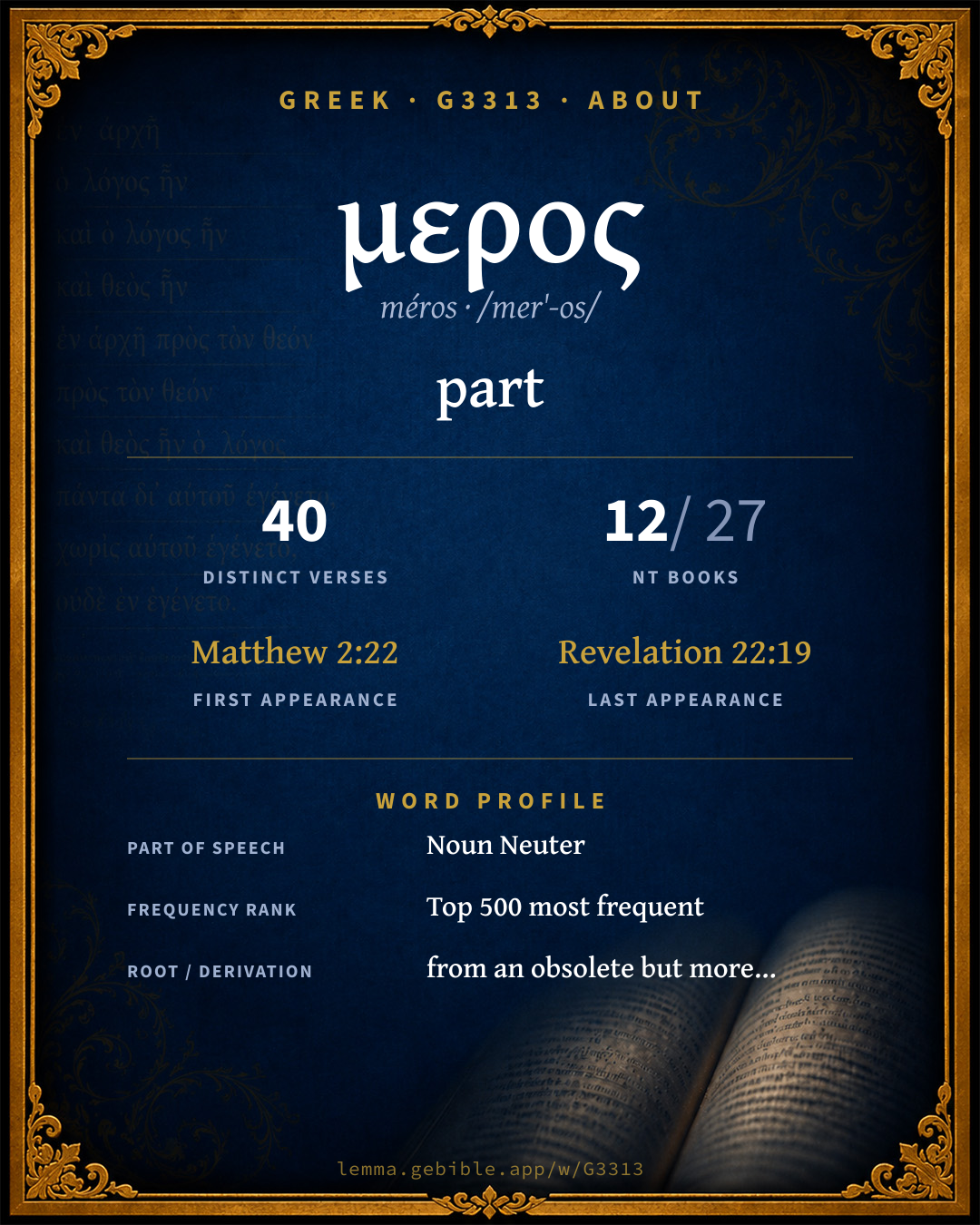
μέρος
part
‘part’ is one of 3 main senses fuller range ↓
Full lexicon entry — Thayer's Greek Lexicon
From Thayer's Greek Lexicon
Where this word appears
See every Accusative-case word in the Greek New Testament →
Grammar key — what these labels mean
Part of speech
- Noun
- A naming word — a person, place, thing, or idea.
Case
- Accusative
- The case of the direct object and of extent.
- Genitive
- The case of source, possession, or “of” — answers “whose / from what.”
- Dative
- The case of the indirect object, means, or location — “to / for / with / in.”
- Nominative
- The case of the subject (and the predicate nominative).
Gender
- Neuter
- Grammatically neuter.
Number
- Singular
- One.
- Plural
- More than one.
Every verse where G3313 appears in the Book of Acts — 7 distinct verses. Click any verse to open its interlinear word-by-word view. Verse text shown in the World English Bible for context — . Each verse’s Greek form is shown with its reference; the English is not keyword-highlighted, since the data carries no word-level English alignment. Use “Compare translations” on any verse to read it across multiple English versions. This concordance covers the Greek New Testament; Septuagint (Greek Old Testament) occurrences of this word are not indexed here.
Acts
- Acts 2:10 μέρη n acc pl neut Phrygia, Pamphylia, Egypt, the parts of Libya around Cyrene, visitors from Rome, both Jews and proselytes,
- Acts 5:2 μέρος n acc sg neut and kept back part of the price, his wife also being aware of it, and brought a certain part, and laid it at the apostles' feet.
- Acts 19:1 μέρη n acc pl neut It happened that, while Apollos was at Corinth, Paul, having passed through the upper country, came to Ephesus, and found certain disciples.
- Acts 19:27 μέρος n acc sg neut Not only is there danger that this our trade come into disrepute, but also that the temple of the great goddess Artemis will be counted as nothing, and her majesty destroyed, whom all Asia and the world worships."
- Acts 20:2 μέρη n acc pl neut When he had gone through those parts, and had encouraged them with many words, he came into Greece.
- Acts 23:6 μέρος n nom sg neut But when Paul perceived that the one part were Sadducees and the other Pharisees, he cried out in the council, "Men and brothers, I am a Pharisee, a son of Pharisees. Concerning the hope and resurrection of the dead I am being judged!"
- Acts 23:9 μέρους n gen sg neut A great clamor arose, and some of the scribes of the Pharisees part stood up, and contended, saying, "We find no evil in this man. But if a spirit or angel has spoken to him, let's not fight against God!"
About this entry
At a glance — auto-summarized from this page’s data, not written by a person. Every figure links to its source below. This summary describes the numbers; it doesn’t interpret them.
“part” is the headline sense of the Greek noun μερος (méros). Its earliest occurrence is Matthew 2:22. The Greek New Testament uses it across 40 verses — moderately common. Lexicons map it across 3 senses. Related forms include μεριζω, μερις and μορφη. The sections below give every sense, occurrence, and version rendering.
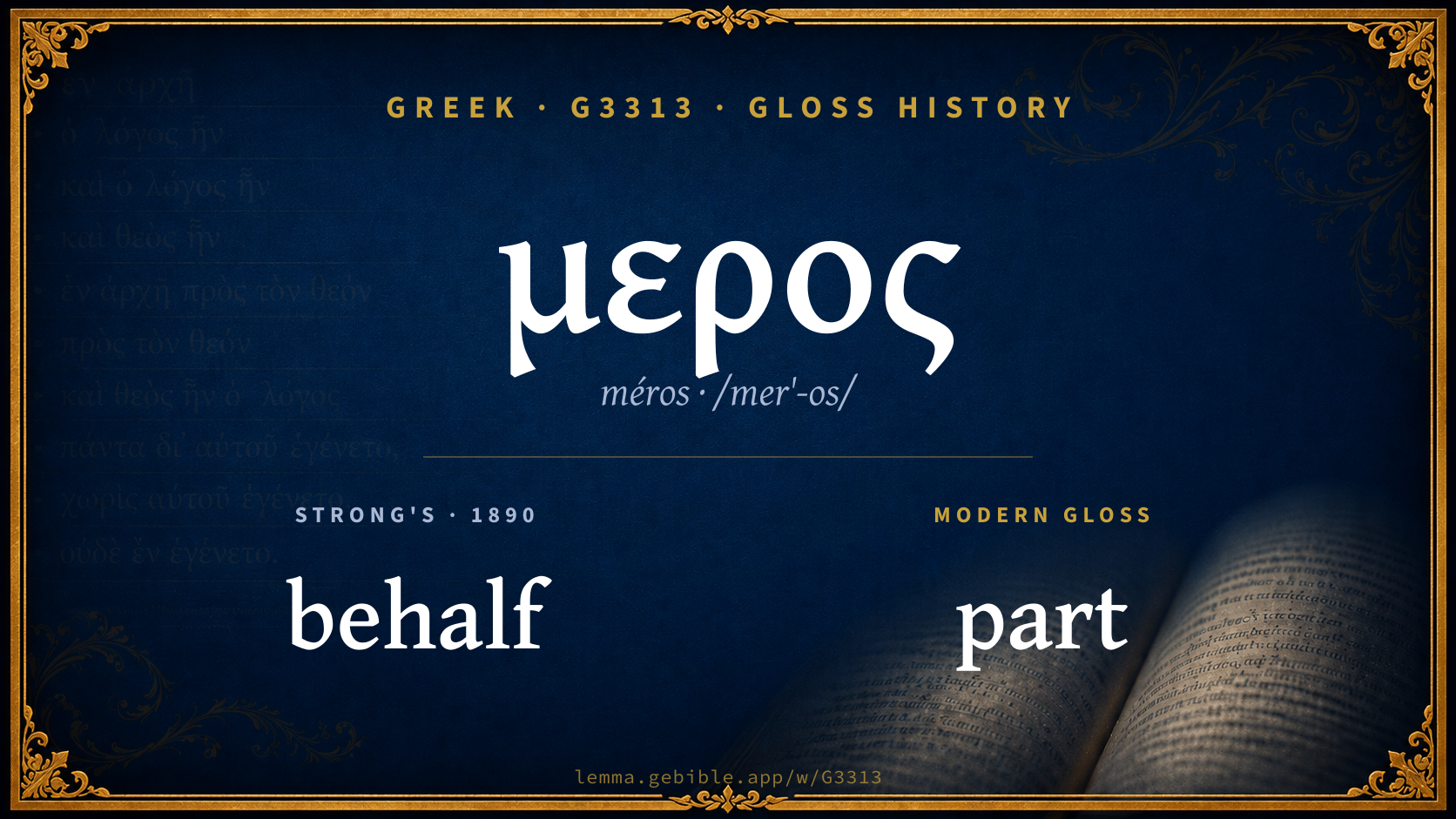
Gloss history
Strong's 1890 vs modern scholarship
About this word
Strong's G3313 catalogs a Greek word from the Greek New Testament.
These counts are not copied from any lexicon or concordance. They are computed here, from the morphology-tagged Greek New Testament. What Lemma adds →
- 40
- distinct verses
- The word appears in 40 distinct verses.
- 12 / 27
- NT books
- The word appears in 12 of 27 New Testament books.
- #356
- by frequency
- Top 500 most frequent Greek words (rank 356 of 5,347 Greek words by occurrence).
View all 40 occurrences in the concordance →
Most concentrated in
- Acts 7 verses 18%
- 1 Corinthians 6 verses 15%
- Matthew 4 verses 10%
By section of the New Testament
By traditional corpus
Conventional, traditional groupings — biblical authorship is debated, so this is a traditional corpus grouping, not an authorship claim. Some books belong to more than one corpus (Luke is in both the Gospels and the Lukan corpus, and so on), so these shares overlap and need not total 100%. Each figure is a share of the word’s 40 distinct verses.
- Pauline corpus 16 verses · 40%
- Gospels 12 verses · 30%
- Lukan (Luke–Acts) 11 verses · 28%
- Johannine 7 verses · 18%
- Revelation 4 verses · 10%
- Hebrews 1 verse · 3%
How translations render this word
Counts come from each version’s own published word-to-Strong’s tagging or interlinear alignment — an approximate guide to how each version renders this word, not a word-level alignment the data otherwise carries. Because each total is that version’s own tagged count, the per-version totals vary from one another and need not match the appearance or distinct-verse counts above. These counts may also differ from a printed concordance because Lemma counts each distinctly tagged rendering and does not collapse phrase taggings into a single head-word total. This is a fixed set of word-tagged versions (KJV, ASV, BSB, ULT) and does not change with the reading translation you choose elsewhere. Each version’s license is shown beside its name below (and on Sources).
- King James Version: Part 16×, Parts 7×, Coasts 3×
- American Standard Version: Part 16×, Parts 8×, Portion 3×
- Berean Standard Bible: Part 9×, Parts 4×, District 3×
- unfoldingWord Literal Text: Part 12×, Regions 5×, Parts 3×
King James Version Public Domain
Renders G3313 across 41 tagged occurrences — most commonly:
Plus 8 renderings that appear only once — usually multi-word phrases or single function words the recovered tagging swept in, not distinct renderings. Not rendered by a distinct English word in 2 further occurrences.
American Standard Version Public Domain
Renders G3313 across 42 tagged occurrences — most commonly:
Plus 12 renderings that appear only once — usually multi-word phrases or single function words the recovered tagging swept in, not distinct renderings.
Berean Standard Bible Public Domain
Renders G3313 across 38 tagged occurrences — most commonly:
Plus 17 renderings that appear only once — usually multi-word phrases or single function words the recovered tagging swept in, not distinct renderings. Not rendered by a distinct English word in 4 further occurrences.
unfoldingWord Literal Text CC BY-SA 4.0
Renders G3313 across 44 tagged occurrences — most commonly:
Plus 14 renderings that appear only once — usually multi-word phrases or single function words the recovered tagging swept in, not distinct renderings.
Senses in Thayer's
The 3 senses Thayer's distinguishes for this word, in lexicon order (not ranked by frequency or importance). The full entry — with sub-senses — is in the Lexicon Entry tab.
- a part due or assigned to one
- lot, destiny
- one of the constituent parts of a whole
Word origin
Origin: from an obsolete but more primary form of meiromai (to get as a section or allotment)
From an obsolete but more primary form of μείρομαι meiromai (to get as a section or allotment ); a division or share (literally or figuratively in a wide application): - behalf coast course craft particular (+ -ly) part (+ -ly) piece portion respect side some sort (-what).
— Strong’s Exhaustive Concordance (1890), public domain.
Forms in the corpus
The 4 distinct written forms G3313 takes in the Greek New Testament, most frequent first — each parse links to that case’s occurrences in the concordance.
| Form | Parsing | Example | Uses |
|---|---|---|---|
| μέρος méros | Noun, Accusative, Singular, Neuter | Matthew 24:51 | 16 |
| μέρους mérous | Noun, Genitive, Singular, Neuter | Acts 23:9 | 12 |
| μέρη mérē | Noun, Accusative, Plural, Neuter | Matthew 2:22 | 11 |
| μέρει mérei | Noun, Dative, Singular, Neuter | 2 Corinthians 3:10 | 3 |
Same root — word family
Other Thayer's entries built from the same root as G3313, grouped by Strong’s listed origin. These share a root / origin per the lexicon — not necessarily a shared meaning. Each links to that word’s own entry.
Derived from this word
Compare all same-root words → They share a root, not necessarily a meaning.
Septuagint usage
The same Greek word μερος appears 107 times in the Greek Old Testament (Septuagint), across 91 verses in 18 books.
- 107
- LXX occurrences
- Tagged occurrences of this Greek word in the Septuagint.
- 91
- verses
- Distinct Septuagint verses containing this word.
- 18 / 39
- OT books
- The word appears in 18 of the 39 Old Testament books.
Sample Septuagint occurrences
- Genesis 23:9 μέρος
- Exodus 16:35 μέρος
- Numbers 8:2 μέρος
- Joshua 2:18 μέρος
- 1 Samuel 6:8 μέρος
- 2 Samuel 13:34 μέρος
- 1 Kings 2:46 μέρος
- 2 Kings 7:5 μέρος
- 2 Chronicles 36:7 μέρος
- Ezra 4:20 μέρος
- Job 26:14 μέρος
- Proverbs 17:2 μέρος
Septuagint occurrences (same lexeme)
Every verse where the same Strong’s number (G3313) appears in the Greek Septuagint — showing the first 50 of 91. Verse text shown in the World English Bible for context; the Greek form is the matched word — the English is not keyword-highlighted.
- Genesis 23:9 μέρος that he may give me the cave of Machpelah, which he has, which is in the end of his field. For the full price let him give it to me in the midst of you for a possession of a burying-place."
- Genesis 47:24 μέρος It will happen at the harvests, that you shall give a fifth to Pharaoh, and four parts will be your own, for seed of the field, for your food, for them of your households, and for food for your little ones."
- Exodus 16:35 μέρος The children of Israel ate the manna forty years, until they came to an inhabited land. They ate the manna until they came to the borders of the land of Canaan.
- Exodus 25:26 μέρος You shall make four rings of gold for it, and put the rings in the four corners that are on its four feet.
- Exodus 26:4 μέρος You shall make loops of blue on the edge of the one curtain from the edge in the coupling; and likewise shall you make in the edge of the curtain that is outmost in the second coupling.
- Exodus 26:5 μέρος You shall make fifty loops in the one curtain, and you shall make fifty loops in the edge of the curtain that is in the second coupling. The loops shall be opposite one to another.
- Exodus 26:19 μέρος You shall make forty sockets of silver under the twenty boards; two sockets under one board for its two tenons, and two sockets under another board for its two tenons.
- Exodus 26:21 μέρος and their forty sockets of silver; two sockets under one board, and two sockets under another board.
- Exodus 26:22 μέρος For the far part of the tent westward you shall make six boards.
- Exodus 26:25 μέρος There shall be eight boards, and their sockets of silver, sixteen sockets; two sockets under one board, and two sockets under another board.
- Exodus 26:26 μέρος "You shall make bars of acacia wood: five for the boards of the one side of the tent,
- Exodus 26:35 μέρος You shall set the table outside the veil, and the lampstand over against the table on the side of the tent toward the south: and you shall put the table on the north side.
- Exodus 28:7 μέρος It shall have two shoulder-pieces joined to the two ends of it, that it may be joined together.
- Exodus 32:15 μέρος Moses turned, and went down from the mountain, with the two tablets of the testimony in his hand; tablets that were written on both their sides; on the one side and on the other they were written.
- Exodus 36:11 μέρος He made loops of blue on the edge of the one curtain from the edge in the coupling. Likewise he made in the edge of the curtain that was outmost in the second coupling.
- Exodus 36:24 μέρος He made forty sockets of silver under the twenty boards; two sockets under one board for its two tenons, and two sockets under another board for its two tenons.
- Exodus 38:14 μέρος The hangings for the one side were fifteen cubits; their pillars three, and their sockets three;
- Exodus 38:24 μέρος All the gold that was used for the work in all the work of the sanctuary, even the gold of the offering, was twenty-nine talents, and seven hundred thirty shekels, after the shekel of the sanctuary.
- Numbers 8:2 μέρος "Speak to Aaron, and tell him, 'When you light the lamps, the seven lamps shall give light in front of the lampstand.'"
- Numbers 8:3 μέρος Aaron did so. He lit its lamps to light the area in front of the lampstand, as Yahweh commanded Moses.
- Numbers 11:1 μέρος The people were as murmurers, [speaking] evil in the ears of Yahweh: and when Yahweh heard it, his anger was kindled; and the fire of Yahweh burnt among them, and devoured in the uttermost part of the camp.
- Numbers 20:16 μέρος and when we cried to Yahweh, he heard our voice, and sent an angel, and brought us forth out of Egypt: and, behold, we are in Kadesh, a city in the uttermost of your border.
- Numbers 22:36 μέρος When Balak heard that Balaam was come, he went out to meet him to the City of Moab, which is on the border of the Arnon, which is in the utmost part of the border.
- Numbers 22:41 μέρος It happened in the morning, that Balak took Balaam, and brought him up into the high places of Baal; and he saw from there the utmost part of the people.
- Numbers 23:13 μέρος Balak said to him, Please come with me to another place, from whence you may see them; you shall see but the utmost part of them, and shall not see them all: and curse me them from there.
- Numbers 33:6 μέρος They traveled from Succoth, and encamped in Etham, which is in the edge of the wilderness.
- Numbers 34:3 μέρος then your south quarter shall be from the wilderness of Zin along by the side of Edom, and your south border shall be from the end of the Salt Sea eastward;
- Joshua 2:18 μέρος Behold, when we come into the land, you shall bind this line of scarlet thread in the window which you did let us down by: and you shall gather to you into the house your father, and your mother, and your brothers, and all your father's household.
- Joshua 3:8 μέρος You shall command the priests who bear the ark of the covenant, saying, When you are come to the brink of the waters of the Jordan, you shall stand still in the Jordan.
- Joshua 3:15 μέρος and when those who bore the ark were come to the Jordan, and the feet of the priests who bore the ark were dipped in the brink of the water (for the Jordan overflows all its banks all the time of harvest),
- Joshua 3:16 μέρος that the waters which came down from above stood, and rose up in one heap, a great way off, at Adam, the city that is beside Zarethan; and those that went down toward the sea of the Arabah, even the Salt Sea, were wholly cut off: and the people passed over right against Jericho.
- Joshua 4:19 μέρος The people came up out of the Jordan on the tenth day of the first month, and encamped in Gilgal, on the east border of Jericho.
- Joshua 12:2 μέρος Sihon king of the Amorites, who lived in Heshbon, and ruled from Aroer, which is on the edge of the valley of the Arnon, and [the city that is in] the middle of the valley, and half Gilead, even to the river Jabbok, the border of the children of Ammon;
- Joshua 13:27 μέρος and in the valley, Beth Haram, and Beth Nimrah, and Succoth, and Zaphon, the rest of the kingdom of Sihon king of Heshbon, the Jordan and the border [of it], to the uttermost part of the sea of Chinnereth beyond the Jordan eastward.
- Joshua 15:2 μέρος Their south border was from the uttermost part of the Salt Sea, from the bay that looks southward;
- Joshua 15:5 μέρος The east border was the Salt Sea, even to the end of the Jordan. The border of the north quarter was from the bay of the sea at the end of the Jordan;
- Joshua 15:8 μέρος and the border went up by the valley of the son of Hinnom to the side of the Jebusite southward (the same is Jerusalem); and the border went up to the top of the mountain that lies before the valley of Hinnom westward, which is at the uttermost part of the valley of Rephaim northward;
- Joshua 18:14 μέρος The border extended [there], and turned about on the west quarter southward, from the mountain that lies before Beth Horon southward; and the goings out of it were at Kiriath Baal (the same is Kiriath Jearim), a city of the children of Judah: this was the west quarter.
- Joshua 18:15 μέρος The south quarter was from the uttermost part of Kiriath Jearim; and the border went out westward, and went out to the spring of the waters of Nephtoah;
- Joshua 18:16 μέρος and the border went down to the uttermost part of the mountain that lies before the valley of the son of Hinnom, which is in the valley of Rephaim northward; and it went down to the valley of Hinnom, to the side of the Jebusite southward, and went down to En Rogel;
- Joshua 18:19 μέρος and the border passed along to the side of Beth Hoglah northward; and the goings out of the border were at the north bay of the Salt Sea, at the south end of the Jordan: this was the south border.
- Joshua 18:20 μέρος The Jordan was the border of it on the east quarter. This was the inheritance of the children of Benjamin, by the borders of it round about, according to their families.
- 1 Samuel 6:8 μέρος and take the ark of Yahweh, and lay it on the cart; and put the jewels of gold, which you return him for a trespass-offering, in a coffer by the side of it; and send it away, that it may go.
- 1 Samuel 9:27 μέρος As they were going down at the end of the city, Samuel said to Saul, Bid the servant pass on before us (and he passed on), but stand you still first, that I may cause you to hear the word of God.
- 1 Samuel 23:26 μέρος Saul went on this side of the mountain, and David and his men on that side of the mountain: and David made haste to get away for fear of Saul; for Saul and his men compassed David and his men round about to take them.
- 1 Samuel 30:14 μέρος We made a raid on the South of the Cherethites, and on that which belongs to Judah, and on the South of Caleb; and we burned Ziklag with fire.
- 2 Samuel 13:34 μέρος But Absalom fled. The young man who kept the watch lifted up his eyes, and looked, and, behold, there came much people by the way of the hill-side behind him.
- 1 Kings 2:46 μέρος So the king commanded Benaiah the son of Jehoiada; and he went out, and fell on him, so that he died. The kingdom was established in the hand of Solomon.
- 1 Kings 5:4 μέρος But now Yahweh my God has given me rest on every side; there is neither adversary, nor evil occurrence.
- 1 Kings 6:24 μέρος Five cubits was the one wing of the cherub, and five cubits the other wing of the cherub: from the uttermost part of the one wing to the uttermost part of the other were ten cubits.
These are occurrences of the same Greek lexeme (G3313) in the Septuagint — not a translation of any one Hebrew word. The store carries no word-level Hebrew↔Greek alignment, so no Hebrew original is asserted here. Counts come from the recovered LXX Strong's tagging — high-frequency vocabulary is well covered, while rare or late forms may be untagged — so they reflect tagged occurrences and may slightly undercount.