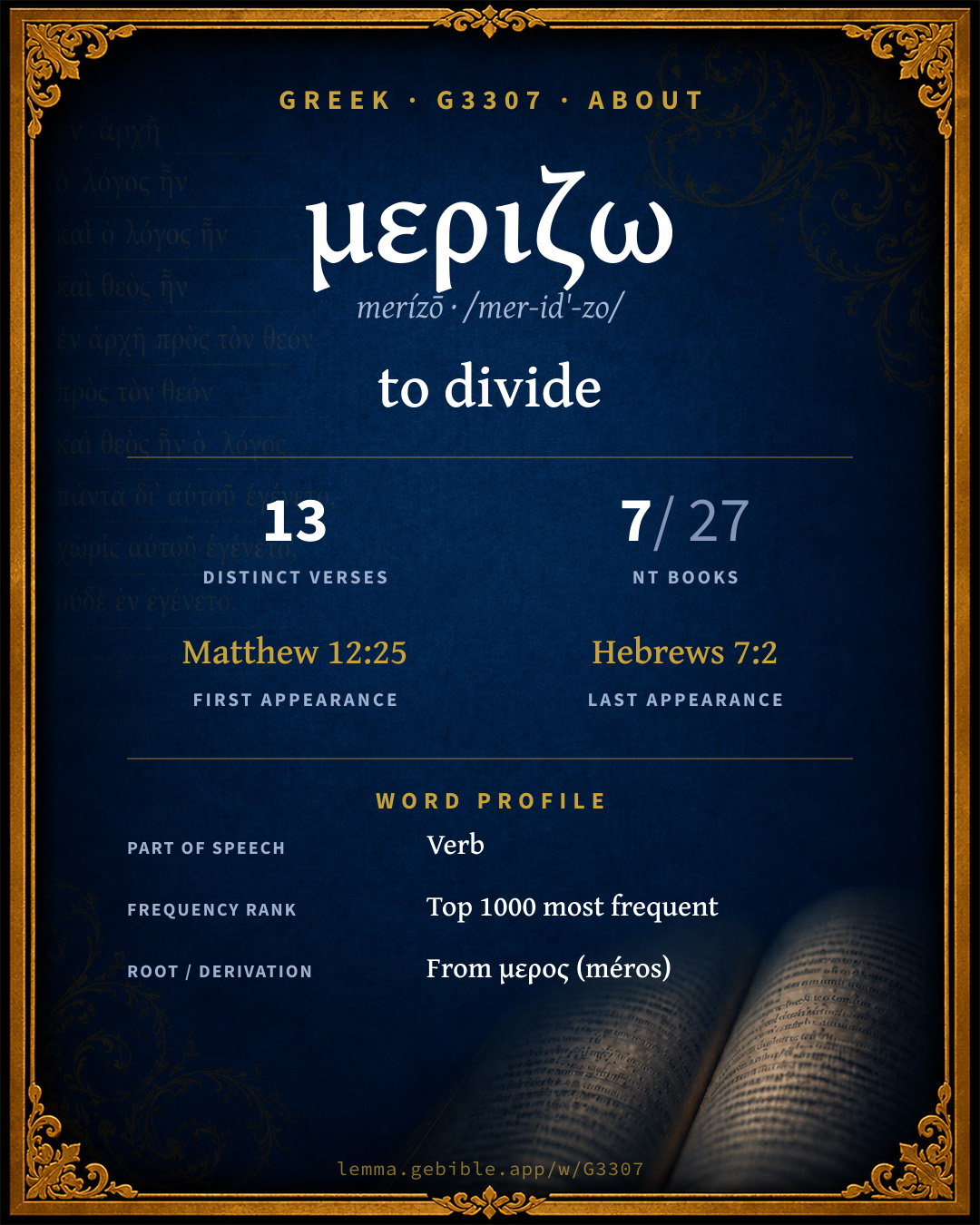
μερίζω
to divide
‘to divide’ is one of 2 main senses fuller range ↓
Full lexicon entry — Thayer's Greek Lexicon
From Thayer's Greek Lexicon
Where this word appears
See every Aorist-tense verb in the Greek New Testament →
Grammar key — what these labels mean
Part of speech
- Verb
- An action or state-of-being word.
Tense
- Aorist
- Action viewed as a simple whole, without regard to duration — often past (perfective aspect).
- Perfect
- A completed past action with continuing present results.
Voice
- Active
- The subject performs the action.
- Passive
- The subject receives the action.
- Middle
- The subject acts on or for itself, or with special interest in the action.
Mood
- Indicative
- States a fact or asks a factual question (the mood of reality).
- Participle
- A verbal adjective (“writing,” “having written”).
- Subjunctive
- Expresses probability, purpose, or possibility (the mood of contingency).
- Infinitive
- A verbal noun (“to write”), unmarked for person or number.
Case
- Nominative
- The case of the subject (and the predicate nominative).
Person
- 3rd person
- The one spoken about (“he / she / it / they”).
Gender
- Feminine
- Grammatically feminine.
Number
- Singular
- One.
Grammatical forms
- Verb, Aorist, Active, Indicative, 3rd person, Singular 4 times (29%)
- Verb, Aorist, Passive, Indicative, 3rd person, Singular 2 times (14%)
- Verb, Aorist, Passive, Participle, Nominative, Singular, Feminine 2 times (14%)
- Verb, Aorist, Passive, Subjunctive, 3rd person, Singular 2 times (14%)
- Verb, Perfect, Passive, Indicative, 3rd person, Singular 2 times (14%)
- Verb, Aorist, Middle, Infinitive 1 time (7%)
- Verb, Perfect, Active, Indicative, 3rd person, Singular 1 time (7%)
Parsed forms decoded from the imported morphology (Robinson–Tischendorf, public domain), counted across 14 parsed occurrences — not distinct verses.
Every verse where G3307 appears — 13 distinct verses across 7 books. Click any verse to open its interlinear word-by-word view. Verse text shown in the World English Bible for context — . Each verse’s Greek form is shown with its reference; the English is not keyword-highlighted, since the data carries no word-level English alignment. Use “Compare translations” on any verse to read it across multiple English versions. This concordance covers the Greek New Testament; Septuagint (Greek Old Testament) occurrences of this word are not indexed here.
Matthew 2 verses
- Matthew 12:25 μερισθεῖσα μερισθεῖσα aor pass ptcp nom sg fem aor pass ptcp nom sg fem Knowing their thoughts, Jesus said to them, "Every kingdom divided against itself is brought to desolation, and every city or house divided against itself will not stand.
- Matthew 12:26 ἐμερίσθη aor pass ind 3sg If Satan casts out Satan, he is divided against himself. How then will his kingdom stand?
Mark 4 verses
- Mark 3:24 μερισθῇ aor pass subj 3sg If a kingdom is divided against itself, that kingdom cannot stand.
- Mark 3:25 μερισθῇ aor pass subj 3sg If a house is divided against itself, that house cannot stand.
- Mark 3:26 ἐμερίσθη aor pass ind 3sg If Satan has risen up against himself, and is divided, he can't stand, but has an end.
- Mark 6:41 ἐμέρισεν aor act ind 3sg He took the five loaves and the two fish, and looking up to heaven, he blessed and broke the loaves, and he gave to his disciples to set before them, and he divided the two fish among them all.
Luke 1 verse
Romans 1 verse
1 Corinthians 3 verses
- 1 Corinthians 1:13 μεμέρισται perf pass ind 3sg Is Christ divided? Was Paul crucified for you? Or were you baptized into the name of Paul?
- 1 Corinthians 7:17 μεμέρικεν perf act ind 3sg Only, as the Lord has distributed to each man, as God has called each, so let him walk. So I command in all the assemblies.
- 1 Corinthians 7:34 μεμέρισται perf pass ind 3sg There is also a difference between a wife and a virgin. The unmarried woman cares about the things of the Lord, that she may be holy both in body and in spirit. But she who is married cares about the things of the world--how she may please her husband.
2 Corinthians 1 verse
Hebrews 1 verse
About this entry
At a glance — auto-summarized from this page’s data, not written by a person. Every figure links to its source below. This summary describes the numbers; it doesn’t interpret them.
μεριζω (merízō) is a Greek verb most often rendered “to divide.” It first appears in Matthew 12:25. The Greek New Testament uses it across 13 verses — uncommon. Mark dominates its distribution — 4 of 13 verses. Ranging over 2 senses, it is not a single-sense word. The sections below give every sense, occurrence, and version rendering.
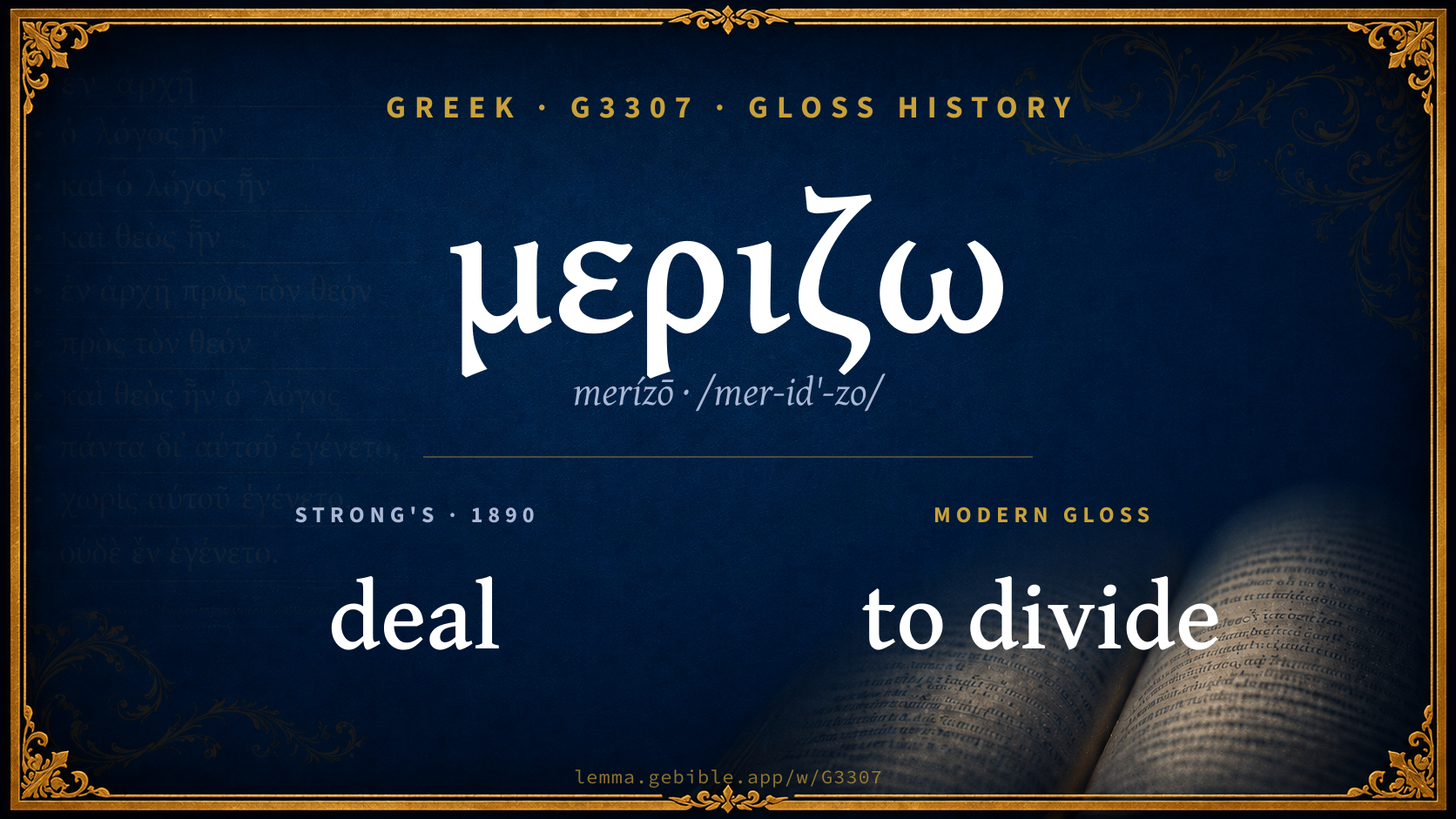
Gloss history
Strong's 1890 vs modern scholarship
About this word
Strong's G3307 catalogs a Greek word from the Greek New Testament.
These counts are not copied from any lexicon or concordance. They are computed here, from the morphology-tagged Greek New Testament. What Lemma adds →
- 13
- distinct verses
- The word appears in 13 distinct verses.
- 7 / 27
- NT books
- The word appears in 7 of 27 New Testament books.
- #814
- by frequency
- Top 1000 most frequent Greek words (rank 814 of 5,347 Greek words by occurrence).
View all 13 occurrences in the concordance →
Most concentrated in
- Mark 4 verses 31%
- 1 Corinthians 3 verses 23%
- Matthew 2 verses 15%
By section of the New Testament
By traditional corpus
Conventional, traditional groupings — biblical authorship is debated, so this is a traditional corpus grouping, not an authorship claim. Some books belong to more than one corpus (Luke is in both the Gospels and the Lukan corpus, and so on), so these shares overlap and need not total 100%. Each figure is a share of the word’s 13 distinct verses.
- Gospels 7 verses · 54%
- Pauline corpus 5 verses · 38%
- Lukan (Luke–Acts) 1 verse · 8%
- Hebrews 1 verse · 8%
How translations render this word
Counts come from each version’s own published word-to-Strong’s tagging or interlinear alignment — an approximate guide to how each version renders this word, not a word-level alignment the data otherwise carries. Because each total is that version’s own tagged count, the per-version totals vary from one another and need not match the appearance or distinct-verse counts above. These counts may also differ from a printed concordance because Lemma counts each distinctly tagged rendering and does not collapse phrase taggings into a single head-word total. This is a fixed set of word-tagged versions (KJV, ASV, BSB, ULT) and does not change with the reading translation you choose elsewhere. Each version’s license is shown beside its name below (and on Sources).
- King James Version: Be divided 3×, Divided 3×, Hath distributed 2×
- American Standard Version: Divided 4×, Be divided 2×, Is divided 2×
- Berean Standard Bible: Divided 3×, Is divided 3×, Has assigned 2×
- unfoldingWord Literal Text: Divided 2×, Has assigned 2×, Has been divided 2×
King James Version Public Domain
Renders G3307 across 15 tagged occurrences — most commonly:
Plus 7 renderings that appear only once — usually multi-word phrases or single function words the recovered tagging swept in, not distinct renderings.
American Standard Version Public Domain
Renders G3307 across 15 tagged occurrences — most commonly:
Plus 7 renderings that appear only once — usually multi-word phrases or single function words the recovered tagging swept in, not distinct renderings.
Berean Standard Bible Public Domain
Renders G3307 across 14 tagged occurrences — most commonly:
Plus 6 renderings that appear only once — usually multi-word phrases or single function words the recovered tagging swept in, not distinct renderings.
unfoldingWord Literal Text CC BY-SA 4.0
Renders G3307 across 15 tagged occurrences — most commonly:
Plus 9 renderings that appear only once — usually multi-word phrases or single function words the recovered tagging swept in, not distinct renderings.
Senses in Thayer's
The 2 senses Thayer's distinguishes for this word, in lexicon order (not ranked by frequency or importance). The full entry — with sub-senses — is in the Lexicon Entry tab.
- to separate into parts, cut into pieces
- to distribute
Word origin
Derived from μερος (méros) (G3313) — part.
From G3313 ; to part that is (literally) to apportion bestow share or (figuratively) to disunite differ : - deal be difference between distribute divide give part.
— Strong’s Exhaustive Concordance (1890), public domain.
Forms in the corpus
The 7 distinct written forms G3307 takes in the Greek New Testament, most frequent first — each parse links to that tense’s occurrences in the concordance.
| Form | Parsing | Example | Uses |
|---|---|---|---|
| ἐμέρισεν emérisen | Verb, Aorist, Active, Indicative, 3rd person, Singular | Mark 6:41 | 4 |
| μεμέρισται meméristai | Verb, Perfect, Passive, Indicative, 3rd person, Singular | 1 Corinthians 1:13 | 2 |
| μερισθεῖσα meristheîsa | Verb, Aorist, Passive, Participle, Nominative, Singular, Feminine | Matthew 12:25 | 2 |
| μερισθῇ meristhē̂ | Verb, Aorist, Passive, Subjunctive, 3rd person, Singular | Mark 3:24 | 2 |
| ἐμερίσθη emerísthē | Verb, Aorist, Passive, Indicative, 3rd person, Singular | Matthew 12:26 | 2 |
| μεμέρικεν memériken | Verb, Perfect, Active, Indicative, 3rd person, Singular | 1 Corinthians 7:17 | 1 |
| μερίσασθαι merísasthai | Verb, Aorist, Middle, Infinitive | Luke 12:13 | 1 |
Same root — word family
Other Thayer's entries built from the same root as G3307, grouped by Strong’s listed origin. These share a root / origin per the lexicon — not necessarily a shared meaning. Each links to that word’s own entry.
Derives from
Shares the same root
Derived from this word
Compare all same-root words → Showing 4 of 7 — not the complete family. They share a root, not necessarily a meaning.
Septuagint usage
The same Greek word μεριζω appears 25 times in the Greek Old Testament (Septuagint), across 25 verses in 13 books.
- 25
- LXX occurrences
- Tagged occurrences of this Greek word in the Septuagint.
- 25
- verses
- Distinct Septuagint verses containing this word.
- 13 / 39
- OT books
- The word appears in 13 of the 39 Old Testament books.
Sample Septuagint occurrences
- Exodus 15:9 μερίζω
- Numbers 26:53 μερίζω
- Deuteronomy 18:8 μερίζω
- Joshua 13:7 μερίζω
- 1 Samuel 23:28 μερίζω
- 1 Kings 16:21 μερίζω
- Ezra 23:13 μερίζω
- Job 31:2 μερίζω
- Proverbs 8:21 μερίζω
- Isaiah 53:12 μερίζω
- Jeremiah 12:14 μερίζω
- Daniel 11:4 μερίζω
Septuagint occurrences (same lexeme)
Every verse where the same Strong’s number (G3307) appears in the Greek Septuagint. Verse text shown in the World English Bible for context; the Greek form is the matched word — the English is not keyword-highlighted.
- Exodus 15:9 μερίζω The enemy said, 'I will pursue, I will overtake, I will divide the spoil. My desire shall be satisfied on them. I will draw my sword, my hand shall destroy them.'
- Numbers 26:53 μερίζω To these the land shall be divided for an inheritance according to the number of names.
- Numbers 26:55 μερίζω Notwithstanding, the land shall be divided by lot: according to the names of the tribes of their fathers they shall inherit.
- Numbers 26:56 μερίζω According to the lot shall their inheritance be divided between the more and the fewer.
- Deuteronomy 18:8 μερίζω They shall have like portions to eat, besides that which comes of the sale of his patrimony.
- Deuteronomy 33:21 μερίζω He provided the first part for himself, For there was the lawgiver's portion reserved; He came [with] the heads of the people; He executed the righteousness of Yahweh, His ordinances with Israel.
- Joshua 13:7 μερίζω Now therefore divide this land for an inheritance to the nine tribes, and the half-tribe of Manasseh.
- Joshua 14:5 μερίζω As Yahweh commanded Moses, so the children of Israel did; and they divided the land.
- Joshua 18:6 μερίζω You shall describe the land into seven portions, and bring [the description] here to me; and I will cast lots for you here before Yahweh our God.
- 1 Samuel 23:28 μερίζω So Saul returned from pursuing after David, and went against the Philistines: therefore they called that place Sela Hammahlekoth.
- 1 Samuel 30:24 μερίζω Who will listen to you in this matter? for as his share is who goes down to the battle, so shall his share be who tarries by the baggage: they shall share alike.
- 1 Kings 16:21 μερίζω Then were the people of Israel divided into two parts: half of the people followed Tibni the son of Ginath, to make him king; and half followed Omri.
- 1 Kings 18:6 μερίζω So they divided the land between them to pass throughout it: Ahab went one way by himself, and Obadiah went another way by himself.
- Ezra 23:13 μερίζω
- Job 31:2 μερίζω For what is the portion from God above, And the heritage from the Almighty on high?
- Job 39:17 μερίζω Because God has deprived her of wisdom, Neither has he imparted to her understanding.
- Proverbs 8:21 μερίζω That I may give wealth to those who love me. I fill their treasuries.
- Proverbs 14:18 μερίζω The simple inherit folly, But the prudent are crowned with knowledge.
- Proverbs 19:14 μερίζω House and riches are an inheritance from fathers, But a prudent wife is from Yahweh.
- Proverbs 29:24 μερίζω Whoever is an accomplice of a thief is an enemy of his own soul. He takes an oath, but dares not testify.
- Isaiah 53:12 μερίζω Therefore will I divide him a portion with the great, and he shall divide the spoil with the strong; because he poured out his soul to death, and was numbered with the transgressors: yet he bore the sin of many, and made intercession for the transgressors.
- Jeremiah 12:14 μερίζω Thus says Yahweh against all my evil neighbors, who touch the inheritance which I have caused my people Israel to inherit: behold, I will pluck them up from off their land, and will pluck up the house of Judah from among them.
- Jeremiah 28:34 μερίζω
- Daniel 11:4 μερίζω When he shall stand up, his kingdom shall be broken, and shall be divided toward the four winds of the sky, but not to his posterity, nor according to his dominion with which he ruled; for his kingdom shall be plucked up, even for others besides these.
- Hosea 10:2 μερίζω Their heart is divided. Now they will be found guilty. He will demolish their altars. He will destroy their sacred stones.
These are occurrences of the same Greek lexeme (G3307) in the Septuagint — not a translation of any one Hebrew word. The store carries no word-level Hebrew↔Greek alignment, so no Hebrew original is asserted here. Counts come from the recovered LXX Strong's tagging — high-frequency vocabulary is well covered, while rare or late forms may be untagged — so they reflect tagged occurrences and may slightly undercount.