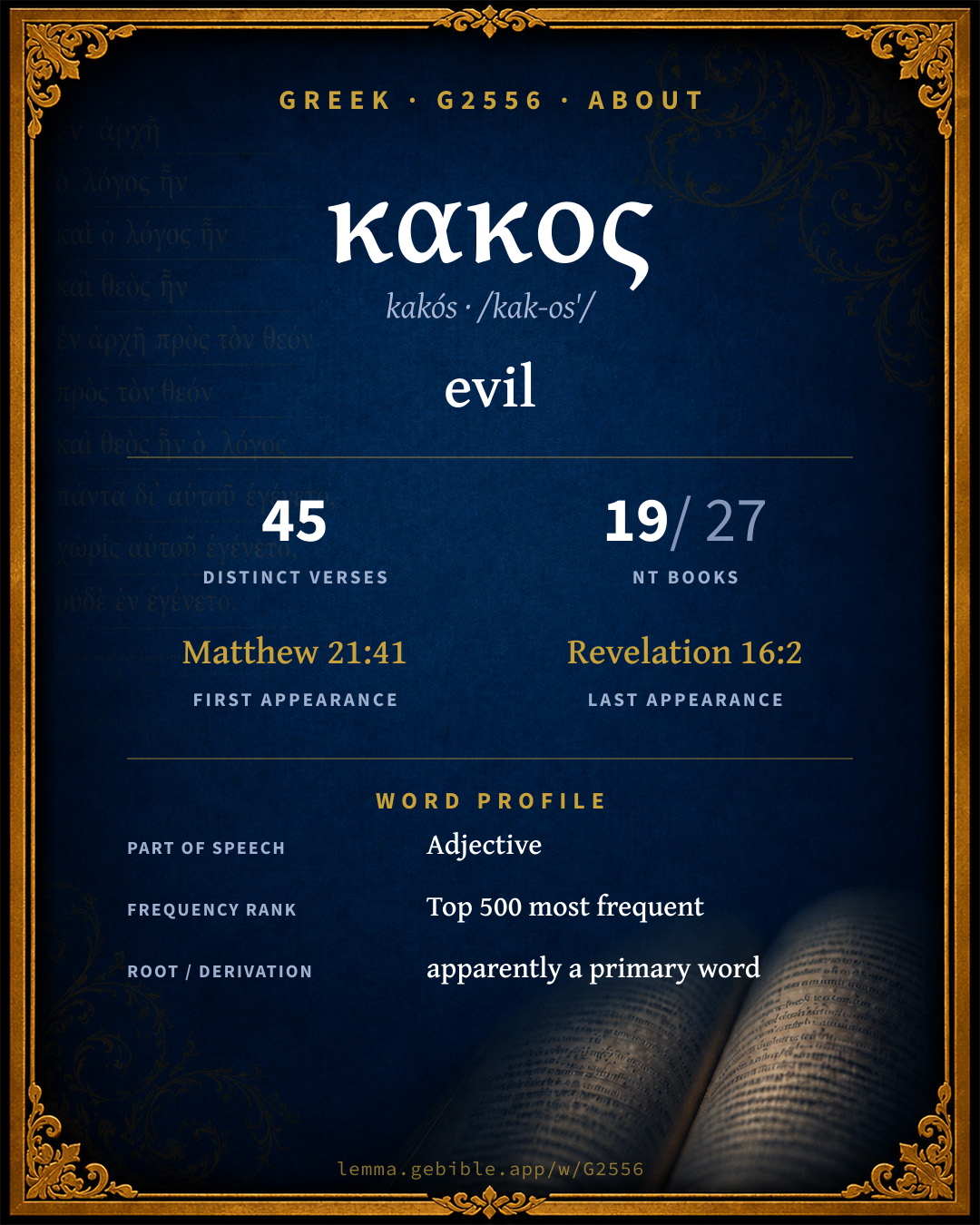
κακός
evil
‘evil’ is one of 3 main senses fuller range ↓
Full lexicon entry — Thayer's Greek Lexicon
From Thayer's Greek Lexicon
Where this word appears
See every Accusative-case word in the Greek New Testament →
Grammar key — what these labels mean
Part of speech
- Adjective
- A word that describes or qualifies a noun.
Case
- Accusative
- The case of the direct object and of extent.
- Genitive
- The case of source, possession, or “of” — answers “whose / from what.”
- Nominative
- The case of the subject (and the predicate nominative).
- Dative
- The case of the indirect object, means, or location — “to / for / with / in.”
Gender
- Neuter
- Grammatically neuter.
- Masculine
- Grammatically masculine.
- Feminine
- Grammatically feminine.
Number
- Singular
- One.
- Plural
- More than one.
Every verse where G2556 appears in the Book of Matthew — 3 distinct verses. Click any verse to open its interlinear word-by-word view. Verse text shown in the World English Bible for context — . Each verse’s Greek form is shown with its reference; the English is not keyword-highlighted, since the data carries no word-level English alignment. Use “Compare translations” on any verse to read it across multiple English versions. This concordance covers the Greek New Testament; Septuagint (Greek Old Testament) occurrences of this word are not indexed here.
Matthew
- Matthew 21:41 κακοὺς adj acc pl masc They told him, "He will miserably destroy those miserable men, and will lease out the vineyard to other farmers, who will give him the fruit in its season."
- Matthew 24:48 κακὸς adj nom sg masc But if that evil servant should say in his heart, 'My lord is delaying his coming,'
- Matthew 27:23 κακὸν adj acc sg neut But the governor said, "Why? What evil has he done?" But they cried out exceedingly, saying, "Let him be crucified!"
About this entry
At a glance — auto-summarized from this page’s data, not written by a person. Every figure links to its source below. This summary describes the numbers; it doesn’t interpret them.
κακος (kakós) is a Greek adjective most often rendered “evil.” Scripture first uses it in Matthew 21:41. It turns up in 45 verses across 19 books, a moderately common footprint. It concentrates in Romans, which alone accounts for 27% of its uses. Ranging over 3 senses, it is not a single-sense word. For the data behind this summary, explore the sense tree and the renderings breakdown below.
Gloss history
Strong's 1890 vs modern scholarship

About this word
Strong's G2556 catalogs a Greek word from the Greek New Testament.
These counts are not copied from any lexicon or concordance. They are computed here, from the morphology-tagged Greek New Testament. What Lemma adds →
- 45
- distinct verses
- The word appears in 45 distinct verses.
- 19 / 27
- NT books
- The word appears in 19 of 27 New Testament books.
- #310
- by frequency
- Top 500 most frequent Greek words (rank 310 of 5,347 Greek words by occurrence).
View all 45 occurrences in the concordance →
By section of the New Testament
By traditional corpus
Conventional, traditional groupings — biblical authorship is debated, so this is a traditional corpus grouping, not an authorship claim. Some books belong to more than one corpus (Luke is in both the Gospels and the Lukan corpus, and so on), so these shares overlap and need not total 100%. Each figure is a share of the word’s 45 distinct verses.
- Pauline corpus 22 verses · 49%
- Gospels 9 verses · 20%
- General (Catholic) Epistles 7 verses · 16%
- Lukan (Luke–Acts) 6 verses · 13%
- Johannine 5 verses · 11%
- Revelation 2 verses · 4%
- Hebrews 1 verse · 2%
How translations render this word
Counts come from each version’s own published word-to-Strong’s tagging or interlinear alignment — an approximate guide to how each version renders this word, not a word-level alignment the data otherwise carries. Because each total is that version’s own tagged count, the per-version totals vary from one another and need not match the appearance or distinct-verse counts above. These counts may also differ from a printed concordance because Lemma counts each distinctly tagged rendering and does not collapse phrase taggings into a single head-word total. This is a fixed set of word-tagged versions (KJV, ASV, BSB, ULT) and does not change with the reading translation you choose elsewhere. Each version’s license is shown beside its name below (and on Sources).
- King James Version: Evil 38×, Is evil 3×, Evil things 2×
- American Standard Version: Evil 36×, Is evil 3×, Bad 2×
- Berean Standard Bible: Evil 29×, Wrong 4×, Bad 3×
- unfoldingWord Literal Text: Evil 31×, Bad 3×, Evil things 3×
King James Version Public Domain
Renders G2556 across 51 tagged occurrences — most commonly:
Plus 6 renderings that appear only once — usually multi-word phrases or single function words the recovered tagging swept in, not distinct renderings.
American Standard Version Public Domain
Renders G2556 across 51 tagged occurrences — most commonly:
Plus 6 renderings that appear only once — usually multi-word phrases or single function words the recovered tagging swept in, not distinct renderings.
Berean Standard Bible Public Domain
Renders G2556 across 50 tagged occurrences — most commonly:
Plus 11 renderings that appear only once — usually multi-word phrases or single function words the recovered tagging swept in, not distinct renderings.
unfoldingWord Literal Text CC BY-SA 4.0
Renders G2556 across 54 tagged occurrences — most commonly:
Plus 6 renderings that appear only once — usually multi-word phrases or single function words the recovered tagging swept in, not distinct renderings.
Senses in Thayer's
The 3 senses Thayer's distinguishes for this word, in lexicon order (not ranked by frequency or importance). The full entry — with sub-senses — is in the Lexicon Entry tab.
- not such as it ought to be
- of a mode of thinking, feeling, acting
- troublesome, injurious, pernicious, destructive, baneful
Word origin
Origin: apparently a primary word
Apparently a primary word; worthless ( intrinsically such; whereas G4190 properly refers to effects ) that is (subjectively) depraved or (objectively) injurious : - bad evil harm ill noisome wicked.
— Strong’s Exhaustive Concordance (1890), public domain.
Forms in the corpus
The 13 distinct written forms G2556 takes in the Greek New Testament, most frequent first — each parse links to that case’s occurrences in the concordance.
| Form | Parsing | Example | Uses |
|---|---|---|---|
| κακὸν kakòn | Adjective, Accusative, Singular, Neuter | Matthew 27:23 | 16 |
| κακόν kakón | Adjective, Accusative, Singular, Neuter | Mark 15:14 | 8 |
| κακοῦ kakoû | Adjective, Genitive, Singular, Neuter | John 18:23 | 8 |
| κακὰ kakà | Adjective, Accusative, Plural, Neuter | Acts 9:13 | 4 |
| κακῶν kakō̂n | Adjective, Genitive, Plural, Neuter | Romans 1:30 | 4 |
| κακά kaká | Adjective, Accusative, Plural, Neuter | Luke 16:25 | 2 |
| κακοὺς kakoùs | Adjective, Accusative, Plural, Masculine | Matthew 21:41 | 2 |
| κακήν kakḗn | Adjective, Accusative, Singular, Feminine | Colossians 3:5 | 1 |
| κακαί kakaí | Adjective, Nominative, Plural, Feminine | 1 Corinthians 15:33 | 1 |
| κακούς kakoús | Adjective, Accusative, Plural, Masculine | Revelation 2:2 | 1 |
| κακοὶ kakoì | Adjective, Nominative, Plural, Masculine | Mark 7:21 | 1 |
| κακὸς kakòs | Adjective, Nominative, Singular, Masculine | Matthew 24:48 | 1 |
| κακῷ kakō̂ | Adjective, Dative, Singular, Neuter | Romans 13:3 | 1 |
Same root — word family
Other Thayer's entries built from the same root as G2556, grouped by Strong’s listed origin. These share a root / origin per the lexicon — not necessarily a shared meaning. Each links to that word’s own entry.
Derived from this word
- ηττον hḗtton G2276 less
- κακια kakía G2549 malice
- κακοηθεια kakoḗtheia G2550 maliciousness
- κακολογεω kakologéō G2551 to revile
- κακοπαθεια kakopátheia G2552 suffering
- κακοποιος kakopoiós G2555 evildoer
- κακουργος kakoûrgos G2557 malefactor
- κακουχεω kakouchéō G2558 to treat ill
- κακοω kakóō G2559 to oppress
- κακως kakōs G2560 miserable
- χειρων cheírōn G5501 worse
Compare all same-root words → Showing 4 of 12 — not the complete family. They share a root, not necessarily a meaning.
Septuagint usage
The same Greek word κακος appears 288 times in the Greek Old Testament (Septuagint), across 265 verses in 30 books.
- 288
- LXX occurrences
- Tagged occurrences of this Greek word in the Septuagint.
- 265
- verses
- Distinct Septuagint verses containing this word.
- 30 / 39
- OT books
- The word appears in 30 of the 39 Old Testament books.
Sample Septuagint occurrences
- Genesis 19:19 κακός
- Exodus 5:19 κακός
- Numbers 14:23 κακός
- Deuteronomy 1:39 κακός
- Judges 2:15 κακός
- 1 Samuel 10:19 κακός
- 2 Samuel 12:11 κακός
- 1 Kings 3:9 κακός
- 2 Kings 8:12 κακός
- 1 Chronicles 7:23 κακός
- 2 Chronicles 18:7 κακός
- Ezra 23:18 κακός
Septuagint occurrences (same lexeme)
Every verse where the same Strong’s number (G2556) appears in the Greek Septuagint — showing the first 50 of 265. Verse text shown in the World English Bible for context; the Greek form is the matched word — the English is not keyword-highlighted.
- Genesis 19:19 κακός See now, your servant has found favor in your sight, and you have magnified your loving kindness, which you have shown to me in saving my life. I can't escape to the mountain, lest evil overtake me, and I die.
- Genesis 24:50 κακός Then Laban and Bethuel answered, "The thing proceeds from Yahweh. We can't speak to you bad or good.
- Genesis 26:29 κακός that you will do us no harm, as we have not touched you, and as we have done to you nothing but good, and have sent you away in peace.' You are now the blessed of Yahweh."
- Genesis 44:34 κακός For how will I go up to my father, if the boy isn't with me? Lest I see the evil that will come on my father."
- Genesis 48:16 κακός the angel who has redeemed me from all evil, bless the lads, and let my name be named on them, and the name of my fathers Abraham and Isaac. Let them grow into a multitude in the midst of the earth."
- Genesis 50:15 κακός When Joseph's brothers saw that their father was dead, they said, "It may be that Joseph will hate us, and will fully pay us back for all of the evil which we did to him.
- Exodus 5:19 κακός The officers of the children of Israel saw that they were in trouble, when it was said, "You shall not diminish anything from your daily quota of bricks!"
- Numbers 14:23 κακός surely they shall not see the land which I swore to their fathers, neither shall any of those who despised me see it:
- Numbers 32:11 κακός Surely none of the men who came up out of Egypt, from twenty years old and upward, shall see the land which I swore to Abraham, to Isaac, and to Jacob; because they have not wholly followed me:
- Numbers 32:23 κακός But if you will not do so, behold, you have sinned against Yahweh; and be sure your sin will find you out.
- Deuteronomy 1:39 κακός Moreover your little ones, whom you said should be a prey, and your children, who this day have no knowledge of good or evil, they shall go in there, and to them will I give it, and they shall possess it.
- Deuteronomy 29:20 κακός Yahweh will not pardon him, but then the anger of Yahweh and his jealousy will smoke against that man, and all the curse that is written in this book shall lie on him, and Yahweh will blot out his name from under the sky.
- Deuteronomy 30:15 κακός Behold, I have set before you this day life and good, and death and evil;
- Deuteronomy 31:17 κακός Then my anger shall be kindled against them in that day, and I will forsake them, and I will hide my face from them, and they shall be devoured, and many evils and troubles shall come on them; so that they will say in that day, Haven't these evils come on us because our God is not among us?
- Deuteronomy 31:29 κακός For I know that after my death you will utterly corrupt yourselves, and turn aside from the way which I have commanded you; and evil will happen to you in the latter days; because you will do that which is evil in the sight of Yahweh, to provoke him to anger through the work of your hands.
- Deuteronomy 32:23 κακός I will heap evils on them; I will spend my arrows on them:
- Judges 2:15 κακός Wherever they went out, the hand of Yahweh was against them for evil, as Yahweh had spoken, and as Yahweh had sworn to them: and they were sore distressed.
- Judges 6:13 κακός Gideon said to him, Oh, my lord, if Yahweh is with us, why then has all this happened to us? and where are all his wondrous works which our fathers told us of, saying, Did not Yahweh bring us up from Egypt? but now Yahweh has cast us off, and delivered us into the hand of Midian.
- 1 Samuel 10:19 κακός but you have this day rejected your God, who himself saves you out of all your calamities and your distresses; and you have said to him, [No], but set a king over us. Now therefore present yourselves before Yahweh by your tribes, and by your thousands.
- 1 Samuel 20:13 κακός Yahweh do so to Jonathan, and more also, should it please my father to do you evil, if I don't disclose it to you, and send you away, that you may go in peace: and Yahweh be with you, as he has been with my father.
- 1 Samuel 24:18 κακός You have declared this day how that you have dealt well with me, because when Yahweh had delivered me up into your hand, you didn't kill me.
- 1 Samuel 25:26 κακός Now therefore, my lord, as Yahweh lives, and as your soul lives, seeing Yahweh has withheld you from blood guiltiness, and from avenging yourself with your own hand, now therefore let your enemies, and those who seek evil to my lord, be as Nabal.
- 1 Samuel 25:39 κακός When David heard that Nabal was dead, he said, Blessed be Yahweh, who has pleaded the cause of my reproach from the hand of Nabal, and has kept back his servant from evil: and the evil-doing of Nabal has Yahweh returned on his own head. David sent and spoke concerning Abigail, to take her to him as wife.
- 2 Samuel 12:11 κακός This is what Yahweh says: 'Behold, I will raise up evil against you out of your own house; and I will take your wives before your eyes, and give them to your neighbor, and he will lie with your wives in the sight of this sun.
- 2 Samuel 12:18 κακός It happened on the seventh day, that the child died. The servants of David feared to tell him that the child was dead; for they said, Behold, while the child was yet alive, we spoke to him, and he didn't listen to our voice: how will he then vex himself, if we tell him that the child is dead!
- 2 Samuel 17:14 κακός Absalom and all the men of Israel said, The counsel of Hushai the Archite is better than the counsel of Ahithophel. For Yahweh had ordained to defeat the good counsel of Ahithophel, to the intent that Yahweh might bring evil on Absalom.
- 2 Samuel 18:32 κακός The king said to the Cushite, Is it well with the young man Absalom? The Cushite answered, The enemies of my lord the king, and all who rise up against you to do you hurt, be as that young man is.
- 2 Samuel 19:8 κακός Then the king arose, and sat in the gate. They told to all the people, saying, Behold, the king is sitting in the gate: and all the people came before the king. Now Israel had fled every man to his tent.
- 2 Samuel 19:36 κακός Your servant would but just go over the Jordan with the king: and why should the king recompense it me with such a reward?
- 1 Kings 3:9 κακός Give your servant therefore an understanding heart to judge your people, that I may discern between good and evil; for who is able to judge this your great people?
- 1 Kings 20:21 κακός The king of Israel went out, and struck the horses and chariots, and killed the Syrians with a great slaughter.
- 1 Kings 22:8 κακός The king of Israel said to Jehoshaphat, there is yet one man by whom we may inquire of Yahweh, Micaiah the son of Imlah: but I hate him; for he does not prophesy good concerning me, but evil. Jehoshaphat said, "Don't let the king say so."
- 1 Kings 22:18 κακός The king of Israel said to Jehoshaphat, Didn't I tell you that he would not prophesy good concerning me, but evil?
- 1 Kings 22:23 κακός Now therefore, behold, Yahweh has put a lying spirit in the mouth of all these your prophets; and Yahweh has spoken evil concerning you.
- 2 Kings 8:12 κακός Hazael said, Why weeps my lord? He answered, Because I know the evil that you will do to the children of Israel: their strongholds will you set on fire, and their young men will you kill with the sword, and will dash in pieces their little ones, and rip up their women with child.
- 2 Kings 21:12 κακός therefore thus says Yahweh, the God of Israel, Behold, I bring such evil on Jerusalem and Judah, that whoever hears of it, both his ears shall tingle.
- 2 Kings 22:16 κακός Thus says Yahweh, Behold, I will bring evil on this place, and on the inhabitants of it, even all the words of the book which the king of Judah has read.
- 2 Kings 22:20 κακός Therefore, behold, I will gather you to your fathers, and you shall be gathered to your grave in peace, neither shall your eyes see all the evil which I will bring on this place. They brought the king word again.
- 1 Chronicles 7:23 κακός He went in to his wife, and she conceived, and bore a son, and he named him Beriah, because it went evil with his house.
- 2 Chronicles 18:7 κακός The king of Israel said to Jehoshaphat, There is yet one man by whom we may inquire of Yahweh: but I hate him; for he never prophesies good concerning me, but always evil: the same is Micaiah the son of Imla. Jehoshaphat said, Don't let the king say so.
- 2 Chronicles 18:17 κακός The king of Israel said to Jehoshaphat, Didn't I tell you that he would not prophesy good concerning me, but evil?
- 2 Chronicles 18:22 κακός Now therefore, behold, Yahweh has put a lying spirit in the mouth of these your prophets; and Yahweh has spoken evil concerning you.
- 2 Chronicles 20:9 κακός If evil come on us, the sword, judgment, or pestilence, or famine, we will stand before this house, and before you, (for your name is in this house), and cry to you in our affliction, and you will hear and save.
- 2 Chronicles 34:24 κακός Thus says Yahweh, Behold, I will bring evil on this place, and on the inhabitants of it, even all the curses that are written in the book which they have read before the king of Judah.
- 2 Chronicles 34:28 κακός Behold, I will gather you to your fathers, and you shall be gathered to your grave in peace, neither shall your eyes see all the evil that I will bring on this place, and on the inhabitants of it. They brought back word to the king.
- Ezra 23:18 κακός
- Esther 7:7 κακός The king arose in his wrath from the banquet of wine [and went] into the palace garden: and Haman stood up to make request for his life to Esther the queen; for he saw that there was evil determined against him by the king.
- Esther 9:25 κακός but when [the matter] came before the king, he commanded by letters that his wicked device, which he had devised against the Jews, should return on his own head, and that he and his sons should be hanged on the gallows.
- Job 1:5 κακός It was so, when the days of their feasting had run their course, that Job sent and sanctified them, and rose up early in the morning, and offered burnt offerings according to the number of them all. For Job said, "It may be that my sons have sinned, and renounced God in their hearts." Thus did Job continually.
- Job 2:3 κακός Yahweh said to Satan, "Have you considered my servant Job? For there is none like him in the earth, a blameless and an upright man, one who fears God, and turns away from evil. He still maintains his integrity, although you incited me against him, to ruin him without cause."
These are occurrences of the same Greek lexeme (G2556) in the Septuagint — not a translation of any one Hebrew word. The store carries no word-level Hebrew↔Greek alignment, so no Hebrew original is asserted here. Counts come from the recovered LXX Strong's tagging — high-frequency vocabulary is well covered, while rare or late forms may be untagged — so they reflect tagged occurrences and may slightly undercount.