
Romans 1:30

Greek (Tischendorf 8th ed.) Romans 1:30 appears in the Greek New Testament. The text above is from the Tischendorf 8th edition. Each word links to its Strong’s number and a concise gloss. Click any word for its full Thayer’s Greek Lexicon entry.
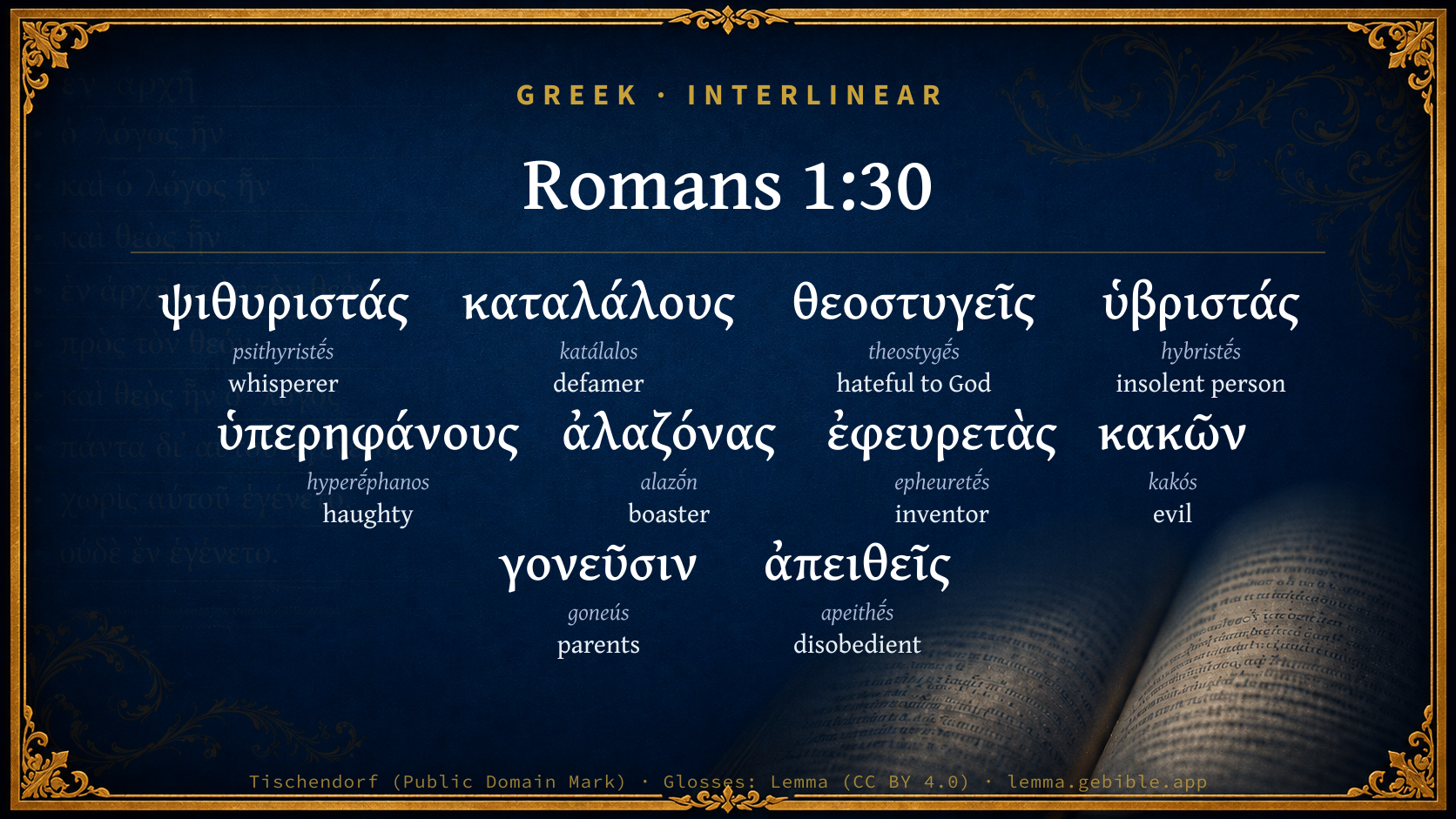
Download image
Cite this verse

Romans 1:30 (World English Bible). Public Domain. Lemma interlinear Bible study tool, https://lemma.gebible.app/v/romans/1/30.

Show BibTeX & RIS
BibTeX
RIS
English Translation
backbiters, hateful to God, insolent, haughty, boastful, inventors of evil things, disobedient to parents,
World English Bible · Public Domain
Highlights
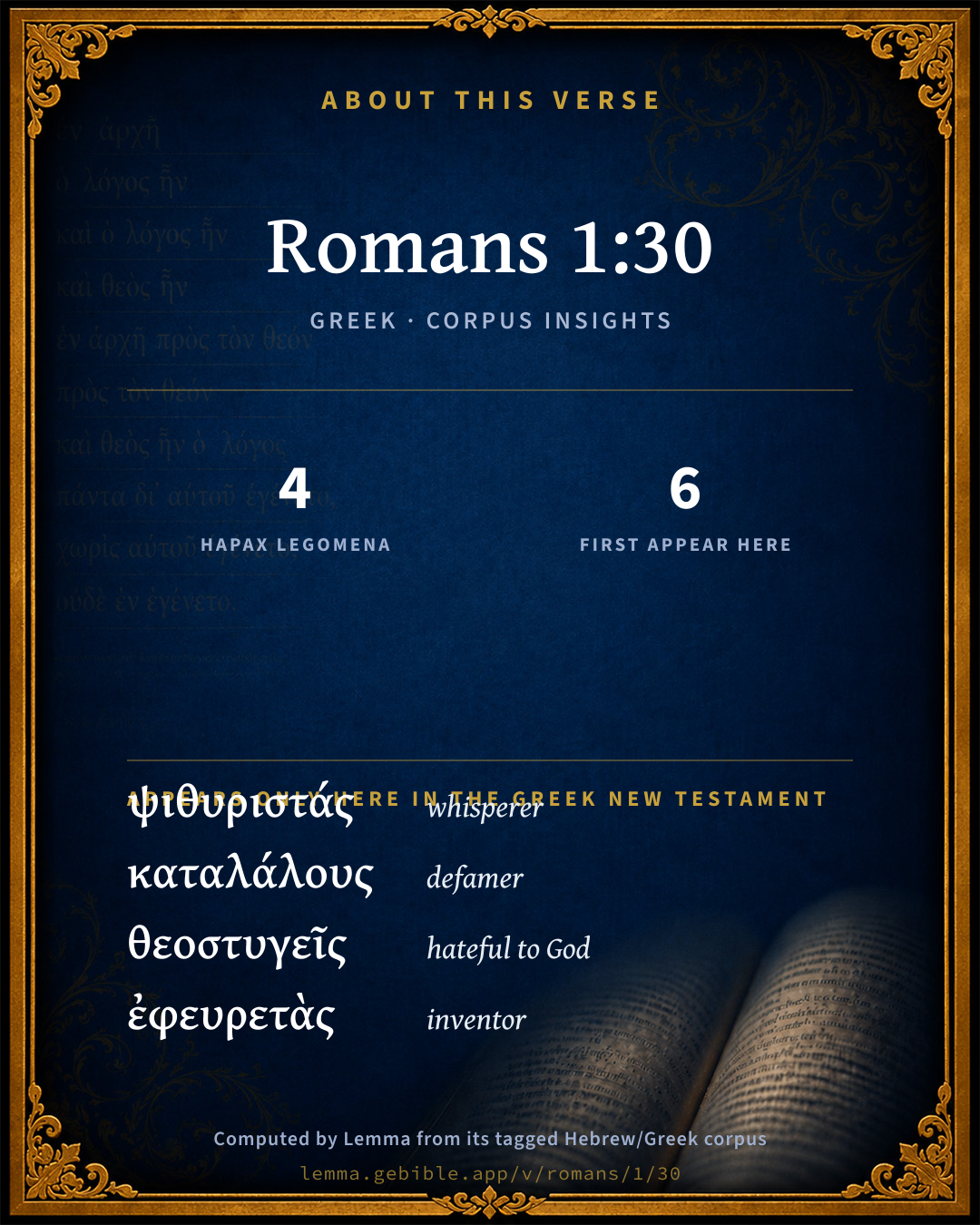
  • 4 hapax legomena — only here in the Greek New Testament
  • 6 first appearances in the Greek New Testament
Full analysis ↓
Download a study sheet

One document with this verse’s original text, its word-by-word gloss line, the meaning frame, cross-references with their text, attributed commentary, and full source and license credits — printable, and it pastes into notes with its structure intact.

This verse Autodidact and up

Study sheet (.html) Plain text (.txt)

A passage Seminary Student

Up to 50 verses in one chapter. A passage sheet keeps up to 6 commentary sources and 12 cross-references per verse, in the order this page ranks them, and says so on the sheet whenever that leaves anything out. Ask for a single verse and you get the Autodidact verse sheet above.

Everything on this page stays free to read, with no account — the sheet is a download of what is already on screen, not access to it.

Want to remove ads? Support Godless Engineer
Compare translations 3

The same verse in 3 English versions, stacked beneath the original-language interlinear above. Click any original word for its lexicon entry.

Each is an independent rendering of the whole verse — the interlinear is not word-aligned to these translations.

Highlighted words mark where these versions differ — a whole-verse word diff, not a word-by-word alignment.

  • World English Bible Public Domain
    backbiters, hateful to God, insolent, haughty, boastful, inventors of evil things, disobedient to parents,
  • King James Version Public Domain
    Backbiters, haters of God, despiteful, proud, boasters, inventors of evil things, disobedient to parents,
  • unfoldingWord Literal Text CC BY-SA 4.0
    slanderers, haters of God, insolent, arrogant, boastful, inventors of evil things, disobedient to parents,

unfoldingWord Literal Text — © unfoldingWord, licensed CC BY-SA 4.0. Word-aligned USFM3 via Door43 (git.door43.org/unfoldingWord/en_ult).

Versions to compare (up to 4)

3 of 4 selected

Show all 19 translations

Every available English version of this verse, each an independent rendering of the whole verse.

  • World English Bible Public Domain
    backbiters, hateful to God, insolent, haughty, boastful, inventors of evil things, disobedient to parents,
  • Berean Standard Bible Public Domain
    slanderers, God-haters, insolent, arrogant, and boastful. They invent new forms of evil; they disobey their parents.
  • Majority Standard Bible Public Domain
    slanderers, God-haters, insolent, arrogant, and boastful. They invent new forms of evil; they disobey their parents.
  • King James Version Public Domain
    Backbiters, haters of God, despiteful, proud, boasters, inventors of evil things, disobedient to parents,
  • American Standard Version (1901) Public Domain
    backbiters, hateful to God, insolent, haughty, boastful, inventors of evil things, disobedient to parents,
  • Revised Version (1885) Public Domain
    backbiters, hateful to God, insolent, haughty, boastful, inventors of evil things, disobedient to parents,
  • Geneva Bible (1599) Public Domain
    Backbiters, haters of God, doers of wrong, proude, boasters, inuenters of euil things, disobedient to parents, without vnderstanding, couenant breakers, without naturall affection, such as can neuer be appeased, mercilesse.
  • Douay-Rheims (1899) Public Domain
    Detractors, hateful to God, contumelious, proud, haughty, inventors of evil things, disobedient to parents,
  • Young's Literal Translation Public Domain
    evil-speakers, God-haters, insulting, proud, boasters, inventors of evil things, disobedient to parents,
  • Literal Standard Version CC BY-SA 4.0
    evil-speakers, God-haters, insulting, proud, boasters, inventors of evil things, disobedient to parents,
  • Unlocked Literal Bible CC BY-SA 4.0
    slanderers, haters of God, insolent, arrogant, boastful, inventing ways of doing evil; they are disobedient to parents.
  • unfoldingWord Literal Text CC BY-SA 4.0
    slanderers, haters of God, insolent, arrogant, boastful, inventors of evil things, disobedient to parents,
  • Darby Bible Public Domain
    back-biters, hateful to God, insolent, proud, boasters, inventors of evil things, disobedient to parents,
  • World Messianic Bible Public Domain
    backbiters, hateful to God, insolent, arrogant, boastful, inventors of evil things, disobedient to parents,
  • Webster's Bible Public Domain
    Backbiters, haters of God, despiteful, proud, boasters, inventers of evil things, disobedient to parents,
  • Free Bible Version CC BY-SA 4.0
    They're back-stabbers and God-haters. They're arrogant, proud, and boastful. They devise new ways of sinning. They rebel against their parents.
  • Bible in Basic English Public Domain
    Hated by God, full of pride, without respect, full of loud talk, given to evil inventions, not honouring father or mother,
  • Text-Critical English NT CC BY 4.0
    slanderers, haters of God, insolent, proud, boasters, inventors of evil, disobedient to parents,
  • Tyndale New Testament (1534) Public Domain
    backbyters haters of God doers of wronge proude bosters bringers vp of evyll thinges disobedient to father and mother

Literal Standard Version (2020), Covenant Press — licensed CC BY-SA 4.0. Text via the HelloAO Bible API (eBible.org). Unlocked Literal Bible (unfoldingWord) — licensed CC BY-SA 4.0. Text via the HelloAO Bible API (eBible.org). unfoldingWord Literal Text — © unfoldingWord, licensed CC BY-SA 4.0. Word-aligned USFM3 via Door43 (git.door43.org/unfoldingWord/en_ult). Free Bible Version, Dr. Jonathan Gallagher — licensed CC BY-SA 4.0. Text via the HelloAO Bible API (eBible.org).

Word by word

More ways to search: Search by grammar → Find every occurrence → Compare this word →

Practice this passage: Drill this verse → Learn its vocabulary →

About this verse

These counts appear in no published source. They are computed here, from the morphology-tagged text and Lemma’s own curated glosses. What Lemma adds →

10
words
10
distinct lemmas
Pauline Epistles
section

Notable vocabulary

4 hapax legomena — words that appear only here in the entire Greek New Testament:

  • ψιθυριστάς whisperer G5588
  • καταλάλους defamer G2637
  • θεοστυγεῖς hateful to God G2319
  • ἐφευρετὰς inventor G2182

First appearance in Scripture

These words make their first canonical appearance in the Greek New Testament here:

  • ψιθυριστάς whisperer G5588
  • καταλάλους defamer G2637
  • θεοστυγεῖς hateful to God G2319
  • ὑβριστάς insolent person G5197
  • ἀλαζόνας boaster G213
  • ἐφευρετὰς inventor G2182

Shared distinctive vocabulary

ὑβριστάς insolent person G5197 occurs in 2 verses of the Greek New Testament. Also found in:
Cross-references

38

Topical passages linked to Romans 1:30 in the Treasury of Scripture Knowledge — connected by theme and wording, ordered by reader-vote popularity; previews shown in the World English Bible.

  • 2 Timothy 3:2 For men will be lovers of self, lovers of money, boastful, arrogant, blasphemers, disobedient to parents, unthankful, unholy,
  • Jude 1:16 These are murmurers and complainers, walking after their lusts (and their mouth speaks proud things), showing respect of persons to gain advantage.
  • 2 Peter 2:18 For, uttering great swelling words of emptiness, they entice in the lusts of the flesh, by licentiousness, those who are indeed escaping from those who live in error;
  • Romans 8:7–8 because the mind of the flesh is hostile towards God; for it is not subject to God's law, neither indeed can it be.
  • Titus 3:3 For we were also once foolish, disobedient, deceived, serving various lusts and pleasures, living in malice and envy, hateful, and hating one another.
  • James 3:5 So the tongue is also a little member, and boasts great things. See how a small fire can spread to a large forest!
  • James 4:16 But now you glory in your boasting. All such boasting is evil.
  • Numbers 10:35 It happened, when the ark set forward, that Moses said, Rise up, Yahweh, and let your enemies be scattered; and let those who hate you flee before you.
  • Deuteronomy 7:10 and repays those who hate him to their face, to destroy them: he will not be slack to him who hates him, he will repay him to his face.
  • Deuteronomy 21:18–21 If a man have a stubborn and rebellious son, who will not obey the voice of his father, or the voice of his mother, and, though they chasten him, will not listen to them;
  • Deuteronomy 27:16 Cursed be he who sets light by his father or his mother. All the people shall say, Amen.
  • 1 Kings 20:11 The king of Israel answered, Tell him, Don't let him who girds on [his armor] boast himself as he who puts it off.
  • 2 Chronicles 19:2 Jehu the son of Hanani the seer went out to meet him, and said to king Jehoshaphat, Should you help the wicked, and love those who hate Yahweh? for this thing wrath is on you from before Yahweh.
  • 2 Chronicles 25:19 You say, Behold, you have struck Edom; and your heart lifts you up to boast: abide now at home; why should you meddle to [your] hurt, that you should fall, even you, and Judah with you?
  • Psalms 49:6 Those who trust in their wealth, And boast in the multitude of their riches--
  • Psalms 52:1 Why do you boast of mischief, mighty man? God's loving kindness endures continually.
  • Psalms 81:15 The haters of Yahweh would cringe before him, And their punishment would last forever.
  • Psalms 94:4 They pour out arrogant words. All the evil-doers boast.
  • Psalms 97:7 Let all them be shamed who serve engraved images, Who boast in their idols. Worship him, all you gods!
  • Psalms 99:8 You answered them, Yahweh our God. You are a God who forgave them, Although you took vengeance for their doings.
  • Psalms 106:39 Thus were they defiled with their works, And prostituted themselves in their deeds.
  • Proverbs 8:36 But he who sins against me wrongs his own soul. All those who hate me love death."
  • Proverbs 25:23 The north wind brings forth rain: So a backbiting tongue brings an angry face.
  • Ecclesiastes 7:29 Behold, this only have I found: that God made man upright; but they search for many schemes.
  • Ezekiel 22:7 In you have they set light by father and mother; in the midst of you have they dealt by oppression with the foreigner; in you have they wronged the fatherless and the widow.
  • Matthew 15:4 For God commanded, 'Honor your father and your mother,' and, 'He who speaks evil of father or mother, let him be put to death.'
  • Matthew 16:21 From that time, Jesus began to show his disciples that he must go to Jerusalem and suffer many things from the elders, chief priests, and scribes, and be killed, and the third day be raised up.
  • Luke 21:16 You will be handed over even by parents, brothers, relatives, and friends. Some of you they will cause to be put to death.
  • John 15:23–24 He who hates me, hates my Father also.
  • Acts 5:36 For before these days Theudas rose up, making himself out to be somebody; to whom a number of men, about four hundred, joined themselves: who was slain; and all, as many as obeyed him, were dispersed, and came to nothing.
  • Romans 2:17 Indeed you bear the name of a Jew, and rest on the law, and glory in God,
  • Romans 2:23 You who glory in the law, through your disobedience of the law do you dishonor God?
  • Romans 3:27 Where then is the boasting? It is excluded. By what manner of law? Of works? No, but by a law of faith.
  • 2 Corinthians 10:15 not boasting beyond proper limits in other men's labors, but having hope that as your faith grows, we will be abundantly enlarged by you in our sphere of influence,
  • 2 Thessalonians 2:4 he who opposes and exalts himself against all that is called God or that is worshiped; so that he sits as God in the temple of God, setting himself up as God.
  • Psalms 10:3 For the wicked boasts of his heart's cravings, He blesses the greedy, and condemns Yahweh.
  • Proverbs 30:17 The eye that mocks at his father, And scorns obedience to his mother: The ravens of the valley shall pick it out, The young eagles shall eat it.
  • John 7:7 The world can't hate you, but it hates me, because I testify about it, that its works are evil.

Cross-references courtesy of OpenBible.info (CC BY 4.0).

Commentary

Notes on Romans 1:30 from classic Christian and Jewish commentators (each source and its license shown beneath its notes). The classic Christian expositions comment on the surrounding passage and are grouped to its opening verse, so a note may address several verses; the Jewish commentaries on the Tanakh (Rashi and others) are per-verse, so they appear only where the commentator wrote on this verse.

Lemma curates 59 commentaries, every one of them public domain or Creative Commons licensed, each selected and text-cleaned for this edition rather than reprinted as found. About our sources →

Bengel's Gnomon

Johann Albrecht Bengel

Rom 1:30. ψιθυριστάς, whisperers), who defame secretly.—καταλάλους, back-biters), who defame openly.—θεοστυγεῖς) men who show themselves to be haters of God—ὑβριστὰς) those who insolently drive away from themselves all that is good and salutary.—ὑπερηφάνους) those who exalt themselves above others. On this vice, and others which are here noticed, see 2Ti 3:2, etc.—ἀλαζόνας) [‘boasters,’ Engl. vers.], assuming, in reference to things great and good.[18]—ἐφευρετὰς κακῶν, inventors of evil things) of new pleasures, of new methods of acquiring wealth, of new modes of injuring others, for example in war, 2Ma 7:31. Antiochus is said to have been πάσης κακίας εὑρετής [an inventor of every kind of evil] against the Hebrews.

[18] ἀλαζών, boastful in words; ὑπερήφανος, proud in thoughts; ὑβριοτής, insolent in acts.—See Trench Syn.—ED.

Rom 1:30-31. Γονεῦσιν ἀπειθε͂ις, ἀσυνέτους, ἀσυνθέτους, ἀστόργους, ἀσπόνδους, ἀνελεήμονας, disobedient to parents, without understanding, refractory, [But covenant-breakers—Eng. vers.], without natural affection, implacable, unmerciful) Two triplets [groups consisting of three each], the former referring to one’s conduct to superiors, the latter to inferiors.

Bengel's Gnomon of the New Testament — English translation (T&T Clark, Edinburgh, 1860) — public domain. Text from a community e-Sword module.

Geneva Bible (1599)

Geneva Bible translators

Unmindful of their covenants and bargains.

Geneva Bible (1599) marginal notes — public domain. Text via Bolls.life.

Jamieson, Fausset & Brown

Robert Jamieson, A. R. Fausset & David Brown

haters of God--The word usually signifies "God-hated," which some here prefer, in the sense of "abhorred of the Lord"; expressing the detestableness of their character in His sight (compare Pro 22:14; Psa 73:20). But the active sense of the word, adopted in our version and by the majority of expositors, though rarer, agrees perhaps better with the context.

Jamieson, Fausset & Brown — Commentary Critical and Explanatory on the Whole Bible (1871) — public domain (CC PDM 1.0). Text via the HelloAO Bible API.

Adam Clarke's Commentary

Verse 30. Backbiters] καταλαλους, from κατα, against, and λαλεω, I speak; those who speak against others; false accusers, slanderers.

Haters of God] θεοστυγεις, atheists, contemners of sacred things, maligners of providence, scorners, c. All profligate deists are of this class and it seems to be the finishing part of a diabolic character.

Despiteful] υβριστας, from υβριζω, to treat with injurious insolence; stormy, boisterous; abusing both the characters and persons of those over whom they can have any power.

Proud] υπερηφανους, from υπερ, above or over, and φαινω, I show or shine. They who are continually exalting themselves and depressing others; magnifying themselves at the expense of their neighbours; and wishing all men to receive their sayings as oracles.

Boasters] αλαζονας, from λαζομαι, to assume; self-assuming, vain-glorious, and arrogant men.

Inventors of evil things] εφευρετας κακων. Those who have invented destructive customs, rites, fashions, c. such as the different religious ceremonies among the Greeks and Romans-the orgies of Bacchus, the mysteries of Ceres, the lupercalia, feasts of the Bona Dea, &c., &c. Multitudes of which evil things, destructive and abominable ceremonies, are to be found in every part of the heathen worship.

Disobedient to parents] Though filial affection was certainly more recommended and cultivated than many other virtues, yet there are many instances on record of the grossest violation of this great branch of the law of nature.

Adam Clarke's Commentary on the Bible (1810–1826) — public domain. Text from a community e-Sword/MySword module.

John Calvin's Commentaries

30. The word θεοστυγεῖς, means, no doubt, haters of God; for there is no reason to take it in a passive sense, (hated of God,) since Paul here proves men to be guilty by manifest vices. Those, then, are designated, who hate God, whose justice they seem to resist by doing wrong. Whisperers (susurrones) and slanderers (obtrectatores) are to be thus distinguished; the former, by secret accusations, break off the friendships of good men, inflame their minds with anger, defame the innocent, and sow discords; and the latter through an innate malignity, spare the reputation of no one, and, as though they were instigated by the fury of evilspeaking, they revile the deserving as well as the undeserving We have translated ὑβριστὰς, villanous, (maleficos;) for the Latin authors are wont to call notable injuries villanies, such as plunders, thefts, burnings, and sorceries; and these where the vices which Paul meant to point out here. I have rendered the word ὑπερήφανους, used by Paul, insolent, (contumeliosos;) for this is the meaning of the Greek word: and the reason for the word is this, — because such being raised, as it were, on high, look down on those who are, as it were, below them with contempt, and they cannot bear to look on their equals. Haughty are they who swell with the empty wind of overweeningness. Unsociable are those who, by their iniquities, unloose the bands of society, or those in whom there is no sincerity or constancy of faith, who may be called truce-breakers.

John Calvin's Commentaries (1540-1563) — public domain. Text from the Calvin Translation Society English edition (1840s-50s) via the Christian Classics Ethereal Library (ccel.org). Calvin's coverage is partial (roughly two-thirds of the Bible); uncommented books and verses are honest gaps, never fabricated. The 19th-century editor's footnotes and remarks are omitted so the notes are faithfully Calvin's own voice.

Ellicott's Commentary for English Readers

(30) Haters of God.—Rather, perhaps, hated by God. There seem to be no examples of the active sense. The Apostle apparently throws in one emphatic word summing up the catalogue as far as it has gone; he then resumes with a new class of sins. Hitherto he has spoken chiefly of sins of malice, now he turns to sins of pride.

Despiteful, proud, boasters.—The three words correspond to the distinction between act, thought, and word. The first implies distinctly insolence in outward bearing; it is the word translated “injurious” in 1Ti_1:13. The second is a strong self-esteem mixed with contempt for others. (See 2Ti_3:2.) The third is used especially of boastfulness or braggadocio in language.

A Bible Commentary for English Readers, edited by Charles John Ellicott (1878–1897) — public domain. Text from a community e-Sword module.

The Cambridge Bible for Schools and Colleges

gen. ed. J. J. S. Perowne

30. backbiters] Rather, evil speakers, without the special notion of speaking in the absence of the person attacked.

haters of God] The Gr., by formation and classical usage, should rather mean hateful to God; men whose character is peculiarly abhorrent to Him. Similar words or phrases were familiar at Athens to denote defiant evil; and this would well suit the two words here following.

disobedient to parents] A symptom of deep moral and social disorder. Parental authority stands in the Decalogue among the great foundations of virtue and duty; and our Lord Himself is significantly said (Luk_2:51) to have been “subject” to Joseph and Mary.

The Cambridge Bible for Schools and Colleges (gen. ed. J. J. S. Perowne; Cambridge University Press, 1878–1918) — public domain. Text from a community e-Sword module.

John Gill's Exposition

Backbiters,.... Who more publicly defamed the characters of their neighbours, and hurt their good name, credit and reputation, though behind their backs:

haters of God; some read it, "hated of God"; as all workers of iniquity are; but rather this expresses their sin, that they were deniers of the being and providence of God, and showed themselves to be enemies to him by their evil works:

despiteful; both by opprobrious words, and injurious actions:

proud; of their natural knowledge, learning, eloquence and vain philosophy:

boasters: of their parts, abilities, wisdom and works; all which they attributed to themselves, and to the sharpness of their wit, their sagacity and industry:

inventors of evil things; of evil schemes of morality and philosophy, and of evil practices, as well as principles:

disobedient to parents; which was acting contrary to the light of nature.

John Gill's Exposition of the Whole Bible (1746–1763) — public domain (CC PDM 1.0). Text via the HelloAO Bible API.

Trapp's Complete Commentary

John Trapp

30 Backbiters, haters of God, despiteful, proud, boasters, inventors of evil things, disobedient to parents,

Ver. 30. Haters of God] And so God-murderers, 1Jn 3:15. {See Trapp on "1Jn 3:15"}

John Trapp, A Commentary or Exposition upon All the Books of the Old and New Testament (1647–1656) — public domain. Text from a community e-Sword module.

Albert Barnes' Notes on the Bible

Backbiters - Those Who calumniate, slander, or speak ill of those who are absent. Whisperers declare secretly, and with great reserve, the supposed faults of others. Backbiters proclaim them publicly and avowedly.

Haters of God - There is no charge which can be brought against people more severe than this. It is the highest possible crime; yet it is a charge which the conduct of people will abundantly justify, and the truth of which all those experience who are brought to see their true character. To an awakened sinner there is often nothing more plain and painful than that he is a hater of God. His heart rises up against Him, and his Law, and his plan of saving people; and he deeply feels that nothing can subdue this but the mighty power of the Holy One. This is a charge which is not unfrequently brought against people in the Bible; see Joh 7:7; Joh 15:18, Joh 15:24-25; Joh 3:19-20. Surely, if this be the native character of man, then it is “far gone from original righteousness.” No more striking proof of depravity could be given; and in no creed or confession of faith is there a more painful and humiliating representation given of human wickedness, than in this declaration of an inspired apostle, that people are by nature haters of God.

Despiteful - This word denotes those who abuse, or treat with unkindness or disdain, those who are present. Whisperers and backbiters are those who calumniate those who are absent.

Proud - Pride is well understood. It is an inordinate self-esteem; an unreasonable conceit of one’s superiority in talents, beauty, wealth, accomplishments, etc. (Webster). Of the existence of this everywhere, there is abundant proof. And it was particularly striking among the ancients. The sect of the Stoics was distinguished for it, and this was the general character of their philosophers. People will be proud where they suppose none are superior; and it is only the religion that reveals a great and infinite God, and that teaches that all blessings are his gift, and that he has given us the station which we occupy, that will produce true humility. We may add, that the system of paganism did not disclose the wickedness of the heart, and that rids was a main reason why they were elevated in self-esteem.

Boasters - Those who arrogate to themselves what they do not possess, and glory on it. This is closely connected with pride. A man who has an inordinate self-conceit, will not be slow to proclaim his own merits to those around him.

Inventors of evil things - This doubtless refers to their seeking to find out new arts or plans to practice evil; new devices to gratify their lusts and passions; new forms of luxury, and vice, etc. So intent were they on practicing evil, so resolved to gratify their passions, that the mind was excited to discover new modes of gratification. In cities of luxury and vice, this has always been done. Vices change their form, people become satiated, and they are obliged to resort to some new form. The passions cease to be gratified with old forms of indulgence, and consequently people are obliged to resort to new devices to pamper their appetites, and to rekindle their dying passions to a flame. This was eminently true of ancient Rome; a place where all the arts of luxury, all the devices of passion, all the designs of splendid gratification, were called forth to excite and pamper the evil passions of people. Their splendid entertainments, their games, their theaters, their sports - cruel and bloody - were little else than new and ever-varying inventions of evil things to gratify the desires of lust and of pride.

Disobedient to parents - This expresses the idea that they did not show to parents that honor, respect, and attention which was due. This has been a crime of paganism in every age; and though among the Romans the duty of honoring parents was enjoined by the laws, yet it is not improbable that the duty was often violated, and that parents were treated with great neglect and even contempt. “Disobedience to parents was punished by the Jewish Law with death, and with the Hindus it is attended with the loss of the child’s inheritance. The ancient Greeks considered the neglect of it to be extremely impious, and attended with the most certain effects of divine vengeance. Solon ordered all persons who refused to make due provision for their parents to be punished with infamy, and the same penalty was incurred for personal violence toward them.” Kent’s Commentaries on American Law, vol. ii. p. 207; compare Virg. AEniad, ix. 283. The feelings of pride and haughtiness would lead to disregard of parents. It might also be felt that to provide for them when aged and infirm was a burden; and hence, there would arise disregard for their wants, and probably open opposition to their wishes, as being the demands of petulance and age. It has been one characteristic of paganism every where, that it leaves children to treat their parents with neglect. Among the Sandwich islanders it was customary, when a parent was old, infirm, and sick beyond the hope of recovery, for his own children to bury him alive; and it has been the common custom in India for children to leave their aged parents to perish on the banks of the Ganges.

Albert Barnes' Notes on the Bible (1834–1885) — public domain. Text from a community e-Sword/MySword module.

Haydock's Catholic Bible Commentary

Hateful [5] to God. The Greek may also signify, haters of God. (Witham) --- Greek: theostugeis means either haters of God, or hated by God. (Menochius) --- Disobedient to parents. The Greek literally signifies, Not listening to the advice of their parents; who rise up against them, and refuse to obey. (Calmet)

===============================

[BIBLIOGRAPHY]

Deo odibiles. Greek: theostugeis.

George Leo Haydock (1774–1849), Haydock's Catholic Family Bible and Commentary, 1859 edition — public domain. Excludes Psalms (Douay-Rheims chapter numbering differs from Protestant) and Deuterocanonical books (Catholic canon only).

Matthew Poole's English Annotations

Haters of God; the original word hath a passive termination, and therefore some read it, hated of God. But words passive are sometimes actively taken: see 2Pe 1:3. And the apostle here intendeth a catalogue of the Gentiles’ sins, whereof this was one: see Psa 81:15.

Despiteful; or, injurious.

Inventors of evil things; they were not contented with old usual evils, but they invented new; whether we refer this to evils of pain, or evils of sin, we may find examples thereof amongst the heathen. Phalaris propounded a reward to him that could devise a new torment; and Sardanapalus offered rewards to such as could find out new venereal pleasures.

Disobedient to parents, either natural or political.

Matthew Poole's English Annotations on the Holy Bible (1683–1685) — public domain. Text from a community e-Sword/MySword module.

Whedon's Commentary on the Bible

Daniel D. Whedon

30. Backbiters—Open slanderers.

Haters of God—Railers against religion and the Divine Being.

Inventors of evil things—Not only doers of wrong, but fertile in inventing new forms of wickedness.

Daniel D. Whedon (gen. ed.), Commentary on the Old and New Testaments (1874–1909) — public domain. Text from a community e-Sword module.

John Wesley's Explanatory Notes

Whisperers - Such as secretly defame others. Backbiters - Such as speak against others behind their back. Haters of God - That is, rebels against him, deniers of his providence, or accusers of his justice in their adversities; yea, having an inward heart- enmity to his justice and holiness. Inventors of evil things - Of new pleasures, new ways of gain, new arts of hurting, particularly in war.

John Wesley, Explanatory Notes Upon the Whole Bible (1754–1765) — public domain. Text via the GEBible commentary corpus.

Godbey's Commentary on the New Testament

William B. Godbey

30. “Secret maligners,” i. e., eaves-droppers clandestinely stirring up a hell-fire to burn you forever, meanwhile they flatter you with their lips, and claim to be your best friends. “These slanderers.” How frequently does murder follow slander! These remorseless liars, whether clandestinely or openly, set whole communities on the fires of hell, often deluging homes with blood. “Haters of God.” Satan imparts his own nature to the people given up to him. So they actually loathe and despise the God who made them and gives them the air they breathe. “Proud, haughty, arrogant.”

These words express different phases of that abominable Satanic delusion that makes the beggar think he is a king, the fool think he is a philosopher, the debauchee think he is a gentleman, and the hypocrite think he is a saint. “Practitioners of evil,” i. e., they are professional scoundrels, ready to do anything that is bad and nothing that is good. If they pretentiously do good, it is only a cloak for their meanness, that they may unsuspected perpetrate a blacker crime. “Disobedient to parents.” How awfully dissolute the present age on parental discipline: children rushing headlong to hell under the immediate eye of parents who make a profession of Christianity! In many so-called Christian homes, the children are Incorrigible. In Georgia, an old- style Methodist forbade his daughters to attend Satan’s dances, their silly, half-hearted mother encouraging them to go and catch beaux so they could marry. One day the father comes into the family room, finding them all busy making lustful ball-dresses, getting ready for Satan’s fandango. They could no longer hide the matter, so they confess outright. He then picks up all of the goods, seventy dollars worth, and laid them into the big, old-style wood fire, and looks at them till they all burn into ashes. Then turning he addresses his wife and daughters: “If there is anything more of this, I will sell out [and he had a princely house] and give all I have to the missionary cause, tramp for my living, and you shall all go to the wash-tub for your bread.” He had an iron will, and they knew he would do it, so he had no more trouble to rule his house. Good Lord, give us more like him!

William B. Godbey, Commentary on the New Testament (1896–1900) — public domain. Text from a community e-Sword module.

McGarvey & Pendleton's Commentaries

J. W. McGarvey

backbiters [outspoken slanderers], hateful to God [many contend that this should read "haters of God," since Paul is enumerating the vices of men, and not God's attitude toward them. Others, following the reading in the text, see in these words what Meyer calls "a resting-point in the disgraceful catalogue"--a place where Paul pauses to reveal God's moral indignation toward the crimes particularized. But Alford takes the words in a colloquial sense as describing the political informers of that period. "If," says he, "any crime was known more than another, as 'hated by the God,' it was that of informers, abandoned persons who circumvented and ruined others by a system of malignant espionage and false information," though he does not confine the term wholly to that class], insolent, haughty, boastful [these three words describe the various phases of self-exultation, which, a sin in all ages, was at that time indulged in to the extent of blasphemy, for Cicero, Juvenal and Horace all claim that virtue is from man himself, and not from God], inventors of evil things [inventors of new methods of evading laws, schemers who discover new ways by which to unjustly accumulate property, discoverers of new forms of sensuous, lustful gratification, etc.], disobedient to parents ,

J. W. McGarvey (with Philip Y. Pendleton), Commentaries on the New Testament (The Fourfold Gospel, 1914; Acts; and the epistles) — public domain. Text from a community e-Sword/MySword module.

The People's New Testament

B. W. Johnson

30. Haters of God. “Hateful to God,” in the Revision. Hateful, because so polluted with sin.

B. W. Johnson's The People's New Testament with Notes (1889–1891) — public domain. Electronic text from the Christian Classics Ethereal Library (CCEL) ThML edition.

International Critical Commentary

30. ψιθυριστάς, καταλάλους. The idea of secresy is contained in the first of these words, not in the second: ψιθ. susurratores Cypr. Lucif. Ambrstr. susurrones Aug. Vulg.; καταλ. detractores Cypr. Aug. Vulg., detrectatores (detract-) Lucif. Ambrstr. al.

θεοστυγεῖς: may be either (i) passive, Deo odibiles Vulg.; so Mey. Weiss. Fri. Oltr. Lips. Lid. on the ground that this is the constant meaning in class. Gk., where the word is not uncommon; or (ii) active, Dei osores = abhorrentes Deo Cypr.: so Euthym.-Zig. (τοὺς τὸν Θεὸν μισοῦντας), Tyn. and other English versions not derived from Vulg., also Gif. Go. Va., with some support from Clem.-Rom.. ad Cor. xxxv. 5, who in paraphrasing this passage uses θεοστυγία clearly with an active signification, though he follows it by στυγητοὶ τῷ Θεῷ. As one among a catalogue of vices this would give the more pointed sense, unless we might suppose that θεοστυγεῖς had come to have a meaning like our ‘desperadoes.’ The three terms which follow remind us of the bullies and braggarts of the Elizabethan stage. For the distinction between them see Trench, Syn. p. 95 ff.

It is well preserved in the Cyprianic Latin, iniuriosi, superbi, iactantes sui. For the last phrase Lucif. has gloriantes; either would be better than the common rendering elatos (Cod. Clarom. Cod. Boern. Ambrstr. Aug. Vulg.).

ὑπερήφανος. Mayor (on Jas. iv. 6) derives this word from the adjectival form ὕπερος (rather than ὑπέρ Trench) and φαίνω, comparing ἐλαφηβόλος from ἔλαφος and βάλλω: he explains it as meaning ‘conspicuous beyond others,’ ‘outshining them,’ and so ‘proud,’ ‘haughty’: see his note, and the exx. there quoted from Ecclus. and Pss. Sol.

International Critical Commentary — older volumes (1896–1929), various authors — public domain. Text from a community e-Sword module.

Godet's Commentaries

Frédéric Louis Godet

Vv. 30a. “Whisperers, backbiters, haters of God, despiteful, proud, boasters.”

The dispositions expressed in the six terms of this group are those of which pride is the centre. There is no reason for reducing them to four, as Hofmann would, by making the second term the epithet of the first, and the fourth that of the third; this does not suit the rapidity of the enumeration and the need of accumulating terms.—Ψιθυριστής, whisperer, the man who pours his poison against his neighbor by whispering into the ear; κατάλαλος, the man who blackens publicly; θεοστυγής signifies, in the two classical passages where it is found (Euripides), hated of God, and Meyer therefore contends that the passive sense ought to be preserved here, while generalizing it; the name would thus signify all hardened malefactors. But this general meaning is impossible in an enumeration in which the sense of each term is limited by that of all the rest. The active signification: hating God, is therefore the only suitable one; it is the highest manifestation of pride, which cannot brook the thought of this superior and judge; one might say: the most monstrous form of calumny (the malediction of Providence); Suidas and CEcumenius, two writers nearer the living language than we, thought they could give to this word the active signification, a fact which justifies it sufficiently. To insolence toward God (the sin of ὕβρις among the Greeks) there is naturally joined insult offered to men: ὑβριστής, insolent, despiteful. The term ὑπερήφανος (from ὑπέρ, φαίνομαι), proud, designates the man who, from a feeling of his own superiority, regards others with haughtiness; while ἀλαζών, boaster, denotes the man who seeks to attract admiration by claiming advantages he does not really possess.

Vv. 30b, 31. “Inventors of evil things, disobedient to parents, without understanding, covenant-breakers, without tenderness, without pity.”

The last group refers to the extinction of all the natural feelings of humanity, filial affection, loyalty, tenderness, and pity. It includes six terms. The first, inventors of evil things, denotes those who pass their lives meditating on the evil to be done to others; so Antiochus Epiphanes is called by the author of 2 Macc. (2Ma 7:31), πάσης κακίας εὑρετής, and Sejanus by Tacitus, facinorum repertor. People of this stamp have usually begun to betray their bad character in the bosom of their families—they have been disobedient to their parents.—᾿Ασύνετος, without understanding, denotes the man who is incapable of lending an ear to wise counsel; thus understood, it has a natural connection with the previous term; Hofmann cites Psa 32:8-9.—᾿Ασύνθετος, which many translate irreconcilable, can hardly have this meaning, for the verb from which it comes does not signify to reconcile, but to decide in common, and hence to make a treaty. The adjective therefore describes the man who without scruple violates the contracts he has signed, the faithless man.— ῎Αστοργος, without tenderness, from στέργειν, to cherish, caress, foster; this word denotes the destruction even of the feelings of natural tenderness, as is seen in a mother who exposes or kills her child, a father who abandons his family, or children who neglect their aged parents. If the following word in the T. R., ἀσπόνδους, truce-breakers, were authentic, its meaning would be confounded with that of ἀσυνθέτους, rightly understood.—᾿Ανελεήμων, without pity, is closely connected with the preceding ἀστόργους, without tenderness; but its meaning is more general. It refers not only to tender feelings within the family circle; here it calls up before the mind the entire population of the great cities flocking to the circus to behold the fights of gladiators, frantically applauding the effusion of human blood, and gloating over the dying agonies of the vanquished combatant. Such is an example of the unspeakable hardness of heart to which the whole society of the Gentile world descended. What would it have come to if a regenerating breath had not at this supreme moment passed over it? It is in this last group that the fact which the apostle is concerned to bring out is most forcibly emphasized, that of a divine judgment manifesting itself in this state of things. In fact, we have no more before us iniquities which can be explained by a simple natural egoism. They are enormities which are as unnatural as the infamies described above as the punishment of heathenism. Thus is proved the abandonment of men to a mind void of discernment (the ἀδόκιμος νοῦς of Rom 1:28).

Frédéric Louis Godet — Commentaries on Luke, John, Romans, and 1 Corinthians — English translation (T&T Clark, Edinburgh, 1870s–1890s) — public domain. Text from a community e-Sword module.

Hodge's Commentary on Romans, Ephesians & First Corinthians

Charles Hodge

Rom_1:29-31

Being filled with all unrighteousness, fornication, wickedness, etc. The accusative πεπληρωμένους is connected with αὐτοὺς of the preceding verse. He gave them up, filled with all righteousness; or it depends on the preceding infinitive ποιεῖν, so that they, filled with all unrighteousness, should commit, etc. It is not so connected with παρέδωκεν, as to imply that God gave them up after they were thus corrupt, but it is so connected with ποιεῖν as to express the consequence of Gods abandoning them to do the things which are not convenient. The crimes here mentioned were not of rare occurrence. The heathen were filled with them. They not only abounded, but in many cases were palliated and even justified. Dark as the picture here drawn is, it is not so dark as that presented by the most distinguished Greek and Latin authors, of their own countrymen. Commentators have collected a fearful array of passages from the ancient writers, which more than sustain the account given by the apostle. We select a single passage from, Senca de Ira, 2:8: Omnia sceleribus ac vitiis plena sunt; plus committitur quàm quod possit coercitione sanari. Certatur ingenti quodam nequitiae, certamine; major quotidie peccandi cupiditas, minor verecundia est. Expulso melioris aequiorisque respectn, quocunque visum est, libido se impingit; nec furtiva jam scelera sunt, praeter oculos eunt. Adeoque in publicum missa nequitia est, et in omnium pectoribus evaluit, ut ionocentia non rara, sed nulla sit. Numquid enim singuli aut panci rupere legenm undique, velut signo dato, ad fas nefasque miscendum coorti sunt. What Paul says of the ancient heathen world, is found to be true in all its essential features of men of all generations. Wherever men have existed, there have they shown themselves to be sinners, ungodly and unrighteous, and therefore justly exposed to the wrath of God. Of the vices with which the heathen were filled, πορνεία, fornication, stands first as the most prominent; πονρία, malice, the disposition to inflict evil; πλεονεχία, rapacity, the desire to have more than is our due; κακία, malignity, malice in exercise; φθόνος and φόνος, envy and murder, united either from similarity in sound or because the former tends to the latter; ἔρις, δόλος, contention and fraud, nearly related evils. The primary meaning of δόλος is a bait, food exposed to entrap an animal; then the disposition to deceive, or an act of deception; κακοήθεια (κακός and ἦθοϚ), malevolence, the disposition to make the worst of everything; ψιθυριστής, a whisperer, clandestine slanderer; κατάλαλος, a detractor, one who speaks against others; θεστυγής, hateful to God, or hating God. Usage is in favor of the passive sense, the connection of the active. All wicked men, and not any one particular class, are the objects of the divine displeasure. To meet this difficulty, Meyer proposes to make this word a mere qualification of the preceding, God-abhorred detractors. This, however, is out of keeping with the whole passage. The great majority of commentators adopt the active sense. Then follow three designations, expressive of the different forms of pride, ὑβρισταί, the insolent; υπερήφανοι, the self-conceited; ἀλαζόνυς, boasters: ἐφευρεταὶ κακῶν, inventors of crimes; γονεῦσιν ἀπειθεῖς, disobedient to parents. That such should be included in this fearful list, shows the light in which filial disobedience is regarded by the sacred writers. In Rom_1:31, all the words begin with the ἀ privative, ἀσυνέτους, without (σύνεσιϚ) insight into moral or religious things, i.e., blinded, besotted, so as to think evil good, and good evil; ἀσυνθέτους, perfidious; ἀστόργους, those in whom the natural affection for parents or children is suppressed; ἀσπόνδους, implacable; ἀνελεήμονας, without pity.

Charles Hodge — Commentary on Romans (1835), First Corinthians (1857), and Ephesians (1856) — public domain. Text from a community e-Sword module.

Lesson kit

Teaching starters — assembled from the data on this page, not authored interpretation. Every prompt links to the verse data it draws on. Edit before teaching.

Romans, in the Pauline Epistles, opens this verse with 10 words (10 distinct Greek lemmas). Its most distinctive word is psithyristḗs (“whisperer”). A historical commentator’s framing appears above. Read the whole chapter for the surrounding context.

Discussion questions

  1. How does “whisperer” (psithyristḗs) shape what this verse is saying?
  2. This verse holds 4 words here found nowhere else in the Greek New Testament. What might the rare words draw attention to?
  3. 6 words here appear for the first time in Scripture. What is being introduced at this debut?
  4. 1 Timothy 1:13 shares the word «insolent person» with this verse. How do the two illuminate each other?
  5. These translations render this verse differently; the difference is in the English rendering, not the original. What questions does that raise?
  6. Reading how Bengel's Gnomon and Geneva Bible (1599) read this verse, where do the two commentators agree and where do they part?

Things to notice

  • 4 words in this verse appear nowhere else in the Greek New Testament.
  • 6 words make their first canonical appearance in Scripture here.
  • These translations choose different wording for 11 words in this verse.
  • 10 distinct Greek lemmas span 10 words in this verse.

Reading settings

Reading text

Shown beneath each verse's original-language words.

Old Testament
Old Testament edition

Read the OT as the Masoretic Hebrew (MT) or the Greek Septuagint (LXX).

English shown for the Greek Septuagint (in the Hebrew ↔ Greek comparison).

Comparing translations? Open the Compare panel on any verse page to stack up to four side by side.