
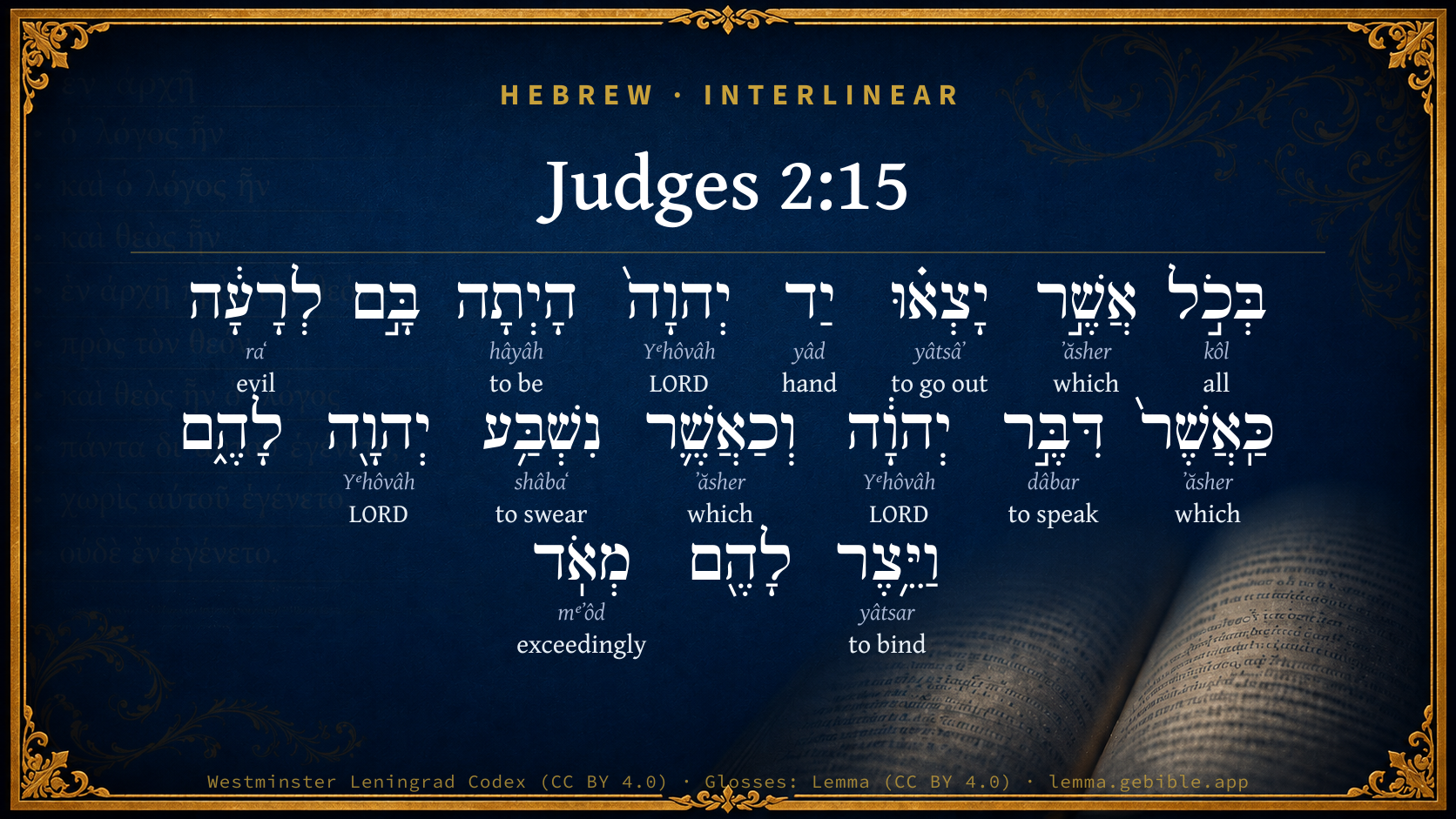
Judges 2:15

Hebrew (Westminster Leningrad Codex) Judges 2:15 appears in the Hebrew Old Testament. The text above is from the Westminster Leningrad Codex. Each word links to its Strong’s number, a concise gloss, and parsing drawn from the Open Scriptures Hebrew Bible morphology. Click any word for its full Brown-Driver-Briggs (BDB) entry.
Download image
Cite this verse

Judges 2:15 (World English Bible). Public Domain. Lemma interlinear Bible study tool, https://lemma.gebible.app/v/judges/2/15.

Show BibTeX & RIS
BibTeX
RIS
English Translation
Wherever they went out, the hand of Yahweh was against them for evil, as Yahweh had spoken, and as Yahweh had sworn to them: and they were sore distressed.
World English Bible · Public Domain
Download a study sheet

One document with this verse’s original text, its word-by-word gloss line, the meaning frame, cross-references with their text, attributed commentary, and full source and license credits — printable, and it pastes into notes with its structure intact.

This verse Autodidact and up

Study sheet (.html) Plain text (.txt)

A passage Seminary Student

Up to 50 verses in one chapter. A passage sheet keeps up to 6 commentary sources and 12 cross-references per verse, in the order this page ranks them, and says so on the sheet whenever that leaves anything out. Ask for a single verse and you get the Autodidact verse sheet above.

Everything on this page stays free to read, with no account — the sheet is a download of what is already on screen, not access to it.

Want to remove ads? Support Godless Engineer
Compare translations 3

The same verse in 3 English versions, stacked beneath the original-language interlinear above. Click any original word for its lexicon entry.

Each is an independent rendering of the whole verse — the interlinear is not word-aligned to these translations.

Highlighted words mark where these versions differ — a whole-verse word diff, not a word-by-word alignment.

  • World English Bible Public Domain
    Wherever they went out, the hand of Yahweh was against them for evil, as Yahweh had spoken, and as Yahweh had sworn to them: and they were sore distressed.
  • King James Version Public Domain
    Whithersoever they went out, the hand of the LORD was against them for evil, as the LORD had said, and as the LORD had sworn unto them: and they were greatly distressed.
  • unfoldingWord Literal Text CC BY-SA 4.0
    In all that they went out, the hand of Yahweh was against them for calamity, just as Yahweh had spoken and just as Yahweh had sworn to them. And it narrowed to them greatly.

unfoldingWord Literal Text — © unfoldingWord, licensed CC BY-SA 4.0. Word-aligned USFM3 via Door43 (git.door43.org/unfoldingWord/en_ult).

Versions to compare (up to 4)

3 of 4 selected

Show all 18 translations

Every available English version of this verse, each an independent rendering of the whole verse.

  • World English Bible Public Domain
    Wherever they went out, the hand of Yahweh was against them for evil, as Yahweh had spoken, and as Yahweh had sworn to them: and they were sore distressed.
  • Berean Standard Bible Public Domain
    Wherever Israel marched out, the hand of the LORD was against them to bring calamity, just as He had sworn to them. So they were greatly distressed.
  • Majority Standard Bible Public Domain
    Wherever Israel marched out, the hand of the LORD was against them to bring calamity, just as He had sworn to them. So they were greatly distressed.
  • King James Version Public Domain
    Whithersoever they went out, the hand of the LORD was against them for evil, as the LORD had said, and as the LORD had sworn unto them: and they were greatly distressed.
  • American Standard Version (1901) Public Domain
    Whithersoever they went out, the hand of Jehovah was against them for evil, as Jehovah had spoken, and as Jehovah had sworn unto them: and they were sore distressed.
  • Revised Version (1885) Public Domain
    Whithersoever they went out, the hand of the LORD was against them for evil, as the LORD had spoken, and as the LORD had sworn unto them: and they were sore distressed.
  • Geneva Bible (1599) Public Domain
    Whithersoeuer they went out, the hand of the Lord was sore against them, as ye Lord had sayd, and as the Lord had sworne vnto them: so he punished them sore.
  • Douay-Rheims (1899) Public Domain
    But whithersoever they meant to go, the hand of the Lord was upon them, as he had said, and as he had sworn to them: and they were greatly distressed.
  • Young's Literal Translation Public Domain
    in every `place' where they have gone out, the hand of Jehovah hath been against them for evil, as Jehovah hath spoken, and as Jehovah hath sworn to them, and they are distressed -- greatly.
  • Literal Standard Version CC BY-SA 4.0
    in every [place] where they have gone out, the hand of YHWH has been against them for calamity, as YHWH has spoken, and as YHWH has sworn to them, and they are greatly distressed.
  • Unlocked Literal Bible CC BY-SA 4.0
    Wherever Israel went out to fight, Yahweh's hand was against them to defeat them, just as he had sworn to them and they were in terrible distress.
  • unfoldingWord Literal Text CC BY-SA 4.0
    In all that they went out, the hand of Yahweh was against them for calamity, just as Yahweh had spoken and just as Yahweh had sworn to them. And it narrowed to them greatly.
  • Darby Bible Public Domain
    Whenever they marched out, the hand of the LORD was against them for evil, as the LORD had warned, and as the LORD had sworn to them; and they were in sore straits.
  • World Messianic Bible Public Domain
    Wherever they went out, the LORD’s hand was against them for evil, as the LORD had spoken, and as the LORD had sworn to them; and they were very distressed.
  • Webster's Bible Public Domain
    Whithersoever they went out, the hand of the LORD was against them for evil, as the LORD had said, and as the LORD had sworn to them: and they were greatly distressed.
  • Free Bible Version CC BY-SA 4.0
    Whenever Israel went into battle, the Lord fought against them and defeated them, just as he had warned them and as he had vowed he would do. They were in a great deal of trouble.
  • Bible in Basic English Public Domain
    Wherever they went out, the hand of the Lord was against them for evil, as the Lord had taken his oath it would be; and things became very hard for them.
  • JPS Tanakh (1917) Public Domain
    Whithersoever they went out, the hand of the LORD was against them for evil, as the LORD had spoken, and as the LORD had sworn unto them; and they were sore distressed.

Literal Standard Version (2020), Covenant Press — licensed CC BY-SA 4.0. Text via the HelloAO Bible API (eBible.org). Unlocked Literal Bible (unfoldingWord) — licensed CC BY-SA 4.0. Text via the HelloAO Bible API (eBible.org). unfoldingWord Literal Text — © unfoldingWord, licensed CC BY-SA 4.0. Word-aligned USFM3 via Door43 (git.door43.org/unfoldingWord/en_ult). Free Bible Version, Dr. Jonathan Gallagher — licensed CC BY-SA 4.0. Text via the HelloAO Bible API (eBible.org).

Word by word

More ways to search: Search by grammar → Find every occurrence → Compare this word →

Practice this passage: Drill this verse → Learn its vocabulary →

וַיֵּ֥צֶר
yâtsar
H3334
“and · to bind”
Conjunction + Verb, Qal, Sequential Imperfect, 3rd Person, Masculine, Singular
Part of Speech
Conjunction + Verb
Stem
Qal
Form
Sequential Imperfect
Person
3rd Person
Gender
Masculine
Number
Singular
Full BDB Definition

Origin: a primitive root

TWOT: 1973

to bind, be distressed, be in distress, be cramped, be narrow, be scant, be in straits, make narrow, cause distress, beseige - (Qal) to suffer distress
  1. בְּכֹ֣ל kôl H3605 “in/at · all” Preposition + Noun, Common, Masculine, Singular, Absolute
  2. אֲשֶׁ֣ר ʼăsher H834 “which” Particle, Relative
  3. יָצְא֗וּ yâtsâʼ H3318 “to go out” Verb, Qal, Perfect, 3rd Person, Common, Plural
  4. יַד yâd H3027 “hand of” Noun, Common, Both, Singular, Construct
  5. יְהוָה֙ Yᵉhôvâh H3068 “LORD” Noun, Proper
  6. הָיְתָה hâyâh H1961 “to be” Verb, Qal, Perfect, 3rd Person, Feminine, Singular
  7. לְרָעָ֔ה raʻ H7451 “to/for · evil” Preposition + Noun, Common, Feminine, Singular, Absolute
  8. כַּֽאֲשֶׁר֙ ʼăsher H834 “like/as · which” Preposition + Particle, Relative
  9. דִּבֶּ֣ר dâbar H1696 “to speak” Verb, Piel, Perfect, 3rd Person, Masculine, Singular
  10. יְהוָ֔ה Yᵉhôvâh H3068 “LORD” Noun, Proper
  11. וְכַאֲשֶׁ֛ר ʼăsher H834 “and · like/as · which” Conjunction + Preposition + Particle, Relative
  12. נִשְׁבַּ֥ע shâbaʻ H7650 “to swear” Verb, Niphal, Perfect, 3rd Person, Masculine, Singular
  13. יְהוָ֖ה Yᵉhôvâh H3068 “LORD” Noun, Proper
  14. מְאֹֽד mᵉʼôd H3966 “exceedingly” Adverb

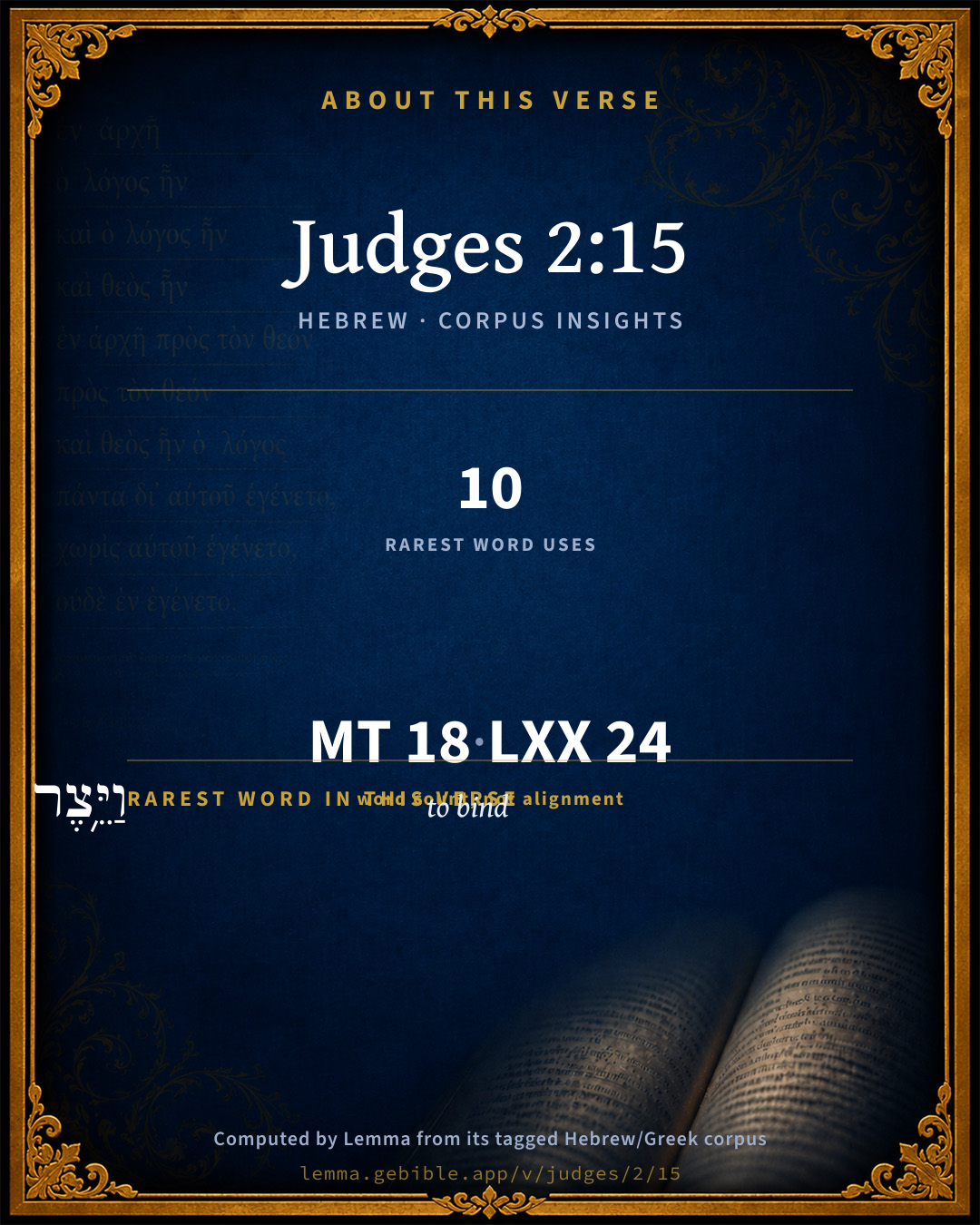
About this verse

These counts appear in no published source. They are computed here, from the morphology-tagged text and Lemma’s own curated glosses. What Lemma adds →

18
words
11
distinct lemmas
Historical
section

Notable vocabulary

The rarest word here is וַיֵּ֥צֶר to bind H3334 — appearing just 10 times in the whole Hebrew Bible.

Shared distinctive vocabulary

וַיֵּ֥צֶר to bind H3334 occurs in 10 verses of the Hebrew Bible. Also found in:

Grammatical profile

  • 5 verbs
  • 6 nouns
  • 3 prepositions
  • 1 adverb
  • 3 particles

Verb forms

  • יָצְא֗וּ Qal · Perfect
  • הָיְתָה Qal · Perfect
  • דִּבֶּ֣ר Piel · Perfect
  • נִשְׁבַּ֥ע Niphal · Perfect
  • וַיֵּ֥צֶר Qal · Sequential Imperfect

Repetition

Words recur within this verse — often emphatic in Hebrew:

  • יְהוָה֙ LORD H3068 ×3
  • אֲשֶׁ֣ר which H834 ×3

Hebrew & Septuagint length

In English translation the verse runs 29 words from the Hebrew and 31 from the Septuagint (LXX English) — closely comparable.

A rough comparison of the two English renderings, which tokenize alike — not a word-level alignment.

Word counts can differ between the Hebrew and the Greek without any difference in meaning — e.g. the Hebrew direct-object marker אֵת has no separate Greek word, and Greek often adds the article ὁ.

In the original languages it is 18 Hebrew tokens and 24 Greek tokens — but the two are counted differently (Hebrew bundles its prefixes and suffixes into one token; the Greek is in lemma form), so that isn’t a like-for-like length.

Cross-references

15

Topical passages linked to Judges 2:15 in the Treasury of Scripture Knowledge — connected by theme and wording, ordered by reader-vote popularity; previews shown in the World English Bible.

  • Deuteronomy 28:15–68 But it shall come to pass, if you will not listen to the voice of Yahweh your God, to observe to do all his commandments and his statutes which I command you this day, that all these curses shall come on you, and overtake you.
  • Joshua 23:15–16 It shall happen, that as all the good things are come on you of which Yahweh your God spoke to you, so will Yahweh bring on you all the evil things, until he have destroyed you from off this good land which Yahweh your God has given you.
  • Leviticus 26:14–46 "'But if you will not listen to me, and will not do all these commandments;
  • Deuteronomy 4:25–28 When you shall father children, and children's children, and you shall have been long in the land, and shall corrupt yourselves, and make an engraved image in the form of anything, and shall do that which is evil in the sight of Yahweh your God, to provoke him to anger;
  • Deuteronomy 32:40–41 For I lift up my hand to heaven, And say, As I live forever,
  • Judges 10:9 The children of Ammon passed over the Jordan to fight also against Judah, and against Benjamin, and against the house of Ephraim; so that Israel was sore distressed.
  • 1 Samuel 13:6 When the men of Israel saw that they were in a strait (for the people were distressed), then the people did hide themselves in caves, and in thickets, and in rocks, and in coverts, and in pits.
  • 1 Samuel 14:24 The men of Israel were distressed that day; for Saul had adjured the people, saying, Cursed be the man who eats any food until it be evening, and I be avenged on my enemies. So none of the people tasted food.
  • 1 Samuel 30:6 David was greatly distressed; for the people spoke of stoning him, because the soul of all the people was grieved, every man for his sons and for his daughters: but David strengthened himself in Yahweh his God.
  • Jeremiah 18:8 if that nation, concerning which I have spoken, turn from their evil, I will repent of the evil that I thought to do to them.
  • Jeremiah 21:10 For I have set my face on this city for evil, and not for good, says Yahweh: it shall be given into the hand of the king of Babylon, and he shall burn it with fire.
  • Jeremiah 44:11 Therefore thus says Yahweh of Hosts, the God of Israel: Behold, I will set my face against you for evil, even to cut off all Judah.
  • Jeremiah 44:27 Behold, I watch over them for evil, and not for good; and all the men of Judah who are in the land of Egypt shall be consumed by the sword and by the famine, until there be an end of them.
  • Micah 2:3 Therefore thus says Yahweh: "Behold, I am planning against these people a disaster, From which you will not remove your necks, Neither will you walk haughtily; For it is an evil time.
  • 2 Corinthians 4:8 We are pressed on every side, yet not crushed; perplexed, yet not to despair;

Cross-references courtesy of OpenBible.info (CC BY 4.0).

Hebrew and Greek witnesses Masoretic Hebrew ↔ Greek Septuagint

The same verse in the two great witnesses to the Old Testament, shown verse-for-verse.

These are two independent witnesses, not word-aligned to each other, and the Septuagint is shown in lemma (dictionary) form.

Hebrew Judges 2:15 Masoretic · Westminster Leningrad Codex

בְּכֹ֣ל אֲשֶׁ֣ר יָצְא֗וּ יַד יְהוָה֙ הָיְתָה בָּ֣ם לְרָעָ֔ה כַּֽאֲשֶׁר֙ דִּבֶּ֣ר יְהוָ֔ה וְכַאֲשֶׁ֛ר נִשְׁבַּ֥ע יְהוָ֖ה לָהֶ֑ם וַיֵּ֥צֶר לָהֶ֖ם מְאֹֽד

Wherever they went out, the hand of Yahweh was against them for evil, as Yahweh had spoken, and as Yahweh had sworn to them: and they were sore distressed.

World English Bible · Public Domain

Greek LXX Judges 2:15 Septuagint · lemma form

ἐν πᾶς ὅς ἐκπορεύομαι καί χείρ κύριος εἰμί ἐπί αὐτός εἰς κακός καθώς λαλέω κύριος καί καθώς ὄμνυμι κύριος αὐτός καί ἐκθλίβω αὐτός σφόδρα

among whoever they went; and the hand of the Lord was against them for evil, as the Lord spoke, and as the Lord swore to them; and he greatly afflicted them.

LXX2012 (modern English Septuagint) · Public Domain

Hebrew: Westminster Leningrad Codex (CC BY 4.0). Greek: Septuagint (public domain); English from LXX2012 (modern English Septuagint) (Public Domain). How the Septuagint differs from the Hebrew →

Targum (Aramaic paraphrase)

1

The Targum is the ancient Jewish Aramaic paraphrase of the Hebrew Scriptures — an interpretive translation, not the Hebrew text itself. Onkelos (literal) and Pseudo-Jonathan (expansive) render the Torah, and Jonathan the Prophets. Coverage is partial: where no permissively-licensed English translation exists for a verse, only the Aramaic is shown. This is verse-level text, not a word-by-word alignment to the Hebrew.

  1. Targum Jonathan Prophets (Joshua–Malachi)
    בְּכָל אֲתַר דִי נְפַקוּ מָחָא מִן קֳדָם יְיָ הֲוַת בְּהוֹן לְבִישָׁא כְּמָא דְמַלֵיל יְיָ וּכְמָא דְקַיֵם יְיָ לְהוֹן וְעָקַת לְהוֹן לַחֲדָא:

    (no public-domain English translation for this verse)

    Targum Jonathan — Aramaic: “Mikraot Gedolot” (public domain). English: “Sefaria Community Translation” (CC0 1.0 (public-domain dedication)); “London "Chaldee Paraphrase," 1871” (public domain). Text via Sefaria.

Commentary

Notes on Judges 2:15 from classic Christian and Jewish commentators (each source and its license shown beneath its notes). The classic Christian expositions comment on the surrounding passage and are grouped to its opening verse, so a note may address several verses; the Jewish commentaries on the Tanakh (Rashi and others) are per-verse, so they appear only where the commentator wrote on this verse.

Lemma curates 59 commentaries, every one of them public domain or Creative Commons licensed, each selected and text-cleaned for this edition rather than reprinted as found. About our sources →

Trapp's Complete Commentary

John Trapp

Jdg 2:15 Whithersoever they went out, the hand of the LORD was against them for evil, as the LORD had said, and as the LORD had sworn unto them: and they were greatly distressed.

Ver. 15. As the Lord had said, and as the Lord had sworn.] But they would never believe till they felt, as holding all to be spoken in terrorem only to frighten silly people, or putting off all with a "God forbid," as those in Luk 20:16; but execution followeth commination, unless repentance interpose and take up the quarrel.

And they were greatly distressed.] See Zep 3:5. {See Trapp on "Zep 3:5"}

John Trapp, A Commentary or Exposition upon All the Books of the Old and New Testament (1647–1656) — public domain. Text from a community e-Sword module.

Geneva Bible (1599)

Geneva Bible translators

The vengeance.

In all their enterprises.

Geneva Bible (1599) marginal notes — public domain. Text via Bolls.life.

Adam Clarke's Commentary

Verse 15. The hand of the Lord was against them] The power which before protected them when obedient, was now turned against them because of their disobedience. They not only had not God with them, but they had God against them.

Adam Clarke's Commentary on the Bible (1810–1826) — public domain. Text from a community e-Sword/MySword module.

Ellicott's Commentary for English Readers

(15) The hand of the Lord was against them.—Contrast this with Jos_1:9.

As the Lord had said.—Lev_26:17-36; Deu_28:25, &c.

A Bible Commentary for English Readers, edited by Charles John Ellicott (1878–1897) — public domain. Text from a community e-Sword module.

The Cambridge Bible for Schools and Colleges

gen. ed. J. J. S. Perowne

15. For the threat of punishment in case of disloyalty see Deu_28:48-53 and Lev_26:17; Lev_26:36-39.

The Cambridge Bible for Schools and Colleges (gen. ed. J. J. S. Perowne; Cambridge University Press, 1878–1918) — public domain. Text from a community e-Sword module.

John Gill's Exposition

Whithersoever they went out, the hand of the Lord was against them for evil,.... They prospered not in any business they undertook, or put their hands unto; or in any expedition they went upon, or when they went out to war, as Kimchi, Ben Melech, and Abarbinel explain the phrase: the battle went against them, because God was against them; his hand was against them, and there was no resisting and turning that back; and this sense seems to agree with what goes before and follows after; though in some Jewish writings (a) it is explained of those that went out of the land to escape the calamities of it, and particularly of Elimelech and his two sons, Mahlon and Chilion, Rut 1:1,

as the Lord had said, and as the Lord had sworn unto them; having ratified and confirmed his threatening with an oath, that if they served other gods, he would surely bring upon them all the curses of the law; see Deu 29:12,

and they were greatly distressed; by the Canaanites they suffered to dwell among them, who were pricks in their eyes, and thorns in their sides, as had been threatened them; and by the nations round about them, who came in upon them, and plundered them, and carried them captive.

(a) Seder Olam Rabba, c. 12. p. 34.

John Gill's Exposition of the Whole Bible (1746–1763) — public domain (CC PDM 1.0). Text via the HelloAO Bible API.

Matthew Poole's English Annotations

Whithersoever they went out, i.e. whatsoever expedition or business they undertook; which is usually signified by going out and coming in.

Matthew Poole's English Annotations on the Holy Bible (1683–1685) — public domain. Text from a community e-Sword/MySword module.

Whedon's Commentary on the Bible

Daniel D. Whedon

15. Whithersoever they went out — Whether in the avocations of peace or to the field of war. Sad indeed is the condition of that nation with which the Almighty wages a constant war.

The hand of the Lord was against them for evil — Providence worked against them, so that all manner of misfortunes befell them. Now they were scourged by famine, now by war and oppression.

Daniel D. Whedon (gen. ed.), Commentary on the Old and New Testaments (1874–1909) — public domain. Text from a community e-Sword module.

John Wesley's Explanatory Notes

Whithersoever they went - That is, Whatsoever expedition or business they undertook; which is usually signified by going out, and coming in.

John Wesley, Explanatory Notes Upon the Whole Bible (1754–1765) — public domain. Text via the GEBible commentary corpus.

Rashi

Rabbi Shlomo Yitzchaki (Rashi)

Wherever they went, the hand of Adonoy was destructive to them. This refers to Elimelech, Machlon, and Chilyon— Seder Olam.

Rashi on the Tanakh — English translations: “The Judaica Press complete Tanach with Rashi, translated by A. J. Rosenberg” (CC BY 4.0); “Pentateuch with Rashi's commentary by M. Rosenbaum and A.M. Silbermann, 1929-1934” (public domain); “The Metsudah Tanach series, Lakewood, N.J” (CC BY 4.0); and “The Book of Joshua, Metsudah Publications, 1997” (CC BY 4.0). Text via Sefaria.

Lesson kit

Teaching starters — assembled from the data on this page, not authored interpretation. Every prompt links to the verse data it draws on. Edit before teaching.

Judges, in the Historical, opens this verse with 18 words (11 distinct Hebrew lemmas). Its most distinctive word is yâtsar (“to bind”). A historical commentator’s framing appears above. Read the whole chapter for the surrounding context.

Discussion questions

  1. The word yâtsar carries the sense “to bind.” How does it shape the verse?
  2. Genesis 32:7 shares the word «to bind» with this verse. How do the two illuminate each other?
  3. “LORD” occurs 3× in this one verse. What is the effect of the repetition?
  4. The translations on this page render this verse differently — a whole-verse word diff, not a word-by-word alignment. What might account for the different wordings?
  5. The verb «יָצְא֗וּ» is Qal Perfect. How does its form color the action?
  6. Reading how Trapp's Complete Commentary and Geneva Bible (1599) read this verse, where do the two commentators agree and where do they part?

Things to notice

Reading settings

Reading text

Shown beneath each verse's original-language words.

Old Testament
Old Testament edition

Read the OT as the Masoretic Hebrew (MT) or the Greek Septuagint (LXX).

English shown for the Greek Septuagint (in the Hebrew ↔ Greek comparison).

Comparing translations? Open the Compare panel on any verse page to stack up to four side by side.