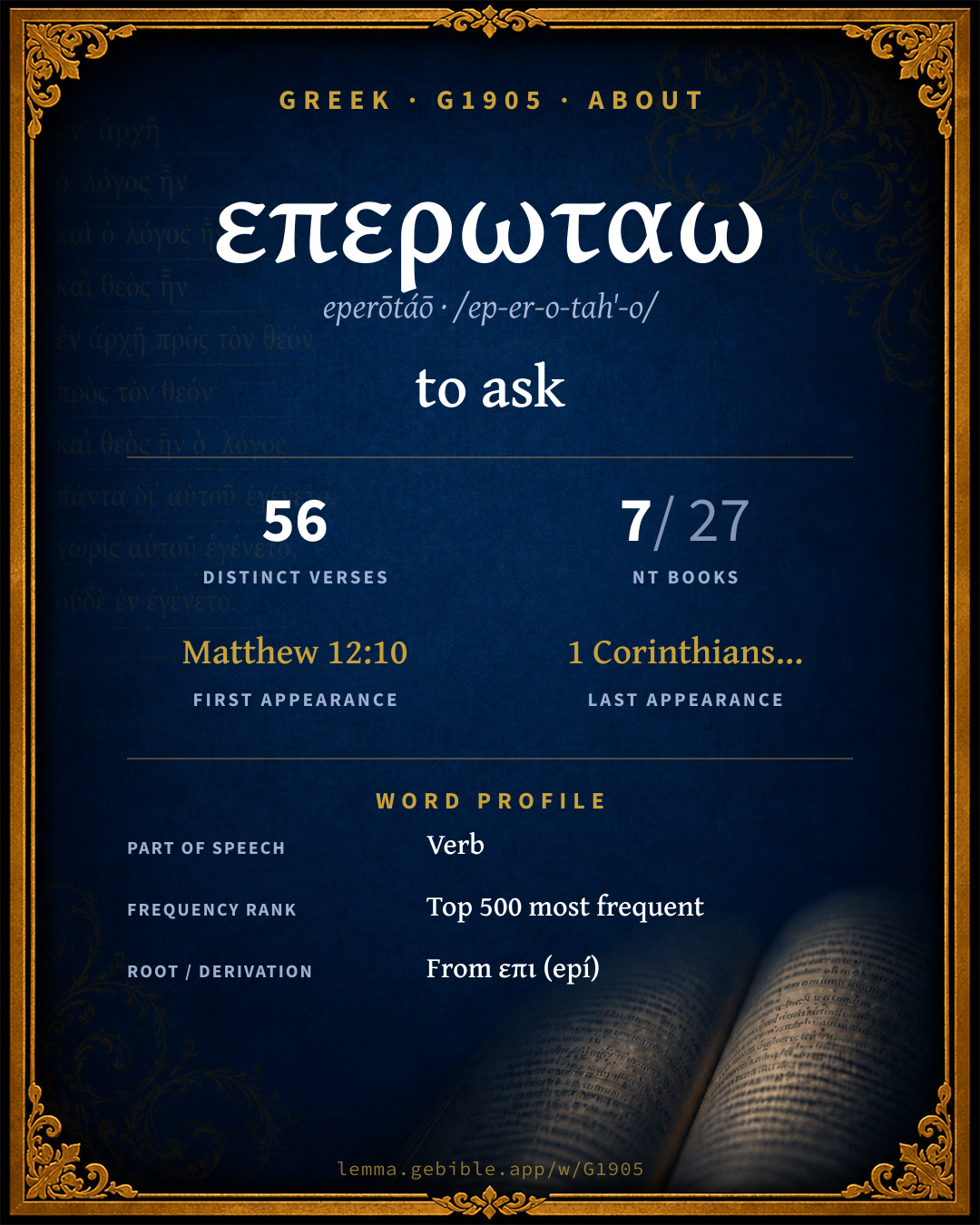
ἐπερωτάω
to ask
‘to ask’ is one of 2 main senses fuller range ↓
Full lexicon entry — Thayer's Greek Lexicon
From Thayer's Greek Lexicon
Where this word appears
See every Imperfect-tense verb in the Greek New Testament →
Grammar key — what these labels mean
Part of speech
- Verb
- An action or state-of-being word.
Tense
- Aorist
- Action viewed as a simple whole, without regard to duration — often past (perfective aspect).
- Imperfect
- Continuous or repeated action in past time (“was writing”).
- Future
- Action expected in future time.
- Present
- Ongoing or general action in present time (imperfective aspect).
Voice
- Active
- The subject performs the action.
- Passive
- The subject receives the action.
Mood
- Indicative
- States a fact or asks a factual question (the mood of reality).
- Infinitive
- A verbal noun (“to write”), unmarked for person or number.
- Imperative
- Expresses a command or request.
- Participle
- A verbal adjective (“writing,” “having written”).
Case
- Nominative
- The case of the subject (and the predicate nominative).
- Accusative
- The case of the direct object and of extent.
- Dative
- The case of the indirect object, means, or location — “to / for / with / in.”
Person
- 3rd person
- The one spoken about (“he / she / it / they”).
- 2nd person
- The one addressed (“you”).
- 1st person
- The speaker (“I / we”).
Gender
- Masculine
- Grammatically masculine.
Number
- Singular
- One.
- Plural
- More than one.
8 verses where G1905 appears in the Aorist tense in the Book of Mark. Filtered view — show all forms. Click any verse to open its interlinear word-by-word view. Verse text shown in the World English Bible for context — . Each verse’s Greek form is shown with its reference; the English is not keyword-highlighted, since the data carries no word-level English alignment. Use “Compare translations” on any verse to read it across multiple English versions. This concordance covers the Greek New Testament; Septuagint (Greek Old Testament) occurrences of this word are not indexed here.
Mark
- Mark 9:16 ἐπηρώτησεν aor act ind 3sg He asked the scribes, "What are you asking them?"
- Mark 9:21 ἐπηρώτησεν aor act ind 3sg He asked his father, "How long has it been since this has come to him?" He said, "From childhood.
- Mark 9:32 ἐπερωτῆσαι aor act inf But they didn't understand the saying, and were afraid to ask him.
- Mark 12:28 ἐπηρώτησεν aor act ind 3sg One of the scribes came, and heard them questioning together. Knowing that he had answered them well, asked him, "Which commandment is the greatest of all?"
- Mark 12:34 ἐπερωτῆσαι aor act inf When Jesus saw that he answered wisely, he said to him, "You are not far from the Kingdom of God." No one dared ask him any question after that.
- Mark 14:60 ἐπηρώτησεν aor act ind 3sg The high priest stood up in the midst, and asked Jesus, "Have you no answer? What is it which these testify against you?"
- Mark 15:2 ἐπηρώτησεν aor act ind 3sg Pilate asked him, "Are you the King of the Jews?" He answered, "So you say."
- Mark 15:44 ἐπηρώτησεν aor act ind 3sg Pilate marveled if he were already dead; and summoning the centurion, he asked him whether he had been dead long.
About this entry
At a glance — auto-summarized from this page’s data, not written by a person. Every figure links to its source below. This summary describes the numbers; it doesn’t interpret them.
At its core, επερωταω (eperōtáō) means “to ask.” Older and newer Bibles part ways — “asked” in the King James Version, “questioned” (unfoldingWord Literal Text) in modern versions. See the renderings breakdown. It turns up in 56 verses across 7 books, a moderately common footprint. The word gravitates to Mark (45%), then Luke and Matthew. Catalogued under 2 senses, its meaning is not single-sense. Dig into 56-verse concordance and the renderings breakdown below.
Gloss history
Strong's 1890 vs modern scholarship
About this word
Strong's G1905 catalogs a Greek word from the Greek New Testament.
These counts are not copied from any lexicon or concordance. They are computed here, from the morphology-tagged Greek New Testament. What Lemma adds →
- 56
- distinct verses
- The word appears in 56 distinct verses.
- 7 / 27
- NT books
- The word appears in 7 of 27 New Testament books.
- #286
- by frequency
- Top 500 most frequent Greek words (rank 286 of 5,347 Greek words by occurrence).
View all 56 occurrences in the concordance →
By section of the New Testament
By traditional corpus
Conventional, traditional groupings — biblical authorship is debated, so this is a traditional corpus grouping, not an authorship claim. Some books belong to more than one corpus (Luke is in both the Gospels and the Lukan corpus, and so on), so these shares overlap and need not total 100%. Each figure is a share of the word’s 56 distinct verses.
- Gospels 52 verses · 93%
- Lukan (Luke–Acts) 19 verses · 34%
- Johannine 2 verses · 4%
- Pauline corpus 2 verses · 4%
How translations render this word
Counts come from each version’s own published word-to-Strong’s tagging or interlinear alignment — an approximate guide to how each version renders this word, not a word-level alignment the data otherwise carries. Because each total is that version’s own tagged count, the per-version totals vary from one another and need not match the appearance or distinct-verse counts above. These counts may also differ from a printed concordance because Lemma counts each distinctly tagged rendering and does not collapse phrase taggings into a single head-word total. This is a fixed set of word-tagged versions (KJV, ASV, BSB, ULT) and does not change with the reading translation you choose elsewhere. Each version’s license is shown beside its name below (and on Sources).
- King James Version: Asked 25×, He asked 12×, They asked 7×
- American Standard Version: Asked 26×, He asked 11×, They asked 7×
- Berean Standard Bible: Asked 15×, Questioned 10×, He asked 7×
- unfoldingWord Literal Text: Questioned 11×, Asked 5×, Ask 4×
King James Version Public Domain
Renders G1905 across 62 tagged occurrences — most commonly:
Plus 13 renderings that appear only once — usually multi-word phrases or single function words the recovered tagging swept in, not distinct renderings.
American Standard Version Public Domain
Renders G1905 across 61 tagged occurrences — most commonly:
Plus 12 renderings that appear only once — usually multi-word phrases or single function words the recovered tagging swept in, not distinct renderings.
Berean Standard Bible Public Domain
Renders G1905 across 56 tagged occurrences — most commonly:
Plus 9 renderings that appear only once — usually multi-word phrases or single function words the recovered tagging swept in, not distinct renderings.
unfoldingWord Literal Text CC BY-SA 4.0
Renders G1905 across 59 tagged occurrences — most commonly:
Plus 15 renderings that appear only once — usually multi-word phrases or single function words the recovered tagging swept in, not distinct renderings.
Senses in Thayer's
The 2 senses Thayer's distinguishes for this word, in lexicon order (not ranked by frequency or importance). The full entry — with sub-senses — is in the Lexicon Entry tab.
- to accost one with an enquiry, put a question to, enquiry of, ask, interrogate
- to address one with a request or demand
Word origin
Derived from επι (epí) (G1909) — upon.
Forms in the corpus
The 16 distinct written forms G1905 takes in the Greek New Testament, most frequent first — each parse links to that tense’s occurrences in the concordance.
Same root — word family
Other Thayer's entries built from the same root as G1905, grouped by Strong’s listed origin. These share a root / origin per the lexicon — not necessarily a shared meaning. Each links to that word’s own entry.
Derives from
Shares the same root
- επαγγελλω epangéllō G1861 to announce
- επαγω epágō G1863 to bring upon
- επαγωνιζομαι epagōnízomai G1864 to contend
- επαθροιζω epathroízō G1865 to gather together
- επαινεω epainéō G1867 to approve
- επαινος épainos G1868 approval
- επαιρω epaírō G1869 to lift up
- επαισχυνομαι epaischýnomai G1870 to be ashamed
- επαιτεω epaitéō G1871 to ask repeatedly
- επακουω epakoúō G1873 to give ear to
- επακροαομαι epakroáomai G1874 to listen to
- επαν epán G1875 after
- επαναγκες epánankes G1876 necessarily
- επαναγω epanágō G1877 to lead back
- επαναμιμνησκω epanamimnḗskō G1878 to remind
- επαναπαυομαι epanapaúomai G1879 to rest upon
- επανερχομαι epanérchomai G1880 to return
- επανισταμαι epanístamai G1881 to raise up against
- επανορθωσις epanórthōsis G1882 correction
- επανω epánō G1883 above
- επαρκεω eparkéō G1884 to avail
- επαρχια eparchía G1885 office of governor
- επαυλις épaulis G1886 farm
- επαυριον epaúrion G1887 the next day
+110 more words share this root (not shown).
Derived from this word
Proper names from this root
People and places named from this root — a name, not an additional meaning of the word.
Compare all same-root words → Showing 4 of 138 — not the complete family. 1 of the same-root words is a proper name (a person or place). They share a root, not necessarily a meaning.
Septuagint usage
The same Greek word επερωταω appears 55 times in the Greek Old Testament (Septuagint), across 54 verses in 21 books.
- 55
- LXX occurrences
- Tagged occurrences of this Greek word in the Septuagint.
- 54
- verses
- Distinct Septuagint verses containing this word.
- 21 / 39
- OT books
- The word appears in 21 of the 39 Old Testament books.
Sample Septuagint occurrences
- Genesis 24:23 ἐπιἐρωτάω
- Numbers 23:3 ἐπιἐρωτάω
- Deuteronomy 4:32 ἐπιἐρωτάω
- Joshua 9:14 ἐπιἐρωτάω
- Judges 1:1 ἐπιἐρωτάω
- 1 Samuel 9:9 ἐπιἐρωτάω
- 2 Samuel 2:1 ἐπιἐρωτάω
- 1 Kings 12:24 ἐπιἐρωτάω
- 2 Kings 1:2 ἐπιἐρωτάω
- 1 Chronicles 10:13 ἐπιἐρωτάω
- Job 8:8 ἐπιἐρωτάω
- Psalms 136:3 ἐπιἐρωτάω
Septuagint occurrences (same lexeme)
Every verse where the same Strong’s number (G1905) appears in the Greek Septuagint — showing the first 50 of 54. Verse text shown in the World English Bible for context; the Greek form is the matched word — the English is not keyword-highlighted.
- Genesis 24:23 ἐπιἐρωτάω and said, "Whose daughter are you? Please tell me. Is there room in your father's house for us to lodge in?"
- Genesis 26:7 ἐπιἐρωτάω The men of the place asked him about his wife. He said, "She is my sister," for he was afraid to say, "My wife," lest, he thought, the men of the place might kill me for Rebekah, because she was beautiful to look on.
- Genesis 38:21 ἐπιἐρωτάω Then he asked the men of her place, saying, "Where is the prostitute, that was at Enaim by the road?" They said, "There has been no prostitute here."
- Genesis 43:7 ἐπιἐρωτάω They said, "The man asked directly concerning ourselves, and concerning our relatives, saying, 'Is your father still alive? Have you another brother?' We just answered his questions. Is there any way we could know that he would say, 'Bring your brother down?'"
- Numbers 23:3 ἐπιἐρωτάω Balaam said to Balak, Stand by your burnt offering, and I will go: perhaps Yahweh will come to meet me; and whatever he shows me I will tell you. He went to a bare height.
- Numbers 23:15 ἐπιἐρωτάω He said to Balak, Stand here by your burnt offering, while I meet [Yahweh] yonder.
- Numbers 27:21 ἐπιἐρωτάω He shall stand before Eleazar the priest, who shall inquire for him by the judgment of the Urim before Yahweh: at his word shall they go out, and at his word they shall come in, both he, and all the children of Israel with him, even all the congregation.
- Deuteronomy 4:32 ἐπιἐρωτάω For ask now of the days that are past, which were before you, since the day that God created man on the earth, and from the one end of the sky to the other, whether there has been [any such thing] as this great thing is, or has been heard like it?
- Deuteronomy 18:11 ἐπιἐρωτάω or a charmer, or a consulter with a familiar spirit, or a wizard, or a necromancer.
- Deuteronomy 32:7 ἐπιἐρωτάω Remember the days of old, Consider the years of many generations: Ask your father, and he will show you; Your elders, and they will tell you.
- Joshua 9:14 ἐπιἐρωτάω The men took of their provision, and didn't ask counsel at the mouth of Yahweh.
- Judges 1:1 ἐπιἐρωτάω It happened after the death of Joshua, the children of Israel asked of Yahweh, saying, Who shall go up for us first against the Canaanites, to fight against them?
- Judges 8:14 ἐπιἐρωτάω He caught a young man of the men of Succoth, and inquired of him: and he described for him the princes of Succoth, and the elders of it, seventy-seven men.
- Judges 20:28 ἐπιἐρωτάω and Phinehas, the son of Eleazar, the son of Aaron, stood before it in those days), saying, Shall I yet again go out to battle against the children of Benjamin my brother, or shall I cease? Yahweh said, Go up; for tomorrow I will deliver him into your hand.
- 1 Samuel 9:9 ἐπιἐρωτάω (In earlier times in Israel, when a man went to inquire of God, thus he said, Come, and let us go to the seer; for he who is now called a Prophet was before called a Seer.)
- 1 Samuel 10:22 ἐπιἐρωτάω Therefore they asked of Yahweh further, Is there yet a man to come here? Yahweh answered, Behold, he has hid himself among the baggage.
- 1 Samuel 14:37 ἐπιἐρωτάω Saul asked counsel of God, Shall I go down after the Philistines? will you deliver them into the hand of Israel? But he didn't answer him that day.
- 1 Samuel 23:2 ἐπιἐρωτάω Therefore David inquired of Yahweh, saying, Shall I go and strike these Philistines? Yahweh said to David, Go, and strike the Philistines, and save Keilah.
- 1 Samuel 28:6 ἐπιἐρωτάω When Saul inquired of Yahweh, Yahweh didn't answer him, neither by dreams, nor by Urim, nor by prophets.
- 1 Samuel 28:16 ἐπιἐρωτάω Samuel said, Why then do you ask of me, seeing Yahweh is departed from you, and is become your adversary?
- 1 Samuel 30:8 ἐπιἐρωτάω David inquired of Yahweh, saying, If I pursue after this troop, shall I overtake them? He answered him, Pursue; for you shall surely overtake [them], and shall without fail recover [all].
- 2 Samuel 2:1 ἐπιἐρωτάω It happened after this, that David inquired of Yahweh, saying, Shall I go up into any of the cities of Judah? Yahweh said to him, Go up. David said, Where shall I go up? He said, To Hebron.
- 2 Samuel 5:23 ἐπιἐρωτάω When David inquired of Yahweh, he said, You shall not go up: make a circuit behind them, and come on them over against the mulberry trees.
- 2 Samuel 11:7 ἐπιἐρωτάω When Uriah was come to him, David asked of him how Joab did, and how the people fared, and how the war prospered.
- 2 Samuel 14:18 ἐπιἐρωτάω Then the king answered the woman, Please don't hide anything from me that I shall ask you. The woman said, Let my lord the king now speak.
- 2 Samuel 16:23 ἐπιἐρωτάω The counsel of Ahithophel, which he gave in those days, was as if a man inquired at the oracle of God: so was all the counsel of Ahithophel both with David and with Absalom.
- 2 Samuel 20:18 ἐπιἐρωτάω Then she spoke, saying, They were wont to speak in old time, saying, They shall surely ask [counsel] at Abel: and so they ended [the matter].
- 1 Kings 12:24 ἐπιἐρωτάω Thus says Yahweh, You shall not go up, nor fight against your brothers the children of Israel: return every man to his house; for this thing is of me. So they listened to the word of Yahweh, and returned and went their way, according to the word of Yahweh.
- 1 Kings 22:5 ἐπιἐρωτάω Jehoshaphat said to the king of Israel, Please inquire first for the word of Yahweh.
- 1 Kings 22:7 ἐπιἐρωτάω But Jehoshaphat said, Isn't there here a prophet of Yahweh besides, that we may inquire of him?
- 1 Kings 22:8 ἐπιἐρωτάω The king of Israel said to Jehoshaphat, there is yet one man by whom we may inquire of Yahweh, Micaiah the son of Imlah: but I hate him; for he does not prophesy good concerning me, but evil. Jehoshaphat said, "Don't let the king say so."
- 2 Kings 1:2 ἐπιἐρωτάω Ahaziah fell down through the lattice in his upper chamber that was in Samaria, and was sick: and he sent messengers, and said to them, Go, inquire of Baal Zebub, the god of Ekron, whether I shall recover of this sickness.
- 2 Kings 8:6 ἐπιἐρωτάω When the king asked the woman, she told him. So the king appointed to her a certain officer, saying, Restore all that was hers, and all the fruits of the field since the day that she left the land, even until now.
- 1 Chronicles 10:13 ἐπιἐρωτάω So Saul died for his trespass which he committed against Yahweh, because of the word of Yahweh, which he didn't keep; and also because he asked counsel of one who had a familiar spirit, to inquire [thereby],
- Job 8:8 ἐπιἐρωτάω "Please inquire of past generations, Find out about the learning of their fathers.
- Job 12:7 ἐπιἐρωτάω "But ask the animals, now, and they shall teach you; The birds of the sky, and they shall tell you.
- Psalms 136:3 ἐπιἐρωτάω Give thanks to the Lord of lords; For his loving kindness endures forever:
- Proverbs 17:28 ἐπιἐρωτάω Even a fool, when he keeps silent, is counted wise. When he shuts his lips, he is thought to be discerning.
- Ecclesiastes 7:10 ἐπιἐρωτάω Don't say, "Why were the former days better than these?" For you do not ask wisely about this.
- Isaiah 19:3 ἐπιἐρωτάω The spirit of Egypt shall fail in the midst of it; and I will destroy the counsel of it: and they shall seek to the idols, and to the charmers, and to those who have familiar spirits, and to the wizards.
- Isaiah 30:2 ἐπιἐρωτάω that set out to go down into Egypt, and have not asked at my mouth; to strengthen themselves in the strength of Pharaoh, and to take refuge in the shadow of Egypt!
- Isaiah 65:1 ἐπιἐρωτάω I am inquired of by those who didn't ask; I am found by those who didn't seek me: I said, See me, see me, to a nation that was not called by my name.
- Jeremiah 21:2 ἐπιἐρωτάω Please inquire of Yahweh for us; for Nebuchadrezzar king of Babylon makes war against us: peradventure Yahweh will deal with us according to all his wondrous works, that he may go up from us.
- Jeremiah 37:14 ἐπιἐρωτάω Then said Jeremiah, It is false; I am not falling away to the Chaldeans. But he didn't listen to him; so Irijah laid hold on Jeremiah, and brought him to the princes.
- Ezekiel 14:7 ἐπιἐρωτάω For everyone of the house of Israel, or of the strangers who sojourn in Israel, who separates himself from me, and takes his idols into his heart, and puts the stumbling block of his iniquity before his face, and comes to the prophet to inquire for himself of me; I Yahweh will answer him by myself:
- Ezekiel 14:10 ἐπιἐρωτάω They shall bear their iniquity: the iniquity of the prophet shall be even as the iniquity of him who seeks [to him];
- Ezekiel 20:1 ἐπιἐρωτάω It happened in the seventh year, in the fifth [month], the tenth [day] of the month, that certain of the elders of Israel came to inquire of Yahweh, and sat before me.
- Ezekiel 20:3 ἐπιἐρωτάω Son of man, speak to the elders of Israel, and tell them, Thus says the Lord Yahweh: Is it to inquire of me that you have come? As I live, says the Lord Yahweh, I will not be inquired of by you.
- Ezekiel 21:26 ἐπιἐρωτάω thus says the Lord Yahweh: Remove the turban, and take off the crown; this [shall be] no more the same; exalt that which is low, and abase that which is high.
- Daniel 2:10 ἐπιἐρωτάω The Chaldeans answered before the king, and said, There is not a man on the earth who can show the king's matter, because no king, lord, or ruler, has asked such a thing of any magician, or enchanter, or Chaldean.
These are occurrences of the same Greek lexeme (G1905) in the Septuagint — not a translation of any one Hebrew word. The store carries no word-level Hebrew↔Greek alignment, so no Hebrew original is asserted here. Counts come from the recovered LXX Strong's tagging — high-frequency vocabulary is well covered, while rare or late forms may be untagged — so they reflect tagged occurrences and may slightly undercount.