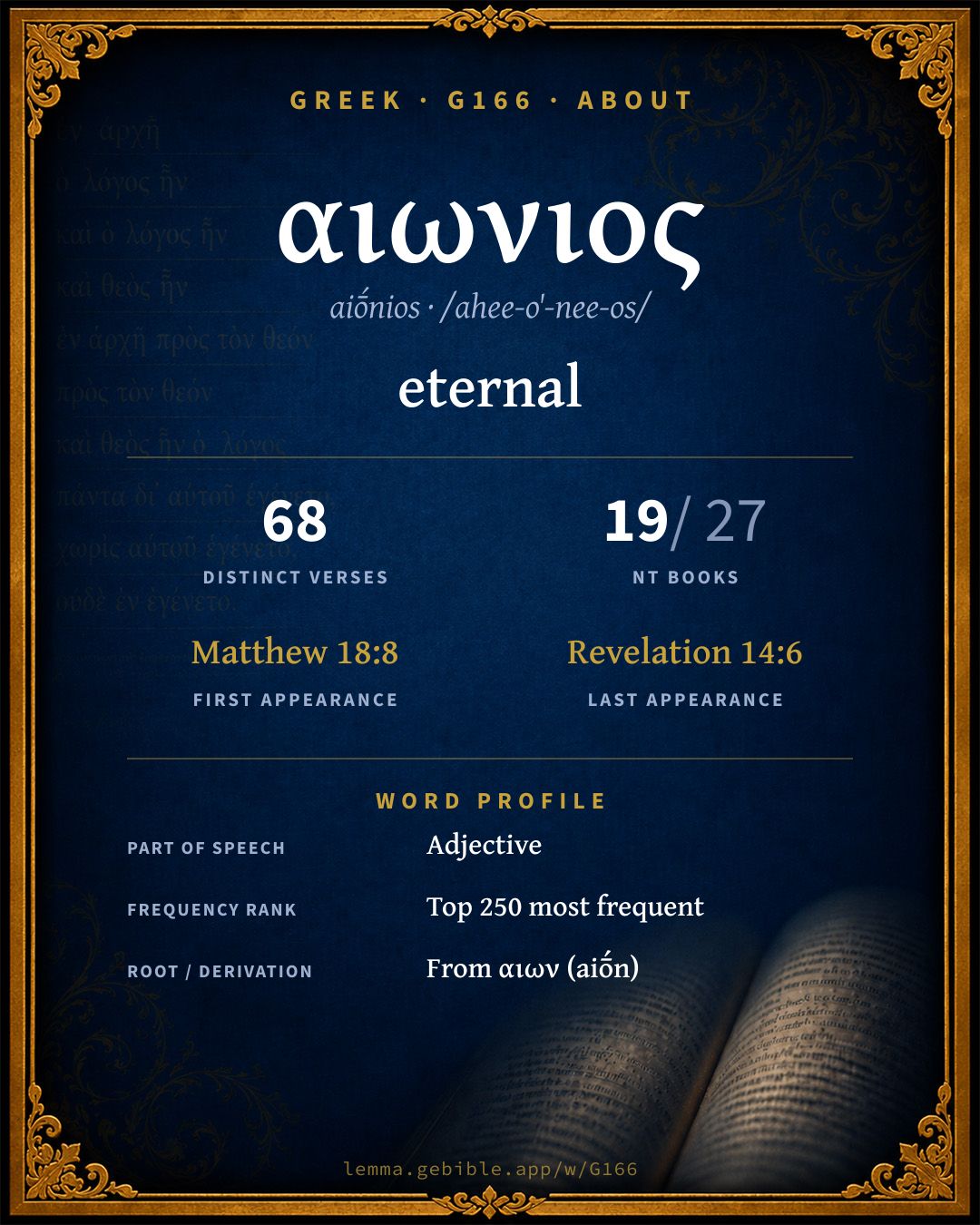
αἰώνιος
eternal
‘eternal’ is one of 3 main senses fuller range ↓
Full lexicon entry — Thayer's Greek Lexicon
From Thayer's Greek Lexicon
Where this word appears
See every Accusative-case word in the Greek New Testament →
Grammar key — what these labels mean
Part of speech
- Adjective
- A word that describes or qualifies a noun.
Case
- Accusative
- The case of the direct object and of extent.
- Genitive
- The case of source, possession, or “of” — answers “whose / from what.”
- Nominative
- The case of the subject (and the predicate nominative).
- Dative
- The case of the indirect object, means, or location — “to / for / with / in.”
Gender
- Feminine
- Grammatically feminine.
- Neuter
- Grammatically neuter.
- Masculine
- Grammatically masculine.
Number
- Singular
- One.
- Plural
- More than one.
Every verse where G166 appears in the Book of 2 Corinthians — 3 distinct verses. Click any verse to open its interlinear word-by-word view. Verse text shown in the World English Bible for context — . Each verse’s Greek form is shown with its reference; the English is not keyword-highlighted, since the data carries no word-level English alignment. Use “Compare translations” on any verse to read it across multiple English versions. This concordance covers the Greek New Testament; Septuagint (Greek Old Testament) occurrences of this word are not indexed here.
2 Corinthians
- 2 Corinthians 4:17 αἰώνιον adj acc sg neut For our light affliction, which is for the moment, works for us more and more exceedingly an eternal weight of glory;
- 2 Corinthians 4:18 αἰώνια adj nom pl neut while we don't look at the things which are seen, but at the things which are not seen. For the things which are seen are temporal, but the things which are not seen are eternal.
- 2 Corinthians 5:1 αἰώνιον adj acc sg fem For we know that if the earthly house of our tent is dissolved, we have a building from God, a house not made with hands, eternal, in the heavens.
About this entry
At a glance — auto-summarized from this page’s data, not written by a person. Every figure links to its source below. This summary describes the numbers; it doesn’t interpret them.
αιωνιος (aiṓnios) is a Greek adjective most often rendered “eternal.” Where the King James Version keeps “everlasting,” modern versions use “eternal” — see the renderings breakdown. The Greek New Testament uses it across 68 verses — moderately common. John dominates its distribution — 17 of 68 verses. Its lexical range runs to 3 senses. The sections below give every sense, occurrence, and version rendering.
Gloss history
Strong's 1890 vs modern scholarship
About this word
Strong's G166 catalogs a Greek word from the Greek New Testament.
These counts are not copied from any lexicon or concordance. They are computed here, from the morphology-tagged Greek New Testament. What Lemma adds →
- 68
- distinct verses
- The word appears in 68 distinct verses.
- 19 / 27
- NT books
- The word appears in 19 of 27 New Testament books.
- #239
- by frequency
- Top 250 most frequent Greek words (rank 239 of 5,347 Greek words by occurrence).
View all 68 occurrences in the concordance →
By section of the New Testament
By traditional corpus
Conventional, traditional groupings — biblical authorship is debated, so this is a traditional corpus grouping, not an authorship claim. Some books belong to more than one corpus (Luke is in both the Gospels and the Lukan corpus, and so on), so these shares overlap and need not total 100%. Each figure is a share of the word’s 68 distinct verses.
- Gospels 29 verses · 43%
- Johannine 24 verses · 35%
- Pauline corpus 20 verses · 29%
- General (Catholic) Epistles 10 verses · 15%
- Lukan (Luke–Acts) 6 verses · 9%
- Hebrews 6 verses · 9%
- Revelation 1 verse · 1%
How translations render this word
Counts come from each version’s own published word-to-Strong’s tagging or interlinear alignment — an approximate guide to how each version renders this word, not a word-level alignment the data otherwise carries. Because each total is that version’s own tagged count, the per-version totals vary from one another and need not match the appearance or distinct-verse counts above. These counts may also differ from a printed concordance because Lemma counts each distinctly tagged rendering and does not collapse phrase taggings into a single head-word total. This is a fixed set of word-tagged versions (KJV, ASV, BSB, ULT) and does not change with the reading translation you choose elsewhere. Each version’s license is shown beside its name below (and on Sources).
- King James Version: Eternal 40×, Everlasting 25×
- American Standard Version: Eternal 65×
- Berean Standard Bible: Eternal 66×, Began 2×
- unfoldingWord Literal Text: Eternal 65×
King James Version Public Domain
Renders G166 across 69 tagged occurrences — most commonly:
Plus 4 renderings that appear only once — usually multi-word phrases or single function words the recovered tagging swept in, not distinct renderings. Not rendered by a distinct English word in 2 further occurrences.
American Standard Version Public Domain
Renders G166 across 70 tagged occurrences — most commonly:
Plus 5 renderings that appear only once — usually multi-word phrases or single function words the recovered tagging swept in, not distinct renderings.
Berean Standard Bible Public Domain
Renders G166 across 70 tagged occurrences — most commonly:
Plus 2 renderings that appear only once — usually multi-word phrases or single function words the recovered tagging swept in, not distinct renderings.
unfoldingWord Literal Text CC BY-SA 4.0
Renders G166 across 70 tagged occurrences — most commonly:
Plus 5 renderings that appear only once — usually multi-word phrases or single function words the recovered tagging swept in, not distinct renderings.
Senses in Thayer's
The 3 senses Thayer's distinguishes for this word, in lexicon order (not ranked by frequency or importance). The full entry — with sub-senses — is in the Lexicon Entry tab.
- without beginning and end, that which always has been and always will be
- without beginning
- without end, never to cease, everlasting
Word origin
Derived from αιων (aiṓn) (G165) — age.
From G165 ; perpetual (also used of past time or past and future as well): - eternal for ever everlasting world (began).
— Strong’s Exhaustive Concordance (1890), public domain.
Forms in the corpus
The 9 distinct written forms G166 takes in the Greek New Testament, most frequent first — each parse links to that case’s occurrences in the concordance.
| Form | Parsing | Example | Uses |
|---|---|---|---|
| αἰώνιον aiṓnion | Adjective, Accusative, Singular, Feminine | Matthew 19:16 | 45 |
| αἰωνίου aiōníou | Adjective, Genitive, Singular, Feminine | Mark 3:29 | 14 |
| αἰώνιος aiṓnios | Adjective, Nominative, Singular, Feminine | John 17:3 | 3 |
| αἰωνίαν aiōnían | Adjective, Accusative, Singular, Feminine | 2 Thessalonians 2:16 | 2 |
| αἰωνίων aiōníōn | Adjective, Genitive, Plural, Masculine | 2 Timothy 1:9 | 2 |
| αἰωνίοις aiōníois | Adjective, Dative, Plural, Masculine | Romans 16:25 | 1 |
| αἰωνίους aiōníous | Adjective, Accusative, Plural, Feminine | Luke 16:9 | 1 |
| αἰώνια aiṓnia | Adjective, Nominative, Plural, Neuter | 2 Corinthians 4:18 | 1 |
| αἰώνιός aiṓniós | Adjective, Nominative, Singular, Feminine | John 12:50 | 1 |
Septuagint usage
The same Greek word αιωνιος appears 114 times in the Greek Old Testament (Septuagint), across 110 verses in 16 books.
- 114
- LXX occurrences
- Tagged occurrences of this Greek word in the Septuagint.
- 110
- verses
- Distinct Septuagint verses containing this word.
- 16 / 39
- OT books
- The word appears in 16 of the 39 Old Testament books.
Sample Septuagint occurrences
- Genesis 9:12 αἰώνιος
- Exodus 3:15 αἰώνιος
- Leviticus 6:11 αἰώνιος
- Numbers 10:8 αἰώνιος
- 2 Samuel 23:5 αἰώνιος
- 1 Chronicles 16:17 αἰώνιος
- Job 3:18 αἰώνιος
- Psalms 23:7 αἰώνιος
- Proverbs 22:28 αἰώνιος
- Isaiah 24:5 αἰώνιος
- Jeremiah 5:22 αἰώνιος
- Ezekiel 16:60 αἰώνιος
Septuagint occurrences (same lexeme)
Every verse where the same Strong’s number (G166) appears in the Greek Septuagint — showing the first 50 of 110. Verse text shown in the World English Bible for context; the Greek form is the matched word — the English is not keyword-highlighted.
- Genesis 9:12 αἰώνιος God said, "This is the token of the covenant which I make between me and you and every living creature that is with you, for perpetual generations:
- Genesis 9:16 αἰώνιος The rainbow will be in the cloud. I will look at it, that I may remember the everlasting covenant between God and every living creature of all flesh that is on the earth."
- Genesis 17:7 αἰώνιος I will establish my covenant between me and you and your seed after you throughout their generations for an everlasting covenant, to be a God to you and to your seed after you.
- Genesis 17:8 αἰώνιος I will give to you, and to your seed after you, the land where you are traveling, all the land of Canaan, for an everlasting possession. I will be their God."
- Genesis 17:13 αἰώνιος He who is born in your house, and he who is bought with your money, must be circumcised. My covenant will be in your flesh for an everlasting covenant.
- Genesis 17:19 αἰώνιος God said, "No, but Sarah, your wife, will bear you a son. You shall call his name Isaac. I will establish my covenant with him for an everlasting covenant for his seed after him.
- Genesis 21:33 αἰώνιος Abraham planted a tamarisk tree in Beersheba, and called there on the name of Yahweh, the Everlasting God.
- Genesis 48:4 αἰώνιος and said to me, 'Behold, I will make you fruitful, and multiply you, and I will make of you a company of peoples, and will give this land to your seed after you for an everlasting possession.'
- Exodus 3:15 αἰώνιος God said moreover to Moses, "You shall tell the children of Israel this, 'Yahweh, the God of your fathers, the God of Abraham, the God of Isaac, and the God of Jacob, has sent me to you.' This is my name forever, and this is my memorial to all generations.
- Exodus 12:14 αἰώνιος This day shall be to you for a memorial, and you shall keep it a feast to Yahweh: throughout your generations you shall keep it a feast by an ordinance forever.
- Exodus 12:17 αἰώνιος You shall observe the feast of unleavened bread; for in this same day have I brought your hosts out of the land of Egypt: therefore shall you observe this day throughout your generations by an ordinance forever.
- Exodus 27:21 αἰώνιος In the tent of meeting, outside the veil which is before the testimony, Aaron and his sons shall keep it in order from evening to morning before Yahweh: it shall be a statute forever throughout their generations on the behalf of the children of Israel.
- Exodus 28:43 αἰώνιος They shall be on Aaron, and on his sons, when they go in to the tent of meeting, or when they come near to the altar to minister in the holy place; that they don't bear iniquity, and die: it shall be a statute forever to him and to his descendants after him.
- Exodus 29:28 αἰώνιος and it shall be for Aaron and his sons as their portion forever from the children of Israel; for it is a heave-offering: and it shall be a heave-offering from the children of Israel of the sacrifices of their peace-offerings, even their heave-offering to Yahweh.
- Exodus 30:21 αἰώνιος So they shall wash their hands and their feet, that they not die: and it shall be a statute forever to them, even to him and to his descendants throughout their generations."
- Exodus 31:16 αἰώνιος Therefore the children of Israel shall keep the Sabbath, to observe the Sabbath throughout their generations, for a perpetual covenant.
- Exodus 31:17 αἰώνιος It is a sign between me and the children of Israel forever; for in six days Yahweh made heaven and earth, and on the seventh day he rested, and was refreshed.'"
- Leviticus 6:11 αἰώνιος He shall take off his garments, and put on other garments, and carry the ashes outside the camp to a clean place.
- Leviticus 6:15 αἰώνιος He shall take from there his handful of the fine flour of the meal offering, and of its oil, and all the frankincense which is on the meal offering, and shall burn it on the altar for a sweet savor, as its memorial, to Yahweh.
- Leviticus 7:34 αἰώνιος For the waved breast and the heaved thigh I have taken from the children of Israel out of the sacrifices of their peace offerings, and have given them to Aaron the priest and to his sons as their portion forever from the children of Israel.'"
- Leviticus 7:36 αἰώνιος which Yahweh commanded to be given them of the children of Israel, in the day that he anointed them. It is their portion forever throughout their generations.
- Leviticus 10:9 αἰώνιος "Drink no wine nor strong drink, you, nor your sons with you, when you go into the Tent of Meeting, that you don't die: it shall be a statute forever throughout your generations:
- Leviticus 10:15 αἰώνιος The heaved thigh and the waved breast they shall bring with the offerings made by fire of the fat, to wave it for a wave offering before Yahweh: and it shall be yours, and your sons' with you, as a portion forever; as Yahweh has commanded."
- Leviticus 16:29 αἰώνιος "It shall be a statute to you forever: in the seventh month, on the tenth day of the month, you shall afflict your souls, and shall do no manner of work, the native-born, or the stranger who lives as a foreigner among you:
- Leviticus 16:31 αἰώνιος It is a Sabbath of solemn rest to you, and you shall afflict your souls; it is a statute forever.
- Leviticus 16:34 αἰώνιος "This shall be an everlasting statute for you, to make atonement for the children of Israel once in the year because of all their sins." It was done as Yahweh commanded Moses.
- Leviticus 17:7 αἰώνιος They shall no more sacrifice their sacrifices to the goat idols, after which they play the prostitute. This shall be a statute forever to them throughout their generations.'
- Leviticus 23:14 αἰώνιος You shall eat neither bread, nor roasted grain, nor fresh grain, until this same day, until you have brought the offering of your God. This is a statute forever throughout your generations in all your dwellings.
- Leviticus 23:21 αἰώνιος You shall make proclamation on the same day: there shall be a holy convocation to you; you shall do no regular work. This is a statute forever in all your dwellings throughout your generations.
- Leviticus 23:31 αἰώνιος You shall do no manner of work: it is a statute forever throughout your generations in all your dwellings.
- Leviticus 23:41 αἰώνιος You shall keep it a feast to Yahweh seven days in the year: it is a statute forever throughout your generations; you shall keep it in the seventh month.
- Leviticus 24:3 αἰώνιος Outside of the veil of the Testimony, in the Tent of Meeting, shall Aaron keep it in order from evening to morning before Yahweh continually: it shall be a statute forever throughout your generations.
- Leviticus 24:8 αἰώνιος Every Sabbath day he shall set it in order before Yahweh continually. It is on the behalf of the children of Israel an everlasting covenant.
- Leviticus 24:9 αἰώνιος It shall be for Aaron and his sons; and they shall eat it in a holy place: for it is most holy to him of the offerings of Yahweh made by fire by a perpetual statute."
- Leviticus 25:34 αἰώνιος But the field of the suburbs of their cities may not be sold; for it is their perpetual possession.
- Numbers 10:8 αἰώνιος The sons of Aaron, the priests, shall blow the trumpets; and they shall be to you for a statute forever throughout your generations.
- Numbers 15:15 αἰώνιος For the assembly, there shall be one statute for you, and for the stranger who lives as a foreigner [with you], a statute forever throughout your generations: as you are, so shall the foreigner be before Yahweh.
- Numbers 18:8 αἰώνιος Yahweh spoke to Aaron, I, behold, I have given you the charge of my heave-offerings, even all the holy things of the children of Israel; to you have I given them by reason of the anointing, and to your sons, as a portion forever.
- Numbers 18:11 αἰώνιος This is your: the heave-offering of their gift, even all the wave-offerings of the children of Israel; I have given them to you, and to your sons and to your daughters with you, as a portion forever; everyone who is clean in your house shall eat of it.
- Numbers 18:19 αἰώνιος All the heave-offerings of the holy things, which the children of Israel offer to Yahweh, have I given you, and your sons and your daughters with you, as a portion forever: it is a covenant of salt forever before Yahweh to you and to your seed with you.
- Numbers 18:23 αἰώνιος But the Levites shall do the service of the tent of meeting, and they shall bear their iniquity: it shall be a statute forever throughout your generations; and among the children of Israel they shall have no inheritance.
- Numbers 19:10 αἰώνιος He who gathers the ashes of the heifer shall wash his clothes, and be unclean until the even: and it shall be to the children of Israel, and to the stranger who lives as a foreigner among them, for a statute forever.
- Numbers 19:21 αἰώνιος It shall be a perpetual statute to them: and he who sprinkles the water for impurity shall wash his clothes, and he who touches the water for impurity shall be unclean until even.
- Numbers 25:13 αἰώνιος and it shall be to him, and to his seed after him, the covenant of an everlasting priesthood; because he was jealous for his God, and made atonement for the children of Israel.
- 2 Samuel 23:5 αἰώνιος Most assuredly my house is not so with God; Yet he has made with me an everlasting covenant, Ordered in all things, and sure: For it is all my salvation, and all [my] desire, Although he doesn't make it grow.
- 1 Chronicles 16:17 αἰώνιος Confirmed the same to Jacob for a statute, To Israel for an everlasting covenant,
- Job 3:18 αἰώνιος There the prisoners are at ease together. They don't hear the voice of the taskmaster.
- Job 10:22 αἰώνιος The land dark as midnight, Of the shadow of death, without any order, Where the light is as midnight.'"
- Job 21:11 αἰώνιος They send forth their little ones like a flock. Their children dance.
- Job 22:15 αἰώνιος Will you keep the old way Which wicked men have trodden,
These are occurrences of the same Greek lexeme (G166) in the Septuagint — not a translation of any one Hebrew word. The store carries no word-level Hebrew↔Greek alignment, so no Hebrew original is asserted here. Counts come from the recovered LXX Strong's tagging — high-frequency vocabulary is well covered, while rare or late forms may be untagged — so they reflect tagged occurrences and may slightly undercount.