
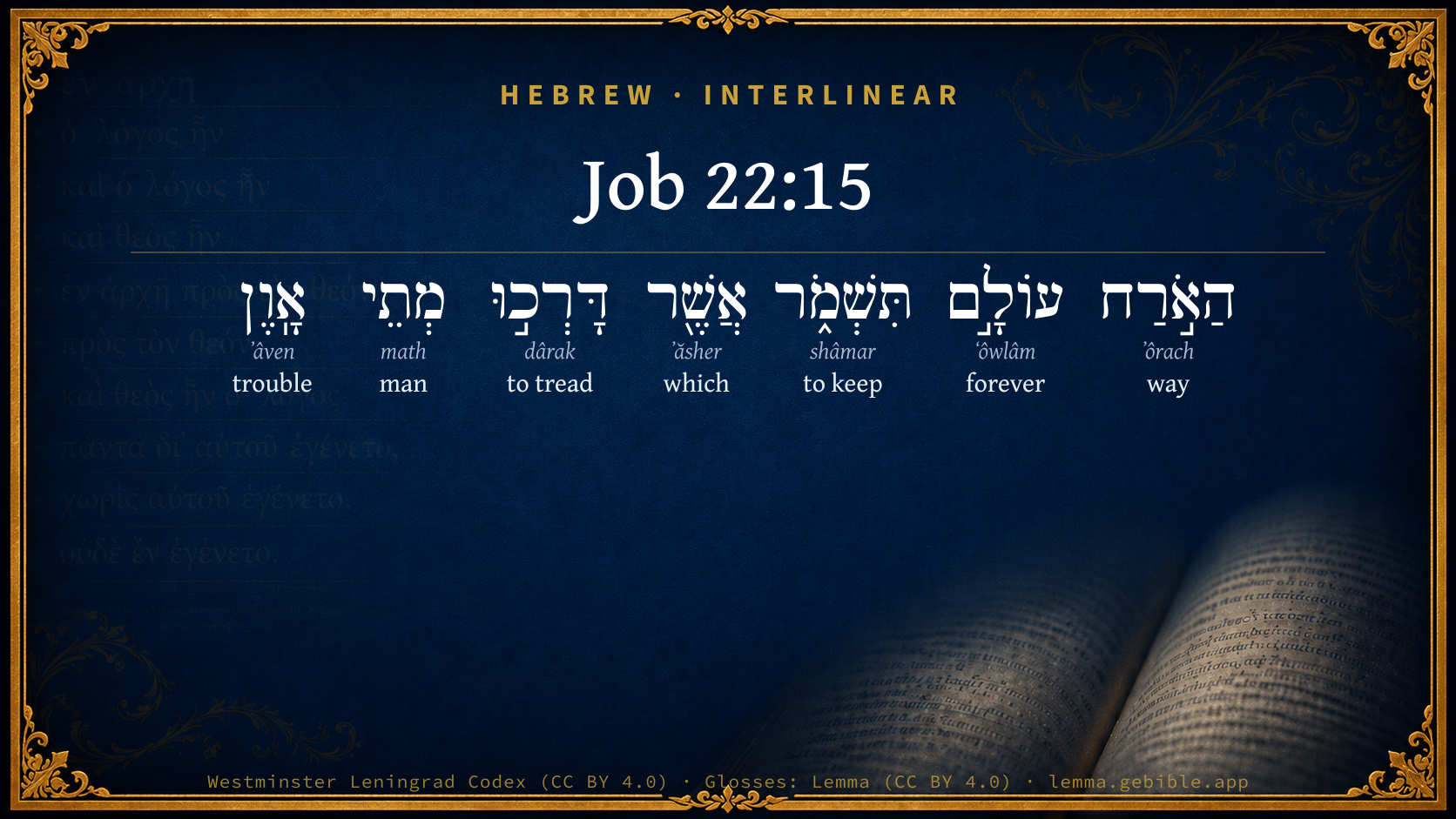
Job 22:15

Hebrew (Westminster Leningrad Codex) Job 22:15 appears in the Hebrew Old Testament. The text above is from the Westminster Leningrad Codex. Each word links to its Strong’s number, a concise gloss, and parsing drawn from the Open Scriptures Hebrew Bible morphology. Click any word for its full Brown-Driver-Briggs (BDB) entry.
Download image
Cite this verse

Job 22:15 (World English Bible). Public Domain. Lemma interlinear Bible study tool, https://lemma.gebible.app/v/job/22/15.

Show BibTeX & RIS
BibTeX
RIS
English Translation
Will you keep the old way Which wicked men have trodden,
World English Bible · Public Domain
Download a study sheet

One document with this verse’s original text, its word-by-word gloss line, the meaning frame, cross-references with their text, attributed commentary, and full source and license credits — printable, and it pastes into notes with its structure intact.

This verse Autodidact and up

Study sheet (.html) Plain text (.txt)

A passage Seminary Student

Up to 50 verses in one chapter. A passage sheet keeps up to 6 commentary sources and 12 cross-references per verse, in the order this page ranks them, and says so on the sheet whenever that leaves anything out. Ask for a single verse and you get the Autodidact verse sheet above.

Everything on this page stays free to read, with no account — the sheet is a download of what is already on screen, not access to it.

Want to remove ads? Support Godless Engineer
Compare translations 3

The same verse in 3 English versions, stacked beneath the original-language interlinear above. Click any original word for its lexicon entry.

Each is an independent rendering of the whole verse — the interlinear is not word-aligned to these translations.

Highlighted words mark where these versions differ — a whole-verse word diff, not a word-by-word alignment.

  • World English Bible Public Domain
    Will you keep the old way Which wicked men have trodden,
  • King James Version Public Domain
    Hast thou marked the old way which wicked men have trodden?
  • unfoldingWord Literal Text CC BY-SA 4.0
    Will you keep the old way that men of iniquity have walked,

unfoldingWord Literal Text — © unfoldingWord, licensed CC BY-SA 4.0. Word-aligned USFM3 via Door43 (git.door43.org/unfoldingWord/en_ult).

Versions to compare (up to 4)

3 of 4 selected

Show all 18 translations

Every available English version of this verse, each an independent rendering of the whole verse.

  • World English Bible Public Domain
    Will you keep the old way Which wicked men have trodden,
  • Berean Standard Bible Public Domain
    Will you stay on the ancient path that wicked men have trod?
  • Majority Standard Bible Public Domain
    Will you stay on the ancient path that wicked men have trod?
  • King James Version Public Domain
    Hast thou marked the old way which wicked men have trodden?
  • American Standard Version (1901) Public Domain
    Wilt thou keep the old way Which wicked men have trodden?
  • Revised Version (1885) Public Domain
    Wilt thou keep the old way which wicked men have trodden?
  • Geneva Bible (1599) Public Domain
    Hast thou marked the way of the worlde, wherein wicked men haue walked?
  • Douay-Rheims (1899) Public Domain
    Dost thou desire to keep the path of ages, which wicked men have trodden?
  • Young's Literal Translation Public Domain
    The path of the age dost thou observe, That men of iniquity have trodden?
  • Literal Standard Version CC BY-SA 4.0
    Do you observe the path of the age, || That men of iniquity have trodden,
  • Unlocked Literal Bible CC BY-SA 4.0
    Will you keep the old way that wicked men have walked—
  • unfoldingWord Literal Text CC BY-SA 4.0
    Will you keep the old way that men of iniquity have walked,
  • Darby Bible Public Domain
    Dost thou mark the ancient path which wicked men have trodden?
  • World Messianic Bible Public Domain
    Will you keep the old way, which wicked men have trodden,
  • Webster's Bible Public Domain
    Hast thou marked the old way which wicked men have trodden?
  • Free Bible Version CC BY-SA 4.0
    Why do you insist on following the traditional thinking of the wicked?
  • Bible in Basic English Public Domain
    Will you keep the old way by which evil men went?
  • JPS Tanakh (1917) Public Domain
    Wilt thou keep the old way which wicked men have trodden?

Literal Standard Version (2020), Covenant Press — licensed CC BY-SA 4.0. Text via the HelloAO Bible API (eBible.org). Unlocked Literal Bible (unfoldingWord) — licensed CC BY-SA 4.0. Text via the HelloAO Bible API (eBible.org). unfoldingWord Literal Text — © unfoldingWord, licensed CC BY-SA 4.0. Word-aligned USFM3 via Door43 (git.door43.org/unfoldingWord/en_ult). Free Bible Version, Dr. Jonathan Gallagher — licensed CC BY-SA 4.0. Text via the HelloAO Bible API (eBible.org).

Word by word

More ways to search: Search by grammar → Find every occurrence → Compare this word →

Practice this passage: Drill this verse → Learn its vocabulary →

About this verse

These counts appear in no published source. They are computed here, from the morphology-tagged text and Lemma’s own curated glosses. What Lemma adds →

7
words
7
distinct lemmas
Wisdom
section

Notable vocabulary

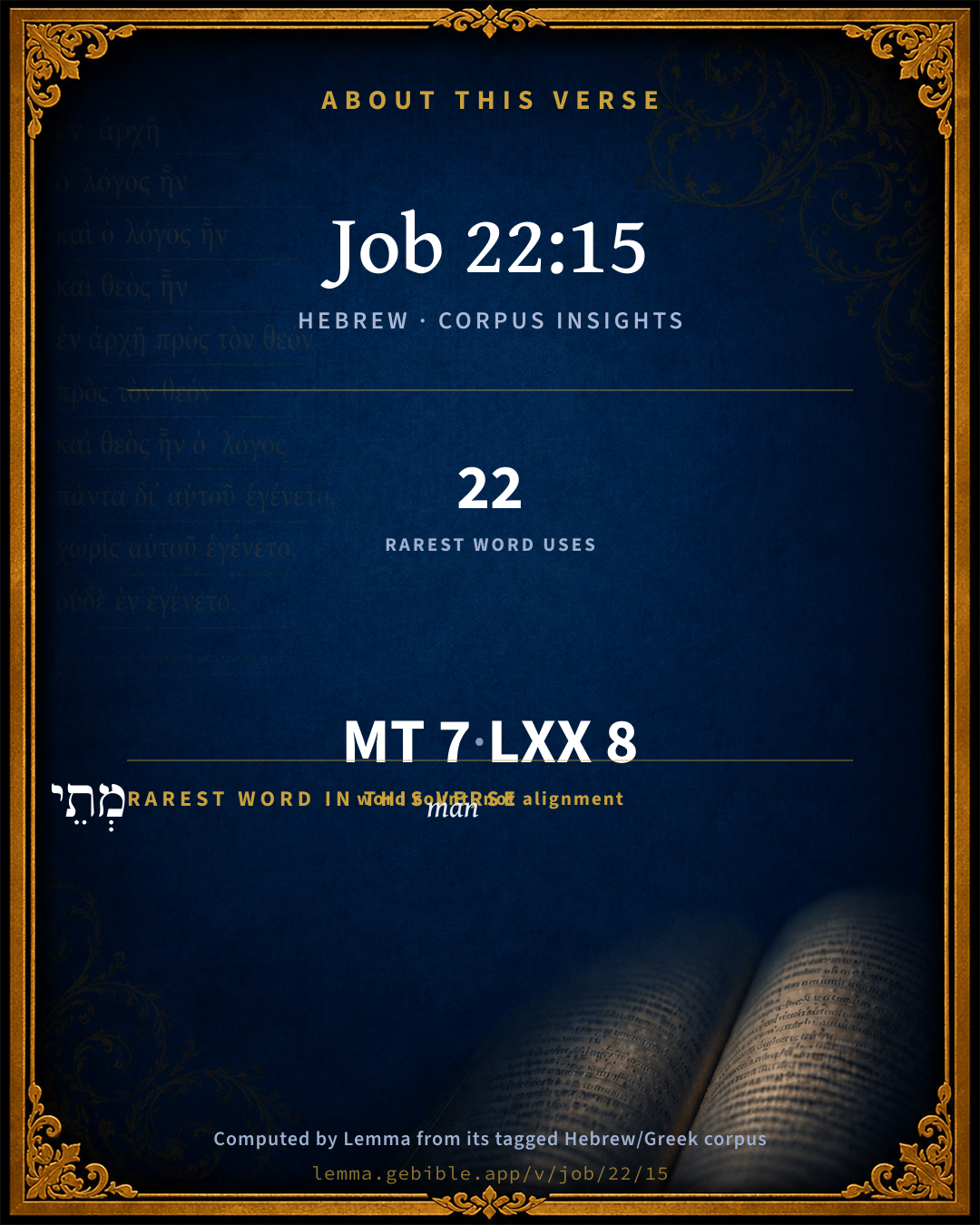
The rarest word here is מְתֵי man H4962 — appearing just 22 times in the whole Hebrew Bible.

Shared distinctive vocabulary

מְתֵי man H4962 occurs in 21 verses of the Hebrew Bible. Also found in:

Grammatical profile

  • 2 verbs
  • 4 nouns
  • 1 particle

Verb forms

  • תִּשְׁמֹ֑ר Qal · Imperfect
  • דָּרְכ֣וּ Qal · Perfect

Hebrew & Septuagint length

In English translation the verse runs 11 words from the Hebrew and 12 from the Septuagint (LXX English) — closely comparable.

A rough comparison of the two English renderings, which tokenize alike — not a word-level alignment.

Word counts can differ between the Hebrew and the Greek without any difference in meaning — e.g. the Hebrew direct-object marker אֵת has no separate Greek word, and Greek often adds the article ὁ.

In the original languages it is 7 Hebrew tokens and 8 Greek tokens — but the two are counted differently (Hebrew bundles its prefixes and suffixes into one token; the Greek is in lemma form), so that isn’t a like-for-like length.

Cross-references

3

Topical passages linked to Job 22:15 in the Treasury of Scripture Knowledge — connected by theme and wording, ordered by reader-vote popularity; previews shown in the World English Bible.

  • Luke 17:26–27 As it happened in the days of Noah, even so will it be also in the days of the Son of Man.
  • Genesis 6:5 Yahweh saw that the wickedness of man was great in the earth, and that every imagination of the thoughts of his heart was only evil continually.
  • Genesis 6:11–13 The earth was corrupt before God, and the earth was filled with violence.

Cross-references courtesy of OpenBible.info (CC BY 4.0).

Hebrew and Greek witnesses Masoretic Hebrew ↔ Greek Septuagint

The same verse in the two great witnesses to the Old Testament, shown verse-for-verse.

These are two independent witnesses, not word-aligned to each other, and the Septuagint is shown in lemma (dictionary) form.

Hebrew Job 22:15 Masoretic · Westminster Leningrad Codex

הַאֹ֣רַח עוֹלָ֣ם תִּשְׁמֹ֑ר אֲשֶׁ֖ר דָּרְכ֣וּ מְתֵי אָֽוֶן

Will you keep the old way Which wicked men have trodden,

World English Bible · Public Domain

Greek LXX Job 22:15 Septuagint · lemma form

μή τρίβος αἰώνιος φυλάσσω ὅς πατέω ἀνήρ ἄδικος

Will you not mark the old way, which righteous men have trodden?

LXX2012 (modern English Septuagint) · Public Domain

On this verse, Haydock's Catholic Bible Commentary discusses the Septuagint’s reading. Read the note in Commentary ↓

Hebrew: Westminster Leningrad Codex (CC BY 4.0). Greek: Septuagint (public domain); English from LXX2012 (modern English Septuagint) (Public Domain). How the Septuagint differs from the Hebrew →

Commentary

Notes on Job 22:15 from classic Christian and Jewish commentators (each source and its license shown beneath its notes). The classic Christian expositions comment on the surrounding passage and are grouped to its opening verse, so a note may address several verses; the Jewish commentaries on the Tanakh (Rashi and others) are per-verse, so they appear only where the commentator wrote on this verse.

Lemma curates 59 commentaries, every one of them public domain or Creative Commons licensed, each selected and text-cleaned for this edition rather than reprinted as found. About our sources →

Matthew Henry's Commentary

Eliphaz, having endeavoured to convict Job, by setting his sins (as he thought) in order before him, here endeavours to awaken him to a sight and sense of his misery and danger by reason of sin; and this he does by comparing his case with that of the sinners of the old world; as if he had said, "Thy condition is bad now, but, unless thou repent, it will be worse, as theirs was - theirs who were overflown with a flood, as the old world (Job 22:16), and theirs the remnant of whom the fire consumed" (Job 22:20), namely, the Sodomites, who, in comparison of the old world, were but a remnant. And these two instances of the wrath of God against sin and sinners are more than once put together, for warning to a careless world, as by our Saviour (Luk 17:26, etc.) and the apostle, Pe2 2:5, Pe2 2:6. Eliphaz would have Job to mark the old way which wicked men have trodden (Job 22:15) and see what came of it, what the end of their way was. Note, There is an old way which wicked men have trodden. Religion had but newly entered when sin immediately followed it. But though it is an old way, a broad way, a tracked way, it is a dangerous way and it leads to destruction; and it is good for us to mark it, that we may not dare to walk in it. Eliphaz here puts Job in mind of it, perhaps in opposition to what he had said of the prosperity of the wicked; as if he had said, "Thou canst find out here and there a single instance, it may be, of a wicked man ending his days in peace; but what is that to those two great instances of the final perdition of ungodly men - the drowning of the whole world and the burning of Sodom?" destructions by wholesale, in which he thinks Job may, as in a glass, see his own face. Observe, 1. The ruin of those sinners (Job 22:16): They were cut down out of time; that is, they were cut off in the midst of their days, when, as man's time then went, many of them might, in the course of nature, have lived some hundreds of years longer, which made their immature extirpation the more grievous. They were cut down out of time, to be hurried into eternity. And their foundation, the earth on which they built themselves and all their hopes, was overflown with a flood, the flood which was brought in upon the world of the ungodly, Pe2 2:5. Note, Those who build upon the sand choose a foundation which will be overflown when the rains descend and the floods come (Mat 7:27), and then their building must needs fall and they perish in the ruins of it, and repent of their folly when it is too late. 2. The sin of those sinners, which brought that ruin (Job 22:17): They said unto God, Depart from us. Job had spoken of some who said so and yet prospered, Job 21:14. "But these did not (says Eliphaz); they found to their cost what it was to set God at defiance. Those who were resolved to lay the reins on the neck of their appetites and passions began with this; they said unto God, Depart; they abandoned all religion, hated the thoughts of it, and desired to live without God in the world; they shunned his word, and silenced conscience, his deputy. And what can the Almighty do for them?" Some make this to denote the justness of their punishment. They said to God, Depart from us; and then what could the Almighty do with them but cut them off? Those who will not submit to God's golden sceptre must expect to be broken to pieces with his iron rod. Others make it to denote the injustice of their sin: But what hath the Almighty done against them? What iniquity have they found in him, or wherein has he wearied them? Mic 6:3; Jer 2:5. Others make it to denote the reason of their sin: They say unto God, Depart, asking what the Almighty can do to them. "What has he done to oblige us? What can he do in a way of wrath to make us miserable, or in a way of favour to make us happy?" As they argue, Zep 1:12. The Lord will not do good, neither will he do evil. Eliphaz shows the absurdity of this in one word, and that is, calling God the Almighty; for, if he be so, what cannot he do? But it is not strange if those cast off all religion who neither dread God's wrath nor desire his favour. 3. The aggravation of this sin: Yet he had filled their houses with good things, Job 22:18. Both those of the old world and those of Sodom had great plenty of all the delights of sense; for they ate, they drank, they bought, they sold, etc. (Luk 17:27), so that they had no reason to ask what the Almighty could do for them, for they lived upon his bounty, no reason to bid him depart from them who had been so kind to them. Many have their houses full of goods but their hearts empty of grace, and thereby are marked for ruin. 4. The protestation which Eliphaz makes against the principles and practices of those wicked people: But the counsel of the wicked is far from me. Job had said so (Job 21:16) and Eliphaz will not be behind him. If they cannot agree in their own principles concerning God, yet they agree in renouncing the principles of those that live without God in the world. Note, Those that differ from each other in some matters of religion, and are engaged in disputes about them, yet ought unanimously and vigorously to appear against atheism and irreligion, and to take care that their disputes do not hinder either their vigour or unanimity in that common cause of God, that righteous cause. 5. The pleasure and satisfaction which the righteous shall have in this. (1.) In seeing the wicked destroyed, Job 22:19. They shall see it, that is, observe it, and take notice of it (Hos 14:9); and they shall be glad, not to see their fellow-creatures miserable, or any secular turn of their own served, or point gained, but to see God glorified, the word of God fulfilled, the power of oppressors broken, and thereby the oppressed relieved - to see sin shamed, atheists and infidels confounded, and fair warning given to all others to shun such wicked courses. Nay, they shall laugh them to scorn, that is, they justly might do it, they shall do it, as God does it, in a holy manner, Psa 2:4; Pro 1:26. They shall take occasion thence to expose the folly of sinners and show how ridiculous their principles are, though they call themselves wits. Lo, this is the man that made not God his strength; and see what comes of it, Psa 52:7. Some understand this of righteous Noah and his family, who beheld the destruction of the old world and rejoiced in it, as he had grieved for their impiety. Lot, who saw the ruin of Sodom, had the same reason to rejoice, Pe2 2:7, Pe2 2:8. (2.) In seeing themselves distinguished (Job 22:20): "Whereas our substance is not cut down, as theirs was, and as thine is; we continue to prosper, which is a sign that we are the favourites of Heaven, and in the right." The same rule that served him to condemn Job by served him to magnify himself and his companions by. His substance is cut down; therefore he is a wicked man; ours is not; therefore we are righteous. But it is a deceitful rule to judge by; for none knows love or hatred by all that is before him. If others be consumed, and we be not, instead of censuring them and lifting up ourselves, as Eliphaz does here, we ought to be thankful to God and take it for a warning to ourselves to prepare for similar calamities.

Matthew Henry's Commentary on the Whole Bible (1708–1710) — public domain (CC PDM 1.0). Text via the HelloAO Bible API.

Trapp's Complete Commentary

John Trapp

Job 22:15 Hast thou marked the old way which wicked men have trodden?

Ver. 15. Hast thou, marked the old way] Heb. The way of old. Broughton rendereth it, the way of the old world; of those ungodly ones before the flood. Hereby it appeareth, say our learned annotators, that Job lived before the deliverance out of Egypt, because he mentioneth the creation and the flood, but not the deliverance; which, had he known, it would have afforded him an excellent argument to prove that godly men might be in great affliction, as the Israelites were in Egypt; and his friends a plausible argument that God useth to destroy wicked men for their sin, as he did the Egyptians in the Red Sea.

Which wicked men have trodden?] Heb. Mortals of iniquity or vanity. Viri nequam et nequaquam, vel nihili, Men of wickedness with a witness. The face of the old world was grown so foul, that God was fain to wash it with a flood. All was out of order in family, State, and Church. In the family was found luxury and unlawful marriages. In the State tyranny, violence, rapacity, and injustice. In the Church contempt of God’s word, and a fond opinion that God did not order all by his providence, but that a man might do well enough without him. Now that this was the opinion of those antediluvian Belialists, some have gathered from this text, which they read thus, Wilt thou follow the old way; that is, the tenet of those old sinners against their own souls, whom God, for their damnable security and licentiousness (the products of such a portentous opinion), buried all together in one universal grave of waters?

John Trapp, A Commentary or Exposition upon All the Books of the Old and New Testament (1647–1656) — public domain. Text from a community e-Sword module.

The Biblical Illustrator

Joseph S. Exell

Job_22:15-20

Hast thou marked the old way which wicked men have trodden?

The way of the wicked described

It is commonly remarked, how little advantage mankind make of each others experience. This is surely a striking proof of the folly and presumption of our nature. Eliphaz here is reasoning on the principle stated. Though he misapplied the admonition conveyed in his question, the admonition itself is important, for without marking this way of the wicked, how shall we have knowledge of it; and without knowing it, how shall we avoid it?

I. Some particulars concerning the way of the wicked.

1. The sameness, or oneness, of the way. There are, indeed, many different kinds of sin in which the wicked are living. But they are all turning their backs on the same objects; they are all proceeding in the same direction; they are all tending to the same end.

2. This way is the old way. Eliphaz so called it in the time of Job. It is a way as old as the fall of man.

3. It is a trodden way. This word gives the idea of a way which has been much used and frequented; a beaten road, in which many passengers are always to be found.

II. A more exact description of the way itself. By the wicked, in the Bible, are meant all who are devoid of an inward principle of godliness; who, whatever their lives and characters in the sight and judgment of the world may be, are yet in the sight of God without any practical fear and love of Him in their hearts. The way of the wicked is the way of practical ungodliness. Here men are all guilty. They forget God, and walk after the course of this world.

III. The end to which the way of wicked men leads. Our Saviour says, It leadeth to destruction. The end resembles that of the sinners in the days of Noah and Lot. Learn, that you may not be an open sinner, and yet you may be walking in the way of the wicked, as you live a mere sensual, worldly life, without any habitual regard to the will and glory of God. (E. Cooper.)

The history of wickedness

1. It is a history of ancient date. It is an old way--the track of old.

2. It is a history of terrible calamities. Which were cut down out of time, etc. There are personal, social, material calamities.

3. It is a history of practical atheism.

(1) A guilty conscience makes men dread God.

(2) Dread of God makes men hate Him.

(3) Hating God prompts men to repel Him.

4. It is a history liable to misinterpretation. Men make misapplication of the history of wickedness--

(1) When they conclude that God is indifferent in relation to the moral character of men.

(2) When they conclude that, because God does not punish wicked men at once, He will not punish them at all.

Yet this history has lessons of great significance.

(1) It teaches the vastness of mans power.

(2) It teaches the greatness of mans patience.

(3) It teaches the energy of human influence.

(4) It teaches the magnitude of Christs work. (Homilist.)

The way which wicked men have trodden

I. The way itself. Eliphaz calla it an old way. It is almost as old as the human race, or as the world which they inhabit. In the account of the conduct of the first sinner, we see selfishness, or Eves preference of herself to God. We see also pride, which produced discontent. We see sensuality, or a disposition to be governed and guided by her senses, and to seek their gratification in an unlawful manner. We see unbelief, a distrust of Gods Word, and a consequent belief of the tempters suggestions. She could believe the tempters falsehood. From the conduct of Adam and Eve at the close of the day, we may obtain further acquaintance with the way in which sinners walk. They exhibited sullen hardness of heart, impenitence, and despair of forgiveness. They expressed no sorrow, nor penitence, nothing like brokenness of heart. They made no confession of sin; they uttered no cries for mercy; they expressed no wish to be restored to the favour of their offended Judge. They displayed a self-justifying temper. They showed a disposition to reflect upon God as the cause of their disobedience. In a manner precisely similar have sinners ever since acted.

II. Its termination. It leads to destruction. That it does so, we might infer from what has taken place in the world. Application--

1. Whether some of you are not walking in this way?

2. Should any of you be convinced that you are in this dangerous way, permit me to urge you to forsake it without delay. (E. Payson, D. D.)

The old way of the wicked

Hast thou marked the old way? Antiquity is no guarantee for truth. It was the old way, but it was the wrong way. It was an old way, but they who ran in it perished in it just as surely as if it had been a new way of sinning entirely of their own invention: antiquity will be no consolation to those who perish by following evil precedents.

I. The way. First, what it was. There is no doubt that Eliphaz is here alluding to those who sinned before the flood. He is looking to what were ancient days to him.

1. Now this way, in the first place, was a way of rebellion against God.

2. In the next place, the old way was a way of selfishness.

3. The old way was a way of pride. Our mother Eve rebelled against God because she thought she knew better than God did.

4. The old way which wicked men have trodden is a way of self-righteousness. If Abel kneels by the altar, Cain will kneel by the altar also. Beware, I entreat you, for this is the old way of the Pharisee when he thanked God that he was not as other men.

5. The old way which wicked men have trodden was, in the next place, a way of unbelief. Noah was sent to tell those ancient sinners that the world would be destroyed by a flood. They thought him an old dotard, and mocked him to scorn.

6. The old way which wicked men have trodden is a way of worldliness and carelessness and procrastination. What did those men before the flood? They married and were given in marriage till the flood came and swept them all away. Eliphaz says, Hast thou marked the way?

I want you to stop a little while, and look at that road again, and mark it anew.

1. The first thing I observe as I look into it is, that it is a very broad way.

2. Observe that it is a very popular road. The way downward to destruction is a very fashionable one, and it always will be.

3. It is a very easy way, too. You need not trouble yourself about finding the entrance into it, you can find it in the dark.

4. This old way, if you look at it, is the way in which all men naturally run. For all that, it is a most unsatisfactory road.

5. One thing more, across it here and there Divine mercy has set bars. The angel of mercy stands before you now, and bids you tarry. Why will ye die?

II. The end: Which were cut down out of time, whose foundation was overflown with a flood. The end of these travellers was not according to their unbelief, but according to the despised truth. They would not believe Noah, but the flood came. Remember this, then, unbelief will not, laugh as it may, remove one jot of the penalty. The flood, like the destroying fire which will come upon ungodly men, was total in its destructiveness. It did not sweep away some of them, but all, and the punishments of God will not be to a few rebels, but to all. It will find out the rich in their palaces, as well as the poor in their hovels. Moreover, it was a final overthrow. The text gives us two pictures, and these two may suffice to bring out the meaning of Eliphaz. First, he says, they were cut down out of time. The representation here is that of a tree with abundant foliage and wide-spreading boughs, to which the woodman comes. Such is the sinner in his prosperity, spreading himself like a green bay tree; birds of song are amongst his branches, and his fruit is fair to look upon; but the axe of death is near, and where the tree falleth there it must forever lie; fixed is its everlasting state. The other picture of the text is that of a building which is utterly swept away. Here I would have you notice that Eliphaz does not say that the flood came and swept away the building of the wicked, but swept away their very foundations. If in the next world the sinner only lost his wealth or his health, or his outward comforts of this life, it would be subject for serious reflection; but when it comes to this, that he loses his soul, his very self; then it becomes a thing to consider with all ones reason, and with something more of the enlightenment which Gods Spirit can add to our reason. Oh that we would but be wise and think of this:

III. The warning: Am I or am I not treading in that broad way? Ah! saith one, I do not know. I will help thee to answer it. Are you travelling in the narrow way in which believers in Christ are walking? I cannot say that, say you. Well, then, I can tell you without hesitation that you are treading in the broad way, for there are but two ways. As for you who confessedly are in the old way, would you turn, would you leave it? Then the turning point is at yonder cross, where Jesus hangs a bleeding sacrifice for the sons of men. (C. H. Spurgeon.)

The Biblical Illustrator, edited by Joseph S. Exell (c. 1880s–1900s) — public domain. Text from a community e-Sword module.

Joseph Benson's Commentary

Job 22:15-16. Hast thou marked the old way? — Hebrew, ארח עולם, orach gnolam, the way of antiquity, that is, of men living in ancient times, or former ages. And, by their way, he either means their course, and common practice, or their end and success. Which were cut down out of time — Before their time; who died a violent and untimely death. Whose foundation was overflown, &c. — Who, together with their foundation the earth, and all their supports and enjoyments, were destroyed by a flood of waters. As the universal deluge was a most signal and memorable instance of God’s displeasure against wickedness and wicked men, and was, doubtless, very well known in those days, Eliphaz takes occasion to enlarge upon it, for five or six verses together, as a proper lesson (so he thought it) for his friend; and then closes it with the mention of another destruction by fire, either past or to be expected, which is described to be as general and as fatal to the wicked.

Joseph Benson's Commentary on the Old and New Testaments (1811–1818) — public domain. Text from a community e-Sword module.

Geneva Bible (1599)

Geneva Bible translators

How God hath punished them from the beginning?

Geneva Bible (1599) marginal notes — public domain. Text via Bolls.life.

Jamieson, Fausset & Brown

Robert Jamieson, A. R. Fausset & David Brown

marked--Rather, Dost thou keep to? that is, wish to follow (so Hebrew, Sa2 22:22). If so, beware of sharing their end.

the old way--the degenerate ways of the world before the flood (Gen 6:5).

Jamieson, Fausset & Brown — Commentary Critical and Explanatory on the Whole Bible (1871) — public domain (CC PDM 1.0). Text via the HelloAO Bible API.

Adam Clarke's Commentary

Verse 15. Hast thou marked the old way] This is supposed to be another accusation; as i! he had said, "Thou hollowest the same way that the wicked of old have walked in." Here is an evident allusion to the FLOOD, as is particularly noted in the next verse.

Adam Clarke's Commentary on the Bible (1810–1826) — public domain. Text from a community e-Sword/MySword module.

Ellicott's Commentary for English Readers

(15) Hast thou marked the old way . . .?—Rather, Dost thou keep the old way which the wicked men trod? Dost thou hold their tenets?

A Bible Commentary for English Readers, edited by Charles John Ellicott (1878–1897) — public domain. Text from a community e-Sword module.

The Cambridge Bible for Schools and Colleges

gen. ed. J. J. S. Perowne

15. It was under a similar feeling in regard to God that the great sinners before the Flood filled the earth with violence, and Eliphaz asks Job whether he will go the length of accepting the principles and following the conduct of such men? Compare the words of Elihu, ch. Job_34:8.

Hast thou marked the old way] Rather, wilt thou keep …? i. e. follow the path they walked in.

The Cambridge Bible for Schools and Colleges (gen. ed. J. J. S. Perowne; Cambridge University Press, 1878–1918) — public domain. Text from a community e-Sword module.

John Gill's Exposition

Which were cut down out of time,.... Sent out of time into eternity, time being no more with men, and they no longer in time, when death seizes upon them; or "before time" (a), before the common term of life, which, according to the course of nature, and human probability, they might have arrived unto: as this is spoken of the men of the old world that lived before the flood, when the lives of men were very long, it is highly probable there, were many that were destroyed by the general deluge, who, had it not for that, might have lived many hundreds of years, according to the usual course: or "without time" (b), without any delay suddenly, at once, at an unawares; for, though they had notice of the flood, they did not regard it, but lived careless and secure; and it came upon them without any further warning, and swept them away, when they were "cut down", as trees by the axe laid to the root of them, to which wicked, men in great power and flourishing circumstances are sometimes compared, Psa 37:35; or like grass by the scythe, which it is not able to resist, and to which all men are like for their numbers and weaknesses, and who are cut down by death as easily as the grass is by the mower, see Psa 37:1. Some render it "wrinkled" (c), as in Job 16:8; as bodies when dead are, and especially such as are drowned, and have been long floating in the water, as those that perished by the flood were, for to such the words have respect, as appears by what follows:

whose foundation was overflown with a flood; either of water, or of fire and brimstone, as Jarchi observes; the former is most likely to be meant; for by the flood, or universal deluge, all that was thought firm and permanent, and might be called a foundation, was overflown and carried away, as houses, goods, furniture, wealth, and riches, and everything that men had a dependence upon for the support and comfort of life; yea, the earth itself, on which they dwelt, and was reckoned "terra firma", this being founded upon, and over the waters; or, as the Apostle Peter describes it, "it standing out of the water and in the water", Pe2 3:5; or "their foundation was a flood poured out" (d); what they thought were solid, and firm, and durable, and built their hopes of happiness upon, were like a flood of water, poured, dissipated, and scattered, and which disappeared and came to nothing: and such is every foundation that a man builds his hope, especially of eternal happiness, upon, short of Christ, the only sure foundation laid in Zion, his person, grace, blood, and righteousness; everything else, let it seem ever so firm, is as sand, yea, as water, as a flood of water that spreads itself, and quickly comes to nothing.

(a) "ante tempus suum", V. L. Mercerus; "ante tempus", Cocceius, Schultens. (b) "Sine mora", Cocceius; "in momento", Codurcus. (c) "corrugati sunt", Junius & Tremellius, Piscator, Bolducius, Cocceius. (d) "fundamentum eorum ut flumen diffluxit", Tigurine version; "fluvius effusus fundamentum eorum", Codurcus, Beza; to the same sense Drusius, Mercerus, Cocceius, Schultens.

John Gill's Exposition of the Whole Bible (1746–1763) — public domain (CC PDM 1.0). Text via the HelloAO Bible API.

Albert Barnes' Notes on the Bible

Hast thou marked the old way which wicked men have trodden? - Hast thou seen what has happened in former times to wicked people? Job had maintained that God did not deal with people in this world according to their character. To meet this, Eliphaz now appeals to ancient facts, and especially refers to the deluge, when the wicked were cut off by a flood for their sins. Schultens, Dr. Good, Noyes, and Reiske, however, suppose that tbe word here rendered “mark,” means to “pursue,” or “imitate,” and that the sense is,” Are you willing to adopt the principles of those wicked people who lived in the time of the deluge?” But the sense is not materially affected. The general design is to refer Job to the case of the impious generation that was swept off by a flood. The judgments of God on them were a full refutation, in his view, of the sentiments of Job.

Albert Barnes' Notes on the Bible (1834–1885) — public domain. Text from a community e-Sword/MySword module.

Haydock's Catholic Bible Commentary

Wicked. Alexandrian Septuagint, "just." But Grabe substitutes unjust; (Haydock) as otherwise, Eliphaz would argue against his own principles: unless just be put ironically for hypocrites. (Calmet) --- Wilt thou imitate the ancient giants, before the deluge? (Calmet)

George Leo Haydock (1774–1849), Haydock's Catholic Family Bible and Commentary, 1859 edition — public domain. Excludes Psalms (Douay-Rheims chapter numbering differs from Protestant) and Deuterocanonical books (Catholic canon only).

Matthew Poole's English Annotations

Heb. the way of antiquity, i.e. of men living in ancient times, or former ages. By this way is here meant, either,

1. Their course or common practice; or,

2. Their end or success; as the

way is taken, 1Sa 9:6,8; and as death, which is, and is called, the end of all men, Ecc 7:2, is also called the way of all the earth, Jos 23:14; 1Ki 2:2.

Matthew Poole's English Annotations on the Holy Bible (1683–1685) — public domain. Text from a community e-Sword/MySword module.

Whedon's Commentary on the Bible

Daniel D. Whedon

15. Hast thou marked — Wilt thou keep.

The old way — Hebrew, עולם. He probably means the way of the antediluvians. A man’s faith, or voidness of faith, is a finger-pointer to the life he leads. The tenor of the argument is, that those who hold godless opinions must lead godless lives.

NOTE. — The asterisk in the Hebrew Bible indicates that the middle of the book is now reached, the book consisting of 1,070 verses.

Daniel D. Whedon (gen. ed.), Commentary on the Old and New Testaments (1874–1909) — public domain. Text from a community e-Sword module.

The Pulpit Commentary

Hast thou marked the old way which wicked men have trodden? rather, Wilt thou keep the old way"etc.? (see the Revised Version). Eliphaz assumes that it is Job"s intention to cast in his lot with these persons whose prosperous wickedness he has described in the preceding chapter (vers. 7-15). And this notwithstanding Job"s final protest, "Be the counsel of the wicked far from me" (ver. 16). He calls the mode of life pursued by these wicked persons "the old way," either with allusion to the seed of Cain before the Flood, who "corrupted their way", (Gen_6:12) or perhaps with reference to the descendants of Nimrod after it (see Professor Lee"s "Book of Job," p. 361).

The Pulpit Commentary (1880–1919), ed. H.D.M. Spence-Jones & Joseph S. Exell — public domain. Text from a community e-Sword module.

John Wesley's Explanatory Notes

Old way - Hebrew. the way of antiquity, of men living in ancient times, their end or success.

John Wesley, Explanatory Notes Upon the Whole Bible (1754–1765) — public domain. Text via the GEBible commentary corpus.

Keil & Delitzsch

C. F. Keil & F. Delitzsch

15 Wilt thou observe the way of the ancient world,

Which evil men have trodden,

16 Who were withered up before their time,

Their foundation was poured out as a stream,

17 Who said unto God: Depart from us!

And what can the Almighty do to them?

18 And notwithstanding He had filled their houses with good-

The counsel of the wicked be far from me!

While in Psa 139:24 דרך עולם prospectively signifies a way of eternal duration (comp. Eze 26:20, עם עולם, of the people who sleep the interminably long sleep of the grave), ארח עולם signifies here retrospectively the way of the ancient world, but not, as in Jer 6:16; Jer 18:15, the way of thinking and acting of the pious forefathers which put their posterity to shame, but of a godless race of the ancient world which stands out as a terrible example to posterity. Eliphaz asks if Job will observe, i.e., keep (שׁמר as in Psa 18:22), this way trodden by people (מתי, comp. אנשׁי, Job 34:36) of wickedness. Those worthless ones were withered up, i.e., forcibly seized and crushed, ולא־עת, when it was not yet time (ולא after the manner of a circumstantial clause: quum nondum, as Psa 139:16), i.e., when according to God's creative order their time was not yet come. On קמּטוּ,

(Note: This קמטו, according to the Masora, is the middle word of the book of Job (חצי הספר).)

vid., on Job 16:8; lxx correctly, συνελήφθησαν ἄωροι, nevertheless συλλαμβάνειν is too feeble as a translation of קמט; for as Arab. qbṣ signifies to take with the tip of the finer, whereas Arab. qbḍ signifies to take with the whole bent hand, so קמט, in conformity to the dull, emphatic final consonant, signifies "to bind firmly together." In Job 22:16 יוּצק is not perf. Pual for יצּק (Ew. 83, b), for this exchange, contrary to the law of vowels, of the sharp form with the lengthened form is without example; it must at least have been written יוּצּק (comp. Jdg 18:29). It is fut. Hoph., which, according to Job 11:15, might be יצּק; here, however, it is with a resolving, not assimilation, of the Jod, as in Lev 21:10. The fut. has the signification of the imperfect which it acquires in an historic connection. It is not to be translated: their place became a stream which has flowed away (Hirz.), for the היה which would be required by such an interpretation could not be omitted; also not: flumen effusum est in fundamentum eorum (Rosenm., Hahn, and others), which would be ליסודם, and would still be very liable to be misunderstood; also not: whose foundation was a poured-out stream (Umbr., Olsh.), for then there would be one attributive clause inserted in the other; but: their solid ground became fluid like a stream (Ew., Hlgst., Schlottm.), so that נהר, after the analogy of the verbs with two accusative, Ges. 139, 2, is a so-called second acc. of the obj. which by the passive becomes a nominative (comp. Job 28:2), although it might also be an apposition of the following subj. placed first: a stream (as such, like such a one) their solid ground was brought into a river; the ground on which they and their habitations stood was placed under water and floated away: without doubt the flood is intended; reference to this perfectly accords with the patriarchal pre-and extra-Israelitish standpoint of the book of Job; and the generation of the time of the flood (דור המבול) is accounted in the holy scriptures of the Old and New Testament as a paragon of godlessness, the contemporaries of Noah are the απειθοῦντες, סוררים, κατ ̓ ἐξοχήν (comp. Pe1 3:20 with Psa 68:19).

Accordingly they are now here also further described (Job 22:17) as those who said to God, "Depart from us," and what could the Almighty do to them (למו instead of לנוּ, which was to be expected, since, as in Job 19:28, there is a change from the oratio directa to obliqua)! Olshausen explains with Hahn: "with respect to what thou sayest: and what then does the Almighty do to them (for it)? He fills their houses with prosperity, while the counsel of the wicked is far from me (notwithstanding I am unfortunate)." But this explanation is as forced (since ומה without a אמרת or תאמר standing with it is taken as the word of Job) as it is contrary to the syntax (since the circumstantial clause with והוא is not recognised, and on the other hand ועצת וגו, instead of which it ought at least to have been וּממּנּי וגו, is regarded as such an one). No indeed, just this is an exceedingly powerful effect, that Eliphaz describes those godless ones who dismiss God with סור ממנו, to whom, according to Job's assertion, Job 21:13., undimmed prosperity is portioned out, by referring to a memorable fact as that which has fallen under the strict judgment of God; and that with the very same words with which Job, Job 21:16, declines communion with such prosperous evil-doers: "the counsel of the wicked be far from me," he will have nothing more to do, not with the wicked alone, but, with a side glance at Job, even with those who place themselves on a level with them by a denial of the just government of God in the world. פּעל ל, as the following circumstantial clause shows, is intended like Psa 68:29, comp. Job 31:20; Isa 26:12 : how can the Almighty then help or profit them? Thus they asked, while He had filled their houses with wealth - Eliphaz will have nothing to do with this contemptible misconstruction of the God who proves himself so kind to those who dwell below on the earth, but who, though He is rewarded with ingratitude, is so just. The truly godly are not terrified like Job 17:8, that retributive justice is not to be found in God's government of the world; on the contrary, they rejoice over its actual manifestation in their own case, which makes them free, and therefore so joyous.

Keil & Delitzsch — Biblical Commentary on the Old Testament (1861–1891) — public domain (CC PDM 1.0). Text via the HelloAO Bible API. (Old Testament only.)

unfoldingWord translationNotes

Door43 World Missions Community

Connecting Statement:

Eliphaz continues speaking to Job.

Will you keep the old way that wicked men have walked

Doing wicked deeds is compared to walking in a path. AT: "Will you continue to do the things that evil people do" (See: Metaphor)

those who were snatched away

Dying is compared to God snatching them away. This can be stated in active form. AT: "those who died" or "those whom God took away" (See: Metaphor and Active or Passive)

those whose foundations have washed away like a river

The death of wicked people is compared to buildings that had their foundations washed away by a flood. (See: Simile)

What can the Almighty do to us?

Eliphaz quotes a question wicked people use to mock God. AT: "The Almighty cannot do anything to us!" (See: Rhetorical Question)

translationWords

evil

walk

found

God

Almighty

unfoldingWord translationNotes — © Distant Shores Media and the Door43 World Missions Community, licensed CC BY-SA 4.0. Source: git.door43.org/Door43/en_tn.

Rashi

Rabbi Shlomo Yitzchaki (Rashi)

the old way The way of the ancients who were in days of yore.

Will you keep Have you kept in your heart to remember what happened to them?

Rashi on the Tanakh — English translations: “The Judaica Press complete Tanach with Rashi, translated by A. J. Rosenberg” (CC BY 4.0); “Pentateuch with Rashi's commentary by M. Rosenbaum and A.M. Silbermann, 1929-1934” (public domain); “The Metsudah Tanach series, Lakewood, N.J” (CC BY 4.0); and “The Book of Joshua, Metsudah Publications, 1997” (CC BY 4.0). Text via Sefaria.

Lesson kit

Teaching starters — assembled from the data on this page, not authored interpretation. Every prompt links to the verse data it draws on. Edit before teaching.

Job, in the Wisdom, opens this verse with 7 words (7 distinct Hebrew lemmas). Its most distinctive word is math (“man”). A historical commentator’s framing appears above. Read the whole chapter for the surrounding context.

Discussion questions

  1. The word math carries the sense “man.” How does it shape the verse?
  2. How does Genesis 34:30, which shares the word «man», read alongside this verse?
  3. These translations render this verse differently. What is at stake in choosing one wording over another?
  4. «תִּשְׁמֹ֑ר» is a Qal Imperfect verb. How does that grammatical form shape the action described?
  5. Compare how Matthew Henry's Commentary and Trapp's Complete Commentary read this verse. Where do they agree or differ?

Things to notice

Reading settings

Reading text

Shown beneath each verse's original-language words.

Old Testament
Old Testament edition

Read the OT as the Masoretic Hebrew (MT) or the Greek Septuagint (LXX).

English shown for the Greek Septuagint (in the Hebrew ↔ Greek comparison).

Comparing translations? Open the Compare panel on any verse page to stack up to four side by side.