
Exodus 29:28

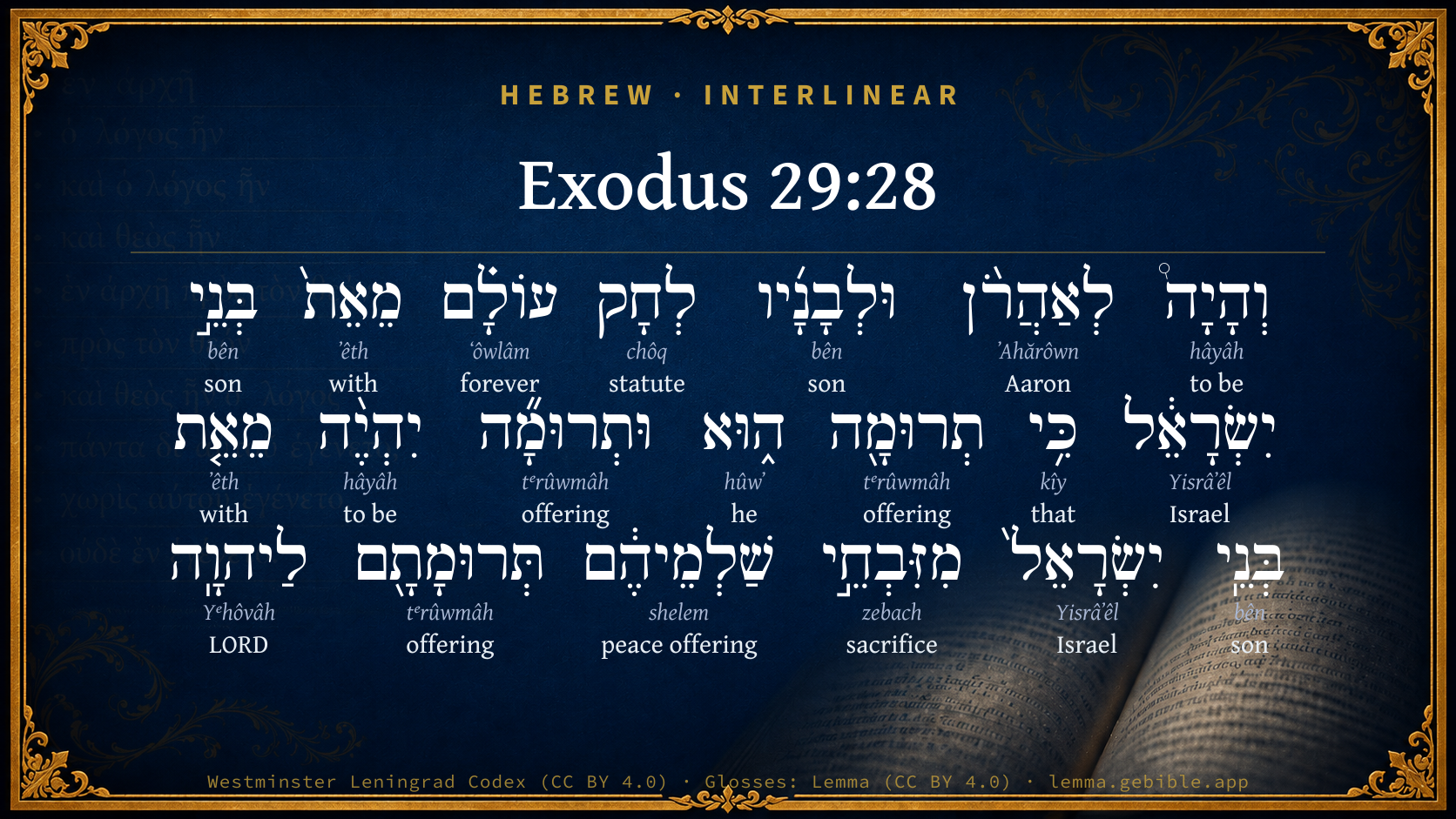
Hebrew (Westminster Leningrad Codex) Exodus 29:28 appears in the Hebrew Old Testament. The text above is from the Westminster Leningrad Codex. Each word links to its Strong’s number, a concise gloss, and parsing drawn from the Open Scriptures Hebrew Bible morphology. Click any word for its full Brown-Driver-Briggs (BDB) entry.
Download image
Cite this verse

Exodus 29:28 (World English Bible). Public Domain. Lemma interlinear Bible study tool, https://lemma.gebible.app/v/exodus/29/28.

Show BibTeX & RIS
BibTeX
RIS
English Translation
and it shall be for Aaron and his sons as their portion forever from the children of Israel; for it is a heave-offering: and it shall be a heave-offering from the children of Israel of the sacrifices of their peace-offerings, even their heave-offering to Yahweh.
World English Bible · Public Domain
Download a study sheet

One document with this verse’s original text, its word-by-word gloss line, the meaning frame, cross-references with their text, attributed commentary, and full source and license credits — printable, and it pastes into notes with its structure intact.

This verse Autodidact and up

Study sheet (.html) Plain text (.txt)

A passage Seminary Student

Up to 50 verses in one chapter. A passage sheet keeps up to 6 commentary sources and 12 cross-references per verse, in the order this page ranks them, and says so on the sheet whenever that leaves anything out. Ask for a single verse and you get the Autodidact verse sheet above.

Everything on this page stays free to read, with no account — the sheet is a download of what is already on screen, not access to it.

Want to remove ads? Support Godless Engineer
Compare translations 3

The same verse in 3 English versions, stacked beneath the original-language interlinear above. Click any original word for its lexicon entry.

Each is an independent rendering of the whole verse — the interlinear is not word-aligned to these translations.

Highlighted words mark where these versions differ — a whole-verse word diff, not a word-by-word alignment.

  • World English Bible Public Domain
    and it shall be for Aaron and his sons as their portion forever from the children of Israel; for it is a heave-offering: and it shall be a heave-offering from the children of Israel of the sacrifices of their peace-offerings, even their heave-offering to Yahweh.
  • King James Version Public Domain
    And it shall be Aaron's and his sons' by a statute for ever from the children of Israel: for it is an heave offering: and it shall be an heave offering from the children of Israel of the sacrifice of their peace offerings, even their heave offering unto the LORD.
  • unfoldingWord Literal Text CC BY-SA 4.0
    And it shall belong to Aaron and to his sons—as an eternal requirement—for it is an offering from the sons of Israel. And it shall be an offering from the sons of Israel from the sacrifices of their peace offerings, their offerings to Yahweh.

unfoldingWord Literal Text — © unfoldingWord, licensed CC BY-SA 4.0. Word-aligned USFM3 via Door43 (git.door43.org/unfoldingWord/en_ult).

Versions to compare (up to 4)

3 of 4 selected

Show all 18 translations

Every available English version of this verse, each an independent rendering of the whole verse.

  • World English Bible Public Domain
    and it shall be for Aaron and his sons as their portion forever from the children of Israel; for it is a heave-offering: and it shall be a heave-offering from the children of Israel of the sacrifices of their peace-offerings, even their heave-offering to Yahweh.
  • Berean Standard Bible Public Domain
    This will belong to Aaron and his sons as a regular portion from the Israelites, for it is the heave offering the Israelites will make to the LORD from their peace offerings.
  • Majority Standard Bible Public Domain
    This will belong to Aaron and his sons as a regular portion from the Israelites, for it is the heave offering the Israelites will make to the LORD from their peace offerings.
  • King James Version Public Domain
    And it shall be Aaron's and his sons' by a statute for ever from the children of Israel: for it is an heave offering: and it shall be an heave offering from the children of Israel of the sacrifice of their peace offerings, even their heave offering unto the LORD.
  • American Standard Version (1901) Public Domain
    and it shall be for Aaron and his sons as `their' portion for ever from the children of Israel; for it is a heave-offering: and it shall be a heave-offering from the children of Israel of the sacrifices of their peace-offerings, even their heave-offering unto Jehovah.
  • Revised Version (1885) Public Domain
    and it shall be for Aaron and his sons as a due for ever from the children of Israel: for it is an heave offering: and it shall be an heave offering from the children of Israel of the sacrifices of their peace offerings, even their heave offering unto the LORD.
  • Geneva Bible (1599) Public Domain
    And Aaron and his sonnes shall haue it by a statute for euer, of the children of Israel: for it is an heaue offering, and it shall be an heaue offering of the children of Israel, of their peace offerings, euen their heaue offering to the Lord.
  • Douay-Rheims (1899) Public Domain
    Wherewith Aaron was consecrated and his sons, and they shall fall to Aarons share and his sons' by a perpetual right from the children of Israel: because they are the choicest and the beginnings of their peace victims which they offer to the Lord.
  • Young's Literal Translation Public Domain
    and it hath been for Aaron and for his sons, by a statute age-during from the sons of Israel, for it `is' a heave-offering; and it is a heave offering from the sons of Israel, from the sacrifices of their peace-offerings -- their heave-offering to Jehovah.
  • Literal Standard Version CC BY-SA 4.0
    and it has been for Aaron and for his sons, by a continuous statute from the sons of Israel, for it [is] a raised-offering; and it is a raised-offering from the sons of Israel, from the sacrifices of their peace-offerings—their raised-offering to YHWH.
  • Unlocked Literal Bible CC BY-SA 4.0
    This will be a perpetual ordinance for Aaron and his sons. It will be a contribution from the people of Israel to give to Yahweh from their peace offerings.
  • unfoldingWord Literal Text CC BY-SA 4.0
    And it shall belong to Aaron and to his sons—as an eternal requirement—for it is an offering from the sons of Israel. And it shall be an offering from the sons of Israel from the sacrifices of their peace offerings, their offerings to Yahweh.
  • Darby Bible Public Domain
    And they shall be for Aaron and his sons, as an everlasting statute, on the part of the children of Israel; for it is a heave-offering; and it shall be a heave-offering on the part of the children of Israel of the sacrifices of their peace-offerings, [as] their heave-offering to Jehovah.
  • World Messianic Bible Public Domain
    It shall be for Aaron and his sons as their portion forever from the children of Israel; for it is a wave offering. It shall be a wave offering from the children of Israel of the sacrifices of their peace offerings, even their wave offering to the LORD.
  • Webster's Bible Public Domain
    And it shall be Aaron's and his sons' by a statute for ever, from the children of Israel: for it is a heave-offering: and it shall be a heave-offering from the children of Israel of the sacrifice of their peace-offerings, even their heave-offering to the LORD.
  • Free Bible Version CC BY-SA 4.0
    From now on whenever the Israelites lift up peace offerings to the Lord, these parts will belong to Aaron and his sons forever as a regular share from the Israelites.
  • Bible in Basic English Public Domain
    And it will be their part as a right for ever from the children of Israel, it is a special offering from the children of Israel, made from their peace-offerings, a special offering lifted up to the Lord.
  • JPS Tanakh (1917) Public Domain
    And it shall be for Aaron and his sons as a due for ever from the children of Israel; for it is a heave-offering; and it shall be a heave-offering from the children of Israel of their sacrifices of peace-offerings, even their heave-offering unto the LORD.

Literal Standard Version (2020), Covenant Press — licensed CC BY-SA 4.0. Text via the HelloAO Bible API (eBible.org). Unlocked Literal Bible (unfoldingWord) — licensed CC BY-SA 4.0. Text via the HelloAO Bible API (eBible.org). unfoldingWord Literal Text — © unfoldingWord, licensed CC BY-SA 4.0. Word-aligned USFM3 via Door43 (git.door43.org/unfoldingWord/en_ult). Free Bible Version, Dr. Jonathan Gallagher — licensed CC BY-SA 4.0. Text via the HelloAO Bible API (eBible.org).

Word by word

More ways to search: Search by grammar → Find every occurrence → Compare this word →

Practice this passage: Drill this verse → Learn its vocabulary →

תְרוּמָ֖ה
tᵉrûwmâh
H8641
“offering”
Noun, Common, Feminine, Singular, Absolute
Part of Speech
Noun
Type
Common
Gender
Feminine
Number
Singular
State
Absolute
Full BDB Definition

Origin: from H7311

TWOT: 2133i

contribution, offering - a heave offering - any offering - an offering to God - an offering (of grain, money, etc) - contribution
  1. וְהָיָה֩ hâyâh H1961 “and · to be” Conjunction + Verb, Qal, Sequential Perfect, 3rd Person, Masculine, Singular
  2. לְאַהֲרֹ֨ן ʼAhărôwn H175 “to/for · Aaron” Preposition + Noun, Proper
  3. וּלְבָנָ֜יו bên H1121 “and · to/for · sons · his” Conjunction + Preposition + Noun, Common, Masculine, Plural, Construct + Suffix, Personal, 3rd Person, Masculine, Singular
  4. לְחָק chôq H2706 “to/for · statute of” Preposition + Noun, Common, Masculine, Singular, Construct
  5. עוֹלָ֗ם ʻôwlâm H5769 “forever” Noun, Common, Masculine, Singular, Absolute
  6. מֵאֵת֙ ʼêth H854 “from · with” Preposition + Preposition
  7. בְּנֵ֣י bên H1121 “sons of” Noun, Common, Masculine, Plural, Construct
  8. יִשְׂרָאֵ֔ל Yisrâʼêl H3478 “Israel” Noun, Proper
  9. כִּ֥י kîy H3588 “that” Conjunction
  10. ה֑וּא hûwʼ H1931 “he” Pronoun, Personal, 3rd Person, Masculine, Singular
  11. וּתְרוּמָ֞ה tᵉrûwmâh H8641 “and · offering” Conjunction + Noun, Common, Feminine, Singular, Absolute
  12. יִהְיֶ֨ה hâyâh H1961 “to be” Verb, Qal, Imperfect, 3rd Person, Masculine, Singular
  13. מֵאֵ֤ת ʼêth H854 “from · with” Preposition + Preposition
  14. בְּנֵֽי bên H1121 “sons of” Noun, Common, Masculine, Plural, Construct
  15. יִשְׂרָאֵל֙ Yisrâʼêl H3478 “Israel” Noun, Proper
  16. מִזִּבְחֵ֣י zebach H2077 “from · sacrifices of” Preposition + Noun, Common, Masculine, Plural, Construct
  17. שַׁלְמֵיהֶ֔ם shelem H8002 “peace offerings · their” Noun, Common, Masculine, Plural, Construct + Suffix, Personal, 3rd Person, Masculine, Plural
  18. תְּרוּמָתָ֖ם tᵉrûwmâh H8641 “offering · their” Noun, Common, Feminine, Singular, Construct + Suffix, Personal, 3rd Person, Masculine, Plural
  19. לַיהוָֽה Yᵉhôvâh H3068 “to/for · LORD” Preposition + Noun, Proper

About this verse

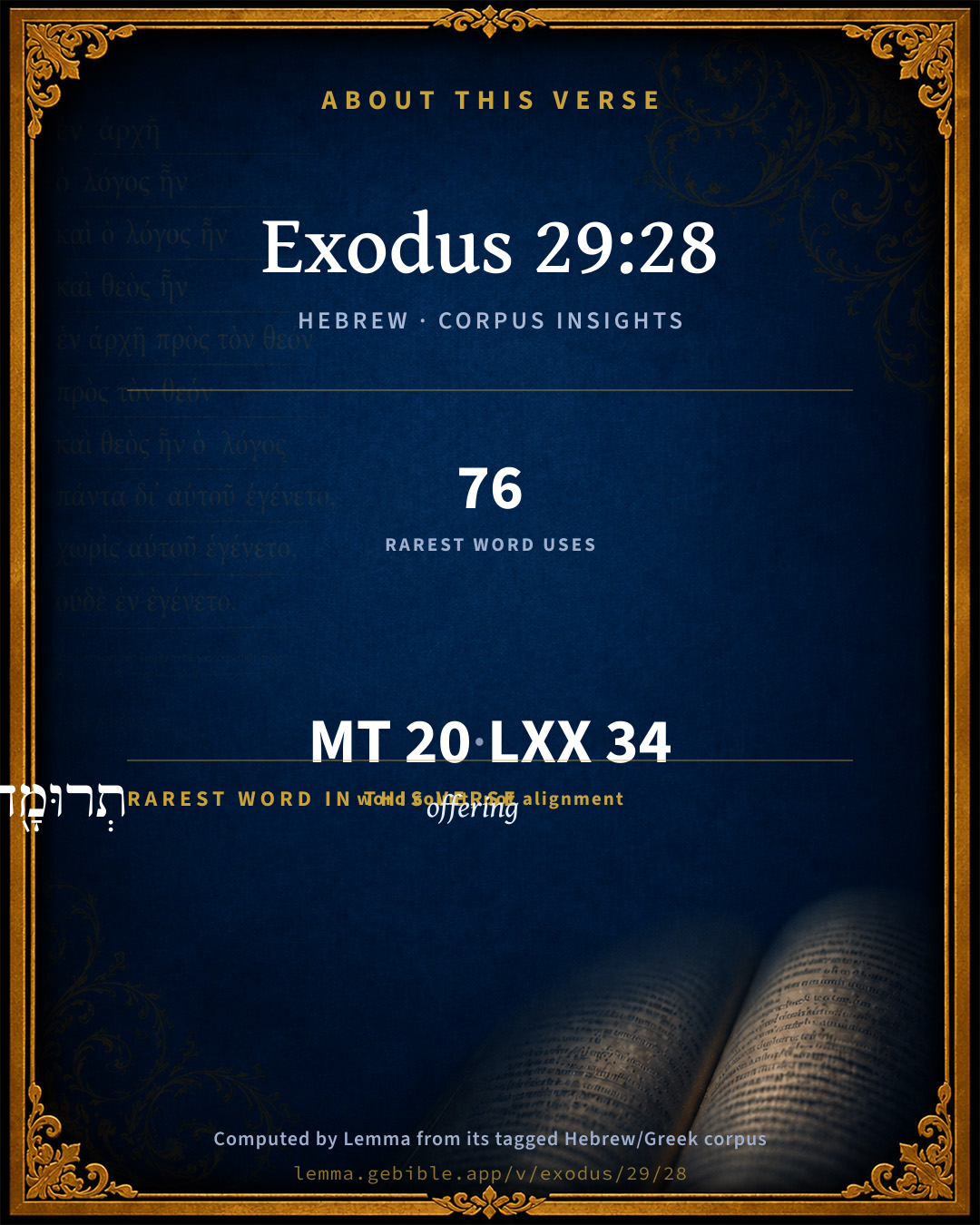
These counts appear in no published source. They are computed here, from the morphology-tagged text and Lemma’s own curated glosses. What Lemma adds →

20
words
13
distinct lemmas
Pentateuch
section

Grammatical profile

  • 2 verbs
  • 14 nouns
  • 1 pronoun
  • 2 prepositions
  • 1 conjunction

Verb forms

  • וְהָיָה֩ Qal · Sequential Perfect
  • יִהְיֶ֨ה Qal · Imperfect

Repetition

Words recur within this verse — often emphatic in Hebrew:

  • וּלְבָנָ֜יו son H1121 ×3
  • תְרוּמָ֖ה offering H8641 ×3
  • וְהָיָה֩ to be H1961 ×2
  • יִשְׂרָאֵ֔ל Israel H3478 ×2
  • מֵאֵת֙ with H854 ×2

Hebrew & Septuagint length

In English translation the verse runs 45 words from the Hebrew and 49 from the Septuagint (LXX English) — closely comparable.

A rough comparison of the two English renderings, which tokenize alike — not a word-level alignment.

Word counts can differ between the Hebrew and the Greek without any difference in meaning — e.g. the Hebrew direct-object marker אֵת has no separate Greek word, and Greek often adds the article ὁ.

In the original languages it is 20 Hebrew tokens and 34 Greek tokens — but the two are counted differently (Hebrew bundles its prefixes and suffixes into one token; the Greek is in lemma form), so that isn’t a like-for-like length.

Cross-references

10

Topical passages linked to Exodus 29:28 in the Treasury of Scripture Knowledge — connected by theme and wording, ordered by reader-vote popularity; previews shown in the World English Bible.

  • Exodus 29:27 You shall sanctify the breast of the wave-offering, and the thigh of the heave-offering, which is waved, and which is heaved up, of the ram of consecration, even of that which is for Aaron, and of that which is for his sons:
  • Leviticus 3:1 "'If his offering is a sacrifice of peace offerings; if he offers it from the herd, whether male or female, he shall offer it without blemish before Yahweh.
  • Leviticus 7:11–38 "'This is the law of the sacrifice of peace offerings, which one shall offer to Yahweh.
  • Leviticus 10:14–15 The waved breast and the heaved thigh you shall eat in a clean place, you, and your sons, and your daughters with you: for they are given as your portion, and your sons' portion, out of the sacrifices of the peace offerings of the children of Israel.
  • Numbers 15:19–20 then it shall be that when you eat of the bread of the land, you shall offer up a heave-offering to Yahweh.
  • Numbers 18:24 For the tithe of the children of Israel, which they offer as a heave-offering to Yahweh, I have given to the Levites for an inheritance: therefore I have said to them, Among the children of Israel they shall have no inheritance.
  • Numbers 18:29 Out of all your gifts you shall offer every heave-offering of Yahweh, of all the best of it, even the holy part of it out of it.
  • Numbers 31:29 take it of their half, and give it to Eleazar the priest, for Yahweh's heave-offering.
  • Numbers 31:41 Moses gave the tribute, which was Yahweh's heave-offering, to Eleazar the priest, as Yahweh commanded Moses.
  • Deuteronomy 18:3 This shall be the priests' due from the people, from those who offer a sacrifice, whether it be ox or sheep, that they shall give to the priest the shoulder, and the two cheeks, and the maw.

Cross-references courtesy of OpenBible.info (CC BY 4.0).

Hebrew and Greek witnesses Masoretic Hebrew ↔ Greek Septuagint

The same verse in the two great witnesses to the Old Testament, shown verse-for-verse.

These are two independent witnesses, not word-aligned to each other, and the Septuagint is shown in lemma (dictionary) form.

Hebrew Exodus 29:28 Masoretic · Westminster Leningrad Codex

וְהָיָה֩ לְאַהֲרֹ֨ן וּלְבָנָ֜יו לְחָק עוֹלָ֗ם מֵאֵת֙ בְּנֵ֣י יִשְׂרָאֵ֔ל כִּ֥י תְרוּמָ֖ה ה֑וּא וּתְרוּמָ֞ה יִהְיֶ֨ה מֵאֵ֤ת בְּנֵֽי יִשְׂרָאֵל֙ מִזִּבְחֵ֣י שַׁלְמֵיהֶ֔ם תְּרוּמָתָ֖ם לַיהוָֽה

and it shall be for Aaron and his sons as their portion forever from the children of Israel; for it is a heave-offering: and it shall be a heave-offering from the children of Israel of the sacrifices of their peace-offerings, even their heave-offering to Yahweh.

World English Bible · Public Domain

Greek LXX Exodus 29:28 Septuagint · lemma form

καί εἰμί ααρων καί ὁ υἱός αὐτός νόμιμος αἰώνιος παρά ὁ υἱός ἰσραήλ εἰμί γάρ ἀφαίρεμα οὗτος καί ἀφαίρεμα εἰμί παρά ὁ υἱός ἰσραήλ ἀπό ὁ θῦμα ὁ σωτήριον ὁ υἱός ἰσραήλ ἀφαίρεμα κύριος

And it shall be a perpetual statute of the children of Israel to Aaron and his sons, for this is a separate offering; and it shall be a special offering from the children of Israel, from the peace-offerings of the children of Israel, a special offering to the Lord.

LXX2012 (modern English Septuagint) · Public Domain

Hebrew: Westminster Leningrad Codex (CC BY 4.0). Greek: Septuagint (public domain); English from LXX2012 (modern English Septuagint) (Public Domain). How the Septuagint differs from the Hebrew →

Targum (Aramaic paraphrase)

2

The Targum is the ancient Jewish Aramaic paraphrase of the Hebrew Scriptures — an interpretive translation, not the Hebrew text itself. Onkelos (literal) and Pseudo-Jonathan (expansive) render the Torah, and Jonathan the Prophets. Coverage is partial: where no permissively-licensed English translation exists for a verse, only the Aramaic is shown. This is verse-level text, not a word-by-word alignment to the Hebrew.

  1. Targum Onkelos Torah (Genesis–Deuteronomy)
    וִיהֵי לְאַהֲרֹן וְלִבְנוֹהִי לִקְיַם עָלָם מִן בְּנֵי יִשְׂרָאֵל אֲרֵי אַפְרָשׁוּתָא הוּא וְאַפְרָשׁוּתָא יְהֵי מִן בְּנֵי יִשְׂרָאֵל מִנִכְסַת קוּדְשֵׁיהוֹן אַפְרָשׁוּתְהוֹן קֳדָם יְיָ:

    (no public-domain English translation for this verse)

    Targum Onkelos — Aramaic: “Onkelos Genesis” (public domain); “Onkelos Exodus” (public domain); “Onkelos Leviticus” (public domain); “Onkelos Numbers” (public domain); “Onkelos Deuteronomy” (public domain). English: “Sefaria Community Translation” (CC0 1.0 (public-domain dedication)); “J.W. Etheridge. The Targums of Onkelos and Jonathan Ben Uzziel on the Pentateuch. London: Longmans, Green, 1862” (public domain). Text via Sefaria.

  2. Targum Pseudo-Jonathan Torah (Genesis–Deuteronomy)
    וִיהֵי לְאַהֲרן וְלִבְנוֹי לִקְיַים עֲלָם מִן בְּנֵי יִשְרָאֵל אֲרֵי אַפְרָשׁוּתָא הוּא וְאַפְרְשׁוּתָא יְהֵי מִן בְּנֵי יִשְרָאֵל מִנִּכְסַת קוּדְשֵׁיהוֹן אַפְרָשׁוּתְהוֹן קֳדָם יְיָ

    And it shall be for Aharon and for his sons by a perpetual statute for the sons of Israel; because it is a separation, and a separation it shall be from the sons of Israel from the offerings of their consecration, their separation before the Lord.

    Targum Pseudo-Jonathan — Aramaic: “Targum Jonathan on Genesis” (public domain); “Targum Jonathan on Exodus” (public domain); “Targum Jonathan on Leviticus” (public domain); “Targum Jonathan on Numbers” (public domain); “Targum Jonathan on Deuteronomy” (public domain). English: “The Targum of Jonathan ben Uzziel, trans. J. W. Etheridge, London, 1862” (public domain). Text via Sefaria.

Commentary

Notes on Exodus 29:28 from classic Christian and Jewish commentators (each source and its license shown beneath its notes). The classic Christian expositions comment on the surrounding passage and are grouped to its opening verse, so a note may address several verses; the Jewish commentaries on the Tanakh (Rashi and others) are per-verse, so they appear only where the commentator wrote on this verse.

Lemma curates 59 commentaries, every one of them public domain or Creative Commons licensed, each selected and text-cleaned for this edition rather than reprinted as found. About our sources →

Trapp's Complete Commentary

John Trapp

Exo 29:28 And it shall be Aaron’s and his sons’ by a statute for ever from the children of Israel: for it [is] an heave offering: and it shall be an heave offering from the children of Israel of the sacrifice of their peace offerings, [even] their heave offering unto the LORD.

Ver. 28. A heave offering.] Signifying the heaving of Christ upon the cross, and the heaving up of our hearts to God for so great benefits.

John Trapp, A Commentary or Exposition upon All the Books of the Old and New Testament (1647–1656) — public domain. Text from a community e-Sword module.

Geneva Bible (1599)

Geneva Bible translators

Which were offerings of thanksgiving to God for his benefits.

Geneva Bible (1599) marginal notes — public domain. Text via Bolls.life.

The Cambridge Bible for Schools and Colleges

gen. ed. J. J. S. Perowne

28. for Aaron and his sons] in Lev_7:33 it is laid down that the ‘heave thigh’ is to be in particular the perquisite of the officiating priest.

a due (ḥôḳ; lit. statute) for ever] See on Exo_27:21.

an heave offering (twice)] a contribution (v. 27); something ‘lifted off’ and separated from the rest of the sacrifice as a priestly due: cf. Num_18:8; Num_Exo_18:11; Num_18:19.

of the sacrifices] out of would be clearer, as in the || Lev_7:34.

peace offerings] See more fully on Leviticus 3, and Lev_7:28-34.

unto Jehovah] who, however, gives them back to the priests (Num_18:8).

The Cambridge Bible for Schools and Colleges (gen. ed. J. J. S. Perowne; Cambridge University Press, 1878–1918) — public domain. Text from a community e-Sword module.

John Gill's Exposition

And it shall be Aaron's and his sons by a statute for ever from the children of Israel,.... That is, the shoulder, which seems particularly meant, though the breast also was theirs, which was at this time given to Moses, he being priest; and this was an everlasting statute and ordinance in all generations, as long as the priesthood of Aaron lasted, until the Messiah should come and put an end to it: and this the children of Israel were always to allow the priests; the shoulder, because Aaron bore their names before the Lord upon his shoulders, for a memorial; and the breast for a like reason, because he bore their names in the breastplate of judgment upon his heart, and their judgment also before the Lord continually, Exo 28:12,

for it is an heave offering: it is lifted up to the Lord, and therefore is given to his priest:

and it shall be an heave offering from the children of Israel of the sacrifice of their peace offerings, even their heave offering unto the Lord: it being heaved up and given to the priest, it was reckoned an offering to the Lord, and was accepted by him as a peace offering; and it was an emblem of the lifting up of their hearts to God, and of the going up of the affections and desires of their souls to him, and of their serving and worshipping him in spirit and in truth, who is a spirit, and was their Father in heaven, to whom their eyes, hearts, and hands, were to be lifted up.

John Gill's Exposition of the Whole Bible (1746–1763) — public domain (CC PDM 1.0). Text via the HelloAO Bible API.

Haydock's Catholic Bible Commentary

Israel. As these parts have been offered by Aaron to the Lord, so the Israelites shall present them to him and his sons, when they offer sacrifice. (Menochius) --- All the different kinds of victims were immolated on this occasion, because the priests were consecrated to offer them all. (Du Hamel)

George Leo Haydock (1774–1849), Haydock's Catholic Family Bible and Commentary, 1859 edition — public domain. Excludes Psalms (Douay-Rheims chapter numbering differs from Protestant) and Deuterocanonical books (Catholic canon only).

Matthew Poole's English Annotations

It is an heave-offering; under which is comprehended also the wave-offering; as plainly appears both from the context, and from the parity of reason, these offerings being of the same nature, and designed for the same purpose.

Matthew Poole's English Annotations on the Holy Bible (1683–1685) — public domain. Text from a community e-Sword/MySword module.

Rashi

Rabbi Shlomo Yitzchaki (Rashi)

לחק עולם מאת בני ישראל AS AN ASSIGNED PORTION FROM THE CHILDREN OF ISRAEL — because peace-offerings belong to the “owner”, and the breast and the shoulder shall they give to the priest.

כי תרומה הוא FOR IT IS A HEAVE OFFERING — i.e. the breast and the shoulder form a heave-offering.

Rashi on the Tanakh — English translations: “The Judaica Press complete Tanach with Rashi, translated by A. J. Rosenberg” (CC BY 4.0); “Pentateuch with Rashi's commentary by M. Rosenbaum and A.M. Silbermann, 1929-1934” (public domain); “The Metsudah Tanach series, Lakewood, N.J” (CC BY 4.0); and “The Book of Joshua, Metsudah Publications, 1997” (CC BY 4.0). Text via Sefaria.

Lesson kit

Teaching starters — assembled from the data on this page, not authored interpretation. Every prompt links to the verse data it draws on. Edit before teaching.

Exodus, in the Pentateuch, opens this verse with 20 words (13 distinct Hebrew lemmas). Its most distinctive word is tᵉrûwmâh (“offering”). A historical commentator’s framing appears above. Read the whole chapter for the surrounding context.

Discussion questions

  1. The word tᵉrûwmâh carries the sense “offering.” How does it shape the verse?
  2. How does Exodus 29:27, which shares this passage’s theme, read alongside this verse?
  3. What does the repetition of “son” (3× in this one verse) do in this verse?
  4. These translations render this verse differently; the difference is in the English rendering, not the original. What questions does that raise?
  5. «וְהָיָה֩» is a Qal Sequential Perfect verb. How does that grammatical form shape the action described?
  6. Compare how Trapp's Complete Commentary and Geneva Bible (1599) read this verse. Where do they agree or differ?

Things to notice

Reading settings

Reading text

Shown beneath each verse's original-language words.

Old Testament
Old Testament edition

Read the OT as the Masoretic Hebrew (MT) or the Greek Septuagint (LXX).

English shown for the Greek Septuagint (in the Hebrew ↔ Greek comparison).

Comparing translations? Open the Compare panel on any verse page to stack up to four side by side.