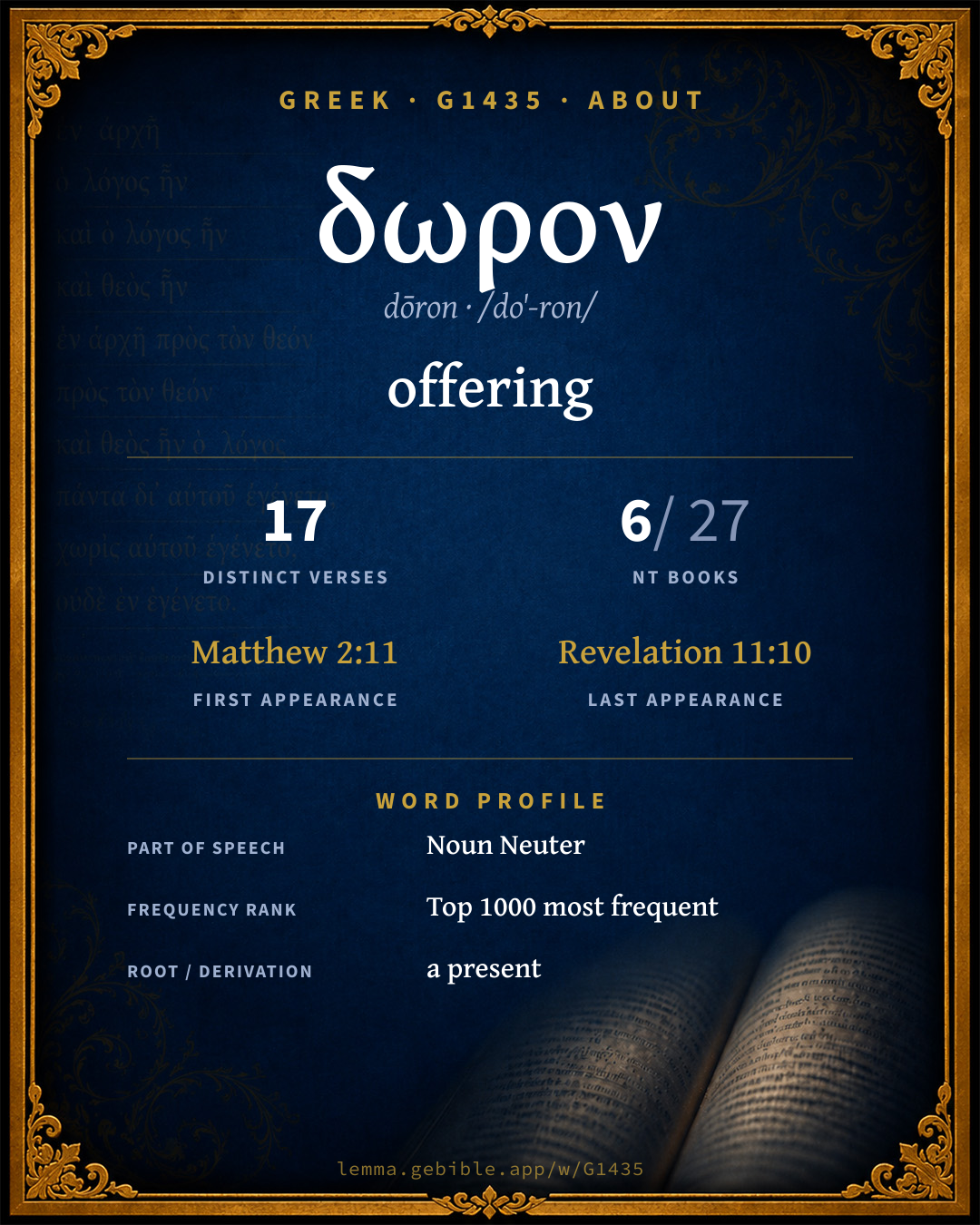
δῶρον
offering
‘offering’ is one of 2 main senses fuller range ↓
Full lexicon entry — Thayer's Greek Lexicon
From Thayer's Greek Lexicon
Where this word appears
See every Accusative-case word in the Greek New Testament →
Grammar key — what these labels mean
Part of speech
- Noun
- A naming word — a person, place, thing, or idea.
Case
- Accusative
- The case of the direct object and of extent.
- Nominative
- The case of the subject (and the predicate nominative).
- Dative
- The case of the indirect object, means, or location — “to / for / with / in.”
Gender
- Neuter
- Grammatically neuter.
Number
- Plural
- More than one.
- Singular
- One.
5 distinct verses where G1435 appears in the Nominative case, across 4 books. Filtered view — show all forms. Click any verse to open its interlinear word-by-word view. Verse text shown in the World English Bible for context — . Each verse’s Greek form is shown with its reference; the English is not keyword-highlighted, since the data carries no word-level English alignment. Use “Compare translations” on any verse to read it across multiple English versions. This concordance covers the Greek New Testament; Septuagint (Greek Old Testament) occurrences of this word are not indexed here.
Matthew 2 verses
- Matthew 15:5 δῶρον n nom sg neut But you say, 'Whoever may tell his father or his mother, "Whatever help you might otherwise have gotten from me is a gift devoted to God,"
- Matthew 23:19 δῶρον δῶρον n nom sg neut n acc sg neut You blind fools! For which is greater, the gift, or the altar that sanctifies the gift?
Mark 1 verse
Ephesians 1 verse
Hebrews 1 verse
About this entry
At a glance — auto-summarized from this page’s data, not written by a person. Every figure links to its source below. This summary describes the numbers; it doesn’t interpret them.
“offering” is the headline sense of the Greek noun δωρον (dōron). Scripture first uses it in Matthew 2:11. It appears 17 verses across 6 books of the Greek New Testament, among its uncommon vocabulary. More than a third of its appearances fall in Matthew. Catalogued under 2 senses, its meaning is not single-sense. The sections below give every sense, occurrence, and version rendering.
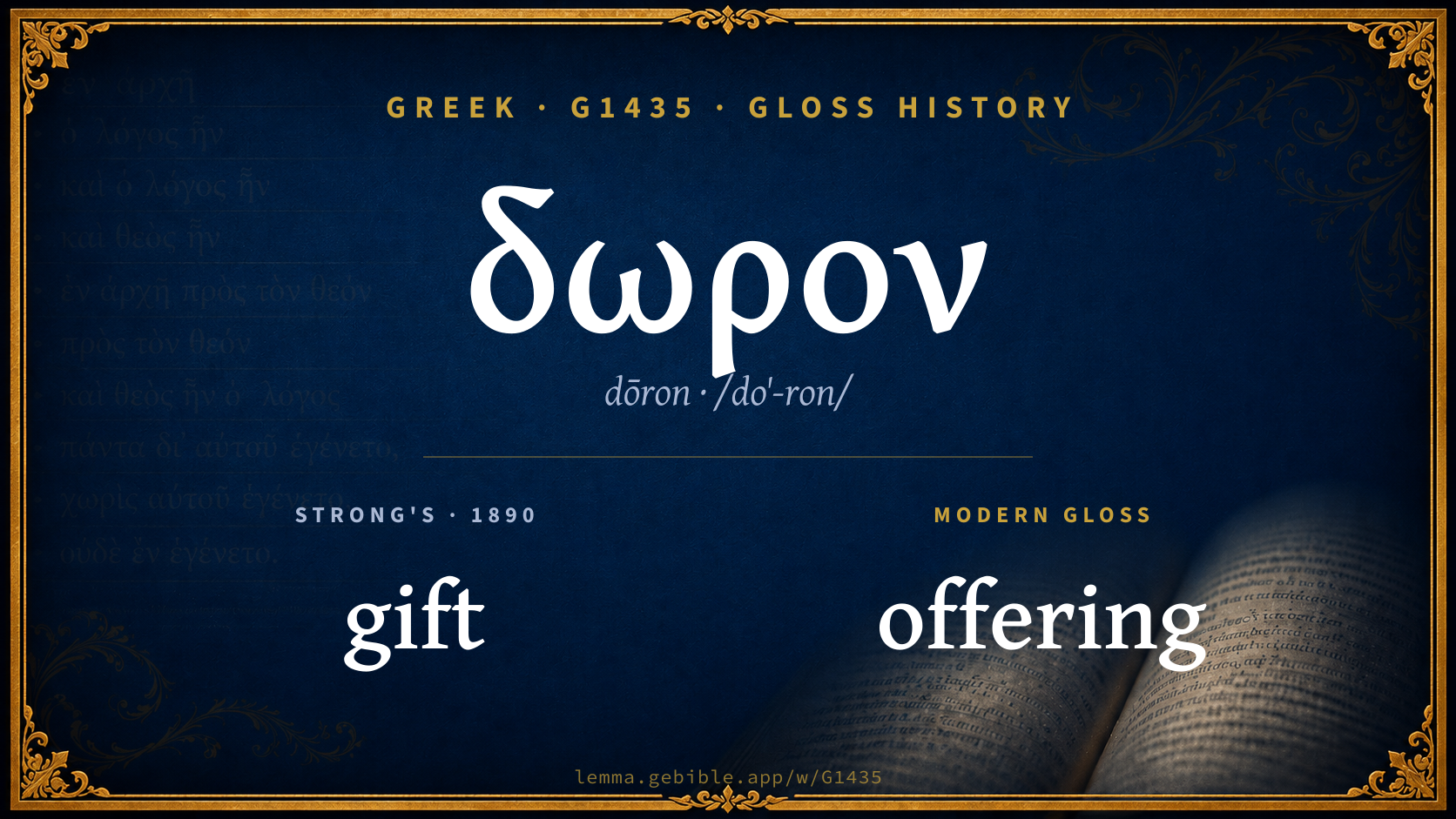
Gloss history
Strong's 1890 vs modern scholarship
About this word
Strong's G1435 catalogs a Greek word from the Greek New Testament.
These counts are not copied from any lexicon or concordance. They are computed here, from the morphology-tagged Greek New Testament. What Lemma adds →
- 17
- distinct verses
- The word appears in 17 distinct verses.
- 6 / 27
- NT books
- The word appears in 6 of 27 New Testament books.
- #644
- by frequency
- Top 1000 most frequent Greek words (rank 644 of 5,347 Greek words by occurrence).
View all 17 occurrences in the concordance →
By section of the New Testament
By traditional corpus
Conventional, traditional groupings — biblical authorship is debated, so this is a traditional corpus grouping, not an authorship claim. Some books belong to more than one corpus (Luke is in both the Gospels and the Lukan corpus, and so on), so these shares overlap and need not total 100%. Each figure is a share of the word’s 17 distinct verses.
- Gospels 10 verses · 59%
- Hebrews 5 verses · 29%
- Lukan (Luke–Acts) 2 verses · 12%
- Johannine 1 verse · 6%
- Pauline corpus 1 verse · 6%
- Revelation 1 verse · 6%
How translations render this word
Counts come from each version’s own published word-to-Strong’s tagging or interlinear alignment — an approximate guide to how each version renders this word, not a word-level alignment the data otherwise carries. Because each total is that version’s own tagged count, the per-version totals vary from one another and need not match the appearance or distinct-verse counts above. These counts may also differ from a printed concordance because Lemma counts each distinctly tagged rendering and does not collapse phrase taggings into a single head-word total. This is a fixed set of word-tagged versions (KJV, ASV, BSB, ULT) and does not change with the reading translation you choose elsewhere. Each version’s license is shown beside its name below (and on Sources).
- King James Version: Gift 8×, Gifts 8×
- American Standard Version: Gifts 9×, Gift 7×
- Berean Standard Bible: Gifts 8×, Gift 7×
- unfoldingWord Literal Text: Gift 9×, Gifts 9×
King James Version Public Domain
Renders G1435 across 19 tagged occurrences — most commonly:
Plus 3 renderings that appear only once — usually multi-word phrases or single function words the recovered tagging swept in, not distinct renderings.
American Standard Version Public Domain
Renders G1435 across 19 tagged occurrences — most commonly:
Plus 3 renderings that appear only once — usually multi-word phrases or single function words the recovered tagging swept in, not distinct renderings.
Berean Standard Bible Public Domain
Renders G1435 across 17 tagged occurrences — most commonly:
Plus 2 renderings that appear only once — usually multi-word phrases or single function words the recovered tagging swept in, not distinct renderings. Not rendered by a distinct English word in 2 further occurrences.
unfoldingWord Literal Text CC BY-SA 4.0
Renders G1435 across 20 tagged occurrences — most commonly:
Plus 2 renderings that appear only once — usually multi-word phrases or single function words the recovered tagging swept in, not distinct renderings.
Senses in Thayer's
The 2 senses Thayer's distinguishes for this word, in lexicon order (not ranked by frequency or importance). The full entry — with sub-senses — is in the Lexicon Entry tab.
- gifts offered in expression of honour
- the offering of a gift or of gifts
Word origin
Origin: a present
A present ; specifically a sacrifice : - gift offering.
— Strong’s Exhaustive Concordance (1890), public domain.
Forms in the corpus
The 6 distinct written forms G1435 takes in the Greek New Testament, most frequent first — each parse links to that case’s occurrences in the concordance.
| Form | Parsing | Example | Uses |
|---|---|---|---|
| δῶρον dō̂ron | Noun, Nominative, Singular, Neuter | Matthew 15:5 | 6 |
| δῶρα dō̂ra | Noun, Accusative, Plural, Neuter | Matthew 2:11 | 5 |
| δῶρά dō̂rá | Noun, Accusative, Plural, Neuter | Hebrews 5:1 | 3 |
| δῶρόν dō̂rón | Noun, Accusative, Singular, Neuter | Matthew 5:23 | 3 |
| δώροις dṓrois | Noun, Dative, Plural, Neuter | Hebrews 11:4 | 1 |
| δώρῳ dṓrō | Noun, Dative, Singular, Neuter | Matthew 23:18 | 1 |
Same root — word family
Other Thayer's entries built from the same root as G1435, grouped by Strong’s listed origin. These share a root / origin per the lexicon — not necessarily a shared meaning. Each links to that word’s own entry.
Derived from this word
Compare all same-root words → They share a root, not necessarily a meaning.
Septuagint usage
The same Greek word δωρον appears 158 times in the Greek Old Testament (Septuagint), across 149 verses in 21 books.
- 158
- LXX occurrences
- Tagged occurrences of this Greek word in the Septuagint.
- 149
- verses
- Distinct Septuagint verses containing this word.
- 21 / 39
- OT books
- The word appears in 21 of the 39 Old Testament books.
Sample Septuagint occurrences
- Genesis 4:4 δῶρον
- Exodus 23:7 δῶρον
- Leviticus 1:2 δῶρον
- Numbers 5:15 δῶρον
- Deuteronomy 10:17 δῶρον
- Judges 3:15 δῶρον
- 1 Samuel 8:3 δῶρον
- 1 Kings 2:46 δῶρον
- 2 Kings 16:8 δῶρον
- 1 Chronicles 16:29 δῶρον
- 2 Chronicles 9:24 δῶρον
- Ezra 23:31 δῶρον
Septuagint occurrences (same lexeme)
Every verse where the same Strong’s number (G1435) appears in the Greek Septuagint — showing the first 50 of 149. Verse text shown in the World English Bible for context; the Greek form is the matched word — the English is not keyword-highlighted.
- Genesis 4:4 δῶρον Abel also brought some of the firstborn of his flock and of the fat of it. Yahweh respected Abel and his offering,
- Genesis 24:53 δῶρον The servant brought forth jewels of silver, and jewels of gold, and clothing, and gave them to Rebekah. He gave also to her brother and to her mother precious things.
- Genesis 30:20 δῶρον Leah said, "God has endowed me with a good dowry. Now my husband will live with me, because I have borne him six sons." She named him Zebulun.
- Genesis 32:14 δῶρον two hundred female goats and twenty male goats, two hundred ewes and twenty rams,
- Genesis 32:19 δῶρον He commanded also the second, and the third, and all that followed the herds, saying, "This is how you shall speak to Esau, when you find him.
- Genesis 32:21 δῶρον So the present passed over before him: and he himself lodged that night in the camp.
- Genesis 32:22 δῶρον He rose up that night, and took his two wives, and his two handmaids, and his eleven sons, and passed over the ford of the Jabbok.
- Genesis 33:10 δῶρον Jacob said, "Please, no, if I have now found favor in your sight, then receive my present at my hand, because I have seen your face, as one sees the face of God, and you were pleased with me.
- Genesis 43:11 δῶρον Their father, Israel, said to them, "If it be so now, do this. Take from the choice fruits of the land in your bags, and carry down a present for the man, a little balm, a little honey, spices and myrrh, nuts, and almonds;
- Genesis 43:15 δῶρον The men took that present, and they took double money in their hand, and Benjamin; and rose up, went down to Egypt, and stood before Joseph.
- Genesis 43:25 δῶρον They made ready the present for Joseph's coming at noon, for they heard that they should eat bread there.
- Genesis 43:26 δῶρον When Joseph came home, they brought him the present which was in their hand into the house, and bowed down themselves to him to the earth.
- Exodus 23:7 δῶρον "Keep far from a false charge, and don't kill the innocent and righteous: for I will not justify the wicked.
- Exodus 23:8 δῶρον You shall take no bribe, for a bribe blinds those who have sight and perverts the words of the righteous.
- Leviticus 1:2 δῶρον "Speak to the children of Israel, and tell them, 'When anyone of you offers an offering to Yahweh, you shall offer your offering of the cattle, from the herd and from the flock.
- Leviticus 1:3 δῶρον "'If his offering is a burnt offering from the herd, he shall offer a male without blemish. He shall offer it at the door of the Tent of Meeting, that he may be accepted before Yahweh.
- Leviticus 1:10 δῶρον "'If his offering is from the flock, from the sheep, or from the goats, for a burnt offering, he shall offer a male without blemish.
- Leviticus 1:14 δῶρον "'If his offering to Yahweh is a burnt offering of birds, then he shall offer his offering of turtledoves, or of young pigeons.
- Leviticus 2:1 δῶρον "'When anyone offers an offering of a meal offering to Yahweh, his offering shall be of fine flour; and he shall pour oil on it, and put frankincense on it.
- Leviticus 2:4 δῶρον "'When you offer an offering of a meal offering baked in the oven, it shall be unleavened cakes of fine flour mixed with oil, or unleavened wafers anointed with oil.
- Leviticus 2:5 δῶρον If your offering is a meal offering of the baking pan, it shall be of unleavened fine flour, mixed with oil.
- Leviticus 2:7 δῶρον If your offering is a meal offering of the frying pan, it shall be made of fine flour with oil.
- Leviticus 2:12 δῶρον As an offering of firstfruits you shall offer them to Yahweh: but they shall not come up for a sweet savor on the altar.
- Leviticus 2:13 δῶρον Every offering of your meal offering you shall season with salt; neither shall you allow the salt of the covenant of your God to be lacking from your meal offering. With all your offerings you shall offer salt.
- Leviticus 3:1 δῶρον "'If his offering is a sacrifice of peace offerings; if he offers it from the herd, whether male or female, he shall offer it without blemish before Yahweh.
- Leviticus 3:2 δῶρον He shall lay his hand on the head of his offering, and kill it at the door of the tent of meeting: and Aaron's sons the priests shall sprinkle the blood on the altar round about.
- Leviticus 3:6 δῶρον "'If his offering for a sacrifice of peace offerings to Yahweh is from the flock; male or female, he shall offer it without blemish.
- Leviticus 3:7 δῶρον If he offers a lamb for his offering, then he shall offer it before Yahweh;
- Leviticus 3:8 δῶρον and he shall lay his hand on the head of his offering, and kill it before the tent of meeting: and Aaron's sons shall sprinkle its blood on the altar round about.
- Leviticus 3:12 δῶρον "'If his offering is a goat, then he shall offer it before Yahweh:
- Leviticus 4:23 δῶρον if his sin, in which he has sinned, is made known to him, he shall bring as his offering a goat, a male without blemish.
- Leviticus 4:32 δῶρον "'If he brings a lamb as his offering for a sin offering, he shall bring a female without blemish.
- Leviticus 5:11 δῶρον "'But if he can't afford two turtledoves, or two young pigeons, then he shall bring his offering for that in which he has sinned, the tenth part of an ephah of fine flour for a sin offering. He shall put no oil on it, neither shall he put any frankincense on it, for it is a sin offering.
- Leviticus 6:13 δῶρον Fire shall be kept burning on the altar continually; it shall not go out.
- Leviticus 7:13 δῶρον With cakes of leavened bread he shall offer his offering with the sacrifice of his peace offerings for thanksgiving.
- Leviticus 7:14 δῶρον Of it he shall offer one out of each offering for a heave offering to Yahweh. It shall be the priest's who sprinkles the blood of the peace offerings.
- Leviticus 7:16 δῶρον "'But if the sacrifice of his offering is a vow, or a freewill offering, it shall be eaten on the day that he offers his sacrifice; and on the next day what remains of it shall be eaten:
- Leviticus 7:29 δῶρον "Speak to the children of Israel, saying, 'He who offers the sacrifice of his peace offerings to Yahweh shall bring his offering to Yahweh out of the sacrifice of his peace offerings.
- Leviticus 7:38 δῶρον which Yahweh commanded Moses in Mount Sinai, in the day that he commanded the children of Israel to offer their offerings to Yahweh, in the wilderness of Sinai.
- Leviticus 9:7 δῶρον Moses said to Aaron, "Draw near to the altar, and offer your sin offering, and your burnt offering, and make atonement for yourself, and for the people; and offer the offering of the people, and make atonement for them; as Yahweh commanded."
- Leviticus 9:15 δῶρον He presented the people's offering, and took the goat of the sin offering which was for the people, and killed it, and offered it for sin, like the first.
- Leviticus 17:4 δῶρον and hasn't brought it to the door of the Tent of Meeting, to offer it as an offering to Yahweh before the tabernacle of Yahweh: blood shall be imputed to that man. He has shed blood; and that man shall be cut off from among his people.
- Leviticus 21:6 δῶρον They shall be holy to their God, and not profane the name of their God; for they offer the offerings of Yahweh made by fire, the bread of their God; therefore they shall be holy.
- Leviticus 21:8 δῶρον You shall sanctify him therefore; for he offers the bread of your God: he shall be holy to you: for I Yahweh, who sanctify you, am holy.
- Leviticus 21:17 δῶρον "Say to Aaron, 'None of your seed throughout their generations who has a blemish, may approach to offer the bread of his God.
- Leviticus 21:21 δῶρον no man of the seed of Aaron the priest, who has a blemish, shall come near to offer the offerings of Yahweh made by fire. Since has a blemish, he shall not come near to offer the bread of his God.
- Leviticus 21:22 δῶρον He shall eat the bread of his God, both of the most holy, and of the holy.
- Leviticus 22:18 δῶρον "Speak to Aaron, and to his sons, and to all the children of Israel, and say to them, 'Whoever is of the house of Israel, or of the foreigners in Israel, who offers his offering, whether it be any of their vows, or any of their freewill offerings, which they offer to Yahweh for a burnt offering;
- Leviticus 22:25 δῶρον Neither from the hand of a foreigner shall you offer the bread of your God of any of these; because their corruption is in them. There is a blemish in them. They shall not be accepted for you.'"
- Leviticus 22:27 δῶρον "When a bull, or a sheep, or a goat, is born, then it shall remain seven days with its mother; and from the eighth day and thenceforth it shall be accepted for the offering of an offering made by fire to Yahweh.
These are occurrences of the same Greek lexeme (G1435) in the Septuagint — not a translation of any one Hebrew word. The store carries no word-level Hebrew↔Greek alignment, so no Hebrew original is asserted here. Counts come from the recovered LXX Strong's tagging — high-frequency vocabulary is well covered, while rare or late forms may be untagged — so they reflect tagged occurrences and may slightly undercount.