

Psalms 74:22

Hebrew (Westminster Leningrad Codex) Psalms 74:22 appears in the Hebrew Old Testament. The text above is from the Westminster Leningrad Codex. Each word links to its Strong’s number, a concise gloss, and parsing drawn from the Open Scriptures Hebrew Bible morphology. Click any word for its full Brown-Driver-Briggs (BDB) entry.
Download image
Cite this verse

Psalms 74:22 (World English Bible). Public Domain. Lemma interlinear Bible study tool, https://lemma.gebible.app/v/psalms/74/22.

Show BibTeX & RIS
BibTeX
RIS
English Translation
Arise, God! Plead your own cause. Remember how the foolish man mocks you all day.
World English Bible · Public Domain
Download a study sheet

One document with this verse’s original text, its word-by-word gloss line, the meaning frame, cross-references with their text, attributed commentary, and full source and license credits — printable, and it pastes into notes with its structure intact.

This verse Autodidact and up

Study sheet (.html) Plain text (.txt)

A passage Seminary Student

Up to 50 verses in one chapter. A passage sheet keeps up to 6 commentary sources and 12 cross-references per verse, in the order this page ranks them, and says so on the sheet whenever that leaves anything out. Ask for a single verse and you get the Autodidact verse sheet above.

Everything on this page stays free to read, with no account — the sheet is a download of what is already on screen, not access to it.

Want to remove ads? Support Godless Engineer
Compare translations 3

The same verse in 3 English versions, stacked beneath the original-language interlinear above. Click any original word for its lexicon entry.

Each is an independent rendering of the whole verse — the interlinear is not word-aligned to these translations.

Highlighted words mark where these versions differ — a whole-verse word diff, not a word-by-word alignment.

  • World English Bible Public Domain
    Arise, God! Plead your own cause. Remember how the foolish man mocks you all day.
  • King James Version Public Domain
    Arise, O God, plead thine own cause: remember how the foolish man reproacheth thee daily.
  • unfoldingWord Literal Text CC BY-SA 4.0
    Arise, God! Plead your case! Remember your reproach from the fool all of the day.

unfoldingWord Literal Text — © unfoldingWord, licensed CC BY-SA 4.0. Word-aligned USFM3 via Door43 (git.door43.org/unfoldingWord/en_ult).

Versions to compare (up to 4)

3 of 4 selected

Show all 18 translations

Every available English version of this verse, each an independent rendering of the whole verse.

  • World English Bible Public Domain
    Arise, God! Plead your own cause. Remember how the foolish man mocks you all day.
  • Berean Standard Bible Public Domain
    Rise up, O God; defend Your cause! Remember how the fool mocks You all day long.
  • Majority Standard Bible Public Domain
    Rise up, O God; defend Your cause! Remember how the fool mocks You all day long.
  • King James Version Public Domain
    Arise, O God, plead thine own cause: remember how the foolish man reproacheth thee daily.
  • American Standard Version (1901) Public Domain
    Arise, O God, plead thine own cause: Remember how the foolish man reproacheth thee all the day.
  • Revised Version (1885) Public Domain
    Arise, O God, plead thine own cause: remember how the foolish man reproacheth thee all the day.
  • Geneva Bible (1599) Public Domain
    Arise, O God: mainteine thine owne cause: remember thy dayly reproche by the foolish man.
  • Douay-Rheims (1899) Public Domain
    Arise, O God, judge thy own cause: remember thy reproaches with which the foolish man hath reproached thee all the day.
  • Young's Literal Translation Public Domain
    Arise, O God, plead Thy plea, Remember Thy reproach from a fool all the day.
  • Literal Standard Version CC BY-SA 4.0
    Arise, O God, plead Your plea, || Remember Your reproach from a fool all the day.
  • Unlocked Literal Bible CC BY-SA 4.0
    Arise, God; defend your own honor; call to mind how fools insult you all day long.
  • unfoldingWord Literal Text CC BY-SA 4.0
    Arise, God! Plead your case! Remember your reproach from the fool all of the day.
  • Darby Bible Public Domain
    Rise up, O God, plead thine own cause: remember how the foolish man reproacheth thee all the day;
  • World Messianic Bible Public Domain
    Arise, God! Plead your own cause. Remember how the foolish man mocks you all day.
  • Webster's Bible Public Domain
    Arise, O God, plead thy own cause: remember how the foolish man reproacheth thee daily.
  • Free Bible Version CC BY-SA 4.0
    Stand up, God, and plead your case. Don't forget how these foolish people insulted you all the time.
  • Bible in Basic English Public Domain
    Up! O God, be the judge of your cause; keep in mind the bitter things which the man of evil behaviour says against you every day.
  • JPS Tanakh (1917) Public Domain
    Arise, O God, plead Thine own cause; remember Thy reproach all the day at the hand of the base man.

Literal Standard Version (2020), Covenant Press — licensed CC BY-SA 4.0. Text via the HelloAO Bible API (eBible.org). Unlocked Literal Bible (unfoldingWord) — licensed CC BY-SA 4.0. Text via the HelloAO Bible API (eBible.org). unfoldingWord Literal Text — © unfoldingWord, licensed CC BY-SA 4.0. Word-aligned USFM3 via Door43 (git.door43.org/unfoldingWord/en_ult). Free Bible Version, Dr. Jonathan Gallagher — licensed CC BY-SA 4.0. Text via the HelloAO Bible API (eBible.org).

Word by word

More ways to search: Search by grammar → Find every occurrence → Compare this word →

Practice this passage: Drill this verse → Learn its vocabulary →

נָ֝בָ֗ל
nâbâl
H5036
“foolish”
Adjective, Adjective, Masculine, Singular, Absolute
Part of Speech
Adjective
Type
Adjective
Gender
Masculine
Number
Singular
State
Absolute
Full BDB Definition

Origin: from H5034

TWOT: 1285a

foolish, senseless, fool
  1. קוּמָ֣ה qûwm H6965 “rise” Verb, Qal, Imperative, 2nd Person, Masculine, Singular + Suffix, h
  2. אֱ֭לֹהִים ʼĕlôhîym H430 “God(s)” Noun, Common, Masculine, Plural, Absolute
  3. רִיבָ֣ה rîyb H7378 “contend” Verb, Qal, Imperative, 2nd Person, Masculine, Singular + Suffix, h
  4. רִיבֶ֑ךָ rîyb H7379 “strife · your” Noun, Common, Both, Singular, Construct + Suffix, Personal, 2nd Person, Masculine, Singular
  5. זְכֹ֥ר zâkar H2142 “remember” Verb, Qal, Imperative, 2nd Person, Masculine, Singular
  6. חֶרְפָּתְךָ֥ cherpâh H2781 “reproach · your” Noun, Common, Feminine, Singular, Construct + Suffix, Personal, 2nd Person, Masculine, Singular
  7. מִנִּי min H4480 “from” Preposition
  8. כָּל kôl H3605 “all of” Noun, Common, Masculine, Singular, Construct
  9. הַיּֽוֹם yôwm H3117 “the · day” Particle, Definite Article + Noun, Common, Masculine, Singular, Absolute

About this verse

These counts appear in no published source. They are computed here, from the morphology-tagged text and Lemma’s own curated glosses. What Lemma adds →

10
words
10
distinct lemmas
Wisdom
section

Notable vocabulary

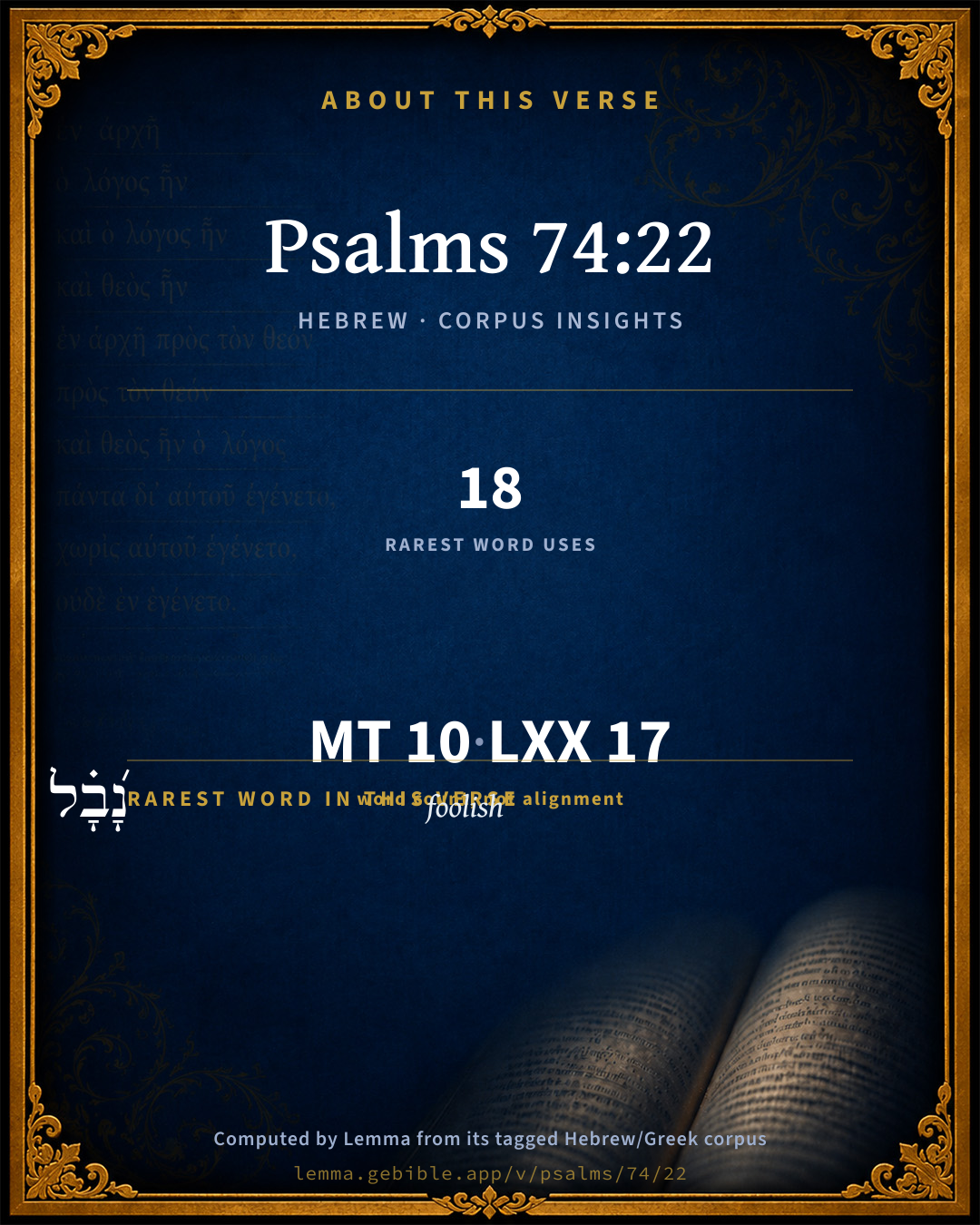
The rarest word here is נָ֝בָ֗ל foolish H5036 — appearing just 18 times in the whole Hebrew Bible.

Shared distinctive vocabulary

נָ֝בָ֗ל foolish H5036 occurs in 18 verses of the Hebrew Bible. Also found in:

Grammatical profile

  • 3 verbs
  • 5 nouns
  • 1 adjective
  • 1 preposition

Verb forms

  • קוּמָ֣ה Qal · Imperative
  • רִיבָ֣ה Qal · Imperative
  • זְכֹ֥ר Qal · Imperative

Hebrew & Septuagint length

In English translation the verse runs 15 words from the Hebrew and 18 from the Septuagint (LXX English) — closely comparable.

A rough comparison of the two English renderings, which tokenize alike — not a word-level alignment.

Word counts can differ between the Hebrew and the Greek without any difference in meaning — e.g. the Hebrew direct-object marker אֵת has no separate Greek word, and Greek often adds the article ὁ.

In the original languages it is 10 Hebrew tokens and 17 Greek tokens — but the two are counted differently (Hebrew bundles its prefixes and suffixes into one token; the Greek is in lemma form), so that isn’t a like-for-like length.

Cross-references

7

Topical passages linked to Psalms 74:22 in the Treasury of Scripture Knowledge — connected by theme and wording, ordered by reader-vote popularity; previews shown in the World English Bible.

  • Psalms 74:18 Remember this, that the enemy has mocked you, Yahweh. Foolish people have blasphemed your name.
  • Psalms 53:1 The fool has said in his heart, "There is no God." They are corrupt, and have done abominable iniquity. There is no one who does good.
  • Isaiah 52:5 Now therefore, what do I here, says Yahweh, seeing that my people is taken away for nothing? those who rule over them do howl, says Yahweh, and my name continually all the day is blasphemed.
  • Psalms 9:19–20 Arise, Yahweh! Don't let man prevail. Let the nations be judged in your sight.
  • Psalms 75:4–5 I said to the arrogant, "Don't boast;" To the wicked, "Don't lift up the horn.
  • Psalms 79:9–10 Help us, God of our salvation, for the glory of your name. Deliver us, and forgive our sins, for your name's sake.
  • Psalms 89:50–51 Remember, Lord, the reproach of your servants, How I bear in my heart the taunts of all the mighty peoples,

Cross-references courtesy of OpenBible.info (CC BY 4.0).

Hebrew and Greek witnesses Masoretic Hebrew ↔ Greek Septuagint

The same verse in the two great witnesses to the Old Testament, shown verse-for-verse.

You’re reading Greek Psalm 73 (Hebrew Psalm 74). The Septuagint counts the superscription, so verse numbers can differ from the Hebrew — chapter-level alignment, not verse-by-verse. Numbering follows Rahlfs.

These are two independent witnesses, not word-aligned to each other, and the Septuagint is shown in lemma (dictionary) form.

Hebrew Psalms 74:22 Masoretic · Westminster Leningrad Codex

קוּמָ֣ה אֱ֭לֹהִים רִיבָ֣ה רִיבֶ֑ךָ זְכֹ֥ר חֶרְפָּתְךָ֥ מִנִּי נָ֝בָ֗ל כָּל הַיּֽוֹם

Arise, God! Plead your own cause. Remember how the foolish man mocks you all day.

World English Bible · Public Domain

Greek LXX Greek Psalm 73:22 Septuagint · lemma form

ἀναἵστημι ὁ θεός δικάζω ὁ δίκη σύ μιμνήσκω ὁ ὀνειδισμός σύ ὁ ὑπό ἄφρων ὅλος ὁ ἡμέρα

Arise, O God, plead your cause: remember your reproaches that come from the foolish one all the day.

LXX2012 (modern English Septuagint) · Public Domain

On this verse, John Gill's Exposition discusses the Septuagint’s reading. Read the note in Commentary ↓

Hebrew: Westminster Leningrad Codex (CC BY 4.0). Greek: Septuagint (public domain); English from LXX2012 (modern English Septuagint) (Public Domain). How the Septuagint differs from the Hebrew →

Commentary

Notes on Psalms 74:22 from classic Christian and Jewish commentators (each source and its license shown beneath its notes). The classic Christian expositions comment on the surrounding passage and are grouped to its opening verse, so a note may address several verses; the Jewish commentaries on the Tanakh (Rashi and others) are per-verse, so they appear only where the commentator wrote on this verse.

Lemma curates 59 commentaries, every one of them public domain or Creative Commons licensed, each selected and text-cleaned for this edition rather than reprinted as found. About our sources →

Trapp's Complete Commentary

John Trapp

Psa 74:22 Arise, O God, plead thine own cause: remember how the foolish man reproacheth thee daily.

Ver. 22. Plead thine own cause] For if we miscarry, thou art sure to suffer among the proud Chaldees as an impotent God.

Remember how the foolish man, &c.] See Psa 74:18.

John Trapp, A Commentary or Exposition upon All the Books of the Old and New Testament (1647–1656) — public domain. Text from a community e-Sword module.

J. A. Alexander on Psalms

Joseph Addison Alexander

Psa 74:22. Arise, 0 God! Plead thine own cause! Remember thy reviling by the fool all day! The first prayer is the common one, that God would put an end to his apparent inaction and indifference to the sufferings of his servants. See above, on Psa 3:7; Psa 7:6; Psa 9:19; Psa 10:12; Psa 17:13; Psa 35:2; Psa 44:26. Plead thine own cause, literally strive thy strife. See above, on Psa 43:1. "Remember how thou art reviled by the irrational transgressor, and arouse thyself to silence his reproaches."

Joseph Addison Alexander, The Psalms Translated and Explained (1850) — public domain. Text from a community e-Sword module.

Geneva Bible (1599)

Geneva Bible translators

He showeth that God cannot suffer his Church to be oppressed, except he loose his own right.

Geneva Bible (1599) marginal notes — public domain. Text via Bolls.life.

Adam Clarke's Commentary

Verse 22. Plead thine own cause] Thy honour is concerned, as well as our safety and salvation. The fool-the idolater, reproacheth thee daily - he boasts of the superiority of his idols, by whose power, he asserts, we are brought under their domination.

Adam Clarke's Commentary on the Bible (1810–1826) — public domain. Text from a community e-Sword/MySword module.

John Calvin's Commentaries

22. Arise, O God! plead thy cause. The pious Jews again supplicate God to ascend into his judgment-seat. He is then said to arise, when, after having long exercised forbearance, he shows, in very deed, that he has not forgotten his office as judge. To induce him to undertake this cause the more readily, they call upon him to maintain his own right. Lord, as if they had said, since the matter in hand is what peculiarly concerns thyself; it is not time for thee to remain inactive. They declare, at the same time, how this was, in a special sense, the cause of God. It was so, because the foolish people daily cast reproaches upon him. We may here again translate the word נבל, nabal, the worthless people, instead of the foolish people. The wickedness charged against the persons spoken of is aggravated from the circumstance, that, not content with reproaching God on one occasion, they continued their derision and mockery without intermission. For this reason, the faithful conclude by invoking God that he would not forget such heaven-daring conduct in men who not only had the audacity to reproach his majesty, but who fiercely and outrageously poured forth their blasphemies against him. They seemed, it is true, to do this indirectly; but, as they despised God, it is asserted that they rose up against him with reckless and infatuated presumption, after the manner of the Giants of old, and that their haughtiness was carried to the greatest excess.

John Calvin's Commentaries (1540-1563) — public domain. Text from the Calvin Translation Society English edition (1840s-50s) via the Christian Classics Ethereal Library (ccel.org). Calvin's coverage is partial (roughly two-thirds of the Bible); uncommented books and verses are honest gaps, never fabricated. The 19th-century editor's footnotes and remarks are omitted so the notes are faithfully Calvin's own voice.

Ellicott's Commentary for English Readers

(22, 23) These verses show that the psalm was actually composed amidst the dark days it describes. It ends in expostulatory prayer, with as yet no brighter gleam of hope than prayer itself implies—and that when seemingly directed to deaf ears.

A Bible Commentary for English Readers, edited by Charles John Ellicott (1878–1897) — public domain. Text from a community e-Sword module.

The Cambridge Bible for Schools and Colleges

gen. ed. J. J. S. Perowne

22, 23. A final appeal. Elsewhere the Psalmist prays ‘plead my cause’ (Psa_43:1), but Israel’s cause is God’s cause: His honour is at stake.

the foolish man] The fool, the members of ‘the foolish people,’ Psa_74:18. The Targ. paraphrases, “the reproach of thy people from the foolish king,” but there is nothing to shew that this meant Antiochus rather than Nebuchadnezzar. daily] All the day (R.V.).

The Cambridge Bible for Schools and Colleges (gen. ed. J. J. S. Perowne; Cambridge University Press, 1878–1918) — public domain. Text from a community e-Sword module.

John Gill's Exposition

Forget not the voice of thine enemies,.... Their roaring in the midst of the sanctuary and the congregation, Psa 74:4, their reproaching and blaspheming voice, Psa 74:10,

the tumult of those that rise up against thee increaseth continually, or "ascendeth" (i); goes up to God, and is taken notice of by him; the cry of their sins, like that of Sodom and Gomorrah, and of the city of Nineveh, Gen 18:20, was continually going up to God; wherefore it might be hoped and expected that vengeance in a little time would come down; see Rev 18:5, the Septuagint, and the versions that follow that, render it, "the pride of those", &c. all these petitions are prayers of faith, and are, or will be, heard and answered; upon which will follow thanksgivings, with which the next psalm begins.

(i) "ascendens semper", Montanus; "ascendit semper", V. L. Musculus, Gejerus.

Next: Psalms Chapter 75

John Gill's Exposition of the Whole Bible (1746–1763) — public domain (CC PDM 1.0). Text via the HelloAO Bible API.

Albert Barnes' Notes on the Bible

Arise, O God - As if God were now insensible to the wrongs and sufferings of his people; as if he were inattentive and indisposed to come to their help. See the notes at Psa 3:7.

Plead thine own cause - literally, “Contend thine own contention.” That is, Maintain a cause which is really thine own. Thine own honor is concerned; thine own law and authority are assailed; the war is really made on “thee.” This is always the true idea in the prayers which are offered for the conversion of sinners, for the establishment of truth, and for the spread of the Gospel in the world. It is not originally the cause of the church; it is the cause of God. Everything in regard to truth, to justice, to humanity, to temperance, to liberty, to religion, is the cause of God. All the assaults made on these, are assaults made on God.

Remember how the foolish man reproacheth thee daily - Constantly. He does not cease. The word “foolish” refers to the wicked. The idea is, that the wicked constantly reproach God - either by their language or their conduct; and this is a reason for calling on him to interpose. No better reason for asking his interposition can be given, than that such conduct is a real reproach to God, and reflects on his honor in the world.

Albert Barnes' Notes on the Bible (1834–1885) — public domain. Text from a community e-Sword/MySword module.

Matthew Poole's English Annotations

Plead thine own cause; maintain thy honour, and worship, and service against those that reproach thee, as it here follows, and was noted before, Psa 74:10,18. As we are reviled and persecuted for thy sake, so thou art injured in all our wrongs.

Matthew Poole's English Annotations on the Holy Bible (1683–1685) — public domain. Text from a community e-Sword/MySword module.

The Treasury of David

Charles H. Spurgeon

Ver. 22. Arise, O God, plead thine own cause. Answer thou the taunts of the profane by arguments which shall annihilate both the blasphemy and the blasphemer. God's judgments are awful replies to the defiance of his foes. When he makes empires crumble, and smites persecutors to the heart, his cause is pleaded by himself as none other could have advocated it. O that the Lord himself would come into the battle field. Long has the fight been trembling in the balance; one glance of his eyes, one word from his lip, and the banners of victory shall be borne on the breeze.

Remember how the foolish man reproacheth thee daily. The Lord is begged to remember that he is himself reproached, and that by a mere man--that man a fool, and he is also reminded that these foul reproaches are incessant and repeated with every revolving day. It is bravely done when faith can pluck pleas out of the dragon's mouth and out of the blasphemies of fools find arguments with God.

None.

Ver. 22. God pleading his own cause in providential visitations of nations and individuals, as also in remarkable conversions and awakenings.

Ver. 22.

I. The glory of our cause: it is the Lord's own.

II. The hope of our cause: he will plead it himself.

III. The hope thus derivable from the violence of man: it

will move the Lord to arise.

Psalms 74:23*

Charles H. Spurgeon's The Treasury of David (1869–1885) — public domain. Psalms only. Text from a community e-Sword/MySword module.

Whedon's Commentary on the Bible

Daniel D. Whedon

22. Thine own cause—Again the issue is urged as between Jehovah and the gods of the heathen, and the “cause” is thrown upon him. The chastened importunity of the prayer closes with a tone of subdued and plaintive appeal.

Daniel D. Whedon (gen. ed.), Commentary on the Old and New Testaments (1874–1909) — public domain. Text from a community e-Sword module.

The Pulpit Commentary

Arise, O God, plead thine own cause; i.e. assert thyself, show forth thy power, avenge thyself on thine enemies. Remember how the foolish man reproacheth thee daily (comp. ver. 18, and see the comment ad loc. ). In the ancient world the conquest of a people was always regarded as a triumph over the people"s god or gods. Naturally, insults to the god found a place in the victor"s songs of triumph. (see 2Ki_19:10-13 Isa_10:8-11)

God"s cause that of his people.

"Arise... thine own cause." The great problems of life, and the inner depths of human experience, are the same in all ages. The surface of society changes marvellously; but heart still answers to heart. Asaph"s questions and troubles and prayers find their echo in ten thousand Christian hearts today. It would be extremely interesting if we could certainly tell to what crisis of Israel"s history this noble psalm refers. Some say the Chaldean invasion; others, the Maecabean tyranny. Very strong reasons are given in the "Speaker"s Commentary" for believing that it refers to the Egyptian invasion in the reign of Rehobeam. (2Ch 12) As that was the first time when the kingdom of David fell under the power of a heathen conqueror, so the trial to the faith of God"s people was correspondingly severe. It seemed as though God had forgotten his covenant, and Church and state (to use our modern phrase) were to Perish in common ruin. The spiritual lesson is not affected by any uncertainty as to the historic reference. The psalmist takes refuge in God. His plea is that it is God"s own cause which is at stake. In effect, it is the same which Moses urged; (Exo_32:11 Num_14:13) and Joshua, "What wilt thou do unto thy great Name?". (Jos_7:9) "Arise," etc.

I THE CAUSE OF GOD"S CHURCH IS GOD"S OWN CAUSE. The word so rendered means "strife," "controversy". (comp. Hos_4:1 Mic_6:2 Jer_25:31) The Lord"s cause, then, is that ancient controversy which began when sin entered the world; and will never cease till sin is conquered, and death, the last enemy, destroyed, and all things placed Under the feet of Christ. The strife between truth and lies, holiness and sin, right and wrong, between "the things that make for peace" and the things about which men cry, "Peace! peace!" but God says, "There is no Peace to the wicked." One of the moral dangers of our time is a feeble sense of the reality, greatness, infinite issues, of the conflict. Society is awake, sensitive, as never before, to human suffering and misery; but no corresponding sense of man"s sin and guilt. Criminals are often more pitied for their punishment than condemned for their wickedness. We can understand (or think we can) our Saviour"s tears over the approaching calamities of Jerusalem; but, perhaps, fail to see that the deepest source of his grief was the unbelief and the sin of which those impending calamities would be the outcome. (Luk_19:42 Mat_23:37) We see how dreadful it is for savages to run about naked and eat one another, to be enslaved or massacred. But do we see how far more terrible it is for them to be without God in the world, without Christ, without hope? We do not want to be less humane, soft-hearted, sympathetic; but we do want to measure by a juster standard, to see that God"s cause is the supreme interest of human history, that there is nothing we can pray for, work for, live for, to be compared with this that his Name be hallowed, his kingdom triumph, his will be done. We can see that this is God"s own cause; but how is it the cause of his people, of Israel in ancient days, of the Church of Christ in our own? Just because this is the very end for the sake of which the Church exists, for the sake of which the nation of Israel was called into being. Christians are in danger of just the mistake into which the Jews fell. They thought they were the chosen, favoured people of Jehovah, to the exclusion of all other nations, and that they might despise and hate the Gentiles. Whereas the truth was, it was for the sake of all mankind that they were chosen to be God"s witnesses, that all nations might be blessed in their promised King and Saviour. So Christians are not saved simply for their own sake, but to be the "salt of the earth" and "light of the world; firstfruits". (Jam_1:18)

II Therefore, secondly, THE CAUSE OF GOD IS THE CAUSE OF MANKIND. Attempts have been made to set in opposition "the service of God" and "the service of man." In actual fact, none have rendered such service to men as those devoted to the service of God. No power but the gospel of Jesus Christ can take a horde of naked cannibals and, in a single generation, change them into peaceful, intelligent, useful members of the great community of nations many of them willing martyrs for truth and charity. The moral ideas of universal justice, personal liberty, human brotherhood, the value of each human being, the duty of the rich to the poor, which have abolished slavery and serfdom, and are working so mightily towards the regeneration of society, find room only in Christianized nations, and have their fountain in the gospel. But the gospel aims at something very different from regenerating society with ideas, however true and Divine. It aims to bring each human being, as a lost wanderer, home to God. Alone among systems, the gospel goes to the heart and root of all man"s wretchedness and degradationsin. The estrangement of the individual heart and life from God, and disobedience to his law of love. If you want an unanswerable proof that the gospel is God"s word, not man"s, you may find one (among innumerable others) in the view given of sin and God"s dealing with it. Take just four passages: Joh_1:29 1Jn_4:10; ("our sins;" q.d. "of the whole world," 2:2; Joh_6:51, "the bread," etc.) Joh_16:8.

III THE SUCCESS OF GOD"S CAUSE DEPENDS ON GOD HIMSELF PLEADING IT. Asa"s plea. (2Ch_14:11) We may be in danger of forgetting this. If we see full subscription lists, large congregations, plenty of new societies, we think God"s work is surely prospering. If the reverse, we are downcast, perhaps almost despairing. One way in which God wonderfully holds the work in his own hand is in the raising up of workers. What would the religious history of mankind have been without Abraham, Moses, St. Paul? Such men as John Wesley, J. F. Oberlin, Felix Neff, Robert Moffat, are not results of any law of evolution and human progress. Each is unique a gift from God. God only is the Judge, in what way best to plead his own cause. Sometimes by letting men take their own blind, proud way, and eat the fruit of their doings. Spain has never recovered the withering blight brought on her by the Inquisition, which trampled out her noblest life. Nor France the massacre of the Huguenots and the Revocation of the Edict of Nantes.

IV Therefore we are WARRANTED, ENCOURAGED, CONSTRAINED, TO OFFER THIS PRAYER. "Arise," etc. Beware of playing as though we were more zealous for God"s cause than God himself, more earnest for his glory, more compassionate towards perishing men. Yet we are not to treat prayer as a mere form. Sometimes it seems inscrutable, almost incredible, that our poor, weak prayers can be of any account in the world"s history the fulfilment of God"s promises. But God knows best. He has made prayer one of the great laws of his spiritual universe. Ours not to question, but obey. What infinite comfort to turn from our own failures, the world"s unbelief and misery, and the mysteries of providence to God"s plain word. of promise and command! (Mat_6:9)

The Pulpit Commentary (1880–1919), ed. H.D.M. Spence-Jones & Joseph S. Exell — public domain. Text from a community e-Sword module.

unfoldingWord translationNotes

Door43 World Missions Community

defend your own honor

"show everyone that you are right"

call to mind

"Pay attention to." God has not forgotten how fools insult him, but he does not seem to be thinking about it. See how this is translated in verse Psalms 2.

the voice of your adversaries

The word "voice" is a metonym for the words people use when they speak. AT: "what your adversaries are saying" (See: Metonymy)

or the uproar of those who continually defy you

The psalmist speaks of the words of those who defy God as if they were the loud sound of animals or non-living objects like water or the wind. AT: "and pay attention to the loud and meaningless words of those who continually defy you" (See: Ellipsis and Metaphor)

defy

boldly oppose

translationWords

raise

honor

fool

voice

unfoldingWord translationNotes — © Distant Shores Media and the Door43 World Missions Community, licensed CC BY-SA 4.0. Source: git.door43.org/Door43/en_tn.

Rashi

Rabbi Shlomo Yitzchaki (Rashi)

Your disgrace Your blasphemies, as (verse 18): “Remember how the enemy reviled.”

Rashi on the Tanakh — English translations: “The Judaica Press complete Tanach with Rashi, translated by A. J. Rosenberg” (CC BY 4.0); “Pentateuch with Rashi's commentary by M. Rosenbaum and A.M. Silbermann, 1929-1934” (public domain); “The Metsudah Tanach series, Lakewood, N.J” (CC BY 4.0); and “The Book of Joshua, Metsudah Publications, 1997” (CC BY 4.0). Text via Sefaria.

Lesson kit

Teaching starters — assembled from the data on this page, not authored interpretation. Every prompt links to the verse data it draws on. Edit before teaching.

Psalms, in the Wisdom, opens this verse with 10 words (10 distinct Hebrew lemmas). Its most distinctive word is nâbâl (“foolish”). A historical commentator’s framing appears above. Read the whole chapter for the surrounding context.

Discussion questions

  1. What does “foolish” (nâbâl) contribute to the verse as a whole?
  2. How does Deuteronomy 32:6, which shares the word «foolish», read alongside this verse?
  3. These translations render this verse differently; the difference is in the English rendering, not the original. What questions does that raise?
  4. «קוּמָ֣ה» is a Qal Imperative verb. How does that grammatical form shape the action described?
  5. Compare how Trapp's Complete Commentary and J. A. Alexander on Psalms read this verse. Where do they agree or differ?

Things to notice

Reading settings

Reading text

Shown beneath each verse's original-language words.

Old Testament
Old Testament edition

Read the OT as the Masoretic Hebrew (MT) or the Greek Septuagint (LXX).

English shown for the Greek Septuagint (in the Hebrew ↔ Greek comparison).

Comparing translations? Open the Compare panel on any verse page to stack up to four side by side.