Isaiah 57:16

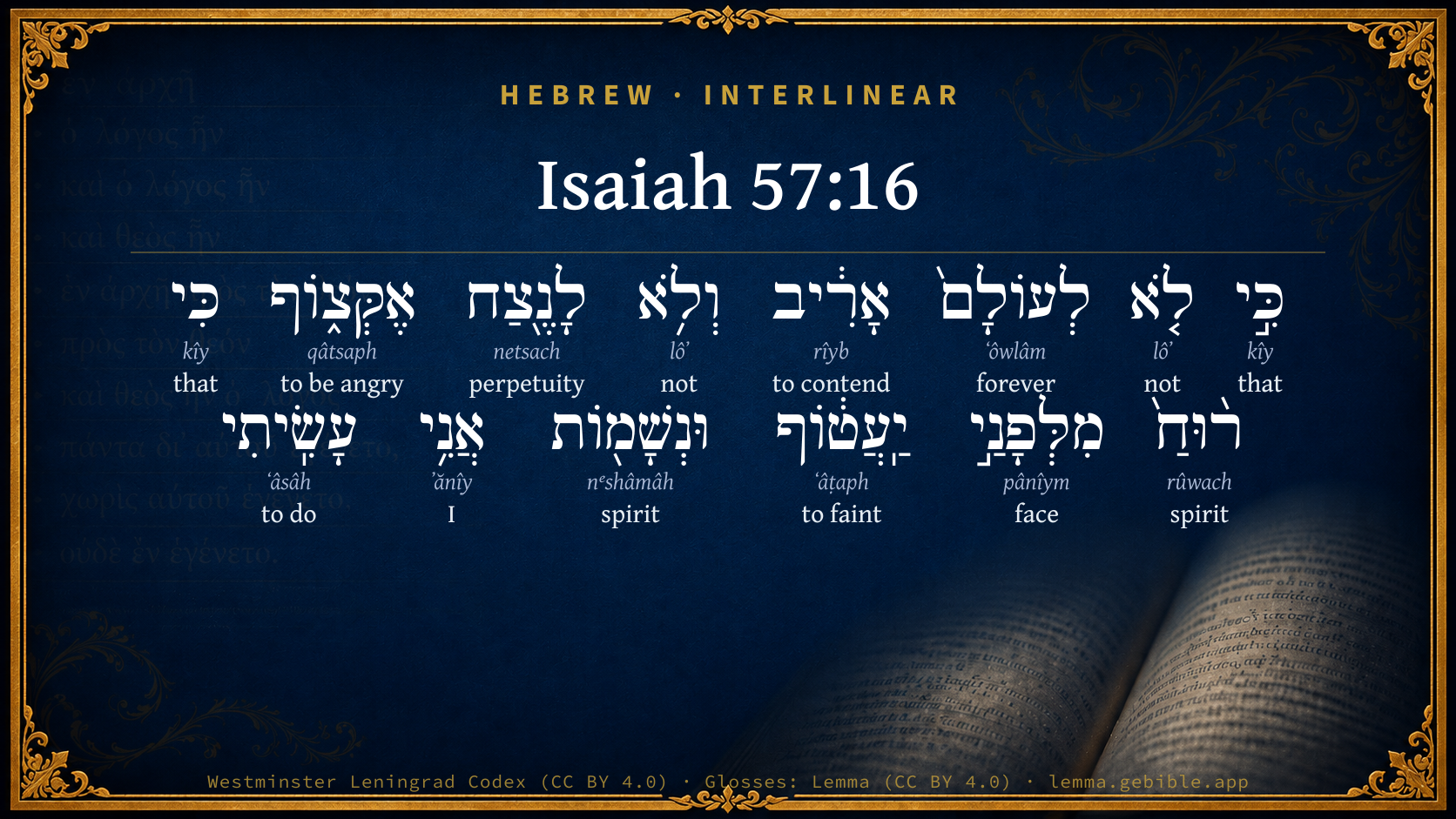
Hebrew (Westminster Leningrad Codex) Isaiah 57:16 appears in the Hebrew Old Testament. The text above is from the Westminster Leningrad Codex. Each word links to its Strong’s number, a concise gloss, and parsing drawn from the Open Scriptures Hebrew Bible morphology. Click any word for its full Brown-Driver-Briggs (BDB) entry.
Download image
Cite this verse

Isaiah 57:16 (World English Bible). Public Domain. Lemma interlinear Bible study tool, https://lemma.gebible.app/v/isaiah/57/16.

Show BibTeX & RIS
BibTeX
RIS
English Translation
For I will not contend forever, neither will I be always angry; for the spirit would faint before me, and the souls who I have made.
World English Bible · Public Domain
Download a study sheet

One document with this verse’s original text, its word-by-word gloss line, the meaning frame, cross-references with their text, attributed commentary, and full source and license credits — printable, and it pastes into notes with its structure intact.

This verse Autodidact and up

Study sheet (.html) Plain text (.txt)

A passage Seminary Student

Up to 50 verses in one chapter. A passage sheet keeps up to 6 commentary sources and 12 cross-references per verse, in the order this page ranks them, and says so on the sheet whenever that leaves anything out. Ask for a single verse and you get the Autodidact verse sheet above.

Everything on this page stays free to read, with no account — the sheet is a download of what is already on screen, not access to it.

Want to remove ads? Support Godless Engineer
Compare translations 3

The same verse in 3 English versions, stacked beneath the original-language interlinear above. Click any original word for its lexicon entry.

Each is an independent rendering of the whole verse — the interlinear is not word-aligned to these translations.

Highlighted words mark where these versions differ — a whole-verse word diff, not a word-by-word alignment.

  • World English Bible Public Domain
    For I will not contend forever, neither will I be always angry; for the spirit would faint before me, and the souls who I have made.
  • King James Version Public Domain
    For I will not contend for ever, neither will I be always wroth: for the spirit should fail before me, and the souls which I have made.
  • unfoldingWord Literal Text CC BY-SA 4.0
    For I will not contend to eternity, and I will not be angry for ever, for the spirit would faint from to my face and the breaths I, I have made.

unfoldingWord Literal Text — © unfoldingWord, licensed CC BY-SA 4.0. Word-aligned USFM3 via Door43 (git.door43.org/unfoldingWord/en_ult).

Versions to compare (up to 4)

3 of 4 selected

Show all 18 translations

Every available English version of this verse, each an independent rendering of the whole verse.

  • World English Bible Public Domain
    For I will not contend forever, neither will I be always angry; for the spirit would faint before me, and the souls who I have made.
  • Berean Standard Bible Public Domain
    For I will not accuse you forever, nor will I always be angry; for then the spirit of man would grow weak before Me, with the breath of those I have made.
  • Majority Standard Bible Public Domain
    For I will not accuse you forever, nor will I always be angry; for then the spirit of man would grow weak before Me—the breath of life I have made.
  • King James Version Public Domain
    For I will not contend for ever, neither will I be always wroth: for the spirit should fail before me, and the souls which I have made.
  • American Standard Version (1901) Public Domain
    For I will not contend for ever, neither will I be always wroth; for the spirit would faint before me, and the souls that I have made.
  • Revised Version (1885) Public Domain
    For I will not contend for ever, neither will I be always wroth: for the spirit should fail before me, and the souls which I have made.
  • Geneva Bible (1599) Public Domain
    For I will not contende for euer, neither will I be alwayes wroth, for the spirite should fayle before me: and I haue made the breath.
  • Douay-Rheims (1899) Public Domain
    For I will not contend for ever, neither will I be angry unto the end: because the spirit shall go forth from my face, end breathings I will make.
  • Young's Literal Translation Public Domain
    For, not to the age do I strive, nor for ever am I wroth, For the spirit from before Me is feeble, And the souls I have made.
  • Literal Standard Version CC BY-SA 4.0
    For I do not strive for all time, nor am I angry forever, || For the spirit is feeble before Me, || And the souls I have made.
  • Unlocked Literal Bible CC BY-SA 4.0
    For I will not accuse forever, nor will I be angry forever, for then man's spirit would faint before me, the lives that I have made.
  • unfoldingWord Literal Text CC BY-SA 4.0
    For I will not contend to eternity, and I will not be angry for ever, for the spirit would faint from to my face and the breaths I, I have made.
  • Darby Bible Public Domain
    For I will not contend for ever, neither will I be always wroth; for the spirit would fail before me, and the souls [which] I have made.
  • World Messianic Bible Public Domain
    For I will not contend forever, neither will I always be angry; for the spirit would faint before me, and the souls whom I have made.
  • Webster's Bible Public Domain
    For I will not contend for ever, neither will I be always wroth: for the spirit would fail before me, and the souls which I have made.
  • Free Bible Version CC BY-SA 4.0
    I won't fight with you forever; I won't be angry with you forever. Otherwise you'd lose heart, the very people I gave life to.
  • Bible in Basic English Public Domain
    For I will not give punishment for ever, or be angry without end: for from me breath goes out; and I it was who made the souls.
  • JPS Tanakh (1917) Public Domain
    For I will not contend for ever, neither will I be always wroth; for the spirit that enwrappeth itself is from Me, and the souls which I have made.

Literal Standard Version (2020), Covenant Press — licensed CC BY-SA 4.0. Text via the HelloAO Bible API (eBible.org). Unlocked Literal Bible (unfoldingWord) — licensed CC BY-SA 4.0. Text via the HelloAO Bible API (eBible.org). unfoldingWord Literal Text — © unfoldingWord, licensed CC BY-SA 4.0. Word-aligned USFM3 via Door43 (git.door43.org/unfoldingWord/en_ult). Free Bible Version, Dr. Jonathan Gallagher — licensed CC BY-SA 4.0. Text via the HelloAO Bible API (eBible.org).

Word by word

More ways to search: Search by grammar → Find every occurrence → Compare this word →

Practice this passage: Drill this verse → Learn its vocabulary →

יַֽעֲט֔וֹף
ʻâṭaph
H5848
“to faint”
Verb, Qal, Imperfect, 3rd Person, Masculine, Singular
Part of Speech
Verb
Stem
Qal
Form
Imperfect
Person
3rd Person
Gender
Masculine
Number
Singular
Full BDB Definition

Origin: a primitive root

TWOT: 1605 , 1606 , 1607

to turn aside - (Qal) to turn aside, turn (in order to cover) - to envelop oneself - (Qal) to envelop oneself, cover - to be feeble, be faint, grow weak - (Qal) to be feeble, be faint - (Niphal) to faint - (Hiphil) to show feebleness - (Hithpael) to faint, faint away
  1. כִּ֣י kîy H3588 “that” Conjunction
  2. לֹ֤א lôʼ H3808 “not” Particle, Negative
  3. לְעוֹלָם֙ ʻôwlâm H5769 “to/for · forever” Preposition + Noun, Common, Masculine, Singular, Absolute
  4. אָרִ֔יב rîyb H7378 “to contend” Verb, Qal, Imperfect, 1st Person, Common, Singular
  5. וְלֹ֥א lôʼ H3808 “and · not” Conjunction + Particle, Negative
  6. לָנֶ֖צַח netsach H5331 “to/for · perpetuity” Preposition + Noun, Common, Masculine, Singular, Absolute
  7. אֶקְּצ֑וֹף qâtsaph H7107 “to be angry” Verb, Qal, Imperfect, 1st Person, Common, Singular
  8. כִּי kîy H3588 “that” Conjunction
  9. ר֨וּחַ֙ rûwach H7307 “spirit” Noun, Common, Both, Singular, Absolute
  10. מִלְּפָנַ֣י pânîym H6440 “from · to/for · face(s) · my” Preposition + Preposition + Noun, Common, Both, Plural, Construct + Suffix, Personal, 1st Person, Common, Singular
  11. וּנְשָׁמ֖וֹת nᵉshâmâh H5397 “and · spirits” Conjunction + Noun, Common, Feminine, Plural, Absolute
  12. אֲנִ֥י ʼănîy H589 “I” Pronoun, Personal, 1st Person, Common, Singular
  13. עָשִֽׂיתִי ʻâsâh H6213 “to do” Verb, Qal, Perfect, 1st Person, Common, Singular

About this verse

These counts appear in no published source. They are computed here, from the morphology-tagged text and Lemma’s own curated glosses. What Lemma adds →

14
words
12
distinct lemmas
Prophets
section

Notable vocabulary

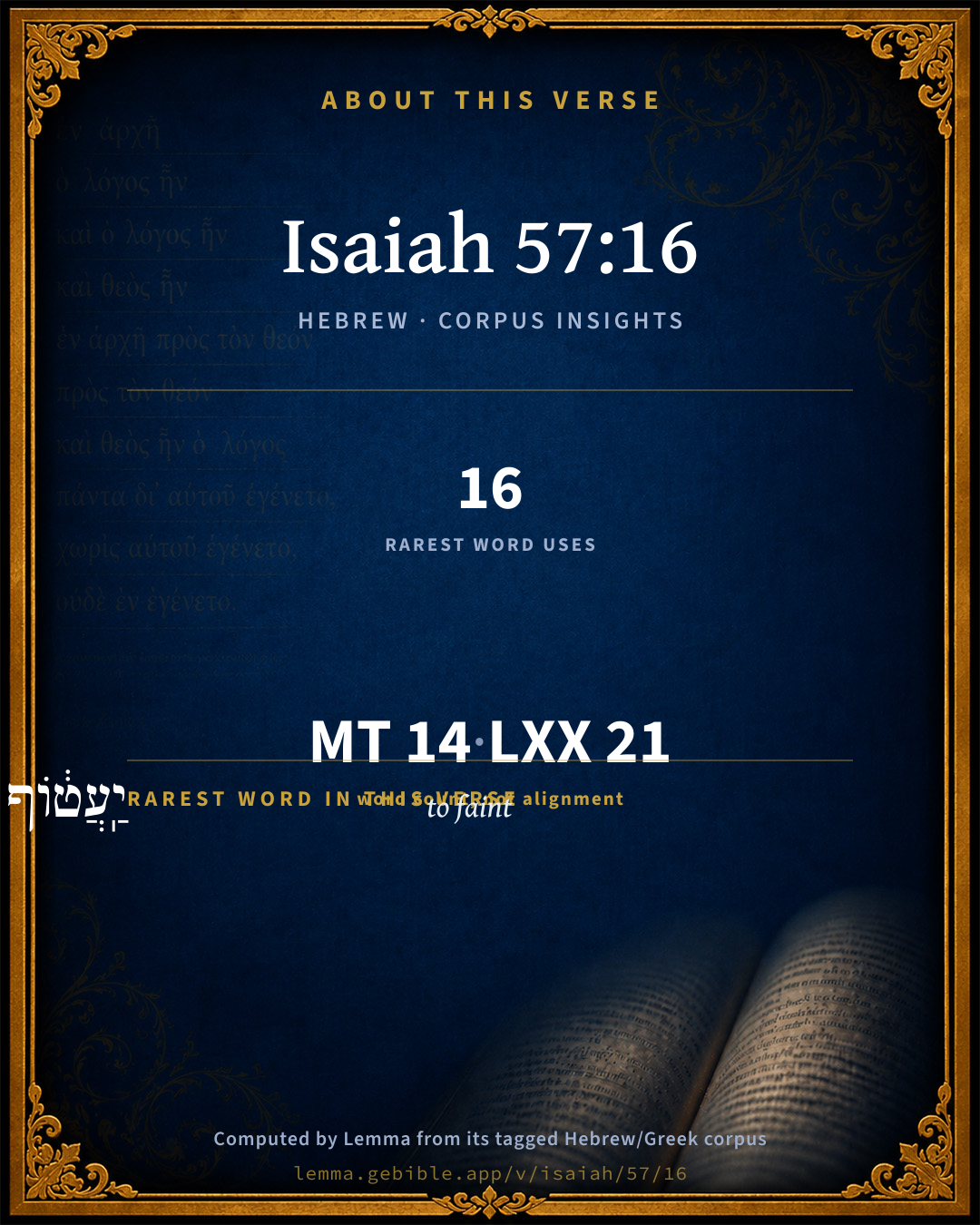
The rarest word here is יַֽעֲט֔וֹף to faint H5848 — appearing just 16 times in the whole Hebrew Bible.

Shared distinctive vocabulary

יַֽעֲט֔וֹף to faint H5848 occurs in 15 verses of the Hebrew Bible. Also found in:

Grammatical profile

  • 4 verbs
  • 5 nouns
  • 1 pronoun
  • 2 conjunctions
  • 2 particles

Verb forms

  • אָרִ֔יב Qal · Imperfect
  • אֶקְּצ֑וֹף Qal · Imperfect
  • יַֽעֲט֔וֹף Qal · Imperfect
  • עָשִֽׂיתִי Qal · Perfect

Repetition

Words recur within this verse — often emphatic in Hebrew:

  • כִּ֣י that H3588 ×2
  • לֹ֤א not H3808 ×2

Hebrew & Septuagint length

In English translation the verse runs 26 words from the Hebrew and 31 from the Septuagint (LXX English) — closely comparable.

A rough comparison of the two English renderings, which tokenize alike — not a word-level alignment.

Word counts can differ between the Hebrew and the Greek without any difference in meaning — e.g. the Hebrew direct-object marker אֵת has no separate Greek word, and Greek often adds the article ὁ.

In the original languages it is 14 Hebrew tokens and 21 Greek tokens — but the two are counted differently (Hebrew bundles its prefixes and suffixes into one token; the Greek is in lemma form), so that isn’t a like-for-like length.

Cross-references

13

Topical passages linked to Isaiah 57:16 in the Treasury of Scripture Knowledge — connected by theme and wording, ordered by reader-vote popularity; previews shown in the World English Bible.

  • Micah 7:18 Who is a God like you, who pardons iniquity, And passes over the disobedience of the remnant of his heritage? He doesn't retain his anger forever, Because he delights in loving kindness.
  • Jeremiah 10:24 Yahweh, correct me, but in measure: not in your anger, lest you bring me to nothing.
  • Psalms 85:5 Will you be angry with us forever? Will you draw out your anger to all generations?
  • Psalms 103:9–16 He will not always accuse; Neither will he stay angry forever.
  • Hebrews 12:9 Furthermore, we had the fathers of our flesh to chasten us, and we paid them respect. Shall we not much rather be in subjection to the Father of spirits, and live?
  • Psalms 78:38–39 But he, being merciful, forgave iniquity, and didn't destroy them. Yes, many times he turned his anger away, And didn't stir up all his wrath.
  • Genesis 6:3 Yahweh said, "My Spirit will not strive with man forever, because he also is flesh; yet will his days be one hundred twenty years."
  • Numbers 16:22 They fell on their faces, and said, God, the God of the spirits of all flesh, shall one man sin, and will you be angry with all the congregation?
  • Job 34:14–15 If he set his heart on himself, If he gathered to himself his spirit and his breath;
  • Isaiah 42:5 Thus says God Yahweh, he who created the heavens, and stretched them forth; he who spread abroad the earth and that which comes out of it; he who gives breath to the people on it, and spirit to those who walk therein:
  • Jeremiah 38:16 So Zedekiah the king swore secretly to Jeremiah, saying, As Yahweh lives, who made us this soul, I will not put you to death, neither will I give you into the hand of these men who seek your life.
  • Ecclesiastes 12:7 And the dust returns to the earth as it was, And the spirit returns to God who gave it.
  • Zechariah 12:1 An oracle. The word of Yahweh concerning Israel. Yahweh, who stretches out the heavens, and lays the foundation of the earth, and forms the spirit of man within him says:

Cross-references courtesy of OpenBible.info (CC BY 4.0).

Hebrew and Greek witnesses Masoretic Hebrew ↔ Greek Septuagint

The same verse in the two great witnesses to the Old Testament, shown verse-for-verse.

These are two independent witnesses, not word-aligned to each other, and the Septuagint is shown in lemma (dictionary) form.

Hebrew Isaiah 57:16 Masoretic · Westminster Leningrad Codex

כִּ֣י לֹ֤א לְעוֹלָם֙ אָרִ֔יב וְלֹ֥א לָנֶ֖צַח אֶקְּצ֑וֹף כִּי ר֨וּחַ֙ מִלְּפָנַ֣י יַֽעֲט֔וֹף וּנְשָׁמ֖וֹת אֲנִ֥י עָשִֽׂיתִי

For I will not contend forever, neither will I be always angry; for the spirit would faint before me, and the souls who I have made.

World English Bible · Public Domain

Greek LXX Isaiah 57:16 Septuagint · lemma form

οὐ εἰς ὁ αἰών ἐκδικέω σύ οὐδέ διά πᾶς ὀργίζω σύ πνεῦμα γάρ παρά ἐγώ ἐκἔρχομαι καί πνοή πᾶς ἐγώ ποιέω

I will not take vengeance on you for ever, neither will I be always angry with you: for my Spirit shall go forth from me, and I have created all breath.

LXX2012 (modern English Septuagint) · Public Domain

On this verse, Keil & Delitzsch discusses the Septuagint’s reading. Read the note in Commentary ↓

Hebrew: Westminster Leningrad Codex (CC BY 4.0). Greek: Septuagint (public domain); English from LXX2012 (modern English Septuagint) (Public Domain). How the Septuagint differs from the Hebrew →

Targum (Aramaic paraphrase)

1

The Targum is the ancient Jewish Aramaic paraphrase of the Hebrew Scriptures — an interpretive translation, not the Hebrew text itself. Onkelos (literal) and Pseudo-Jonathan (expansive) render the Torah, and Jonathan the Prophets. Coverage is partial: where no permissively-licensed English translation exists for a verse, only the Aramaic is shown. This is verse-level text, not a word-by-word alignment to the Hebrew.

  1. Targum Jonathan Prophets (Joshua–Malachi)
    אֲרֵי לָא לְעַלְמָא אִתְפְּרַע בְּדִין וְלָא לְאַפְרֵשׁ יְהֵי רוּגְזִי אֲרֵי רוּחִי מֵתַיָא אֲנָא עֲתִיד לַאֲתָבָא וְנִשְׁמָתָא אֲנָא עֲבָדֵית:

    For I will not take vengeance of judgment for ever, neither shall my wrath be eternal: I will revive the spirits of the dead, and the souls I have created.

    Targum Jonathan — Aramaic: “Mikraot Gedolot” (public domain). English: “Sefaria Community Translation” (CC0 1.0 (public-domain dedication)); “London "Chaldee Paraphrase," 1871” (public domain). Text via Sefaria.

Commentary

Notes on Isaiah 57:16 from classic Christian and Jewish commentators (each source and its license shown beneath its notes). The classic Christian expositions comment on the surrounding passage and are grouped to its opening verse, so a note may address several verses; the Jewish commentaries on the Tanakh (Rashi and others) are per-verse, so they appear only where the commentator wrote on this verse.

Lemma curates 59 commentaries, every one of them public domain or Creative Commons licensed, each selected and text-cleaned for this edition rather than reprinted as found. About our sources →

Trapp's Complete Commentary

John Trapp

Isa 57:16 For I will not contend for ever, neither will I be always wroth: for the spirit should fail before me, and the souls [which] I have made.

Ver. 16. For I will not contend for ever.] It soon repenteth the Lord concerning his servants. Et pro magno peccato parum supplicii satis est patti. {a} See Psa 103:9.

For the spirit would fail before me.] Heb., Would be overcovered - sc., tenebris ac terroribus, it would even sink and faint away. When the child swoons in the whipping, God lets fall the rod, and falls akissing it, to fetch life into it again. {Jer 31:20} As the rule in medicine is still to maintain nature, so doth he their spirits by cordials.

{a} Terent.

John Trapp, A Commentary or Exposition upon All the Books of the Old and New Testament (1647–1656) — public domain. Text from a community e-Sword module.

The Biblical Illustrator

Joseph S. Exell

Isa_57:16-18

For I will not contend for ever

Gods contendings with man

I.

LET US ADVERT TO THE CONTROVERSY ITSELF--WHAT IT IS, WHY IT IS, AND HOW IT IS CARRIED ON. What this quarrel is we know. It is a part of that ancient strife for mastery, which has been going on ever since the fall, between truth and error, light and darkness, holiness and sin. The carnal mind is enmity against God. Unconverted men may demur to these representations; they tell us that they merely withhold from the Divine Being the homage which He expects and claims; but repugnance, hatred, enmity towards Him, they have none. But do they not hate the law of God? Would they not, if it were in their power, have Him alter the scheme of His entire moral government, His permissions, His requirements? This, speaking after the manner of men, makes God angry--sometimes the contendings of God with man take a judicial form. They are to condemn the sinner out of his own mouth, in that he did not see, in the bitter experiences of a life of evil, how the goodness of God was leading him to repentance. See a form of this contending with us, in that fixed and universal law of our being, which always makes us unhappy, when we are striving with God, when we reject His counsels, or resist His will, or try to get from under His yoke, or wrestle with all the obstructions of His providence, in order to have our own way. But, further, and more directly, God contends with us by His Word, and Spirit, and outward providences--by powerful awakenings at the heart when we look not for them, or byinterposed checks and barriers when we are bent on the way of sin. There are restraints upon us often from without. And there are restraints upon us from within from the suggestions, and the admonitions, and remonstrances of the Divine Spirit in our hearts. But a more comforting view of our text, and one more in harmony with its general spirit, is that which supposes God to be contending with us, avowedly for the purposes of His own Fatherly correction, and only for the fulfilment of those ends; waiting to remove from us His heavy hand. These contendings of God with His own children take many forms. Chastening is a universal discipline. Very hard to bear is this contending of God with us; there is only one thing harder, and that is, the state in which He should not contend with us at all, but should leave us to ourselves.

II. THE LIMITS WHICH GOD HAS HIMSELF ASSIGNED TO THIS CONTROVERSY WITH THE SOULS OF MEN, AND THE REASONS MOVING HIM THERETO,

Contend with us He must, and be wroth with us He must. It is a necessity forced upon Him by the circumstances of our fallen nature; but He will not contend for ever. Wisdom and goodness have decreed the bounds of this flooding wave and it shall go no farther. Now, in the case of the obstinately wicked and impenitent, we have seen why God will not contend for ever. They have their day of visitation and they outlive it; their accepted time and they sin on. The Judge wastes not scourges up, on them; they will make scourges enough for themselves. Hell itself is but Heavens assisting grace withdrawn, and man left to the evil of his own heart. But in His own children, the limits of Gods chastening are merciful limits. He for our profit--here is the universal law of the scourge; it will cease whenever our souls profit ceases. I will not contend for ever; nor longer than may be necessary to try our faith, to prove our repentance, to see what there is in our hearts, whether we will keep the Divine commandments or not. These seasons of sadness are sometimes permitted to take us off from a false theology and a false rest. For the spirit should fail before Me. Very instructive are those Scriptures, and very comforting, which tell us how largely the thought of our mortal frailness enters into the considerate care of Heaven. The uppermost thought which our subject should leave upon the mind, and which the heart should cleave to with all the energies of a loving faith is, that it goes very hard with God to afflict man at all; and that He has in some mysterious sense to wrestle with the conflicting powers of the Godhead before He can give up a soul altogether. It seems as if God could take every step towards the sinners condemnation but the last. He can admonish, rebuke, threaten; but when it comes to smiting, then comes the hesitation, then begins Gods strange work. (D. Moore, M. A.)

Contention ended and grace reigning

The Lord is holding high soliloquy. He allows His prophet to stand where he can hear the sacred soliloquy of the great Supreme; and he does hear it, and then under the dictate of the Divine Spirit he records it in the inspired book, where it remains to this day for our instruction.

I. GOD CONTENDS WITH MEN, AND THE DIVINE CONTENTION IS WELL DESERVED ON THEIR PART. He says, I will not contend for ever, in which it is implied that He does contend sometimes. Smiting comes before saving.

1. I would speak of this to the seeking sinner. Anything is better than the horrible calm of the dead sea of spiritual indifference. The Lords design in contending with you is to convince you of your sin. The next reason for the

Lords contending with you will begin to operate when the first purpose has been accomplished. You will, in your self-abasement, be driven to look to the grace of God. It is hard to part a man from his sin, it is still harder to divorce him from his self-righteousness: and this is a part of the Lords contention with awakened souls. Moreover, no one can be surprised that the Lord lets forth a measure of His wrath upon seeking sinners when we see how they behave, even while they are seeking. We have known them red hot one day and icy cold another, and albeit that they long for mercy, you will see them at certain seasons acting as if they despised it.

2. But now I turn to the people of God. Sometimes our Lord hath a contention with us. This is not at all wonderful when we consider how unworthily we often live towards His sacred name; indeed, it is of the Lords mercies that we are not consumed. His contention with us will show itself occasionally in adverse providences. Even more severe are His blows when it comes to be a controversy carried on by His Spirit within the mind.

II. THIS DIVINE CONTENTION WILL COME TO AN END WITH THE CONTRITE, I will not contend for ever, etc. The question arises: When may we expect that this promise will be fulfilled? Notice the verse which precedes the text, for that assures us that God hath no controversy with the humble and the contrite. This is self-evident, for He declares Chat with such He will dwell, and the God of grace will not dwell in a house that is full of contention. He contends where He does not abide, but where He abides there is peace. It is wonderful how the pity of God has in some cases been excited, even by a temporary repentance. When wicked Ahab rent his clothes and put sackcloth upon himself, the Lord took note of it and said, Seest thou how Ahab humbled himself before Me? Because he humbled himself before Me I will not bring the evil in his days. When the Ninevites repented, though probably there was very little that was spiritual about their humbling, the Lord turned from His fierce anger and there was a reprieve for the wicked city. He has given a promise of grace which runs thus, Humble yourselves in the sight of the Lord, and He shall lift you up. He cannot spurn those who submit themselves before Him, for it is written, Though the Lord be high, yet hath He respect unto the lowly. Condescension to the lowly is His glory, as the blessed Virgin sang of old, and as many fainting ones may sing at this moment if they will: He hath put down the mighty from their seats, and exalted them of low degree: He hath filled the hungry with good things: and the rich He hath sent empty away. Lowly roofs attract the Deity. He comes to those who are broken in heart, and when He comes the contention is over. And what else doth the Lord promise to do? He says He will dwell with the humble, and He adds that He will revive them.

III. GOD HIMSELF FINDS REASONS FOR ENDING THE CONTENTION. We could not have found any, for in ourselves there is much cause for the Lords anger, but none for His grace.

1. The first is found in human weakness, and its inability to bear the Divine contention.

2. His second reason is, to my mind, even more extraordinary. It is given in the next verse: For the iniquity of his covetousness was I wroth and smote him: I hid Me, and was wroth, and he went on frowardly in the way of his heart. This argument is founded on the inoperativeness of the Divine contention upon the heart which is to be won. If wrath will not humble us the Lord may yet in His grace try what love can do. He will love us to a better mind.

IV. God Himself having found a reason why He should cease from contention, nay, two reasons,. HE HIMSELF INVENTS AND PROPOSES ANOTHER METHOD FOR ENDING HIS CONTENTIONS and making us right with Himself.

1. It is an astonishing method. I have seen his ways, and will heal him.

2. It is an effectual method. I will heal him,--not I will smite him again, but I will treat his sin as if it were a disease. It is true that sin is much more than a disease, and God might treat us altogether and only from its criminal side, but still it is a disease, and therefore He resolves to treat it as such.

3. It is a tender way. I will lead him also.

4. Observe, how complete is this method. As if all that went before were not enough, it is added, I will restore comforts unto him and to his mourners. He will take away the sorrow as well as the sin, the killing grief as well as the killing disease. (C. H. Spurgeon.)

The Biblical Illustrator, edited by Joseph S. Exell (c. 1880s–1900s) — public domain. Text from a community e-Sword module.

Geneva Bible (1599)

Geneva Bible translators

I will not use my power against frail man, whose life is but a blast.

Geneva Bible (1599) marginal notes — public domain. Text via Bolls.life.

Jamieson, Fausset & Brown

Robert Jamieson, A. R. Fausset & David Brown

For--referring to the promise in Isa 57:14-15, of restoring Israel when "contrite" (Gen 6:3; Gen 8:21; Psa 78:38-39; Psa 85:5; Psa 103:9, Psa 103:13-14; Mic 7:18). God "will not contend for ever" with His people, for their human spirit would thereby be utterly crushed, whereas God's object is to chasten, not to destroy them (Lam 3:33-34; Mic 7:8-9). With the ungodly He is "angry every day" (Psa 7:11; Rev 14:11).

spirit . . . before me--that is, the human spirit which went forth from Me (Num 16:22), answering to "which I have made" in the parallel clause.

Jamieson, Fausset & Brown — Commentary Critical and Explanatory on the Whole Bible (1871) — public domain (CC PDM 1.0). Text via the HelloAO Bible API.

Adam Clarke's Commentary

Verse 16. For I will not contend for ever] The learned have taken a great deal of pains to little purpose on the latter part of this verses which they suppose to be very obscure. After all their labours upon it, I think the best and easiest explication of it is given in the two following elegant passages of the Psalms, which I presume are exactly parallel to it, and very clearly express the same sentiment.

"But he in his tender mercy will forgive their sin

And will not destroy them;

Yea, oftentimes will he turn away his wrath,

And will not rouse up his indignation:

For he remembereth that they are but flesh,

A breath that passeth, and returneth not."

Ps 78:38-39.

"He will not always contend

Neither will he for ever hold his wrath:

As a father yearneth towards his children,

So is JEHOVAH tenderly compassionate towards them

that fear him:

For he knoweth our frame;

He remembereth that we are but dust."

Ps 103:9; Ps 103:13-14.

In the former of these two passages the second line seems to be defective both in measure and sense. I suppose the word אותם otham, them, is lost at the end; which seems to be acknowledged by the Chaldee and Vulgate, who render as if they had read ולא ישחית אותם velo yaschith otham. - L.

For the spirit] רוח ruach, the animal life.

And the souls] נשמות neshamoth, the immortal spirits. The Targum understands this of the resurrection. I will restore the souls of the dead, i.e., to their bodies.

Adam Clarke's Commentary on the Bible (1810–1826) — public domain. Text from a community e-Sword/MySword module.

Ellicott's Commentary for English Readers

(16) I will not contend for ever . . .—The words come as a message of comfort to the penitent who is still bearing the chastisement of his sins. The time during which God “contends” with him as an accuser and a judge has its limits. Were it not so. the souls which he had made would be utterly consumed, and His purpose in creation would be frustrated. The words seem like an echo of Gen_6:3; Gen_8:21. (Comp. Psa_103:9-10).

A Bible Commentary for English Readers, edited by Charles John Ellicott (1878–1897) — public domain. Text from a community e-Sword module.

The Cambridge Bible for Schools and Colleges

gen. ed. J. J. S. Perowne

16. Hardly less remarkable is the motive here assigned for the Divine clemency,—Jehovah’s compassion for the frailty of His creatures (Psa_103:9; Psa_103:13 f., Psa_78:39). The argument somewhat resembles that of ch. Isa_45:18 ff.: it cannot be Jehovah’s purpose to undo His own creation. The continuance of His anger would annihilate the souls which He Himself has made; therefore when chastisement has produced the contrite and humble spirit, He relents and shews mercy.

The word for souls is that which in Gen_2:7 means “breath (of life),” the principle of life in virtue of which man becomes “a living person” (cf. ch. Isa_42:5). The parallel spirit has the same sense; it is the Divine power by which human life is sustained.

The Cambridge Bible for Schools and Colleges (gen. ed. J. J. S. Perowne; Cambridge University Press, 1878–1918) — public domain. Text from a community e-Sword module.

John Gill's Exposition

For I will not contend for ever,.... By afflictive providences; with the humble and contrite, the end being in a great measure answered by their humiliation and contrition; when God afflicts his people, it shows that he has a controversy with them, for their good, and his own glory; and when these ends are obtained, he will carry it on no longer:

neither will I be always wroth; as he seems to be in the apprehensions of his people, when he either hides his face from them, or chastises them with a rod of affliction:

for the spirit should fail before me; the spirit of the afflicted, which not being able to bear up any longer under the affliction, would sink and faint, or be "overwhelmed", as the word (c) signifies:

and the souls which I have made; which are of God's immediate creation, and which are also renewed by his grace, and made new creatures. The proselytes Abraham made are called the souls he made in Haran, Gen 12:5, much more may this be said of the Father of spirits, the author both of the old and new creation. The Lord knowing the weakness of the human frame, therefore restrains his hand, or moderates or removes the affliction; see a like reason in Psa 78:38, the last days of trouble to God's people, which will be the time of the slaying of the witnesses, will be such that if they are not shortened, no flesh can be saved, but for the elect's sake they will be shortened, Mat 24:22.

(c) "obrueretur", Junius & Tremellius, Vitriuga; "in deliquium incideret", Piscator, Gataker.

John Gill's Exposition of the Whole Bible (1746–1763) — public domain (CC PDM 1.0). Text via the HelloAO Bible API.

Albert Barnes' Notes on the Bible

For I will not contend for ever - I will not be angry with my people forever, nor always refuse to pardon and comfort them (see Psa 103:9). This is to be regarded as having been primarily addressed to the Jews in their long and painful exile in Babylon. It is, however, couched in general language; and the idea is, that although God would punish his people for their sins, yet his wrath would not be perpetual. If they were his children, he would visit them again in mercy, and would restore to them his favor.

For the spirit should fail before me - Critics have taken a great deal of pains on this part of the verse, which they suppose to be very obscure. The simple meaning seems to be, that if God should continue in anger against people they would be consumed. The human soul could not endure a long-continued controversy with God. Its powers would fail; its strength decay; it must sink to destruction. As God did not intend this in regard to his own people; as he meant that his chastisements should not be for their destruction, but for their salvation; and as he knew how much they could bear, and how much they needed, he would lighten the burden, and restore them to his favor. And the truth taught here is, that if we are his children, we are safe. We may suffer much and long. We may suffer so much that it seems scarcely possible that we should endure more. But he knows how much we can bear; and he will remove the lead, so that we shall not be utterly crushed. A similar sentiment is found in the two following elegant passages of the Psalms, which are evidently parallel to this, and express the same idea:

But he being full of compassion,

Forgave their iniquity, and destroyed them not;

Yea many a time burned he his anger away,

And did not stir up all his wrath.

For he remembered that they were but flesh;

A wind that passeth away and returneth not again.

Psa 78:38-39

He will not always chide;

Neither will he keep his anger forever.

Like as a father pitieth his children,

So the Lord pitieth them that fear him.

For he knoweth our frame;

He remembereth that we are dust.

Psa 103:9, Psa 103:13-14

The Hebrew word which is rendered here ‘should fail’ (עטף ‛âṭaph), means properly to cover, as with a garment; or to envelope with anything, as darkness. Then it is used in the sense of having the mind covered or muffled up with sorrow; and means to languish, to be faint or feeble, to fail. Thus it is used in Psa 61:2; Psa 107:5; Psa 142:3; Lam 2:11-12, Lam 2:19; Jon 2:7. Other interpretations of this verse may be seen in Rosenmuller; but the above seems to be the true sense. According to this, it furnishes ground of encouragement and comfort to all the children of God who are afflicted. No sorrow will be sent which they will not be able to endure, no calamity which will not be finally for their own good. At the same time, it is a passage full of alarm to the sinner. How can he contend forever with God? How can he struggle always with the Almighty? And what must be the state in that dreadful world, where God shall contend for ever with the soul, and where all its powers shall be crushed beneath the vengeance of his eternal arm!

Albert Barnes' Notes on the Bible (1834–1885) — public domain. Text from a community e-Sword/MySword module.

Haydock's Catholic Bible Commentary

End. I will not always threaten or be angry, Genesis vi. 3. (Calmet) --- Spirit. Holy Ghost. (St. Irenæus v. 12.) (St. Augustine) --- God spares the humble penitent, and grants what they desire with as much eagerness as a sailor does a fair wind. (Worthington) --- He does not regard the indifferent. (Haydock)

George Leo Haydock (1774–1849), Haydock's Catholic Family Bible and Commentary, 1859 edition — public domain. Excludes Psalms (Douay-Rheims chapter numbering differs from Protestant) and Deuterocanonical books (Catholic canon only).

Matthew Poole's English Annotations

I will not contend for ever; I will not constantly proceed to the utmost severity with sinful men in this life, and therefore I will put an end to the miseries of the Jews, and turn their captivity.

For the spirit should fail before me, and the souls which I have made; for then their spirits would sink and die under my stroke, and I should do nothing else but destroy the works of mine own hands. Therefore I consider their infirmity, and spare them. Compare Psa 78:38,39; 103:13,14.

Matthew Poole's English Annotations on the Holy Bible (1683–1685) — public domain. Text from a community e-Sword/MySword module.

Whedon's Commentary on the Bible

Daniel D. Whedon

16. I will not contend for ever — The prophet speaks for Jehovah in anthropopathic terms; that is, in terms as if He, the Infinite One, does actually think and feel human thoughts and emotions, and so does sympathize, as no being else can, with man’s spiritual needs, woes, and joys. He is able, in truth, so to represent the deity; but in doing so, the prophet’s object is to make divine relations to human wants the more vividly felt. God deals trial to his people for necessary discipline. “But he will not always chide, neither will he keep his anger for ever, for he knoweth our frame.”

Daniel D. Whedon (gen. ed.), Commentary on the Old and New Testaments (1874–1909) — public domain. Text from a community e-Sword module.

The Pulpit Commentary

I will not contend for ever. God "will not always chide, neither will he keep his anger for ever". (Psa_103:9) If he were "extreme to mark what is done amiss," none could abide it. (Psa_130:3) He remits somewhat, therefore, from the claims of strict justice, and is content to take lower ground. Were it otherwise, man"s spirit should fail before him. Man, i.e. , would be utterly unable to justify himself, and would faint and fade away before the Divine fury. The souls which God has made would, one and all, perish. He, however, has not made them for this purpose, but that they should live; (Deu_30:19 Eze_18:31) and has therefore devised for them a way of salvation. (see Isa_53:5-10)

The Pulpit Commentary (1880–1919), ed. H.D.M. Spence-Jones & Joseph S. Exell — public domain. Text from a community e-Sword module.

John Wesley's Explanatory Notes

For - I will not proceed to the utmost severity with sinful men.

John Wesley, Explanatory Notes Upon the Whole Bible (1754–1765) — public domain. Text via the GEBible commentary corpus.

Keil & Delitzsch

C. F. Keil & F. Delitzsch

The compassion, by virtue of which God has His abode and His work of grace in the spirit and heart of the penitent, is founded in that free anticipating love which called man and his self-conscious spirit-soul into being at the first. "For I do not contend for ever, and I am not angry for ever: for the spirit would pine away before me, and the souls of men which I have created." The early translators (lxx, Syr., Jer., possibly also the Targum) give to יעטף the meaning egredietur, which certainly cannot be established. And so also does Stier, so far as the thought is concerned, when he adopts the rendering, "A spirit from me will cover over, and breath of life will I make;" and so Hahn, "When the spirit pines away before me, I create breath in abundance." But in both cases the writer would at any rate have used the perf. consec. ועשׂיתי, and the last clause of the v. has not the syntactic form of an apodosis. The rendering given above is the only one that is unassailable both grammatically and in fact. כּי introduces the reason for the self-limitation of the divine wrath, just as in Psa 78:38-39 (cf., Psa 103:14): if God should put no restraint upon His wrath, the consequence would be the entire destruction of human life, which was His creative work at first. The verb עטף, from its primary meaning to bend round (Comm. on Job, at Job 23:9), has sometimes the transitive meaning to cover, and sometimes the meaning to wrap one's self round, i.e., to become faint or weak (compare עטוּף, fainted away, Lam 2:19; and התעטּף in Psa 142:4, which is applied to the spirit, like the kal here). מלּפני is equivalent to "in consequence of the wrath proceeding from me." נשׁמות (a plural only met with here) signifies, according to the fixed usage of the Old Testament (Isa 2:22; Isa 42:5), the souls of men, the origin of which is described as a creation in the attributive clause (with an emphatic אני), just as in Jer 38:16 (cf., Zac 12:1). Whether the accents are intended to take עשׂיתי אני in this attributive sense or not, cannot be decided from the tiphchah attached to ונשׁמות. The prophet, who refers to the flood in other passages also (e.g., Isa 54:9), had probably in his mind the promise given after the flood, according to which God would not make the existing and inherited moral depravity an occasion for utterly destroying the human race.

Keil & Delitzsch — Biblical Commentary on the Old Testament (1861–1891) — public domain (CC PDM 1.0). Text via the HelloAO Bible API. (Old Testament only.)

J. A. Alexander on Isaiah

Joseph Addison Alexander

“For not to eternity will I contend, and not to perpetuity will I be wroth; for the spirit from before me will faint, and the souls (which) I have made.” A reason for exercising mercy is here drawn from the frailty of the creature. (Compare Isa 42:3; Psa 78:38-39; Psa 103:9; Psa 103:14). Suffering being always represented in Scripture as the consequence of sin, its infliction is often metaphorically spoken of as a divine quarrel or controversy with the sufferer. ‘From before me’ is connected by the Hebrew accents with the verb to ‘faint’, and indicates God’s presence as the cause of the depression. A more perfect parallelism would, however, be obtained by understanding ‘from before me’ as referring to the origin of human life and as corresponding to the words ‘which I have made’ in the other member.

Joseph Addison Alexander, The Prophecies of Isaiah (1846–1847; New York: Scribner, 1870–1878) — public domain. Text from a community e-Sword module.

unfoldingWord translationNotes

Door43 World Missions Community

General Information:

Yahweh continues speaking to the people of Israel.

I hid my face

This means God gave up on his people and no longer helped or blessed them. (See: Idiom)

he went backward in the way of his heart

This means the Israelites kept rejecting the true God for false ones. Here "backward" and "way" are location words representing motivations and feelings. (See: Metonymy)

translationWords

accuse

eternity

anger

spirit

life

sin

punish

face

heart

unfoldingWord translationNotes — © Distant Shores Media and the Door43 World Missions Community, licensed CC BY-SA 4.0. Source: git.door43.org/Door43/en_tn.

Rashi

Rabbi Shlomo Yitzchaki (Rashi)

For I will not contend forever If I bring afflictions upon a person, My contention with him is not for a long time, neither is My anger forever.

when a spirit from before Me humbles itself Heb. יַעֲטוֹף. When the spirit of man, which is from before Me, humbles itself, confesses and humbles itself because of its betrayal. Comp. (Lam. 2:19) “humbled (הָעֲטוּפִים) with hunger,” “when the small child and the suckling are humbled (בֵּעָטֵף).” And the souls which I made.

when a spirit from before Me Heb. כִּי. This instance of the word כִּי is used as an expression of “when.” Comp. (infra 58:7) “When you see (כִּי תִרְאֶה)”; (Deut. 26:1) “When you come (כִּי תָבוֹא).” That is to say, when his spirit is humbled, and he is humbled, I terminate My quarrel and My anger from upon him.

Rashi on the Tanakh — English translations: “The Judaica Press complete Tanach with Rashi, translated by A. J. Rosenberg” (CC BY 4.0); “Pentateuch with Rashi's commentary by M. Rosenbaum and A.M. Silbermann, 1929-1934” (public domain); “The Metsudah Tanach series, Lakewood, N.J” (CC BY 4.0); and “The Book of Joshua, Metsudah Publications, 1997” (CC BY 4.0). Text via Sefaria.

Ibn Ezra

Rabbi Abraham ibn Ezra

I will not contend with Israel.

Neither will I be always wroth; for I have created the spirits, and the spirit that comes from me should be humble.

The souls which I made. Repetition of the same idea.

יעטף Should be humble. Comp. כי יעטף לעני of the afflicted, when he is humble (Ps. 102:1)

Ibn Ezra on the Tanakh — English translations: “Sefaria Community Translation” (CC0 1.0 (public-domain dedication)); “Yalkut, Sifsei Chachomim Chumash, Metsudah Publications, 2009” (CC BY 4.0); and “Commentary of Ibn Ezra on Isaiah - trans. by M. Friedlander, 1873” (public domain). Text via Sefaria.

Lesson kit

Teaching starters — assembled from the data on this page, not authored interpretation. Every prompt links to the verse data it draws on. Edit before teaching.

Isaiah, in the Prophets, opens this verse with 14 words (12 distinct Hebrew lemmas). Its most distinctive word is ʻâṭaph (“to faint”). A historical commentator’s framing appears above. Read the whole chapter for the surrounding context.

Discussion questions

  1. The word ʻâṭaph carries the sense “to faint.” How does it shape the verse?
  2. Genesis 30:42 shares the word «to faint» with this verse. How do the two illuminate each other?
  3. “that” occurs 2× in this one verse. What is the effect of the repetition?
  4. The translations on this page render this verse differently — a whole-verse word diff, not a word-by-word alignment. What might account for the different wordings?
  5. The verb «אָרִ֔יב» is Qal Imperfect. How does its form color the action?
  6. Reading how Trapp's Complete Commentary and The Biblical Illustrator read this verse, where do the two commentators agree and where do they part?

Things to notice

Reading settings

Reading text

Shown beneath each verse's original-language words.

Old Testament
Old Testament edition

Read the OT as the Masoretic Hebrew (MT) or the Greek Septuagint (LXX).

English shown for the Greek Septuagint (in the Hebrew ↔ Greek comparison).

Comparing translations? Open the Compare panel on any verse page to stack up to four side by side.