
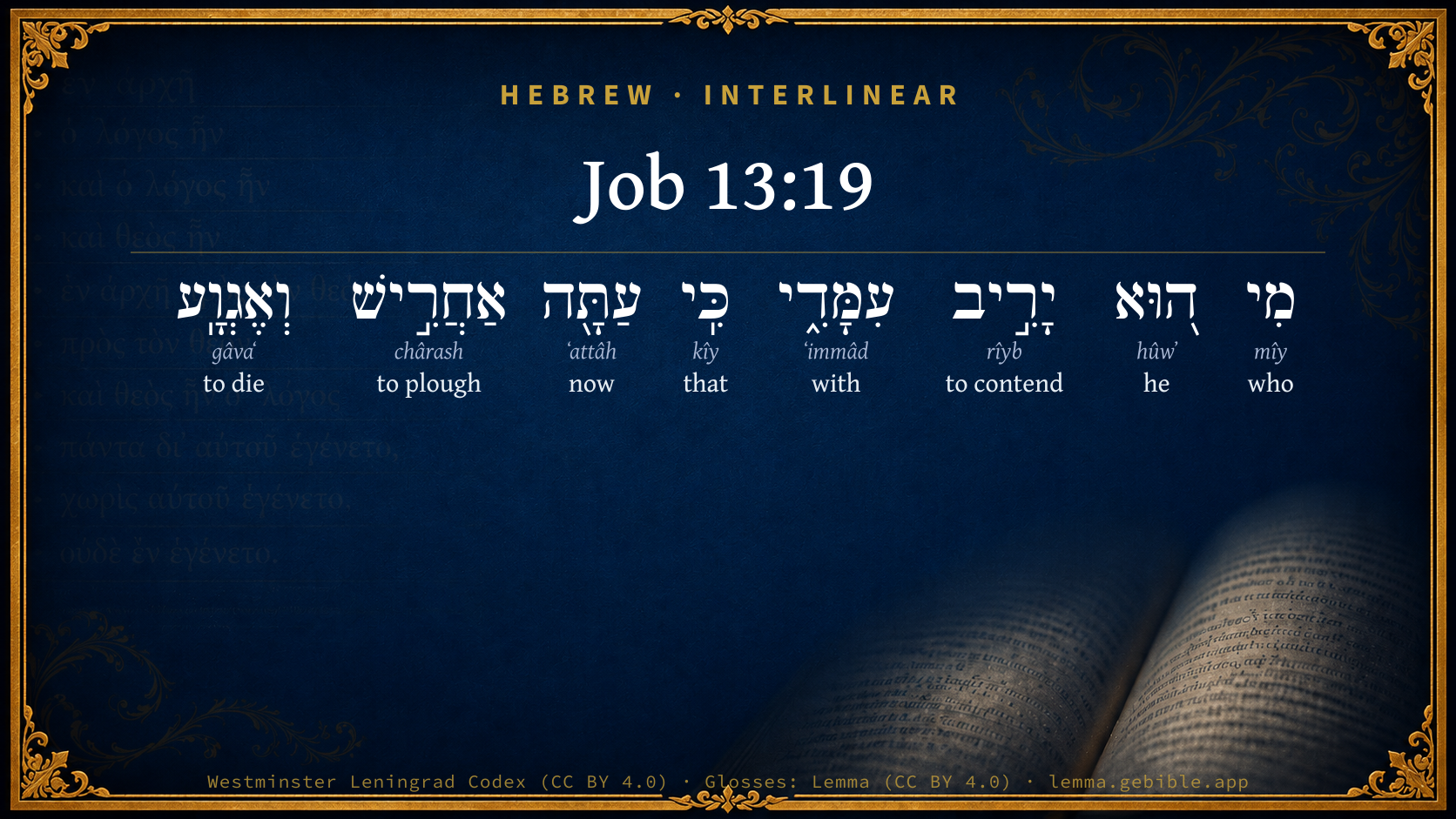
Job 13:19

Hebrew (Westminster Leningrad Codex) Job 13:19 appears in the Hebrew Old Testament. The text above is from the Westminster Leningrad Codex. Each word links to its Strong’s number, a concise gloss, and parsing drawn from the Open Scriptures Hebrew Bible morphology. Click any word for its full Brown-Driver-Briggs (BDB) entry.
Download image
Cite this verse

Job 13:19 (World English Bible). Public Domain. Lemma interlinear Bible study tool, https://lemma.gebible.app/v/job/13/19.

Show BibTeX & RIS
BibTeX
RIS
English Translation
Who is he who will contend with me? For then would I hold my peace and give up the spirit.
World English Bible · Public Domain
Download a study sheet

One document with this verse’s original text, its word-by-word gloss line, the meaning frame, cross-references with their text, attributed commentary, and full source and license credits — printable, and it pastes into notes with its structure intact.

This verse Autodidact and up

Study sheet (.html) Plain text (.txt)

A passage Seminary Student

Up to 50 verses in one chapter. A passage sheet keeps up to 6 commentary sources and 12 cross-references per verse, in the order this page ranks them, and says so on the sheet whenever that leaves anything out. Ask for a single verse and you get the Autodidact verse sheet above.

Everything on this page stays free to read, with no account — the sheet is a download of what is already on screen, not access to it.

Want to remove ads? Support Godless Engineer
Compare translations 3

The same verse in 3 English versions, stacked beneath the original-language interlinear above. Click any original word for its lexicon entry.

Each is an independent rendering of the whole verse — the interlinear is not word-aligned to these translations.

Highlighted words mark where these versions differ — a whole-verse word diff, not a word-by-word alignment.

  • World English Bible Public Domain
    Who is he who will contend with me? For then would I hold my peace and give up the spirit.
  • King James Version Public Domain
    Who is he that will plead with me? for now, if I hold my tongue, I shall give up the ghost.
  • unfoldingWord Literal Text CC BY-SA 4.0
    Who he will contend with me? For then I will be silent and expire.

unfoldingWord Literal Text — © unfoldingWord, licensed CC BY-SA 4.0. Word-aligned USFM3 via Door43 (git.door43.org/unfoldingWord/en_ult).

Versions to compare (up to 4)

3 of 4 selected

Show all 18 translations

Every available English version of this verse, each an independent rendering of the whole verse.

  • World English Bible Public Domain
    Who is he who will contend with me? For then would I hold my peace and give up the spirit.
  • Berean Standard Bible Public Domain
    Can anyone indict me? If so, I will be silent and die.
  • Majority Standard Bible Public Domain
    Can anyone indict me? If so, I will be silent and die.
  • King James Version Public Domain
    Who is he that will plead with me? for now, if I hold my tongue, I shall give up the ghost.
  • American Standard Version (1901) Public Domain
    Who is he that will contend with me? For then would I hold my peace and give up the ghost.
  • Revised Version (1885) Public Domain
    Who is he that will contend with me? for now shall I hold my peace and give up the ghost.
  • Geneva Bible (1599) Public Domain
    Who is he, that will pleade with me? for if I nowe holde my tongue, I dye.
  • Douay-Rheims (1899) Public Domain
    Who is he that will plead against me? let him come: why am I consumed holding my peace?
  • Young's Literal Translation Public Domain
    Who `is' he that doth strive with me? For now I keep silent and gasp.
  • Literal Standard Version CC BY-SA 4.0
    Who [is] he that strives with me? For now I keep silent and gasp.
  • Unlocked Literal Bible CC BY-SA 4.0
    Who is the one who would argue against me in court? If you came to do so, and if I were proved wrong, then I would be silent and give up my life.
  • unfoldingWord Literal Text CC BY-SA 4.0
    Who he will contend with me? For then I will be silent and expire.
  • Darby Bible Public Domain
    Who is he that contendeth with me? For if I were silent now, I should expire.
  • World Messianic Bible Public Domain
    Who is he who will contend with me? For then I would hold my peace and give up the spirit.
  • Webster's Bible Public Domain
    Who is he that will plead with me? for now, if I hold my tongue, I shall expire.
  • Free Bible Version CC BY-SA 4.0
    Who wants to argue with me? If I'm proved wrong, I'm prepared to be quiet and die.
  • Bible in Basic English Public Domain
    Is any one able to take up the argument against me? If so, I would keep quiet and give up my breath.
  • JPS Tanakh (1917) Public Domain
    Who is he that will contend with me? For then would I hold my peace and die.

Literal Standard Version (2020), Covenant Press — licensed CC BY-SA 4.0. Text via the HelloAO Bible API (eBible.org). Unlocked Literal Bible (unfoldingWord) — licensed CC BY-SA 4.0. Text via the HelloAO Bible API (eBible.org). unfoldingWord Literal Text — © unfoldingWord, licensed CC BY-SA 4.0. Word-aligned USFM3 via Door43 (git.door43.org/unfoldingWord/en_ult). Free Bible Version, Dr. Jonathan Gallagher — licensed CC BY-SA 4.0. Text via the HelloAO Bible API (eBible.org).

Word by word

More ways to search: Search by grammar → Find every occurrence → Compare this word →

Practice this passage: Drill this verse → Learn its vocabulary →

About this verse

These counts appear in no published source. They are computed here, from the morphology-tagged text and Lemma’s own curated glosses. What Lemma adds →

8
words
8
distinct lemmas
Wisdom
section

Notable vocabulary

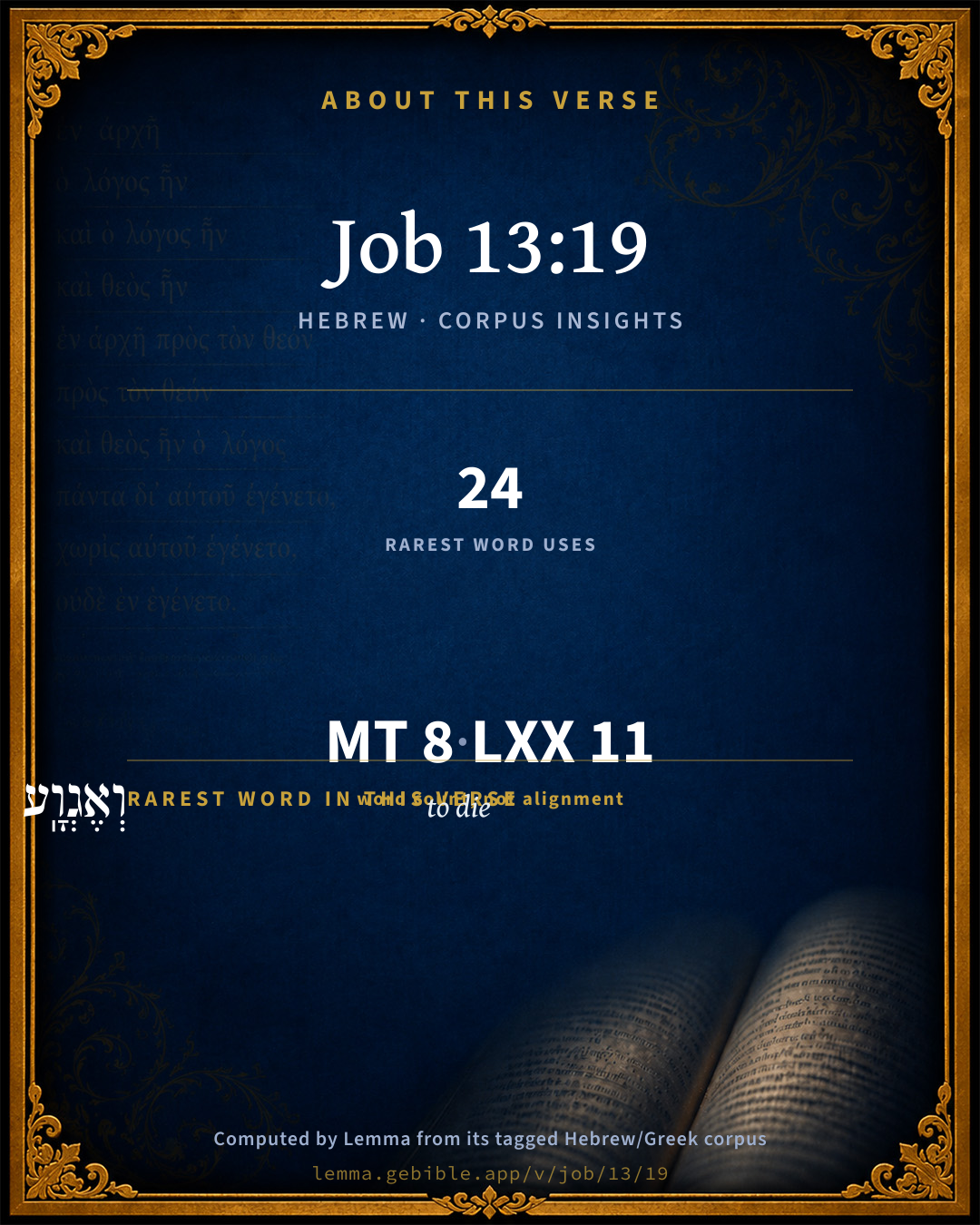
The rarest word here is וְאֶגְוָֽע to die H1478 — appearing just 24 times in the whole Hebrew Bible.

Shared distinctive vocabulary

וְאֶגְוָֽע to die H1478 occurs in 23 verses of the Hebrew Bible. Also found in:

Grammatical profile

  • 3 verbs
  • 1 pronoun
  • 1 preposition
  • 1 conjunction
  • 1 adverb
  • 1 particle

Verb forms

  • יָרִ֣יב Qal · Imperfect
  • אַחֲרִ֣ישׁ Hiphil · Imperfect
  • וְאֶגְוָֽע Qal · Imperfect

Hebrew & Septuagint length

In English translation the verse runs 20 words from the Hebrew and 17 from the Septuagint (LXX English) — closely comparable.

A rough comparison of the two English renderings, which tokenize alike — not a word-level alignment.

Word counts can differ between the Hebrew and the Greek without any difference in meaning — e.g. the Hebrew direct-object marker אֵת has no separate Greek word, and Greek often adds the article ὁ.

In the original languages it is 8 Hebrew tokens and 11 Greek tokens — but the two are counted differently (Hebrew bundles its prefixes and suffixes into one token; the Greek is in lemma form), so that isn’t a like-for-like length.

Cross-references

9

Topical passages linked to Job 13:19 in the Treasury of Scripture Knowledge — connected by theme and wording, ordered by reader-vote popularity; previews shown in the World English Bible.

  • Isaiah 50:7–8 For the Lord Yahweh will help me; therefore I have not been confounded: therefore have I set my face like a flint, and I know that I shall not be disappointed.
  • Job 7:11 "Therefore I will not keep silent. I will speak in the anguish of my spirit. I will complain in the bitterness of my soul.
  • Job 10:8 'Your hands have framed me and fashioned me altogether; Yet you destroy me.
  • Job 13:13 "Be silent, leave me alone, that I may speak. Let come on me what will.
  • Job 19:5 If indeed you will magnify yourselves against me, And plead against me my reproach;
  • Job 33:5–7 If you can, answer me; Set your words in order before me, and stand forth.
  • Job 33:32 If you have anything to say, answer me: Speak, for I desire to justify you.
  • Jeremiah 20:9 If I say, I will not make mention of him, nor speak any more in his name, then there is in my heart as it were a burning fire shut up in my bones, and I am weary with forbearing, and I can't [contain].
  • Romans 8:33 Who could bring a charge against God's chosen ones? It is God who justifies.

Cross-references courtesy of OpenBible.info (CC BY 4.0).

Hebrew and Greek witnesses Masoretic Hebrew ↔ Greek Septuagint

The same verse in the two great witnesses to the Old Testament, shown verse-for-verse.

These are two independent witnesses, not word-aligned to each other, and the Septuagint is shown in lemma (dictionary) form.

Hebrew Job 13:19 Masoretic · Westminster Leningrad Codex

מִי ה֭וּא יָרִ֣יב עִמָּדִ֑י כִּֽי עַתָּ֖ה אַחֲרִ֣ישׁ וְאֶגְוָֽע

Who is he who will contend with me? For then would I hold my peace and give up the spirit.

World English Bible · Public Domain

Greek LXX Job 13:19 Septuagint · lemma form

τίς γάρ εἰμί ὁ κρίνω ἐγώ ὅτι νῦν κωφεύω καί ἐκλείπω

For who is he that shall plead with me, that I should now be silent, and expire?

LXX2012 (modern English Septuagint) · Public Domain

Hebrew: Westminster Leningrad Codex (CC BY 4.0). Greek: Septuagint (public domain); English from LXX2012 (modern English Septuagint) (Public Domain). How the Septuagint differs from the Hebrew →

Commentary

Notes on Job 13:19 from classic Christian and Jewish commentators (each source and its license shown beneath its notes). The classic Christian expositions comment on the surrounding passage and are grouped to its opening verse, so a note may address several verses; the Jewish commentaries on the Tanakh (Rashi and others) are per-verse, so they appear only where the commentator wrote on this verse.

Lemma curates 59 commentaries, every one of them public domain or Creative Commons licensed, each selected and text-cleaned for this edition rather than reprinted as found. About our sources →

Trapp's Complete Commentary

John Trapp

Job 13:19 Who [is] he [that] will plead with me? for now, if I hold my tongue, I shall give up the ghost.

Ver. 19. Who is he that will plead with me?] Of my justification in both respects I am so confident, that I dare encounter any that shall deny it. Who is he, and where is he, that shall lay anything to my charge, since it is God that justifieth? Rom 8:33. Having ordered my cause, and cleared my conscience by confession and judging myself, and now being justified by faith, I can cast down the gauntlet to all comers, and, Goliath like, call for an opposite to grapple with; in the name of the Lord of hosts I will undertake him, and am sure to come off more than a conqueror, even a triumph, 2Co 2:14, there being not any one "condemnation" (neither from God, nor the devil, from the law, sin, or death) "to them that are in Christ Jesus, who walk not after the flesh, but after the Spirit," as Job did, Rom 8:1; Rom 8:33. Here he challengeth all the world, saith Gregory, if they could, to accuse him for anything outwardly done amiss by him. And herein if none could tax him, there, was nothing but evil cogitations in his heart, of which he could be guilty; but for these, from which none can be free, he held not his peace, but spake and complained internally hereof to God by reproving his own ways; and if he should have been silent, and not speak hereof, and bewail them, he should die and perish; for so he readeth the following words, according to the Vulgate translation.

For now, if I hold my tongue, I shall give up the ghost] Vulgate Wherefore being silent, I am consumed. Broughton, If now I speak not, I should starve. The Hebrew is, For now I shall be silent and die, q.d. My passion must have a vent, or else it will make an end of me, as Job 7:11; so tormented I am with these aspersions of my friends, that I know not how to live unless I may wipe them off; or, at least, unless I pour out my soul into God’s blessed bosom.

John Trapp, A Commentary or Exposition upon All the Books of the Old and New Testament (1647–1656) — public domain. Text from a community e-Sword module.

Geneva Bible (1599)

Geneva Bible translators

To prove that God doth thus punish me for my sins.

If I defend not my cause, every man will condemn me.

Geneva Bible (1599) marginal notes — public domain. Text via Bolls.life.

Jamieson, Fausset & Brown

Robert Jamieson, A. R. Fausset & David Brown

if, &c.--Rather, "Then would I hold my tongue and give up the ghost"; that is, if any one can contend with me and prove me false, I have no more to say. "I will be silent and die." Like our "I would stake my life on it" [UMBREIT].

Jamieson, Fausset & Brown — Commentary Critical and Explanatory on the Whole Bible (1871) — public domain (CC PDM 1.0). Text via the HelloAO Bible API.

Adam Clarke's Commentary

Verse 19. Who is he that will plead with me?] Let my accuser, the plaintiff, come forward; I will defend my cause against him.

I shall give up the ghost.] I shall cease to breathe. Defending myself will be as respiration unto me; or, While he is stating his case, I will be so silent as scarcely to appear to breathe.

Adam Clarke's Commentary on the Bible (1810–1826) — public domain. Text from a community e-Sword/MySword module.

Ellicott's Commentary for English Readers

(19) If I hold my tongue, I shall give up the ghost.—A marvellous confession, equivalent to, “If I give up my faith in Him who is my salvation, and my personal innocence, which goes hand-in-hand therewith, I shall perish. To give up my innocence is to give up Him in whom I hold my innocence, and in whom I live.”

A Bible Commentary for English Readers, edited by Charles John Ellicott (1878–1897) — public domain. Text from a community e-Sword module.

The Cambridge Bible for Schools and Colleges

gen. ed. J. J. S. Perowne

19. Who is he that will plead with me] i. e. plead against me, enter to oppose me with good reasons—who will bring a valid argument against me? The words are a triumphant expression of the feeling that no one will or can, cf. Isa_50:8.

for now if I hold my tongue, &c.] Rather, for then would I hold my peace, and give up the ghost; that is, in case any one should appear against him with proof of his sin. The words form a splendid climax to the declaration of his consciousness of innocence. He is sure he shall be found in the right, nay, none will be found to contend with him; if he thought any one could he would be silent and die.

The Cambridge Bible for Schools and Colleges (gen. ed. J. J. S. Perowne; Cambridge University Press, 1878–1918) — public domain. Text from a community e-Sword module.

John Gill's Exposition

Who is he that will plead with me,.... Enter the lists with him; dispute the point, and try the strength of his arguments he had to plead for his own justification: thus Christ, the head of the church, and the surety of his people, is represented as speaking when he had by his obedience and sufferings made satisfaction for them, by bringing in an everlasting righteousness, and was, as their public and federal head, justified and acquitted, Isa 1:4; and much the same words are put into the mouth of a believer in him, and are expressed by him, Rom 8:33; who stands acquitted from all charges that men or devils, friends or foes, the law or justice of God, the devil and his own unbelieving heart, at any time, can bring against him. Job, well knowing the uprightness of his heart and life, the justness of his cause depending between him and his friends, boldly challenges them to come forth, and try it with him; or rather he seems desirous that God himself would take the case in hand, and plead with him; he was ready to engage with him, and in the presence of his friends, and in their hearing; and doubted not of being acquitted before God, and at his bar; so satisfied was he of his own innocence as to the things charged upon him:

for now, if I hold my peace, I shall give up the ghost; his sense seems to be, that if he was not allowed to speak for himself, and plead his cause, and have a hearing of it out, he could not live, he could not contain himself, he must burst and die; nor could he live under such charges and calumnies, he must die under the weight and pressure of them; though some think that this not only expresses his eagerness and impatience to have his cause tried fairly before God, but contains in it an argument to hasten it, taken from the near approach of his death: "for now", in a little time, "I shall be silent" (w); be in the silent grave: "I shall expire"; or die; and then it will be too late; therefore if any will plead with me, let them do it immediately, or I shall be soon gone, and then it will be all over: or rather the sense is, I challenge anyone to reason the matter, and dispute the point with me; and I promise that, if the cause goes against me, "now will I be silent"; I will not say one word more in my vindication: "I will die"; or submit to any death, or any sort of punishment, that shall be pronounced upon me; I shall patiently endure it, and not complain of it, or object to the execution of it; so Sephorno.

(w) "nune enim silebo et expirabo", Cocceius; so Schmidt, Schultens.

John Gill's Exposition of the Whole Bible (1746–1763) — public domain (CC PDM 1.0). Text via the HelloAO Bible API.

Albert Barnes' Notes on the Bible

Who is he that will plead with me? - That is, “who is there now that will take up the cause, and enter into an argument against me? I have set my cause before God. I appeal now to all to take up the argument against me, and have no fear if they do as to the result. I am confident of a sucessful issue, and await calmly the divine adjudication.”

For now, if I hold my tongue I shall give up the ghost - This translation, in my view, by no means expresses the sense of the original, if indeed it is not exactly the reverse. According to this version, the meaning is, that if he did not go into a vindication of himself he would die. The Hebrew, however is, “for now I will be silent, and die.” That is, “I have maintained my cause, I will say no more. If there is anyone who can successfully contend with me, and can prove that my course cannot be vindicated, then I have no more to say. I will be silent, and die. I will submit to my fate without further argument, and without a complaint. I have said all that needs to be said, and nothing would remain but to submit and die.”

Albert Barnes' Notes on the Bible (1834–1885) — public domain. Text from a community e-Sword/MySword module.

Haydock's Catholic Bible Commentary

Peace. It will be some consolation to explain my reasons. If I am fairly overcome, I shall die with more content. (Calmet)

George Leo Haydock (1774–1849), Haydock's Catholic Family Bible and Commentary, 1859 edition — public domain. Excludes Psalms (Douay-Rheims chapter numbering differs from Protestant) and Deuterocanonical books (Catholic canon only).

Matthew Poole's English Annotations

Who is he that will plead with me? where is the man that will do it? nay, oh that God would do it! which here he implies, and presently expresseth.

I shall give up the ghost; my grief for God’s heavy hand and find your bitter reproaches would break my heart, if I should not give it vent.

Matthew Poole's English Annotations on the Holy Bible (1683–1685) — public domain. Text from a community e-Sword/MySword module.

Whedon's Commentary on the Bible

Daniel D. Whedon

19. He — Hitzig is right in his view that “he” refers only to God. If God seriously question his innocence, poor Job can only keep silent and expire.

If I hold my tongue — Tayler Lewis reads as in the text, but a better reading is: I would be silent and die.

Daniel D. Whedon (gen. ed.), Commentary on the Old and New Testaments (1874–1909) — public domain. Text from a community e-Sword module.

The Pulpit Commentary

Who is he that will plead with me? Will God himself plead? Or will he depute some one, man or angel? Job is impatient that the pleadings should begin. For now, if I hold my tongue, I shall give up the ghost. Some translate, "For now shall I hold my peace and give up the ghost," which they explain to mean, "If God does implead me, I shall take refuge in silence, and straightway expire." But this seems an impossible conclusion, when all that Job has been aiming at and striving for since his opponents taxed him with wickedness has been that he might "speak to the Almighty, and reason with God" (ver. 3). It is far simpler to keep to the translation of the Authorized Version, and understand Job to mean that things have now reached a point at which he must either speak or expire.

The Pulpit Commentary (1880–1919), ed. H.D.M. Spence-Jones & Joseph S. Exell — public domain. Text from a community e-Sword module.

John Wesley's Explanatory Notes

The ghost - My grief would break my heart, if I should not give it vent.

John Wesley, Explanatory Notes Upon the Whole Bible (1754–1765) — public domain. Text via the GEBible commentary corpus.

Rashi

Rabbi Shlomo Yitzchaki (Rashi)

I will be silent and perish If I will not contend, I will be silent and perish.

Rashi on the Tanakh — English translations: “The Judaica Press complete Tanach with Rashi, translated by A. J. Rosenberg” (CC BY 4.0); “Pentateuch with Rashi's commentary by M. Rosenbaum and A.M. Silbermann, 1929-1934” (public domain); “The Metsudah Tanach series, Lakewood, N.J” (CC BY 4.0); and “The Book of Joshua, Metsudah Publications, 1997” (CC BY 4.0). Text via Sefaria.

Lesson kit

Teaching starters — assembled from the data on this page, not authored interpretation. Every prompt links to the verse data it draws on. Edit before teaching.

Job, in the Wisdom, opens this verse with 8 words (8 distinct Hebrew lemmas). Its most distinctive word is gâvaʻ (“to die”). A historical commentator’s framing appears above. Read the whole chapter for the surrounding context.

Discussion questions

  1. How does “to die” (gâvaʻ) shape what this verse is saying?
  2. How does Genesis 6:17, which shares the word «to die», read alongside this verse?
  3. The translations on this page render this verse differently — a whole-verse word diff, not a word-by-word alignment. What might account for the different wordings?
  4. «יָרִ֣יב» is a Qal Imperfect verb. How does that grammatical form shape the action described?
  5. Compare how Trapp's Complete Commentary and Geneva Bible (1599) read this verse. Where do they agree or differ?

Things to notice

Reading settings

Reading text

Shown beneath each verse's original-language words.

Old Testament
Old Testament edition

Read the OT as the Masoretic Hebrew (MT) or the Greek Septuagint (LXX).

English shown for the Greek Septuagint (in the Hebrew ↔ Greek comparison).

Comparing translations? Open the Compare panel on any verse page to stack up to four side by side.