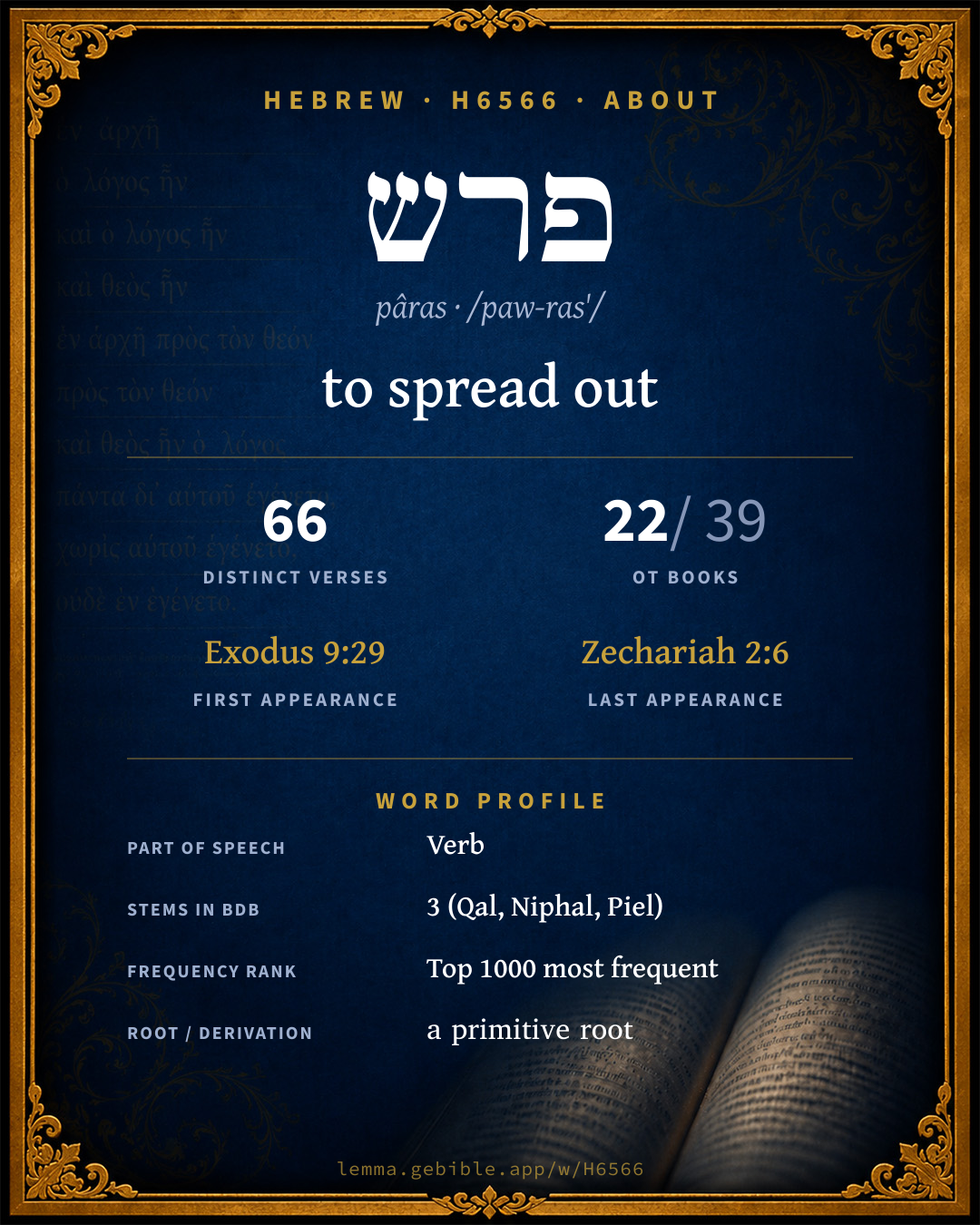
פָּרַשׂ
to spread out
‘to spread out’ is one of 2 main senses fuller range ↓
Full lexicon entry — Brown-Driver-Briggs (BDB)
From Brown-Driver-Briggs (BDB)
Where this word appears
Grammar key — what these labels mean
Part of speech
- Verb
- An action or state-of-being word.
Stem
- Qal
- The basic, simple active stem — the plain form of the verb (“he wrote”). Here: ‘spread out a garment’
- Piel
- An intensive or resultative active stem. Here: ‘spread out’
- Niphal
- Usually the simple passive or reflexive of the Qal (“he was written”).
Form
- Sequential Imperfect
- An imperfect with prefixed waw — the standard past-narrative form (waw-consecutive imperfect).
- Sequential Perfect
- A perfect with prefixed waw continuing a preceding imperfect or command (waw-consecutive perfect).
- Perfect
- A completed action or state — Hebrew marks aspect (completeness) more than strict tense (“he wrote”).
- Imperfect
- An incomplete, ongoing, or future action (“he will / would write”).
- Participle Active
- A verbal adjective expressing ongoing or characteristic action (“writing / one who writes”).
- Infinitive Construct
- A bound verbal noun, frequently with prepositions (“to write / in writing”).
- Participle Passive
- A verbal adjective expressing action received (“written”).
State
- Absolute
- The independent form of a noun, not bound to a following word.
- Construct
- A noun bound to a following noun in a possessive / “of” relationship (the construct chain).
Person
- 3rd Person
- The one spoken about (“he / she / it / they”).
- 1st Person
- The speaker (“I / we”).
- 2nd Person
- The one addressed (“you”).
Gender
- Masculine
- Grammatically masculine.
- Common
- Either gender — not distinguished for this form.
- Feminine
- Grammatically feminine.
Number
- Singular
- One.
- Plural
- More than one (in Hebrew, generally three or more).
Every verse where H6566 appears in the Book of Hosea — 2 distinct verses. Click any verse to open its interlinear word-by-word view. Verse text shown in the World English Bible for context — . Each verse’s Hebrew form is shown with its reference; the English is not keyword-highlighted, since the data carries no word-level English alignment. Use “Compare translations” on any verse to read it across multiple English versions. This concordance covers the Hebrew Bible; Septuagint (Greek Old Testament) occurrences are not indexed here.
Hosea
- Hosea 5:1 פְּרוּשָׂ֥ה Qal ptcp.pass fs "Listen to this, you priests! Listen, house of Israel, And give ear, house of the king! For the judgment is against you; For you have been a snare at Mizpah, And a net spread on Tabor.
- Hosea 7:12 אֶפְר֤וֹשׂ Qal impf 1cs When they go, I will spread my net on them. I will bring them down like the birds of the sky. I will chastise them, as their congregation has heard.
About this entry
At a glance — auto-summarized from this page’s data, not written by a person. Every figure links to its source below. This summary describes the numbers; it doesn’t interpret them.
“to spread out” is the headline sense of the Hebrew verb פרש (pâras). Translators differ — “spread” in the King James Version, then “they shall spread” (unfoldingWord Literal Text), as the renderings breakdown shows. It turns up in 66 verses across 22 books, a moderately common footprint. First canonically at Exodus 9:29, it enters the text early. The verb spans 3 stems, from Qal to Niphal. The sections below give every sense, occurrence, and version rendering.
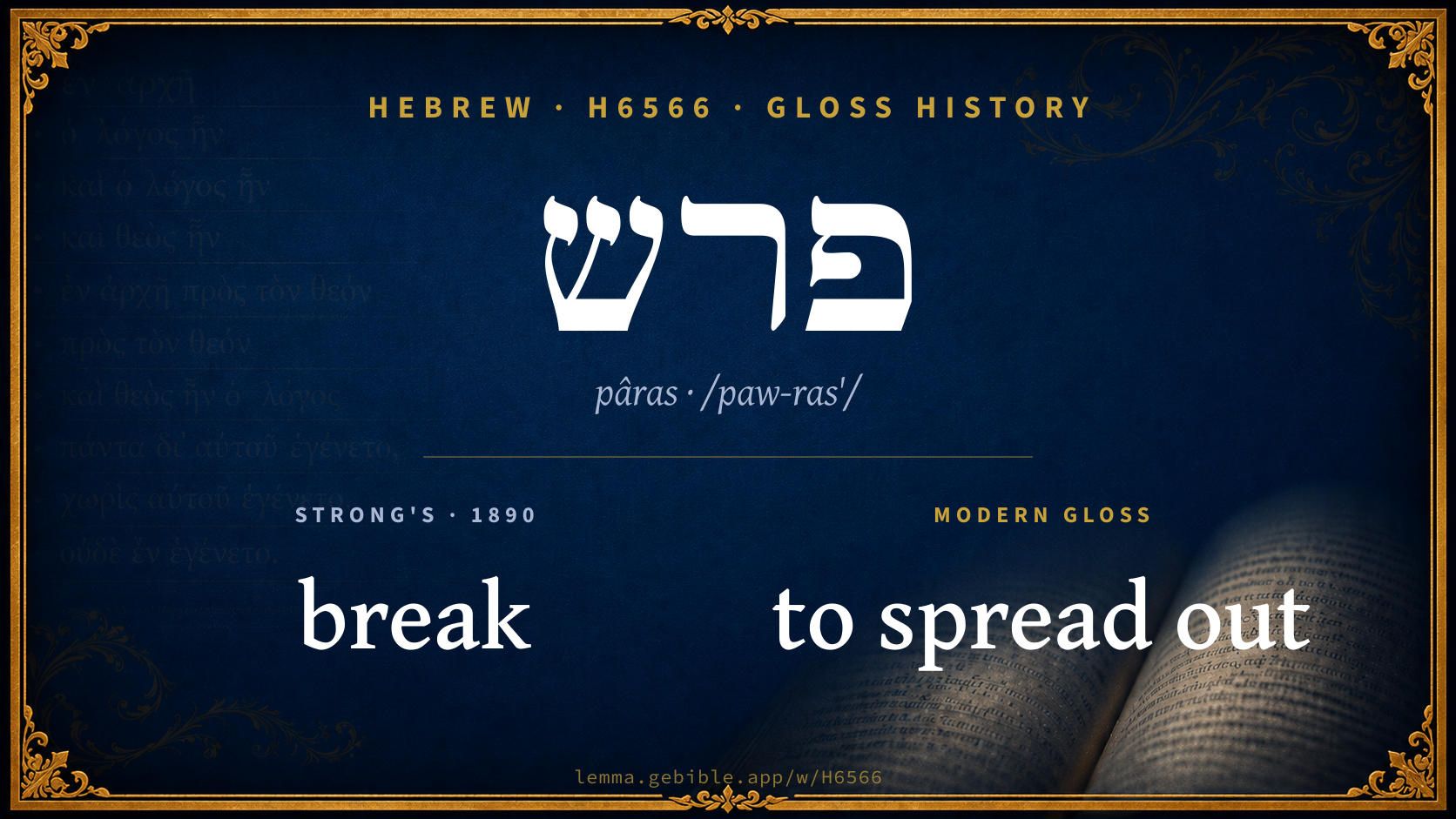
Gloss history
Strong's 1890 vs modern scholarship
About this word
Strong's H6566 catalogs a Hebrew word from the Hebrew Old Testament.
These counts are not copied from any lexicon or concordance. They are computed here, from the morphology-tagged Hebrew Old Testament. What Lemma adds →
- 66
- distinct verses
- The word appears in 66 distinct verses.
- 22 / 39
- OT books
- The word appears in 22 of 39 Old Testament books.
- #587
- by frequency
- Top 1000 most frequent Hebrew words (rank 587 of 8,640 Hebrew words by occurrence).
View all 66 occurrences in the concordance →
By section of the Old Testament
By traditional corpus
Conventional, traditional groupings — biblical authorship is debated, so this is a traditional corpus grouping, not an authorship claim. Each share is this word’s portion of its verses in that division of the Hebrew canon. Each figure is a share of the word’s 66 distinct verses.
- Prophets (Nevi'im) 30 verses · 45%
- Writings (Ketuvim) 23 verses · 35%
- Torah (Pentateuch) 13 verses · 20%
How translations render this word
Counts come from each version’s own published word-to-Strong’s tagging or interlinear alignment — an approximate guide to how each version renders this word, not a word-level alignment the data otherwise carries. Because each total is that version’s own tagged count, the per-version totals vary from one another and need not match the appearance or distinct-verse counts above. These counts may also differ from a printed concordance because Lemma counts each distinctly tagged rendering and does not collapse phrase taggings into a single head-word total. This is a fixed set of word-tagged versions (KJV, ASV, BSB, ULT) and does not change with the reading translation you choose elsewhere. Each version’s license is shown beside its name below (and on Sources).
BDB lists this Strong’s number as 2 distinct words (homographs). Each count above pools all of them and is not split by sense — see the Senses section below. A low-frequency rendering may belong to a different one of those words, not the primary meaning.
- King James Version†: Spread 10×, Spread forth 6×, They shall spread 5×
- American Standard Version†: Spread 9×, Spread forth 7×, They shall spread 5×
- Berean Standard Bible†: Spread 12×, Spread out 7×, He spread 4×
- unfoldingWord Literal Text†: They shall spread 7×, He spread 6×, Spread 6×
King James Version Public Domain
Renders H6566 across 67† tagged occurrences — most commonly:
Plus 33 renderings that appear only once — usually multi-word phrases or single function words the recovered tagging swept in, not distinct renderings.
American Standard Version Public Domain
Renders H6566 across 67† tagged occurrences — most commonly:
Plus 36 renderings that appear only once — usually multi-word phrases or single function words the recovered tagging swept in, not distinct renderings.
Berean Standard Bible Public Domain
Renders H6566 across 65† tagged occurrences — most commonly:
Plus 28 renderings that appear only once — usually multi-word phrases or single function words the recovered tagging swept in, not distinct renderings. Not rendered by a distinct English word in 2 further occurrences.
unfoldingWord Literal Text CC BY-SA 4.0
Renders H6566 across 73† tagged occurrences — most commonly:
Plus other, less common renderings. Plus 24 renderings that appear only once — usually multi-word phrases or single function words the recovered tagging swept in, not distinct renderings.
11 senses and sub-senses in the full BDB
Hebrew verbs can shift meaning by stem (binyan): Qal is the basic action, Niphal is often passive or reflexive, Piel often intensifies or makes it factitive, and Hiphil is typically causative. The senses below are grouped under the stem BDB assigns to each.
What do BDB’s symbols mean?
BDB uses these scholarly abbreviations:
| Symbol | Meaning |
|---|---|
| 𝔊 | the Septuagint (the ancient Greek translation, LXX) |
| 𝔙 | the Vulgate (the Latin translation) |
| 𝔖 | the Syriac version (the Peshitta) |
| 𝔗 | the Targum (the Aramaic translation) |
| ψ | the Psalms |
| √ | root (the underlying root or stem) |
| ‖ | parallel passage (a synonymous or contrasted parallel) |
| † | the dagger: every passage where the word occurs is cited |
The 11 senses and sub-senses the full Brown-Driver-Briggs lexicon distinguishes for this word, in lexicon order (not ranked by frequency), with BDB’s own verbatim wording and sub-sense lettering. Shown in Hebrew script with BDB’s own scholarly abbreviations. The condensed entry is in the Lexicon Entry tab. See also the Forms in the corpus table below.
פרש I erron. פָּרַשׂ NöZA j, 417] vb. break in two, divide (NH in der. forms
- 1. c. acc. פַּרְסָה divide hoof, i.e. have divided hoof (> denom. have hoofs), Dt 14:6, 7, 8 and ‖ Lv 11:3, 4, 5, 6, 7, so also Lv 11:26; מַפְרִיסֵי הַפּ׳ Dt 14:7 = מַפְרִסֵי הַפּ׳ Lv 11:4 (H). e.g. Deuteronomy 14:6
- 2. pt. abs. denom. ψ 69:32 having hoofs (+ מַקְרִן). e.g. Psalms 69:32
פרש II spread out, spread (NH id.
Qal
- Pf. 3 ms. פ׳ La 1:10 +; 2 ms. וּפָרַשְׂתָּ֫ Jb 11:13; Ru 3:9, etc.; Impf. 3 ms. יִפְרשֹׁ Dt 32:11 +; 3 fs. וַתִּפְרשֹׁ 2 S 17:19, etc.; Pt. act. פּוֹרֵשׂ Pr 29:5, etc.; pass. פָּרֻשׂ Jo 2:2; fs. פְּרוּשָׂה Ho 5:1; pl. פְּרֻשׂוֹת 1 K 8:54;— e.g. Lamentations 1:10
- 1. spread out a garment (שִׂמְלָה) Ju 8:25, + לִפְנֵי pers. Dt 22:17;—wings 32:11; 1 K 6:27 (read כַּנְפֵיהֶם 𝔊 Sta Kmp Kit Benz), + עַל Je 49:22 (fig.), + אֶל 48:40 1 K 8:7 = 2 Ch 5:8 (עַל), + ל Jb 39:26, לְמַעְלָה Ex 25:20; 37:9; wings om. 1 Ch 28:18 and perhaps 2 Ch 3:13 (del. כַּנְפֵי Be); of י׳, פ׳ עָלָיו אוֹרוֹ Jb 36:30; spread out writing, לִפְנֵי pers. 2 K 19:14 = Is 37:14, Ez 2:10; sail Is 33:23; fishing-net, מִכְמֶרֶת Is 19:8 (עַל loc.); net (רֶשֶׁת) as snare, fig. Ho 5:1 (עַל loc.), ψ 140:6, לְרַגְלַי La 1:13, c. עַל pers. Ho 7:12 (of י׳), Ez 12:13 = 17:20, 19:8; 32:3, עַל־פְּעָמָיו Pr 29:5; פ׳ כַּפַּיִם in prayer, + אֶל Ex 9:29,33 (J), 1 K 8:38 = 2 Ch 6:29, Ezr 9:5; Jb 11:13, + ל ψ 44:21, + הַשָּׁמַיִם 1 K 8:22 = 2 Ch 6:13 (הַשָּׁמָ֑יְמָה), 1 K 8:54, no complem. 2 Ch 6:12; of almsgiving, כַּפָּהּ פָּֽרְשָׂה לֶעָנִי Pr 31:20; פ׳ יַד, c. עַל rei, La 1:10 of enemy’s greed (si vera l., v. Bu); spread out = display וּכְסִיל יִפְרשֹׁ אִוֶּלֶת Pr 13:16. e.g. Judges 8:25
- 2. spread covering over 2 S 17:19 (מָסָךְ + עַל־פְּנֵי rei), הַמַּכְבֵּר over (עַל) face of another 2 K 8:15, כָּנָף skirt, עַל pers. Ru 3:9 Ez 16:8 (fig. of י׳); בֶּגֶד c. עַל rei Nu 4:7,8,11,13, c. מִלְמָ֑עְלָה v 6; כְּסוּי c. עַל rei v 14; אֶת־הָאֹהֶל, c. עַל־הַמִּשְׁכָּן Ex 40:19; שַׁחַר פָּרֻשׂ עַל־הֶהָרִים Jo 2:2; of י׳, פ׳ עָנָן לְמָסָךְ ψ 105:39.—Mi 3:3 La 4:4 v. פָּרַס. e.g. 2 Samuel 17:19
Niphal
- Impf. 3 mpl. יִכָרְ֑שׂזּ Ez 17:21 they shall be scattered לְכָל־רוּחַ; 34:12 read prob. Pt. צֹאן נִפְרָשׂוֹת (for -שׂוֹת, Hä Krae; on emend. of context v. especially Toy Krae). e.g. Ezekiel 17:21
Piel
- Pf. 3 ms. consec. וּפֵרַשׂ Is 25:11, etc.; Impf. 3 ms. יְפָרֵשׂ v 11, 3 fs. תְּפָרֵשׂ Je 4:31; Inf. cstr. פָּרֵשׂ ψ 68:15, sf. פָּרִשְׂכֶם Is 1:15;— e.g. Isaiah 25:11
- 1. spread out:
- a. c. acc. כַּפַּיִם in prayer Is 1:15; Je 4:31, so c. יָדַיִם ψ 143:6 (אֶל־י׳), and of י׳ entreating people Is 65:2 (אֶל); פ׳ צִיּוֹן בְּיָדֶיהָ La 1:17. e.g. Isaiah 1:15
- b. spread out hands as in swimming Is 25:11, and (יָדַיִם om.) v 11. e.g. Isaiah 25:11
- 2. = scatter, (?) subj. י׳, c. acc. pers. Zc 2:10 (𝔊 We Now קִבַּצְתִּי מִן, yet v. GASm); ψ 68:15, in doubtful connexion. e.g. Zechariah 2:10
Senses from the full Brown-Driver-Briggs lexicon (Brown, Driver, Briggs; Oxford 1906 — public domain), digitized via Sefaria, supplemented by the OpenScriptures HebrewLexicon (CC BY 4.0). Full attribution on Sources.
Word origin
II. erron. פָּרַשׂ NöZA j, 417] vb. break in two, divide (NH in der. forms; Assyrian parâsu, divide, hinder; Arabic فَرَسَ break neck, etc.; Syriac ܦܰܪܣܳܐ hoof, 𝔗 פַּרְסְתָא (v. פַּרְסָה infr.); cf. NöZA i. 417 f.);—Qal Pf. 3 pl. וּפָֽרְשׂוּ Mi 3:3 they have broken up bones, as in kettle (? read Impf. וַיִּפְרְשׂוּ Nöl.c.); Inf. abs. פָּרֹס לָרָעֵב לַחְמֶ֑ךָ Is 58:7 a breaking for the hungry thy bread, so Impf. 3 mpl. יִפְרְסוּ לָהֶם Je 16:7 (לֶחֶם om.; but read יִפ׳ לֶחֶם אֶל־אָבֵל Gie, cf. [in part] 𝔊 𝔙 Gf); Pt. פֹרֵשׂ לָהֶם La 4:4 (acc. לֶחֶם om.). Hiph. Pf. 3 fs. הִפְרִיסָה Lv 11:6, etc.; Impf. 3 ms. יַפְרִיס v 5; Pt. מַפְרִיס v 4 +, מַפְרֶסֶת v 3 +, etc.;—
I. vb. spread out, spread (NH id.; Arabic فَرَشَ; 𝔗 פְּרַס (rare), Syriac ܦܪܰܣ; cf. Assyrian parašu, fly (der. spec.; proposes spread [wings]); v. also NöZA i. 417);—
— Brown-Driver-Briggs (Oxford 1906, public domain), digitized via Sefaria, supplemented by the OpenScriptures HebrewLexicon (CC BY 4.0). See Sources.
Origin: a primitive root
Jastrow Dictionary
A second Hebrew/Aramaic lexicon for comparison, covering Aramaic and post-biblical (Talmudic, Targumic, Midrashic) usage that the biblical-Hebrew BDB does not. Matched by lemma rather than by Strong’s number, so a lemma may carry more than one Jastrow headword (shown separately below), and the entries cover usage well beyond the Bible.
פָּרַשׂ
- , v. פָּרַס, פְּרַס.
פָּרַשׁ
- (b. h.) [to divide, separate,]
- 1. (neut. verb) to go away, go aside, depart; to keep off. Yoma I, 5 הוא פוֹרֵשׁ … פּוֹרְשִׁין וכ׳ he turned aside and wept, and so did they. Y. Keth. I, 25ᵈ bot. ראו אותו פורש מציפורין they saw him come out of Sepphoris (so that he is presumably an inhabitant of Sepphoris); פירש מן הבתים they saw him leave one of the houses of Sepphoris. Num. R. s. 9 את פָּרַשְׁתְּ מדרך וכ׳ thou didst depart from the way (disregard the customs) of Israel’s daughters. Zeb. 113ᵃ (play on פרשה, Num. XIX, 5) מקים שפּוֹרֶשֶׁת למיתה וכ׳ there where she departs for death, she shall be burnt. Y. M. Kat. I, 80ᵇ bot. (ref. to Lev. XIII, 45) כדי שתהא טומאה … פְּרוֹשׁ that the uncleanness itself may cry out …, ‘keep off’; Y. Maas. Sh. V, beg. 55ᵈ; a. fr. e.g. Numbers 19:5
- 2. to pass, cross. Yalk. Prov. 946; Yalk. Num. 738 הספינות פּוֹרְשׁוֹת בים the ships make their way through the sea.
- 3. (act. verb) to separate, keep off. Num. R. s. 10 כשם שאדם פירש את עצמו וכ׳ as a person keeps himself away (abstains) from the fruits of Orlah, so will those who misbehave towards their handmaids, be separated from the virtuous on the day of judgment.; a. fr.—Part. pass. פָּרוּשׁ, q. v.
- 4. (cmp. פָּרַט) to single out, specify, speak distinctly. Ib. (expl. יַפְלִא, Num. VI, 2) כשיִפְרוֹשׁ לנדור וכ׳ when he speaks out his vow, to the exclusion of him who thinks it in his heart; a. fr.—Sifré Num. 24 עד שיפרוש לך … כדרך שפירש וכ׳ (Yalk. ib. 710 שיפרוט … שפרט), v. פָּרַט. e.g. Numbers 6:2
- to be separated, kept away. Lev. R. s. 22 והן נִפְרָשִׁים מעבודה זרה and thus they will be kept away from idolatrous worship; a. e.
- 1. (neut. verb) (neut. verb) to depart, withdraw; to abstain. Snh. 82ᵇ היה לו … לפרוש ולא פי׳ Zimri might have withdrawn (from the woman), but he did not. Ib.ᵃ אם פ׳ וכ׳ if Z. had withdrawn, and Phineas had slain him &c. Pes. 87ᵇ פ׳ מן האשה withdrew from contact with his wife. Gen. R. s. 20 שפֵּירְשָׁה חיה מאדם that Eve was separated from Adam.—Sabb. 86ᵇ פירשה מן האיש the semen issued from a man.—Pes. 49ᵇ שנה ופ׳ קשה וכ׳ he that studied and gave it up, is the worst of all (in hostility to scholars); a. fr.
- 2. to go on a voyage; to cross the ocean (cmp. פָּלַג Hif.). Y. M. Kat. III, beg. 81ᶜ אסור לפָרֵשׁ לים הגדול it is forbidden to start on a sea voyage (during the festive week). Y. Yeb. XVI, 15ᵈ top עשיתי מְפָרֵשׁ וכ׳ I was crossing &c. Y. Meg. II, 73ᵇ top מְפָרְשֵׁי ימים voyagers on the sea; a. fr.
- 3. (act. verb) to separate. Gen. R. s. 22 אילו רצה המלך פֵּירְשָׁן ולא רצה המלך לפָרְשָׁן if the king desired it, he would separate them (the fighters), but the king does not wish to separate them; Yalk. ib. 38.
- 4. to specify, express clearly. Ib. א"א לפה לפָרְשוֹ no mouth can express it. Men. 91ᵃ דמְפָרֵשׁ when he (in making his vow) specified (‘sheep’ or ‘cattle’), opp. בסתמא. Gen. R. s. 6 אנשי … פֵּירְשׁוּ אותו the men of the Great Assembly said it plainly. Snh. VII, 5 עד שיְפָרֵשׁ השם until he mentions the Name expressly (uses the Tetragrammaton), opp. כִּינּוּי. Gitt. 36ᵃ שיהו עדים מְפָרְשִׁין שמותיהן that witnesses must sign their full names; a. fr.—Part. pass. מְפוֹרָשׁ, f. מְפוֹרֶשֶׁת; pl. מְפוֹרָשִׁים, מְפוֹרָשִׁין; מְפוֹרָשׁוֹת. B. Kam. 54ᵇ, a. fr. מה הפרט מפ׳, v. פְּרָט. B. Mets. 94ᵇ שלישית בשואל מפ׳ that the third paragraph treats of a borrower, is explicitly stated (Ex. XXII, 13). Sot. 38ᵃ, a. fr. שם המפ׳ the special Name (the Tetragrammaton), v. supra. Zeb. 53ᵃ, v. סָתַם. Ḥag. 22ᵇ ומה סתומות … מפ׳ וכ׳ if your undefined teachings are so well-founded, how much more your explicit teachings; a. fr. e.g. Exodus 22:13
- 5. to explain, interpret, define. Ned. 2ᵇ פתח … ומפרש ידות the Mishnah begins with kinnuyim …, and goes on explaining yadoth! Zeb. 13ᵃ ואין לי לפרש and I am unable to explain (the reason of the distinction between receiving and sprinkling the blood); אני אֲפָרֵשׁ I shall explain it. Ned. 81ᵃ דבר זה … ולא פֵירְשׁוּהוּ עד שפֵּירְשׁוֹ וכ׳ that question (Jer. IX, 11) was asked of prophets and scholars, and they could not explain it, until the Lord himself explained it (ib. 12). M. Kat. 16ᵇ; Ber. 18ᵃ לא פֵירְשׁוּ לך they did not interpret (the verse) to you; v. שָׁנָה I. Gen. R. s. 31 ולא פ׳ and did not explain (of what material the serpent was to be made); Y. R. Hash. III, end, 59ᵃ; a. fr.—Part. pass. as ab. Meg. 3ᵃ, a. e. (ref. to Neh. VIII, 8) מפ׳ זה תרגום m’forash means interpretation. e.g. Jeremiah 9:11
- to be specified, defined; to be explained. Lev. R. s. 6 כל נביא שנתפ׳ וכ׳ a prophet whose name is stated. Gen. R. l. c. בשלשה נ׳ ובאחד לא נ׳ in three places (in which עֲשֵׂה occurs) the command is specified, but in the fourth (Num. XXI, 8) it is not specified, v. supra. Yalk. Gen. 20 דבר שאינו מִתְפָּרֵשׁ בִמקימו וכ׳ a thing which is not defined in its original place but is defined in another passage; a. e. e.g. Numbers 21:8
- 1. to separate; to set aside, dedicate. Yoma I, 1 מַפְרִישִׁין כהן וכ׳ they removed the high priest from his house to the cell &c. Ter. IV, 1 המַפְרִישׁ מקצת וכ׳ he who sets aside one portion of what is due of T’rumah or tithes. Num. R. s. 10 (ref. to Num. VI, 11, ועשה) שיַפְרִישֵׁם הכהן וכ׳ that the priest when offering them designates them, one for a sin-offering &c. Ib. (ref. to Prov. XXIII, 32) מה צפעון זה מפריש … כך היין מפריש וכ׳ as the adder divides between life and death, so wine removes from the ways of life to those of death; Lev. R. s. 12 כך ה׳ היין בין אדם וכ׳ so wine caused a separation between Adam and Eve; ה׳ היין בין נח לבניו לעבדות wine caused a division between Noah and his sons with regard to slavery; ה׳ היין בין אהרן ובניו למיתה wine caused a division between Aaron and his sons with regard to death; Yalk. Prov. 960. Tam. IV, 3 מן הכבד … ה׳ severed the lungs from the liver; a. fr.—Part. pass. מוּפְרָשׁ. Ned. I, 1 מוּפְרְשַׁנִי ממך I will be separated from thee (will have no dealings with thee, accept no favors &c.); ib. 5ᵃ; a. e.—2) to go to sea. Gen. R. s. 13 היו מַפְרִישִׁין לים וכ׳ were crossing the ocean; a. e. e.g. Numbers 6:11
פְּרַשׁ
- 1. (neut. verb) to keep off, abstain &c. Targ. Y. I Num. VI, 3. Ib. 2 יַפְרִישׁ. Ib. XXV, 8 [read:] דהוה ליה למִיפְרַשׁ ולא פירש (v. Snh. 82ᵇ, quot. in preced.); a. fr.—Part. פָּרֵשׁ, פָּרֵישׁ. Ib. XIX, 16; 18; a. fr.—Ḥull. 45ᵇ חד פריש לליבא וכ׳ one artery branches off to the heart, the other to the lungs &c. Zeb. 73ᵃ, sq. כל דפריש מרובא פריש whatever comes out of a mixed multitude, is presumed to have come from the majority, i.e. has the legal status of the majority; Keth. 15ᵃ; a. fr.
- 2. to cross the ocean. Gen. R. s. 6 בעא דיִפְרוֹשׁ, v. infra. Koh. R. to III, 6 הוה אזיל פריש בימא was about to go to sea; a. e.
- 3. to set aside, distinguish. Targ. Y. Deut. IV, 34; a. e.
- 4. to explain. Part. pass. פָּרִישׁ. Ḥull. 52ᵃ ליבעי מיניה חדא דפ׳ לן תרתי let him be asked one question by which both cases will be made clear to us; a. e.
- 1. (neut. verb) (neut. verb) to depart, keep off. Targ. Prov. XIX, 27 (ed. Lag. a. oth. Pe.).—[Targ. Y. Num. XXV, 8 פֵּירַשׁ Hebraism, v. supra.]
- 2. to go to sea. Gen. R. l. c. הוה מְפָרֵשׁ בימא was about to undertake a sea voyage. Ib. בעא … פָּרְשֵׁי he wanted to go to sea; said the matron, do people go to sea at this season?; a. e.
- 3. to separate, divide, distinguish. Targ. O. a. Y. II Deut. XXXII, 8 בפָרָשׁוּתֵיה (Y. I באַפְרָ׳, Af.); a. e.—Y. Ab. Zar. II, end, 42ᵃ ידע אנא מְפָרְשָׁה בין וכ׳ I can tell the roe of clean fish from that of unclean fish. e.g. Deuteronomy 32:8
- 4. to express clearly, define. Targ. O. Gen. XXX, 28. Targ. O. Lev. XXII, 21 (Y. Af.). Ib. XXIV, 11; 16; a. e.—Part. pass. מְפָרַשׁ. Targ. Y. II ib. XXIV, 11 שמא מְפָרָשָׁא (= h. שם המפורש, v. preced.; Y. I Ithpe.). Targ. Y. II, Gen. XXX, 22; a. e.—Yoma 3ᵇ פָּרוּשֵׁי קא מְפָרַשׁ וכ׳ it is clearly indicated in the text that it is ‘from thine own’ (the high priest’s private property); a. e.
- 5. to distinguish, make wonderful.—Part. pass. as ab. Targ. Jud. XIII, 18 (h. text פלאי).
- 6. to explain, interpret. Targ. O. Deut. I, 5 (h. text באר).—B. Bath. 121ᵃ גמיר … ולא ירע ליה לפָרוּשָׁהּ he learned the Boraitha by heart, but knew not how to explain it. Y. Kil. I, 27ᵃ bot. ופָרְשַׁנְתָּהּ תמן and we explained it there (to B. Kam. V, 10); ib. ופרשתנה (corr. acc.). Erub. 54ᵃ לא … עד דמְפָרְשַׁת וכ׳ thou shalt not rest on thy legs (sit down) until thou hast explained these verses to me. R. Hash. 26ᵃ לפָרוּשֵׁי מאה וכ׳ it is important for the explanation of meah ḳs’iṭah (Gen. XXXIII, 19) &c.; a. fr. e.g. Genesis 33:19
- 1. to separate, divide, make a distinction; to set aside, dedicate. Targ. Gen. I, 4; 6. Ib. XXX, 40. Targ. Is. LVI, 3. Targ. O. Num. XVIII, 24 (Y. ed. Vien. Pe.); a. fr.—
- *2. (neut. verb) to keep aloof, abstain. Targ. Y. Num. VI, 2 (v. supra).
- 3. to warn off, keep away. Sabb. 40ᵇ (ל)אַפְרוּשֵׁי מאיסורא to warn a person off from doing wrong.
- 4. to speak out, declare. Targ. O. Num. VI, 2 (ed. Berl. Pa.). Targ. Lev. XXVII, 2 (O. ed. Berl. Pa.); a. e.
- 5. to distinguish, make wonderful. Targ. O. Deut. XXVIII, 59; a. e.—Part. pass. מַפְרַשׁ; f. מַפְרְשָׁא; pl. מַפְרְשִׁין; מַפְרְשָׁן. Targ. II Sam. I, 26. Targ. Is. XXIX, 14; a. e.
- ; Ithpe. אִתְפְּרַשׁ, אִיפְּ׳
- 1. to be separated, to part, depart; to be set aside, dedicated. Targ. Gen. X, 32. Targ. Is. LII, 11. Targ. Lev. IV, 10 (O. ed. Berl. Ittaf.). Targ. Ex. XXIX, 27 (O. ed. Berl. Ittaf.); a. fr.
- 2. to be distinctly expressed, declared; to be explained, interpreted. Targ. Num. I, 17. Targ. Y. Lev. XXIV, 11 (v. supra); a. fr.—Meg. 3ᵃ דמִיפָּרְשָׁן, v. סְתַם. B. Kam. 112ᵇ, a. fr. לדידי מִיפָּרְשָׁא לי מיניה וכ׳ to me it was explained by &c. Y. Keth. IV, 28ᵈ bot. אתתבת ולא אִפָּרְשַׁת a question was raised, but it was not made clear (solved); אתתבת ואפ׳ it was raised and met.
- to be set aside, dedicated; to be distinguished. Targ. O., ed. Berl., Lev. IV, 10; a. e., v. supra.—Targ. Y. I Gen. III, 18 יִתְאַפְרַשׁ let there be a distinction. e.g. Leviticus 4:10
פְּרַשׁ ²
- , constr. of פָּרָשָׁא.
פֶּרֶשׁ
- secretion, excrements (found in the entrails). Pes. 20ᵃ נמצאת בפ׳ if the liquid is found in the excrements of the slaughtered animal. Ib. (in Chald. dict.) וליהדר פ׳ וכ׳ why should not the excrements again make the flesh unclean? Ib. פ׳ עבה thick, substantial excrements, פ׳ רכה soft, viscid secretions. Ab. Zar. 34ᵇ פִּרְשׁוֹ מותרת its discharge may be used. Y. ib. II, 41ᶜ bot. פִּירְשָׁהּ גיפה הוא an animal’s discharge is part of its body; a. e.
פָּרָשׁ
- to chase, be fast, v. Fried. Del. Proleg. p. 95, note; cmp. פֶּרֶד II) horseman, knight.—Pl. פָּרָשִׁים. Snh. 95ᵇ והשאר פ׳ and the rest of the army were horsemen; a. e.
פָּרָשׁ ²
- Targ. Nah. III, 3.—Sabb. 109ᵇ אידמי ליה כפ׳ he (Elijah) appeared to him as a horseman. Yeb. 121ᵇ וי ליה לפ׳ וכ׳ alas, for the brave horseman (city guardsman) that is dead! B. Bath. 8ᵃ לפ׳ Rashi (ed. לפַרְשָׁאָה) towards maintaining the city guard, v. טוּרְזַיָּנָא. Ab. Zar. 18ᵃ נקט נפשיה כחד פ׳ דמלכא Ms. M. (ed. only כפ׳; Ar. מן פָּרָשַׁיָּא) he (R. Meïr) assumed the disguise of a Roman knight.—Pl. פָּרָשִׁין, פָּרָשַׁיָּא, פָּרָשֵׁי. Targ. Jud. XV, 8. Targ. Ex. XIV, 28. Ib. 17; a. fr.—Ab. Zar. l. c., v. supra. B. Mets. 86ᵃ, v. גּוּנְדָּא I; a. e.
A Dictionary of the Targumim, the Talmud Babli and Yerushalmi, and the Midrashic Literature (Marcus Jastrow; London, Luzac, 1903) — Public Domain. Digitized via Sefaria. Digitized via Sefaria. Full attribution on Sources.
Forms in the corpus
The 52 distinct written forms H6566 takes in the Hebrew Bible, most frequent first — each parse links to that stem’s occurrences in the concordance. Hebrew forms include their vowel points and cantillation, so a single lemma takes many written forms.
Same root — word family
Other BDB entries built from the same root as H6566, grouped by Strong’s listed origin. These share a root / origin per the lexicon — not necessarily a shared meaning. Each links to that word’s own entry.
Derived from this word
Compare all same-root words → They share a root, not necessarily a meaning.
Septuagint verse parallels
This word appears in 64 verses that also exist in the Greek Old Testament (Septuagint), out of the 66 Hebrew verses it occurs in. You can read those verses in Greek by switching the Old Testament edition to the Septuagint.
Read these verses in the Septuagint
- Exodus 9:29
- Numbers 4:6
- Deuteronomy 22:17
- Judges 8:25
- Ruth 3:9
- 2 Samuel 17:19
- 1 Kings 6:27
- 2 Kings 8:15
- 1 Chronicles 28:18
- 2 Chronicles 3:13
- Ezra 9:5
- Job 11:13
This is a verse-level parallel only — the same verses exist in both the Hebrew and Greek Old Testaments. No word-level Hebrew↔Greek correspondence is claimed: the data carries no such alignment, so no Greek word is shown as this Hebrew word’s translation. Coverage is not total — the Septuagint omits the deuterocanon and renumbers the Psalms, so some Hebrew verses have no direct Greek parallel.