
Proverbs 13:16

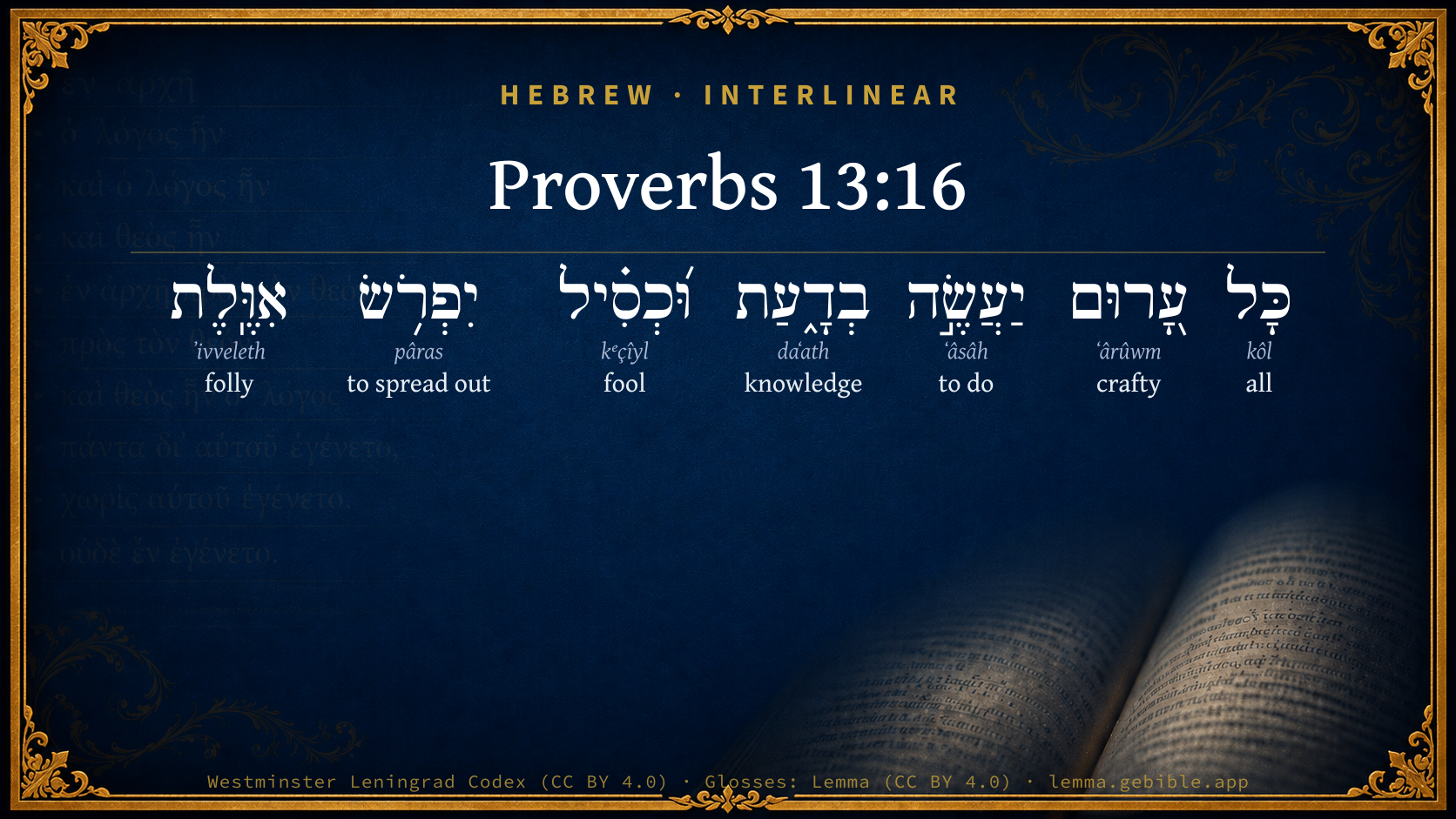
Hebrew (Westminster Leningrad Codex) Proverbs 13:16 appears in the Hebrew Old Testament. The text above is from the Westminster Leningrad Codex. Each word links to its Strong’s number, a concise gloss, and parsing drawn from the Open Scriptures Hebrew Bible morphology. Click any word for its full Brown-Driver-Briggs (BDB) entry.
Download image
Cite this verse

Proverbs 13:16 (World English Bible). Public Domain. Lemma interlinear Bible study tool, https://lemma.gebible.app/v/proverbs/13/16.

Show BibTeX & RIS
BibTeX
RIS
English Translation
Every prudent man acts from knowledge, But a fool exposes folly.
World English Bible · Public Domain
Download a study sheet

One document with this verse’s original text, its word-by-word gloss line, the meaning frame, cross-references with their text, attributed commentary, and full source and license credits — printable, and it pastes into notes with its structure intact.

This verse Autodidact and up

Study sheet (.html) Plain text (.txt)

A passage Seminary Student

Up to 50 verses in one chapter. A passage sheet keeps up to 6 commentary sources and 12 cross-references per verse, in the order this page ranks them, and says so on the sheet whenever that leaves anything out. Ask for a single verse and you get the Autodidact verse sheet above.

Everything on this page stays free to read, with no account — the sheet is a download of what is already on screen, not access to it.

Want to remove ads? Support Godless Engineer
Compare translations 3

The same verse in 3 English versions, stacked beneath the original-language interlinear above. Click any original word for its lexicon entry.

Each is an independent rendering of the whole verse — the interlinear is not word-aligned to these translations.

Highlighted words mark where these versions differ — a whole-verse word diff, not a word-by-word alignment.

  • World English Bible Public Domain
    Every prudent man acts from knowledge, But a fool exposes folly.
  • King James Version Public Domain
    Every prudent man dealeth with knowledge: but a fool layeth open his folly.
  • unfoldingWord Literal Text CC BY-SA 4.0
    Every prudent acts with knowledge, but a stupid person displays folly.

unfoldingWord Literal Text — © unfoldingWord, licensed CC BY-SA 4.0. Word-aligned USFM3 via Door43 (git.door43.org/unfoldingWord/en_ult).

Versions to compare (up to 4)

3 of 4 selected

Show all 18 translations

Every available English version of this verse, each an independent rendering of the whole verse.

  • World English Bible Public Domain
    Every prudent man acts from knowledge, But a fool exposes folly.
  • Berean Standard Bible Public Domain
    Every prudent man acts with knowledge, but a fool displays his folly.
  • Majority Standard Bible Public Domain
    Every prudent man acts with knowledge, but a fool displays his folly.
  • King James Version Public Domain
    Every prudent man dealeth with knowledge: but a fool layeth open his folly.
  • American Standard Version (1901) Public Domain
    Every prudent man worketh with knowledge; But a fool flaunteth `his' folly.
  • Revised Version (1885) Public Domain
    Every prudent man worketh with knowledge: but a fool spreadeth out folly.
  • Geneva Bible (1599) Public Domain
    Euery wise man will worke by knowledge: but a foole will spread abroade folly.
  • Douay-Rheims (1899) Public Domain
    The prudent mall doth all things with counsel: but he that is a fool, layeth open his folly.
  • Young's Literal Translation Public Domain
    Every prudent one dealeth with knowledge, And a fool spreadeth out folly.
  • Literal Standard Version CC BY-SA 4.0
    Every prudent one deals with knowledge, || And a fool spreads out folly.
  • Unlocked Literal Bible CC BY-SA 4.0
    Prudent people act out of knowledge in every decision, but a fool parades his folly.
  • unfoldingWord Literal Text CC BY-SA 4.0
    Every prudent acts with knowledge, but a stupid person displays folly.
  • Darby Bible Public Domain
    Every prudent [man] acteth with knowledge; but the foolish layeth open [his] folly.
  • World Messianic Bible Public Domain
    Every prudent man acts from knowledge, but a fool exposes folly.
  • Webster's Bible Public Domain
    Every prudent man dealeth with knowledge: but a fool layeth open his folly.
  • Free Bible Version CC BY-SA 4.0
    All wise people act intelligently, but stupid people demonstrate their stupidity.
  • Bible in Basic English Public Domain
    A sharp man does everything with knowledge, but a foolish man makes clear his foolish thoughts.
  • JPS Tanakh (1917) Public Domain
    Every prudent man dealeth with forethought; but a fool unfoldeth folly.

Literal Standard Version (2020), Covenant Press — licensed CC BY-SA 4.0. Text via the HelloAO Bible API (eBible.org). Unlocked Literal Bible (unfoldingWord) — licensed CC BY-SA 4.0. Text via the HelloAO Bible API (eBible.org). unfoldingWord Literal Text — © unfoldingWord, licensed CC BY-SA 4.0. Word-aligned USFM3 via Door43 (git.door43.org/unfoldingWord/en_ult). Free Bible Version, Dr. Jonathan Gallagher — licensed CC BY-SA 4.0. Text via the HelloAO Bible API (eBible.org).

Word by word

More ways to search: Search by grammar → Find every occurrence → Compare this word →

Practice this passage: Drill this verse → Learn its vocabulary →

About this verse

These counts appear in no published source. They are computed here, from the morphology-tagged text and Lemma’s own curated glosses. What Lemma adds →

7
words
7
distinct lemmas
Wisdom
section

Notable vocabulary

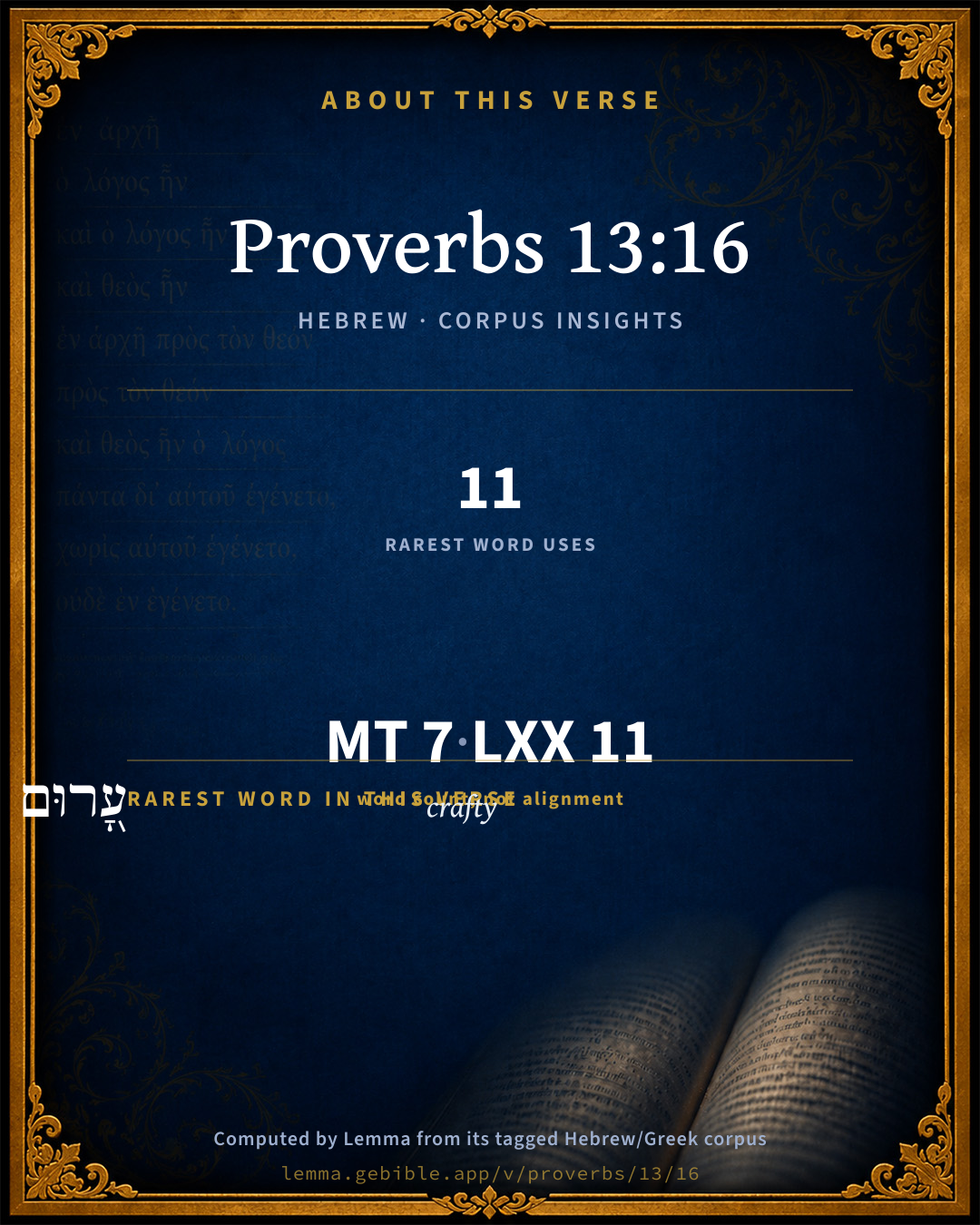
The rarest word here is עָ֭רוּם crafty H6175 — appearing just 11 times in the whole Hebrew Bible.

Shared distinctive vocabulary

עָ֭רוּם crafty H6175 occurs in 11 verses of the Hebrew Bible. Also found in:

Grammatical profile

  • 2 verbs
  • 3 nouns
  • 2 adjectives

Verb forms

  • יַעֲשֶׂ֣ה Qal · Imperfect
  • יִפְרֹ֥שׂ Qal · Imperfect

Hebrew & Septuagint length

In English translation the verse runs 11 words from the Hebrew and 13 from the Septuagint (LXX English) — closely comparable.

A rough comparison of the two English renderings, which tokenize alike — not a word-level alignment.

Word counts can differ between the Hebrew and the Greek without any difference in meaning — e.g. the Hebrew direct-object marker אֵת has no separate Greek word, and Greek often adds the article ὁ.

In the original languages it is 7 Hebrew tokens and 11 Greek tokens — but the two are counted differently (Hebrew bundles its prefixes and suffixes into one token; the Greek is in lemma form), so that isn’t a like-for-like length.

Cross-references

13

Topical passages linked to Proverbs 13:16 in the Treasury of Scripture Knowledge — connected by theme and wording, ordered by reader-vote popularity; previews shown in the World English Bible.

  • Proverbs 15:2 The tongue of the wise commends knowledge, But the mouth of fools gush out folly.
  • Proverbs 12:22–23 Lying lips are an abomination to Yahweh, But those who do the truth are his delight.
  • Ephesians 5:17 Therefore don't be foolish, but understand what the will of the Lord is.
  • Ecclesiastes 10:3 Yes also, when the fool walks by the way, his understanding fails him, and he says to everyone that he is a fool.
  • Isaiah 52:13 Behold, my servant shall deal wisely, he shall be exalted and lifted up, and shall be very high.
  • Romans 16:19 For your obedience has become known to all. I rejoice therefore over you. But I desire to have you wise in that which is good, but innocent in that which is evil.
  • 1 Samuel 25:10–11 Nabal answered David's servants, and said, Who is David? and who is the son of Jesse? there are many servants now-a-days who break away every man from his master.
  • 1 Samuel 25:17 Now therefore know and consider what you will do; for evil is determined against our master, and against all his house: for he is such a worthless fellow that one can't speak to him.
  • 1 Samuel 25:25 Please don't let my lord regard this worthless fellow, even Nabal; for as his name is, so is he; Nabal is his name, and folly is with him: but I your handmaid didn't see the young men of my lord, whom you did send.
  • Psalms 112:5 It is well with the man who deals graciously and lends. He will maintain his cause in judgment.
  • Proverbs 21:24 The proud and haughty man, "scoffer" is his name; He works in the arrogance of pride.
  • Matthew 10:16 "Behold, I send you out as sheep in the midst of wolves. Therefore be wise as serpents, and harmless as doves.
  • 1 Corinthians 14:20 Brothers, don't be children in thoughts, yet in malice be babies, but in thoughts be mature.

Cross-references courtesy of OpenBible.info (CC BY 4.0).

Hebrew and Greek witnesses Masoretic Hebrew ↔ Greek Septuagint

The same verse in the two great witnesses to the Old Testament, shown verse-for-verse.

These are two independent witnesses, not word-aligned to each other, and the Septuagint is shown in lemma (dictionary) form.

Hebrew Proverbs 13:16 Masoretic · Westminster Leningrad Codex

כָּל עָ֭רוּם יַעֲשֶׂ֣ה בְדָ֑עַת וּ֝כְסִ֗יל יִפְרֹ֥שׂ אִוֶּֽלֶת

Every prudent man acts from knowledge, But a fool exposes folly.

World English Bible · Public Domain

Greek LXX Proverbs 13:16 Septuagint · lemma form

πᾶς πανοῦργος πράσσω μετά γνῶσις ὁ δέ ἄφρων ἐκπεταννύω ἑαυτοῦ κακία

Every prudent man acts with knowledge: but the fool displays his own mischief.

LXX2012 (modern English Septuagint) · Public Domain

Hebrew: Westminster Leningrad Codex (CC BY 4.0). Greek: Septuagint (public domain); English from LXX2012 (modern English Septuagint) (Public Domain). How the Septuagint differs from the Hebrew →

Commentary

Notes on Proverbs 13:16 from classic Christian and Jewish commentators (each source and its license shown beneath its notes). The classic Christian expositions comment on the surrounding passage and are grouped to its opening verse, so a note may address several verses; the Jewish commentaries on the Tanakh (Rashi and others) are per-verse, so they appear only where the commentator wrote on this verse.

Lemma curates 59 commentaries, every one of them public domain or Creative Commons licensed, each selected and text-cleaned for this edition rather than reprinted as found. About our sources →

Trapp's Complete Commentary

John Trapp

Pro 13:16 Every prudent [man] dealeth with knowledge: but a fool layeth open [his] folly.

Ver. 16. Every prudent man dealeth with knowledge.] Observes circumstances, and deports himself with discretion; thrusts not himself into unnecessary dangers; carves not a piece of his heart but to those he is well assured of. See an instance of this prudence in Ezra; {Ezr 8:22} in Nehemiah, {Neh 2:5} he calls it not the place of God’s worship - such an expression that heathen king might have disgusted - but the place of his father’s sepulchres; in Esther, who concealed her stock and kindred till she saw her time; in Christ, when he was tried for his life; in Paul, {Act 23:6; Act 19:10} who lived two years at Ephesus, and spake not much against the worship of their great goddess Diana. {Act 19:35; Act 19:37} "The prudent shall keep silence in an evil time." {Amo 5:13} It is not good provoking evil men that are irreformable, nor safe pulling a bear or mad dog by the ear.

But a fool layeth open his folly.] Plasheth it, and setteth it a sunning, as it were, by his headlong, headstrong exorbitances. By his inconsiderate courses he openly bewrays and proclaims what he is; he sets his folly "upon the cliff of the rock, that it should not be covered." {Eze 24:7}

John Trapp, A Commentary or Exposition upon All the Books of the Old and New Testament (1647–1656) — public domain. Text from a community e-Sword module.

The Biblical Illustrator

Joseph S. Exell

Pro_13:16

Every prudent man dealeth with knowledge: but a fool layeth open his folly.

The wise and the foolish

I. The wise man. He dealeth with knowledge. This implies--

1. That he has knowledge. Knowledge is essential to a wise man. All true knowledge has its foundation in God. There is no knowledge that includes Him not. It implies--

2. That a wise man treats his knowledge wisely. He dealeth with knowledge. A man may have a great deal of knowledge, and no wisdom. Wisdom consists in the right application of knowledge. The wise man so deals with his knowledge as to culture his own nature and promote the real progress of his race. Perfect freedom, says Plato, hath four parts--viz., wisdom, the principle of doing things aright; justice, the principle of doing things equally in public and private; fortitude, the principle of not flying danger, but meeting it; and temperance, the principle of subduing desires, and living moderately.

II. The foolish man. Foolish men show their folly in at least two ways.

1. By talking about things of which they know little or nothing. There are two notable facts in human nature. Empty-minded persons are generally talkative. The thinker, discerning difficulties in every turn, moves cautiously, reverently, and even with hesitation.

2. By attempting things which they are incapable of achieving. The foolish man knows not his aptitudes and inaptitudes. Hence he is seen everywhere, striving to be what he never can be; to do that which he never can accomplish. (D. Thomas, D.D.)

The Biblical Illustrator, edited by Joseph S. Exell (c. 1880s–1900s) — public domain. Text from a community e-Sword module.

The Preacher's Complete Homiletical Commentary

Joseph S. Exell (gen. ed.)

CRITICAL NOTES.—

Pro_13:16. Dealeth with knowledge, i.e. acteth with foresight. Layeth open, rather “spreadeth abroad.” Delitzsch Says, “There lies in the word something derisive; as the merchant unrolls and spreads out his wares in order to commend them, so the fool deals with his folly.”

MAIN HOMILETICS OF Pro_13:16

DEALING WITH KNOWLEDGE

For a definition of prudence see Homiletics on chap. Pro_8:12-13, page 109. Carrying out the thought that prudence is wisdom applied to practice, we remark,

I. That a prudent man deals, or acts with knowledge from a sense of responsibility.

1. In commercial life. No prudent man will engage in any business transaction without first making himself thoroughly acquainted with it in all its bearings. He will, if possible, look far into the future and weigh probabilities and calculate results, so as to secure himself from ultimate loss. He will not deal with the matter at all unless he understands it. This we conceive is “dealing with knowledge.” And it is the course pursued by every prudent man of business from a sense of responsibility. He feels that he has obligations to fulfil to others and a character to maintain, and therefore he thinks before he acts. A man who values his life at all will not deliberately walk over a precipice, and a prudent man will not go very near the edge, he will know what is the safe distance at which he may walk without even risking the possibility of a false step.

2. As a teacher or leader of others. A man who undertakes the guidance of his fellow-creatures in any way, is especially bound to “deal with knowledge.” If he is a teacher of youth, and is a prudent man, he will make it his business to know his pupils, to become acquainted with the best methods of imparting instruction and developing their mental and moral powers. He feels that they are in his hands very much as clay in the hands of the potter, and that it depends very much upon him whether they become vessels of honour or of dishonour, and this invests all his dealings with them with a deep sense of responsibility. So with the statesman, the Christian teacher, or any other man who finds himself entrusted with influence over his fellows. Prudence is almost as necessary as goodness and right intentions. A man may have abundance of wealth at his disposal whereby to accomplish some desired end. But if he does not know how to use it, he may as surely miss his aim as if he were poor. So a man may have much spiritual wealth and an earnest desire to use it for the good of others, but if he is not a prudent man—if he neglects to acquire a knowledge of the how, and the when, and the where to do it, he may not only fail to realise his desire, but may cause his good to be evil spoken of. And the principle applies to every good man, however limited his sphere or humble his position. It is the special trade of a good man to do good, but he may greatly injure his trade by neglecting to “deal with knowledge.” “What king,” says our Lord, “going to make war against another king, sitteth not down first, and consulteth whether he be able with ten thousand to meet him that cometh against him with twenty thousand!” (Luk_14:31). It is implied that this man has a sense of the importance of the undertaking upon which he is about to embark, that he duly estimates the possible loss or gain which may result from it. He may serve as an illustration of what is meant by a prudent man “dealing with knowledge” in any and every step in life, whether it be apparently great or small, weighty or trivial. For there are no little things in human life—the greatest issues often hang upon what men ignorantly call trifles.

II. A fool by rash and inconsiderate conduct “layeth open” or “publishes” his folly. It is implied by contrasting him with the prudent man who “deals with knowledge” that he deals without it, that he leaps before he looks and walks in the dark when he might avail himself of a light to guide him. Such conduct arises from a lack of the sense of responsibility. He does not consider what is involved in his failure, how much misery may thus be entailed on himself and others. Every man who does not weigh results proves himself thereby to be a fool.

OUTLINES AND SUGGESTIVE COMMENTS

He that is wise will not be doing or dealing in anything unless he know what it is wherein he dealeth, and unless he deal so as he knoweth that he should. He knoweth that a man is known by his dealing. He knoweth that others look on his dealing, and therefore he looketh so to it as that they may know him to be wise by it. But a fool will be dealing, although by dealing he uncover his nakedness. The shame of his folly shall be spread abroad as wide as his dealings are heard of.—Jermin.

Observes circumstances, and deports himself with discretion; thrusts not himself into unnecessary dangers; carves not a piece of his heart but to those he is well assured of. See an instance of this prudence in Ezra, chap. Pro_8:22; in Nehemiah, chap. Pro_2:5. He calls it not the place of God’s worship—such an expression might have disgusted the heathen king—but the place of his father’s sepulchres. In Christ, when He was tried for His life; in Paul, who lived two years at Ephesus, and spake not much against the worship of their great goddess Diana (Act_23:6; Act_19:10).—Trapp.

Fools might be esteemed half-wise if they had sense enough to keep their folly to themselves.—Lawson.

Wide is the sphere for trading with this responsible talent. In the family economy (Jdg_13:8-12; chap. Pro_14:1; Pro_31:27). In the church; in a wise accommodation to circumstances (Gal_2:2); in the conviction of gainsayers (Tit_1:9); in forbearing with the prejudices of the weak (Act_15:22-29); in the exercise of Christian admonition (Rom_15:14).—Bridges.

The Preacher's Complete Homiletical Commentary (gen. ed. Joseph S. Exell; Funk & Wagnalls, c. 1892) — public domain (pre-1929). A full-Bible homiletical/sermon-outline anthology covering 65 of 66 books (2 John is absent from the source module). Text from a community e-Sword module.

Matthew Henry's Commentary

Note, 1. It is wisdom to be cautious. Every prudent discreet man does all with knowledge (considering with himself and consulting with others), acts with deliberation and is upon the reserve, is careful not to meddle with that which he has not some knowledge of, not to launch out into business which he has not acquainted himself with, will not deal with those that he has not some knowledge of, whether they may be confided in. He is still dealing in knowledge, that he may increase the stock he has. 2. It is folly to be rash, as the fool is, who is forward to talk of things he knows nothing of and undertake that which he is no way fit for, and so lays open his folly and makes himself ridiculous. He began to build and was not able to finish.

Matthew Henry's Commentary on the Whole Bible (1708–1710) — public domain (CC PDM 1.0). Text via the HelloAO Bible API.

Jamieson, Fausset & Brown

Robert Jamieson, A. R. Fausset & David Brown

dealeth--acts with foresight.

a fool . . . folly--for want of caution.

Jamieson, Fausset & Brown — Commentary Critical and Explanatory on the Whole Bible (1871) — public domain (CC PDM 1.0). Text via the HelloAO Bible API.

The Cambridge Bible for Schools and Colleges

gen. ed. J. J. S. Perowne

16. dealeth] Rather, worketh. He works with knowledge, turning it to good account for beauty and profit, as a cunning artificer does with precious metals, Exo_31:4-5, where the Heb. word is the same. This, however, is probably intended by dealeth, A.V. Comp. our use of the words deal, dealer, in connection with trade or traffic.

layeth open] Rather, spreadeth, A.V. marg., or spreadeth out, R.V. text, exposes it. “When your money is all in copper you may afford to throw it about, but when it is all in gold you have to be cautious.” Horton.

The Cambridge Bible for Schools and Colleges (gen. ed. J. J. S. Perowne; Cambridge University Press, 1878–1918) — public domain. Text from a community e-Sword module.

John Gill's Exposition

Every prudent man dealeth with knowledge,.... In order to get more, and with men of knowledge for the same purpose; all he does is with knowledge and discretion; he does not meddle with things, nor has he to do with persons, he knows nothing of; he both acts and speaks with knowledge, cautiously, wisely, considering well time, place, and persons: and every wise and good man deals with evangelical knowledge, and studies to grow in the knowledge of the Gospel, and the mysteries of it; in the knowledge of Christ, and of God in Christ; the issue of which is life eternal;

but a fool layeth open his folly; or "spreads" (q) it; and exposes it to the view of everyone, by his foolish talk and indiscreet actions.

(q) "expandit", Mercerus, Gejerus, Michaelis.

John Gill's Exposition of the Whole Bible (1746–1763) — public domain (CC PDM 1.0). Text via the HelloAO Bible API.

Matthew Poole's English Annotations

Dealeth, Heb. acteth, or

doth, manageth all his affairs, with knowledge; considerately and discreetly.

Layeth open his folly, by his heady and foolish actions.

Matthew Poole's English Annotations on the Holy Bible (1683–1685) — public domain. Text from a community e-Sword/MySword module.

Whedon's Commentary on the Bible

Daniel D. Whedon

16. Dealeth with knowledge — Acts with thought, or foresight of what he is about to do.

A fool layeth open — Or spreads abroad.

His folly — The foolish man does not act with wise consideration, and, therefore, exposes his ignorance. Comp. Pro_12:23; Pro_15:2.

Daniel D. Whedon (gen. ed.), Commentary on the Old and New Testaments (1874–1909) — public domain. Text from a community e-Sword module.

The Pulpit Commentary

Every prudent man dealeth (worketh, acteth) with knowledge; i.e. with thought and deliberation, having previously well considered the bearings and issues of his plans. But a fool layeth open his folly; Revised Version, spreadeth out folly, as if exposing the wares of his shop. (Pro_12:23 Pro_15:2) One works; the other talks.

The Pulpit Commentary (1880–1919), ed. H.D.M. Spence-Jones & Joseph S. Exell — public domain. Text from a community e-Sword module.

John Wesley's Explanatory Notes

Knowledge - Considerately and discreetly. Layeth open - By his foolish actions.

John Wesley, Explanatory Notes Upon the Whole Bible (1754–1765) — public domain. Text via the GEBible commentary corpus.

Keil & Delitzsch

C. F. Keil & F. Delitzsch

16 Every prudent man acteth with understanding;

But a fool spreadeth abroad folly.

Hitzig reads, with the Syr. (but not the Targ.) and Jerome, כּל (omnia agit), but contrary to the Hebr. syntax. The כּל־ is not feeble and useless, but means that he always acts בּדּעת, mit Bedacht [with judgment] (opp. בּבלי דעת, inconsulto, Deu 4:42; Deu 19:4), while on the contrary the fool displays folly. Pro 12:23 and Pro 15:2 serve to explain both members of the verse. Bedchtigkeit [judgment] is just knowledge directed to a definite practical end, a clear thought concentrated on a definite point. יקרא, he calls out, and יבּיע, he sputters out, are parallels to יפרשׂ. Fleischer: פּרשׂ, expandit (opp. Arab. ṭawy, intra animum cohibuit), as a cloth or paper folded or rolled together, cf. Schiller's

(Note: "Er breitet es heiter und glnzend aus,

Das zusammengewickelte Leben.") -

"He spreads out brightly and splendidly

The enveloped life."

There lies in the word something derisive: as the merchant unrolls and spreads out his wares in order to commend them, so the fool does with his foolery, which he had enveloped, i.e., had the greatest interest to keep concealed within himself - he is puffed up therewith.

Keil & Delitzsch — Biblical Commentary on the Old Testament (1861–1891) — public domain (CC PDM 1.0). Text via the HelloAO Bible API. (Old Testament only.)

Bridges on Proverbs

Charles Bridges

How often is even valuable knowledge frittered away from the want of prudent application! We must ponder the time, measure, helps, and means of dealing with it, so as to put it out to its full advantage. (Pro 15:2 .) And how wide is the sphere for trading with this responsible talent! In daily life, it provides against foreseen dangers (Pro 22:3 ), and makes a way to escape in trying difficulties.†1 Not less useful is it in the family economy; in the training of children (Jdg 13:8-12 ); in the "guidance of affairs" (Pro 14:1 ); in looking well to household occupations. (Pro 31:27 .) Must we not also deal with it in the Church; in a wise accommodation to circumstances (Gal 2:2 ); in the conviction of gainsayers (Tit 1:9 ); in forbearing with the prejudices of the weak (Act 15:22-29 ); in the exercise of Christian admonition? (Rom 15:14 .) The want of it is the source of an unstable profession. In understanding we are children, not men. (1Co 14:20 .) Most precious therefore is "the word of knowledge," as "the manifestation of the Spirit given to us to profit withal." (1Co 12:7 .) Greatly also do we need this gift in our intercourse with the world; to avoid occasions of stumbling;†2 to mark seasonable times of reproof;†3 to refrain from needless offense.†4 Nay — even in the political world what need have we of "understanding of the times, to know what Israel ought to do!" (1Ch 12:32 .) Thus to deal with knowledge in this diversified application, is the responsibility of a prudent man of God. (Pro 14:8, Pro 14:15 .)

From the want of this prudence, the fool layeth open his folly, he pours out his wrath. (Pro 12:16 . Num 22:29-30 .) He vaunts out his vanity. (1Sa 17:44 .) He exposes his thoughtlessness. (Mat 14:7 .) He exercises no judgment (Pro 18:13 ), and fills his sphere of influence with mischief.

Let us study the minute details of our Master’s well-filled life. He shall deal prudently (Isa 52:13 .). This was his distinctive character. The Spirit of prudence was the furniture for his work. (Isa 11:2-3 .) How gloriously did it shine forth in the confounding of his enemies (Mat 21:24 ; Mat 22:42-46 ), and in tender sympathy with his afflicted people! (Isa 50:4 .) How good is it to have our knowledge disciplined by his teaching, and consecrated to his service!

Footnotes:

†1 Act 16:37-38; Act 22:25 ; Act 23:7 .

†2 Ezr 8:22. Neh 6:11 .

†3 Pro 9:7-8; Pro 15:23 . 1Sa 25:36 . Amo 5:13 . Mat 7:6 .

†4 Neh 2:5. Speaking of his land before a heathen King, in reference not to the God of Israel, but to the sepulchres of his fathers.

Charles Bridges, An Exposition of the Book of Proverbs (1846) — public domain. Text from a community e-Sword module.

Kretzmann's Popular Commentary

Paul E. Kretzmann

v. 16. Every prudent man dealeth with knowledge, with a careful weighing of all facts as presented to him; but a fool layeth open his folly, exposing it, spreading it before the eyes of all men, showing off his folly.

Paul E. Kretzmann, Popular Commentary of the Bible (1921–1924) — public domain. Text from a community e-Sword module.

Rashi

Rabbi Shlomo Yitzchaki (Rashi)

Every cunning man acts with forethought He performs his deeds with forethought, like David: “Let them seek for my lord, the king, a young girl, a virgin, etc.” (I Kings 1:2).

but a fool exposes [his] stupidity This is Ahasuerus (Esther 2:3): “Let the king appoint, etc.” They knew that he would not marry them all. Therefore, whoever had a daughter concealed her.

Rashi on the Tanakh — English translations: “The Judaica Press complete Tanach with Rashi, translated by A. J. Rosenberg” (CC BY 4.0); “Pentateuch with Rashi's commentary by M. Rosenbaum and A.M. Silbermann, 1929-1934” (public domain); “The Metsudah Tanach series, Lakewood, N.J” (CC BY 4.0); and “The Book of Joshua, Metsudah Publications, 1997” (CC BY 4.0). Text via Sefaria.

Lesson kit

Teaching starters — assembled from the data on this page, not authored interpretation. Every prompt links to the verse data it draws on. Edit before teaching.

Proverbs, in the Wisdom, opens this verse with 7 words (7 distinct Hebrew lemmas). Its most distinctive word is ʻârûwm (“crafty”). A historical commentator’s framing appears above. Read the whole chapter for the surrounding context.

Discussion questions

  1. How does “crafty” (ʻârûwm) shape what this verse is saying?
  2. Genesis 3:1 shares the word «crafty» with this verse. How do the two illuminate each other?
  3. The translations on this page render this verse differently — a whole-verse word diff, not a word-by-word alignment. What might account for the different wordings?
  4. The verb «יַעֲשֶׂ֣ה» is Qal Imperfect. How does its form color the action?
  5. Reading how Trapp's Complete Commentary and The Biblical Illustrator read this verse, where do the two commentators agree and where do they part?

Things to notice

Reading settings

Reading text

Shown beneath each verse's original-language words.

Old Testament
Old Testament edition

Read the OT as the Masoretic Hebrew (MT) or the Greek Septuagint (LXX).

English shown for the Greek Septuagint (in the Hebrew ↔ Greek comparison).

Comparing translations? Open the Compare panel on any verse page to stack up to four side by side.