
Psalms 143:6

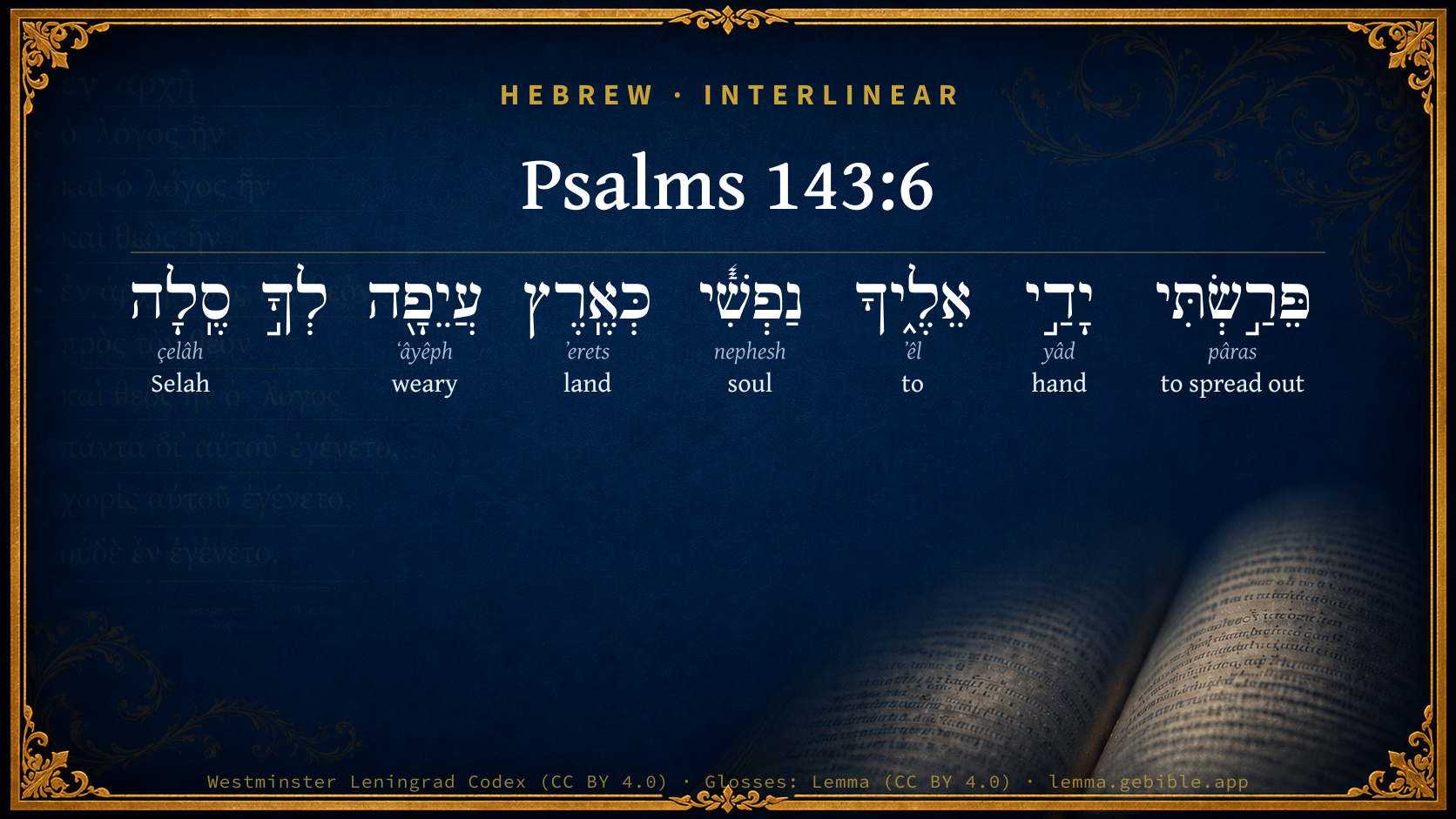
Hebrew (Westminster Leningrad Codex) Psalms 143:6 appears in the Hebrew Old Testament. The text above is from the Westminster Leningrad Codex. Each word links to its Strong’s number, a concise gloss, and parsing drawn from the Open Scriptures Hebrew Bible morphology. Click any word for its full Brown-Driver-Briggs (BDB) entry.
Download image
Cite this verse

Psalms 143:6 (World English Bible). Public Domain. Lemma interlinear Bible study tool, https://lemma.gebible.app/v/psalms/143/6.

Show BibTeX & RIS
BibTeX
RIS
English Translation
I spread forth my hands to you. My soul thirsts for you, like a parched land. Selah.
World English Bible · Public Domain
Download a study sheet

One document with this verse’s original text, its word-by-word gloss line, the meaning frame, cross-references with their text, attributed commentary, and full source and license credits — printable, and it pastes into notes with its structure intact.

This verse Autodidact and up

Study sheet (.html) Plain text (.txt)

A passage Seminary Student

Up to 50 verses in one chapter. A passage sheet keeps up to 6 commentary sources and 12 cross-references per verse, in the order this page ranks them, and says so on the sheet whenever that leaves anything out. Ask for a single verse and you get the Autodidact verse sheet above.

Everything on this page stays free to read, with no account — the sheet is a download of what is already on screen, not access to it.

Want to remove ads? Support Godless Engineer
Compare translations 3

The same verse in 3 English versions, stacked beneath the original-language interlinear above. Click any original word for its lexicon entry.

Each is an independent rendering of the whole verse — the interlinear is not word-aligned to these translations.

Highlighted words mark where these versions differ — a whole-verse word diff, not a word-by-word alignment.

  • World English Bible Public Domain
    I spread forth my hands to you. My soul thirsts for you, like a parched land. Selah.
  • King James Version Public Domain
    I stretch forth my hands unto thee: my soul thirsteth after thee, as a thirsty land. Selah.
  • unfoldingWord Literal Text CC BY-SA 4.0
    I spread out my hands to you; my soul, as a thirsty land, to you. Selah

unfoldingWord Literal Text — © unfoldingWord, licensed CC BY-SA 4.0. Word-aligned USFM3 via Door43 (git.door43.org/unfoldingWord/en_ult).

Versions to compare (up to 4)

3 of 4 selected

Show all 18 translations

Every available English version of this verse, each an independent rendering of the whole verse.

  • World English Bible Public Domain
    I spread forth my hands to you. My soul thirsts for you, like a parched land. Selah.
  • Berean Standard Bible Public Domain
    I stretch out my hands to You; my soul thirsts for You like a parched land. Selah
  • Majority Standard Bible Public Domain
    I stretch out my hands to You; my soul thirsts for You like a parched land. Selah
  • King James Version Public Domain
    I stretch forth my hands unto thee: my soul thirsteth after thee, as a thirsty land. Selah.
  • American Standard Version (1901) Public Domain
    I spread forth my hands unto thee: My soul `thirsteth' after thee, as a weary land. Selah
  • Revised Version (1885) Public Domain
    I spread forth my hands unto thee: my soul thirsteth after thee, as a weary land. Selah
  • Geneva Bible (1599) Public Domain
    I stretch forth mine hands vnto thee: my soule desireth after thee, as the thirstie land. Selah.
  • Douay-Rheims (1899) Public Domain
    I cried to thee, O Lord: I said: Thou art my hope, my portion in the land of the living.
  • Young's Literal Translation Public Domain
    I have spread forth my hands unto Thee, My soul `is' as a weary land for Thee. Selah.
  • Literal Standard Version CC BY-SA 4.0
    I have spread forth my hands to You, || My soul [is] as a weary land for You. Selah.
  • Unlocked Literal Bible CC BY-SA 4.0
    I spread my hands out to you; my soul thirsts for you in a parched land. Selah
  • unfoldingWord Literal Text CC BY-SA 4.0
    I spread out my hands to you; my soul, as a thirsty land, to you. Selah
  • Darby Bible Public Domain
    I stretch forth my hands unto thee: my soul, as a parched land, [thirsteth] after thee. Selah.
  • World Messianic Bible Public Domain
    I spread out my hands to you. My soul thirsts for you, like a parched land. Selah.
  • Webster's Bible Public Domain
    I stretch forth my hands to thee: my soul thirsteth after thee, as a thirsty land. Selah.
  • Free Bible Version CC BY-SA 4.0
    I stretch out my hands to you, thirsting for you like dried-out land. Selah.
  • Bible in Basic English Public Domain
    My hands are stretched out to you: my soul is turned to you, like a land in need of water. (Selah.)
  • JPS Tanakh (1917) Public Domain
    I spread forth my hands unto Thee; my soul thirsteth after Thee, as a weary land. Selah

Literal Standard Version (2020), Covenant Press — licensed CC BY-SA 4.0. Text via the HelloAO Bible API (eBible.org). Unlocked Literal Bible (unfoldingWord) — licensed CC BY-SA 4.0. Text via the HelloAO Bible API (eBible.org). unfoldingWord Literal Text — © unfoldingWord, licensed CC BY-SA 4.0. Word-aligned USFM3 via Door43 (git.door43.org/unfoldingWord/en_ult). Free Bible Version, Dr. Jonathan Gallagher — licensed CC BY-SA 4.0. Text via the HelloAO Bible API (eBible.org).

Word by word

More ways to search: Search by grammar → Find every occurrence → Compare this word →

Practice this passage: Drill this verse → Learn its vocabulary →

About this verse

These counts appear in no published source. They are computed here, from the morphology-tagged text and Lemma’s own curated glosses. What Lemma adds →

8
words
7
distinct lemmas
Wisdom
section

Notable vocabulary

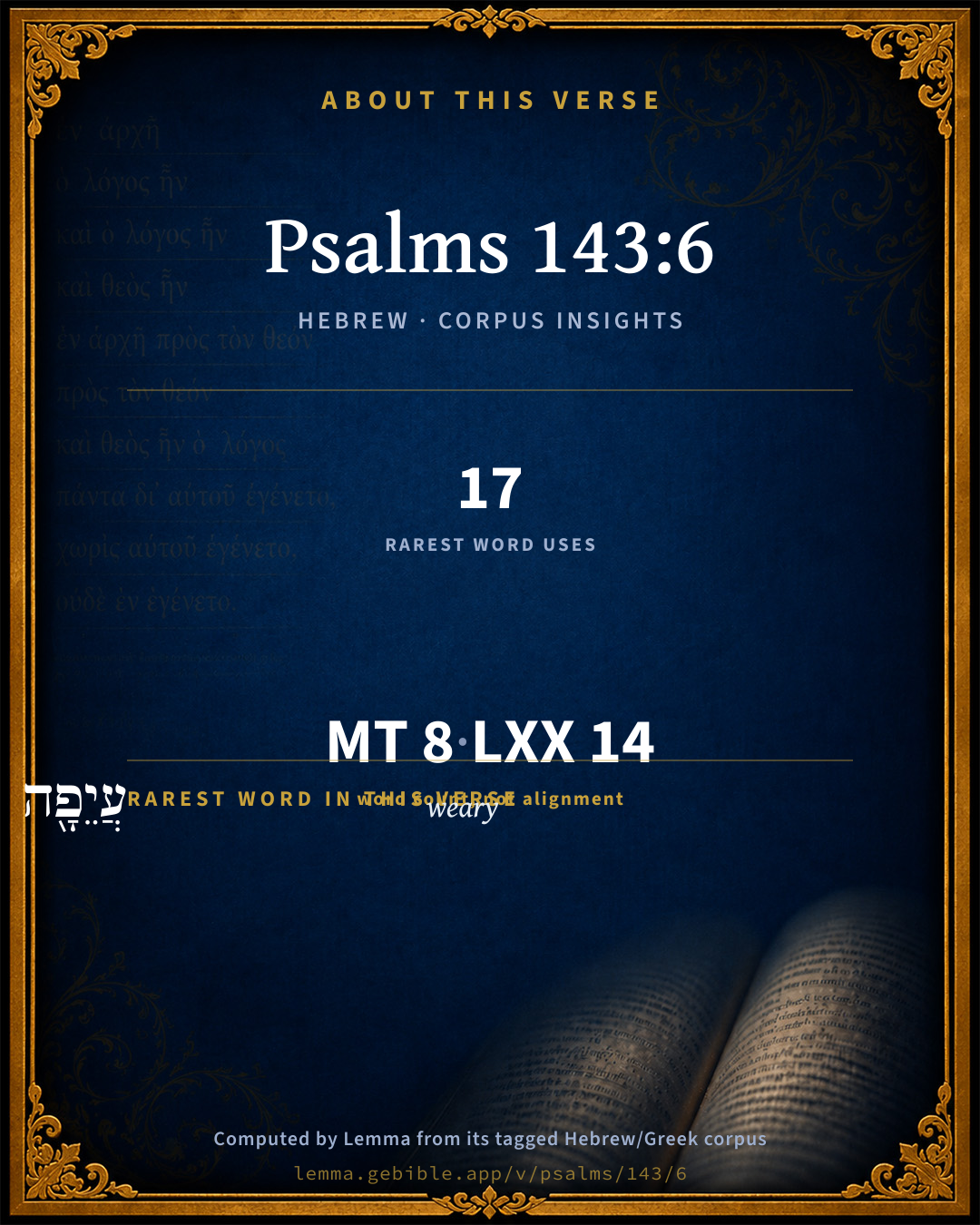
The rarest word here is עֲיֵפָ֖ה weary H5889 — appearing just 17 times in the whole Hebrew Bible.

Shared distinctive vocabulary

עֲיֵפָ֖ה weary H5889 occurs in 17 verses of the Hebrew Bible. Also found in:

Grammatical profile

  • 1 verb
  • 3 nouns
  • 1 adjective
  • 2 prepositions
  • 1 particle

Verb forms

  • פֵּרַ֣שְׂתִּי Piel · Perfect

Hebrew & Septuagint length

In English translation the verse runs 17 words from the Hebrew and 17 from the Septuagint (LXX English) — the same length.

A rough comparison of the two English renderings, which tokenize alike — not a word-level alignment.

Word counts can differ between the Hebrew and the Greek without any difference in meaning — e.g. the Hebrew direct-object marker אֵת has no separate Greek word, and Greek often adds the article ὁ.

In the original languages it is 8 Hebrew tokens and 14 Greek tokens — but the two are counted differently (Hebrew bundles its prefixes and suffixes into one token; the Greek is in lemma form), so that isn’t a like-for-like length.

Cross-references

9

Topical passages linked to Psalms 143:6 in the Treasury of Scripture Knowledge — connected by theme and wording, ordered by reader-vote popularity; previews shown in the World English Bible.

  • Job 11:13 "If you set your heart aright, Stretch out your hands toward him.
  • Psalms 63:1 God, you are my God. I will earnestly seek you. My soul thirsts for you, My flesh longs for you, In a dry and weary land, where there is no water.
  • Psalms 84:2 My soul longs, and even faints for the courts of Yahweh. My heart and my flesh cry out for the living God.
  • Psalms 88:9 My eyes are dim from grief. I have called on you daily, Yahweh. I have spread out my hands to you.
  • Psalms 42:1–2 As the deer pants for the water brooks, So my soul pants after you, God.
  • Psalms 44:20 If we have forgotten the name of our God, Or spread forth our hands to a strange god;
  • Isaiah 26:8–9 Yes, in the way of your judgments, Yahweh, have we waited for you; to your name, even to your memorial [name], is the desire of our soul.
  • Isaiah 35:7 The glowing sand shall become a pool, and the thirsty ground springs of water: in the habitation of jackals, where they lay, shall be grass with reeds and rushes.
  • John 7:37 Now on the last and greatest day of the feast, Jesus stood and cried out, "If anyone is thirsty, let him come to me and drink!

Cross-references courtesy of OpenBible.info (CC BY 4.0).

Hebrew and Greek witnesses Masoretic Hebrew ↔ Greek Septuagint

The same verse in the two great witnesses to the Old Testament, shown verse-for-verse.

You’re reading Greek Psalm 142 (Hebrew Psalm 143). The Septuagint counts the superscription, so verse numbers can differ from the Hebrew — chapter-level alignment, not verse-by-verse. Numbering follows Rahlfs.

These are two independent witnesses, not word-aligned to each other, and the Septuagint is shown in lemma (dictionary) form.

Hebrew Psalms 143:6 Masoretic · Westminster Leningrad Codex

פֵּרַ֣שְׂתִּי יָדַ֣י אֵלֶ֑יךָ נַפְשִׁ֓י כְּאֶֽרֶץ עֲיֵפָ֖ה לְךָ֣ סֶֽלָה

I spread forth my hands to you. My soul thirsts for you, like a parched land. Selah.

World English Bible · Public Domain

Greek LXX Greek Psalm 142:6 Septuagint · lemma form

διαπετάζω ὁ χείρ ἐγώ πρός σύ ὁ ψυχή ἐγώ ὡς γῆ ἄνυδρος σύ διάψαλμα

I spread forth my hands to you; my soul thirsts for you, as a dry land. Pause.

LXX2012 (modern English Septuagint) · Public Domain

Hebrew: Westminster Leningrad Codex (CC BY 4.0). Greek: Septuagint (public domain); English from LXX2012 (modern English Septuagint) (Public Domain). How the Septuagint differs from the Hebrew →

Commentary

Notes on Psalms 143:6 from classic Christian and Jewish commentators (each source and its license shown beneath its notes). The classic Christian expositions comment on the surrounding passage and are grouped to its opening verse, so a note may address several verses; the Jewish commentaries on the Tanakh (Rashi and others) are per-verse, so they appear only where the commentator wrote on this verse.

Lemma curates 59 commentaries, every one of them public domain or Creative Commons licensed, each selected and text-cleaned for this edition rather than reprinted as found. About our sources →

Trapp's Complete Commentary

John Trapp

Psa 143:6 I stretch forth my hands unto thee: my soul [thirsteth] after thee, as a thirsty land. Selah.

Ver. 6. I stretch forth my hands unto thee] As a poor beggar for an alms. Beggary here is not the easiest and poorest trade, but the hardest and richest of all other.

My soul thirsteth after thee] And is therefore a fit subject for thy Spirit of grace and comfort to be poured upon, Isa 44:3; Isa 55:1.

John Trapp, A Commentary or Exposition upon All the Books of the Old and New Testament (1647–1656) — public domain. Text from a community e-Sword module.

J. A. Alexander on Psalms

Joseph Addison Alexander

6. (Psa 143:6) I spread my hands unto thee; my soul is like a weary land to thee, i.e. thirst or longs for thee, as a dry or thirsty land for rain. See above, on Psa 63:1. A weary land is an unusual expression, and one of the peculiar features of this psalm. With the first clause compare Psa 44:20. The close of the complaint or lamentation, and the strength of the feeling with which it is uttered, are both indicated by the Selah.

Joseph Addison Alexander, The Psalms Translated and Explained (1850) — public domain. Text from a community e-Sword module.

Tyndale Open Study Notes

Tyndale Open Resources

143:6 The psalmist’s thirst is a deep longing for God’s redemption (see 42:1-2).

Tyndale Open Study Notes — © Tyndale Open Resources, licensed CC BY-SA 4.0. Text via the HelloAO Bible API.

Adam Clarke's Commentary

Verse 6. I stretch forth my hands] This is a natural action. All in distress, or under the influence of eager desire, naturally extend their hands and arms, as if to catch at help and obtain succour.

As a thirsty land.] Parched and burned by the sun, longs for rain, so does my thirsty soul for the living God.

Adam Clarke's Commentary on the Bible (1810–1826) — public domain. Text from a community e-Sword/MySword module.

John Calvin's Commentaries

6. I have stretched forth my hands to thee. Here appears the good effect of meditation, that it stirred David up to pray; for if we reflect seriously upon the acting’s of God towards his people, and towards ourselves in our own experience, this will necessarily lead out our minds to seek after him, under the alluring influence of his goodness. Prayer, indeed, springs from faith; but as practical proofs of the favor and mercy confirm this faith, they are means evidently fitted for dissipating languor. He makes use of a striking figure to set forth the ardor of his affection, comparing his soul to the parched earth. In great heats we see that the earth is cleft, and opens, as it were, its mouth to heaven for moisture. David therefore intimates, he drew near to God with vehement desire, as if the very sap of life failed him, as he shows more fully in the verse which follows. In this he gives another proof of his extraordinary faith. Feeling himself weak, and ready to sink into the very grave, he does not vacillate between this and the other hope of relief, but fixes his sole dependence upon God. And heavy as the struggle was that he underwent with his own felt weakness, the fainting of spirit he speaks of was a better stimulant to prayer than any stoical obstinacy he might have shown in suppressing fear, grief, or anxiety. We must not overlook the fact, how in order to induce himself to depend exclusively upon God, he dismisses all other hopes from his mind, and makes a chariot to himself of the extreme necessity of his case, in which he ascends upwards to God.

John Calvin's Commentaries (1540-1563) — public domain. Text from the Calvin Translation Society English edition (1840s-50s) via the Christian Classics Ethereal Library (ccel.org). Calvin's coverage is partial (roughly two-thirds of the Bible); uncommented books and verses are honest gaps, never fabricated. The 19th-century editor's footnotes and remarks are omitted so the notes are faithfully Calvin's own voice.

Ellicott's Commentary for English Readers

(6) With the first clause comp. Psa_44:20.

Thirsty land.—See Psa_63:1, which explains this elliptical sentence. As our Lord taught, God is even more ready to send the refreshing spiritual shower than man’s heart to receive it.

A Bible Commentary for English Readers, edited by Charles John Ellicott (1878–1897) — public domain. Text from a community e-Sword module.

The Cambridge Bible for Schools and Colleges

gen. ed. J. J. S. Perowne

6. I stretch forth]. R.V. I spread forth. Cp. Psa_44:20; Psa_88:9; Lam_1:17.

my soul thirsteth for thee, as a weary land] ‘Thirsteth’ or some similar verb must be supplied. Cp. Psa_60:1, from which the words are taken. As the parched land, wearied with long continued drought, longs for refreshing rain, so he longs for a renewal of the old manifestation of God’s goodness. Cp. Psa_68:9, note, for rain as an emblem of Divine blessing.

The Cambridge Bible for Schools and Colleges (gen. ed. J. J. S. Perowne; Cambridge University Press, 1878–1918) — public domain. Text from a community e-Sword module.

John Gill's Exposition

I stretch forth my hands unto thee,.... In prayer, as the Targum adds; for this is a prayer gesture, Kg1 8:38; both hands were stretched forth, earnestly imploring help, and ready to receive and embrace every blessing bestowed with thankfulness;

my soul thirsteth after thee as a thirsty land. As a dry land, which wants water, gapes, and as it were thirsts for rain, which is very refreshing to it; so his soul thirsted after God, after his word and ordinances, after communion with him in them, after his grace and fresh supplies of it; particularly after pardoning grace and mercy, after the coming of Christ, and the blessings of grace by him; as reconciliation, atonement, righteousness, and salvation; after more knowledge of God and Christ, and divine truths; and after the enjoyment of them in heaven to all eternity. Some copies read, "in a thirsty land" (x), and so some versions; see Psa 42:1.

Selah; on this word; see Gill on Psa 3:2.

(x) Cod. Heb. Bomberg. Venet. "in terra siticulosa", Musculus, Tarnovius.

John Gill's Exposition of the Whole Bible (1746–1763) — public domain (CC PDM 1.0). Text via the HelloAO Bible API.

Albert Barnes' Notes on the Bible

I stretch forth my hands unto thee - In prayer. I have nowhere else to go. See Psa 88:9.

My soul thirsteth after thee, as a thirsty land - As land in a time of drought “seems” to thirst for rain. See the notes at Psa 63:1. Compare Psa 42:1. The word rendered “thirsty” here means properly “weary.” The idea is that of a land which seems to be weary; which has no vigor of growth; and where everything seems to be exhausted. The same word occurs in Isa 32:2 : “As the shadow of a great rock in a weary land.”

Albert Barnes' Notes on the Bible (1834–1885) — public domain. Text from a community e-Sword/MySword module.

Matthew Poole's English Annotations

I stretch forth my hands unto thee; I pray to thee fervently. See Poole "Psa 141:2".

Thirsteth after thee; after thy favour and help.

As a thirsty land, to wit, thirsteth for rain.

Matthew Poole's English Annotations on the Holy Bible (1683–1685) — public domain. Text from a community e-Sword/MySword module.

The Treasury of David

Charles H. Spurgeon

Ver. 6. I stretch forth my hands unto thee. As a poor beggar for an alms. Beggary here is not the easiest and poorest trade, but the hardest and richest of all other. John Trapp.

Ver. 6. I stretch forth my hands unto thee, as if I were in hope thou wouldst take me by the hand and draw me to thee. Sir Richard Baker.

Ver. 6. My soul thirsteth after thee, etc. Alas! this thirst is rare to be found. Worldly thirsts there are in many: the drunkard's thirst, De 29:19; the worldling's thirst, Hab 2:5; the epicure's thirst, whose belly is his god, Php 3:19; the ambitious man's thirstDiotrephes, 3Jo 1:9; and the malicious man's thirst, the blood thirsty, Ps 5:6. Thirst after these things doth keep away that thirst after grace without which we shall never escape Dives' thirst in hell, Lu 16:24. If we have a godly thirst, it will appear by diligence in frequenting the place and means of grace, Pr 8:34; brute beasts for want of water will break through hedges, and grace thirsty souls will make their ways through all encumbrances to come where they may have satisfaction. Thomas Pierson, 1570-1633.

Ver. 6. My soul thirsteth after thee, as a thirsty land. He declareth his vehement affection to God by a very pretty similitude, taken from the ground which is thirsty by the long drought of summer, wherein the earth, rent in pieces, as it were, and with open mouth through long thirst, seeketh drink from heaven. By which he showeth that he came to God as destitute of natural substance, and therefore seeketh from above that which he lacked. So in all his extremities he looked ever upward; from above he seeketh help and comfort. Albeit we be in extremity, and as it were rent asunder, yet here is comfort, there are waters in heaven which will refresh us, if we gape after them. Here is a blessingthose that thirst shall be satisfied. If we thirst for mercy, for deliverance, for spiritual or temporal comfort, we shall be satisfied therewith; for if God heard the prayers of Hagar and Ishmael being athirst in the wilderness, and opened unto them a fountain (Ge 21:17, 19), will he forsake Isaac, the child of promise? If he heard Samson in the bitterness of his heart, when he said, "I die from thirst", and opened a spring out of the jawbone of an ass (Jud 15:19), will he forsake us in time of our distress, if we thirst aright? Archibald Symson.

Ver. 6. My soul thirsteth after thee, as a thirsty land. Sir John Chardin, in his MSS. says: "The lands of the East, which the great dryness there causes to crack, are the ground of this figure, which is certainly extremely beautiful; for these dry lands have chinks too deep for a person to see the bottom of: this may be observed in the Indies more than anywhere, a little before the rains fall, and wherever the lands are rich and hard." Harmer's Observations.

Ver. 6. I stretch forth my hands unto thee, etc. It is not a strange thing, then, for the soul to find its life in God. This is its native air: God as the Environment of the soul has been from the remotest age the doctrine of all the deepest thinkers in religion. How profoundly Hebrew poetry is saturated with this high thought will appear when we try to conceive of it with this left out. True poetry is only science in another form. And long before it was possible for religion to give scientific expression to its greatest truths, men of insight uttered themselves in psalms which could not have been truer to Nature had the most modern light controlled the inspiration. "As the hart panteth after the water brooks, so panteth my soul after thee, O God." What fine sense of the natural analogy of the natural and spiritual does not underlie these words. As the hart after its environment, so man after his; as the water brooks are fitly designed to meet the natural wants, so fitly does God implement the spiritual need of man. It will be noticed that in the Hebrew poets the longing for God never strikes one as morbid, or unnatural to the men who uttered it. It is as natural for them to long for God as for the swallow to seek her nest. Throughout all their images no suspicion rises within us that they are exaggerating. We feel how truly they are reading themselves, their deepest selves. No false note occurs in all their aspiration. There is no weariness even in their ceaseless sighing, except the lover's weariness for the absentif they would fly away, it is only to be at rest. Men who have no soul can only wonder at this. Men who have a soul, but with little faith, can only envy it. How joyous a thing it was to the Hebrews to seek their God! How artlessly they call upon him to entertain them in his pavilion, to cover them with his feathers, to hide them in his secret place, to hold them in the hollow of his hand, or stretch around them the everlasting arms! These men were true children of nature. As the humming bird among its own palm trees, as the ephemera in the sunshine of a summer evening, so they lived their joyous lives. And even the full share of the sadder experiences of life which came to all of them but drove them the further into the secret place, and led them with more consecration to make, as they expressed it, "the Lord their portion." All that has been said since from Marcus Aurelius to Swedenborg, from Augustine to Schleiermacher, of a besetting God as the full complement of humanity is but a repetition of the Hebrew poets' faith. And even the New Testament has nothing higher to offer man than this. The Psalmist's" God is our refuge and strength" is only the earlier form, less defined, less practicable, but not less noble, of Christ's "Come unto me, and I will give you rest." Henry Drummond, in "Natural Law in the Spiritual World", 1884.

Ver. 6-7. I stretch forth my hands...Hear me, etc. So will the weary bands be raised yet again, through faith in him who stretched forth his hands upon the cross. So will the fainting soul wait and long for the outpouring of his grace, who upon the cross said, "I thirst." We shall thirst for our salvation, even as the parched up fields and dying herbs seem to gasp and pant like living things for the sweet and cheering showers in the fierce heat of summer. So will the soul cry to the heard, and that soon, lest its faith grow faint with delay; and the hiding of God's face, the denying of his smile of pardon, will press on the spirit like sickness, and weigh it down like the heaviness of death. J. W. Burgon.

Ver. 6. God alone the desire of his people.

Ver. 6. Deep calling to deep.

1. The insatiable craving of the heart.

2. The vast riches in glory.

3. The rushing together of the seas: "My soul is to thee." W. B. H.

Psalms 143:7*

Charles H. Spurgeon's The Treasury of David (1869–1885) — public domain. Psalms only. Text from a community e-Sword/MySword module.

Whedon's Commentary on the Bible

Daniel D. Whedon

6. As a thirsty land—A parched land opens in seams and cracks— “poor, poor dumb mouths”—to plead for rain. So David waits in silent, anxious attitude of prayer.

Daniel D. Whedon (gen. ed.), Commentary on the Old and New Testaments (1874–1909) — public domain. Text from a community e-Sword module.

The Pulpit Commentary

I stretch forth my hands unto thee. These recollections draw me to thee, O God, and make me stretch forth my hands in prayer to thee, (Psa_141:2) and entreat thee for succor. My soul thirsteth after thee, as a thirsty land. As a parched and withered land. seems to look up to heaven and long for rain, so does my soul long for thee, O Lord, "and thy refreshing grace". (comp. Psa_42:1) The "pause-mark," "selah," at the end of the verse, at once gives time for secret prayer, and makes a division of the psalm into two parts.

The Pulpit Commentary (1880–1919), ed. H.D.M. Spence-Jones & Joseph S. Exell — public domain. Text from a community e-Sword module.

John Wesley's Explanatory Notes

As land - Thirsteth for rain.

John Wesley, Explanatory Notes Upon the Whole Bible (1754–1765) — public domain. Text via the GEBible commentary corpus.

Rashi

Rabbi Shlomo Yitzchaki (Rashi)

like a weary land in exile.

Rashi on the Tanakh — English translations: “The Judaica Press complete Tanach with Rashi, translated by A. J. Rosenberg” (CC BY 4.0); “Pentateuch with Rashi's commentary by M. Rosenbaum and A.M. Silbermann, 1929-1934” (public domain); “The Metsudah Tanach series, Lakewood, N.J” (CC BY 4.0); and “The Book of Joshua, Metsudah Publications, 1997” (CC BY 4.0). Text via Sefaria.

Lesson kit

Teaching starters — assembled from the data on this page, not authored interpretation. Every prompt links to the verse data it draws on. Edit before teaching.

Psalms, in the Wisdom, opens this verse with 8 words (7 distinct Hebrew lemmas). Its most distinctive word is ʻâyêph (“weary”). A historical commentator’s framing appears above. Read the whole chapter for the surrounding context.

Discussion questions

  1. The word ʻâyêph carries the sense “weary.” How does it shape the verse?
  2. Genesis 25:29 shares the word «weary» with this verse. How do the two illuminate each other?
  3. These translations render this verse differently. What is at stake in choosing one wording over another?
  4. The verb «פֵּרַ֣שְׂתִּי» is Piel Perfect. How does its form color the action?
  5. Reading how Trapp's Complete Commentary and J. A. Alexander on Psalms read this verse, where do the two commentators agree and where do they part?

Things to notice

Reading settings

Reading text

Shown beneath each verse's original-language words.

Old Testament
Old Testament edition

Read the OT as the Masoretic Hebrew (MT) or the Greek Septuagint (LXX).

English shown for the Greek Septuagint (in the Hebrew ↔ Greek comparison).

Comparing translations? Open the Compare panel on any verse page to stack up to four side by side.