Isaiah 65:2

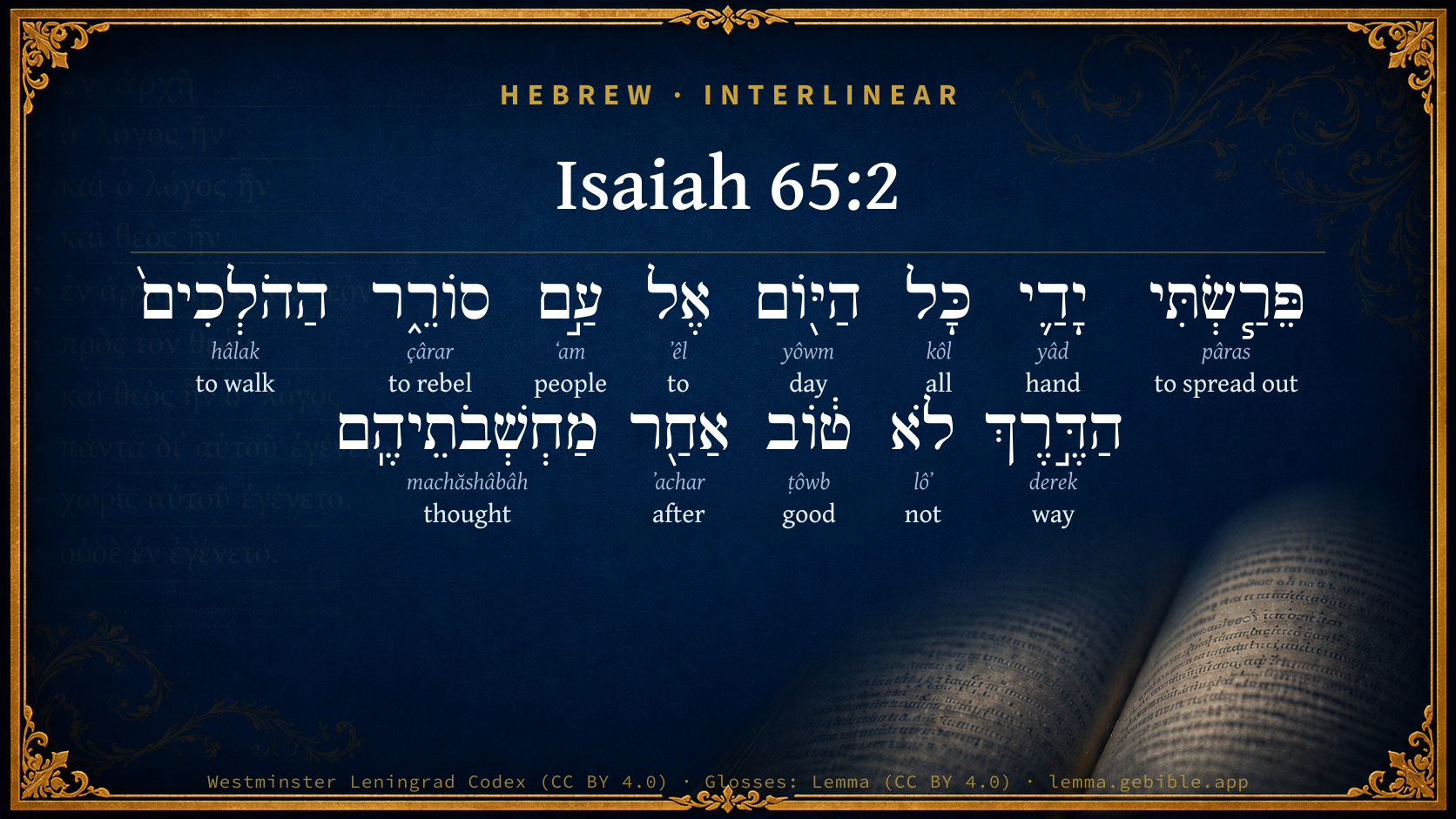
Hebrew (Westminster Leningrad Codex) Isaiah 65:2 appears in the Hebrew Old Testament. The text above is from the Westminster Leningrad Codex. Each word links to its Strong’s number, a concise gloss, and parsing drawn from the Open Scriptures Hebrew Bible morphology. Click any word for its full Brown-Driver-Briggs (BDB) entry.
Download image
Cite this verse

Isaiah 65:2 (World English Bible). Public Domain. Lemma interlinear Bible study tool, https://lemma.gebible.app/v/isaiah/65/2.

Show BibTeX & RIS
BibTeX
RIS
English Translation
I have spread out my hands all the day to a rebellious people, who walk in a way that is not good, after their own thoughts;
World English Bible · Public Domain
Download a study sheet

One document with this verse’s original text, its word-by-word gloss line, the meaning frame, cross-references with their text, attributed commentary, and full source and license credits — printable, and it pastes into notes with its structure intact.

This verse Autodidact and up

Study sheet (.html) Plain text (.txt)

A passage Seminary Student

Up to 50 verses in one chapter. A passage sheet keeps up to 6 commentary sources and 12 cross-references per verse, in the order this page ranks them, and says so on the sheet whenever that leaves anything out. Ask for a single verse and you get the Autodidact verse sheet above.

Everything on this page stays free to read, with no account — the sheet is a download of what is already on screen, not access to it.

Want to remove ads? Support Godless Engineer
Compare translations 3

The same verse in 3 English versions, stacked beneath the original-language interlinear above. Click any original word for its lexicon entry.

Each is an independent rendering of the whole verse — the interlinear is not word-aligned to these translations.

Highlighted words mark where these versions differ — a whole-verse word diff, not a word-by-word alignment.

  • World English Bible Public Domain
    I have spread out my hands all the day to a rebellious people, who walk in a way that is not good, after their own thoughts;
  • King James Version Public Domain
    I have spread out my hands all the day unto a rebellious people, which walketh in a way that was not good, after their own thoughts;
  • unfoldingWord Literal Text CC BY-SA 4.0
    I spread out my hands all of the day to a rebelling people, ones walking a way not good, after their thoughts,

unfoldingWord Literal Text — © unfoldingWord, licensed CC BY-SA 4.0. Word-aligned USFM3 via Door43 (git.door43.org/unfoldingWord/en_ult).

Versions to compare (up to 4)

3 of 4 selected

Show all 18 translations

Every available English version of this verse, each an independent rendering of the whole verse.

  • World English Bible Public Domain
    I have spread out my hands all the day to a rebellious people, who walk in a way that is not good, after their own thoughts;
  • Berean Standard Bible Public Domain
    All day long I have held out My hands to an obstinate people who walk in the wrong path, who follow their own imaginations,
  • Majority Standard Bible Public Domain
    All day long I have held out My hands to an obstinate people who walk in the wrong path, who follow their own imaginations,
  • King James Version Public Domain
    I have spread out my hands all the day unto a rebellious people, which walketh in a way that was not good, after their own thoughts;
  • American Standard Version (1901) Public Domain
    I have spread out my hands all the day unto a rebellious people, that walk in a way that is not good, after their own thoughts;
  • Revised Version (1885) Public Domain
    I have spread out my hands all the day unto a rebellious people, which walketh in a way that is not good, after their own thoughts;
  • Geneva Bible (1599) Public Domain
    I haue spred out mine handes all the day vnto a rebellious people, which walked in a way that was not good, euen after their owne imaginations:
  • Douay-Rheims (1899) Public Domain
    I have spread forth my hands all the day to an unbelieving people, who walk in a way that is not good after their own thoughts.
  • Young's Literal Translation Public Domain
    I have spread out My hands all the day Unto an apostate people, Who are going in the way not good after their own thoughts.
  • Literal Standard Version CC BY-SA 4.0
    I have spread out My hands all the day || To an apostate people, || Who are going in the way [that is] not good, || After their own thoughts.
  • Unlocked Literal Bible CC BY-SA 4.0
    I have spread out my hands all day to a stubborn people, who walk in a way that is not good, who have walked after their own thoughts and plans!
  • unfoldingWord Literal Text CC BY-SA 4.0
    I spread out my hands all of the day to a rebelling people, ones walking a way not good, after their thoughts,
  • Darby Bible Public Domain
    I have stretched out my hands all the day unto a rebellious people, who walk in a way not good, after their own thoughts;
  • World Messianic Bible Public Domain
    I have spread out my hands all day to a rebellious people, who walk in a way that is not good, after their own thoughts;
  • Webster's Bible Public Domain
    I have spread out my hands all the day to a rebellious people, which walketh in a way that is not good, after their own thoughts;
  • Free Bible Version CC BY-SA 4.0
    I spread out my hands all day long, pleading with a stubborn people who follow bad ways, doing whatever they choose.
  • Bible in Basic English Public Domain
    All day my hands have been stretched out to an uncontrolled people, who go in an evil way, after the purposes of their hearts;
  • JPS Tanakh (1917) Public Domain
    I have spread out My hands all the day unto a rebellious people, that walk in a way that is not good, after their own thoughts;

Literal Standard Version (2020), Covenant Press — licensed CC BY-SA 4.0. Text via the HelloAO Bible API (eBible.org). Unlocked Literal Bible (unfoldingWord) — licensed CC BY-SA 4.0. Text via the HelloAO Bible API (eBible.org). unfoldingWord Literal Text — © unfoldingWord, licensed CC BY-SA 4.0. Word-aligned USFM3 via Door43 (git.door43.org/unfoldingWord/en_ult). Free Bible Version, Dr. Jonathan Gallagher — licensed CC BY-SA 4.0. Text via the HelloAO Bible API (eBible.org).

Word by word

More ways to search: Search by grammar → Find every occurrence → Compare this word →

Practice this passage: Drill this verse → Learn its vocabulary →

סוֹרֵ֑ר
çârar
H5637
“rebelling”
Verb, Qal, Participle Active, Masculine, Singular, Absolute
Part of Speech
Verb
Stem
Qal
Form
Participle Active
Gender
Masculine
Number
Singular
State
Absolute
Full BDB Definition

Origin: a primitive root

TWOT: 1549

to rebel, be stubborn, be rebellious, be refractory - (Qal) - to be stubborn - stubborn, rebel (substantive)
  1. פֵּרַ֧שְׂתִּי pâras H6566 “to spread out” Verb, Piel, Perfect, 1st Person, Common, Singular
  2. יָדַ֛י yâd H3027 “hands · my” Noun, Common, Both, Dual, Construct + Suffix, Personal, 1st Person, Common, Singular
  3. כָּל kôl H3605 “all of” Noun, Common, Masculine, Singular, Construct
  4. הַיּ֖וֹם yôwm H3117 “the · day” Particle, Definite Article + Noun, Common, Masculine, Singular, Absolute
  5. אֶל ʼêl H413 “to” Preposition
  6. עַ֣ם ʻam H5971 “people” Noun, Common, Masculine, Singular, Absolute
  7. הַהֹלְכִים֙ hâlak H1980 “the · walking” Particle, Definite Article + Verb, Qal, Participle Active, Masculine, Plural, Absolute
  8. הַדֶּ֣רֶךְ derek H1870 “the · way” Particle, Definite Article + Noun, Common, Both, Singular, Absolute
  9. לֹא lôʼ H3808 “not” Particle, Negative
  10. ט֔וֹב ṭôwb H2896 “good” Adjective, Adjective, Masculine, Singular, Absolute
  11. אַחַ֖ר ʼachar H310 “after” Preposition
  12. מַחְשְׁבֹתֵיהֶֽם machăshâbâh H4284 “thoughts · their” Noun, Common, Feminine, Plural, Construct + Suffix, Personal, 3rd Person, Masculine, Plural

About this verse

These counts appear in no published source. They are computed here, from the morphology-tagged text and Lemma’s own curated glosses. What Lemma adds →

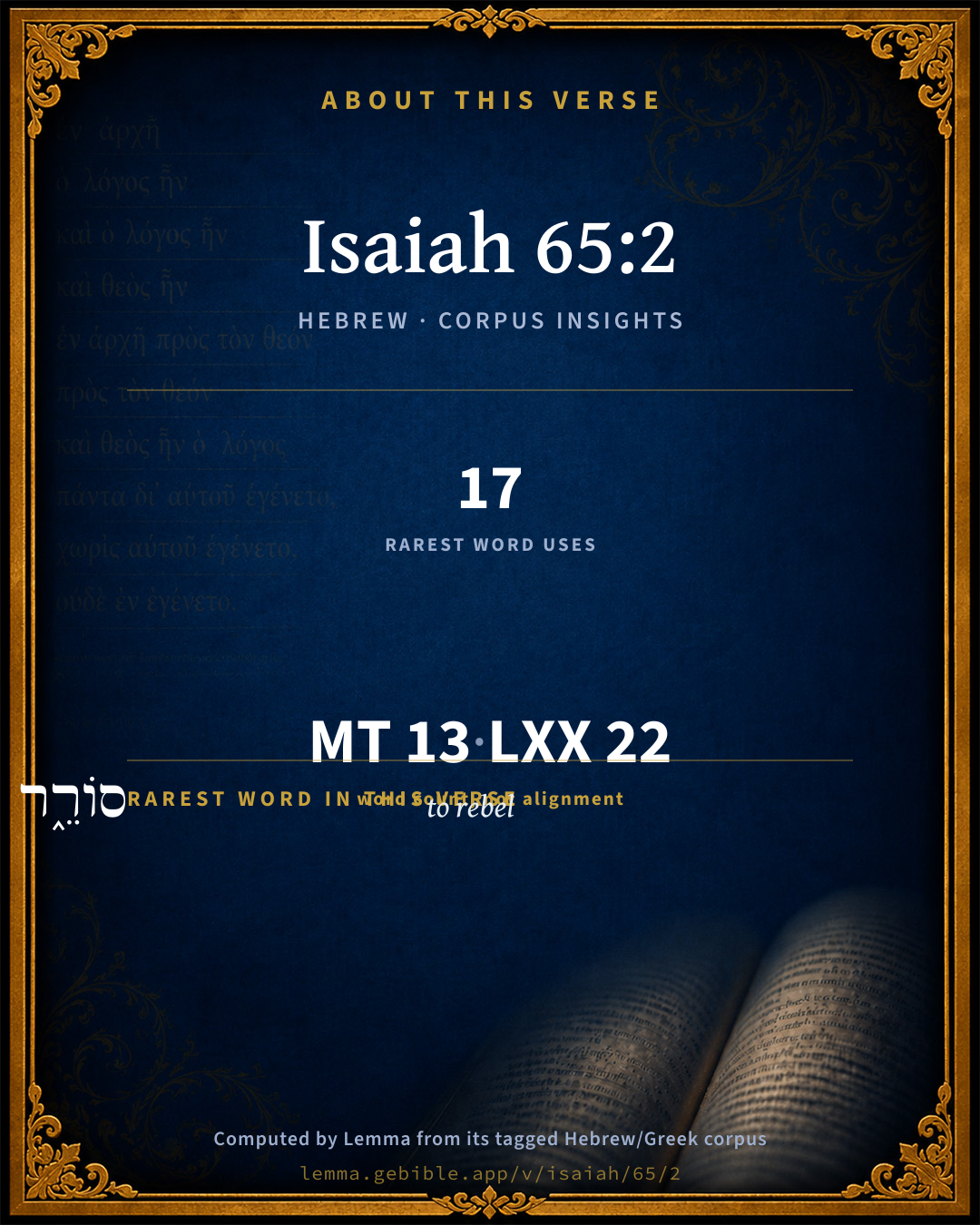
13
words
13
distinct lemmas
Prophets
section

Notable vocabulary

The rarest word here is סוֹרֵ֑ר to rebel H5637 — appearing just 17 times in the whole Hebrew Bible.

Shared distinctive vocabulary

סוֹרֵ֑ר to rebel H5637 occurs in 16 verses of the Hebrew Bible. Also found in:

Grammatical profile

  • 3 verbs
  • 6 nouns
  • 1 adjective
  • 2 prepositions
  • 1 particle

Verb forms

  • פֵּרַ֧שְׂתִּי Piel · Perfect
  • סוֹרֵ֑ר Qal · Participle Active
  • הַהֹלְכִים֙ Qal · Participle Active

Hebrew & Septuagint length

In English translation the verse runs 26 words from the Hebrew and 29 from the Septuagint (LXX English) — closely comparable.

A rough comparison of the two English renderings, which tokenize alike — not a word-level alignment.

Word counts can differ between the Hebrew and the Greek without any difference in meaning — e.g. the Hebrew direct-object marker אֵת has no separate Greek word, and Greek often adds the article ὁ.

In the original languages it is 13 Hebrew tokens and 22 Greek tokens — but the two are counted differently (Hebrew bundles its prefixes and suffixes into one token; the Greek is in lemma form), so that isn’t a like-for-like length.

Cross-references

30

Topical passages linked to Isaiah 65:2 in the Treasury of Scripture Knowledge — connected by theme and wording, ordered by reader-vote popularity; previews shown in the World English Bible.

  • Romans 10:21 But as to Israel he says, "All day long I stretched out my hands to a disobedient and contrary people."
  • Proverbs 1:24 Because I have called, and you have refused; I have stretched out my hand, and no one has paid attention;
  • Jeremiah 4:14 Jerusalem, wash your heart from wickedness, that you may be saved. How long shall your evil thoughts lodge within you?
  • Psalms 81:11–12 But my people didn't listen to my voice. Israel desired none of me.
  • Isaiah 1:2 Hear, heavens, And listen, earth; for Yahweh has spoken: I have nourished and brought up children, And they have rebelled against me.
  • Isaiah 63:10 But they rebelled, and grieved his holy Spirit: therefore he was turned to be their enemy, [and] himself fought against them.
  • Jeremiah 5:23 But this people has a revolting and a rebellious heart; they are revolted and gone.
  • Jeremiah 7:24 But they didn't listen nor turn their ear, but walked in [their own] counsels [and] in the stubbornness of their evil heart, and went backward, and not forward.
  • Matthew 23:37 "Jerusalem, Jerusalem, who kills the prophets, and stones those who are sent to her! How often would I have gathered your children together, even as a hen gathers her chickens under her wings, and you would not!
  • Luke 13:34 "Jerusalem, Jerusalem, that kills the prophets, and stones those who are sent to her! How often I wanted to gather your children together, like a hen gathers her own brood under her wings, and you refused!
  • Luke 19:41–42 When he drew near, he saw the city and wept over it,
  • Acts 7:51–52 "You stiff-necked and uncircumcised in heart and ears, you always resist the Holy Spirit! As your fathers did, so you do.
  • Romans 2:5 But according to your hardness and unrepentant heart you are treasuring up for yourself wrath in the day of wrath, revelation, and of the righteous judgment of God;
  • Genesis 6:5 Yahweh saw that the wickedness of man was great in the earth, and that every imagination of the thoughts of his heart was only evil continually.
  • Deuteronomy 9:7 Remember, don't forget, how you provoked Yahweh your God to wrath in the wilderness: from the day that you went forth out of the land of Egypt, until you came to this place, you have been rebellious against Yahweh.
  • Deuteronomy 29:19 and it happen, when he hears the words of this curse, that he bless himself in his heart, saying, I shall have peace, though I walk in the stubbornness of my heart, to destroy the moist with the dry.
  • Deuteronomy 31:27 For I know your rebellion, and your stiff neck: behold, while I am yet alive with you this day, you have been rebellious against Yahweh; and how much more after my death?
  • Psalms 36:4 He plots iniquity on his bed. He sets himself in a way that is not good; He doesn't abhor evil.
  • Isaiah 1:23 Your princes are rebellious, and companions of thieves. Everyone loves bribes, and follows after rewards. They don't judge the fatherless, Neither does the cause of the widow come to them.
  • Isaiah 66:18 For I [know] their works and their thoughts: [the time] comes, that I will gather all nations and languages; and they shall come, and shall see my glory.
  • Jeremiah 3:17 At that time they shall call Jerusalem the throne of Yahweh; and all the nations shall be gathered to it, to the name of Yahweh, to Jerusalem: neither shall they walk any more after the stubbornness of their evil heart.
  • Ezekiel 2:3–7 He said to me, Son of man, I send you to the children of Israel, to nations that are rebellious, which have rebelled against me: they and their fathers have transgressed against me even to this very day.
  • Matthew 15:19 For out of the heart come forth evil thoughts, murders, adulteries, sexual sins, thefts, false testimony, and blasphemies.
  • Numbers 15:39 and it shall be to you for a fringe, that you may look on it, and remember all the commandments of Yahweh, and do them; and that you not follow after your own heart and your own eyes, after which you use to play the prostitute;
  • Proverbs 16:29 A man of violence entices his neighbor, And leads him in a way that is not good.
  • Isaiah 55:7 let the wicked forsake his way, and the unrighteous man his thoughts; and let him return to Yahweh, and he will have mercy on him; and to our God, for he will abundantly pardon.
  • Isaiah 59:7–8 Their feet run to evil, and they make haste to shed innocent blood: their thoughts are thoughts of iniquity; desolation and destruction are in their paths.
  • Matthew 12:33–34 "Either make the tree good, and its fruit good, or make the tree corrupt, and its fruit corrupt; for the tree is known by its fruit.
  • James 1:14–15 But each one is tempted, when he is drawn away by his own lust, and enticed.
  • 1 Thessalonians 2:15–16 who killed both the Lord Jesus and their own prophets, and drove us out, and didn't please God, and are contrary to all men;

Cross-references courtesy of OpenBible.info (CC BY 4.0).

Hebrew and Greek witnesses Masoretic Hebrew ↔ Greek Septuagint

The same verse in the two great witnesses to the Old Testament, shown verse-for-verse.

These are two independent witnesses, not word-aligned to each other, and the Septuagint is shown in lemma (dictionary) form.

Hebrew Isaiah 65:2 Masoretic · Westminster Leningrad Codex

פֵּרַ֧שְׂתִּי יָדַ֛י כָּל הַיּ֖וֹם אֶל עַ֣ם סוֹרֵ֑ר הַהֹלְכִים֙ הַדֶּ֣רֶךְ לֹא ט֔וֹב אַחַ֖ר מַחְשְׁבֹתֵיהֶֽם

I have spread out my hands all the day to a rebellious people, who walk in a way that is not good, after their own thoughts;

World English Bible · Public Domain

Greek LXX Isaiah 65:2 Septuagint · lemma form

ἐκπετάνννυμι ὁ χείρ ἐγώ ὅλος ὁ ἡμέρα πρός λαός ἀπειθέω καί ἀντιλέγω ὅς οὐ πορεύομαι ὁδός ἀληθινός ἀλλά ὀπίσω ὁ ἁμαρτία αὐτός

I have stretched forth my hands all day to a disobedient and gainsaying people, to them that walked in a way that was not good, but after their sins.

LXX2012 (modern English Septuagint) · Public Domain

On this verse, The Cambridge Bible for Schools and Colleges discusses the Septuagint’s reading. Read the note in Commentary ↓

Hebrew: Westminster Leningrad Codex (CC BY 4.0). Greek: Septuagint (public domain); English from LXX2012 (modern English Septuagint) (Public Domain). How the Septuagint differs from the Hebrew →

Targum (Aramaic paraphrase)

1

The Targum is the ancient Jewish Aramaic paraphrase of the Hebrew Scriptures — an interpretive translation, not the Hebrew text itself. Onkelos (literal) and Pseudo-Jonathan (expansive) render the Torah, and Jonathan the Prophets. Coverage is partial: where no permissively-licensed English translation exists for a verse, only the Aramaic is shown. This is verse-level text, not a word-by-word alignment to the Hebrew.

  1. Targum Jonathan Prophets (Joshua–Malachi)
    שְׁלָחִית נְבִיאֵי כָּל יוֹמָא לְעַמָא מְסָרְבָנָא דְאָזְלִין בְּאוֹרַח דְלָא תַקְנָא בָּתַר עֶשְׁתּוֹנֵיהוֹן:

    I have sent my prophets every day unto a rebellious people, which walketh in a way which was not good, after their own thoughts;

    Targum Jonathan — Aramaic: “Mikraot Gedolot” (public domain). English: “Sefaria Community Translation” (CC0 1.0 (public-domain dedication)); “London "Chaldee Paraphrase," 1871” (public domain). Text via Sefaria.

Commentary

Notes on Isaiah 65:2 from classic Christian and Jewish commentators (each source and its license shown beneath its notes). The classic Christian expositions comment on the surrounding passage and are grouped to its opening verse, so a note may address several verses; the Jewish commentaries on the Tanakh (Rashi and others) are per-verse, so they appear only where the commentator wrote on this verse.

Lemma curates 59 commentaries, every one of them public domain or Creative Commons licensed, each selected and text-cleaned for this edition rather than reprinted as found. About our sources →

The Cambridge Bible for Schools and Colleges

gen. ed. J. J. S. Perowne

2. spread out mine hands] The attitude of supplication; cf. Pro_1:24.

a rebellious (refractory, Hos_4:16) people] LXX. has; λαὸν ἀπειθοῦντα καὶ ἀντιλέγοντα; and so the citation Rom_10:21.

a way that was not good] “A not-good way” (litotes). The same phrase in Psa_36:4; Pro_16:29.

The people referred to here are necessarily the same as those described in the sequel. If these be the paganised Israelites of the North who had not shared the Captivity the two verses reveal an important fact not otherwise recorded. The prophetic representatives of Jehovah in the post-exilic community must, in that case, have sought to win over these outcasts to the pure worship of Jehovah, and the acceptance of the Law. This might appear to be inconsistent with what is told in Ezr_4:1-3, where the friendly advances of the Samaritans are met with a stern refusal on the part of the Jews. But the contradiction is perhaps only apparent. The Jewish leaders might very well have declined the co-operation of these people while they maintained their impure religion, and at the same time been eager to incorporate them in the Theocracy on the terms offered to foreigners in ch. Isa_56:6 f.

In Rom_10:20-21, St Paul quotes parts of these verses, applying Isa_65:1 to the conversion of the Gentiles and Isa_65:2 to the unbelief of Israel. Possibly this exegesis may have been traditional in the Apostle’s time (Delitzsch), although the primary sense of the passage is that the same persons are referred to throughout.

The Cambridge Bible for Schools and Colleges (gen. ed. J. J. S. Perowne; Cambridge University Press, 1878–1918) — public domain. Text from a community e-Sword module.

Trapp's Complete Commentary

John Trapp

Isa 65:2 I have spread out my hands all the day unto a rebellious people, which walketh in a way [that was] not good, after their own thoughts;

Ver. 2. I have spread out my hands.] As preachers use to do, {Pro 1:24 Act 26:1} or as those that invite and beckon others to themselves with the hand. See Mat 11:28.

Unto a rebellious people.] Whose destruction therefore is of themselves, since they will not be ruled, reclaimed.

After their own thoughts.] Which were evil, only evil, continually so. A toad may as easily spit a cordial, as a natural man think a good thought.

John Trapp, A Commentary or Exposition upon All the Books of the Old and New Testament (1647–1656) — public domain. Text from a community e-Sword module.

Joseph Benson's Commentary

Isa 65:2. I have spread out my hands — This is applied to the Jews, Rom 10:21. I have stretched out my hands, I have used all means to reduce them; I have stretched out the hands of a passionate orator, to persuade them; of a liberal benefactor, to load them with my benefits: this I have done continually, in the whole course of my providence with them. To a rebellious people — Yet they are a rebellious people. St. Paul expounds it by λαον απειθουντα και αντιλεγοντα, A people not persuaded, not believing, or, not obeying; but gainsaying, or, contradicting the word and will of God. Which walketh in a way that is not good — Less is expressed than is intended: the meaning is, in a way that is very bad. After their own thoughts — Or, as it is elsewhere expressed, after the imaginations of their hearts; a usual phrase to describe sin, especially in the matter of God’s worship. The Prophet Jeremiah expresses sin in this manner many times.

Joseph Benson's Commentary on the Old and New Testaments (1811–1818) — public domain. Text from a community e-Sword module.

Geneva Bible (1599)

Geneva Bible translators

He showeth that to delight in our own fantasies, is the declining from God and the beginning of all superstition and Idolatry.

He showeth the cause of the rejection of the Jews, because they would not obey him for any admonition of his Prophets, by whom he called them continually and stretched out his hand to draw them.

Geneva Bible (1599) marginal notes — public domain. Text via Bolls.life.

Jamieson, Fausset & Brown

Robert Jamieson, A. R. Fausset & David Brown

spread out . . . hands--inviting them earnestly (Pro 1:24).

all . . . day--continually, late and early (Jer 7:13).

rebellious people--Israel, whose rebellion was the occasion of God's turning to the Gentiles (Rom 11:11-12, Rom 11:15).

way . . . not good--that is, the very reverse of good, very bad (Eze 36:31).

Jamieson, Fausset & Brown — Commentary Critical and Explanatory on the Whole Bible (1871) — public domain (CC PDM 1.0). Text via the HelloAO Bible API.

Ellicott's Commentary for English Readers

(2) I have spread out my hands . . .—Here, of course, the words were meant for Israel, as St. Paul applies them. It may not be without interest to note the fact that the words stand over the portal of the Church of Santa Maria, which stands at the entrance of the Ghetto at Rome. Of how many churches at Rome and elsewhere might it not be said, “Thou art the man,” “The beam is in thine own eye”?

A Bible Commentary for English Readers, edited by Charles John Ellicott (1878–1897) — public domain. Text from a community e-Sword module.

John Gill's Exposition

I have spread out mine hands all the day unto a rebellious people,.... Meaning Israel, as the apostle explains it, Rom 10:21, whom he calls a "disobedient and gainsaying people"; who believed not in Christ, obeyed not his Gospel, but contradicted and blasphemed it; and were rebellious against him, would not have him to reign over them, nor submit to his ordinances; though he most affectionately invited them, earnestly pressed and urged them, and that daily and frequently, to attend his ministry; and used all human methods to gain audience of them, and acceptance with them, but all to no purpose; see Mat 23:37, they remained obstinate and inflexible, and so they did under the ministry of his apostles; for, notwithstanding their ill usage of him, he ordered the Gospel to be first preached to them, as it was, till they treated it with such indignity and contempt, that the apostles turned away from them to the Gentiles, as they were bid; see Act 13:46. The Targum is,

"I sent my prophets every day, &c.''

which walketh in a way that was not good, after their own thoughts; in their own way, of their own devising, choosing, and approving, and which was a wicked one; and after their own imaginations and inventions; after the traditions of the elders the doctrines and commandments of men; and after a righteousness of their own, which they sought by the works of the law, and so submitted not to, but rejected the righteousness of Christ.

John Gill's Exposition of the Whole Bible (1746–1763) — public domain (CC PDM 1.0). Text via the HelloAO Bible API.

Albert Barnes' Notes on the Bible

I have spread out my hands - To spread out the hands is an action denoting invitation or entreaty Pro 1:24. The sense is, that God had invited the Jews constantly to partake of his favors, but they had been rebellious, and had rejected his offers.

All the day - I have not ceased to do it. The Chaldee renders this, ‘I sent my prophets all the day to a rebellious people.’

Unto a rebellious people - (See the notes at Isa 1:2). Paul renders this, Πρὸς λαον ἀπειθοῦντα καὶ ἀντιλέγοντα Pros laon apeithounta kai antilegonta - ‘Unto a disobedient and gainsaying people;’ but the sense is substantially preserved.

Which walketh - In what way they did this, the prophet specifies in the following verse. This is the general reason why he had rejected them, and why he had resolved to make the offer of salvation to the Gentiles. This, at first, was a reason for the calamities which God had brought upon the nation in the suffering of the exile, but it also contains a general principle of which that was only one specimen. They had been rebellious, and God had brought this calamity upon them. It would be also true in future times, that he would reject them and offer salvation to the pagan world, and would be found by those who had never sought for him or called on his name.

Albert Barnes' Notes on the Bible (1834–1885) — public domain. Text from a community e-Sword/MySword module.

Matthew Poole's English Annotations

I have spread out my hands; applied to the Jews, Rom 10:21, I have stretched out my hands; that is, I have used all probable means to reduce them, I have stretched out the hands of a passionate orator to persuade them, of a tender mother to protect and defend them, of a liberal benefactor to lead them with my benefits; this I have done continually in the whole course of my providence with them, yet they are a rebellious people. Paul expounded it by, απειθουντα και αντιγεγοντα, a people not persuaded, not believing, but contradicting the will of God.

Which walketh in a way that was not good; that term, is not good, often signifies what is very bad: see 1Sa 2:21 Pro 24:23; 28:21; Psa 36:4. Though all sins be not equal, yet what is not good is bad.

After their own thoughts: what is here called after their own thoughts, is elsewhere called a walking after the imaginations of their hearts; an ordinary phrase, by which sins (especially sins in the matter of the worship of God) are expressed. Eight times, in the prophet Jeremiah sinning is thus expressed, Jer 3:17; 7:24; 9:14; 11:8; 13:10; 16:12; 18:12; 23:17; so also Deu 29:19. Errors in matter of worship are ordinarily thus expressed, certainly to let us know that all worship must be according to God’s revealed will, and of such errors this text seemeth, by what followeth, to speak; though indeed the reason of all sin is men’s fondness of their own imaginations in opposition to God’s revealed will, whence it is that self-denial is made the law of a discipleship to Christ.

Matthew Poole's English Annotations on the Holy Bible (1683–1685) — public domain. Text from a community e-Sword/MySword module.

The Pulpit Commentary

I have spread out my hands. Not exactly in prayer, but in expostulation. (comp. Pro_1:24, "I have stretched out my hand," where the verb in the Hebrew is the same) All the day; or, all day long, Rom_10:21; i.e. continually, day after day, for years nay, for centuries. A rebellions people. (comp. Isa_30:1; and see also Isa_1:4, 23 Hos_4:16 Jer_5:23 Jer_6:28) The "rebellions people" (am sorer ) is undoubtedly Israel. In a way that was not good; rather, in the way that is not good; i.e. the "way of sinners" (Psa_1:1) the "way that leadeth to destruction". (Mat_7:13)

The Pulpit Commentary (1880–1919), ed. H.D.M. Spence-Jones & Joseph S. Exell — public domain. Text from a community e-Sword module.

John Wesley's Explanatory Notes

I have spread - Applied to the Jews, Rom. x, 21. I have stretched out my hands, I have used all means to reduce them, I have stretched out the hands of a passionate orator to persuade them, of a liberal benefactor to load them with my benefits; this I have done continually in the whole course of my providence with them.

John Wesley, Explanatory Notes Upon the Whole Bible (1754–1765) — public domain. Text via the GEBible commentary corpus.

J. A. Alexander on Isaiah

Joseph Addison Alexander

“I have spread (or stretched) out my hands all the day (or every day) to a rebellious people, those going the way not good, after their own thoughts (or designs).” The gesture mentioned in the first clause is variously explained as a gesture of simple calling, of instruction, of invitation, of persuasion. All agree that it implies God’s gracious offer of Himself and of His favor to the people. Whether all the day or every day be the correct translation, the idea meant to be conveyed is evidently that of frequent repetition, or rather of unremitting constancy. The rebellious people is admitted upon all hands to be Israel. The last clause is an amplification and explanatory paraphrase of the first. ‘Going’ and ‘way’ are common figures for the course of life. ‘A way not good’ is a litotes or meiosis for a bad or for the worst way. (See Psa 36:4; Eze 36:31). Thoughts, not opinions merely, but devices and inventions of wickedness. (See above, on Isa 55:7). With this description compare that of Moses (Deu 32:5).

Joseph Addison Alexander, The Prophecies of Isaiah (1846–1847; New York: Scribner, 1870–1878) — public domain. Text from a community e-Sword module.

Rashi

Rabbi Shlomo Yitzchaki (Rashi)

I spread out My hands in order to accept them with repentance.

contrary Heb. סוֹרֵר, turning away from the road.

Rashi on the Tanakh — English translations: “The Judaica Press complete Tanach with Rashi, translated by A. J. Rosenberg” (CC BY 4.0); “Pentateuch with Rashi's commentary by M. Rosenbaum and A.M. Silbermann, 1929-1934” (public domain); “The Metsudah Tanach series, Lakewood, N.J” (CC BY 4.0); and “The Book of Joshua, Metsudah Publications, 1997” (CC BY 4.0). Text via Sefaria.

Ibn Ezra

Rabbi Abraham ibn Ezra

I have spread out my hands, etc. According to R. Moses Hakkohen, the preceding verse refers to all nations, as if God said, Even to nations that are not called by my name, I was accessible, but as regards my people I have spread my hands to receive them.

הדרך לא טוב In a way that is not good. Supply דרך way before לא טוב not good; comp. טוב ורע עץ הדעת דעת═עץ הדעת טוב ורע the tree of knowledge of good and evil (Gen. 2:9)

Ibn Ezra on the Tanakh — English translations: “Sefaria Community Translation” (CC0 1.0 (public-domain dedication)); “Yalkut, Sifsei Chachomim Chumash, Metsudah Publications, 2009” (CC BY 4.0); and “Commentary of Ibn Ezra on Isaiah - trans. by M. Friedlander, 1873” (public domain). Text via Sefaria.

Lesson kit

Teaching starters — assembled from the data on this page, not authored interpretation. Every prompt links to the verse data it draws on. Edit before teaching.

Isaiah, in the Prophets, opens this verse with 13 words (13 distinct Hebrew lemmas). Its most distinctive word is çârar (“to rebel”). A historical commentator’s framing appears above. Read the whole chapter for the surrounding context.

Discussion questions

  1. How does “to rebel” (çârar) shape what this verse is saying?
  2. Deuteronomy 21:18 shares the word «to rebel» with this verse. How do the two illuminate each other?
  3. The translations on this page render this verse differently — a whole-verse word diff, not a word-by-word alignment. What might account for the different wordings?
  4. The verb «פֵּרַ֧שְׂתִּי» is Piel Perfect. How does its form color the action?
  5. Reading how The Cambridge Bible for Schools and Colleges and Trapp's Complete Commentary read this verse, where do the two commentators agree and where do they part?

Things to notice

Reading settings

Reading text

Shown beneath each verse's original-language words.

Old Testament
Old Testament edition

Read the OT as the Masoretic Hebrew (MT) or the Greek Septuagint (LXX).

English shown for the Greek Septuagint (in the Hebrew ↔ Greek comparison).

Comparing translations? Open the Compare panel on any verse page to stack up to four side by side.