
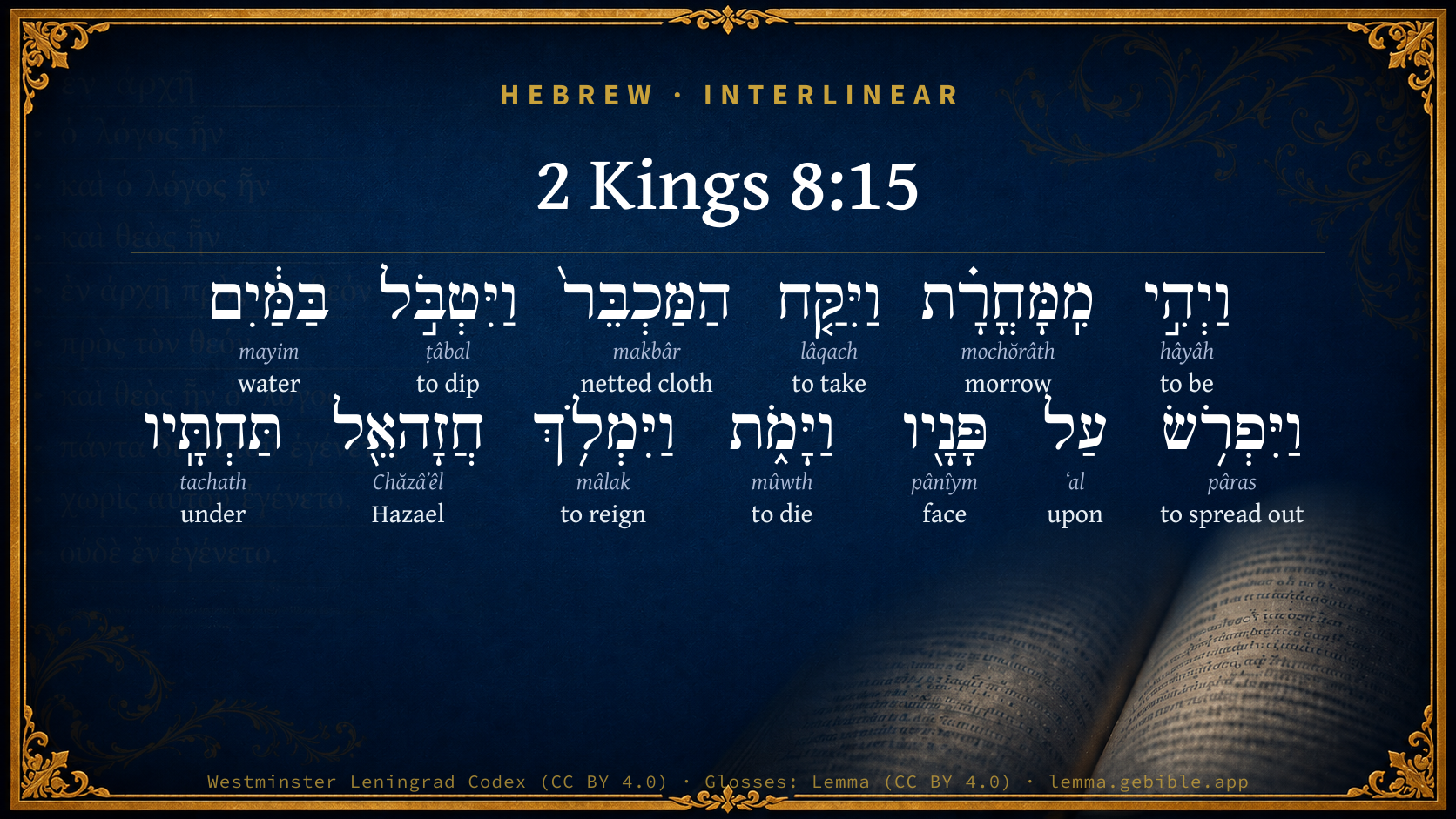
2 Kings 8:15

Hebrew (Westminster Leningrad Codex) 2 Kings 8:15 appears in the Hebrew Old Testament. The text above is from the Westminster Leningrad Codex. Each word links to its Strong’s number, a concise gloss, and parsing drawn from the Open Scriptures Hebrew Bible morphology. Click any word for its full Brown-Driver-Briggs (BDB) entry.
Download image
Cite this verse

2 Kings 8:15 (World English Bible). Public Domain. Lemma interlinear Bible study tool, https://lemma.gebible.app/v/2-kings/8/15.

Show BibTeX & RIS
BibTeX
RIS
English Translation
It happened on the next day, that he took the coverlet, and dipped it in water, and spread it on his face, so that he died: and Hazael reigned in his place.
World English Bible · Public Domain
Highlights
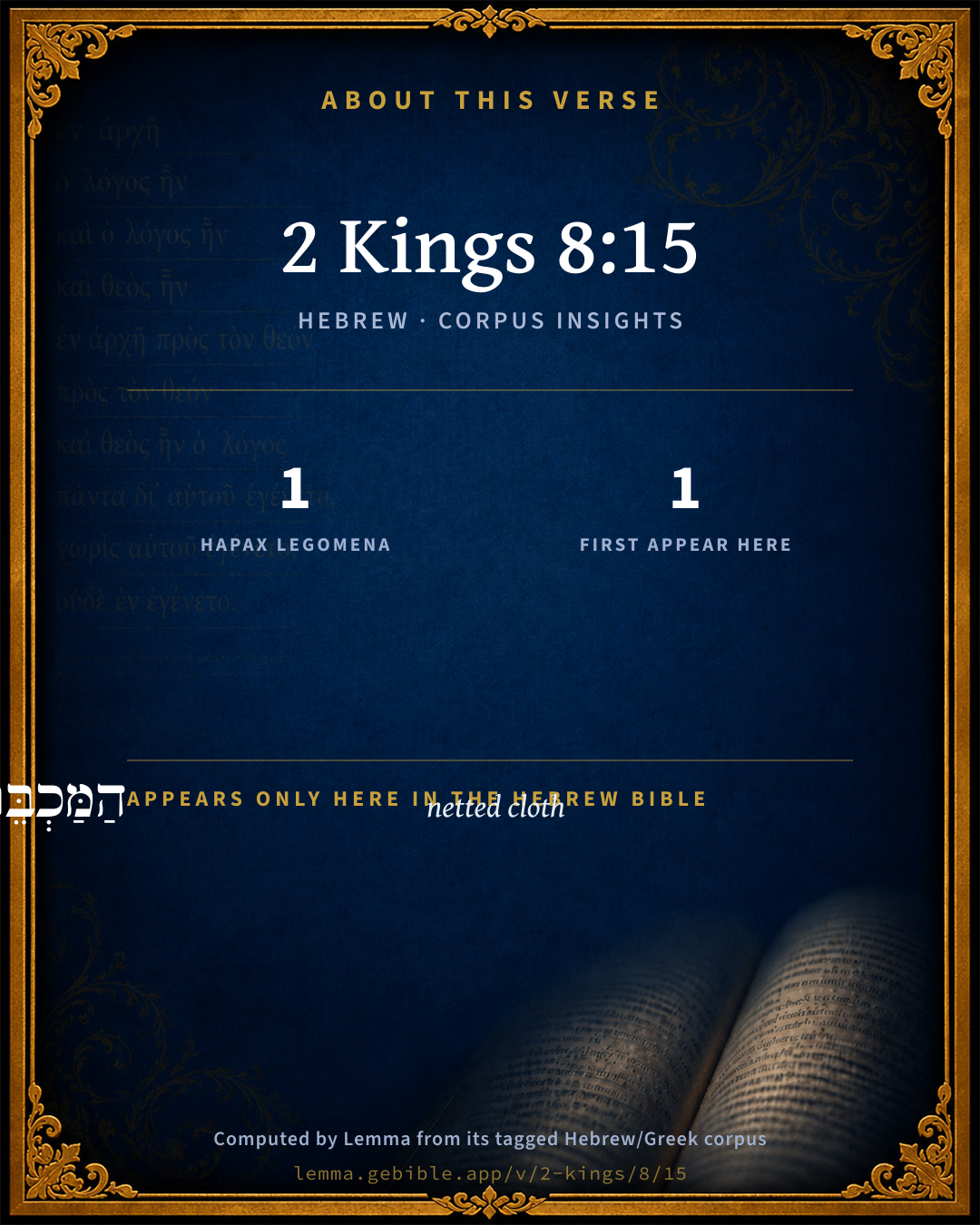
  • 1 hapax legomenon — only here in the Hebrew Bible
  • 1 first appearance in the Hebrew Bible
Full analysis ↓
Download a study sheet

One document with this verse’s original text, its word-by-word gloss line, the meaning frame, cross-references with their text, attributed commentary, and full source and license credits — printable, and it pastes into notes with its structure intact.

This verse Autodidact and up

Study sheet (.html) Plain text (.txt)

A passage Seminary Student

Up to 50 verses in one chapter. A passage sheet keeps up to 6 commentary sources and 12 cross-references per verse, in the order this page ranks them, and says so on the sheet whenever that leaves anything out. Ask for a single verse and you get the Autodidact verse sheet above.

Everything on this page stays free to read, with no account — the sheet is a download of what is already on screen, not access to it.

Want to remove ads? Support Godless Engineer
Compare translations 3

The same verse in 3 English versions, stacked beneath the original-language interlinear above. Click any original word for its lexicon entry.

Each is an independent rendering of the whole verse — the interlinear is not word-aligned to these translations.

Highlighted words mark where these versions differ — a whole-verse word diff, not a word-by-word alignment.

  • World English Bible Public Domain
    It happened on the next day, that he took the coverlet, and dipped it in water, and spread it on his face, so that he died: and Hazael reigned in his place.
  • King James Version Public Domain
    And it came to pass on the morrow, that he took a thick cloth, and dipped it in water, and spread it on his face, so that he died: and Hazael reigned in his stead.
  • unfoldingWord Literal Text CC BY-SA 4.0
    And it happened on the next day that he took a cloth and dipped in water and spread over his face, and he died. And Hazael reigned in his place.

unfoldingWord Literal Text — © unfoldingWord, licensed CC BY-SA 4.0. Word-aligned USFM3 via Door43 (git.door43.org/unfoldingWord/en_ult).

Versions to compare (up to 4)

3 of 4 selected

Show all 18 translations

Every available English version of this verse, each an independent rendering of the whole verse.

  • World English Bible Public Domain
    It happened on the next day, that he took the coverlet, and dipped it in water, and spread it on his face, so that he died: and Hazael reigned in his place.
  • Berean Standard Bible Public Domain
    But the next day Hazael took a thick cloth, dipped it in water, and spread it over the king’s face. So Ben-hadad died, and Hazael reigned in his place.
  • Majority Standard Bible Public Domain
    But the next day Hazael took a thick cloth, dipped it in water, and spread it over the king’s face. So Ben-hadad died, and Hazael reigned in his place.
  • King James Version Public Domain
    And it came to pass on the morrow, that he took a thick cloth, and dipped it in water, and spread it on his face, so that he died: and Hazael reigned in his stead.
  • American Standard Version (1901) Public Domain
    And it came to pass on the morrow, that he took the coverlet, and dipped it in water, and spread it on his face, so that he died: and Hazael reigned in his stead.
  • Revised Version (1885) Public Domain
    And it came to pass on the morrow, that he took the coverlet, and dipped it in water, and spread it on his face, So that he died: and Hazael reigned in his stead.
  • Geneva Bible (1599) Public Domain
    And on the morow he tooke a thick cloth and dipt in it water, and spread it on his face, and hee dyed: and Hazael reigned in his stead.
  • Douay-Rheims (1899) Public Domain
    And on the next day he took a blanket, and pouted water on it, and spread it upon his face: and he died, and Hazael reigned in his stead.
  • Young's Literal Translation Public Domain
    And it cometh to pass on the morrow, that he taketh the coarse cloth, and dippeth in water, and spreadeth on his face, and he dieth, and Hazael reigneth in his stead.
  • Literal Standard Version CC BY-SA 4.0
    And it comes to pass on the next day, that he takes the coarse cloth, and dips [it] in water, and spreads [it] on his face, and he dies, and Hazael reigns in his stead.
  • Unlocked Literal Bible CC BY-SA 4.0
    Then the next day Hazael took the blanket and dipped it in water, and spread it on Ben Hadad's face so that he died. Then Hazael became king in his place.
  • unfoldingWord Literal Text CC BY-SA 4.0
    And it happened on the next day that he took a cloth and dipped in water and spread over his face, and he died. And Hazael reigned in his place.
  • Darby Bible Public Domain
    And it came to pass the next day, that he took the coverlet and dipped [it] in water, and spread it over his face, so that he died; and Hazael reigned in his stead.
  • World Messianic Bible Public Domain
    On the next day, he took a thick cloth, dipped it in water, and spread it on the king’s face, so that he died. Then Hazael reigned in his place.
  • Webster's Bible Public Domain
    And it came to pass on the morrow, that he took a thick cloth, and dipped it in water, and spread it on his face, so that he died: and Hazael reigned in his stead.
  • Free Bible Version CC BY-SA 4.0
    But the following day Hazael took the bed cover, soaked it in water, and spread it over the king's face until he died. Then Hazael took over from him as king.
  • Bible in Basic English Public Domain
    Now on the day after, Hazael took the bed-cover, and making it wet with water, put it over Ben-hadad's face, causing his death: and Hazael became king in his place.
  • JPS Tanakh (1917) Public Domain
    And it came to pass on the morrow, that he took the coverlet, and dipped it in water, and spread it on his face, so that he died; and Hazael reigned in his stead.

Literal Standard Version (2020), Covenant Press — licensed CC BY-SA 4.0. Text via the HelloAO Bible API (eBible.org). Unlocked Literal Bible (unfoldingWord) — licensed CC BY-SA 4.0. Text via the HelloAO Bible API (eBible.org). unfoldingWord Literal Text — © unfoldingWord, licensed CC BY-SA 4.0. Word-aligned USFM3 via Door43 (git.door43.org/unfoldingWord/en_ult). Free Bible Version, Dr. Jonathan Gallagher — licensed CC BY-SA 4.0. Text via the HelloAO Bible API (eBible.org).

Word by word

More ways to search: Search by grammar → Find every occurrence → Compare this word →

Practice this passage: Drill this verse → Learn its vocabulary →

הַמַּכְבֵּר֙
makbâr
H4346
“the · netted cloth”
Particle, Definite Article + Noun, Common, Masculine, Singular, Absolute
Part of Speech
Particle + Noun
Type
Common
Gender
Masculine
Number
Singular
State
Absolute
Full BDB Definition

Origin: from H3527 in the sense of covering

TWOT: 948c

netted cloth or coverlet
  1. וַיְהִ֣י hâyâh H1961 “and · to be” Conjunction + Verb, Qal, Sequential Imperfect, 3rd Person, Masculine, Singular
  2. מִֽמָּחֳרָ֗ת mochŏrâth H4283 “from · morrow” Preposition + Noun, Common, Feminine, Singular, Absolute
  3. וַיִּקַּ֤ח lâqach H3947 “and · to take” Conjunction + Verb, Qal, Sequential Imperfect, 3rd Person, Masculine, Singular
  4. וַיִּטְבֹּ֣ל ṭâbal H2881 “and · to dip” Conjunction + Verb, Qal, Sequential Imperfect, 3rd Person, Masculine, Singular
  5. בַּמַּ֔יִם mayim H4325 “in/at the · water(s)” Preposition, Determined + Noun, Common, Masculine, Plural, Absolute
  6. וַיִּפְרֹ֥שׂ pâras H6566 “and · to spread out” Conjunction + Verb, Qal, Sequential Imperfect, 3rd Person, Masculine, Singular
  7. עַל ʻal H5921 “upon” Preposition
  8. פָּנָ֖יו pânîym H6440 “face(s) · his” Noun, Common, Both, Plural, Construct + Suffix, Personal, 3rd Person, Masculine, Singular
  9. וַיָּמֹ֑ת mûwth H4191 “and · to die” Conjunction + Verb, Qal, Sequential Imperfect, 3rd Person, Masculine, Singular
  10. וַיִּמְלֹ֥ךְ mâlak H4427 “and · to reign” Conjunction + Verb, Qal, Sequential Imperfect, 3rd Person, Masculine, Singular
  11. חֲזָהאֵ֖ל Chăzâʼêl H2371 “Hazael” Noun, Proper
  12. תַּחְתָּֽיו tachath H8478 “under · him” Preposition + Suffix, Personal, 3rd Person, Masculine, Singular

About this verse

These counts appear in no published source. They are computed here, from the morphology-tagged text and Lemma’s own curated glosses. What Lemma adds →

13
words
13
distinct lemmas
Historical
section

Notable vocabulary

1 hapax legomenon — a word that appears only here in the entire Hebrew Bible:

  • הַמַּכְבֵּר֙ netted cloth H4346

First appearance in Scripture

This word makes its first canonical appearance in the Hebrew Bible here:

  • הַמַּכְבֵּר֙ netted cloth H4346

Shared distinctive vocabulary

וַיִּטְבֹּ֣ל to dip H2881 occurs in 16 verses of the Hebrew Bible. Also found in:

Grammatical profile

  • 6 verbs
  • 5 nouns
  • 2 prepositions

Verb forms

  • וַיְהִ֣י Qal · Sequential Imperfect
  • וַיִּקַּ֤ח Qal · Sequential Imperfect
  • וַיִּטְבֹּ֣ל Qal · Sequential Imperfect
  • וַיִּפְרֹ֥שׂ Qal · Sequential Imperfect
  • וַיָּמֹ֑ת Qal · Sequential Imperfect
  • וַיִּמְלֹ֥ךְ Qal · Sequential Imperfect

Hebrew & Septuagint length

In English translation the verse runs 32 words from the Hebrew and 35 from the Septuagint (LXX English) — closely comparable.

A rough comparison of the two English renderings, which tokenize alike — not a word-level alignment.

Word counts can differ between the Hebrew and the Greek without any difference in meaning — e.g. the Hebrew direct-object marker אֵת has no separate Greek word, and Greek often adds the article ὁ.

Cross-references

17

Topical passages linked to 2 Kings 8:15 in the Treasury of Scripture Knowledge — connected by theme and wording, ordered by reader-vote popularity; previews shown in the World English Bible.

  • 2 Kings 8:13 Hazael said, But what is your servant, who is but a dog, that he should do this great thing? Elisha answered, Yahweh has shown me that you shall be king over Syria.
  • 1 Samuel 16:12–13 He sent, and brought him in. Now he was ruddy, and withal of a beautiful face, and goodly to look on. Yahweh said, Arise, anoint him; for this is he.
  • 1 Samuel 24:4–7 The men of David said to him, Behold, the day of which Yahweh said to you, Behold, I will deliver your enemy into your hand, and you shall do to him as it shall seem good to you. Then David arose, and cut off the skirt of Saul's robe secretly.
  • 1 Samuel 24:13 As says the proverb of the ancients, Out of the wicked comes forth wickedness; but my hand shall not be on you.
  • 1 Samuel 26:9–11 David said to Abishai, Don't destroy him; for who can put forth his hand against Yahweh's anointed, and be guiltless?
  • 1 Kings 11:26–37 Jeroboam the son of Nebat, an Ephraimite of Zeredah, a servant of Solomon, whose mother's name was Zeruah, a widow, he also lifted up his hand against the king.
  • 1 Kings 15:28 Even in the third year of Asa king of Judah did Baasha kill him, and reigned in his place.
  • 1 Kings 16:10 and Zimri went in and struck him, and killed him, in the twenty-seventh year of Asa king of Judah, and reigned in his place.
  • 1 Kings 16:18 It happened, when Zimri saw that the city was taken, that he went into the castle of the king's house, and burnt the king's house over him with fire, and died,
  • 1 Kings 19:15 Yahweh said to him, Go, return on your way to the wilderness of Damascus: and when you come, you shall anoint Hazael to be king over Syria;
  • 2 Kings 9:24 Jehu drew his bow with his full strength, and struck Joram between his arms; and the arrow went out at his heart, and he sunk down in his chariot.
  • 2 Kings 15:10–14 Shallum the son of Jabesh conspired against him, and struck him before the people, and killed him, and reigned in his place.
  • 2 Kings 15:25 Pekah the son of Remaliah, his captain, conspired against him, and struck him in Samaria, in the castle of the king's house, with Argob and Arieh; and with him were fifty men of the Gileadites: and he killed him, and reigned in his place.
  • 2 Kings 15:30 Hoshea the son of Elah made a conspiracy against Pekah the son of Remaliah, and struck him, and killed him, and reigned in his place, in the twentieth year of Jotham the son of Uzziah.
  • Psalms 36:4 He plots iniquity on his bed. He sets himself in a way that is not good; He doesn't abhor evil.
  • Isaiah 33:1 Woe to you who destroy, and you weren't destroyed; and deal treacherously, and they didn't deal treacherously with you! When you have ceased to destroy, you shall be destroyed; and when you have made an end of dealing treacherously, they shall deal treacherously with you.
  • Micah 2:1 Woe to those who devise iniquity And work evil on their beds! When the morning is light, they practice it, Because it is in the power of their hand.

Cross-references courtesy of OpenBible.info (CC BY 4.0).

Hebrew and Greek witnesses Masoretic Hebrew ↔ Greek Septuagint

The same verse in the two great witnesses to the Old Testament, shown verse-for-verse.

These are two independent witnesses, not word-aligned to each other, and the Septuagint is shown in lemma (dictionary) form.

Hebrew 2 Kings 8:15 Masoretic · Westminster Leningrad Codex

וַיְהִ֣י מִֽמָּחֳרָ֗ת וַיִּקַּ֤ח הַמַּכְבֵּר֙ וַיִּטְבֹּ֣ל בַּמַּ֔יִם וַיִּפְרֹ֥שׂ עַל פָּנָ֖יו וַיָּמֹ֑ת וַיִּמְלֹ֥ךְ חֲזָהאֵ֖ל תַּחְתָּֽיו

It happened on the next day, that he took the coverlet, and dipped it in water, and spread it on his face, so that he died: and Hazael reigned in his place.

World English Bible · Public Domain

Greek LXX 2 Kings 8:15 Septuagint · lemma form

καί γίγνομαι ὁ ἐπαύριον καί λαμβάνω ὁ μαχμα καί βάπτω ἐν ὁ ὕδωρ καί περιβάλλω ἐπί ὁ πρόσωπον αὐτός καί ἀποθνήσκω καί βασιλεύω αζαηλ ἀντί αὐτός

And it came to pass on the next day that he took a thick cloth, and dipped it in water, and put it on his face, and he died: and Azael reigned in his stead.

LXX2012 (modern English Septuagint) · Public Domain

On this verse, Ellicott's Commentary for English Readers discusses the Septuagint’s reading. Read the note in Commentary ↓

Hebrew: Westminster Leningrad Codex (CC BY 4.0). Greek: Septuagint (public domain); English from LXX2012 (modern English Septuagint) (Public Domain). How the Septuagint differs from the Hebrew →

Targum (Aramaic paraphrase)

1

The Targum is the ancient Jewish Aramaic paraphrase of the Hebrew Scriptures — an interpretive translation, not the Hebrew text itself. Onkelos (literal) and Pseudo-Jonathan (expansive) render the Torah, and Jonathan the Prophets. Coverage is partial: where no permissively-licensed English translation exists for a verse, only the Aramaic is shown. This is verse-level text, not a word-by-word alignment to the Hebrew.

  1. Targum Jonathan Prophets (Joshua–Malachi)
    וַהֲוָה בְּיוֹמָא דְבַתְרוֹהִי וּנְסִיב גוּנְבָא וּטְבַל בְּמַיָא וּפְרַס עַל אַפּוֹהִי וּמִית וּמְלַךְ חֲזָאֵל תְּחוֹתוֹהִי:

    (no public-domain English translation for this verse)

    Targum Jonathan — Aramaic: “Mikraot Gedolot” (public domain). English: “Sefaria Community Translation” (CC0 1.0 (public-domain dedication)); “London "Chaldee Paraphrase," 1871” (public domain). Text via Sefaria.

Commentary

Notes on 2 Kings 8:15 from classic Christian and Jewish commentators (each source and its license shown beneath its notes). The classic Christian expositions comment on the surrounding passage and are grouped to its opening verse, so a note may address several verses; the Jewish commentaries on the Tanakh (Rashi and others) are per-verse, so they appear only where the commentator wrote on this verse.

Lemma curates 59 commentaries, every one of them public domain or Creative Commons licensed, each selected and text-cleaned for this edition rather than reprinted as found. About our sources →

Trapp's Complete Commentary

John Trapp

2Ki 8:15 And it came to pass on the morrow, that he took a thick cloth, and dipped [it] in water, and spread [it] on his face, so that he died: and Hazael reigned in his stead.

Ver. 15. He took a thick cloth.] A blanket, saith the Vulgate; a haircloth, saith Pagnine; a coarse canvas, saith the Chaldee; and that empoisoned, haply, saith Serrarius, as was Hercules’s shirt, sent him by Deianira; or as was the garment put on by Otho III, emperor; by Ladislaus, king of Hungary, and by Solyman the Grand Signior. Princes usually find treason in trust, and are killed by their nearest friends; as Augustus was by his wife Livia, Claudius by Agrippina, &c.

And dipped it in water.] Under a pretence of cooling and curing him, laborabat enim febre ardentissima, for he was sick of a burning fever, saith Vatablus. This he did per imprudentiam, say some; ex industria, say others; on set purpose to put an end to his life, without any mark or sign of violence offered unto him.

So that he died.] To be sure that he should not surely recover, as 2Ki 8:14. Buchanan telleth of Natholicus, the thirty-first king of the Scots, that having usurped the crown, he sent a trusty friend to a famous witch, to know what success he should have in his kingdom, and how long he should live. The witch answered, that he should shortly be murdered, not by an enemy, but by his friend. The messenger instantly inquired, By what friend? By thyself, said the witch. The messenger at first abhorred the thought of any such villainy; but afterwards, conceiving that it was not safe to reveal the witch’s answer, and yet that it could not be concealed, he resolved rather to kill the king to the content of many, than to hazard the loss of his own head. Thereupon, at his return, being in secret with the king, to declare to him the witch’s answer, he suddenly slew him.

John Trapp, A Commentary or Exposition upon All the Books of the Old and New Testament (1647–1656) — public domain. Text from a community e-Sword module.

Joseph Benson's Commentary

2Ki 8:15. And spread it on his face — Pretending, it may be, to cool his immoderate heat with it, but applying it so closely that he choked him therewith; the king being weak, and unable to help himself, or perhaps asleep. By this artifice he prevented his crying out, and his death would appear to be natural, there being no signs of violence upon his body. Such a bubble is the life of the greatest men, and so exposed are princes to treachery and outrage. We found this haughty monarch (1Ki 20:1-10) the terror of the mighty in the land of the living; but now he goes down slain into the pit, with his iniquity upon his bones, Eze 32:25. And Hazael reigned in his stead — Being, it is likely, in great favour, both with the people and the soldiery, and not suspected of the murder of Ben- hadad; and he leaving no son to succeed him in the government.

Joseph Benson's Commentary on the Old and New Testaments (1811–1818) — public domain. Text from a community e-Sword module.

Tyndale Open Study Notes

Tyndale Open Resources

8:15 Hazael became the next king of Aram: Although Hazael obediently delivered Elisha’s answer to Ben-hadad, the next day he hastened the fulfillment of Elisha’s prophecy by assassinating the king and taking the throne for himself. Perhaps Hazael falsely reasoned that the prophecy gave him a divine mandate.

Tyndale Open Study Notes — © Tyndale Open Resources, licensed CC BY-SA 4.0. Text via the HelloAO Bible API.

Geneva Bible (1599)

Geneva Bible translators

Under pretence to refresh or ease him, he stifled him with his cloth.

Geneva Bible (1599) marginal notes — public domain. Text via Bolls.life.

Jamieson, Fausset & Brown

Robert Jamieson, A. R. Fausset & David Brown

took a thick cloth, &c.--a coverlet. In the East, this article of bedding is generally a thick quilt of wool or cotton, so that, with its great weight, when steeped in water, it would be a fit instrument for accomplishing the murderous purpose, without leaving any marks of violence. It has been supposed by many doubtful that Hazael purposely murdered the king. But it is common for Eastern people to sleep with their faces covered with a mosquito net; and, in some cases of fever, they dampen the bedclothes. Hazael, aware of those chilling remedies being usually resorted to, might have, with an honest intention, spread a refreshing cover over him. The rapid occurrence of the king's death and immediate burial were favorable to his instant elevation to the throne.

Jamieson, Fausset & Brown — Commentary Critical and Explanatory on the Whole Bible (1871) — public domain (CC PDM 1.0). Text via the HelloAO Bible API.

Adam Clarke's Commentary

Verse 15. A thick cloth] The versions, in general, understand this of a hairy or woollen cloth.

So that he died] He was smothered, or suffocated.

Adam Clarke's Commentary on the Bible (1810–1826) — public domain. Text from a community e-Sword/MySword module.

Ellicott's Commentary for English Readers

(15) He took—i.e., Hazael, the nearest subject. Ewald objects that if Hazael were meant, his name would not occur where it does at the end of the verse. But the objection does not hold, for in relating who succeeded to the throne, it was natural to give the name of the new king. Further, a considerable pause must be understood at “he died.” The Judæan editor of Kings then appropriately concludes: “So Hazael reigned in his stead.” The mention of the name significantly reminds us that Elisha had designated Hazael as the future king. Besides, after the words “and he died,” it would have been more ambiguous than usual to add, “and he reigned in his stead.”

A thick cloth.—Rather, the quilt, or coverlet. So the LXX., Vulg., Targum, and Arabic. The Syriac renders “curtain;” and, accordingly, Gesenius and others translate, “mosquito net.” The Hebrew term (makbçr) means, etymologically, something plaited or interwoven. It is not found elsewhere, but a word of the same root occurs in 1Sa_19:13. It is clear from the context that the makbçr must have been something which when soaked in water, and laid on the face, would prevent respiration.

Josephus says Hazael strangled his master with a mosquito net. But this and other explanations, such as that of Ewald, do not suit the words of the text. The old commentator, Clericus, may be right when he states Hazaes motive to have been ut hominem facilius suffocaret, ne vi interemptus videretur. And, perhaps, as Thenius supposes, the crown was offered to Hazael as a successful warrior. (Comp. 2Ki_10:32, seq.) When Duncker (Hist. of Antiq., 1:413) ventures to state that Elisha incited Hazael to the murder of Ben-hadad, and afterwards renewed the war against Israel, not without encouragement from the prophet as a persistent enemy of Jehoram and his dynasty, he simply betrays an utter incapacity for understanding the character and function of Hebrew prophecy. The writer of Kings, at all events, did not intend to represent Elisha as a deceiver of foreign sovereigns and a traitor to his own; and this narrative is the only surviving record of the events described.

Hazael reigned in his stead.—On the Black Obelisk of Shalmaneser II. (B.C. 860-825), now in the British Museum, we read: “In my 18th regnal year for the 16th time I crossed the Euphrates. Haza’ilu of the land of Damascus came on to the battle: 1,121 of his chariots, 470 of his horsemen, with his stores, I took from him.” And again: “In my 21st year for the 21st time I crossed the Euphrates: to the cities of Haza’ilu of the land of Damascus I marched, whose towns I took. Tribute of the land of the Tyrians, Sidonians, Giblites, I received.”

A Bible Commentary for English Readers, edited by Charles John Ellicott (1878–1897) — public domain. Text from a community e-Sword module.

The Cambridge Bible for Schools and Colleges

gen. ed. J. J. S. Perowne

15. on the morrow] He would not tarry. The means he employed was probably the coverlet of the bed, which, soaked and laid over the sick man’s face, would effectually stop his breath. The noun rendered ‘thick cloth’ [R.V. the coverlet] is only found here, but it is connected with a verb which signifies ‘to weave’. Hence it was some woven stuff. ‘Coverlet’ is the rendering sanctioned by the LXX. which has τὸ στρῶμα. Death so caused would give very little sign of violence, and might in those early times be readily referred to the disease of which the king was sick. The Targum interprets the word of the mosquito-curtains round the bed, but these would be unsuitable for such a purpose. Josephus explains it of some network (δίκτυον) with which he says Hazael strangled his master. This also is not the notion of the text.

The Cambridge Bible for Schools and Colleges (gen. ed. J. J. S. Perowne; Cambridge University Press, 1878–1918) — public domain. Text from a community e-Sword module.

John Gill's Exposition

And it came to pass on the morrow,.... In such haste was Hazael to be king, as the prophet said he would be:

that he took a thick cloth, and dipped it in water, and spread it on his face, so that he died; not that Benhadad took or ordered such a cloth to be dipped and laid on his own face, to allay the violent heat in him; but Hazael did this, and perhaps under such a pretence; but his real design was to strike in the heat, or suffocate him; for such a thick cloth, one of the bedclothes, made of goats' hair, as is supposed, being dipped in water, would suck in a great deal; and being laid on his face, would press hard, and he not able to throw it off, it would let in much water into his mouth and nostrils, and suffocate him, without leaving any marks of violence, which might render his death suspicious:

and Hazael reigned in his stead; having an interest in the army, of which he was general, and perhaps had done some exploits which had recommended him to the regard of the people.

John Gill's Exposition of the Whole Bible (1746–1763) — public domain (CC PDM 1.0). Text via the HelloAO Bible API.

Albert Barnes' Notes on the Bible

A thick cloth - Probably, a cloth or mat placed between the head and the upper part of the bedstead, which in Egypt and Assyria was often so shaped that pillows (in our sense) were unnecessary.

The objection that Elisha is involved in the guilt of having suggested the deed, has no real force or value. Hazael was no more obliged to murder Benhadad because a prophet announced to him that he would one day be king of Syria, than David was obliged to murder Saul because another prophet anointed him king in Saul’s room 1Sa 16:1-13.

Albert Barnes' Notes on the Bible (1834–1885) — public domain. Text from a community e-Sword/MySword module.

Haydock's Catholic Bible Commentary

Blanket. Hebrew macber, a word which the Septuagint retain. (Haydock) --- It denotes a hairy coverlet, pillow, &c. Tiberius and Frederic II met with the like fate. (Calmet) --- some think that Hazael was only guilty of imprudence; (Menochius) or that Benadad killed himself; as the Hebrew might be rendered, if the sequel did not evince that his death was caused by Hazael’s malice. (Calmet) --- He might pretend that the wet cloth would give Benadad refreshment. (Haydock) --- But it would bring on present death, with most exquisite torture. (Tirinus) --- The names of both these kings were in great veneration among the Syrians, who paid them divine honours. (Josephus, [Antiquities?] ix. 4.) --- Perhaps they might not know that the latter had been guilty of such a base murder. (Haydock)

George Leo Haydock (1774–1849), Haydock's Catholic Family Bible and Commentary, 1859 edition — public domain. Excludes Psalms (Douay-Rheims chapter numbering differs from Protestant) and Deuterocanonical books (Catholic canon only).

Matthew Poole's English Annotations

Spread it on his face; pretending, it may be, to cool his immoderate heat with it; but applying it so closely, that he choked him therewith; by which artifice his death seemed to be natural, there being no signs of a violent death upon his body. And this he the more boldly attempted, because the prophet’s prediction made him confident of the success.

Hazael reigned in his stead; having the favour of the people, and of the men of war.

Matthew Poole's English Annotations on the Holy Bible (1683–1685) — public domain. Text from a community e-Sword/MySword module.

Whedon's Commentary on the Bible

Daniel D. Whedon

15. He took — Hazael, not, as some have thought, Ben-hadad, applied the cloth.

A thick cloth — Probably a bed quilt, with which he suffocated the king; and this method of assassination would leave no marks of violence upon the dead. Thus Kitto: “The coverlets used in the East, where blankets are unknown, being thickly quilted with wool or cotton, become of great weight when soaked in water; and it thus became the fittest instrument for such a purpose that could be found about an Eastern bed; while the use of wet bedclothes in fever would prevent any suspicion arising from the coverlet being found saturated with moisture. It is an Eastern practice, in some kinds of fever, to wet the bedding, and it is in such cases often done with good effect; while in other kinds of fever such an application would be dangerous, if not fatal.”

Hazael reigned in his stead — Ben-hadad perhaps died childless, and so Hazael’s accession to his throne may have been the more easily and quietly brought about.

Daniel D. Whedon (gen. ed.), Commentary on the Old and New Testaments (1874–1909) — public domain. Text from a community e-Sword module.

The Pulpit Commentary

And it came to pass on the morrow, that he took a thick cloth. Macber is a cloth of a coarse texture a mat, or piece of carpeting. It has here the article prefixed to it (ham-macber), which implies that there was but one in the sick-room. We may conjecture that it was a mat used as a sort of pillow, and interposed between the head-rest (so common in Egypt and Assyria) and the head. (compare the c"bir of (1Sa_19:13) And dipped it in water. The water would fill up the interstices through which air might otherwise have been drawn, and hasten the suffocation. A death of the same kind is recorded in the Persian history entitled "Kholasat el Akhbar," which contains (p. 162) the following passage: "The malik ordered that they should place a carpet on Abdallah"s mouth, so that his life was cut off." And spread it on his face, so that he died. It has been supposed by some commentators, as Luther, Schultz, Geddes, Boothroyd, that Benhadad put the wet macber on his own face for refreshment, and accidentally suffocated himself; but this is very unlikely, and it is certainly not the natural sense of the words. As "Hazael" is the subject of "departed" and "came" and "answered" in ver. 14, so it is the natural subject of "took" and "dipped" and "spread" in ver. 15. Ver. 11 also would be unintelligible if Hazael entertained no murderous intentions. Why Ewald ("History of Israel," vol. 4. p. 93, Eng. trans.) introduces a "bath-servant," unmentioned in the text, to murder Benhadad for no assignable reason, it is difficult to conjecture. And Hazael reigned in his stead. The direct succession of Hazael to Benhadad is confirmed by the inscription on the Black Obelisk, where he appears as King of Damascus (line 97) a few years only after Benhadad (Bin-idri) had been mentioned as king.

Vers. 16-27. The power of bad women for evil.

All the evil wrought, all the irreligion, all the licentiousness and depravity, and almost all the misery suffered during the reigns of Ahab, Ahaziah, and Jehoram in Israel, and of Jehoram and Ahaziah in Judah, were caused by the machinations and influence of two wicked women Jezebel and her daughter Athaliah. Jezebel, a proud imperious woman, born in the purple, a "king"s daughter;" and extraordinarily strong-minded and unscrupulous, obtained a complete ascendancy over the weak and unstable Ahab, and must be viewed as the instigator of all his wicked actions. With Ahab"s connivance, she "slew the prophets of the Lord," persecuted the faithful, set up the worship of Baal and Ashtoreth in Samaria, introduced into Israel the unchaste rites of the Dea Syra and of Adonis, threatened the life of Elijah and drove him into banishment, contrived the judicial murder of Naboth, and imparted to Ahab"s reign that character of licentiousness and bloody cruelty which gives it its sad pre-eminence above all others in the black list of Israel"s monarchs. Nor did Jezebel"s evil influence stop her. She outlived her husband by some thirteen years, and during that period was the evil genius of her two sons, Ahaziah and Jehoram. Ahaziah she completely perverted. (2Ki 22:52, 2Ki 22:53) Over Jehoram she had less influence; but to her we must ascribe it that during his reign the Baal-worship continued in the capital (2Ki_10:25-27) and in the country districts, (2Ki_10:21) though he himself took no part in it. (2Ki_3:2) Athaliah, though without the strength of mind and will which characterized her mother, resembled her, as a faint replica resembles a strongly painted portrait. Married to Jehoram of Israel, a weak prince, she had little difficulty in establishing her ascendancy over him, and becoming his chief adviser and counselor (ver. 18). It was under her direction that Jehoram "made high places in the mountains of Judah, and caused the inhabitants of Jerusalem to commit fornication, and compelled Judah thereto", (2Ch_21:11) or, in other words, established the Baal-worship in Judah and Jerusalem, and forced the inhabitants to embrace it. Over Ahaziah, her son, who was but two and twenty at his accession, her influence was naturally greater. He seems to have been a mere puppet in her hands. (2Ch_22:3-5) With a boldness worthy of her mother, Athaliah, on the death of her son Ahaziah, murdered all his half-brothers, and seized the sovereign power, which she held for six years a unique feature in the history of the Jews. The Baal-worship was now made to supersede the worship of Jehovah in the temple on Mount Zion, and Mattan, the chief of Baal, was installed in the place previously occupied by the Aaronic high priest. (2Ch_23:17) Jehovah-worship was forbidden, persecuted, and probably ceased, except in secret; and the kingdom of Judah was, so far as appearances went, apostate. Such were the evils wrought by these two ambitious and wicked women. The history of the world, though it can furnish no exact parallels, has many cases more or less similar. Semiramis may be a myth, but Queen Hatasu in Egypt, Queens Atossa and Parysatis in Persia, Olympia in Greece, Messalina and Poppaea Sabina in Rome, Catharine de Medici, and Catherine Empress of Russia, in modern Europe, were women equally imperious, equally determined, and the prolific causes of equal mischief. It would seem that, in the female nature, where the natural impulses are so largely towards good, if these are perverted and Satan allowed the mastery, there is no longer any let or restraint; the passions become ungovernable, the will as iron, the heart hard and unrelenting; evil has unresisted sway, and the result is something even more fearful and terrible than the wickedness of the worst man. Corruptio optimi pessima. Woman"s function in the world is to be soft and tender, to smooth down man"s roughnesses, to pacify and soothe and mitigate; if she abnegates these functions, and assumes the man"s duties of ruling and repressing and bending to her will the stubborn necks of others, she runs counter to her proper nature, and becomes a monstrosity. There is no saying to what lengths of profligacy, cruelty, and other wickedness she may not go. She is worse than a wild beast, and may do infinitely more evil. She may utterly corrupt a society, or she may deluge with blood a continent. She may ruin the country to which she belongs and bring its fairest provinces to desolation. She may stir up hatreds, set class against class, and cause a civil war that shall cost the lives of hundreds of thousands. The only security against all this mischief is for woman not to desert her sphere, but to remain within it, working for God, and doing the good which she was designed to do.

The Pulpit Commentary (1880–1919), ed. H.D.M. Spence-Jones & Joseph S. Exell — public domain. Text from a community e-Sword module.

John Wesley's Explanatory Notes

Spread it - So closely, that he choaked him therewith.

John Wesley, Explanatory Notes Upon the Whole Bible (1754–1765) — public domain. Text via the GEBible commentary corpus.

Rashi

Rabbi Shlomo Yitzchaki (Rashi)

A blanket. [Targum] Yonoson renders גּוּנְכָא [=blanket], and similarly, “and she covered him with a blanket [=[בַּשְּׂמִיכָה,” he renders, בְּגוּנְכָא [=a blanket], i.e., a garment.

He spread it over his [Ben-Hadad’s] face. To cool off.

Rashi on the Tanakh — English translations: “The Judaica Press complete Tanach with Rashi, translated by A. J. Rosenberg” (CC BY 4.0); “Pentateuch with Rashi's commentary by M. Rosenbaum and A.M. Silbermann, 1929-1934” (public domain); “The Metsudah Tanach series, Lakewood, N.J” (CC BY 4.0); and “The Book of Joshua, Metsudah Publications, 1997” (CC BY 4.0). Text via Sefaria.

Lesson kit

Teaching starters — assembled from the data on this page, not authored interpretation. Every prompt links to the verse data it draws on. Edit before teaching.

2 Kings, in the Historical, opens this verse with 13 words (13 distinct Hebrew lemmas). Its most distinctive word is makbâr (“netted cloth”). A historical commentator’s framing appears above. Read the whole chapter for the surrounding context.

Discussion questions

  1. What does “netted cloth” (makbâr) contribute to the verse as a whole?
  2. This verse holds 1 word here found nowhere else in the Hebrew Bible. What might the rare word draw attention to?
  3. The word “netted cloth” first appears here in Scripture. What is being introduced at this debut?
  4. Genesis 37:31 shares the word «to dip» with this verse. How do the two illuminate each other?
  5. These translations render this verse differently; the difference is in the English rendering, not the original. What questions does that raise?
  6. The verb «וַיְהִ֣י» is Qal Sequential Imperfect. How does its form color the action?
  7. Reading how Trapp's Complete Commentary and Joseph Benson's Commentary read this verse, where do the two commentators agree and where do they part?

Things to notice

  • 1 word in this verse appears nowhere else in the Hebrew Bible.
  • 1 word makes its first canonical appearance in Scripture here.
  • These translations choose different wording for 12 words in this verse.
  • 13 distinct Hebrew lemmas span 13 words in this verse.

Reading settings

Reading text

Shown beneath each verse's original-language words.

Old Testament
Old Testament edition

Read the OT as the Masoretic Hebrew (MT) or the Greek Septuagint (LXX).

English shown for the Greek Septuagint (in the Hebrew ↔ Greek comparison).

Comparing translations? Open the Compare panel on any verse page to stack up to four side by side.