2 Samuel 17:19

Hebrew (Westminster Leningrad Codex) 2 Samuel 17:19 appears in the Hebrew Old Testament. The text above is from the Westminster Leningrad Codex. Each word links to its Strong’s number, a concise gloss, and parsing drawn from the Open Scriptures Hebrew Bible morphology. Click any word for its full Brown-Driver-Briggs (BDB) entry.
Download image
Cite this verse

2 Samuel 17:19 (World English Bible). Public Domain. Lemma interlinear Bible study tool, https://lemma.gebible.app/v/2-samuel/17/19.

Show BibTeX & RIS
BibTeX
RIS
English Translation
The woman took and spread the covering over the well's mouth, and strewed bruised grain thereon; and nothing was known.
World English Bible · Public Domain
Highlights Full analysis ↓
Download a study sheet

One document with this verse’s original text, its word-by-word gloss line, the meaning frame, cross-references with their text, attributed commentary, and full source and license credits — printable, and it pastes into notes with its structure intact.

This verse Autodidact and up

Study sheet (.html) Plain text (.txt)

A passage Seminary Student

Up to 50 verses in one chapter. A passage sheet keeps up to 6 commentary sources and 12 cross-references per verse, in the order this page ranks them, and says so on the sheet whenever that leaves anything out. Ask for a single verse and you get the Autodidact verse sheet above.

Everything on this page stays free to read, with no account — the sheet is a download of what is already on screen, not access to it.

Want to remove ads? Support Godless Engineer
Compare translations 3

The same verse in 3 English versions, stacked beneath the original-language interlinear above. Click any original word for its lexicon entry.

Each is an independent rendering of the whole verse — the interlinear is not word-aligned to these translations.

Highlighted words mark where these versions differ — a whole-verse word diff, not a word-by-word alignment.

  • World English Bible Public Domain
    The woman took and spread the covering over the well's mouth, and strewed bruised grain thereon; and nothing was known.
  • King James Version Public Domain
    And the woman took and spread a covering over the well's mouth, and spread ground corn thereon; and the thing was not known.
  • unfoldingWord Literal Text CC BY-SA 4.0
    And the woman took and stretched out a covering over the face of the well, and she spread grain over it, so the matter was not known.

unfoldingWord Literal Text — © unfoldingWord, licensed CC BY-SA 4.0. Word-aligned USFM3 via Door43 (git.door43.org/unfoldingWord/en_ult).

Versions to compare (up to 4)

3 of 4 selected

Show all 18 translations

Every available English version of this verse, each an independent rendering of the whole verse.

  • World English Bible Public Domain
    The woman took and spread the covering over the well's mouth, and strewed bruised grain thereon; and nothing was known.
  • Berean Standard Bible Public Domain
    Then the man’s wife took a covering and spread it over the mouth of the well, scattering grain over it so nobody would know a thing.
  • Majority Standard Bible Public Domain
    Then the man’s wife took a covering, spread it over the mouth of the well, and scattered grain over it so nobody would know a thing.
  • King James Version Public Domain
    And the woman took and spread a covering over the well's mouth, and spread ground corn thereon; and the thing was not known.
  • American Standard Version (1901) Public Domain
    And the woman took and spread the covering over the well's mouth, and strewed bruised grain thereon; and nothing was known.
  • Revised Version (1885) Public Domain
    And the woman took and spread the covering over the well’s mouth, and strewed bruised corn thereon; and nothing was known.
  • Geneva Bible (1599) Public Domain
    And the wife tooke and spred a couering ouer the welles mouth, and spred ground corne thereon, that the thing should not be knowen.
  • Douay-Rheims (1899) Public Domain
    And a woman took, and spread a covering over the mouth of the well, as it were to dry sodden barley: and so the thing was not known.
  • Young's Literal Translation Public Domain
    and the woman taketh and spreadeth the covering over the face of the well, and spreadeth on it the ground corn, and the thing hath not been known.
  • Literal Standard Version CC BY-SA 4.0
    and the woman takes and spreads the covering over the face of the well, and spreads the ground grain on it, and the thing has not been known.
  • Unlocked Literal Bible CC BY-SA 4.0
    The man's wife took the covering for the well and spread it over the well's opening, and tossed grain over it, so no one knew Jonathan and Ahimaaz were in the well.
  • unfoldingWord Literal Text CC BY-SA 4.0
    And the woman took and stretched out a covering over the face of the well, and she spread grain over it, so the matter was not known.
  • Darby Bible Public Domain
    And the woman took and spread the covering over the well's mouth, and spread ground corn on it; and the thing was not known.
  • World Messianic Bible Public Domain
    The woman took and spread the covering over the well’s mouth, and spread out crushed grain on it; and nothing was known.
  • Webster's Bible Public Domain
    And the woman took and spread a covering over the well's mouth, and spread ground corn upon it; and the thing was not known.
  • Free Bible Version CC BY-SA 4.0
    His wife took a cloth to cover the well and spread it out over the opening and then scattered grain over it. No one knew the men were there.
  • Bible in Basic English Public Domain
    And a woman put a cover over the hole, and put crushed grain on top of it, and no one had any knowledge of it.
  • JPS Tanakh (1917) Public Domain
    And the woman took and spread the covering over the well's mouth, and strewed groats thereon; and nothing was known.

Literal Standard Version (2020), Covenant Press — licensed CC BY-SA 4.0. Text via the HelloAO Bible API (eBible.org). Unlocked Literal Bible (unfoldingWord) — licensed CC BY-SA 4.0. Text via the HelloAO Bible API (eBible.org). unfoldingWord Literal Text — © unfoldingWord, licensed CC BY-SA 4.0. Word-aligned USFM3 via Door43 (git.door43.org/unfoldingWord/en_ult). Free Bible Version, Dr. Jonathan Gallagher — licensed CC BY-SA 4.0. Text via the HelloAO Bible API (eBible.org).

Word by word

More ways to search: Search by grammar → Find every occurrence → Compare this word →

Practice this passage: Drill this verse → Learn its vocabulary →

הָֽרִפ֑וֹת
rîyphâh
H7383
“the · grain”
Particle, Definite Article + Noun, Common, Feminine, Plural, Absolute
Part of Speech
Particle + Noun
Type
Common
Gender
Feminine
Number
Plural
State
Absolute
Full BDB Definition

Origin: from H7322

TWOT: 2160a

a grain or fruit (for grinding) - meaning dubious
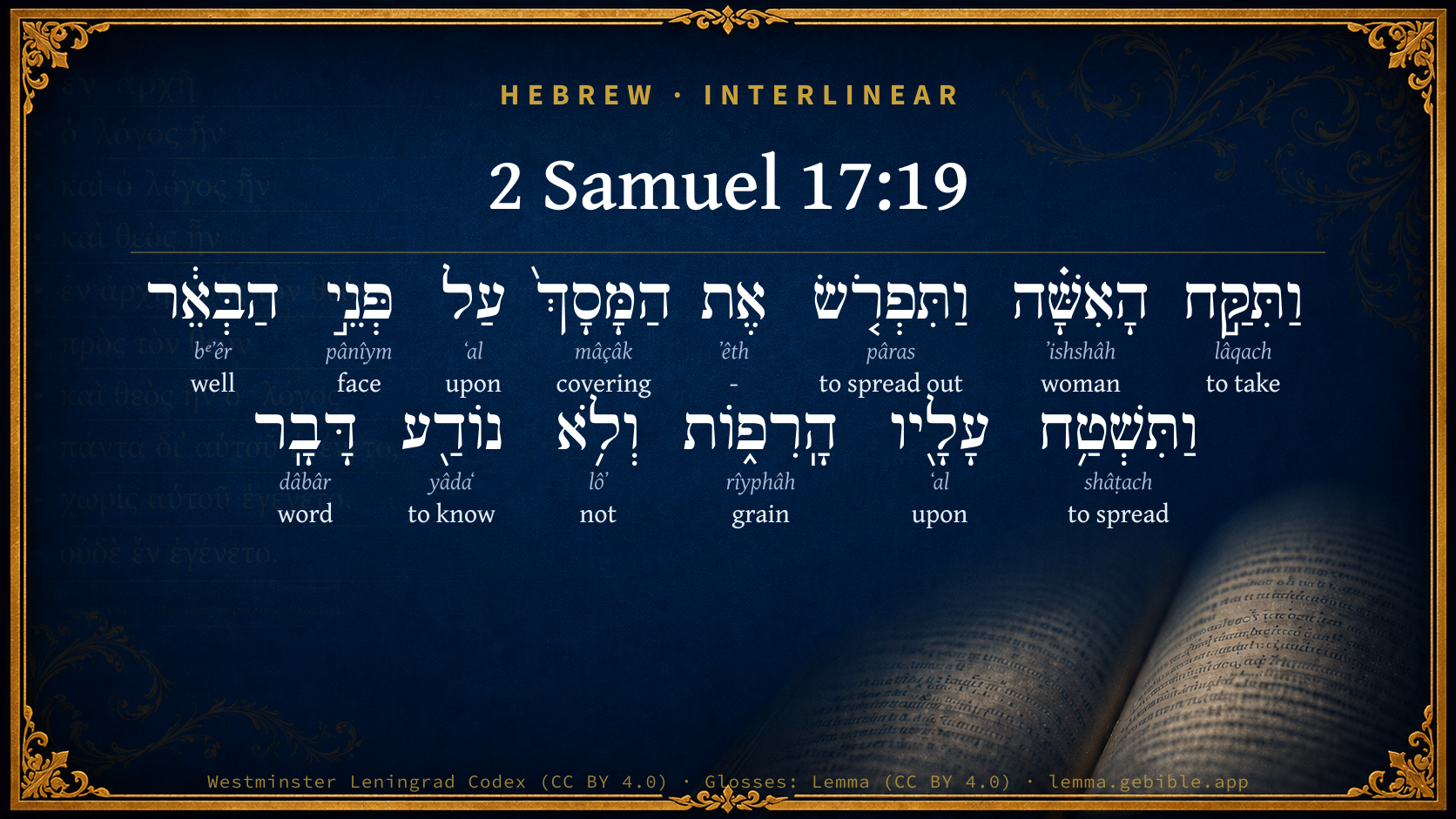
  1. וַתִּקַּ֣ח lâqach H3947 “and · to take” Conjunction + Verb, Qal, Sequential Imperfect, 3rd Person, Feminine, Singular
  2. הָאִשָּׁ֗ה ʼishshâh H802 “the · woman” Particle, Definite Article + Noun, Common, Feminine, Singular, Absolute
  3. וַתִּפְרֹ֤שׂ pâras H6566 “and · to spread out” Conjunction + Verb, Qal, Sequential Imperfect, 3rd Person, Feminine, Singular
  4. אֶת ʼêth H853 “-” Particle, Direct Object
  5. הַמָּסָךְ֙ mâçâk H4539 “the · covering” Particle, Definite Article + Noun, Common, Masculine, Singular, Absolute
  6. עַל ʻal H5921 “upon” Preposition
  7. פְּנֵ֣י pânîym H6440 “face(s) of” Noun, Common, Both, Plural, Construct
  8. הַבְּאֵ֔ר bᵉʼêr H875 “the · well” Particle, Definite Article + Noun, Common, Feminine, Singular, Absolute
  9. וַתִּשְׁטַ֥ח shâṭach H7849 “and · to spread” Conjunction + Verb, Qal, Sequential Imperfect, 3rd Person, Feminine, Singular
  10. עָלָ֖יו ʻal H5921 “upon · him” Preposition + Suffix, Personal, 3rd Person, Masculine, Singular
  11. וְלֹ֥א lôʼ H3808 “and · not” Conjunction + Particle, Negative
  12. נוֹדַ֖ע yâdaʻ H3045 “to know” Verb, Niphal, Perfect, 3rd Person, Masculine, Singular
  13. דָּבָֽר dâbâr H1697 “word” Noun, Common, Masculine, Singular, Absolute

About this verse

These counts appear in no published source. They are computed here, from the morphology-tagged text and Lemma’s own curated glosses. What Lemma adds →

14
words
13
distinct lemmas
Historical
section

Notable vocabulary

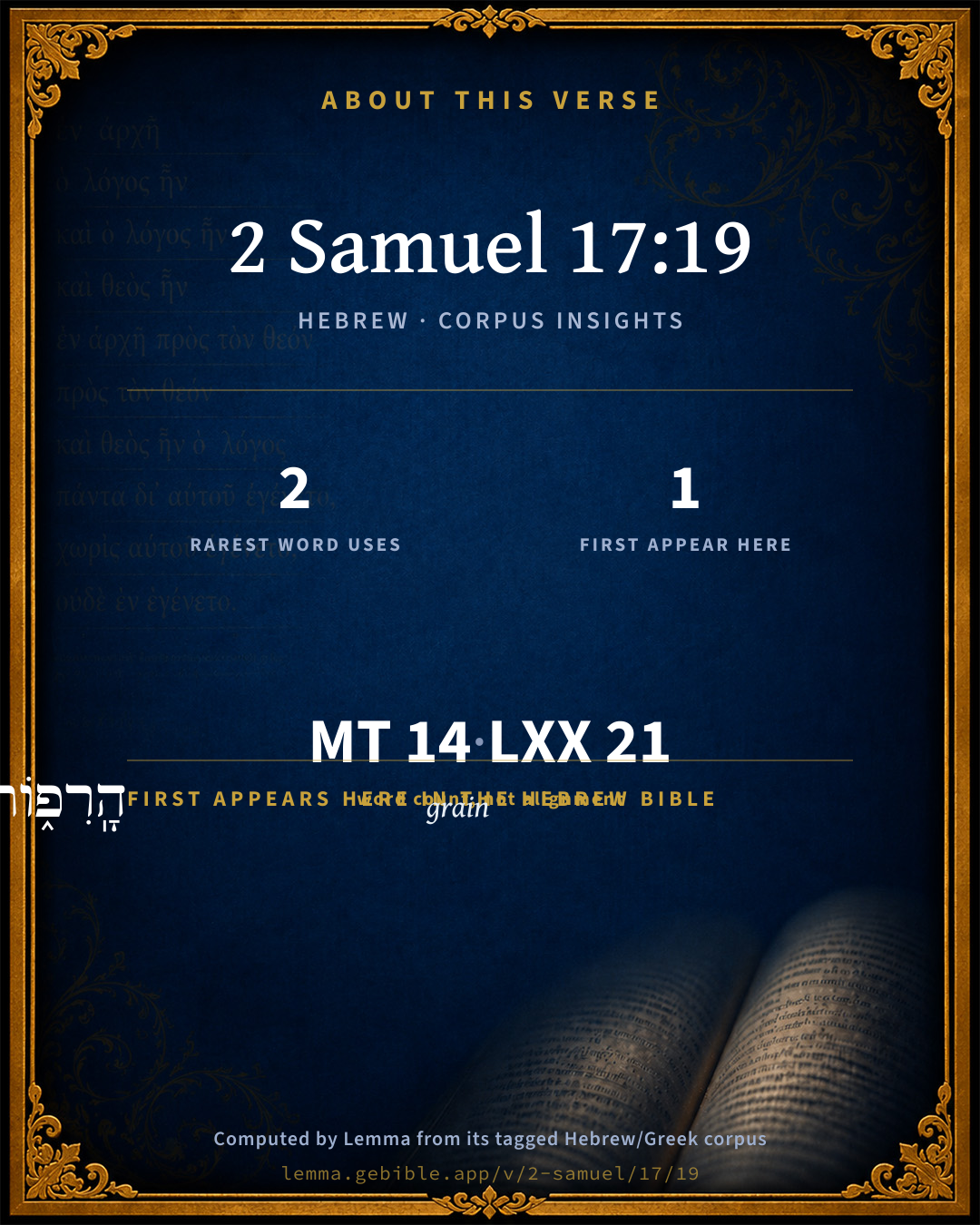
The rarest word here is הָֽרִפ֑וֹת grain H7383 — appearing just 2 times in the whole Hebrew Bible.

First appearance in Scripture

This word makes its first canonical appearance in the Hebrew Bible here:

  • הָֽרִפ֑וֹת grain H7383

Shared distinctive vocabulary

הָֽרִפ֑וֹת grain H7383 occurs in 2 verses of the Hebrew Bible. Also found in:

Grammatical profile

  • 4 verbs
  • 6 nouns
  • 2 prepositions
  • 2 particles

Verb forms

  • וַתִּקַּ֣ח Qal · Sequential Imperfect
  • וַתִּפְרֹ֤שׂ Qal · Sequential Imperfect
  • וַתִּשְׁטַ֥ח Qal · Sequential Imperfect
  • נוֹדַ֖ע Niphal · Perfect

Repetition

A word recurs within this verse — often emphatic in Hebrew:

Hebrew & Septuagint length

In English translation the verse runs 20 words from the Hebrew and 30 from the Septuagint (LXX English) — the Septuagint runs noticeably longer here. See the side-by-side →

A rough comparison of the two English renderings, which tokenize alike — not a word-level alignment.

Word counts can differ between the Hebrew and the Greek without any difference in meaning — e.g. the Hebrew direct-object marker אֵת has no separate Greek word, and Greek often adds the article ὁ.

In the original languages it is 14 Hebrew tokens and 21 Greek tokens — but the two are counted differently (Hebrew bundles its prefixes and suffixes into one token; the Greek is in lemma form), so that isn’t a like-for-like length.

Cross-references

2

Topical passages linked to 2 Samuel 17:19 in the Treasury of Scripture Knowledge — connected by theme and wording, ordered by reader-vote popularity; previews shown in the World English Bible.

  • Exodus 1:19 The midwives said to Pharaoh, "Because the Hebrew women aren't like the Egyptian women; for they are vigorous, and give birth before the midwife comes to them."
  • Joshua 2:4–24 The woman took the two men, and hid them; and she said, Yes, the men came to me, but I didn't know whence they were:

Cross-references courtesy of OpenBible.info (CC BY 4.0).

Hebrew and Greek witnesses Masoretic Hebrew ↔ Greek Septuagint

The same verse in the two great witnesses to the Old Testament, shown verse-for-verse.

Here the Septuagint runs noticeably longer than the Hebrew — LXX2012 (modern English Septuagint) 30 words vs World English Bible 20. A rough length comparison of the two English translations, not a word-level alignment — read both below.

These are two independent witnesses, not word-aligned to each other, and the Septuagint is shown in lemma (dictionary) form.

Hebrew 2 Samuel 17:19 Masoretic · Westminster Leningrad Codex

וַתִּקַּ֣ח הָאִשָּׁ֗ה וַתִּפְרֹ֤שׂ אֶת הַמָּסָךְ֙ עַל פְּנֵ֣י הַבְּאֵ֔ר וַתִּשְׁטַ֥ח עָלָ֖יו הָֽרִפ֑וֹת וְלֹ֥א נוֹדַ֖ע דָּבָֽר

The woman took and spread the covering over the well's mouth, and strewed bruised grain thereon; and nothing was known.

World English Bible · Public Domain

Greek LXX 2 Samuel 17:19 Septuagint · lemma form

καί λαμβάνω ὁ γυνή καί διαπετάζω ὁ ἐπικάλυμμα ἐπί πρόσωπον ὁ λάκκος καί ψύχω ἐπί αὐτός αραφωθ καί οὐ γιγνώσκω ῥῆμα

And a woman took a covering, and spread it over the mouth of the well, and spread out ground corn upon it to dry, and the thing was not known.

LXX2012 (modern English Septuagint) · Public Domain

On this verse, Haydock's Catholic Bible Commentary discusses the Septuagint’s reading. Read the note in Commentary ↓

Hebrew: Westminster Leningrad Codex (CC BY 4.0). Greek: Septuagint (public domain); English from LXX2012 (modern English Septuagint) (Public Domain). How the Septuagint differs from the Hebrew →

Targum (Aramaic paraphrase)

1

The Targum is the ancient Jewish Aramaic paraphrase of the Hebrew Scriptures — an interpretive translation, not the Hebrew text itself. Onkelos (literal) and Pseudo-Jonathan (expansive) render the Torah, and Jonathan the Prophets. Coverage is partial: where no permissively-licensed English translation exists for a verse, only the Aramaic is shown. This is verse-level text, not a word-by-word alignment to the Hebrew.

  1. Targum Jonathan Prophets (Joshua–Malachi)
    וּנְסִיבַת אִתְּתָא וּפַרְסַת יַת פְרָסָא עַל פּוּמָא דְבֵירָא וּשְׁטָחַת עֲלוֹהִי דְקִילָן וְלָא אִתְיְדַע פִּתְגָמָא:

    (no public-domain English translation for this verse)

    Targum Jonathan — Aramaic: “Mikraot Gedolot” (public domain). English: “Sefaria Community Translation” (CC0 1.0 (public-domain dedication)); “London "Chaldee Paraphrase," 1871” (public domain). Text via Sefaria.

Commentary

Notes on 2 Samuel 17:19 from classic Christian and Jewish commentators (each source and its license shown beneath its notes). The classic Christian expositions comment on the surrounding passage and are grouped to its opening verse, so a note may address several verses; the Jewish commentaries on the Tanakh (Rashi and others) are per-verse, so they appear only where the commentator wrote on this verse.

Lemma curates 59 commentaries, every one of them public domain or Creative Commons licensed, each selected and text-cleaned for this edition rather than reprinted as found. About our sources →

Trapp's Complete Commentary

John Trapp

2Sa 17:19 And the woman took and spread a covering over the well’s mouth, and spread ground corn thereon; and the thing was not known.

Ver. 19. And spread ground corn thereon.] Grana tusa et commolita; meal grist, under pretence it needed drying, being moist; or airing, being musty.

John Trapp, A Commentary or Exposition upon All the Books of the Old and New Testament (1647–1656) — public domain. Text from a community e-Sword module.

Geneva Bible (1599)

Geneva Bible translators

Thus God sendeth succor to his, in their greatest dangers.

Geneva Bible (1599) marginal notes — public domain. Text via Bolls.life.

Ellicott's Commentary for English Readers

(19) Ground Corn.—This word occurs elsewhere only in Pro_27:22, and means wheat or barley beaten or ground so as to remove the hull; in this condition it was spread out to dry.

A Bible Commentary for English Readers, edited by Charles John Ellicott (1878–1897) — public domain. Text from a community e-Sword module.

The Cambridge Bible for Schools and Colleges

gen. ed. J. J. S. Perowne

19. a covering] The covering, either the usual cover of the cistern, or, as the general use of the word suggests, the curtain which hung in the doorway. See Exo_26:36 (E. V. hanging).

ground corn] Bruised or husked wheat, which she spread out as if to dry. The mode of its preparation is referred to in Pro_27:22, the only other passage in which the word occurs.

The Cambridge Bible for Schools and Colleges (gen. ed. J. J. S. Perowne; Cambridge University Press, 1878–1918) — public domain. Text from a community e-Sword module.

John Gill's Exposition

And when Absalom's servants came to the woman to the house,.... Who were sent after then, had intelligence which way they took, and into what house they turned:

they said, where are Ahimaaz and Jonathan? calling them by their names, being persons well known, and as to them, so to the woman of the house, as they supposed:

and the woman said unto them, they be gone over the brook of water; the river Jordan; so the Targum,"they have already passed over Jordan;''

this was a lie she told them, which is not to be justified; the Vulgate Latin version,"they passed over hastily, having drank a little water;''and so Josephus (r) in some copies:

and when they had sought and could not find them; not only searched that house, but very probably others in Bahurim:

they returned to Jerusalem; to give an account what success they had.

(r) Antiqu. l. 7. c. 9. sect. 7. Hudson. not. in ib.

John Gill's Exposition of the Whole Bible (1746–1763) — public domain (CC PDM 1.0). Text via the HelloAO Bible API.

Albert Barnes' Notes on the Bible

A covering - Hebrew “the covering,” perhaps “the hanging” or “awning” at the door of the house, as the word seems to mean when spoken of the tabernacle.

Ground corn - Or “peeled barley,” which she spread out as if for the purpose of drying it in the sun.

Albert Barnes' Notes on the Bible (1834–1885) — public domain. Text from a community e-Sword/MySword module.

Haydock's Catholic Bible Commentary

Barley, which was afterwards fried with oil, and eaten. Ptisanas may also denote wheat, &c. Grana cantusa. (Theodotion) --- "Figs." (Calmet) --- Septuagint have the original (hariphoth) untranslated. (Haydock)

George Leo Haydock (1774–1849), Haydock's Catholic Family Bible and Commentary, 1859 edition — public domain. Excludes Psalms (Douay-Rheims chapter numbering differs from Protestant) and Deuterocanonical books (Catholic canon only).

Matthew Poole's English Annotations

Spread ground corn thereon, under pretence of drying it by the sun; which shows it was summer time.

Matthew Poole's English Annotations on the Holy Bible (1683–1685) — public domain. Text from a community e-Sword/MySword module.

The Pulpit Commentary

A covering; Hebrew, the cover; that is, the usual cover of the cistern, which had been taken off to let the young men descend into it. Over it she spread, not ground corn, but brayed or peeled corn, (see Pro_27:22) probably barley groats. She was probably busy in removing the husks of the barley with a pestle in a mortar when Jonathan and Ahimaaz sought refuge with her; and thus her whole proceeding was so natural as to excite no suspicions.

The Pulpit Commentary (1880–1919), ed. H.D.M. Spence-Jones & Joseph S. Exell — public domain. Text from a community e-Sword module.

John Wesley's Explanatory Notes

Spread corn - Under pretense of drying it by the sun: which shews it was summer-time.

John Wesley, Explanatory Notes Upon the Whole Bible (1754–1765) — public domain. Text via the GEBible commentary corpus.

Keil & Delitzsch

C. F. Keil & F. Delitzsch

And the man's wife spread a covering (המּסך, the covering which she had close at hand) over the well (over the opening into the cistern), and scattered groats (ריפות, peeled barley: Pro 27:22) upon it, so that nothing was noticed. The Vulgate explanation is a very good one: "quasi siccans ptisanas" (as if drying peeled barley).

Keil & Delitzsch — Biblical Commentary on the Old Testament (1861–1891) — public domain (CC PDM 1.0). Text via the HelloAO Bible API. (Old Testament only.)

unfoldingWord translationNotes

Door43 World Missions Community

the woman of the house

"the man's wife"

Ahimaaz ... Jonathan

See how you translated these men's names in 2 Samuel 15:27. (See: How to Translate Names)

translationWords

cistern

grain

house

Jerusalem

unfoldingWord translationNotes — © Distant Shores Media and the Door43 World Missions Community, licensed CC BY-SA 4.0. Source: git.door43.org/Door43/en_tn.

Rashi

Rabbi Shlomo Yitzchaki (Rashi)

The curtain. Curtain.

Ground wheat. Ground wheat as [we find], "Among the ground wheat."

Rashi on the Tanakh — English translations: “The Judaica Press complete Tanach with Rashi, translated by A. J. Rosenberg” (CC BY 4.0); “Pentateuch with Rashi's commentary by M. Rosenbaum and A.M. Silbermann, 1929-1934” (public domain); “The Metsudah Tanach series, Lakewood, N.J” (CC BY 4.0); and “The Book of Joshua, Metsudah Publications, 1997” (CC BY 4.0). Text via Sefaria.

Lesson kit

Teaching starters — assembled from the data on this page, not authored interpretation. Every prompt links to the verse data it draws on. Edit before teaching.

2 Samuel, in the Historical, opens this verse with 14 words (13 distinct Hebrew lemmas). Its most distinctive word is rîyphâh (“grain”). The Greek Septuagint runs longer here. A historical commentator’s framing appears above. Read the whole chapter for the surrounding context.

Discussion questions

  1. What does “grain” (rîyphâh) contribute to the verse as a whole?
  2. This is the first place “grain” appears in Scripture (first appears here). What does its debut here establish?
  3. How does Proverbs 27:22, which shares the word «grain», read alongside this verse?
  4. What does the repetition of “upon” (2× in this one verse) do in this verse?
  5. The Septuagint runs longer here than the Hebrew. What might account for the difference?
  6. These translations render this verse differently; the difference is in the English rendering, not the original. What questions does that raise?
  7. «וַתִּקַּ֣ח» is a Qal Sequential Imperfect verb. How does that grammatical form shape the action described?
  8. Compare how Trapp's Complete Commentary and Geneva Bible (1599) read this verse. Where do they agree or differ?

Things to notice

Reading settings

Reading text

Shown beneath each verse's original-language words.

Old Testament
Old Testament edition

Read the OT as the Masoretic Hebrew (MT) or the Greek Septuagint (LXX).

English shown for the Greek Septuagint (in the Hebrew ↔ Greek comparison).

Comparing translations? Open the Compare panel on any verse page to stack up to four side by side.