Jeremiah 9:11

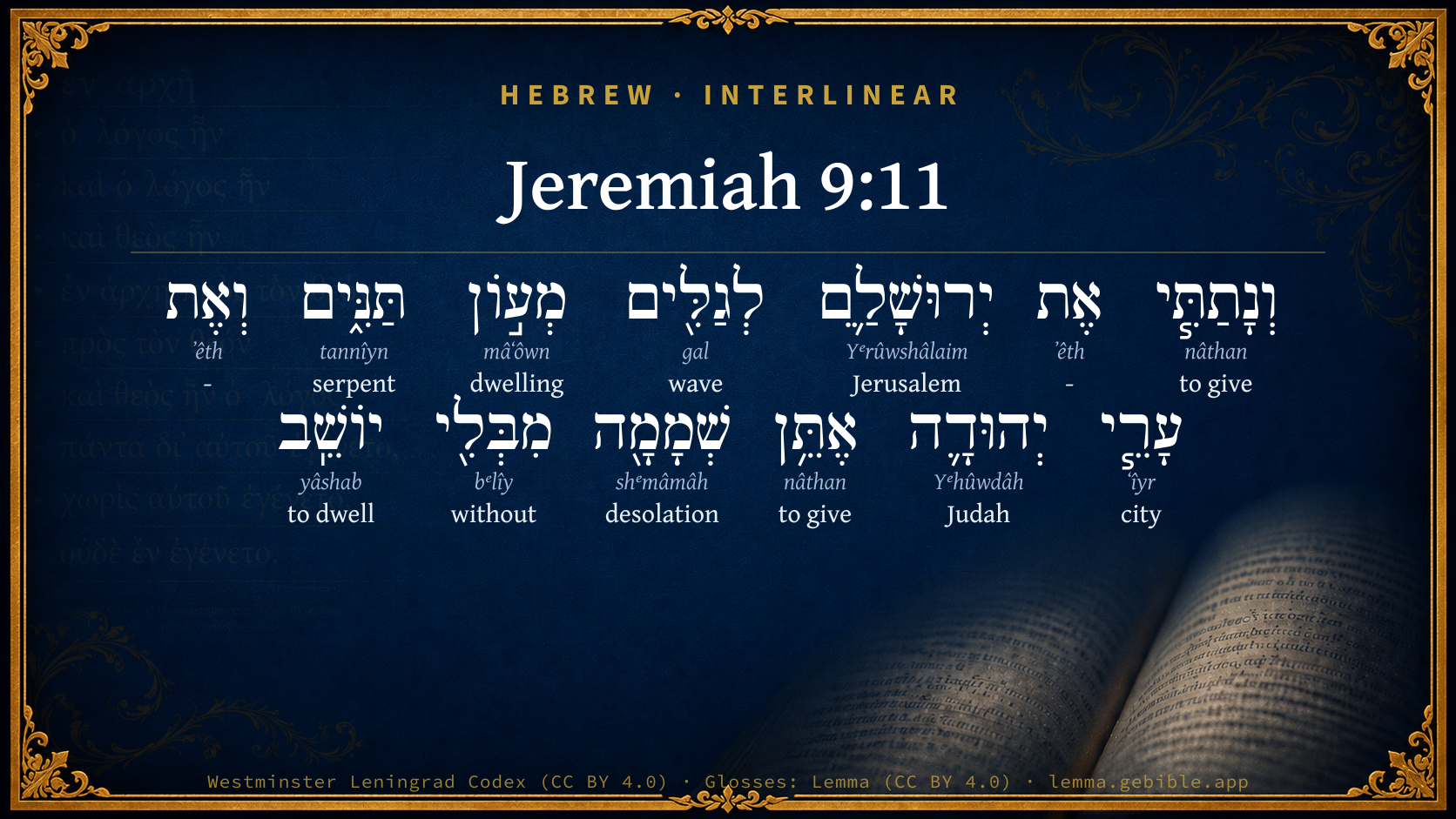
Hebrew (Westminster Leningrad Codex) Jeremiah 9:11 appears in the Hebrew Old Testament. The text above is from the Westminster Leningrad Codex. Each word links to its Strong’s number, a concise gloss, and parsing drawn from the Open Scriptures Hebrew Bible morphology. Click any word for its full Brown-Driver-Briggs (BDB) entry.
Download image
Cite this verse

Jeremiah 9:11 (World English Bible). Public Domain. Lemma interlinear Bible study tool, https://lemma.gebible.app/v/jeremiah/9/11.

Show BibTeX & RIS
BibTeX
RIS
English Translation
I will make Jerusalem heaps, a dwelling-place of jackals; and I will make the cities of Judah a desolation, without inhabitant.
World English Bible · Public Domain
Download a study sheet

One document with this verse’s original text, its word-by-word gloss line, the meaning frame, cross-references with their text, attributed commentary, and full source and license credits — printable, and it pastes into notes with its structure intact.

This verse Autodidact and up

Study sheet (.html) Plain text (.txt)

A passage Seminary Student

Up to 50 verses in one chapter. A passage sheet keeps up to 6 commentary sources and 12 cross-references per verse, in the order this page ranks them, and says so on the sheet whenever that leaves anything out. Ask for a single verse and you get the Autodidact verse sheet above.

Everything on this page stays free to read, with no account — the sheet is a download of what is already on screen, not access to it.

Want to remove ads? Support Godless Engineer
Compare translations 3

The same verse in 3 English versions, stacked beneath the original-language interlinear above. Click any original word for its lexicon entry.

Each is an independent rendering of the whole verse — the interlinear is not word-aligned to these translations.

Highlighted words mark where these versions differ — a whole-verse word diff, not a word-by-word alignment.

  • World English Bible Public Domain
    I will make Jerusalem heaps, a dwelling-place of jackals; and I will make the cities of Judah a desolation, without inhabitant.
  • King James Version Public Domain
    And I will make Jerusalem heaps, and a den of dragons; and I will make the cities of Judah desolate, without an inhabitant.
  • unfoldingWord Literal Text CC BY-SA 4.0
    “And I will make Jerusalem to piles, a dwelling-place of jackals, and I will make the cities of Judah a desolation without dwellers.”

unfoldingWord Literal Text — © unfoldingWord, licensed CC BY-SA 4.0. Word-aligned USFM3 via Door43 (git.door43.org/unfoldingWord/en_ult).

Versions to compare (up to 4)

3 of 4 selected

Show all 18 translations

Every available English version of this verse, each an independent rendering of the whole verse.

  • World English Bible Public Domain
    I will make Jerusalem heaps, a dwelling-place of jackals; and I will make the cities of Judah a desolation, without inhabitant.
  • Berean Standard Bible Public Domain
    “And I will make Jerusalem a heap of rubble, a haunt for jackals; and I will make the cities of Judah a desolation, without inhabitant.”
  • Majority Standard Bible Public Domain
    “And I will make Jerusalem a heap of rubble, a haunt for jackals; and I will make the cities of Judah a desolation, without inhabitant.”
  • King James Version Public Domain
    And I will make Jerusalem heaps, and a den of dragons; and I will make the cities of Judah desolate, without an inhabitant.
  • American Standard Version (1901) Public Domain
    And I will make Jerusalem heaps, a dwelling-place of jackals; and I will make the cities of Judah a desolation, without inhabitant.
  • Revised Version (1885) Public Domain
    And I will make Jerusalem heaps, a dwelling place of jackals; and I will make the cities of Judah a desolation, without inhabitant.
  • Geneva Bible (1599) Public Domain
    And I wil make Ierusalem an heape, and a den of dragons, and I will make the cities of Iudah waste, without an inhabitant.
  • Douay-Rheims (1899) Public Domain
    And I will make Jerusalem to be heaps of sand, and dens of dragons: and I will make the cities of Juda desolate, for want of an inhabitant.
  • Young's Literal Translation Public Domain
    And I make Jerusalem become heaps, A habitation of dragons, And the cities of Judah I make a desolation, Without inhabitant.
  • Literal Standard Version CC BY-SA 4.0
    “And I make Jerusalem become heaps, || A habitation of dragons, || And I make the cities of Judah a desolation, || Without inhabitant.”
  • Unlocked Literal Bible CC BY-SA 4.0
    So I will turn Jerusalem into piles of ruins, a hideout for jackals. I will make Judah's cities ruined places without inhabitants.”
  • unfoldingWord Literal Text CC BY-SA 4.0
    “And I will make Jerusalem to piles, a dwelling-place of jackals, and I will make the cities of Judah a desolation without dwellers.”
  • Darby Bible Public Domain
    And I will make Jerusalem heaps, a dwelling-place of jackals; and I will make the cities of Judah a desolation, without inhabitant.
  • World Messianic Bible Public Domain
    “I will make Jerusalem heaps, a dwelling place of jackals. I will make the cities of Judah a desolation, without inhabitant.”
  • Webster's Bible Public Domain
    And I will make Jerusalem heaps, and a den of dragons; and I will make the cities of Judah desolate, without an inhabitant.
  • Free Bible Version CC BY-SA 4.0
    I'm going to make Jerusalem into a heap of rubble, a place where jackals live. I will destroy the towns of Judah, leaving them empty.
  • Bible in Basic English Public Domain
    And I will make Jerusalem a mass of broken stones, the living-place of jackals; and I will make the towns of Judah a waste, with no man living there.
  • JPS Tanakh (1917) Public Domain
    (9-10) And I will make Jerusalem heaps, a lair of jackals; and I will make the cities of Judah a desolation, without an inhabitant.

Literal Standard Version (2020), Covenant Press — licensed CC BY-SA 4.0. Text via the HelloAO Bible API (eBible.org). Unlocked Literal Bible (unfoldingWord) — licensed CC BY-SA 4.0. Text via the HelloAO Bible API (eBible.org). unfoldingWord Literal Text — © unfoldingWord, licensed CC BY-SA 4.0. Word-aligned USFM3 via Door43 (git.door43.org/unfoldingWord/en_ult). Free Bible Version, Dr. Jonathan Gallagher — licensed CC BY-SA 4.0. Text via the HelloAO Bible API (eBible.org).

Word by word

More ways to search: Search by grammar → Find every occurrence → Compare this word →

Practice this passage: Drill this verse → Learn its vocabulary →

מְע֣וֹן
mâʻôwn
H4583
“dwelling of”
Noun, Common, Both, Singular, Construct
Part of Speech
Noun
Type
Common
Gender
Both
Number
Singular
State
Construct
Full BDB Definition

Origin: from the same as H5772

TWOT: 1581a

dwelling, habitation, refuge - lair, refuge (of jackals) - dwelling
  1. וְנָתַתִּ֧י nâthan H5414 “and · to give” Conjunction + Verb, Qal, Sequential Perfect, 1st Person, Common, Singular
  2. אֶת ʼêth H853 “-” Particle, Direct Object
  3. יְרוּשָׁלִַ֛ם Yᵉrûwshâlaim H3389 “Jerusalem” Noun, Proper
  4. לְגַלִּ֖ים gal H1530 “to/for · waves” Preposition + Noun, Common, Masculine, Plural, Absolute
  5. תַּנִּ֑ים tannîyn H8577 “serpents” Noun, Common, Masculine, Plural, Absolute
  6. וְאֶת ʼêth H853 “and · -” Conjunction + Particle, Direct Object
  7. עָרֵ֧י ʻîyr H5892 “cities of” Noun, Common, Feminine, Plural, Construct
  8. יְהוּדָ֛ה Yᵉhûwdâh H3063 “Judah” Noun, Proper
  9. אֶתֵּ֥ן nâthan H5414 “to give” Verb, Qal, Imperfect, 1st Person, Common, Singular
  10. שְׁמָמָ֖ה shᵉmâmâh H8077 “desolation” Noun, Common, Feminine, Singular, Absolute
  11. מִבְּלִ֖י bᵉlîy H1097 “from · without of” Preposition + Noun, Common, Masculine, Singular, Construct
  12. יוֹשֵֽׁב yâshab H3427 “dwelling” Verb, Qal, Participle Active, Masculine, Singular, Absolute

About this verse

These counts appear in no published source. They are computed here, from the morphology-tagged text and Lemma’s own curated glosses. What Lemma adds →

13
words
11
distinct lemmas
Prophets
section

Notable vocabulary

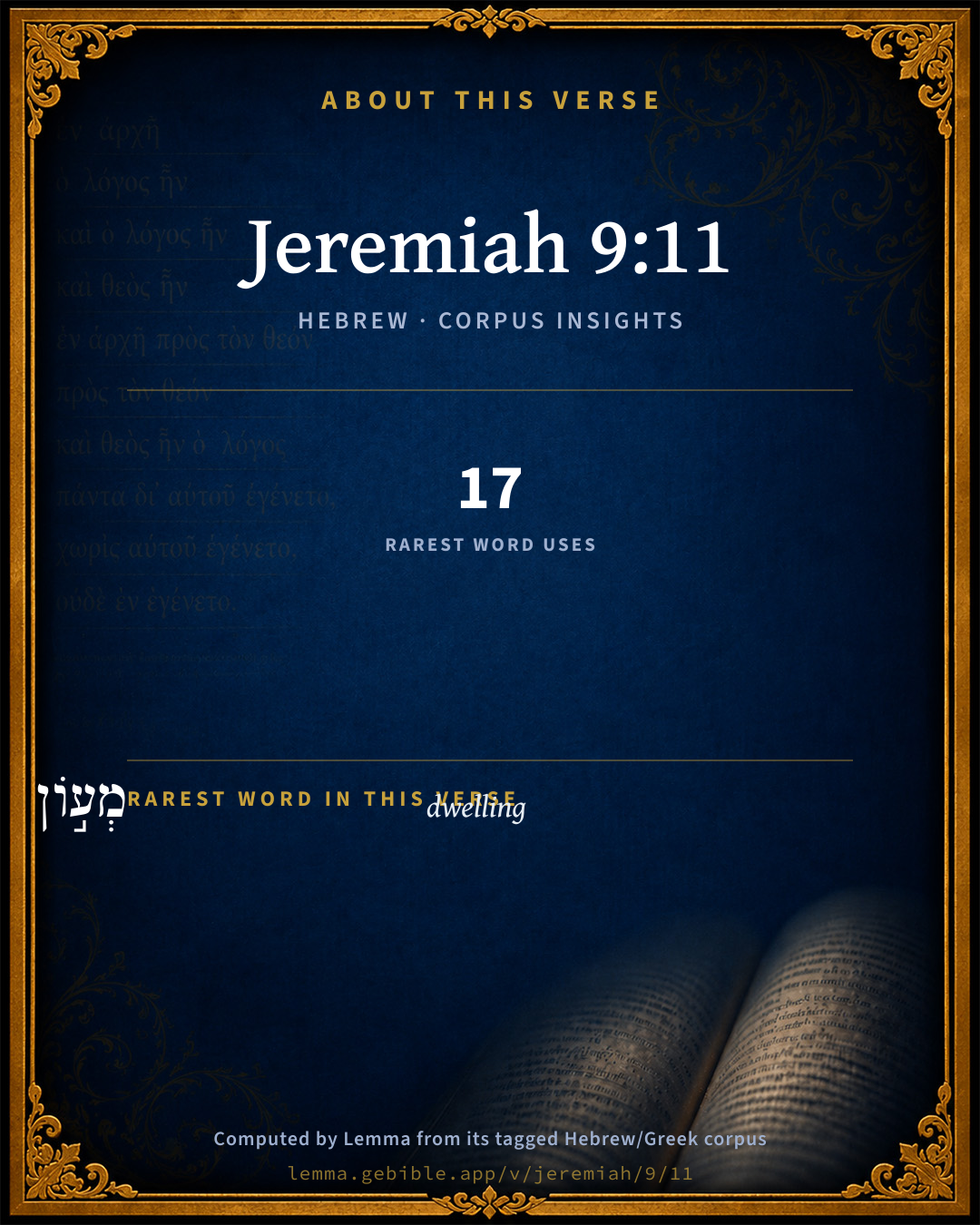
The rarest word here is מְע֣וֹן dwelling H4583 — appearing just 17 times in the whole Hebrew Bible.

Shared distinctive vocabulary

מְע֣וֹן dwelling H4583 occurs in 17 verses of the Hebrew Bible. Also found in:

Grammatical profile

  • 3 verbs
  • 8 nouns
  • 2 particles

Verb forms

  • וְנָתַתִּ֧י Qal · Sequential Perfect
  • אֶתֵּ֥ן Qal · Imperfect
  • יוֹשֵֽׁב Qal · Participle Active

Repetition

A word recurs within this verse — often emphatic in Hebrew:

  • וְנָתַתִּ֧י to give H5414 ×2

Cross-references

20

Topical passages linked to Jeremiah 9:11 in the Treasury of Scripture Knowledge — connected by theme and wording, ordered by reader-vote popularity; previews shown in the World English Bible.

  • Isaiah 25:2 For you have made of a city a heap, of a fortified city a ruin, a palace of strangers to be no city; it shall never be built.
  • Isaiah 13:22 Wolves shall cry in their castles, and jackals in the pleasant palaces: and her time is near to come, and her days shall not be prolonged.
  • Isaiah 34:13 Thorns shall come up in its palaces, nettles and thistles in the fortresses of it; and it shall be a habitation of jackals, a court for ostriches.
  • Jeremiah 10:22 The voice of news, behold, it comes, and a great commotion out of the north country, to make the cities of Judah a desolation, a dwelling-place of jackals.
  • Jeremiah 51:37 Babylon shall become heaps, a dwelling-place for jackals, an astonishment, and a hissing, without inhabitant.
  • Psalms 79:1 God, the nations have come into your inheritance. They have defiled your holy temple. They have laid Jerusalem in heaps.
  • Jeremiah 25:11 This whole land shall be a desolation, and an astonishment; and these nations shall serve the king of Babylon seventy years.
  • Jeremiah 26:18 Micah the Morashtite prophesied in the days of Hezekiah king of Judah; and he spoke to all the people of Judah, saying, Thus says Yahweh of Hosts: Zion shall be plowed as a field, and Jerusalem shall become heaps, and the mountain of the house as the high places of a forest.
  • Jeremiah 34:22 Behold, I will command, says Yahweh, and cause them to return to this city; and they shall fight against it, and take it, and burn it with fire: and I will make the cities of Judah a desolation, without inhabitant.
  • Lamentations 2:2 The Lord has swallowed up all the habitations of Jacob, and has not pitied: He has thrown down in his wrath the strongholds of the daughter of Judah; He has brought them down to the ground; he has profaned the kingdom and the princes of it.
  • Lamentations 2:7–8 The Lord has cast off his altar, he has abhorred his sanctuary; He has given up into the hand of the enemy the walls of her palaces: They have made a noise in the house of Yahweh, as in the day of a solemn assembly.
  • Lamentations 3:47 Fear and the pit are come on us, devastation and destruction.
  • Micah 3:12 Therefore Zion for your sake will be plowed like a field, And Jerusalem will become heaps of rubble, And the mountain of the temple like the high places of a forest.
  • Nehemiah 4:2 He spoke before his brothers and the army of Samaria, and said, What are these feeble Jews doing? will they fortify themselves? will they sacrifice? will they make an end in a day? will they revive the stones out of the heaps of rubbish, seeing they are burned?
  • Isaiah 44:26 who confirms the word of his servant, and performs the counsel of his messengers; who says of Jerusalem, She shall be inhabited; and of the cities of Judah, They shall be built, and I will raise up the waste places of it;
  • Jeremiah 25:18 [to wit], Jerusalem, and the cities of Judah, and the kings of it, and the princes of it, to make them a desolation, an astonishment, a hissing, and a curse, as it is this day;
  • Jeremiah 26:9 Why have you prophesied in the name of Yahweh, saying, This house shall be like Shiloh, and this city shall be desolate, without inhabitant? All the people were gathered to Jeremiah in the house of Yahweh.
  • Micah 1:6 Therefore I will make Samaria like a rubble heap of the field, Like places for planting vineyards; And I will pour down its stones into the valley, And I will uncover its foundations.
  • Micah 6:16 For the statutes of Omri are kept, And all the works of the house of Ahab. You walk in their counsels, That I may make you a ruin, And her inhabitants a hissing; And you will bear the reproach of my people."
  • Revelation 18:2 He cried with a mighty voice, saying, "Fallen, fallen is Babylon the great, and she has become a habitation of demons, a prison of every unclean spirit, and a prison of every unclean and hateful bird!

Cross-references courtesy of OpenBible.info (CC BY 4.0).

Hebrew and Greek witnesses Masoretic Hebrew ↔ Greek Septuagint

The same verse in the two great witnesses to the Old Testament, shown verse-for-verse.

These are two independent witnesses, not word-aligned to each other, and the Septuagint is shown in lemma (dictionary) form.

Hebrew Jeremiah 9:11 Masoretic · Westminster Leningrad Codex

וְנָתַתִּ֧י אֶת יְרוּשָׁלִַ֛ם לְגַלִּ֖ים מְע֣וֹן תַּנִּ֑ים וְאֶת עָרֵ֧י יְהוּדָ֛ה אֶתֵּ֥ן שְׁמָמָ֖ה מִבְּלִ֖י יוֹשֵֽׁב

I will make Jerusalem heaps, a dwelling-place of jackals; and I will make the cities of Judah a desolation, without inhabitant.

World English Bible · Public Domain

Greek LXX Structure differs

In the Septuagint, Jeremiah is about an eighth shorter than the Hebrew and arranges its material differently — the Oracles Against the Nations (Hebrew chapters 46–51) appear in the middle of the Greek book, after 25:13. Because the chapter and verse boundaries do not line up, a verse-for-verse comparison with the Hebrew is not shown.

A verse-for-verse comparison isn’t shown here because the chapters and verses don’t line up. Switch to the LXX edition with the MT / LXX toggle above to read the Greek directly.

On this verse, Ellicott's Commentary for English Readers discusses the Septuagint’s reading. Read the note in Commentary ↓

Hebrew: Westminster Leningrad Codex (CC BY 4.0). Greek: Septuagint (public domain); English from a public-domain English Septuagint. How the Septuagint differs from the Hebrew →

Targum (Aramaic paraphrase)

1

The Targum is the ancient Jewish Aramaic paraphrase of the Hebrew Scriptures — an interpretive translation, not the Hebrew text itself. Onkelos (literal) and Pseudo-Jonathan (expansive) render the Torah, and Jonathan the Prophets. Coverage is partial: where no permissively-licensed English translation exists for a verse, only the Aramaic is shown. This is verse-level text, not a word-by-word alignment to the Hebrew.

  1. Targum Jonathan Prophets (Joshua–Malachi)
    מַן גַבְרָא דְחַכִּים וְיִסְבַּר יַת דָא וּדְאִתְמַלֵל מִן קֳדָם יְיָ עִמֵיהּ וִיחַוִינָהּ עַל מִן חֲרוּבַת אַרְעָא צַדִיאַת כְּמַדְבְרָא מִבְּלִי יָתֵיב:

    (no public-domain English translation for this verse)

    Targum Jonathan — Aramaic: “Mikraot Gedolot” (public domain). English: “Sefaria Community Translation” (CC0 1.0 (public-domain dedication)); “London "Chaldee Paraphrase," 1871” (public domain). Text via Sefaria.

Commentary

Notes on Jeremiah 9:11 from classic Christian and Jewish commentators (each source and its license shown beneath its notes). The classic Christian expositions comment on the surrounding passage and are grouped to its opening verse, so a note may address several verses; the Jewish commentaries on the Tanakh (Rashi and others) are per-verse, so they appear only where the commentator wrote on this verse.

Lemma curates 59 commentaries, every one of them public domain or Creative Commons licensed, each selected and text-cleaned for this edition rather than reprinted as found. About our sources →

Trapp's Complete Commentary

John Trapp

Jer 9:11 And I will make Jerusalem heaps, [and] a den of dragons; and I will make the cities of Judah desolate, without an inhabitant.

Ver. 11. And I will make Jerusalem heaps.] So small a distance is there, saith Seneca, between a great city and none. The world is as full of mutation as of motion.

And a den of dragons.] Because she made mine house a den of thieves. {Jer 7:11}

John Trapp, A Commentary or Exposition upon All the Books of the Old and New Testament (1647–1656) — public domain. Text from a community e-Sword module.

Tyndale Open Study Notes

Tyndale Open Resources

9:11 The Lord clearly spoke these words, counterbalancing the deep emotion of 9:10 with a further declaration of judgment.

Tyndale Open Study Notes — © Tyndale Open Resources, licensed CC BY-SA 4.0. Text via the HelloAO Bible API.

Jamieson, Fausset & Brown

Robert Jamieson, A. R. Fausset & David Brown

And--omit "And." Jehovah here resumes His speech from Jer 9:9.

heaps--(see on Isa 25:2).

dragons--jackals.

Jamieson, Fausset & Brown — Commentary Critical and Explanatory on the Whole Bible (1871) — public domain (CC PDM 1.0). Text via the HelloAO Bible API.

Adam Clarke's Commentary

Verse 11. A den of dragons] תנים tannim is supposed to mean here jackals; the chakal is a beast frequent in the east, an attendant on the lion, the refuse of whose prey he devours. It is an animal that seems to have been bred originally between the wolf and the dog. The original is sometimes interpreted, dragons, whales, &c.

Adam Clarke's Commentary on the Bible (1810–1826) — public domain. Text from a community e-Sword/MySword module.

John Calvin's Commentaries

The Prophet comes now toJerusalem and the neighhouring cities. He said before, that ruin would reach the mountains and the farthest recesses; but he says now, I will turn Jerusalem into heaps This seemed incredible, for it was a well fortified city, and also full of inhabitants to defend it: we know besides that the Jews were in confederacy with the kingdom of Egypt. This denunciation then was extremely unwelcome to the Jews. But though they thought themselves hitherto safe, yet the Prophet set before their eyes their final destruction. They indeed regarded it as a fable; but they found too late, that the despisers of God gain no advantage in hardening· themselves against his threatenings. We shall meet with this verse again; I shall therefore now pass over it lightly.

He says, that it would be hereafter a place for dragons; as though he had said, that it would be no longer inhabited. He declares the same respecting the cities of Judah, — that they would all be a waste. We hence see how courageous and persevering a mind was Jeremiah endued with, that he dared to preach thus in the midst of the city, and to set himself in opposition to the king and his counsellors, and to the whole people, who wished to be soothed with flatteries, and who had been thus treated by the false prophets. As then Jeremiah was thus bold, as a celestial herald, to denounce on them this dreadful calamity, we hence learn that he was endued with the power of God, and that he did not speak as one commissioned by men; for had he not been sustained by God’s power, he must have been a hundred times disheartened, nor would he have dared to speak a word. This invincible courage seals his doctrine; ibr we hence with certainty learn, that it proceeded from God, because the wonderful power of the ttoly Spirit was evident. He afterwards adds —

John Calvin's Commentaries (1540-1563) — public domain. Text from the Calvin Translation Society English edition (1840s-50s) via the Christian Classics Ethereal Library (ccel.org). Calvin's coverage is partial (roughly two-thirds of the Bible); uncommented books and verses are honest gaps, never fabricated. The 19th-century editor's footnotes and remarks are omitted so the notes are faithfully Calvin's own voice.

Ellicott's Commentary for English Readers

(11) A den of dragons.—Better, here and in Jer_10:22; Isa_13:22, jackals. The word means, literally, a howler. The English version follows the LXX. and Vulgate versions; but even taking “dragons” in its non-mythical sense as applied to some species of serpent, there is nothing in the word to lead us to assign this meaning. The mistake has probably arisen from the likeness of the word to those translated “serpent” in Exo_7:9-10; Exo_7:12, “whale” in Gen_1:21 and Job_7:12, and “dragons” in Psa_74:13; Psa_91:13.

A Bible Commentary for English Readers, edited by Charles John Ellicott (1878–1897) — public domain. Text from a community e-Sword module.

The Cambridge Bible for Schools and Colleges

gen. ed. J. J. S. Perowne

11. jackals] mentioned again chs. Jer_10:22 [Jer_14:6], Jer_49:33 [Jer_51:37].

The Cambridge Bible for Schools and Colleges (gen. ed. J. J. S. Perowne; Cambridge University Press, 1878–1918) — public domain. Text from a community e-Sword module.

John Gill's Exposition

And I will make Jerusalem heaps,.... That is, the walls and houses of it shall be thrown down, and become heaps of stones and rubbish:

and a den of dragons; only inhabited by wild beasts:

and I will make the cities of Judah desolate, without inhabitant; so that the calamity would be universal; not only Jerusalem, but all the cities of the land, would be destroyed, forsaken, and uninhabited.

John Gill's Exposition of the Whole Bible (1746–1763) — public domain (CC PDM 1.0). Text via the HelloAO Bible API.

Haydock's Catholic Bible Commentary

Sand. The stones were burnt to dust, 2 Esdras iv. 2. (Calmet)

George Leo Haydock (1774–1849), Haydock's Catholic Family Bible and Commentary, 1859 edition — public domain. Excludes Psalms (Douay-Rheims chapter numbering differs from Protestant) and Deuterocanonical books (Catholic canon only).

Matthew Poole's English Annotations

Heaps, viz. of stones and rubbish.

A den of dragons; noting a desolate place, not any longer fit for fine habitation of mankind, as the next words do speak; but for hideous beasts; as they had made use of the temple for a den of thieves, Jer 7:11. The same also he afterwards threatens on Babylon herself, Jer 51:37.

Matthew Poole's English Annotations on the Holy Bible (1683–1685) — public domain. Text from a community e-Sword/MySword module.

Whedon's Commentary on the Bible

Daniel D. Whedon

11. Dragons — Rather, jackals. Fittingly associated with the ruinous stone heaps of Jerusalem.

Daniel D. Whedon (gen. ed.), Commentary on the Old and New Testaments (1874–1909) — public domain. Text from a community e-Sword module.

The Pulpit Commentary

I will make, etc. Notice how the utterances of the prophets stand side by side with those of Jehovah. A true prophet has no personal views; so that whether his revelations are expressed in the one form or the other makes no difference. Dragons; rather, jackals.

The Pulpit Commentary (1880–1919), ed. H.D.M. Spence-Jones & Joseph S. Exell — public domain. Text from a community e-Sword module.

Rashi

Rabbi Shlomo Yitzchaki (Rashi)

Who is the man so wise Who will understand this, and who is the prophet to whom the mouth of the Lord has spoken,

that he may declare it? And who will declare why the land is ruined and all this retribution has come?

Rashi on the Tanakh — English translations: “The Judaica Press complete Tanach with Rashi, translated by A. J. Rosenberg” (CC BY 4.0); “Pentateuch with Rashi's commentary by M. Rosenbaum and A.M. Silbermann, 1929-1934” (public domain); “The Metsudah Tanach series, Lakewood, N.J” (CC BY 4.0); and “The Book of Joshua, Metsudah Publications, 1997” (CC BY 4.0). Text via Sefaria.

Lesson kit

Teaching starters — assembled from the data on this page, not authored interpretation. Every prompt links to the verse data it draws on. Edit before teaching.

Jeremiah, in the Prophets, opens this verse with 13 words (11 distinct Hebrew lemmas). Its most distinctive word is mâʻôwn (“dwelling”). A historical commentator’s framing appears above. Read the whole chapter for the surrounding context.

Discussion questions

  1. How does “dwelling” (mâʻôwn) shape what this verse is saying?
  2. Deuteronomy 26:15 shares the word «dwelling» with this verse. How do the two illuminate each other?
  3. “to give” occurs 2× in this one verse. What is the effect of the repetition?
  4. These translations render this verse differently; the difference is in the English rendering, not the original. What questions does that raise?
  5. The verb «וְנָתַתִּ֧י» is Qal Sequential Perfect. How does its form color the action?
  6. Reading how Trapp's Complete Commentary and Tyndale Open Study Notes read this verse, where do the two commentators agree and where do they part?

Things to notice

Reading settings

Reading text

Shown beneath each verse's original-language words.

Old Testament
Old Testament edition

Read the OT as the Masoretic Hebrew (MT) or the Greek Septuagint (LXX).

English shown for the Greek Septuagint (in the Hebrew ↔ Greek comparison).

Comparing translations? Open the Compare panel on any verse page to stack up to four side by side.