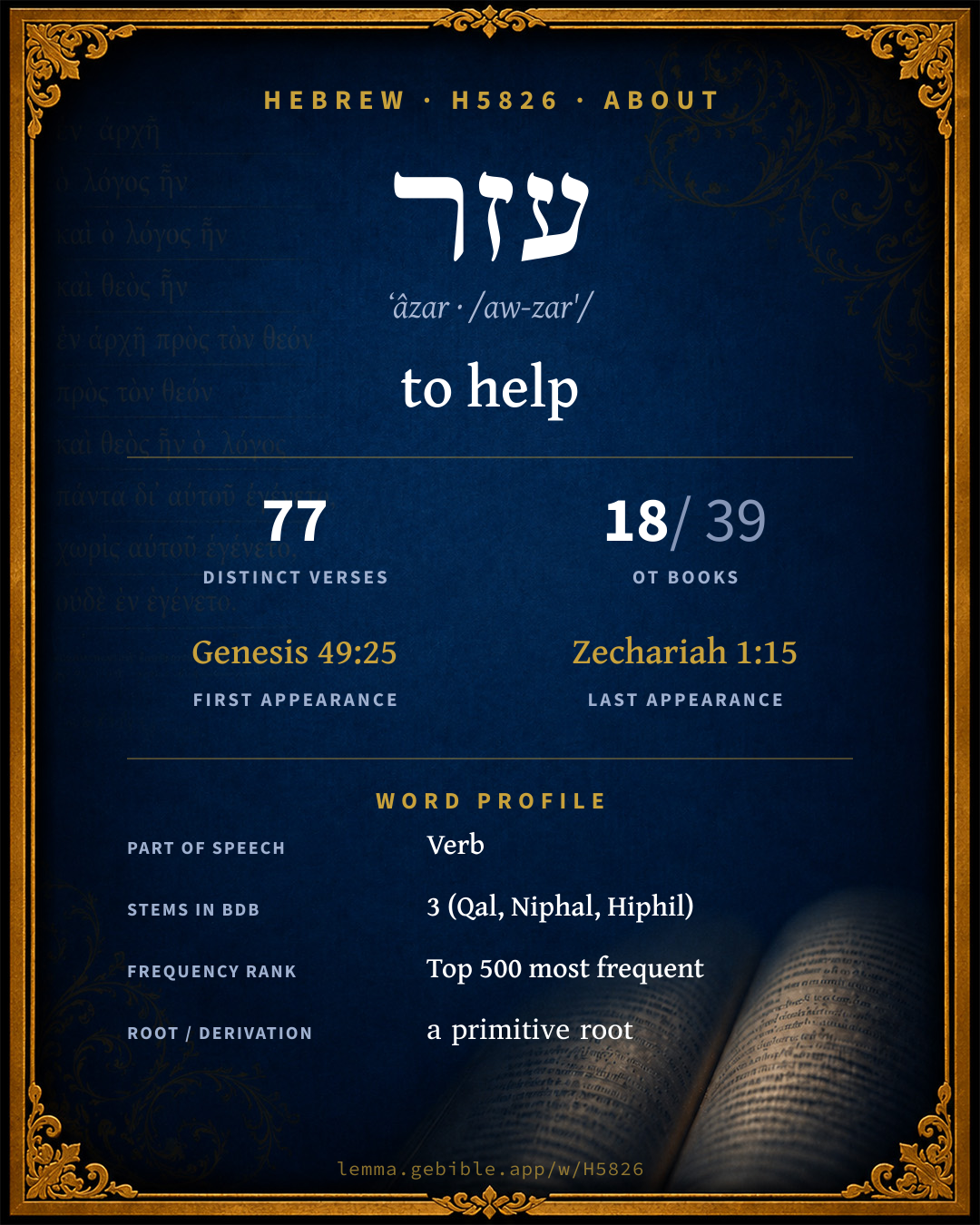
עָזַר
to help
also: succour, support fuller range ↓
Full lexicon entry — Brown-Driver-Briggs (BDB)
From Brown-Driver-Briggs (BDB)
Where this word appears
See every Qal verb in the Hebrew Bible →
Grammar key — what these labels mean
Part of speech
- Verb
- An action or state-of-being word.
Stem
- Qal
- The basic, simple active stem — the plain form of the verb (“he wrote”).
- Niphal
- Usually the simple passive or reflexive of the Qal (“he was written”).
- Hiphil
- The causative active stem (“he caused / brought about”). Here: ‘dub.’
Form
- Participle Active
- A verbal adjective expressing ongoing or characteristic action (“writing / one who writes”).
- Infinitive Construct
- A bound verbal noun, frequently with prepositions (“to write / in writing”).
- Perfect
- A completed action or state — Hebrew marks aspect (completeness) more than strict tense (“he wrote”).
- Imperfect
- An incomplete, ongoing, or future action (“he will / would write”).
- Imperative
- A direct command (“write!”).
- Sequential Imperfect
- An imperfect with prefixed waw — the standard past-narrative form (waw-consecutive imperfect).
- Sequential Perfect
- A perfect with prefixed waw continuing a preceding imperfect or command (waw-consecutive perfect).
- Participle Passive
- A verbal adjective expressing action received (“written”).
State
- Absolute
- The independent form of a noun, not bound to a following word.
- Construct
- A noun bound to a following noun in a possessive / “of” relationship (the construct chain).
Person
- 1st Person
- The speaker (“I / we”).
- 3rd Person
- The one spoken about (“he / she / it / they”).
- 2nd Person
- The one addressed (“you”).
Gender
- Masculine
- Grammatically masculine.
- Common
- Either gender — not distinguished for this form.
Number
- Singular
- One.
- Plural
- More than one (in Hebrew, generally three or more).
2 distinct verses where H5826 appears in the Hiphil stem, across 2 books. Filtered view — show all forms. Click any verse to open its interlinear word-by-word view. Verse text shown in the World English Bible for context — . Each verse’s Hebrew form is shown with its reference; the English is not keyword-highlighted, since the data carries no word-level English alignment. Use “Compare translations” on any verse to read it across multiple English versions. This concordance covers the Hebrew Bible; Septuagint (Greek Old Testament) occurrences are not indexed here.
2 Samuel 1 verse
2 Chronicles 1 verse
About this entry
At a glance — auto-summarized from this page’s data, not written by a person. Every figure links to its source below. This summary describes the numbers; it doesn’t interpret them.
At its core, עזר (ʻâzar) means “to help.” First canonically at Genesis 49:25, it enters the text early. With 77 verses in 18 books, it is a moderately common word in the Hebrew Bible. As a verb its force shifts by stem, across 3 stems (Qal, Niphal, and more). From the same root come עזר, עזרה and יעזיר. Dig into 77-verse concordance and the renderings breakdown below.
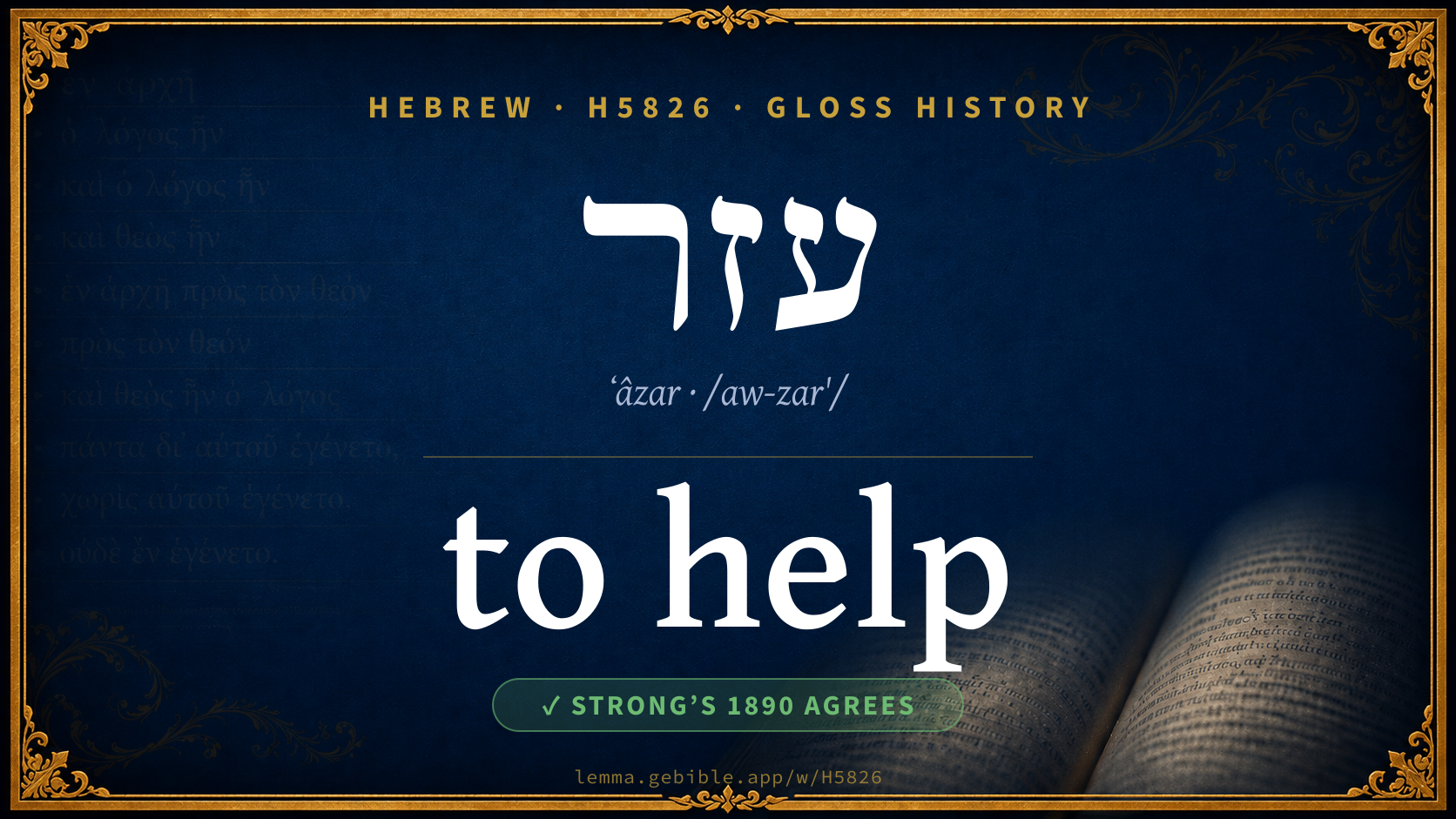
Gloss history
Strong's 1890 vs modern scholarship
About this word
Strong's H5826 catalogs a Hebrew word from the Hebrew Old Testament.
These counts are not copied from any lexicon or concordance. They are computed here, from the morphology-tagged Hebrew Old Testament. What Lemma adds →
- 77
- distinct verses
- The word appears in 77 distinct verses.
- 18 / 39
- OT books
- The word appears in 18 of 39 Old Testament books.
- #487
- by frequency
- Top 500 most frequent Hebrew words (rank 487 of 8,640 Hebrew words by occurrence).
View all 77 occurrences in the concordance →
Most concentrated in
- Psalms 17 verses 22%
- 2 Chronicles 12 verses 16%
- Isaiah 11 verses 14%
By section of the Old Testament
By traditional corpus
Conventional, traditional groupings — biblical authorship is debated, so this is a traditional corpus grouping, not an authorship claim. Each share is this word’s portion of its verses in that division of the Hebrew canon. Each figure is a share of the word’s 77 distinct verses.
- Writings (Ketuvim) 49 verses · 64%
- Prophets (Nevi'im) 26 verses · 34%
- Torah (Pentateuch) 2 verses · 3%
How translations render this word
Counts come from each version’s own published word-to-Strong’s tagging or interlinear alignment — an approximate guide to how each version renders this word, not a word-level alignment the data otherwise carries. Because each total is that version’s own tagged count, the per-version totals vary from one another and need not match the appearance or distinct-verse counts above. These counts may also differ from a printed concordance because Lemma counts each distinctly tagged rendering and does not collapse phrase taggings into a single head-word total. This is a fixed set of word-tagged versions (KJV, ASV, BSB, ULT) and does not change with the reading translation you choose elsewhere. Each version’s license is shown beside its name below (and on Sources).
- King James Version: Help 23×, Helped 10×, Shall help 4×
- American Standard Version: Help 14×, Helped 5×, Will help 4×
- Berean Standard Bible: Help 11×, Help me 6×, Helper 5×
- unfoldingWord Literal Text: Help 11×, Helper 8×, Help me 7×
King James Version Public Domain
Renders H5826 across 81 tagged occurrences — most commonly:
Plus 31 renderings that appear only once — usually multi-word phrases or single function words the recovered tagging swept in, not distinct renderings. Not rendered by a distinct English word in 1 further occurrence.
American Standard Version Public Domain
Renders H5826 across 80 tagged occurrences — most commonly:
Plus 45 renderings that appear only once — usually multi-word phrases or single function words the recovered tagging swept in, not distinct renderings.
Berean Standard Bible Public Domain
Renders H5826 across 81 tagged occurrences — most commonly:
Plus other, less common renderings. Plus 31 renderings that appear only once — usually multi-word phrases or single function words the recovered tagging swept in, not distinct renderings.
unfoldingWord Literal Text CC BY-SA 4.0
Renders H5826 across 88 tagged occurrences — most commonly:
Plus 35 renderings that appear only once — usually multi-word phrases or single function words the recovered tagging swept in, not distinct renderings.
Senses in the full BDB
Hebrew verbs can shift meaning by stem (binyan): Qal is the basic action, Niphal is often passive or reflexive, Piel often intensifies or makes it factitive, and Hiphil is typically causative. The senses below are grouped under the stem BDB assigns to each.
What do BDB’s symbols mean?
BDB uses these scholarly abbreviations:
| Symbol | Meaning |
|---|---|
| 𝔊 | the Septuagint (the ancient Greek translation, LXX) |
| 𝔙 | the Vulgate (the Latin translation) |
| 𝔖 | the Syriac version (the Peshitta) |
| 𝔗 | the Targum (the Aramaic translation) |
| ψ | the Psalms |
| √ | root (the underlying root or stem) |
| ‖ | parallel passage (a synonymous or contrasted parallel) |
| † | the dagger: every passage where the word occurs is cited |
The 3 senses and sub-senses the full Brown-Driver-Briggs lexicon distinguishes for this word, in lexicon order (not ranked by frequency), with BDB’s own verbatim wording and sub-sense lettering. Shown in Hebrew script with BDB’s own scholarly abbreviations. The condensed entry is in the Lexicon Entry tab. See also the Forms in the corpus table below.
Qal
- Pf. 3 ms. sf. עֲזָרָ֑נִי ψ 118:13, עֲזָֽרְךָ 1 Ch 12:19; 3 pl. sf. עֲזָרֻם 1 Ch 12:20, etc.; Impf. 3 ms. יַעֲזָר־ Is 50:7, 9, sf. יַעְזְרֶךָּ Is 44:2; 3 mpl. יַעְזֹ֑רוּ Is 30:7; 41:6, וַיַּעְזְרוּ 1 K 1:7, sf. יַעַזְרֻנִי ψ 119:175, etc.; Imv. ms. sf. עָזְרֵנִי ψ 109:26; 119:86 + Jos 10:4 Kt, mpl. sf. עִזְרֻנִי Qr; etc.; Inf. cstr. לַעֲזֹר 1 Ch 22:17, לַעֲזוֹר 18:5, לַעְזֹר Jos 10:33 + 5 times, לַעְזוֹר 2 Ch 25:8 + 2 S 18:3 Qr (> Kt לַעֲזִיר Hiph.); sf. לְעָזְרֵנִי 1 Ch 12:17 + 2 times, etc.; Pt. act. עֹזֵר 1 K 20:16 +, etc.; pass. עָזֻר Is 31:3;—help, c. acc. pers. 1 K 20:16; Jos 1:14 (D), Is 41:6 + 2 Ch 28:23 reading עֹזְרִים Ges§ 53 o, for MT מַעְזְרִים, appar. Hiph.; subj. false gods); c. acc. loc. (city) Jos 10:33 (D); especially c. sf. pers. Jos 10:4, 6 (+ הוֹשִׁיעַ; both JE), 1 Ch 12:18, 20, 23 (van d. H. v 17, 19, 22), 2 Ch 32:3; Ezr 8:22 (+ מִן of enemy), 10:15; Dn 10:13 (subj. Michael); subj. often God (י׳), c. acc. pers. ψ 10:14; 1 Ch 15:26, usually sf. Gn 49:25 (poem in J), 1 S 7:12; Is 41:10, 13, 14 + 12 times + 2 Ch 26:7 (c. עַל against), ψ 37:40 (+ פִּלֵּט), 46:6 (sf. of city), 109:26 (‖ הוֹשִׁיעַ); subj. false gods Dt 32:8; 2 Ch 28:23; c. לְ pers. 2 S 8:5 + 1 Ch 18:5 + 4 times + 2 S 18:3 (read Qr לַעֲזוֹר, or לְעֹזֵר? cf. HPS); subj. י׳ Is 50:7, 9; c. עִם pers. 1 Ch 12:22 (van d. H. v 21; + עַל against); c. אַחֲרֵי pers. (constr. praegn.) 1 K 1:7; c. בְּ pers. against whom 2 Ch 20:23 (+ inf.); c. בֵּין … לְ, of י׳, 2 Ch 14:10; abs. Is 30:7; 2 Ch 26:13 (+ עַל against), 28:16; ע׳ לְרָעָה Zc 1:15 they helped, with evil result; י׳ subj., 2 Ch 25:8 (opp. הַכְשִׁיל); also pt. c. sf. Ez 30:8 + 3 times; c. לְ pers. 2 K 14:26 + 5 times; of י׳ ψ 30:11; 54:6; abs. Is 31:3; 63:5 Je 47:4 ψ 22:12; 107:12; cstr. עֹזְרֵי הַמִּלְחָמָה 1 Ch 12:1, עֹזְרֵי רָ֑הַב Jb 9:13 (v. רַהַב); Pt. pass. abs. as subst. he who is helped Is 31:3. e.g. Psalms 118:13
Niphal
- Pf. וְנֶעֱזָרְ֑תִּי ψ 28:7 I am helped (sc. by י׳); Impf. 3 mpl. וַיֵּעָֽזְרוּ 1 Ch 5:20 (sc. id.; + עַל against), c. n. cogn. יֵעָֽזְרוּ עֵזֶר מְעָט Dn 11:34; Inf. cstr. הִפְלִיא לְהֵעָזֵר 2 Ch 26:15 he was wonderfully helped (lit. made wonderful to be helped). e.g. Psalms 28:7
Hiphil
- dub.: Inf. cstr. 2 S 18:3 Kt, Pt. pl. מַעְזְרִים 2 Ch 28:23, v. Qal. e.g. 2 Samuel 18:3
Senses from the full Brown-Driver-Briggs lexicon (Brown, Driver, Briggs; Oxford 1906 — public domain), digitized via Sefaria, supplemented by the OpenScriptures HebrewLexicon (CC BY 4.0). Full attribution on Sources.
Word origin
vb. help, succour (NH n. עֶזְרָה help; Ph. in deriv. and cpds. Lzb338 f.; Arabic عَذَرَ excuse, exculpate, also aid; Aramaic ܥܕܰܪ help, Palm. עדר, rarely עזר Lzb338 Cook89.90);—
— Brown-Driver-Briggs (Oxford 1906, public domain), digitized via Sefaria, supplemented by the OpenScriptures HebrewLexicon (CC BY 4.0). See Sources.
Origin: a primitive root
Jastrow Dictionary
A second Hebrew/Aramaic lexicon for comparison, covering Aramaic and post-biblical (Talmudic, Targumic, Midrashic) usage that the biblical-Hebrew BDB does not. Matched by lemma rather than by Strong’s number, so a lemma may carry more than one Jastrow headword (shown separately below), and the entries cover usage well beyond the Bible.
עָזַר
- [to surround,] to help, protect. Yalk. Num. 759 (play on אל אלעזר, Num. XIX, 3) אל אל עוֹזֵר (give her, i.e. Rome, over) to the helping God (omitted in Pesik. Par., p. 41ᵃ; Pesik. R. s. 14). Yeb. 63ᵃ (ref. to Gen. II, 20) זכה עוֹזַרְתּוֹ וכ׳ if he deserves well, she is a help to him &c., v. next w.—Midr. Till. to Ps. CXXI אתם יודעים מי עוזר אתכם עושה וכ׳ do you know who is your helper? The maker of heaven and earth. Gen. R. s. 44 (ref. to Gen. XV, 2 דמשק אליעזר) שבשבילו רדפתי מלכים עד דמשק וַיְעַזְרֵנִי האל for his (Lot’s) sake I pursued the kings as far as Damascus, and God helped me; a. e. e.g. Numbers 19:3
עֵזֶר
- preced.) help; trnsf. (after Gen. II, 20) helpmate. Pirké d’R. El. ch. XII ועשאה ע׳ וכ׳ (not ועשתה) and he made her a help and placed her opposite him. Ib. משבנה לו ע׳ אשה when he had built for him a helpmate named ishshah. Ib. אם זכה תהיה לו ע׳ וכ׳ if he deserves well, she will be to him a help, if not, an opposition; Gen. R. s. 17, a. e., v. נֶגֶד. Yalk. Gen. 62 לאדם ולעֶזְרוֹ for Adam and his wife; Pirké d’R. El. ch. XX. Ib. ch. XXI אדם ועוזרו (corr. acc.); a. e. e.g. Genesis 2:20
A Dictionary of the Targumim, the Talmud Babli and Yerushalmi, and the Midrashic Literature (Marcus Jastrow; London, Luzac, 1903) — Public Domain. Digitized via Sefaria. Digitized via Sefaria. Full attribution on Sources.
Forms in the corpus
The 70 distinct written forms H5826 takes in the Hebrew Bible, most frequent first — each parse links to that stem’s occurrences in the concordance. Hebrew forms include their vowel points and cantillation, so a single lemma takes many written forms.
The 60 most common forms are shown; 10 rarer forms follow in the full concordance.
Same root — word family
Other BDB entries built from the same root as H5826, grouped by Strong’s listed origin. These share a root / origin per the lexicon — not necessarily a shared meaning. Each links to that word’s own entry.
Derived from this word
Proper names from this root
People and places named from this root — a name, not an additional meaning of the word.
- יעזיר Yaʻăzêyr H3270 Jazer
- עזור ʻAzzûwr H5809 Azur
- עזר ʻEzer H5827 Ezer
- עזראל ʻĂzarʼêl H5832 Azarael
- עזריה ʻĂzaryâh H5838 Azariah
Compare all same-root words → Showing 4 of 8 — not the complete family. 5 of the same-root words are proper names (people or places). They share a root, not necessarily a meaning.
Septuagint verse parallels
This word appears in 69 verses that also exist in the Greek Old Testament (Septuagint), out of the 77 Hebrew verses it occurs in. You can read those verses in Greek by switching the Old Testament edition to the Septuagint.
Read these verses in the Septuagint
- Genesis 49:25
- Deuteronomy 32:38
- Joshua 1:14
- 1 Samuel 7:12
- 2 Samuel 8:5
- 1 Kings 1:7
- 2 Kings 14:26
- 1 Chronicles 5:20
- 2 Chronicles 14:11
- Ezra 8:22
- Job 9:13
- Psalms 28:7
This is a verse-level parallel only — the same verses exist in both the Hebrew and Greek Old Testaments. No word-level Hebrew↔Greek correspondence is claimed: the data carries no such alignment, so no Greek word is shown as this Hebrew word’s translation. Coverage is not total — the Septuagint omits the deuterocanon and renumbers the Psalms, so some Hebrew verses have no direct Greek parallel.