
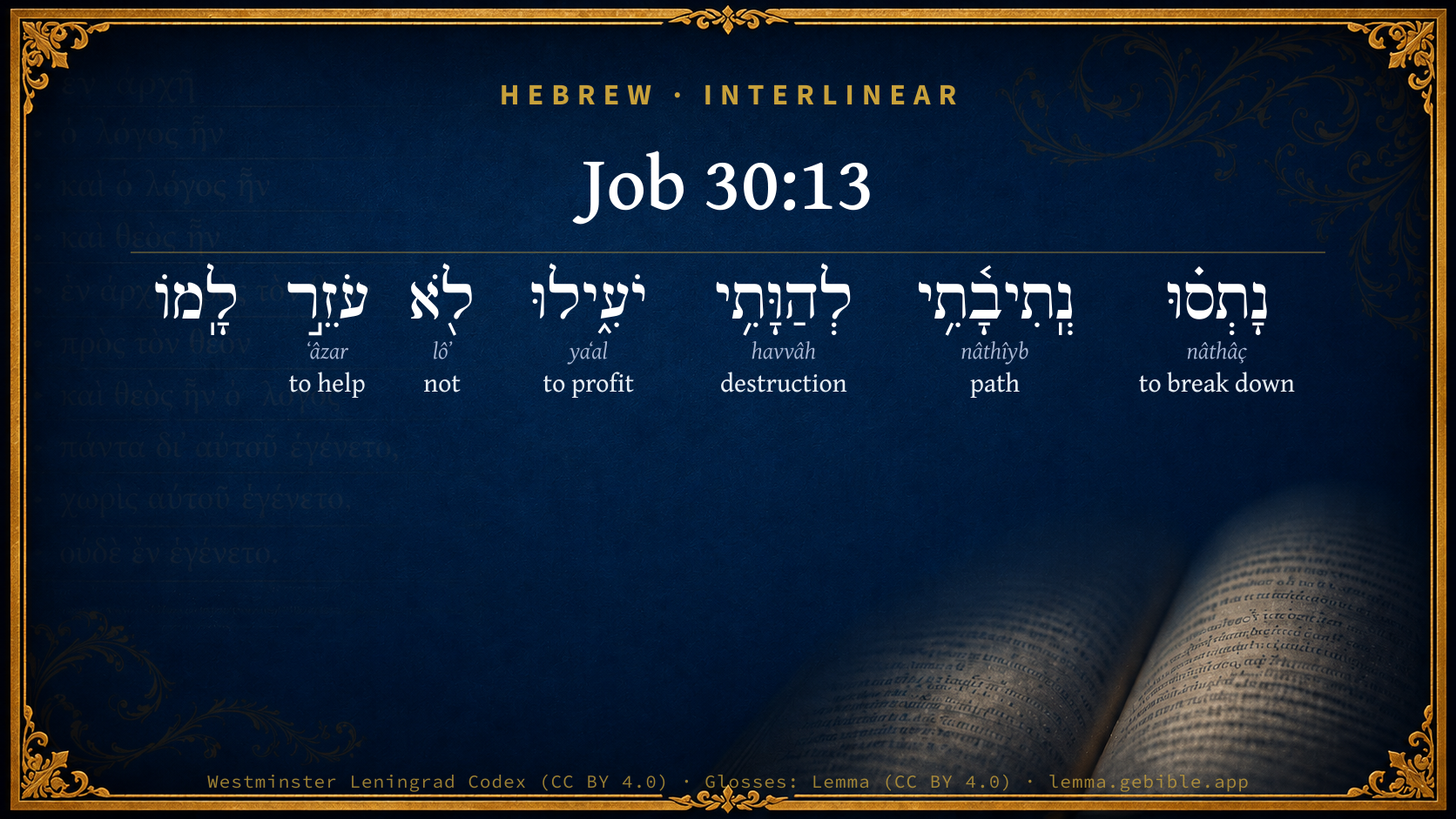
Job 30:13

Hebrew (Westminster Leningrad Codex) Job 30:13 appears in the Hebrew Old Testament. The text above is from the Westminster Leningrad Codex. Each word links to its Strong’s number, a concise gloss, and parsing drawn from the Open Scriptures Hebrew Bible morphology. Click any word for its full Brown-Driver-Briggs (BDB) entry.
Download image
Cite this verse

Job 30:13 (World English Bible). Public Domain. Lemma interlinear Bible study tool, https://lemma.gebible.app/v/job/30/13.

Show BibTeX & RIS
BibTeX
RIS
English Translation
They mar my path, They set forward my calamity, Without anyone's help.
World English Bible · Public Domain
Highlights Full analysis ↓
Download a study sheet

One document with this verse’s original text, its word-by-word gloss line, the meaning frame, cross-references with their text, attributed commentary, and full source and license credits — printable, and it pastes into notes with its structure intact.

This verse Autodidact and up

Study sheet (.html) Plain text (.txt)

A passage Seminary Student

Up to 50 verses in one chapter. A passage sheet keeps up to 6 commentary sources and 12 cross-references per verse, in the order this page ranks them, and says so on the sheet whenever that leaves anything out. Ask for a single verse and you get the Autodidact verse sheet above.

Everything on this page stays free to read, with no account — the sheet is a download of what is already on screen, not access to it.

Want to remove ads? Support Godless Engineer
Compare translations 3

The same verse in 3 English versions, stacked beneath the original-language interlinear above. Click any original word for its lexicon entry.

Each is an independent rendering of the whole verse — the interlinear is not word-aligned to these translations.

Highlighted words mark where these versions differ — a whole-verse word diff, not a word-by-word alignment.

  • World English Bible Public Domain
    They mar my path, They set forward my calamity, Without anyone's help.
  • King James Version Public Domain
    They mar my path, they set forward my calamity, they have no helper.
  • unfoldingWord Literal Text CC BY-SA 4.0
    They destroy my path, they advance my calamity; no help for them.

unfoldingWord Literal Text — © unfoldingWord, licensed CC BY-SA 4.0. Word-aligned USFM3 via Door43 (git.door43.org/unfoldingWord/en_ult).

Versions to compare (up to 4)

3 of 4 selected

Show all 18 translations

Every available English version of this verse, each an independent rendering of the whole verse.

  • World English Bible Public Domain
    They mar my path, They set forward my calamity, Without anyone's help.
  • Berean Standard Bible Public Domain
    They tear up my path; they profit from my destruction, with no one to restrain them.
  • Majority Standard Bible Public Domain
    They tear up my path; they profit from my destruction, with no one to restrain them.
  • King James Version Public Domain
    They mar my path, they set forward my calamity, they have no helper.
  • American Standard Version (1901) Public Domain
    They mar my path, They set forward my calamity, `Even' men that have no helper.
  • Revised Version (1885) Public Domain
    They mar my path, they set forward my calamity, even men that have no helper.
  • Geneva Bible (1599) Public Domain
    They haue destroyed my paths: they tooke pleasure at my calamitie, they had none helpe.
  • Douay-Rheims (1899) Public Domain
    They have destroyed my ways, they have lain in wait against me, and they have prevailed, and there was none to help.
  • Young's Literal Translation Public Domain
    They have broken down my path, By my calamity they profit, `He hath no helper.'
  • Literal Standard Version CC BY-SA 4.0
    They have broken down my path, || They profit by my calamity: He has no helper.
  • Unlocked Literal Bible CC BY-SA 4.0
    They destroy my path; they push forward disaster for me, men who have no one to hold them back.
  • unfoldingWord Literal Text CC BY-SA 4.0
    They destroy my path, they advance my calamity; no help for them.
  • Darby Bible Public Domain
    They mar my path, they set forward my calamity, without any to help them;
  • World Messianic Bible Public Domain
    They mar my path. They promote my destruction without anyone’s help.
  • Webster's Bible Public Domain
    They mar my path, they set forward my calamity, they have no helper.
  • Free Bible Version CC BY-SA 4.0
    They cut off my way of escape; they bring about my downfall and do this without anyone's help.
  • Bible in Basic English Public Domain
    They have made waste my roads, with a view to my destruction; his bowmen come round about me;
  • JPS Tanakh (1917) Public Domain
    They break up my path, they further my calamity, even men that have no helper.

Literal Standard Version (2020), Covenant Press — licensed CC BY-SA 4.0. Text via the HelloAO Bible API (eBible.org). Unlocked Literal Bible (unfoldingWord) — licensed CC BY-SA 4.0. Text via the HelloAO Bible API (eBible.org). unfoldingWord Literal Text — © unfoldingWord, licensed CC BY-SA 4.0. Word-aligned USFM3 via Door43 (git.door43.org/unfoldingWord/en_ult). Free Bible Version, Dr. Jonathan Gallagher — licensed CC BY-SA 4.0. Text via the HelloAO Bible API (eBible.org).

Word by word

More ways to search: Search by grammar → Find every occurrence → Compare this word →

Practice this passage: Drill this verse → Learn its vocabulary →

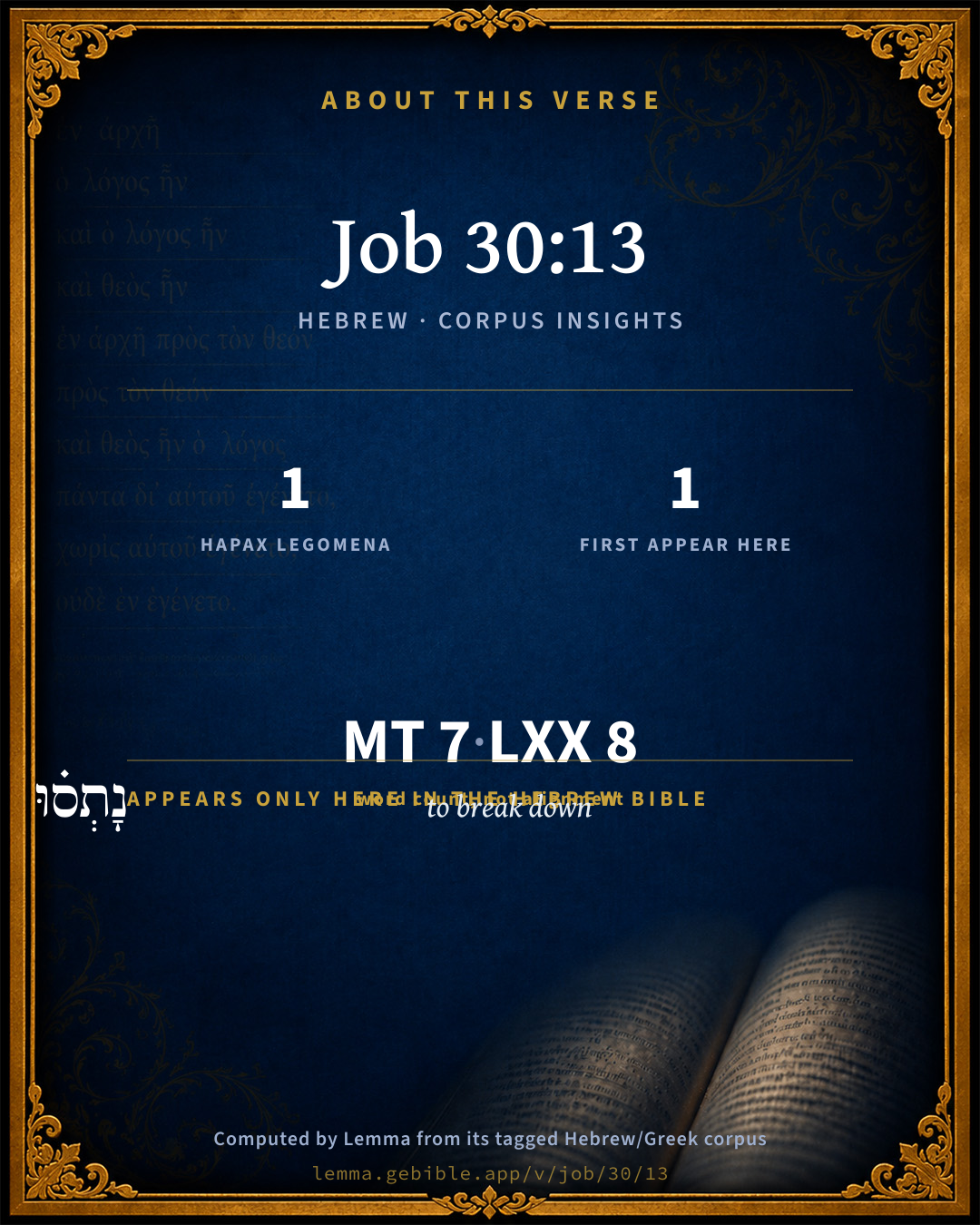
About this verse

These counts appear in no published source. They are computed here, from the morphology-tagged text and Lemma’s own curated glosses. What Lemma adds →

7
words
6
distinct lemmas
Wisdom
section

Notable vocabulary

1 hapax legomenon — a word that appears only here in the entire Hebrew Bible:

  • נָתְס֗וּ to break down H5420

First appearance in Scripture

This word makes its first canonical appearance in the Hebrew Bible here:

  • נָתְס֗וּ to break down H5420

Shared distinctive vocabulary

לְהַוָּתִ֥י destruction H1942 occurs in 16 verses of the Hebrew Bible. Also found in:

Grammatical profile

  • 3 verbs
  • 2 nouns
  • 1 preposition
  • 1 particle

Verb forms

  • נָתְס֗וּ Qal · Perfect
  • יֹעִ֑ילוּ Hiphil · Imperfect
  • עֹזֵ֣ר Qal · Participle Active

Hebrew & Septuagint length

In English translation the verse runs 12 words from the Hebrew and 19 from the Septuagint (LXX English) — the Septuagint runs noticeably longer here. See the side-by-side →

A rough comparison of the two English renderings, which tokenize alike — not a word-level alignment.

Word counts can differ between the Hebrew and the Greek without any difference in meaning — e.g. the Hebrew direct-object marker אֵת has no separate Greek word, and Greek often adds the article ὁ.

In the original languages it is 7 Hebrew tokens and 8 Greek tokens — but the two are counted differently (Hebrew bundles its prefixes and suffixes into one token; the Greek is in lemma form), so that isn’t a like-for-like length.

Cross-references

3

Topical passages linked to Job 30:13 in the Treasury of Scripture Knowledge — connected by theme and wording, ordered by reader-vote popularity; previews shown in the World English Bible.

  • Psalms 69:26 For they persecute him whom you have wounded. They tell of the sorrow of those whom you have hurt.
  • Isaiah 3:12 As for my people, children are their oppressors, And women rule over them. My people, those who lead you cause you to err, And destroy the way of your paths.
  • Zechariah 1:15 I am very angry with the nations that are at ease; for I was but a little displeased, but they added to the calamity."

Cross-references courtesy of OpenBible.info (CC BY 4.0).

Hebrew and Greek witnesses Masoretic Hebrew ↔ Greek Septuagint

The same verse in the two great witnesses to the Old Testament, shown verse-for-verse.

Here the Septuagint runs noticeably longer than the Hebrew — LXX2012 (modern English Septuagint) 19 words vs World English Bible 12. A rough length comparison of the two English translations, not a word-level alignment — read both below.

These are two independent witnesses, not word-aligned to each other, and the Septuagint is shown in lemma (dictionary) form.

Hebrew Job 30:13 Masoretic · Westminster Leningrad Codex

נָתְס֗וּ נְֽתִיבָ֫תִ֥י לְהַוָּתִ֥י יֹעִ֑ילוּ לֹ֖א עֹזֵ֣ר לָֽמוֹ

They mar my path, They set forward my calamity, Without anyone's help.

World English Bible · Public Domain

Greek LXX Job 30:13 Septuagint · lemma form

ἐκτρίβω τρίβος ἐγώ ἐκδύω γάρ ἐγώ ὁ στολή

My paths are ruined; for they have stripped off my raiment: he has shot at me with his weapons.

LXX2012 (modern English Septuagint) · Public Domain

On this verse, Haydock's Catholic Bible Commentary discusses the Septuagint’s reading. Read the note in Commentary ↓

Hebrew: Westminster Leningrad Codex (CC BY 4.0). Greek: Septuagint (public domain); English from LXX2012 (modern English Septuagint) (Public Domain). How the Septuagint differs from the Hebrew →

Commentary

Notes on Job 30:13 from classic Christian and Jewish commentators (each source and its license shown beneath its notes). The classic Christian expositions comment on the surrounding passage and are grouped to its opening verse, so a note may address several verses; the Jewish commentaries on the Tanakh (Rashi and others) are per-verse, so they appear only where the commentator wrote on this verse.

Lemma curates 59 commentaries, every one of them public domain or Creative Commons licensed, each selected and text-cleaned for this edition rather than reprinted as found. About our sources →

Trapp's Complete Commentary

John Trapp

Job 30:13 They mar my path, they set forward my calamity, they have no helper.

Ver. 13. They mar my paths] That is, all my studies and endeavours; they obstruct all passages whereby I might hope for help, as if they were resolved upon my ruin.

They set forward my calamity] See Zec 1:15. {See Trapp on "Zec 1:15"} Or they count it profitable to them to vex me, so great is their malice against me. And though it do them no good, yet if they may do me hurt, they have enough.

They have no helper] Neither need they any to animate them or egg them on to mischief, who of themselves are overly forward, though but small and young, as Vajezatha, Haman’s youngest son, was. {See Trapp on "Est 9:9"}

John Trapp, A Commentary or Exposition upon All the Books of the Old and New Testament (1647–1656) — public domain. Text from a community e-Sword module.

Joseph Benson's Commentary

Job 30:13. They mar my path — Or, rather, dig up my path. As I am in great misery, so they endeavour to stop all my ways out of it, and to frustrate all my counsels and methods for obtaining relief and comfort. The allusion to a place besieged is still carried on; the besiegers of which strive to cut off all communication of the besieged with the country around. Or, the sense may be, they pervert all my ways, putting perverse and false constructions on them, censuring my conscientious discharge of my duty to God and men as nothing but craft and hypocrisy. They set forward my calamity — Increasing it by bitter taunts, invectives, and censures. But יעילו, jognilu, may be rendered, They profit by, or are pleased with, my calamity. Heath reads this and the next clause, They triumph in my calamity: there is none who helpeth me against them.

Joseph Benson's Commentary on the Old and New Testaments (1811–1818) — public domain. Text from a community e-Sword module.

Keil & Delitzsch

C. F. Keil & F. Delitzsch

13 They tear down my path,

They minister to my overthrow,

They who themselves are helpless.

14 As through a wide breach they approach,

Under the crash they roll onwards.

15 Terrors are turned against me,

They pursue my nobility like the wind,

And like a cloud my prosperity passed away. -

They make all freedom of motion and any escape impossible to him, by pulling down, diruunt, the way which he might go. Thus is נתסוּ (cogn. form of נתץ, נתע, נתשׁ) to be translated, not: they tear open (proscindunt), which is contrary to the primary signification and the usage of the language. They, who have no helper, who themselves are so miserable and despised, and yet so feelingless and overbearing, contribute to his ruin. הועיל, to be useful, to do any good,to furnish anything effective (e.g., Isa 47:12), is here united with ל of the purpose; comp. עזר ל, to help towards anything, Zac 1:15. היה (for which the Keri substitutes the primary form הוּה), as was already said on Job 6:2, is prop. hiatus, and then barathrum, pernicies, like הוּה in the signification cupiditas, prop. inhiatio. The verb הוה, Arab. hwy, also signifies delabi, whence it may be extended (vid., on Job 37:6) in like manner to the signification abyss (rapid downfall); but a suitable medium for the two significations, strong passion (Arab. hawa) and abyss (Arab. hâwije, huwwe, mahwa), is offered only by the signification of the root flare (whence hawâ, air). לא עזר למו is a genuine Arabic description of these Idumaean or Hauranite pariahs. Schultens compares a passage of the Hamsa: "We behold you ignoble, poor, laisa lakum min sâir-in-nâsi nasirun, i.e., without a helper among the rest of men." The interpretations of those who take למו for לו, and this again for לי (Eichh., Justi), condemn themselves. It might more readily be explained, with Stick.: without any one helping them, i.e., with their own strong hand; but the thought thus obtained is not only aimless and tame, but also halting and even untrue (vid., Job 19:13).

Job 30:14

The figure of a siege, which is begun with Job 30:12 and continued in Job 30:13, leaves us in no doubt concerning פּרץ רחב and שׁאה. The Targ. translates: like the force of the far-extending waves of the sea, not as though פּרץ could in itself signify a stream of water, but taking it as = פרץ מים, Sa2 5:20 (synon. diffusio aquarum). Hitzig's translation:

(Note: Vid., Deutsche Morgenlnd. Zeitschr. ix. (1855), S. 741, and Proverbs, S. 11.)

"like a broad forest stream they come, like a rapid brook they roll on," gives unheard-of significations to the doubtful words. In Job 16:14 we heard Job complain: He (Eloah) brake through me על־פני־פרץ פרץ, breach upon breach, - by the divine decrees of sufferings, which are completed in this ill-treatment which he receives from good-for-nothing fellows, he is become as a wall with a wide-gaping breach, through which they rush in upon him (instar rupturae, a concise mode of comparison instead of tanquam per rupt.), in order to get him entirely into their power as a plaything for their coarse passions. שׁאה is the crash of the wall with the wide breaches, and תּחת שׁאה signifies sub fragore in a local sense: through the wall which is broken through and crashes above the assailants. There is no ground in Job 30:15 for dividing, with Umbreit, thus: He hath turned against me! Terrors drove away, etc., although this would not be impossible according to the syntax (comp. Gen 49:22, בּנות צעדה). It is translated: terrors are turned against me; so that the predicate stands first in the most natural, but still indefinite, personal form, Ges. 147, a, although בּלּהות might also be taken as the accus. of the object after a passive, Ges. 143, 1. The subj. of Job 30:15 remains the same: they (these terrors) drive away my dignity like the wind; the construction is like Job 27:20; Job 14:19; on the matter, comp. Job 18:11. Hirz. makes כּרוּח the subj.: quasi ventus aufert nobilitatem meam, in which case the subj. would be not so much ventus as similitudo venti, as when one says in Arabic, 'gani kazeidin, there came to me one of Zeid's equals, for in the Semitic languages כּ has the manner of an indeclinable noun in the signification instar. But the reference to בלהות is more natural; and Hahn's objection, that calamity does not first, if it is there, drive away prosperity, but takes the place of that which is driven away, is sophisticated and inadequate, since the object of the driving away here is not Job's prosperity, but Job's נדיבה, appearance and dignity, by which he hitherto commanded the respect of others (Targ. רבּנוּתי). The storms of suffering which pass over him take this nobility away to the last fragment, and his salvation - or rather, since this word in the mouth of an extra-Israelitish hero has not the meaning it usually otherwise has, his prosperous condition (from Arab. wasi‛a, amplum esse) - is as a cloud, so rapidly and without trace (Job 7:9; Isa 44:22), passed away and vanished. Observe the music of the expression כּעב עברה, which cannot be reproduced in translation.

Keil & Delitzsch — Biblical Commentary on the Old Testament (1861–1891) — public domain (CC PDM 1.0). Text via the HelloAO Bible API. (Old Testament only.)

Geneva Bible (1599)

Geneva Bible translators

They need none to help them.

Geneva Bible (1599) marginal notes — public domain. Text via Bolls.life.

Jamieson, Fausset & Brown

Robert Jamieson, A. R. Fausset & David Brown

Image of an assailed fortress continued. They tear up the path by which succor might reach me.

set forward-- (Zac 1:15).

they have no helper--Arabic proverb for contemptible persons. Yet even such afflict Job.

Jamieson, Fausset & Brown — Commentary Critical and Explanatory on the Whole Bible (1871) — public domain (CC PDM 1.0). Text via the HelloAO Bible API.

Adam Clarke's Commentary

Verse 13. They mar my path] They destroy the way-marks, so that there is no safety in travelling through the deserts, the guide-posts and way-marks being gone.

These may be an allusion here to a besieged city: the besiegers strive by every means and way to distress the besieged; stopping up the fountains, breaking up the road, raising up towers to project arrows and stones into the city, called here raising up against it the ways of destruction, Job 30:12; preventing all succour and support.

They have no helper.] "There is not an adviser among them."-Mr. Good. There is none to give them better instruction.

Adam Clarke's Commentary on the Bible (1810–1826) — public domain. Text from a community e-Sword/MySword module.

Ellicott's Commentary for English Readers

(13) They have no helper—i.e., probably without deriving therefrom any help or advantage themselves.

A Bible Commentary for English Readers, edited by Charles John Ellicott (1878–1897) — public domain. Text from a community e-Sword module.

The Cambridge Bible for Schools and Colleges

gen. ed. J. J. S. Perowne

13. They mar my path] Or, they break up my path. The reference can hardly be to the path or way leading to the besieged place (Job_30:12), so that the approach of succour is cut off; if the figure be continued the path must rather be the way of escape. Perhaps the figure is departed from in this clause, and the words may be taken more generally as meaning the path of his life, which they make it impossible to go in.

set forward my calamity] i. e. help on my downfall—aggravate my afflictions and advance the issue of them.

they have no helper] Or, they who have no helper. The phrase “to have no helper” means to be one shunned and despised of all. Yet Such persons now persecute him with injurious insult. The words are an involuntary exclamation. The phrase might mean: against whom there is no helper; i. e. none to rescue Job from them, or to interfere in his behalf against them.

The Cambridge Bible for Schools and Colleges (gen. ed. J. J. S. Perowne; Cambridge University Press, 1878–1918) — public domain. Text from a community e-Sword module.

John Gill's Exposition

They mar my path,.... Hindered him in the exercise of religious duties; would not suffer him to attend the ways and worship of God, or to walk in the paths of holiness and righteousness; or they reproached his holy walk and conversation, and treated it with contempt, and triumphed over religion and godliness:

they set forward my calamity; added affliction to affliction, increased his troubles by their reproaches and calumnies, and were pleased with it, as if it was profitable as well as pleasurable to them, see Zac 1:15;

they have no helper; either no person of note to join them, and, to abet, assist, and encourage them; or they needed none, being forward enough of themselves to give him all the distress and disturbance they could, and he being so weak and unable to resist them; nor there is "no helper against them" (q); none to take Job's part against them, and deliver him out of their hands, see Ecc 4:1.

(q) "adversus illos", Beza, Schmidt, Michaelis; so Noldius, p. 514.

John Gill's Exposition of the Whole Bible (1746–1763) — public domain (CC PDM 1.0). Text via the HelloAO Bible API.

Albert Barnes' Notes on the Bible

They mar my path - They break up all my plans. Perhaps here, also, the image is taken from war, and Job may represent himself as on a line of march, and he says that this rabble comes and breaks up his path altogether. They break down the bridges, and tear up the way, so that it is impossible to pass along. His plans of life were embarrassed by them, and they were to him a perpetual annoyance.

They set forward my calamity - Luther renders this part of the verse, “It was so easy for them to injure me, that they needed no help.” The literal translation of the Hebrew here would be, “they profit for my ruin;” that is, they bring as it were profit to my ruin; they help it on; they promote it. A similar expression occurs in Zec 1:15, “I was but a little displeased, and they helped forward the afliction;” that is, they aided in urging it forward. The idea here is, that they hastened his fall. Instead of assisting him in any way, they contributed all they could to bring him down to the dust.

They have no helper - Very various interpretations have been given of this phrase. It may mean, that they had done this alone, without the aid of others; or that they were persons who were held in abhorrence, and whom no one would assist; or that they were worthless and abandoned persons. Schultens has shown that the phrase, “one who has no helper,” is proverbial among the Arabs, and denotes a worthless person, or one of the lowest class. In proof of this, he quotes the Hamasa, which he thus translates, Videmus vos ignobiles, pauperes, quibus nullus ex reliquis hominibus adjutor. See, also, other similar expressions quoted by him from Arabic writings. The idea here then is, probably, that they were so worthless and abandoned that no one would help them - an expression denoting the utmost degradation.

Albert Barnes' Notes on the Bible (1834–1885) — public domain. Text from a community e-Sword/MySword module.

Haydock's Catholic Bible Commentary

Help them, or me. (Calmet) Septuagint, "they took off my garment." (Haydock) --- Job seemed to be besieged, and could not escape. (Calmet)

George Leo Haydock (1774–1849), Haydock's Catholic Family Bible and Commentary, 1859 edition — public domain. Excludes Psalms (Douay-Rheims chapter numbering differs from Protestant) and Deuterocanonical books (Catholic canon only).

Matthew Poole's English Annotations

As I am in great misery, so they endeavour to stop all my ways out of it, and to frustrate all my counsels and courses of obtaining relief or comfort. And although Job had no hopes of a temporal deliverance or restitution, yet he could not but observe and resent the malice of those who did their utmost to hinder it. Or the sense is, They pervert all my ways, putting perverse and false constructions upon them, censuring all my conscientious discharges of my duty to God and men, as nothing but craft and hypocrisy.

They set forward my calamity; increasing it by their bitter taunts, and invectives, and censures. Or, they profit by, or are pleased and satisfied with, my calamity. It doth them good at the heart to see me in misery.

They have no helper: this is added as an aggravation of their malice; they impudently persisted in their malicious designs against me, though none encouraged or assisted them therein. Or, even they who had no helper, who were themselves in a forlorn and miserable condition; and yet they could so far forget or overlook their own calamities as to take pleasure in mine.

Matthew Poole's English Annotations on the Holy Bible (1683–1685) — public domain. Text from a community e-Sword/MySword module.

Whedon's Commentary on the Bible

Daniel D. Whedon

13. They mar my path — In the process of the siege they break up his paths, that is, the paths that lead to him; they “set forward his calamity.” — make his destruction more certain.

They have no helper — This ambiguous expression is probably a proverbial one for “the friendless” and “the helpless.” “They are too vile to have an ally.” Schultens gives several illustrations of such Oriental use: for instance, “We behold you ignoble, poor, without a helper among the rest of men.” Zockler’s interpretation, “they need no other help,” and that of Hitzig, “they do it without gain to themselves,” are sufficiently self condemned.

Daniel D. Whedon (gen. ed.), Commentary on the Old and New Testaments (1874–1909) — public domain. Text from a community e-Sword module.

The Pulpit Commentary

They mar my path; i.e. interfere with and frustrate whatever I am bent on doing. They set forward my calamity, Professor Lee translates, "They profit by my ruin." They have no helper. If the text is sound, we must understand, "They do all this, they dare all this, even though they have no powerful men to aid them." But it is suspected that there is some corruption in the passage, and that the original gave the sense which is found in the Vulgate, "There is none to help me."

The Pulpit Commentary (1880–1919), ed. H.D.M. Spence-Jones & Joseph S. Exell — public domain. Text from a community e-Sword module.

John Wesley's Explanatory Notes

Mar - As I am in great misery, so they endeavour to stop all my ways out of it. Set forward - Increasing it by their invectives, and censures. Even they - Who are themselves in a forlorn and miserable condition.

John Wesley, Explanatory Notes Upon the Whole Bible (1754–1765) — public domain. Text via the GEBible commentary corpus.

Rashi

Rabbi Shlomo Yitzchaki (Rashi)

They break up my path Heb. נתסוּ. [My] good [path] and do not care for it. נתסוּ is like נתצוּ the “sammech” replacing the “zaddi.”

they serve to increase my calamity they continue to provoke me.

Rashi on the Tanakh — English translations: “The Judaica Press complete Tanach with Rashi, translated by A. J. Rosenberg” (CC BY 4.0); “Pentateuch with Rashi's commentary by M. Rosenbaum and A.M. Silbermann, 1929-1934” (public domain); “The Metsudah Tanach series, Lakewood, N.J” (CC BY 4.0); and “The Book of Joshua, Metsudah Publications, 1997” (CC BY 4.0). Text via Sefaria.

Lesson kit

Teaching starters — assembled from the data on this page, not authored interpretation. Every prompt links to the verse data it draws on. Edit before teaching.

Job, in the Wisdom, opens this verse with 7 words (6 distinct Hebrew lemmas). Its most distinctive word is nâthâç (“to break down”). The Greek Septuagint runs longer here. A historical commentator’s framing appears above. Read the whole chapter for the surrounding context.

Discussion questions

  1. The word nâthâç carries the sense “to break down.” How does it shape the verse?
  2. This verse holds 1 word here found nowhere else in the Hebrew Bible. What might the rare word draw attention to?
  3. The word “to break down” first appears here in Scripture. What is being introduced at this debut?
  4. Job 6:2 shares the word «destruction» with this verse. How do the two illuminate each other?
  5. Compared with the Hebrew, the Septuagint runs longer here. What questions does that raise?
  6. These translations render this verse differently. What is at stake in choosing one wording over another?
  7. The verb «נָתְס֗וּ» is Qal Perfect. How does its form color the action?
  8. Reading how Trapp's Complete Commentary and Joseph Benson's Commentary read this verse, where do the two commentators agree and where do they part?

Things to notice

Reading settings

Reading text

Shown beneath each verse's original-language words.

Old Testament
Old Testament edition

Read the OT as the Masoretic Hebrew (MT) or the Greek Septuagint (LXX).

English shown for the Greek Septuagint (in the Hebrew ↔ Greek comparison).

Comparing translations? Open the Compare panel on any verse page to stack up to four side by side.