2 Chronicles 26:7

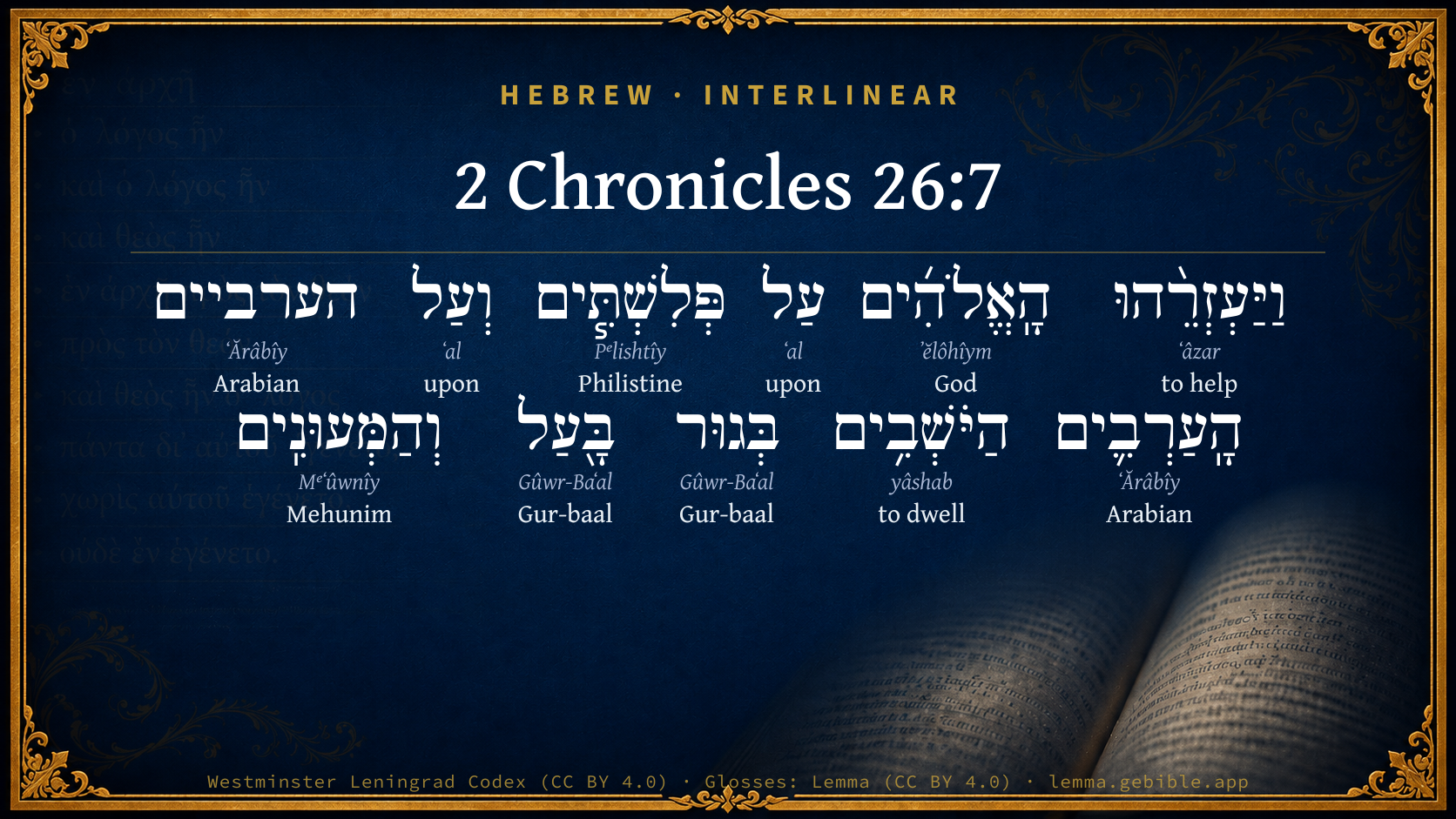
Hebrew (Westminster Leningrad Codex) 2 Chronicles 26:7 appears in the Hebrew Old Testament. The text above is from the Westminster Leningrad Codex. Each word links to its Strong’s number, a concise gloss, and parsing drawn from the Open Scriptures Hebrew Bible morphology. Click any word for its full Brown-Driver-Briggs (BDB) entry.
Download image
Cite this verse

2 Chronicles 26:7 (World English Bible). Public Domain. Lemma interlinear Bible study tool, https://lemma.gebible.app/v/2-chronicles/26/7.

Show BibTeX & RIS
BibTeX
RIS
English Translation
God helped him against the Philistines, and against the Arabians who lived in Gur Baal, and the Meunim.
World English Bible · Public Domain
Highlights
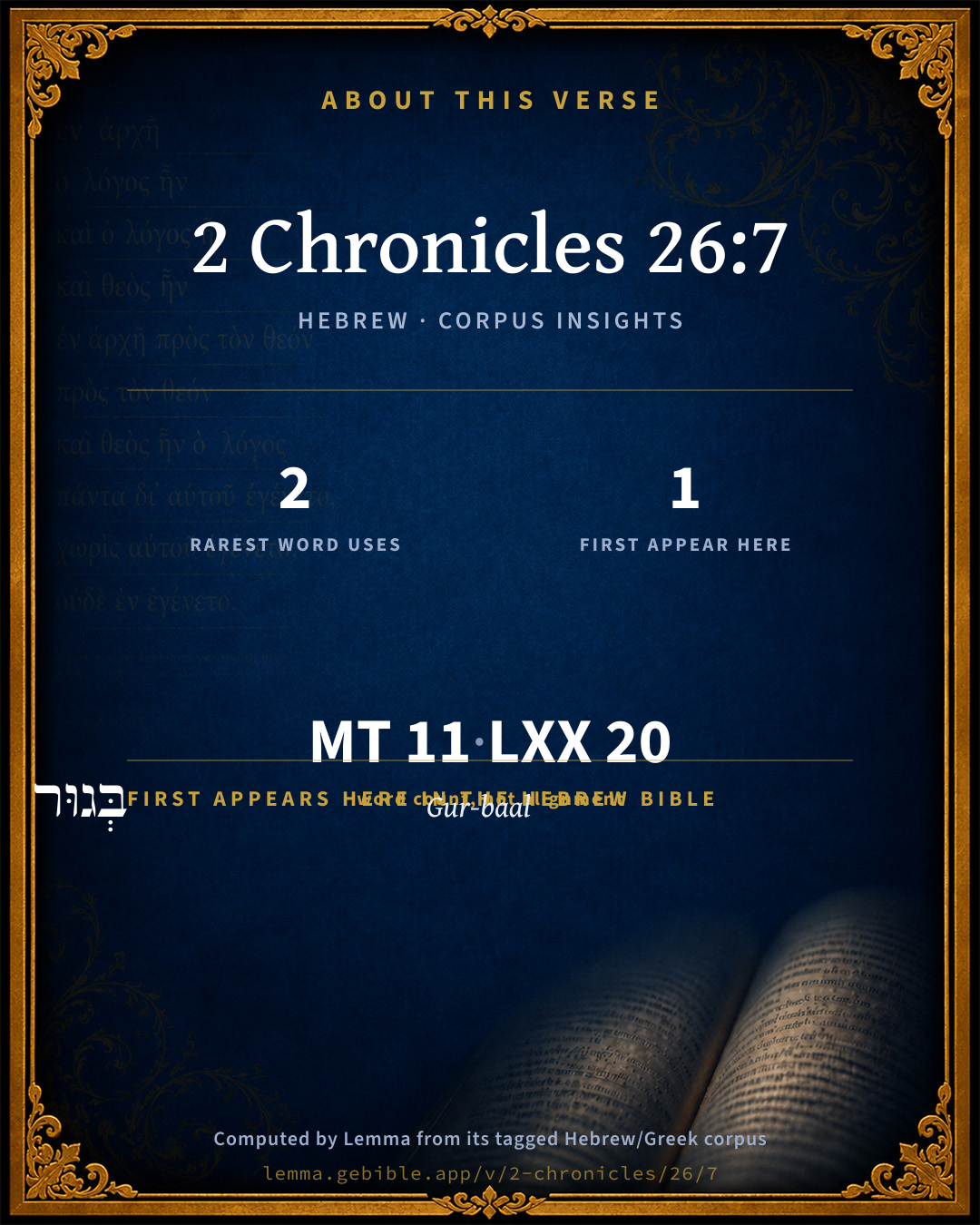
  • 1 first appearance in the Hebrew Bible
Full analysis ↓
Download a study sheet

One document with this verse’s original text, its word-by-word gloss line, the meaning frame, cross-references with their text, attributed commentary, and full source and license credits — printable, and it pastes into notes with its structure intact.

This verse Autodidact and up

Study sheet (.html) Plain text (.txt)

A passage Seminary Student

Up to 50 verses in one chapter. A passage sheet keeps up to 6 commentary sources and 12 cross-references per verse, in the order this page ranks them, and says so on the sheet whenever that leaves anything out. Ask for a single verse and you get the Autodidact verse sheet above.

Everything on this page stays free to read, with no account — the sheet is a download of what is already on screen, not access to it.

Want to remove ads? Support Godless Engineer
Compare translations 3

The same verse in 3 English versions, stacked beneath the original-language interlinear above. Click any original word for its lexicon entry.

Each is an independent rendering of the whole verse — the interlinear is not word-aligned to these translations.

Highlighted words mark where these versions differ — a whole-verse word diff, not a word-by-word alignment.

  • World English Bible Public Domain
    God helped him against the Philistines, and against the Arabians who lived in Gur Baal, and the Meunim.
  • King James Version Public Domain
    And God helped him against the Philistines, and against the Arabians that dwelt in Gurbaal, and the Mehunims.
  • unfoldingWord Literal Text CC BY-SA 4.0
    And God helped him against the Philistines, and against the Arabians who dwelled in Gurbaal, and the Meunites.

unfoldingWord Literal Text — © unfoldingWord, licensed CC BY-SA 4.0. Word-aligned USFM3 via Door43 (git.door43.org/unfoldingWord/en_ult).

Versions to compare (up to 4)

3 of 4 selected

Show all 18 translations

Every available English version of this verse, each an independent rendering of the whole verse.

  • World English Bible Public Domain
    God helped him against the Philistines, and against the Arabians who lived in Gur Baal, and the Meunim.
  • Berean Standard Bible Public Domain
    God helped him against the Philistines, against the Arabs living in Gur-baal, and against the Meunites.
  • Majority Standard Bible Public Domain
    God helped him against the Philistines, against the Arabs living in Gur-baal, and against the Meunites.
  • King James Version Public Domain
    And God helped him against the Philistines, and against the Arabians that dwelt in Gurbaal, and the Mehunims.
  • American Standard Version (1901) Public Domain
    And God helped him against the Philistines, and against the Arabians that dwelt in Gur-baal, and the Meunim.
  • Revised Version (1885) Public Domain
    And God helped him against the Philistines, and against the Arabians that dwelt in Gur-baal, and the Meunim.
  • Geneva Bible (1599) Public Domain
    And God helped him against ye Philistims, and against the Arabians that dwelt in Gur-baal and Hammeunim.
  • Douay-Rheims (1899) Public Domain
    And God helped him against the Philistines, and against the Arabians, that dwelt in Gurbaal, and against the Ammonites.
  • Young's Literal Translation Public Domain
    And God helpeth him against the Philistines, and against the Arabians who are dwelling in Gur-Baal and the Mehunim.
  • Literal Standard Version CC BY-SA 4.0
    And God helps him against the Philistines, and against the Arabians who are dwelling in Gur-Ba‘al and the Mehunim.
  • Unlocked Literal Bible CC BY-SA 4.0
    God helped him against the Philistines, against the Arabians who lived in Gurbaal, and against the Meunites.
  • unfoldingWord Literal Text CC BY-SA 4.0
    And God helped him against the Philistines, and against the Arabians who dwelled in Gurbaal, and the Meunites.
  • Darby Bible Public Domain
    And God helped him against the Philistines, and against the Arabians that dwelt in Gur-Baal, and the Maonites.
  • World Messianic Bible Public Domain
    God helped him against the Philistines, and against the Arabians who lived in Gur Baal, and the Meunim.
  • Webster's Bible Public Domain
    And God helped him against the Philistines, and against the Arabians that dwelt in Gur-baal, and the Mehunims.
  • Free Bible Version CC BY-SA 4.0
    God helped him against the Philistines, against the Arabians living in Gurbaal, and against the Meunites.
  • Bible in Basic English Public Domain
    And God gave him help against the Philistines, and against the Arabians living in Gur-baal, and against the Meunim.
  • JPS Tanakh (1917) Public Domain
    And God helped him against the Philistines, and against the Arabians that dwelt in Gur-baal, and the Meunim.

Literal Standard Version (2020), Covenant Press — licensed CC BY-SA 4.0. Text via the HelloAO Bible API (eBible.org). Unlocked Literal Bible (unfoldingWord) — licensed CC BY-SA 4.0. Text via the HelloAO Bible API (eBible.org). unfoldingWord Literal Text — © unfoldingWord, licensed CC BY-SA 4.0. Word-aligned USFM3 via Door43 (git.door43.org/unfoldingWord/en_ult). Free Bible Version, Dr. Jonathan Gallagher — licensed CC BY-SA 4.0. Text via the HelloAO Bible API (eBible.org).

Word by word

More ways to search: Search by grammar → Find every occurrence → Compare this word →

Practice this passage: Drill this verse → Learn its vocabulary →

בְּגוּר
Gûwr-Baʻal
H1485
“in/at · Gur-baal”
Preposition + Noun, Proper
Part of Speech
Preposition + Noun
Type
Proper
Full BDB Definition

Origin: from H1481 and H1168

TWOT: None

Gur-baal = "dwelling of Baal" - a place in which dwelt Arabians; probably lying between Palestine and the Arabian peninsula
  1. וַיַּעְזְרֵ֨הוּ ʻâzar H5826 “and · to help · him” Conjunction + Verb, Qal, Sequential Imperfect, 3rd Person, Masculine, Singular + Suffix, Personal, 3rd Person, Masculine, Singular
  2. הָֽאֱלֹהִ֜ים ʼĕlôhîym H430 “the · God(s)” Particle, Definite Article + Noun, Common, Masculine, Plural, Absolute
  3. עַל ʻal H5921 “upon” Preposition
  4. פְּלִשְׁתִּ֧ים Pᵉlishtîy H6430 “Philistines” Noun, Gentilic, Masculine, Plural, Absolute
  5. וְעַל ʻal H5921 “and · upon” Conjunction + Preposition
  6. הערביים ʻĂrâbîy H6163 “the · Arabians” Particle, Definite Article + Noun, Gentilic, Masculine, Plural, Absolute
  7. הָֽעַרְבִ֛ים ʻĂrâbîy H6163 “the · Arabians” Particle, Definite Article + Noun, Gentilic, Masculine, Plural, Absolute
  8. הַיֹּשְׁבִ֥ים yâshab H3427 “the · dwelling” Particle, Definite Article + Verb, Qal, Participle Active, Masculine, Plural, Absolute
  9. בָּ֖עַל Gûwr-Baʻal H1485 “Gur-baal” Noun, Proper
  10. וְהַמְּעוּנִֽים Mᵉʻûwnîy H4586 “and · the · Mehunim” Conjunction + Particle, Definite Article + Noun, Gentilic, Masculine, Plural, Absolute

About this verse

These counts appear in no published source. They are computed here, from the morphology-tagged text and Lemma’s own curated glosses. What Lemma adds →

11
words
8
distinct lemmas
Historical
section

Notable vocabulary

The rarest word here is בְּגוּר Gur-baal H1485 — appearing just 2 times in the whole Hebrew Bible.

First appearance in Scripture

This word makes its first canonical appearance in the Hebrew Bible here:

  • בְּגוּר Gur-baal H1485

Grammatical profile

  • 2 verbs
  • 7 nouns
  • 2 prepositions

Verb forms

  • וַיַּעְזְרֵ֨הוּ Qal · Sequential Imperfect
  • הַיֹּשְׁבִ֥ים Qal · Participle Active

Repetition

Words recur within this verse — often emphatic in Hebrew:

  • עַל upon H5921 ×2
  • הערביים Arabian H6163 ×2
  • בְּגוּר Gur-baal H1485 ×2

Hebrew & Septuagint length

In English translation the verse runs 18 words from the Hebrew and 21 from the Septuagint (LXX English) — closely comparable.

A rough comparison of the two English renderings, which tokenize alike — not a word-level alignment.

Word counts can differ between the Hebrew and the Greek without any difference in meaning — e.g. the Hebrew direct-object marker אֵת has no separate Greek word, and Greek often adds the article ὁ.

In the original languages it is 11 Hebrew tokens and 20 Greek tokens — but the two are counted differently (Hebrew bundles its prefixes and suffixes into one token; the Greek is in lemma form), so that isn’t a like-for-like length.

Cross-references

10

Topical passages linked to 2 Chronicles 26:7 in the Treasury of Scripture Knowledge — connected by theme and wording, ordered by reader-vote popularity; previews shown in the World English Bible.

  • 2 Chronicles 21:16 Yahweh stirred up against Jehoram the spirit of the Philistines, and of the Arabians who are beside the Ethiopians:
  • 1 Chronicles 5:20 They were helped against them, and the Hagrites were delivered into their hand, and all who were with them; for they cried to God in the battle, and he was entreated of them, because they put their trust in him.
  • 1 Chronicles 12:18 Then the Spirit came on Amasai, who was chief of the thirty, [and he said], "We are yours, David, and on your side, you son of Jesse: peace, peace be to you, and peace be to your helpers; for your God helps you." Then David received them, and made them captains of the band.
  • 2 Chronicles 14:11 Asa cried to Yahweh his God, and said, Yahweh, there is none besides you to help, between the mighty and him who has no strength: help us, Yahweh our God; for we rely on you, and in your name are we come against this multitude. Yahweh, you are our God; don't let man prevail against you.
  • 2 Chronicles 17:11 Some of the Philistines brought Jehoshaphat presents, and silver for tribute; the Arabians also brought him flocks, seven thousand and seven hundred rams, and seven thousand and seven hundred male goats.
  • 2 Chronicles 20:1 It happened after this, that the children of Moab, and the children of Ammon, and with them some of the Ammonites, came against Jehoshaphat to battle.
  • Psalms 18:29 For by you, I advance through a troop. By my God, I leap over a wall.
  • Psalms 18:34–35 He teaches my hands to war; So that my arms bend a bow of bronze.
  • Isaiah 14:29 Don't rejoice, O Philistia, all of you, because the rod that struck you is broken; for out of the serpent's root shall come forth an adder, and his fruit shall be a fiery flying serpent.
  • Acts 26:22 Having therefore obtained the help that is from God, I stand to this day testifying both to small and great, saying nothing but what the prophets and Moses said would happen,

Cross-references courtesy of OpenBible.info (CC BY 4.0).

Hebrew and Greek witnesses Masoretic Hebrew ↔ Greek Septuagint

The same verse in the two great witnesses to the Old Testament, shown verse-for-verse.

These are two independent witnesses, not word-aligned to each other, and the Septuagint is shown in lemma (dictionary) form.

Hebrew 2 Chronicles 26:7 Masoretic · Westminster Leningrad Codex

וַיַּעְזְרֵ֨הוּ הָֽאֱלֹהִ֜ים עַל פְּלִשְׁתִּ֧ים וְעַל הערביים הָֽעַרְבִ֛ים הַיֹּשְׁבִ֥ים בְּגוּר בָּ֖עַל וְהַמְּעוּנִֽים

God helped him against the Philistines, and against the Arabians who lived in Gur Baal, and the Meunim.

World English Bible · Public Domain

Greek LXX 2 Chronicles 26:7 Septuagint · lemma form

καί καταἰσχύω αὐτός κύριος ἐπί ὁ ἀλλόφυλος καί ἐπί ὁ ἄραψ ὁ καταοἰκέω ἐπί ὁ πέτρα καί ἐπί ὁ μιναῖος

And the Lord strengthened him against the Philistines, and against the Arabians that lived on the rock, and against the Minaeans.

LXX2012 (modern English Septuagint) · Public Domain

On this verse, Ellicott's Commentary for English Readers discusses the Septuagint’s reading. Read the note in Commentary ↓

Hebrew: Westminster Leningrad Codex (CC BY 4.0). Greek: Septuagint (public domain); English from LXX2012 (modern English Septuagint) (Public Domain). How the Septuagint differs from the Hebrew →

Commentary

Notes on 2 Chronicles 26:7 from classic Christian and Jewish commentators (each source and its license shown beneath its notes). The classic Christian expositions comment on the surrounding passage and are grouped to its opening verse, so a note may address several verses; the Jewish commentaries on the Tanakh (Rashi and others) are per-verse, so they appear only where the commentator wrote on this verse.

Lemma curates 59 commentaries, every one of them public domain or Creative Commons licensed, each selected and text-cleaned for this edition rather than reprinted as found. About our sources →

Trapp's Complete Commentary

John Trapp

2Ch 26:7 And God helped him against the Philistines, and against the Arabians that dwelt in Gurbaal, and the Mehunims.

Ver. 7. That dwelt in Gurbaal.] Which is the same with Gerar, saith the Gloss: where Abimelech once reigned, and Abraham sojourned.

And the Mehunims.] Called by profane authors Scenites.

John Trapp, A Commentary or Exposition upon All the Books of the Old and New Testament (1647–1656) — public domain. Text from a community e-Sword module.

Jamieson, Fausset & Brown

Robert Jamieson, A. R. Fausset & David Brown

Gur-baal--thought by some to be Gerar, and by others Gebal.

Jamieson, Fausset & Brown — Commentary Critical and Explanatory on the Whole Bible (1871) — public domain (CC PDM 1.0). Text via the HelloAO Bible API.

Adam Clarke's Commentary

Verse 7. And God helped him] "And the WORD of the Lord helped him against the Philistines, and against the Arabians who lived in Gerar, and the plains of Meun." - Targum. These are supposed to be the Arabs which are called the Meuneons, or Munites, or Meonites.

Adam Clarke's Commentary on the Bible (1810–1826) — public domain. Text from a community e-Sword/MySword module.

Ellicott's Commentary for English Readers

(7) The Philistines, and . . . the Arabians.—They are named together in 2Ch_17:11 also. Their seat, Gur-Baal, only mentioned here, is unknown. The Targum makes it Gerar; the LXX. apparently Petra (in Edom). The reading Gedor-Baal has been proposed.

The Mehunims (Heb., Me’ûnîm) are the Maonites, or people of Maon (Ma’ân), near Mount Seir. (See Note on 2Ch_20:1.)

(The Syriac and Arabic omit from “wall of Ashdod” 2Ch_26:6, to “gifts to Uzziah,” 2Ch_26:8.)

A Bible Commentary for English Readers, edited by Charles John Ellicott (1878–1897) — public domain. Text from a community e-Sword module.

The Cambridge Bible for Schools and Colleges

gen. ed. J. J. S. Perowne

7. Gur-baal] An unidentified place; a “Gur” is mentioned in 2Ki_9:27. A slight correction of the Heb. would give, “in Gerar (cp. Gen_20:1) and against the Meunim.”

Mehunims] R.V. Meunim; cp. 2Ch_20:1 (note).

The Cambridge Bible for Schools and Colleges (gen. ed. J. J. S. Perowne; Cambridge University Press, 1878–1918) — public domain. Text from a community e-Sword module.

John Gill's Exposition

And the Ammonites gave gifts to Uzziah,.... As tributaries to him, or; however, as desirous to live in friendship with him:

and his name spread abroad, even to the entering in of Egypt; so far he carried his arms, and conquered the countries that lay between Palestine and Egypt:

for he strengthened himself exceedingly; his kingdom and its coasts from the force of enemies.

John Gill's Exposition of the Whole Bible (1746–1763) — public domain (CC PDM 1.0). Text via the HelloAO Bible API.

Albert Barnes' Notes on the Bible

On the Mehunims or Maonites, see Jdg 10:12 note.

Albert Barnes' Notes on the Bible (1834–1885) — public domain. Text from a community e-Sword/MySword module.

Haydock's Catholic Bible Commentary

Gurbaal. Gerera, (S. Jerom, Trad.) or Gebal, Psalm lxxxii. 8. Sept. "the rock," or Petra, in Arabia, where Stephanus places the Gabalenes. --- Ammonites. Heb. mehunim. Sept. "Mineans," (chap. xx. 1.; H.) upon the Red Sea, (Stephanus) or Mediterranean, (Pliny vi. 28,) or in Arabia Felix. Strabo) M.

George Leo Haydock (1774–1849), Haydock's Catholic Family Bible and Commentary, 1859 edition — public domain. Excludes Psalms (Douay-Rheims chapter numbering differs from Protestant) and Deuterocanonical books (Catholic canon only).

Whedon's Commentary on the Bible

Daniel D. Whedon

7. And against the Arabians — These also injured Israel in the days of Jehoram. 2Ch_21:16. The position of Gur-baal is unknown; but from its association here with the Mehunims, we infer that it was somewhere in the vicinity of Mount Seir. On the Mehunims, or Maonites, see notes on 2Ch_20:1; 1Ch_4:41; and Jdg_10:12.

Daniel D. Whedon (gen. ed.), Commentary on the Old and New Testaments (1874–1909) — public domain. Text from a community e-Sword module.

The Pulpit Commentary

Gur-baal. Though nothing is known of this place (the meaning of which is "abode of Baal," perhaps from some temple of Baal), yet its companion Maon, the city of the Mehunim (2Ch_22:1; Jud_1:10:12) shows whereabouts it was.

The Pulpit Commentary (1880–1919), ed. H.D.M. Spence-Jones & Joseph S. Exell — public domain. Text from a community e-Sword module.

Lesson kit

Teaching starters — assembled from the data on this page, not authored interpretation. Every prompt links to the verse data it draws on. Edit before teaching.

2 Chronicles, in the Historical, opens this verse with 11 words (8 distinct Hebrew lemmas). Its most distinctive word is Gûwr-Baʻal (“Gur-baal”). A historical commentator’s framing appears above. Read the whole chapter for the surrounding context.

Discussion questions

  1. How does “Gur-baal” (Gûwr-Baʻal) shape what this verse is saying?
  2. This is the first place “Gur-baal” appears in Scripture (first appears here). What does its debut here establish?
  3. How does 2 Chronicles 21:16, which shares this passage’s theme, read alongside this verse?
  4. What does the repetition of “upon” (2× in this one verse) do in this verse?
  5. The translations on this page render this verse differently — a whole-verse word diff, not a word-by-word alignment. What might account for the different wordings?
  6. «וַיַּעְזְרֵ֨הוּ» is a Qal Sequential Imperfect verb. How does that grammatical form shape the action described?
  7. Compare how Trapp's Complete Commentary and Jamieson, Fausset & Brown read this verse. Where do they agree or differ?

Things to notice

Reading settings

Reading text

Shown beneath each verse's original-language words.

Old Testament
Old Testament edition

Read the OT as the Masoretic Hebrew (MT) or the Greek Septuagint (LXX).

English shown for the Greek Septuagint (in the Hebrew ↔ Greek comparison).

Comparing translations? Open the Compare panel on any verse page to stack up to four side by side.