
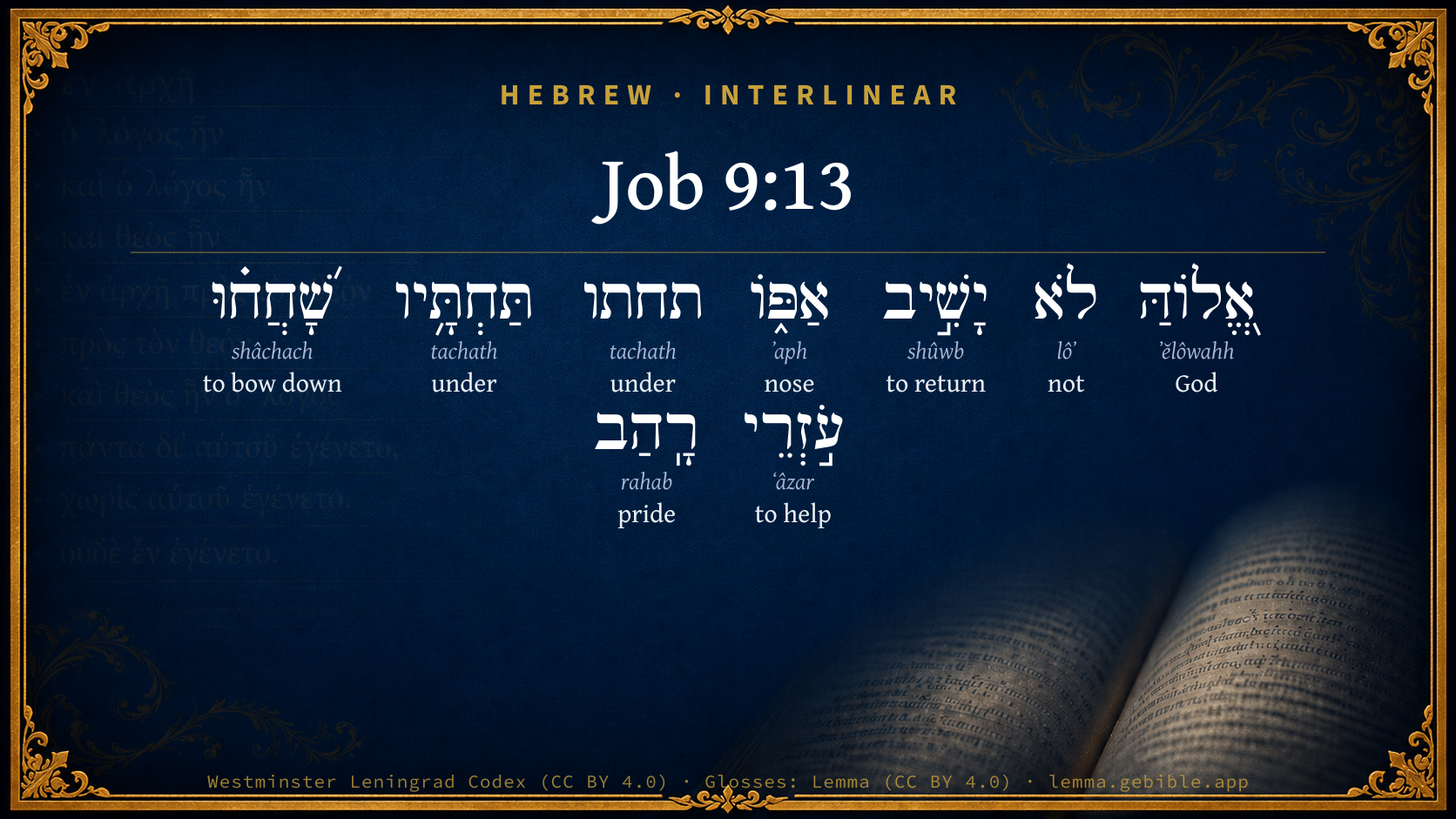
Job 9:13

Hebrew (Westminster Leningrad Codex) Job 9:13 appears in the Hebrew Old Testament. The text above is from the Westminster Leningrad Codex. Each word links to its Strong’s number, a concise gloss, and parsing drawn from the Open Scriptures Hebrew Bible morphology. Click any word for its full Brown-Driver-Briggs (BDB) entry.
Download image
Cite this verse

Job 9:13 (World English Bible). Public Domain. Lemma interlinear Bible study tool, https://lemma.gebible.app/v/job/9/13.

Show BibTeX & RIS
BibTeX
RIS
English Translation
"God will not withdraw his anger; The helpers of Rahab stoop under him.
World English Bible · Public Domain
Highlights
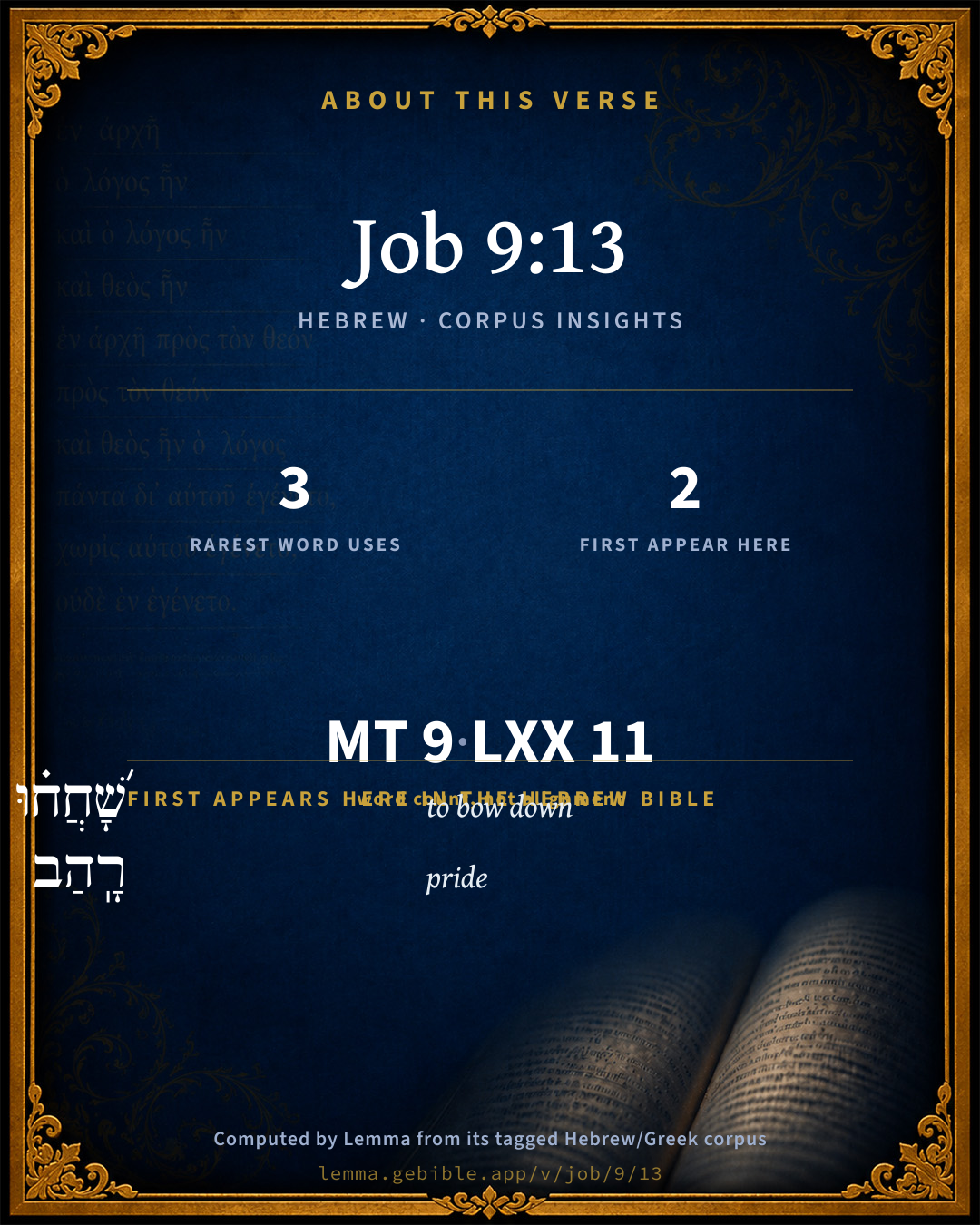
  • 2 first appearances in the Hebrew Bible
Full analysis ↓
Download a study sheet

One document with this verse’s original text, its word-by-word gloss line, the meaning frame, cross-references with their text, attributed commentary, and full source and license credits — printable, and it pastes into notes with its structure intact.

This verse Autodidact and up

Study sheet (.html) Plain text (.txt)

A passage Seminary Student

Up to 50 verses in one chapter. A passage sheet keeps up to 6 commentary sources and 12 cross-references per verse, in the order this page ranks them, and says so on the sheet whenever that leaves anything out. Ask for a single verse and you get the Autodidact verse sheet above.

Everything on this page stays free to read, with no account — the sheet is a download of what is already on screen, not access to it.

Want to remove ads? Support Godless Engineer
Compare translations 3

The same verse in 3 English versions, stacked beneath the original-language interlinear above. Click any original word for its lexicon entry.

Each is an independent rendering of the whole verse — the interlinear is not word-aligned to these translations.

Highlighted words mark where these versions differ — a whole-verse word diff, not a word-by-word alignment.

  • World English Bible Public Domain
    "God will not withdraw his anger; The helpers of Rahab stoop under him.
  • King James Version Public Domain
    If God will not withdraw his anger, the proud helpers do stoop under him.
  • unfoldingWord Literal Text CC BY-SA 4.0
    God will not turn aside his nose; the helpers of Rahab bow beneath him.

unfoldingWord Literal Text — © unfoldingWord, licensed CC BY-SA 4.0. Word-aligned USFM3 via Door43 (git.door43.org/unfoldingWord/en_ult).

Versions to compare (up to 4)

3 of 4 selected

Show all 18 translations

Every available English version of this verse, each an independent rendering of the whole verse.

  • World English Bible Public Domain
    "God will not withdraw his anger; The helpers of Rahab stoop under him.
  • Berean Standard Bible Public Domain
    God does not restrain His anger; the helpers of Rahab cower beneath Him.
  • Majority Standard Bible Public Domain
    God does not restrain His anger; the helpers of Rahab cower beneath Him.
  • King James Version Public Domain
    If God will not withdraw his anger, the proud helpers do stoop under him.
  • American Standard Version (1901) Public Domain
    God will not withdraw his anger; The helpers of Rahab do stoop under him.
  • Revised Version (1885) Public Domain
    God will not withdraw his anger; the helpers of Rahab do stoop under him.
  • Geneva Bible (1599) Public Domain
    God will not withdrawe his anger, and the most mightie helpes doe stoupe vnder him.
  • Douay-Rheims (1899) Public Domain
    God, whose wrath no mall can resist, and under whom they stoop that bear up the world.
  • Young's Literal Translation Public Domain
    God doth not turn back His anger, Under Him bowed have proud helpers.
  • Literal Standard Version CC BY-SA 4.0
    God does not turn back His anger, || Proud helpers have bowed under Him.
  • Unlocked Literal Bible CC BY-SA 4.0
    God will not withdraw his anger; the helpers of Rahab bow beneath him.
  • unfoldingWord Literal Text CC BY-SA 4.0
    God will not turn aside his nose; the helpers of Rahab bow beneath him.
  • Darby Bible Public Domain
    +God withdraweth not his anger; the proud helpers stoop under him:
  • World Messianic Bible Public Domain
    “God will not withdraw his anger. The helpers of Rahab stoop under him.
  • Webster's Bible Public Domain
    If God will not withdraw his anger, the proud helpers do stoop under him.
  • Free Bible Version CC BY-SA 4.0
    God does not restrain his anger; he crushes Rahab's helpers underfoot.
  • Bible in Basic English Public Domain
    God's wrath may not be turned back; the helpers of Rahab were bent down under him.
  • JPS Tanakh (1917) Public Domain
    God will not withdraw His anger; the helpers of Rahab did stoop under Him.

Literal Standard Version (2020), Covenant Press — licensed CC BY-SA 4.0. Text via the HelloAO Bible API (eBible.org). Unlocked Literal Bible (unfoldingWord) — licensed CC BY-SA 4.0. Text via the HelloAO Bible API (eBible.org). unfoldingWord Literal Text — © unfoldingWord, licensed CC BY-SA 4.0. Word-aligned USFM3 via Door43 (git.door43.org/unfoldingWord/en_ult). Free Bible Version, Dr. Jonathan Gallagher — licensed CC BY-SA 4.0. Text via the HelloAO Bible API (eBible.org).

Word by word

More ways to search: Search by grammar → Find every occurrence → Compare this word →

Practice this passage: Drill this verse → Learn its vocabulary →

About this verse

These counts appear in no published source. They are computed here, from the morphology-tagged text and Lemma’s own curated glosses. What Lemma adds →

9
words
8
distinct lemmas
Wisdom
section

Notable vocabulary

The rarest word here is רָֽהַב pride H7293 — appearing just 3 times in the whole Hebrew Bible.

First appearance in Scripture

These words make their first canonical appearance in the Hebrew Bible here:

  • שָׁ֝חֲח֗וּ to bow down H7817
  • רָֽהַב pride H7293

Shared distinctive vocabulary

רָֽהַב pride H7293 occurs in 3 verses of the Hebrew Bible. Also found in:

Grammatical profile

  • 3 verbs
  • 3 nouns
  • 2 prepositions
  • 1 particle

Verb forms

  • יָשִׁ֣יב Hiphil · Imperfect
  • שָׁ֝חֲח֗וּ Qal · Perfect
  • עֹ֣זְרֵי Qal · Participle Active

Repetition

A word recurs within this verse — often emphatic in Hebrew:

  • תחתו under H8478 ×2

Hebrew & Septuagint length

In English translation the verse runs 13 words from the Hebrew and 16 from the Septuagint (LXX English) — closely comparable.

A rough comparison of the two English renderings, which tokenize alike — not a word-level alignment.

Word counts can differ between the Hebrew and the Greek without any difference in meaning — e.g. the Hebrew direct-object marker אֵת has no separate Greek word, and Greek often adds the article ὁ.

In the original languages it is 9 Hebrew tokens and 11 Greek tokens — but the two are counted differently (Hebrew bundles its prefixes and suffixes into one token; the Greek is in lemma form), so that isn’t a like-for-like length.

Cross-references

7

Topical passages linked to Job 9:13 in the Treasury of Scripture Knowledge — connected by theme and wording, ordered by reader-vote popularity; previews shown in the World English Bible.

  • Job 26:12 He stirs up the sea with his power, And by his understanding he strikes through Rahab.
  • Psalms 89:10 You have broken Rahab in pieces, like one of the slain. You have scattered your enemies with your mighty arm.
  • Isaiah 30:7 For Egypt helps in vain, and to no purpose: therefore have I called her Rahab who sits still.
  • Isaiah 51:9 Awake, awake, put on strength, arm of Yahweh; awake, as in the days of old, the generations of ancient times. Isn't it you who did cut Rahab in pieces, who pierced the monster?
  • James 4:6–7 But he gives more grace. Therefore it says, "God resists the proud, but gives grace to the humble."
  • Isaiah 31:2–3 Yet he also is wise, and will bring evil, and will not call back his words, but will arise against the house of the evil-doers, and against the help of those who work iniquity.
  • Job 40:9–11 Or have you an arm like God? Can you thunder with a voice like him?

Cross-references courtesy of OpenBible.info (CC BY 4.0).

Hebrew and Greek witnesses Masoretic Hebrew ↔ Greek Septuagint

The same verse in the two great witnesses to the Old Testament, shown verse-for-verse.

These are two independent witnesses, not word-aligned to each other, and the Septuagint is shown in lemma (dictionary) form.

Hebrew Job 9:13 Masoretic · Westminster Leningrad Codex

אֱ֭לוֹהַּ לֹא יָשִׁ֣יב אַפּ֑וֹ תחתו תַּחְתָּ֥יו שָׁ֝חֲח֗וּ עֹ֣זְרֵי רָֽהַב

"God will not withdraw his anger; The helpers of Rahab stoop under him.

World English Bible · Public Domain

Greek LXX Job 9:13 Septuagint · lemma form

αὐτός γάρ ἀποστρέφω ὀργή ὑπό αὐτός κάμπτω κῆτος ὁ ὑπό οὐρανός

For if he has turned away his anger, the whales under heaven have stooped under him.

LXX2012 (modern English Septuagint) · Public Domain

On this verse, Whedon's Commentary on the Bible discusses the Septuagint’s reading. Read the note in Commentary ↓

Hebrew: Westminster Leningrad Codex (CC BY 4.0). Greek: Septuagint (public domain); English from LXX2012 (modern English Septuagint) (Public Domain). How the Septuagint differs from the Hebrew →

Commentary

Notes on Job 9:13 from classic Christian and Jewish commentators (each source and its license shown beneath its notes). The classic Christian expositions comment on the surrounding passage and are grouped to its opening verse, so a note may address several verses; the Jewish commentaries on the Tanakh (Rashi and others) are per-verse, so they appear only where the commentator wrote on this verse.

Lemma curates 59 commentaries, every one of them public domain or Creative Commons licensed, each selected and text-cleaned for this edition rather than reprinted as found. About our sources →

Trapp's Complete Commentary

John Trapp

Job 9:13 [If] God will not withdraw his anger, the proud helpers do stoop under him.

Ver. 13. If God will not withdraw his anger] That is, of his own free accord forbear to execute his judgments, the stoutest must stoop; for "he is in one mind, and who can turn him? and what his soul desireth even that be doth," Job 23:13, his power is altogether irresistible. Men, though never so puissant, may be withstood and out matched, as Asa was, 2Ch 14:8-9. Nature may be resisted, and her power suspended, as when the fire burned not the three worthies, the Red Sea drowned not the Israelites passing through it. In the creatures there is an essence, and a faculty whereby they work; between these God can separate, and so hinder their working. In the angels there is an essence, and an executive power; God comes between these sometimes, and hinders them from doing what they would. But God is most simple and entire, and, therefore, the strong helper, qui portant orbem, saith the Vulgate, that bear up the pillars of the world (which some understand to be angels, others to be saints, who stand in the gap, Eze 22:30, and others, again, to be carnal combinations), shall not hinder him, but shall stoop and buckle under him, or under it, viz. his wrath, as not able to bear up; helpers shall prove no helpers against the mind and purpose of God; no, though they be as potent and as proud as Egypt (such an allusion there may be in the Hebrew text), or although they be helpers of latitude, as one rendereth it, that is, of the largest extent, either in power, or by an elate mind; and so the meaning is, None are so mighty, or so highly conceited with their own ability, but, if he be angry, he will make them to stoop under, as not being able to bear his wrath.

John Trapp, A Commentary or Exposition upon All the Books of the Old and New Testament (1647–1656) — public domain. Text from a community e-Sword module.

Joseph Benson's Commentary

Job 9:13. If God will not withdraw his anger — There is nothing in the Hebrew for if. The words, literally rendered, are, God will not withdraw his anger; or, continuing the interrogation, used twice in the preceding verse, which Chappelow thinks ought to be continued, Will not God withdraw? &c.; the consequence that follows is then quite natural and just; the proud helpers do (then) stoop under him — Those who undertake to uphold and defend one another against him fall, and are crushed by him; that is, his majesty is so dreadful that nothing can resist it, but every thing must submit that dares to oppose it. They are fitly called proud helpers, because it is a most proud, insolent, and presumptuous act to oppose themselves to the Lord God Almighty, and to his counsels and proceedings; or, helpers of pride, as it is in the Hebrew, because they give assistance to those who carry themselves proudly and stoutly toward God, under his correcting hand.

Joseph Benson's Commentary on the Old and New Testaments (1811–1818) — public domain. Text from a community e-Sword module.

Whedon's Commentary on the Bible

Daniel D. Whedon

Second division, Job_9:13-35. First section: three strophes of four verses each — THE DIVINE OMNIPOTENCE IS NOT ONLY IRRESISTIBLE, OVERBEARING THE CAUSE OF THE CREATURE, BUT IT INVOLVES THE WICKED AND THE GOOD IN ONE COMMON FATE, Job_9:13-24.

Strophe a — A fortiori application to Job himself; the mightiest bend beneath His almightiness, much more suffering Job, notwithstanding his case be urgent and just, Job_9:13-16.

13. If God will not withdraw, etc. — God withdraws not his anger: literally, Does not cause it to return. The if vitiates the sense. “He takes his anger not back till it has accomplished its work.” — Dillmann. His anger is irresistible.

Proud helpers — Literally, Helpers of Rahab, tumultuous helpers. (Furst.) The Septuagint renders it, “Sea monsters under heaven.” Rahab was the poetical name for Egypt. Egypt, in the later books of the Bible, typified tumultuous violence, and was called sea monster and leviathan. Psa_87:4; Psa_89:10; Isa_30:7; Isa_51:9, etc. Olshausen suggests that Rahab’s helpers may be the hosts of Egypt overwhelmed in the sea. Ewald, Hirtzel, and others conjecture, (but without ground, though seemingly justified by the Septuagint,) that Job had in mind some legend of a sea monster that revolted against heaven, and was subdued with all his helpers, and chained to the sky in the form of a constellation — either the Balena, Bellua, or Pistrix, to each of which there is some similar tradition attached. The Babylonian legends abound in allusions to the great dragon, Tiamat, who was finally destroyed by the god Bel. “And the gods, her helpers, who went beside her, trembled, feared, and broke up themselves.” — GEO. SMITH’S Chaldean Account of Genesis, p. 98. For the supposed connexion between turbuhtu, the place or den of the monster, and Rahab, see Ibid., p. 90. The view of Schmidt and Dr. Tayler Lewis accords with the Introduction and several passages of the book, to wit, that Rahab may mean Satan, of whom Job seems to have had some idea as his great enemy. The argument of Job shows that he speaks of infinitely powerful beings, (which is the idea of the Vulgate, qui portant orbem;) but whether from among the gigantic creations of the primitive world, either land or sea, or from the fallen magnates of the superhuman world, does not so readily appear. See note on Job_26:12.

Daniel D. Whedon (gen. ed.), Commentary on the Old and New Testaments (1874–1909) — public domain. Text from a community e-Sword module.

Tyndale Open Study Notes

Tyndale Open Resources

9:13 monsters of the sea (literally the helpers of Rahab): Job personified demonic powers as creatures like this mythical sea monster that represents chaos in ancient literature (26:12; Ps 89:11; Isa 51:9).

Tyndale Open Study Notes — © Tyndale Open Resources, licensed CC BY-SA 4.0. Text via the HelloAO Bible API.

Geneva Bible (1599)

Geneva Bible translators

God will not be appeased for ought that man can say for himself for his justification.

That is, all the reasons that men can lay to approve their cause.

Geneva Bible (1599) marginal notes — public domain. Text via Bolls.life.

Jamieson, Fausset & Brown

Robert Jamieson, A. R. Fausset & David Brown

If God--rather, "God will not withdraw His anger," that is, so long as a mortal obstinately resists [UMBREIT].

the proud helpers--The arrogant, who would help one contending with the Almighty, are of no avail against Him.

Jamieson, Fausset & Brown — Commentary Critical and Explanatory on the Whole Bible (1871) — public domain (CC PDM 1.0). Text via the HelloAO Bible API.

Adam Clarke's Commentary

Verse 13. If God will not withdraw his anger] It is of no use to contend with God; he cannot be successfully resisted; all his opposers must perish.

Adam Clarke's Commentary on the Bible (1810–1826) — public domain. Text from a community e-Sword/MySword module.

Ellicott's Commentary for English Readers

(13) Proud helpers.—Literally, helpers of Rahab. (See Isa_30:7; Psa_87:4.) But whether Rahab was Egypt, or a poetical name for the lost archangel, it is impossible to say. If the former, then there is a probable allusion here to the overthrow of Pharaoh and his hosts; but we lack evidence to make it plain. The phrase is evidently used as expressing the very ideal of strength—the race of the giants.

A Bible Commentary for English Readers, edited by Charles John Ellicott (1878–1897) — public domain. Text from a community e-Sword module.

The Cambridge Bible for Schools and Colleges

gen. ed. J. J. S. Perowne

13. if God will not withdraw] Rather, God withdraws not. His fury is persistent and inexorable till it has accomplished its purpose, cf. ch. Job_23:13-14.

the proud helpers do stoop] Rather, the helpers of Rahab did stoop. The “helpers” are the abettors, the partizans and company of Rahab; and the clause illustrates by an example, the highest example that could be chosen, the statement in the first clause, God withdraws not his anger; to this wrath even the aiders of Rahab succumbed. (1) “Rahab” means pride or arrogancy. But the “helpers of pride” or the “proud helpers” is an expression too indefinite to occur in the present connexion, where, in addition, the perf. bowed beneath him, points to a distinct historical event, adduced as an illustration. (2) In Psa_87:4 Rahab is a name for Egypt; so Psa_89:10, Isa_30:7 (for, “their strength” read Rahab), Isa_51:9. Any historical illustration, however, from the history of Egypt in connexion with Israel is not to be looked for in this Book, the scene of which is laid in an age anterior to the Exodus. Direct allusions do not occur to the history of Israel. Allusions of any kind are rare, but such as are made are to the general history of mankind before Israel became a nation, cf. ch. Job_22:16, a reference to the flood or the cities of the Plain. (3) In Isa_51:9 the parallel clause to “cut Rahab (Egypt) in pieces,” is, “wounded the Dragon.” Again in Psa_74:13-14 the parallel to “didst divide the sea” is “brakest the heads of Leviathan.” From this it appears that Egypt was called Rahab, Dragon or Leviathan with reference to its native monster, which was taken as the symbol of the nation and its character (cf. Psa_68:30 margin). All this leads finally to the conclusion that Rahab is the monster of the sea, which is probably nothing but the sea itself, as appears from Job_26:12. In the poetical nature-myth this stormy sea, assaulting heaven with its waves, was personified as a monster leading his helpers on to wage war with heaven, but was quelled (ch. Job_26:12) by the might of God. This is the instance of God’s power adduced by Job. That the Poet makes use of the floating fragments of superstition and mythology still existing in the popular mind has nothing surprising in it.

The Cambridge Bible for Schools and Colleges (gen. ed. J. J. S. Perowne; Cambridge University Press, 1878–1918) — public domain. Text from a community e-Sword module.

John Gill's Exposition

How much less shall I answer him,.... Who is wise in heart, and mighty in strength, and has done and does the many things before related; who is invisible, passes by, and onwards insensibly; so that there is no knowing where to speak to him, or how to guard against him, since he can come on on every side, at an unawares, and unseen; and who is a sovereign Being, who can do, and does, whatever he pleases; and therefore there is no such thing as disputing any point with him, or calling him to an account for anything done by him: and if the great men of the earth, proud and haughty tyrants, and those prouder spirits, if possible, the infernal principalities and powers, are obliged to bend and stoop to him; how should such a poor, weak, feeble creature as Job was, enter the lists with him, contend with God, and argue with him about his dispensations, or answer to any argument, objection, charge, or article exhibited against him? here Job speaks humbly and meanly of himself, as he in the whole context before speaks highly of God, between whom there was no comparison:

and choose out my words to reason with him? suggesting, that should he pick out words the most fit and proper to be used, and put them together in the most exact order, and which had the greatest force of persuasion and strength of reasoning in them, yet they would be of no avail with God; these could have no influence upon him to turn his mind, or alter either his purposes or his providences; and therefore concluded it was best for him to be silent and make no reply; but if he said anything, to do it in a supplicating way, as follows.

John Gill's Exposition of the Whole Bible (1746–1763) — public domain (CC PDM 1.0). Text via the HelloAO Bible API.

Albert Barnes' Notes on the Bible

If God will not withdraw his anger - That is, if he perseveres in inflicting punishment. He will not turn aside his displeasure by any opposition or resistance made to him.

The proud helpers - Margin, Helpers of pride, or, strength. Jerome renders this, “under whom they who bear up the world bow down.” The Septuagint, not less singularly, “by him the whales (or monsters - κήτος ketos) which are under heaven, are bowed down.” Codurcus renders it, “aids of pride,” and understands by it all the things on which proud men rely, as wealth, health, rank, talent. So Dr. Good renders it, “the supports of the proud.” The meaning is, probably, that all those things which contribute to the support of pride, or all those persons who are allied together to maintain the dominion of pride on the earth, must sink under the wrath of God. Or it may refer to those who sustain the pride of state and empire - the men who stand around the thrones of monarchs, and who contribute, by their talent and power, to uphold the pomp and magnificence of courts. On the meaning of the word here rendered pride (רהב rahab), see the notes at Isa 30:7.

Albert Barnes' Notes on the Bible (1834–1885) — public domain. Text from a community e-Sword/MySword module.

Haydock's Catholic Bible Commentary

God. Protestants, "If God will not withdraw his anger, the proud helpers do stoop under him." Septuagint, "For he is not turned aside by wrath;" (or Roman edition) "God, whose anger cannot be averted," (Haydock) unless we repent: (Calmet) "under him the whales below heaven bend." (Haydock) --- Perhaps they may have had some notions, like the Rabbins, respecting Leviathan; and St. Jerome may have alluded to the fable of the giants placed under mountains; (Virgil, Æneid iii., and ix.; Calmet) or to Atalas propping the skies. (Haydock) --- World. Great heroes, (Calmet) Kings, (Pineda) angels, (Menochius) who move the spheres, (Worthington) or devils, Ephesians vi. 12. (Cajetan)

George Leo Haydock (1774–1849), Haydock's Catholic Family Bible and Commentary, 1859 edition — public domain. Excludes Psalms (Douay-Rheims chapter numbering differs from Protestant) and Deuterocanonical books (Catholic canon only).

Matthew Poole's English Annotations

i.e. If God resolve not to withdraw his rod and stroke, the effect of his anger. Or without if, which is not in the Hebrew,

God will not withdraw his anger, i.e. not forbear to punish, neither because any man can overpower and restrain him, nor for fear lest he should rebuke him for proceeding to punish, as is implied by comparing this verse with the former.

The proud helpers, i.e. those men who shall undertake to uphold and defend him whom God intends to punish and destroy; who are fitly called proud helpers, because this is a most proud, and insolent, and presumptuous act, to oppose themselves to the Lord God Almighty, and to his counsels and courses: or, (as it is in the Hebrew,) helpers of pride, because they give assistance to that man who carries himself proudly and stoutly towards God under his correcting hand: or, (as some translate it,) the helpers of Egypt, or the Egyptian helpers, i.e. the most potent helpers; for Egypt was in Job’s time a powerful and flourishing kingdom, and not far from Job’s country. And the word rahab, here rendered pride, is elsewhere put for Egypt, as Psa 87:4; Isa 51:9; and (as some take it) Job 26:12.

Do stoop under him, i.e. shall fall and be crushed by him; and consequently they who are helped by him must fall with them.

Matthew Poole's English Annotations on the Holy Bible (1683–1685) — public domain. Text from a community e-Sword/MySword module.

The Pulpit Commentary

If God will not withdraw his anger, the proud helpers do stoop under him. There is no "if" in the original; and the passage is best taken categorically: "God does not withdraw his anger;" i.e. the anger which he feels against those who resist him. "The helpers of Rahab do stoop or, "are prostrate under him." Rahab in this passage, and also in Job_26:12, as well us in Isa_51:9, seems to be used as the proper name of some great power of evil Such a power was recognized in the mythology of Egypt, under the names of Set (or Typhon) and of Apophia, the great serpent, continually represented as pierced by Horus (Rawlinson"s "Herodotus," vol. 2. p. 257; "History of Ancient Egypt," vol. 1. p. 395). In the earlier Aryan myths there is a similar personification ofevil in Vitre, called Dasiya, "the Destroyer," and at perpetual enmity with Indra and Agni ("Religions of the Ancient World," p. 114). The Babylonians and Assyrians had a tradition of a great "war in heaven" ("Records of the Past," vol. 5. pp. 133-136). carried on by seven spirits, who were finally reduced to subjection. All these seem to be distorted reminiscences of that great conflict, whereof the only trustworthy account is the one contained in the Revelation of St. John, "There was war in heaven: Michael and his angels fought against the dragon; and the dragon fought and his angels the "helpers" of the present passage prevailed not; neither was their place found any more in heaven". (Rev_12:7, Rev_12:8) Job, it seems, had inherited one of such traditions, one in which the power of evil was known as Rahab, "the Proud One;" and he means here to say that God not only holds men in subjection, but also beings much more powerful than man, as Rahab and his helpers, who had rebelled and made war on God, and been east down from heaven, and were now prostrate under God"s feet.

The Pulpit Commentary (1880–1919), ed. H.D.M. Spence-Jones & Joseph S. Exell — public domain. Text from a community e-Sword module.

John Wesley's Explanatory Notes

Helpers - Those who undertake to uphold and defend one another against him. Stoop - Fall and are crushed by him.

John Wesley, Explanatory Notes Upon the Whole Bible (1754–1765) — public domain. Text via the GEBible commentary corpus.

unfoldingWord translationNotes

Door43 World Missions Community

the helpers of Rahab bow beneath him

Here "bow beneath him" symbolizes submission or defeat. AT: "he crushes the helpers of Rahab" (See: Symbolic Action)

Rahab

The word "Rahab" here refers to a monster of the sea. (See: How to Translate Names)

How much less could I answer him, could I choose words to reason with him?

Job poses two similar questions to emphasize his reluctance to confront God. They can be reworded as a statement. AT: "So I certainly could not answer him or choose words to reason with him." (See: Parallelism and Rhetorical Question)

translationWords

God

anger

bow

word

righteous

mercy

judge

unfoldingWord translationNotes — © Distant Shores Media and the Door43 World Missions Community, licensed CC BY-SA 4.0. Source: git.door43.org/Door43/en_tn.

Rashi

Rabbi Shlomo Yitzchaki (Rashi)

will not hold back His wrath because of fear (other editions: righteousness) of a man.

[all the helpers of Rahab] stoop under Him The celestial host that came to aid the Egyptians. Egypt is called Rahab, as it is said (Isa. 30:7): “Therefore, I called this, ‘They are haughty (רהב) idlers,’” by dint of their haughtiness, for they said, “Who is the Lord? etc.” (Exod. 5:2).

Rashi on the Tanakh — English translations: “The Judaica Press complete Tanach with Rashi, translated by A. J. Rosenberg” (CC BY 4.0); “Pentateuch with Rashi's commentary by M. Rosenbaum and A.M. Silbermann, 1929-1934” (public domain); “The Metsudah Tanach series, Lakewood, N.J” (CC BY 4.0); and “The Book of Joshua, Metsudah Publications, 1997” (CC BY 4.0). Text via Sefaria.

Lesson kit

Teaching starters — assembled from the data on this page, not authored interpretation. Every prompt links to the verse data it draws on. Edit before teaching.

Job, in the Wisdom, opens this verse with 9 words (8 distinct Hebrew lemmas). Its most distinctive word is rahab (“pride”). A historical commentator’s framing appears above. Read the whole chapter for the surrounding context.

Discussion questions

  1. The word rahab carries the sense “pride.” How does it shape the verse?
  2. 2 words here appear for the first time in Scripture. What is being introduced at this debut?
  3. Job 26:12 shares the word «pride» with this verse. How do the two illuminate each other?
  4. “under” occurs 2× in this one verse. What is the effect of the repetition?
  5. These translations render this verse differently; the difference is in the English rendering, not the original. What questions does that raise?
  6. The verb «יָשִׁ֣יב» is Hiphil Imperfect. How does its form color the action?
  7. Reading how Trapp's Complete Commentary and Joseph Benson's Commentary read this verse, where do the two commentators agree and where do they part?

Things to notice

Reading settings

Reading text

Shown beneath each verse's original-language words.

Old Testament
Old Testament edition

Read the OT as the Masoretic Hebrew (MT) or the Greek Septuagint (LXX).

English shown for the Greek Septuagint (in the Hebrew ↔ Greek comparison).

Comparing translations? Open the Compare panel on any verse page to stack up to four side by side.