
Psalms 118:13

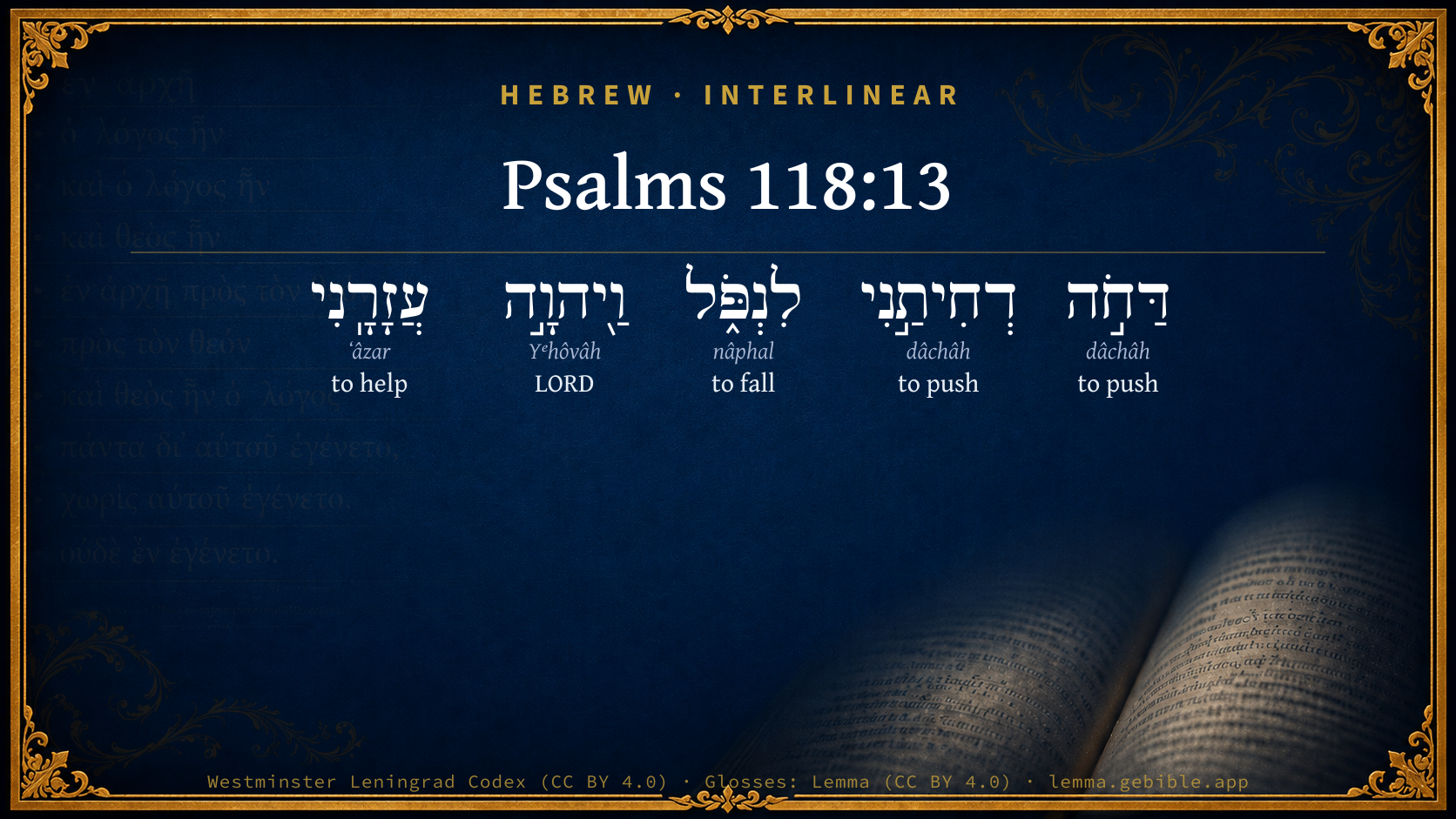
Hebrew (Westminster Leningrad Codex) Psalms 118:13 appears in the Hebrew Old Testament. The text above is from the Westminster Leningrad Codex. Each word links to its Strong’s number, a concise gloss, and parsing drawn from the Open Scriptures Hebrew Bible morphology. Click any word for its full Brown-Driver-Briggs (BDB) entry.
Download image
Cite this verse

Psalms 118:13 (World English Bible). Public Domain. Lemma interlinear Bible study tool, https://lemma.gebible.app/v/psalms/118/13.

Show BibTeX & RIS
BibTeX
RIS
English Translation
You pushed me back hard, to make me fall, But Yahweh helped me.
World English Bible · Public Domain
Download a study sheet

One document with this verse’s original text, its word-by-word gloss line, the meaning frame, cross-references with their text, attributed commentary, and full source and license credits — printable, and it pastes into notes with its structure intact.

This verse Autodidact and up

Study sheet (.html) Plain text (.txt)

A passage Seminary Student

Up to 50 verses in one chapter. A passage sheet keeps up to 6 commentary sources and 12 cross-references per verse, in the order this page ranks them, and says so on the sheet whenever that leaves anything out. Ask for a single verse and you get the Autodidact verse sheet above.

Everything on this page stays free to read, with no account — the sheet is a download of what is already on screen, not access to it.

Want to remove ads? Support Godless Engineer
Compare translations 3

The same verse in 3 English versions, stacked beneath the original-language interlinear above. Click any original word for its lexicon entry.

Each is an independent rendering of the whole verse — the interlinear is not word-aligned to these translations.

Highlighted words mark where these versions differ — a whole-verse word diff, not a word-by-word alignment.

  • World English Bible Public Domain
    You pushed me back hard, to make me fall, But Yahweh helped me.
  • King James Version Public Domain
    Thou hast thrust sore at me that I might fall: but the LORD helped me.
  • unfoldingWord Literal Text CC BY-SA 4.0
    To push down, you pushed me down to fall, but Yahweh helped me.

unfoldingWord Literal Text — © unfoldingWord, licensed CC BY-SA 4.0. Word-aligned USFM3 via Door43 (git.door43.org/unfoldingWord/en_ult).

Versions to compare (up to 4)

3 of 4 selected

Show all 18 translations

Every available English version of this verse, each an independent rendering of the whole verse.

  • World English Bible Public Domain
    You pushed me back hard, to make me fall, But Yahweh helped me.
  • Berean Standard Bible Public Domain
    I was pushed so hard I was falling, but the LORD helped me.
  • Majority Standard Bible Public Domain
    I was pushed so hard I was falling, but the LORD helped me.
  • King James Version Public Domain
    Thou hast thrust sore at me that I might fall: but the LORD helped me.
  • American Standard Version (1901) Public Domain
    Thou didst thrust sore at me that I might fall; But Jehovah helped me.
  • Revised Version (1885) Public Domain
    Thou didst thrust sore at me that I might fall: but the LORD helped me.
  • Geneva Bible (1599) Public Domain
    Thou hast thrust sore at me, that I might fall: but the Lord hath holpen me.
  • Douay-Rheims (1899) Public Domain
    Being pushed I was overturned that I might fall: but the Lord supported me.
  • Young's Literal Translation Public Domain
    Thou hast sorely thrust me to fall, And Jehovah hath helped me.
  • Literal Standard Version CC BY-SA 4.0
    You have severely thrust me to fall, || And YHWH has helped me.
  • Unlocked Literal Bible CC BY-SA 4.0
    They attacked me to knock me down, but Yahweh helped me.
  • unfoldingWord Literal Text CC BY-SA 4.0
    To push down, you pushed me down to fall, but Yahweh helped me.
  • Darby Bible Public Domain
    Thou hast thrust hard at me that I might fall; but Jehovah helped me.
  • World Messianic Bible Public Domain
    You pushed me back hard, to make me fall, but the LORD helped me.
  • Webster's Bible Public Domain
    Thou hast violently thrust at me that I might fall: but the LORD helped me.
  • Free Bible Version CC BY-SA 4.0
    They tried as hard as they could to kill me, but the Lord helped me.
  • Bible in Basic English Public Domain
    I have been hard pushed by you, so that I might have a fall: but the Lord was my helper.
  • JPS Tanakh (1917) Public Domain
    Thou didst thrust sore at me that I might fall; but the LORD helped me.

Literal Standard Version (2020), Covenant Press — licensed CC BY-SA 4.0. Text via the HelloAO Bible API (eBible.org). Unlocked Literal Bible (unfoldingWord) — licensed CC BY-SA 4.0. Text via the HelloAO Bible API (eBible.org). unfoldingWord Literal Text — © unfoldingWord, licensed CC BY-SA 4.0. Word-aligned USFM3 via Door43 (git.door43.org/unfoldingWord/en_ult). Free Bible Version, Dr. Jonathan Gallagher — licensed CC BY-SA 4.0. Text via the HelloAO Bible API (eBible.org).

Word by word

More ways to search: Search by grammar → Find every occurrence → Compare this word →

Practice this passage: Drill this verse → Learn its vocabulary →

About this verse

These counts appear in no published source. They are computed here, from the morphology-tagged text and Lemma’s own curated glosses. What Lemma adds →

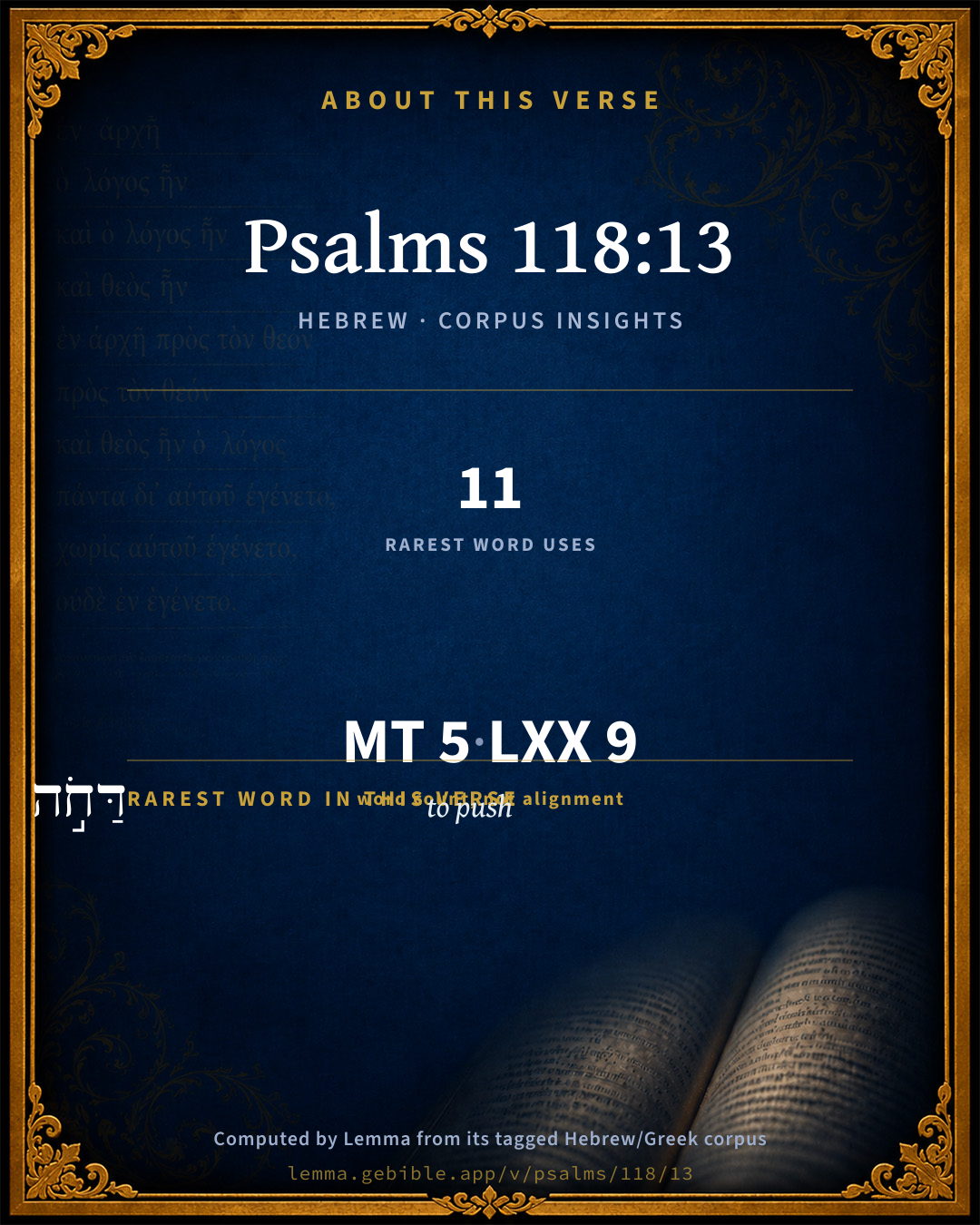
5
words
4
distinct lemmas
Wisdom
section

Notable vocabulary

The rarest word here is דַּחֹ֣ה to push H1760 — appearing just 11 times in the whole Hebrew Bible.

Shared distinctive vocabulary

דַּחֹ֣ה to push H1760 occurs in 10 verses of the Hebrew Bible. Also found in:

Grammatical profile

  • 4 verbs
  • 1 noun

Verb forms

  • דַּחֹ֣ה Qal · Infinitive Absolute
  • דְחִיתַ֣נִי Qal · Perfect
  • לִנְפֹּ֑ל Qal · Infinitive Construct
  • עֲזָרָֽנִי Qal · Perfect

Repetition

A word recurs within this verse — often emphatic in Hebrew:

  • דַּחֹ֣ה to push H1760 ×2

Hebrew & Septuagint length

In English translation the verse runs 13 words from the Hebrew and 15 from the Septuagint (LXX English) — closely comparable.

A rough comparison of the two English renderings, which tokenize alike — not a word-level alignment.

Word counts can differ between the Hebrew and the Greek without any difference in meaning — e.g. the Hebrew direct-object marker אֵת has no separate Greek word, and Greek often adds the article ὁ.

In the original languages it is 5 Hebrew tokens and 9 Greek tokens — but the two are counted differently (Hebrew bundles its prefixes and suffixes into one token; the Greek is in lemma form), so that isn’t a like-for-like length.

Cross-references

10

Topical passages linked to Psalms 118:13 in the Treasury of Scripture Knowledge — connected by theme and wording, ordered by reader-vote popularity; previews shown in the World English Bible.

  • Psalms 140:4 Yahweh, keep me from the hands of the wicked. Preserve me from the violent men who have determined to trip my feet.
  • Psalms 86:17 Show me a sign of your goodness, That those who hate me may see it, and be shamed, Because you, Yahweh, have helped me, and comforted me.
  • Micah 7:8 Don't rejoice against me, my enemy. When I fall, I will arise. When I sit in darkness, Yahweh will be a light to me.
  • Psalms 18:17–18 He delivered me from my strong enemy, From those who hated me; for they were too mighty for me.
  • Matthew 4:1–11 Then Jesus was led up by the Spirit into the wilderness to be tempted by the devil.
  • 1 Samuel 25:29 Though men be risen up to pursue you, and to seek your soul, yet the soul of my lord shall be bound in the bundle of life with Yahweh your God; and the souls of your enemies, them shall he sling out, as from the hollow of a sling.
  • 2 Samuel 17:1–3 Moreover Ahithophel said to Absalom, Let me now choose out twelve thousand men, and I will arise and pursue after David this night:
  • Psalms 56:1–3 Be merciful to me, God, for man wants to swallow me up. All day long, he attacks and oppresses me.
  • 1 Samuel 20:3 David swore moreover, and said, Your father knows well that I have found favor in your eyes; and he says, Don't let Jonathan know this, lest he be grieved: but truly as Yahweh lives, and as your soul lives, there is but a step between me and death.
  • Hebrews 2:14 Since then the children have shared in flesh and blood, he also himself in like manner partook of the same, that through death he might bring to nothing him who had the power of death, that is, the devil,

Cross-references courtesy of OpenBible.info (CC BY 4.0).

Hebrew and Greek witnesses Masoretic Hebrew ↔ Greek Septuagint

The same verse in the two great witnesses to the Old Testament, shown verse-for-verse.

You’re reading Greek Psalm 117 (Hebrew Psalm 118). The Septuagint counts the superscription, so verse numbers can differ from the Hebrew — chapter-level alignment, not verse-by-verse. Numbering follows Rahlfs.

These are two independent witnesses, not word-aligned to each other, and the Septuagint is shown in lemma (dictionary) form.

Hebrew Psalms 118:13 Masoretic · Westminster Leningrad Codex

דַּחֹ֣ה דְחִיתַ֣נִי לִנְפֹּ֑ל וַ֖יהוָ֣ה עֲזָרָֽנִי

You pushed me back hard, to make me fall, But Yahweh helped me.

World English Bible · Public Domain

Greek LXX Greek Psalm 117:13 Septuagint · lemma form

ὠθέω ἀνατρέπω ὁ πίπτω καί ὁ κύριος ἀντιλαμβάνω ἐγώ

I was thrust, and sorely shaken, that I might fall: but the Lord helped me.

LXX2012 (modern English Septuagint) · Public Domain

Hebrew: Westminster Leningrad Codex (CC BY 4.0). Greek: Septuagint (public domain); English from LXX2012 (modern English Septuagint) (Public Domain). How the Septuagint differs from the Hebrew →

Commentary

Notes on Psalms 118:13 from classic Christian and Jewish commentators (each source and its license shown beneath its notes). The classic Christian expositions comment on the surrounding passage and are grouped to its opening verse, so a note may address several verses; the Jewish commentaries on the Tanakh (Rashi and others) are per-verse, so they appear only where the commentator wrote on this verse.

Lemma curates 59 commentaries, every one of them public domain or Creative Commons licensed, each selected and text-cleaned for this edition rather than reprinted as found. About our sources →

Trapp's Complete Commentary

John Trapp

Psa 118:13 Thou hast thrust sore at me that I might fall: but the LORD helped me.

Ver. 13. Thou hast thrust sore at me] Thou, O Saul, or thou, Ishbibenob, 2Sa 21:16, or thou, O Satan, setting such a work.

But the Lord helped me] He sent from heaven and saved me; he came in the nick of time, as it were, out of an engine.

John Trapp, A Commentary or Exposition upon All the Books of the Old and New Testament (1647–1656) — public domain. Text from a community e-Sword module.

The Biblical Illustrator

Joseph S. Exell

Psa_118:13-14

Thou hast thrust sore at me, that I might fall: but the Lord helped me.

Christian experience

Christian experience is the richest product of grace, and it ought to be laid at the feet of the Well-beloved from whom it comes, and to whom it belongs. What God hath done for one of His people is an indication of what He will do for others of His chosen. The Lords providences are promises, and His benedictions are predictions. To be silent concerning the lovingkindness of the Lord is a robbery of the worst kind; it is taking from our God the glory due unto His holy name.

I. Tribulation and patience. Thou hast thrust sore at me, etc. Truth most always strive against error, and holiness must battle against sin. It is an uphill journey to glory, and that man had need be a hardy mountaineer who resolves to ascend into the hill of the Lord, and to dwell in His holy place. He who is born for the crown is bound for the cross. A thousand snares are laid in your path; and only be who made you a Christian can cover your head, and carry you safely through the bombardment which awaits you.

II. Patience and experience The Lord helped me--

1. To believe.

2. To pray.

3. To stand.

4. To fight.

III. Experience and a hope that maketh not ashamed.

1. Our God has become our strength. He is the Lord all-sufficient when we are most insufficient. With Him for our strength, we cannot faint, or fail; but, on the contrary, we shall renew our force, and rise continually to something higher and better than before.

2. Our God has also become our song. It may mean, The Lord is my strength while I am waging the war, and my song when I have won the victory. This is an excellent sense, but another seems to me more clearly in the words, The Lord is my strength and song; both are in the present, we sing while we fight. Your great Lord and mine, when He went to His last tremendous conflict, where the powers of darkness marshalled all their strength against Him, and He strove until He sweat as it were great drops of blood,--how did He go? Here is the answer, After supper, they sang a hymn.Let us claim the victory, anticipate it, and shout it, while yet we are contending. On our beds let us sing Gods high praises, and magnify Him in the midst of the fires. Set your whole lives to music. Make your entire career a psalm. But what shall we sing about? Well, The Lord is my song. Sing the Father and His love eternal. Sing the Son of God, whose delights were with the sons of men before He came here to dwell. Tell how He took our flesh to take away our guilt. Tell how He died, and rose again, and led captivity captive, and ascended up on high. Make that your song, but do not forget to sing the Holy Spirits love. Magnify the Holy Ghost, the Illuminator, Comforter, Guide, abiding Advocate, and Paraclete. (C. H. Spurgeon.)

The Biblical Illustrator, edited by Joseph S. Exell (c. 1880s–1900s) — public domain. Text from a community e-Sword module.

Joseph Benson's Commentary

Psa 118:13-14. Thou hast thrust sore at me, &c. — O mine enemy. The singular number may possibly be here put collectively for all his enemies; or, this apostrophe, which is strong, might be directed to some particular person in the battle, who had put David into great danger. The Lord is my strength and song — The author of my strength, and therefore the just object of my praise; and is become my salvation — The author of my protection and safety, and the source of my peace and comfort. Observe, reader, if God be our strength, he ought to be our song; if he work all our works in us, he ought to have all praise and glory from us. God is sometimes the strength of his people when he is not their song; they have spiritual supports when they want spiritual delights; but if he be both to us, we have indeed abundant reason to triumph in him.

Joseph Benson's Commentary on the Old and New Testaments (1811–1818) — public domain. Text from a community e-Sword module.

J. A. Alexander on Psalms

Joseph Addison Alexander

13. (Psa 118:13) Thou didst thrust, thrust at me, to (make me) fall, and Jehovah helped me. By a lively apostrophe the enemy is here addressed directly, that is, the hostile heathen power, from whose oppression Israel had just been rescued. See above, on Psa 118:7. The verb to thrust or strike at is the root of the noun translated falling in Psa 56:13; Psa 116:8.

Joseph Addison Alexander, The Psalms Translated and Explained (1850) — public domain. Text from a community e-Sword module.

Geneva Bible (1599)

Geneva Bible translators

He noteth Saul his chief enemy.

Geneva Bible (1599) marginal notes — public domain. Text via Bolls.life.

Adam Clarke's Commentary

Verse 13. Thou hast thrust sore at me] In pushing thou hast pushed me that I might fall.

But the Lord helped me.] Though he possessed skill, courage, and strength, yet these could not have prevailed had not God been his helper; and to him he gives the glory of the victory.

Adam Clarke's Commentary on the Bible (1810–1826) — public domain. Text from a community e-Sword/MySword module.

John Calvin's Commentaries

13. Thou hast sorely thrust at me. He either now changes the person, or directs his discourse to Saul, his principal enemy. In the person of one, he sets at defiance all his enemies together. In saying that he had been thrust at, he admits that he did not withstand the onset by his own bravery, as those who are powerful enough to encounter opposition, sustain the assaults of their enemies without flinching. The power of God is more illustriously displayed in raising him up even from ruin itself.

In the subsequent verse he draws the conclusion that God is his strength and song. By the former adjunct he candidly acknowledges his weakness, and ascribes his safety exclusively to God. And having admitted that his strength was in God alone, because he was sustained by his power, immediately he adds, that God is his praise or his song, which must be understood passively. “In myself there was no ground for boasting, to God belongs entirely all the praise of my safety.” The last clause of the verse, in which he says that God was his salvation, refers to the same subject.

John Calvin's Commentaries (1540-1563) — public domain. Text from the Calvin Translation Society English edition (1840s-50s) via the Christian Classics Ethereal Library (ccel.org). Calvin's coverage is partial (roughly two-thirds of the Bible); uncommented books and verses are honest gaps, never fabricated. The 19th-century editor's footnotes and remarks are omitted so the notes are faithfully Calvin's own voice.

The Cambridge Bible for Schools and Colleges

gen. ed. J. J. S. Perowne

13. Thou didst thrust sore at me] The community as an individual addresses its enemies as an individual. Israel and the foe are as it were two warriors matched in single combat. Cp. Mic_7:8.

The Cambridge Bible for Schools and Colleges (gen. ed. J. J. S. Perowne; Cambridge University Press, 1878–1918) — public domain. Text from a community e-Sword module.

John Gill's Exposition

The voice of rejoicing and salvation is in the tabernacles of the righteous,.... In all the dwellings of good men, throughout the land of Israel, was heard nothing but the voice of joy, on account of David's accession to the throne; the deliverance of him from a persecuting Saul, and of them from his real administration; and the victories David obtained over all his enemies: for, "when the righteous are in authority, the people rejoice", Pro 29:2. And still much more occasion is there of joy, in the dwelling places of the saints, though but cottages, and in the churches of God, the tabernacles of the most High, on account of the spiritual and eternal salvation Christ is the author of which joy is inwardly felt in the heart, and outwardly expressed by one saint to another; and in vocal prayer to God, and in singing his praises; which may be done in the houses of the saints, as well as in the house of God. What this voice, or the righteous with their voice, expressed in each of their dwelling houses, is as follows; for the word "saying" may be supplied, and the words connected thus:

saying, the right hand of the Lord doth valiantly; or "acts powerfully" (b); in helping and assisting David, in protecting and defending him, in raising him to the throne, and in giving him rest from all his enemies; and so in supporting the Messiah, his antitype, as man and Mediator, in his work and under his sufferings; in raising him from the dead, and exalting: him at his right hand; and which was done with his right hand, Act 2:33. Jarchi refers this joy here expressed to future times, the times of the Messiah: and in an ancient (c) writing of the Jews the right hand of the Lord, three times mentioned in this verse and Psa 118:16, is interpreted of the Messiah, the sort of David.

(b) "agit strenue", Junius & Tremellius, Piscator; so Cocceius. (c) Raya Mehimna in Zohar in Numb. fol. 64. 1.

John Gill's Exposition of the Whole Bible (1746–1763) — public domain (CC PDM 1.0). Text via the HelloAO Bible API.

Albert Barnes' Notes on the Bible

Thou hast thrust sore at me that I might fall - literally, “Thrusting thou hast thrust at me.” This is the Hebrew mode of expressing intensity, repetition, or emphasis. The meaning is, that they had made a deadly thrust at him; that they had repeated the blows; that they had come with a fierce determination to crush and destroy him. The psalmist, as it were, sees the enemy again before him, and addresses him as if he were present. Everything is vivid to the mind; the whole scene appears again to pass before him.

Albert Barnes' Notes on the Bible (1834–1885) — public domain. Text from a community e-Sword/MySword module.

Matthew Poole's English Annotations

Thou, O mine enemy, and the head of all mine enemies. Possibly he understandeth Saul, whom for honour’s sake he forbears to name; or some other chief commander of his enemies. Or the singular word is here put collectively for all his enemies.

Matthew Poole's English Annotations on the Holy Bible (1683–1685) — public domain. Text from a community e-Sword/MySword module.

The Treasury of David

Charles H. Spurgeon

Ver. 13. Thou hast thrust sore at me, "Thrusting, thou hast thrust at me." It is a vigorous apostrophe, in which the enemy is described as concentrating all his thrusting power into the thrusts which he gave to the man of God. He thrust again and again with the keenest point, even as bees thrust their stings into their victim. The foe had exhibited intense exasperation, and fearful determination, nor had he been without a measure of success; wounds had been given and received, and these smarted much, and were exceeding sore. Now, this is true of many a tried child of God who has been wounded by Satan, by the world, by temptation, by affliction; the sword has entered into his bones, and left its mark.

That I might fall. This was the object of the thrusting: to throw him down, to wound him in such a way that he would no longer be able to keep his place, to make him depart from his integrity, and lose his confidence in God. If our adversaries can do this they will have succeeded to their heart's content: if we fall into grievous sin they will be better pleased than even if they had sent the bullet of the assassin into our heart, for a moral death is worse than a physical one. If they can dishonour us, and God in us, their victory will be complete. "Better death than false of faith" is the motto of one of our noble houses, and it may well be ours. It is to compass our fall that they compass us; they fill us with their venom that they may fill us with their sin.

But the Lord helped me; a blessed "but." This is the saving clause. Other helpers were unable to chase away the angry nations, much less to destroy all the noxious swarms; but when the Lord came to the rescue the hero's single arm was strong enough to vanquish all his adversaries. How sweetly can many of us repeat in the retrospect of our past tribulations this delightful sentence, "But the Lord helped me." I was assailed by innumerable doubts and fears, but the Lord helped me; my natural unbelief was terribly inflamed by the insinuations of Satan, but the Lord helped me; multiplied trial were rendered more intense by the cruel assaults of men, and I knew not what to do, but the Lord helped me. Doubtless, when we land on the hither shore of Jordan, this will be one of our songs, "Flesh and heart were failing me, and the adversaries of my soul surrounded me in the swellings of Jordan, but the Lord helped me. Glory be unto his name."

Ver. 13. Thou hast thrust sore at me that I might fall. The apostrophe is strong, and probably directed to some particular person in the battle, who had put David in great danger. Samuel Burder.

Ver. 13. Thou hast thrust sore at me that I might fall. Thou hast indeed. Thou hast done thy part, O Satan, and it has been well done. Thou hast known all my weakest parts, thou hast seen where my armour was not buckled on tightly, and thou hast attacked me at the right time and in the right way. The great Spanish poet, Calderon, tells of one who wore a heavy suit of armour for a whole year, and laid it by for one hour, and in that hour the enemy came, and the man paid for his negligence with his life. "Blessed is the man that endureth temptation; for when he is tried he shall receive the crown of life, which the Lord hath promised to them that love him." John Mason Neale.

Ver. 13.

1. Our great antagonist.

2. His fierce attacks.

3. His evident object: "that I might fall."

4. His failure: "but the Lord helped me."

Psalms 118:14*

Charles H. Spurgeon's The Treasury of David (1869–1885) — public domain. Psalms only. Text from a community e-Sword/MySword module.

Whedon's Commentary on the Bible

Daniel D. Whedon

13. Thrust sore—Literally, Thrusting thou hast thrust, etc., an intensive form of speech. Thou hast done thy worst at violence and malice. The third person is changed for the second, and he addresses his enemies.

But the Lord helped me—The psalmist does not describe the manner of divine interference, because psalms written for the whole Church, and for all times, and all forms of suffering and deliverance, should not be embarrassed with local details. It is enough to know that Jehovah alone could help him, and that he delivered him.

Daniel D. Whedon (gen. ed.), Commentary on the Old and New Testaments (1874–1909) — public domain. Text from a community e-Sword module.

The Pulpit Commentary

Thou hast thrust lore at me that I might fall; rather, thou didst thrust (Revised Version). The psalmist recalls the past, and throws himself, as it were, once more into the midst of the struggle. Thou mine enemy, Babylon didst make s desperate onset upon me, fully intending my destruction. But the Lord helped me. Frustrated thy purpose preserved the life, the national life, which thou aimedst at destroying, and so did most effectually "help me."

The Pulpit Commentary (1880–1919), ed. H.D.M. Spence-Jones & Joseph S. Exell — public domain. Text from a community e-Sword module.

John Wesley's Explanatory Notes

Thou - O mine enemy. The singular word is here put collectively for all his enemies.

John Wesley, Explanatory Notes Upon the Whole Bible (1754–1765) — public domain. Text via the GEBible commentary corpus.

unfoldingWord translationNotes

Door43 World Missions Community

to knock me down

The writer speaks of the enemy armies trying to defeat him as if they were trying to push him down onto the ground. AT: "in order to defeat me" (See: Metaphor)

Yahweh is my strength and joy

"Yahweh gives me strength and joy"

translationWords

joy

unfoldingWord translationNotes — © Distant Shores Media and the Door43 World Missions Community, licensed CC BY-SA 4.0. Source: git.door43.org/Door43/en_tn.

Rashi

Rabbi Shlomo Yitzchaki (Rashi)

You pushed me to fall You, my enemy.

Rashi on the Tanakh — English translations: “The Judaica Press complete Tanach with Rashi, translated by A. J. Rosenberg” (CC BY 4.0); “Pentateuch with Rashi's commentary by M. Rosenbaum and A.M. Silbermann, 1929-1934” (public domain); “The Metsudah Tanach series, Lakewood, N.J” (CC BY 4.0); and “The Book of Joshua, Metsudah Publications, 1997” (CC BY 4.0). Text via Sefaria.

Lesson kit

Teaching starters — assembled from the data on this page, not authored interpretation. Every prompt links to the verse data it draws on. Edit before teaching.

Psalms, in the Wisdom, opens this verse with 5 words (4 distinct Hebrew lemmas). Its most distinctive word is dâchâh (“to push”). A historical commentator’s framing appears above. Read the whole chapter for the surrounding context.

Discussion questions

  1. How does “to push” (dâchâh) shape what this verse is saying?
  2. Psalms 35:5 shares the word «to push» with this verse. How do the two illuminate each other?
  3. “to push” occurs 2× in this one verse. What is the effect of the repetition?
  4. The translations on this page render this verse differently — a whole-verse word diff, not a word-by-word alignment. What might account for the different wordings?
  5. The verb «דַּחֹ֣ה» is Qal Infinitive Absolute. How does its form color the action?
  6. Reading how Trapp's Complete Commentary and The Biblical Illustrator read this verse, where do the two commentators agree and where do they part?

Things to notice

Reading settings

Reading text

Shown beneath each verse's original-language words.

Old Testament
Old Testament edition

Read the OT as the Masoretic Hebrew (MT) or the Greek Septuagint (LXX).

English shown for the Greek Septuagint (in the Hebrew ↔ Greek comparison).

Comparing translations? Open the Compare panel on any verse page to stack up to four side by side.