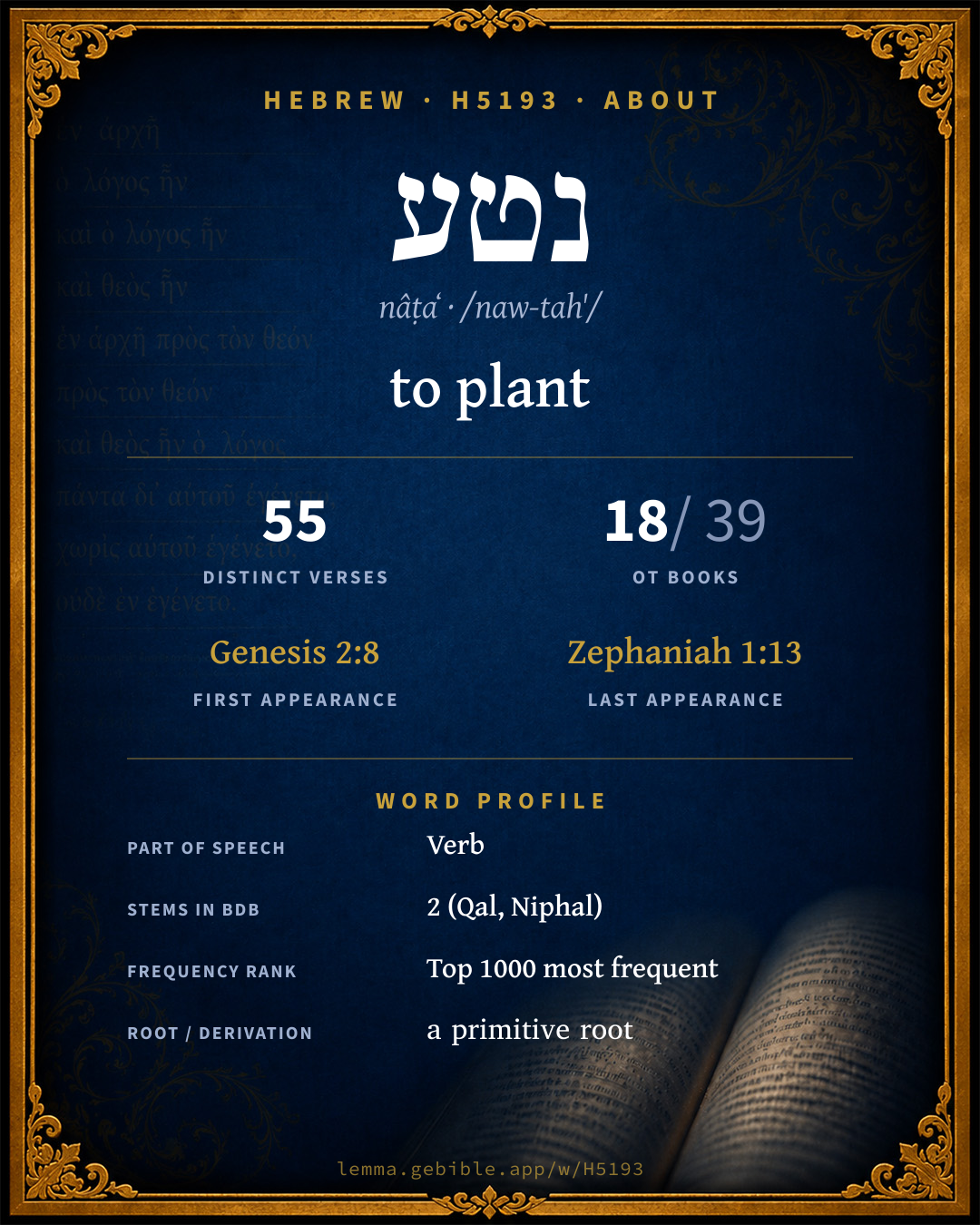
נָטַע
to plant
also: fasten, fix, establish fuller range ↓
Full lexicon entry — Brown-Driver-Briggs (BDB)
From Brown-Driver-Briggs (BDB)
Where this word appears
See every Qal verb in the Hebrew Bible →
Grammar key — what these labels mean
Part of speech
- Verb
- An action or state-of-being word.
Stem
- Qal
- The basic, simple active stem — the plain form of the verb (“he wrote”). Here: ‘plant’
- Niphal
- Usually the simple passive or reflexive of the Qal (“he was written”).
Form
- Perfect
- A completed action or state — Hebrew marks aspect (completeness) more than strict tense (“he wrote”).
- Sequential Perfect
- A perfect with prefixed waw continuing a preceding imperfect or command (waw-consecutive perfect).
- Imperative
- A direct command (“write!”).
- Infinitive Construct
- A bound verbal noun, frequently with prepositions (“to write / in writing”).
- Sequential Imperfect
- An imperfect with prefixed waw — the standard past-narrative form (waw-consecutive imperfect).
- Imperfect
- An incomplete, ongoing, or future action (“he will / would write”).
- Participle Active
- A verbal adjective expressing ongoing or characteristic action (“writing / one who writes”).
- Participle Passive
- A verbal adjective expressing action received (“written”).
State
- Absolute
- The independent form of a noun, not bound to a following word.
- Construct
- A noun bound to a following noun in a possessive / “of” relationship (the construct chain).
Person
- 3rd Person
- The one spoken about (“he / she / it / they”).
- 2nd Person
- The one addressed (“you”).
- 1st Person
- The speaker (“I / we”).
Gender
- Masculine
- Grammatically masculine.
- Common
- Either gender — not distinguished for this form.
- Feminine
- Grammatically feminine.
Number
- Singular
- One.
- Plural
- More than one (in Hebrew, generally three or more).
Grammatical forms 25 distinct
- Verb, Qal, Sequential Perfect, 1st Person, Common, Singular 6 times (10%)
- Verb, Qal, Perfect, 3rd Person, Masculine, Singular 5 times (8%)
- Verb, Qal, Infinitive Construct 5 times (8%)
- Verb, Qal, Perfect, 1st Person, Common, Singular 5 times (8%)
- Verb, Qal, Sequential Perfect, 3rd Person, Common, Plural 4 times (7%)
- Verb, Qal, Imperative, 2nd Person, Masculine, Plural 4 times (7%)
- Verb, Qal, Sequential Imperfect, 3rd Person, Masculine, Singular 4 times (7%)
- Verb, Qal, Imperfect, 2nd Person, Masculine, Singular 4 times (7%)
+17 more forms (22 occurrences)
Parsed forms decoded from the imported morphology (morphhb / Westminster Leningrad Codex — WLC text public domain, morphhb tagging CC BY 4.0), counted across 59 parsed occurrences — not distinct verses.
Every verse where H5193 appears — 55 distinct verses across 18 books. Click any verse to open its interlinear word-by-word view. Verse text shown in the World English Bible for context — . Each verse’s Hebrew form is shown with its reference; the English is not keyword-highlighted, since the data carries no word-level English alignment. Use “Compare translations” on any verse to read it across multiple English versions. This concordance covers the Hebrew Bible; Septuagint (Greek Old Testament) occurrences are not indexed here.
Genesis 3 verses
- Genesis 2:8 וַ/יִּטַּ֞ע conj + Qal wimpf 3ms Yahweh God planted a garden eastward, in Eden, and there he put the man whom he had formed.
- Genesis 9:20 וַ/יִּטַּ֖ע conj + Qal wimpf 3ms Noah began to be a farmer, and planted a vineyard.
- Genesis 21:33 וַ/יִּטַּ֥ע conj + Qal wimpf 3ms Abraham planted a tamarisk tree in Beersheba, and called there on the name of Yahweh, the Everlasting God.
Exodus 1 verse
Leviticus 1 verse
Numbers 1 verse
Deuteronomy 5 verses
- Deuteronomy 6:11 נָטָ֑עְתָּ Qal pf 2ms and houses full of all good things, which you didn't fill, and cisterns dug out, which you didn't dig, vineyards and olive trees, which you didn't plant, and you shall eat and be full;
- Deuteronomy 16:21 תִטַּ֥ע Qal impf 2ms You shall not plant you an Asherah of any kind of tree beside the altar of Yahweh your God, which you shall make you.
- Deuteronomy 20:6 נָטַ֥ע Qal pf 3ms What man is there who has planted a vineyard, and has not used the fruit of it? let him go and return to his house, lest he die in the battle, and another man use the fruit of it.
- Deuteronomy 28:30 תִּטַּ֖ע Qal impf 2ms You shall betroth a wife, and another man shall lie with her: you shall build a house, and you shall not dwell therein: you shall plant a vineyard, and shall not use the fruit of it.
- Deuteronomy 28:39 תִּטַּ֖ע Qal impf 2ms You shall plant vineyards and dress them, but you shall neither drink of the wine, nor gather [the grapes]; for the worm shall eat them.
Joshua 1 verse
2 Samuel 1 verse
2 Kings 1 verse
1 Chronicles 1 verse
Psalms 6 verses
- Psalms 44:2 וַ/תִּטָּעֵ֑/ם conj + Qal wimpf 2ms + sfx pers 3mp You drove out the nations with your hand, But you planted them. You afflicted the peoples, But you spread them abroad.
- Psalms 80:8 וַ/תִּטָּעֶֽ/הָ conj + Qal wimpf 2ms + sfx pers 3fs You brought a vine out of Egypt. You drove out the nations, and planted it.
- Psalms 80:15 נָטְעָ֣ה Qal pf 3fs The stock which your right hand planted, The branch that you made strong for yourself.
- Psalms 94:9 הֲ/נֹ֣טַֽע ptcl inter + Qal ptcp.act ms cs He who implanted the ear, won't he hear? He who formed the eye, won't he see?
- Psalms 104:16 נָטָֽע Qal pf 3ms Yahweh's trees are well watered, The cedars of Lebanon, which he has planted;
- Psalms 107:37 וַ/יִּטְּע֣וּ conj + Qal wimpf 3mp Sow fields, plant vineyards, And reap the fruits of increase.
Proverbs 1 verse
Ecclesiastes 4 verses
- Ecclesiastes 2:4 נָטַ֥עְתִּי Qal pf 1cs I made myself great works. I built myself houses. I planted myself vineyards.
- Ecclesiastes 2:5 וְ/נָטַ֥עְתִּי conj + Qal pf 1cs I made myself gardens and parks, and I planted trees in them of all kinds of fruit.
- Ecclesiastes 3:2 לָ/טַ֔עַת נָטֽוּעַ prep + Qal inf.cs Qal ptcp.pass ms A time to be born, And a time to die; A time to plant, And a time to pluck up that which is planted;
- Ecclesiastes 12:11 נְטוּעִ֖ים Qal ptcp.pass mp The words of the wise are like goads; and like nails well fastened are words from the masters of assemblies, which are given from one shepherd.
Isaiah 8 verses
- Isaiah 5:2 וַ/יִּטָּעֵ֨/הוּ֙ conj + Qal wimpf 3ms + sfx pers 3ms He dug it up, Gathered out its stones, Planted it with the choicest vine, Built a tower in its midst, And also cut out a winepress therein. He looked for it to yield grapes, But it yielded wild grapes.
- Isaiah 17:10 תִּטְּעִי֙ Qal impf 2fs For you have forgotten the God of your salvation, and have not been mindful of the rock of your strength; therefore you plant pleasant plants, and set it with strange slips.
- Isaiah 37:30 וְ/נִטְע֥וּ conj + Qal impv 2mp This shall be the sign to you: you shall eat this year that which grows of itself, and in the second year that which springs of the same; and in the third year sow you, and reap, and plant vineyards, and eat the fruit of it.
- Isaiah 40:24 נִטָּ֗עוּ Niphal pf 3cp Yes, they have not been planted; yes, they have not been sown; yes, their stock has not taken root in the earth: moreover he blows on them, and they wither, and the whirlwind takes them away as stubble.
- Isaiah 44:14 נָטַ֥ע Qal pf 3ms He cuts down cedars for himself, and takes the cypress and the oak, and strengthens for himself one among the trees of the forest: he plants a fir tree, and the rain nourishes it.
- Isaiah 51:16 לִ/נְטֹ֤עַ prep + Qal inf.cs I have put my words in your mouth, and have covered you in the shadow of my hand, that I may plant the heavens, and lay the foundations of the earth, and tell Zion, You are my people.
- Isaiah 65:21 וְ/נָטְע֣וּ conj + Qal wpf 3cp They shall build houses, and inhabit them; and they shall plant vineyards, and eat the fruit of them.
- Isaiah 65:22 יִטְּע֖וּ Qal impf 3mp They shall not build, and another inhabit; they shall not plant, and another eat: for as the days of a tree shall be the days of my people, and my chosen shall long enjoy the work of their hands.
Jeremiah 14 verses
- Jeremiah 1:10 וְ/לִ/נְטֽוֹעַ conj + prep + Qal inf.cs behold, I have this day set you over the nations and over the kingdoms, to pluck up and to break down and to destroy and to overthrow, to build and to plant.
- Jeremiah 2:21 נְטַעְתִּ֣י/ךְ Qal pf 1cs + sfx pers 2fs Yet I had planted you a noble vine, wholly a right seed: how then are you turned into the degenerate branches of a foreign vine to me?
- Jeremiah 11:17 הַ/נּוֹטֵ֣עַ ptcl def.art + Qal ptcp.act ms For Yahweh of Hosts, who planted you, has pronounced evil against you, because of the evil of the house of Israel and of the house of Judah, which they have worked for themselves in provoking me to anger by offering incense to Baal.
- Jeremiah 12:2 נְטַעְתָּ/ם֙ Qal pf 2ms + sfx pers 3mp You have planted them, yes, they have taken root; they grow, yes, they bring forth fruit: you are near in their mouth, and far from their heart.
- Jeremiah 18:9 וְ/לִ/נְטֹֽעַ conj + prep + Qal inf.cs At what instant I shall speak concerning a nation, and concerning a kingdom, to build and to plant it;
- Jeremiah 24:6 וּ/נְטַעְתִּ֖י/ם conj + Qal wpf 1cs + sfx pers 3mp For I will set my eyes on them for good, and I will bring them again to this land: and I will build them, and not pull them down; and I will plant them, and not pluck them up.
- Jeremiah 29:5 וְ/נִטְע֣וּ conj + Qal impv 2mp Build you houses, and dwell in them; and plant gardens, and eat the fruit of them.
- Jeremiah 29:28 וְ/נִטְע֣וּ conj + Qal impv 2mp because he has sent to us in Babylon, saying, [The captivity] is long: build you houses, and dwell in them; and plant gardens, and eat the fruit of them?
- Jeremiah 31:5 תִּטְּעִ֣י נָטְע֥וּ נֹטְעִ֖ים Qal impf 2fs Qal pf 3cp Qal ptcp.act mp Again shall you plant vineyards on the mountains of Samaria; the planters shall plant, and shall enjoy [the fruit of it].
- Jeremiah 31:28 וְ/לִ/נְט֖וֹעַ conj + prep + Qal inf.cs It shall happen that, like as I have watched over them to pluck up and to break down and to overthrow and to destroy and to afflict, so will I watch over them to build and to plant, says Yahweh.
- Jeremiah 32:41 וּ/נְטַעְתִּ֞י/ם conj + Qal wpf 1cs + sfx pers 3mp Yes, I will rejoice over them to do them good, and I will plant them in this land assuredly with my whole heart and with my whole soul.
- Jeremiah 35:7 תִטָּ֔עוּ Qal impf 2mp neither shall you build house, nor sow seed, nor plant vineyard, nor have any; but all your days you shall dwell in tents; that you may live many days in the land in which you sojourn.
- Jeremiah 42:10 וְ/נָטַעְתִּ֥י conj + Qal wpf 1cs If you will still abide in this land, then will I build you, and not pull you down, and I will plant you, and not pluck you up; for I repent me of the evil that I have done to you.
- Jeremiah 45:4 נָטַ֖עְתִּי Qal pf 1cs Thus shall you tell him, Thus says Yahweh: Behold, that which I have built will I break down, and that which I have planted I will pluck up; and this in the whole land.
Ezekiel 2 verses
- Ezekiel 28:26 וְ/נָטְע֣וּ conj + Qal wpf 3cp They shall dwell securely therein; yes, they shall build houses, and plant vineyards, and shall dwell securely, when I have executed judgments on all those who do them despite round about them; and they shall know that I am Yahweh their God.
- Ezekiel 36:36 נָטַ֖עְתִּי Qal pf 1cs Then the nations that are left round about you shall know that I, Yahweh, have built the ruined places, and planted that which was desolate: I, Yahweh, have spoken it, and I will do it.
Daniel 1 verse
Amos 3 verses
- Amos 5:11 נְטַעְתֶּ֔ם Qal pf 2mp Forasmuch therefore as you trample on the poor, And take taxes from him of wheat: You have built houses of hewn stone, But you will not dwell in them. You have planted pleasant vineyards, But you shall not drink their wine.
- Amos 9:14 וְ/נָטְע֣וּ conj + Qal wpf 3cp I will bring back the captivity of my people Israel, And they will rebuild the ruined cities, and inhabit them; and they will plant vineyards, and drink wine from them. They shall also make gardens, And eat the fruit of them.
- Amos 9:15 וּ/נְטַעְתִּ֖י/ם conj + Qal wpf 1cs + sfx pers 3mp I will plant them on their land, And they will no more be plucked up out of their land which I have given them," says Yahweh your God.
Zephaniah 1 verse
About this entry
At a glance — auto-summarized from this page’s data, not written by a person. Every figure links to its source below. This summary describes the numbers; it doesn’t interpret them.
“to plant” is the headline sense of the Hebrew verb נטע (nâṭaʻ). Scripture first uses it in Genesis 2:8. With 55 verses in 18 books, it is a moderately common word in the Hebrew Bible. It concentrates in Jeremiah, which alone accounts for 25% of its uses. Different stems carry different senses — BDB groups them under 2 stems, among them Qal and Niphal. For the data behind this summary, explore the sense tree and the renderings breakdown below.
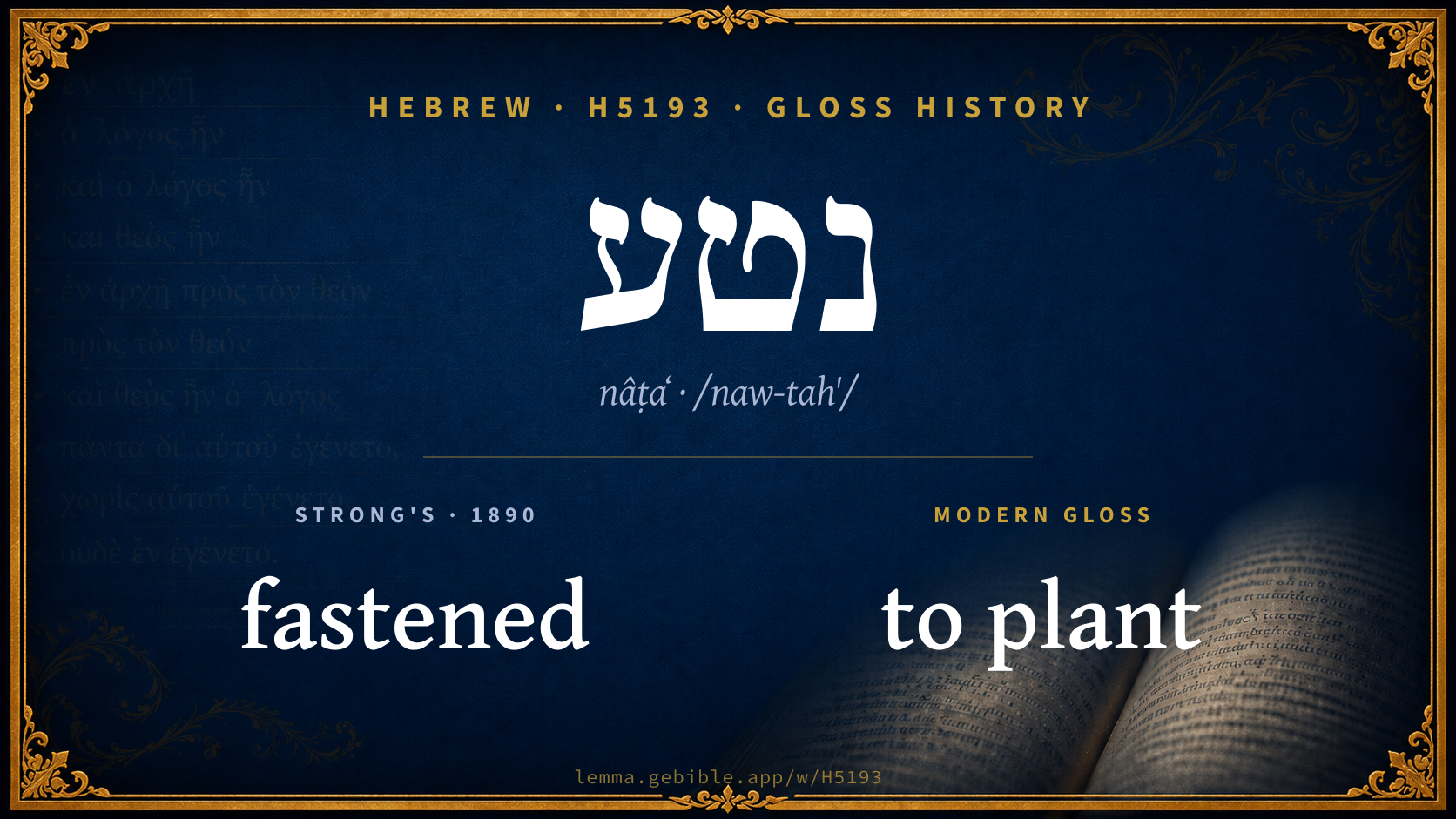
Gloss history
Strong's 1890 vs modern scholarship
About this word
Strong's H5193 catalogs a Hebrew word from the Hebrew Old Testament.
These counts are not copied from any lexicon or concordance. They are computed here, from the morphology-tagged Hebrew Old Testament. What Lemma adds →
- 55
- distinct verses
- The word appears in 55 distinct verses.
- 18 / 39
- OT books
- The word appears in 18 of 39 Old Testament books.
- #647
- by frequency
- Top 1000 most frequent Hebrew words (rank 647 of 8,640 Hebrew words by occurrence).
View all 55 occurrences in the concordance →
By section of the Old Testament
By traditional corpus
Conventional, traditional groupings — biblical authorship is debated, so this is a traditional corpus grouping, not an authorship claim. Each share is this word’s portion of its verses in that division of the Hebrew canon. Each figure is a share of the word’s 55 distinct verses.
- Prophets (Nevi'im) 31 verses · 56%
- Writings (Ketuvim) 13 verses · 24%
- Torah (Pentateuch) 11 verses · 20%
How translations render this word
Counts come from each version’s own published word-to-Strong’s tagging or interlinear alignment — an approximate guide to how each version renders this word, not a word-level alignment the data otherwise carries. Because each total is that version’s own tagged count, the per-version totals vary from one another and need not match the appearance or distinct-verse counts above. These counts may also differ from a printed concordance because Lemma counts each distinctly tagged rendering and does not collapse phrase taggings into a single head-word total. This is a fixed set of word-tagged versions (KJV, ASV, BSB, ULT) and does not change with the reading translation you choose elsewhere. Each version’s license is shown beside its name below (and on Sources).
- King James Version: Plant 12×, I will plant 4×, Planted 3×
- American Standard Version: Plant 6×, Them 6×, Planted 4×
- Berean Standard Bible: Plant 14×, Planted 6×, You will plant 5×
- unfoldingWord Literal Text: Plant 12×, He planted 3×, Planted 3×
King James Version Public Domain
Renders H5193 across 58 tagged occurrences — most commonly:
Plus 30 renderings that appear only once — usually multi-word phrases or single function words the recovered tagging swept in, not distinct renderings.
American Standard Version Public Domain
Renders H5193 across 59 tagged occurrences — most commonly:
Plus 35 renderings that appear only once — usually multi-word phrases or single function words the recovered tagging swept in, not distinct renderings.
Berean Standard Bible Public Domain
Renders H5193 across 57 tagged occurrences — most commonly:
Plus 22 renderings that appear only once — usually multi-word phrases or single function words the recovered tagging swept in, not distinct renderings. Not rendered by a distinct English word in 1 further occurrence.
unfoldingWord Literal Text CC BY-SA 4.0
Renders H5193 across 56 tagged occurrences — most commonly:
Plus 22 renderings that appear only once — usually multi-word phrases or single function words the recovered tagging swept in, not distinct renderings.
Senses in the full BDB
Hebrew verbs can shift meaning by stem (binyan): Qal is the basic action, Niphal is often passive or reflexive, Piel often intensifies or makes it factitive, and Hiphil is typically causative. The senses below are grouped under the stem BDB assigns to each.
What do BDB’s symbols mean?
BDB uses these scholarly abbreviations:
| Symbol | Meaning |
|---|---|
| 𝔊 | the Septuagint (the ancient Greek translation, LXX) |
| 𝔙 | the Vulgate (the Latin translation) |
| 𝔖 | the Syriac version (the Peshitta) |
| 𝔗 | the Targum (the Aramaic translation) |
| ψ | the Psalms |
| √ | root (the underlying root or stem) |
| ‖ | parallel passage (a synonymous or contrasted parallel) |
| † | the dagger: every passage where the word occurs is cited |
The 4 senses and sub-senses the full Brown-Driver-Briggs lexicon distinguishes for this word, in lexicon order (not ranked by frequency), with BDB’s own verbatim wording and sub-sense lettering. Shown in Hebrew script with BDB’s own scholarly abbreviations. The condensed entry is in the Lexicon Entry tab. See also the Forms in the corpus table below.
Qal
- Pf. 3 ms. Nu 24:6 +, 2 ms. נָטָ֑עְתָּ Dt 6:11, sf. 3 mpl. נְטַעְתָּם Je 12:2; 1 s. נָטַ֫עְתִּי Je 45:4 + 2 times, וְנָטַעְתִּ֫י Je 42:10 Ec 2:5, sf. נְטַעְתִּיךְ Je 2:21, וּנְטַעְתִּיו consec. 2 S 7:10 = וּנְטַעְתִּיהוּ 1 Ch 17:9, וּנְטַעְתִּים consec. Am 9:15 + 2 times, etc.; Impf. 3 ms. יִטַּע Dn 11:45, וַיִּטַּע Gn 2:8 + 2 times, sf. וַיִּטָּעֵ֫הוּ Is 5:2; 2 ms. תִּטַּע Dt 16:21 + 2 times, sf. 3 fs. וַתִּטָּעֶ֑הָ ψ 80:9; sf. 3 mpl. וַתִּטָּעֵ֫מוֹ Ex 15:17, וַתִּטָּעֵם ψ 44:3, etc.; Imv. נִטְעוּ Je 29:5 + 3 times; Inf. לִנְטֹעַ Is 51:16 Je 18:9, לִנְטוֹעַ Je 1:10; 31:28, לָטַעַת Ec 3:2; Pt. act. נוֹטֵעַ Je 11:17, נֹטַע ψ 94:9 (shewing orig. a according to LagBN 84); pl. נֹטְעִים Je 31:5; pass. נָטוּעַ Ec 3:2, pl. נְטוּעִים Ec 12:11;— e.g. Numbers 24:6
- 1. plant, c. acc. of tree or vine Nu 24:6 (JE; subj. י׳), Gn 21:33 (J), Lv 19:23 (H), Is 44:14 ψ 106:16 (subj. י׳), Ec 2:5 also (fig. of people) Je 2:21; 11:17 ψ 80:9, 16; c. acc. of vineyard Gn 9:20 (J), Am 5:11; 9:14; 2 K 19:29 = Is 37:30; Zp 1:13; Dt 20:6; 28:30, 39 Je 31:5(×3); 35:7; Ez 28:26; Is 65:21; Pr 31:16 ψ 107:37; Ec 2:4; olive trees and vineyards Dt 6:11 Jos 24:13 (D); garden Gn 2:8 (י׳), Je 29:5, 28; so c. acc. אֲשֵׁרָה כָּל־עֵץ Dt 16:21; נ׳ נִטְעֵי נַעֲמָנִים Is 17:10 (fig. of idolatry); abs. (lit.) Is 65:22; Ec 3:2(×2) (opp. עָקַר); c. 2 acc. Is 5:2 (plant vineyard with vine). e.g. Numbers 24:6
- 2. plant, fig. = establish, usually of establishing people, c. acc. 2 S 17:10 = 1 Ch 17:9 Am 9:15 (opp. נָתַשׁ), Ez 36:36; Ex 15:17 (song), especially Je 24:6; 32:41 (ב loc.), 42:10 (opp. נָתַשׁ), 45:10 (opp. id., ψ 44:3 (all of establishing Isr.); of establishing wicked Je 12:2; abs. of establishing people Je 1:10; 18:9; 31:28; more lit., establish heavens Is 51:16 (‖ לִיסֹד אֶרֶץ); plant i.e. fix (late use) tents Dn 11:45; מַשְׂמְרוֹת נְטוּעִים Ec 12:11 nails planted, i.e. fixed in; even נ׳ אֹזֶן ψ 94:9 he that planted the ear. e.g. 2 Samuel 17:10
Niphal
- Pf. 3 pl. נִמָּ֑עוּ Is 40:24 be planted, fig., = be established. e.g. Isaiah 40:24
Senses from the full Brown-Driver-Briggs lexicon (Brown, Driver, Briggs; Oxford 1906 — public domain), digitized via Sefaria, supplemented by the OpenScriptures HebrewLexicon (CC BY 4.0). Full attribution on Sources.
Word origin
vb. plant (NH id., and deriv.; cf. Sab. נטעת pavilion [? as planted, established] DHM ZMG xxxvii. (1883), 337, 349);—
— Brown-Driver-Briggs (Oxford 1906, public domain), digitized via Sefaria, supplemented by the OpenScriptures HebrewLexicon (CC BY 4.0). See Sources.
Origin: a primitive root
Jastrow Dictionary
A second Hebrew/Aramaic lexicon for comparison, covering Aramaic and post-biblical (Talmudic, Targumic, Midrashic) usage that the biblical-Hebrew BDB does not. Matched by lemma rather than by Strong’s number, so a lemma may carry more than one Jastrow headword (shown separately below), and the entries cover usage well beyond the Bible.
נָטַע
- (b. h.) [to fix,]
- 1. = נָטָה, to pitch a tent; put up a temporary structure. Meg. 5ᵇ נטיעה של שמחה נ׳ he put up a temporary structure for a festive religious occasion, v. אַכְוַרְנְקָא. Ib. היכי נ׳ נטיעה וכ׳ how dared he put up a temporary structure on Purim?—Snh. 111ᵃ ביקש מקום לִנְטוֹעַ אהלו (Ex. R. s. 6 לִנְטוֹת) he wanted a place to put up his tent; a. fr.
- 2. to insert, to plant, contrad. to זרע.Kil. II, 4 זרועה ונמלך לנוֹטְעָהּ if a field was sown, and he resolves to plant trees in it, לא יאמר אֶטַּע וכ׳ he must not say, I will first plant and then &c., v. אָפַךְ. Ib. I, 8 אין נוֹטְעִין ירקות וכ׳ you must not plant vegetables &c.; a. v. fr.—Part. pass. נָטוּעַ; f. נְטוּעָה; pl. נְטוּעִום, נְטוּעִין; נְטוּעוֹת. Ib. V, 1; 4; sq.; a. fr.—Trnsf. to beget. Y. Yeb. I, 2ᵇ, a. e., v. נְטִיעָה.
- to be planted with trees. B. Bath. 24ᵇ; Erub. 23ᵇ נ׳ רובו if the larger portion of it was planted with trees, opp. נזרע. Ohol. XVIII, 3 אינה נִטַּעת כל נטע must not be planted with any kind of trees; Tosef. ib. XVII, 10; a. fr.
נֶטַע
- (b. h.; preced.) plant, plantation. Koh. R. to IV, 6 כמה בית נ׳ וכ׳ how much land fit for plantation is in it?—נ׳ רבעי the fourth year’s fruits of a young tree (Lev. XIX, 24). Maas. Sh. V, 4; a. fr.; v. רְבָעִי. e.g. Leviticus 19:24
A Dictionary of the Targumim, the Talmud Babli and Yerushalmi, and the Midrashic Literature (Marcus Jastrow; London, Luzac, 1903) — Public Domain. Digitized via Sefaria. Digitized via Sefaria. Full attribution on Sources.
Forms in the corpus
The 49 distinct written forms H5193 takes in the Hebrew Bible, most frequent first — each parse links to that stem’s occurrences in the concordance. Hebrew forms include their vowel points and cantillation, so a single lemma takes many written forms.
Same root — word family
Other BDB entries built from the same root as H5193, grouped by Strong’s listed origin. These share a root / origin per the lexicon — not necessarily a shared meaning. Each links to that word’s own entry.
Derived from this word
Compare all same-root words → They share a root, not necessarily a meaning.
Septuagint verse parallels
This word appears in 52 verses that also exist in the Greek Old Testament (Septuagint), out of the 55 Hebrew verses it occurs in. You can read those verses in Greek by switching the Old Testament edition to the Septuagint.
Read these verses in the Septuagint
- Genesis 2:8
- Exodus 15:17
- Leviticus 19:23
- Numbers 24:6
- Deuteronomy 6:11
- Joshua 24:13
- 2 Samuel 7:10
- 2 Kings 19:29
- 1 Chronicles 17:9
- Psalms 44:2
- Proverbs 31:16
- Ecclesiastes 2:4
This is a verse-level parallel only — the same verses exist in both the Hebrew and Greek Old Testaments. No word-level Hebrew↔Greek correspondence is claimed: the data carries no such alignment, so no Greek word is shown as this Hebrew word’s translation. Coverage is not total — the Septuagint omits the deuterocanon and renumbers the Psalms, so some Hebrew verses have no direct Greek parallel.