
Jeremiah 18:9

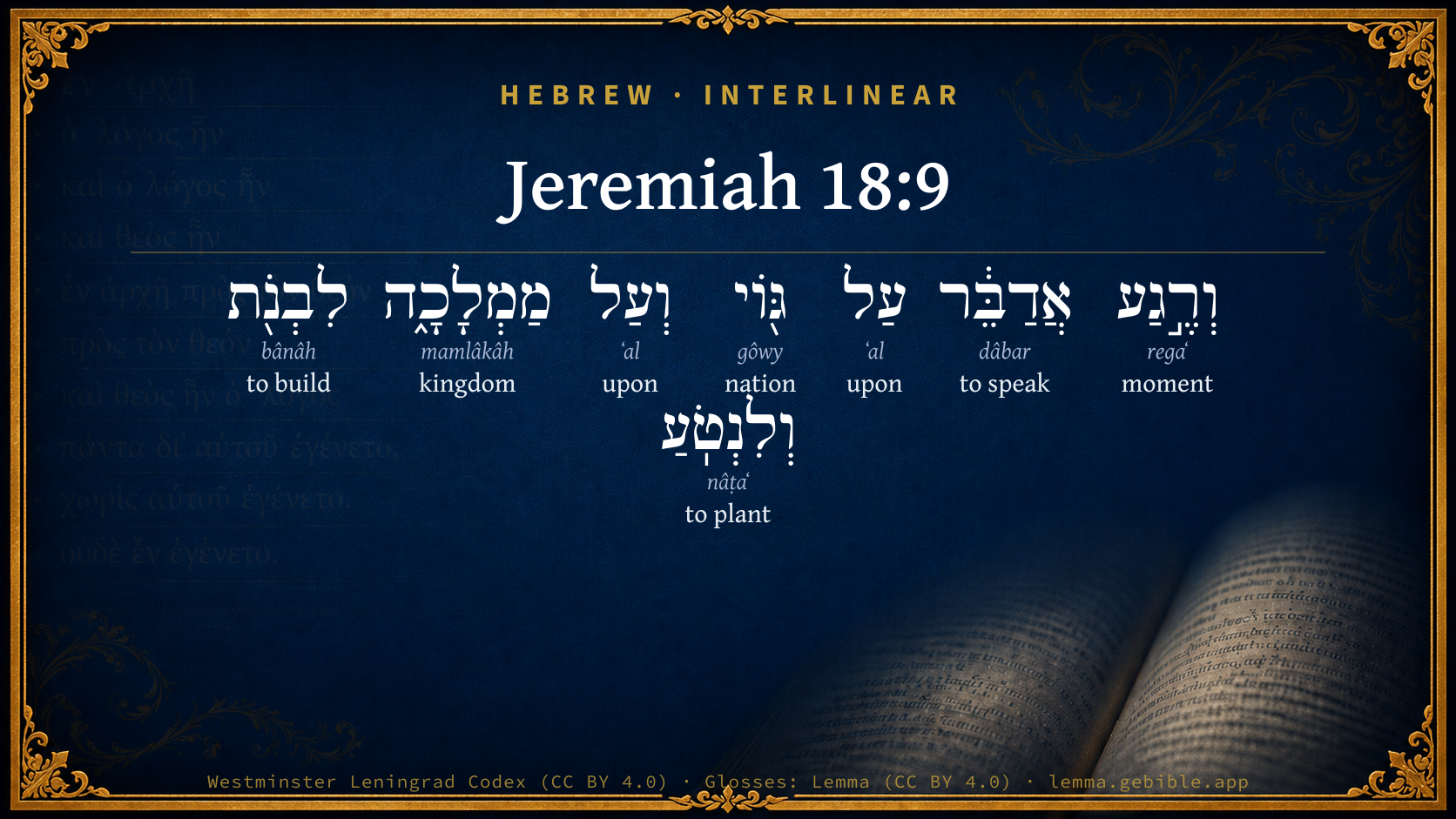
Hebrew (Westminster Leningrad Codex) Jeremiah 18:9 appears in the Hebrew Old Testament. The text above is from the Westminster Leningrad Codex. Each word links to its Strong’s number, a concise gloss, and parsing drawn from the Open Scriptures Hebrew Bible morphology. Click any word for its full Brown-Driver-Briggs (BDB) entry.
Download image
Cite this verse

Jeremiah 18:9 (World English Bible). Public Domain. Lemma interlinear Bible study tool, https://lemma.gebible.app/v/jeremiah/18/9.

Show BibTeX & RIS
BibTeX
RIS
English Translation
At what instant I shall speak concerning a nation, and concerning a kingdom, to build and to plant it;
World English Bible · Public Domain
Download a study sheet

One document with this verse’s original text, its word-by-word gloss line, the meaning frame, cross-references with their text, attributed commentary, and full source and license credits — printable, and it pastes into notes with its structure intact.

This verse Autodidact and up

Study sheet (.html) Plain text (.txt)

A passage Seminary Student

Up to 50 verses in one chapter. A passage sheet keeps up to 6 commentary sources and 12 cross-references per verse, in the order this page ranks them, and says so on the sheet whenever that leaves anything out. Ask for a single verse and you get the Autodidact verse sheet above.

Everything on this page stays free to read, with no account — the sheet is a download of what is already on screen, not access to it.

Want to remove ads? Support Godless Engineer
Compare translations 3

The same verse in 3 English versions, stacked beneath the original-language interlinear above. Click any original word for its lexicon entry.

Each is an independent rendering of the whole verse — the interlinear is not word-aligned to these translations.

Highlighted words mark where these versions differ — a whole-verse word diff, not a word-by-word alignment.

  • World English Bible Public Domain
    At what instant I shall speak concerning a nation, and concerning a kingdom, to build and to plant it;
  • King James Version Public Domain
    And at what instant I shall speak concerning a nation, and concerning a kingdom, to build and to plant it;
  • unfoldingWord Literal Text CC BY-SA 4.0
    And moment I speak concerning a nation or concerning a kingdom, to build and to plant,

unfoldingWord Literal Text — © unfoldingWord, licensed CC BY-SA 4.0. Word-aligned USFM3 via Door43 (git.door43.org/unfoldingWord/en_ult).

Versions to compare (up to 4)

3 of 4 selected

Show all 18 translations

Every available English version of this verse, each an independent rendering of the whole verse.

  • World English Bible Public Domain
    At what instant I shall speak concerning a nation, and concerning a kingdom, to build and to plant it;
  • Berean Standard Bible Public Domain
    And if at another time I announce that I will build up and establish a nation or kingdom,
  • Majority Standard Bible Public Domain
    And if at another time I announce that I will build up and establish a nation or kingdom,
  • King James Version Public Domain
    And at what instant I shall speak concerning a nation, and concerning a kingdom, to build and to plant it;
  • American Standard Version (1901) Public Domain
    And at what instant I shall speak concerning a nation, and concerning a kingdom, to build and to plant it;
  • Revised Version (1885) Public Domain
    And at what instant I shall speak concerning a nation, and concerning a kingdom, to build and to plant it;
  • Geneva Bible (1599) Public Domain
    And I wil speake suddenly concerning a nation, and concerning a kingdome to builde it and to plant it.
  • Douay-Rheims (1899) Public Domain
    And I will suddenly speak of a nation and of a kingdom, to build up and plant it.
  • Young's Literal Translation Public Domain
    And the moment I speak concerning a nation, And concerning a kingdom, to build, and to plant,
  • Literal Standard Version CC BY-SA 4.0
    And the moment I speak concerning a nation, || And concerning a kingdom, to build, and to plant,
  • Unlocked Literal Bible CC BY-SA 4.0
    At another moment, I may proclaim something about a nation or a kingdom, that I will build it up or plant it.
  • unfoldingWord Literal Text CC BY-SA 4.0
    And moment I speak concerning a nation or concerning a kingdom, to build and to plant,
  • Darby Bible Public Domain
    And at the moment that I speak concerning a nation and concerning a kingdom, to build and to plant,
  • World Messianic Bible Public Domain
    At the instant I speak concerning a nation, and concerning a kingdom, to build and to plant it,
  • Webster's Bible Public Domain
    And at what instant I shall speak concerning a nation, and concerning a kingdom, to build and to plant it;
  • Free Bible Version CC BY-SA 4.0
    At another time I could announce that I'm going to build up and give power to a nation or a kingdom.
  • Bible in Basic English Public Domain
    And whenever I say anything about building up a nation or a kingdom, and planting it;
  • JPS Tanakh (1917) Public Domain
    And at one instant I may speak concerning a nation, and concerning a kingdom, to build and to plant it;

Literal Standard Version (2020), Covenant Press — licensed CC BY-SA 4.0. Text via the HelloAO Bible API (eBible.org). Unlocked Literal Bible (unfoldingWord) — licensed CC BY-SA 4.0. Text via the HelloAO Bible API (eBible.org). unfoldingWord Literal Text — © unfoldingWord, licensed CC BY-SA 4.0. Word-aligned USFM3 via Door43 (git.door43.org/unfoldingWord/en_ult). Free Bible Version, Dr. Jonathan Gallagher — licensed CC BY-SA 4.0. Text via the HelloAO Bible API (eBible.org).

Word by word

More ways to search: Search by grammar → Find every occurrence → Compare this word →

Practice this passage: Drill this verse → Learn its vocabulary →

About this verse

These counts appear in no published source. They are computed here, from the morphology-tagged text and Lemma’s own curated glosses. What Lemma adds →

8
words
7
distinct lemmas
Prophets
section

Notable vocabulary

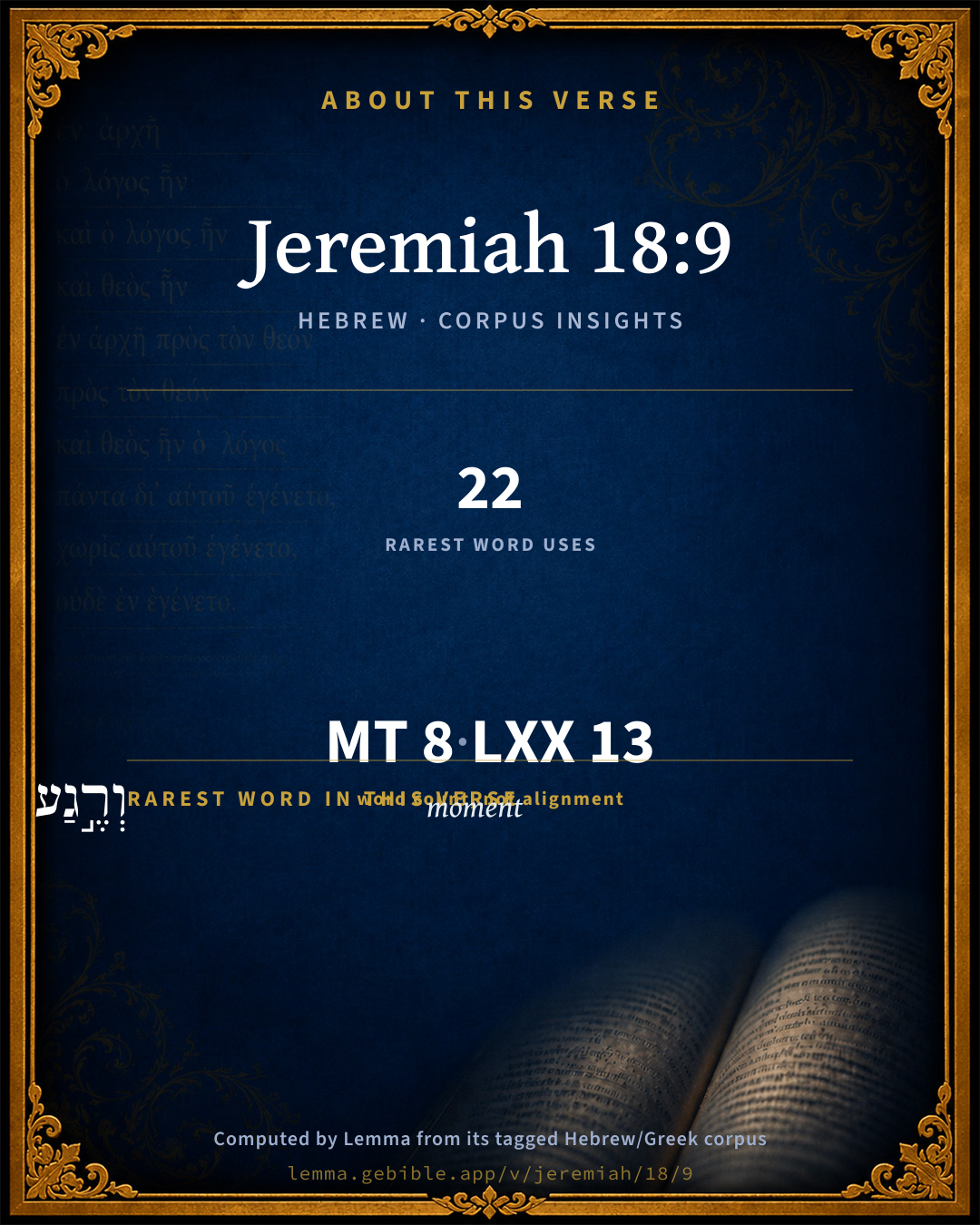
The rarest word here is וְרֶ֣גַע moment H7281 — appearing just 22 times in the whole Hebrew Bible.

Shared distinctive vocabulary

וְרֶ֣גַע moment H7281 occurs in 22 verses of the Hebrew Bible. Also found in:

Grammatical profile

  • 3 verbs
  • 3 nouns
  • 2 prepositions

Verb forms

  • אֲדַבֵּ֔ר Piel · Imperfect
  • לִבְנֹ֖ת Qal · Infinitive Construct
  • וְלִנְטֹֽעַ Qal · Infinitive Construct

Repetition

A word recurs within this verse — often emphatic in Hebrew:

Hebrew & Septuagint length

In the original languages it is 8 Hebrew tokens and 13 Greek tokens — but the two are counted differently (Hebrew bundles its prefixes and suffixes into one token; the Greek is in lemma form), so that isn’t a like-for-like length.

Cross-references

9

Topical passages linked to Jeremiah 18:9 in the Treasury of Scripture Knowledge — connected by theme and wording, ordered by reader-vote popularity; previews shown in the World English Bible.

  • Jeremiah 31:28 It shall happen that, like as I have watched over them to pluck up and to break down and to overthrow and to destroy and to afflict, so will I watch over them to build and to plant, says Yahweh.
  • Amos 9:11–15 In that day I will raise up the tent of David who is fallen, and close up its breaches, and I will raise up its ruins, and I will build it as in the days of old;
  • Jeremiah 1:10 behold, I have this day set you over the nations and over the kingdoms, to pluck up and to break down and to destroy and to overthrow, to build and to plant.
  • Jeremiah 11:17 For Yahweh of Hosts, who planted you, has pronounced evil against you, because of the evil of the house of Israel and of the house of Judah, which they have worked for themselves in provoking me to anger by offering incense to Baal.
  • Ecclesiastes 3:2 A time to be born, And a time to die; A time to plant, And a time to pluck up that which is planted;
  • Jeremiah 30:18 Thus says Yahweh: Behold, I will turn again the captivity of Jacob's tents, and have compassion on his dwelling-places; and the city shall be built on its own hill, and the palace shall be inhabited after its own manner.
  • Jeremiah 31:4 Again will I build you, and you shall be built, O virgin of Israel: again shall you be adorned with your tambourines, and shall go forth in the dances of those who make merry.
  • Jeremiah 31:38 Behold, the days come, says Yahweh, that the city shall be built to Yahweh from the tower of Hananel to the gate of the corner.
  • Jeremiah 32:41 Yes, I will rejoice over them to do them good, and I will plant them in this land assuredly with my whole heart and with my whole soul.

Cross-references courtesy of OpenBible.info (CC BY 4.0).

Hebrew and Greek witnesses Masoretic Hebrew ↔ Greek Septuagint

The same verse in the two great witnesses to the Old Testament, shown verse-for-verse.

These are two independent witnesses, not word-aligned to each other, and the Septuagint is shown in lemma (dictionary) form.

Hebrew Jeremiah 18:9 Masoretic · Westminster Leningrad Codex

וְרֶ֣גַע אֲדַבֵּ֔ר עַל גּ֖וֹי וְעַל מַמְלָכָ֑ה לִבְנֹ֖ת וְלִנְטֹֽעַ

At what instant I shall speak concerning a nation, and concerning a kingdom, to build and to plant it;

World English Bible · Public Domain

Greek LXX Structure differs

In the Septuagint, Jeremiah is about an eighth shorter than the Hebrew and arranges its material differently — the Oracles Against the Nations (Hebrew chapters 46–51) appear in the middle of the Greek book, after 25:13. Because the chapter and verse boundaries do not line up, a verse-for-verse comparison with the Hebrew is not shown.

A verse-for-verse comparison isn’t shown here because the chapters and verses don’t line up. Switch to the LXX edition with the MT / LXX toggle above to read the Greek directly.

Hebrew: Westminster Leningrad Codex (CC BY 4.0). Greek: Septuagint (public domain); English from a public-domain English Septuagint. How the Septuagint differs from the Hebrew →

Targum (Aramaic paraphrase)

1

The Targum is the ancient Jewish Aramaic paraphrase of the Hebrew Scriptures — an interpretive translation, not the Hebrew text itself. Onkelos (literal) and Pseudo-Jonathan (expansive) render the Torah, and Jonathan the Prophets. Coverage is partial: where no permissively-licensed English translation exists for a verse, only the Aramaic is shown. This is verse-level text, not a word-by-word alignment to the Hebrew.

  1. Targum Jonathan Prophets (Joshua–Malachi)
    וּזְמַן אֲמַלֵיל עַל עַמָא וְעַל מַלְכוּתָא לְמִבְנֵי וּלְקַיָמָא:

    (no public-domain English translation for this verse)

    Targum Jonathan — Aramaic: “Mikraot Gedolot” (public domain). English: “Sefaria Community Translation” (CC0 1.0 (public-domain dedication)); “London "Chaldee Paraphrase," 1871” (public domain). Text via Sefaria.

Commentary

Notes on Jeremiah 18:9 from classic Christian and Jewish commentators (each source and its license shown beneath its notes). The classic Christian expositions comment on the surrounding passage and are grouped to its opening verse, so a note may address several verses; the Jewish commentaries on the Tanakh (Rashi and others) are per-verse, so they appear only where the commentator wrote on this verse.

Lemma curates 59 commentaries, every one of them public domain or Creative Commons licensed, each selected and text-cleaned for this edition rather than reprinted as found. About our sources →

Trapp's Complete Commentary

John Trapp

Jer 18:9 And [at what] instant I shall speak concerning a nation, and concerning a kingdom, to build and to plant [it];

Ver. 9. And at what instant I shall speak.] All is done as God the great Induperator commandeth, whether it be for or against a nation, or a particular man only. {Job 34:29}

To build or to plant it.] As he did this kingdom of England; which was therefore anciently called Regnum Dei, kingdom of God, and reckoned among the fortunate islands.

John Trapp, A Commentary or Exposition upon All the Books of the Old and New Testament (1647–1656) — public domain. Text from a community e-Sword module.

Joseph Benson's Commentary

Jer 18:9-10. If I shall speak concerning a nation to build and to plant — That is, To advance and establish all the true interests of it; if it do evil in my sight, &c. — If it lose its piety and virtue, and become profane and vicious; then will I repent of the good, &c. — I will not proceed with the good work which I was performing in its behalf, but it shall be intermitted; and what favours were further designed it shall be withheld. Thus God changed his purpose concerning Eli’s house, 1Sa 2:30; and hurried Israel back into the wilderness, when he had brought them within sight of Canaan; and thus he rejected those lost sheep of the house of Israel who refused to embrace the gospel, notwithstanding the general promises he had made to that people, and even after he had sent his Son to seek and save them. In like manner neither can any particular Christians, nor Christian churches, lay any claim to God’s general promise of preserving and finally saving them, any further than they keep close to that rule of faith and manners which he hath prescribed to them in the New Testament.

Joseph Benson's Commentary on the Old and New Testaments (1811–1818) — public domain. Text from a community e-Sword module.

Adam Clarke's Commentary

Verse 9. See Clarke on Jer 18:7.

Adam Clarke's Commentary on the Bible (1810–1826) — public domain. Text from a community e-Sword/MySword module.

John Calvin's Commentaries

On the other hand, he affirms, that the lost are restored, when the Lord speaks suddenly, of a nation and of a kingdom, to build and to plant; as though it was said, — “I will not only forgive, but I am ready to bestow blessings on those whom I had previously rejected as mine enemies.” Then God amplifies his goodness when he says, that he will not only forgive the sins of men, so as freely to pardon them, but that he is ready to bestow on them all kinds of blessings, if they seek to be reconciled to him.

John Calvin's Commentaries (1540-1563) — public domain. Text from the Calvin Translation Society English edition (1840s-50s) via the Christian Classics Ethereal Library (ccel.org). Calvin's coverage is partial (roughly two-thirds of the Bible); uncommented books and verses are honest gaps, never fabricated. The 19th-century editor's footnotes and remarks are omitted so the notes are faithfully Calvin's own voice.

John Gill's Exposition

Now therefore go to,.... This is the application of the above general rules of procedure to the people of the Jews, and particularly that which relates to the destruction of a nation or kingdom, and the declaration of it in order to reclaim them:

speak to the men of Judah, and to the inhabitants of Jerusalem,

saying, thus saith the Lord; or, "to the man of Judah" (u); the body of the Jewish nation, and especially the inhabitants of the metropolis of it; which was the source of sin to the whole kingdom, and on which the calamity threatened would chiefly come, if not prevented by a reformation:

behold, I frame evil against you; as the potter frames his clay upon the wheel, to which the allusion is; which is to be understood of the evil of punishment, but not of any secret purpose, and settled determination, in the mind of God to bring it upon them; for that is never disannulled by himself or others, or ever changed; but some operation in Providence, which began to work towards their destruction; some providential step which God had taken, and which threatened their ruin:

and devise a device against you; the same as before; by which it looked as if he had thought of the matter, and had contrived a scheme, which if he went on with, would issue in the subversion of their whole state:

return you everyone from his evil way; that so the reformation may be as general as the corruption was: it supposes a sense of the evil of their former conduct, and repentance for their sins, of which their forsaking and abstaining from them would be an evidence:

and make your ways and your doings good; for it is not sufficient barely to abstain from sin, which is only a negative holiness; but there must be a performance of good works, a walking in them, a constant series and course of obedience to God, according to the rule of his word.

(u) "ad virum Jehudah", Montanus, Cocceius, Schmidt.

John Gill's Exposition of the Whole Bible (1746–1763) — public domain (CC PDM 1.0). Text via the HelloAO Bible API.

unfoldingWord translationNotes

Door43 World Missions Community

build it up or plant it

These two phrases mean basically the same thing. Yahweh speaks of strengthening kingdoms as if they were buildings that he would build, and as if they were plants that he would plant. (See: Doublet and Metaphor)

if it does evil in my eyes

Here the word "it" refers to a nation or kingdom, which is a metonym for the people in that nation or kingdom. The word "eyes" represents seeing, and seeing represents thoughts or judgment. AT: "if the people of that nation do things that I consider to be evil" (See: Metonymy and Metaphor)

not listening to my voice

Here the word "voice" represents the words that Yahweh speaks. Here, "not listening" is an idiom that means that they do not obey. AT: "not obeying what I say" (See: Metonymy and Idiom)

translationWords

voice

good

unfoldingWord translationNotes — © Distant Shores Media and the Door43 World Missions Community, licensed CC BY-SA 4.0. Source: git.door43.org/Door43/en_tn.

Lesson kit

Teaching starters — assembled from the data on this page, not authored interpretation. Every prompt links to the verse data it draws on. Edit before teaching.

Jeremiah, in the Prophets, opens this verse with 8 words (7 distinct Hebrew lemmas). Its most distinctive word is regaʻ (“moment”). A historical commentator’s framing appears above. Read the whole chapter for the surrounding context.

Discussion questions

  1. The word regaʻ carries the sense “moment.” How does it shape the verse?
  2. How does Exodus 33:5, which shares the word «moment», read alongside this verse?
  3. What does the repetition of “upon” (2× in this one verse) do in this verse?
  4. The translations on this page render this verse differently — a whole-verse word diff, not a word-by-word alignment. What might account for the different wordings?
  5. «אֲדַבֵּ֔ר» is a Piel Imperfect verb. How does that grammatical form shape the action described?
  6. Compare how Trapp's Complete Commentary and Joseph Benson's Commentary read this verse. Where do they agree or differ?

Things to notice

Reading settings

Reading text

Shown beneath each verse's original-language words.

Old Testament
Old Testament edition

Read the OT as the Masoretic Hebrew (MT) or the Greek Septuagint (LXX).

English shown for the Greek Septuagint (in the Hebrew ↔ Greek comparison).

Comparing translations? Open the Compare panel on any verse page to stack up to four side by side.