Jeremiah 32:41

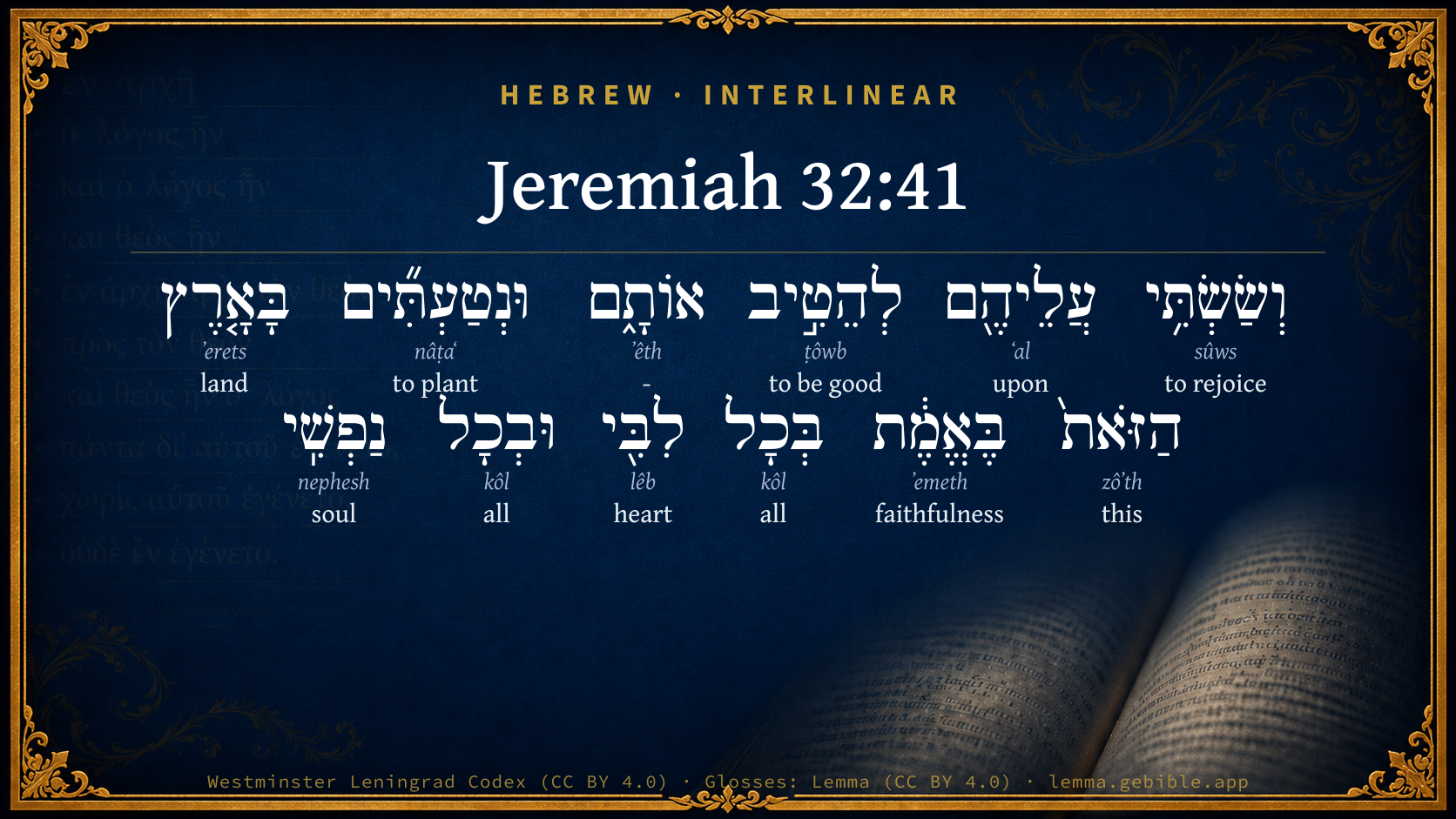
Hebrew (Westminster Leningrad Codex) Jeremiah 32:41 appears in the Hebrew Old Testament. The text above is from the Westminster Leningrad Codex. Each word links to its Strong’s number, a concise gloss, and parsing drawn from the Open Scriptures Hebrew Bible morphology. Click any word for its full Brown-Driver-Briggs (BDB) entry.
Download image
Cite this verse

Jeremiah 32:41 (World English Bible). Public Domain. Lemma interlinear Bible study tool, https://lemma.gebible.app/v/jeremiah/32/41.

Show BibTeX & RIS
BibTeX
RIS
English Translation
Yes, I will rejoice over them to do them good, and I will plant them in this land assuredly with my whole heart and with my whole soul.
World English Bible · Public Domain
Download a study sheet

One document with this verse’s original text, its word-by-word gloss line, the meaning frame, cross-references with their text, attributed commentary, and full source and license credits — printable, and it pastes into notes with its structure intact.

This verse Autodidact and up

Study sheet (.html) Plain text (.txt)

A passage Seminary Student

Up to 50 verses in one chapter. A passage sheet keeps up to 6 commentary sources and 12 cross-references per verse, in the order this page ranks them, and says so on the sheet whenever that leaves anything out. Ask for a single verse and you get the Autodidact verse sheet above.

Everything on this page stays free to read, with no account — the sheet is a download of what is already on screen, not access to it.

Want to remove ads? Support Godless Engineer
Compare translations 3

The same verse in 3 English versions, stacked beneath the original-language interlinear above. Click any original word for its lexicon entry.

Each is an independent rendering of the whole verse — the interlinear is not word-aligned to these translations.

Highlighted words mark where these versions differ — a whole-verse word diff, not a word-by-word alignment.

  • World English Bible Public Domain
    Yes, I will rejoice over them to do them good, and I will plant them in this land assuredly with my whole heart and with my whole soul.
  • King James Version Public Domain
    Yea, I will rejoice over them to do them good, and I will plant them in this land assuredly with my whole heart and with my whole soul.
  • unfoldingWord Literal Text CC BY-SA 4.0
    Then I will rejoice in doing good to them. I will faithfully plant them in this land with all my heart and all my life.

unfoldingWord Literal Text — © unfoldingWord, licensed CC BY-SA 4.0. Word-aligned USFM3 via Door43 (git.door43.org/unfoldingWord/en_ult).

Versions to compare (up to 4)

3 of 4 selected

Show all 18 translations

Every available English version of this verse, each an independent rendering of the whole verse.

  • World English Bible Public Domain
    Yes, I will rejoice over them to do them good, and I will plant them in this land assuredly with my whole heart and with my whole soul.
  • Berean Standard Bible Public Domain
    Yes, I will rejoice in doing them good, and I will faithfully plant them in this land with all My heart and with all My soul.
  • Majority Standard Bible Public Domain
    Yes, I will rejoice in doing them good, and I will faithfully plant them in this land with all My heart and with all My soul.
  • King James Version Public Domain
    Yea, I will rejoice over them to do them good, and I will plant them in this land assuredly with my whole heart and with my whole soul.
  • American Standard Version (1901) Public Domain
    Yea, I will rejoice over them to do them good, and I will plant them in this land assuredly with my whole heart and with my whole soul.
  • Revised Version (1885) Public Domain
    Yea, I will rejoice over them to do them good, and I will plant them in this land assuredly with my whole heart and with my whole soul.
  • Geneva Bible (1599) Public Domain
    Yea, I wil delite in them to do them good, and I wil plant them in this land assuredly with my whole heart, and with all my soule.
  • Douay-Rheims (1899) Public Domain
    And I will rejoice over them, when I shall do them good: and I will plant them in this land in truth, with my whole heart, and with all my soul.
  • Young's Literal Translation Public Domain
    and I have rejoiced over them to do them good, and have planted them in this land in truth, with all my heart, and with all My soul.
  • Literal Standard Version CC BY-SA 4.0
    and I have rejoiced over them to do them good, and have planted them in this land in truth, with all my heart, and with all My soul.”
  • Unlocked Literal Bible CC BY-SA 4.0
    Then I will rejoice in doing good to them. I will faithfully plant them in this land with all my heart and all my life.
  • unfoldingWord Literal Text CC BY-SA 4.0
    Then I will rejoice in doing good to them. I will faithfully plant them in this land with all my heart and all my life.
  • Darby Bible Public Domain
    And I will rejoice over them to do them good, and I will assuredly plant them in this land with my whole heart and with my whole soul.
  • World Messianic Bible Public Domain
    Yes, I will rejoice over them to do them good, and I will plant them in this land assuredly with my whole heart and with my whole soul.”
  • Webster's Bible Public Domain
    Yes, I will rejoice over them to do them good, and I will plant them in this land assuredly with my whole heart and with my whole soul.
  • Free Bible Version CC BY-SA 4.0
    I will be delighted to treat them well, and I will commit myself with the whole of my being to helping them to grow as a nation in this land.
  • Bible in Basic English Public Domain
    And truly, I will take pleasure in doing them good, and all my heart and soul will be given to planting them in this land in good faith.
  • JPS Tanakh (1917) Public Domain
    Yea, I will rejoice over them to do them good, and I will plant them in this land in truth with My whole heart and with My whole soul.

Literal Standard Version (2020), Covenant Press — licensed CC BY-SA 4.0. Text via the HelloAO Bible API (eBible.org). Unlocked Literal Bible (unfoldingWord) — licensed CC BY-SA 4.0. Text via the HelloAO Bible API (eBible.org). unfoldingWord Literal Text — © unfoldingWord, licensed CC BY-SA 4.0. Word-aligned USFM3 via Door43 (git.door43.org/unfoldingWord/en_ult). Free Bible Version, Dr. Jonathan Gallagher — licensed CC BY-SA 4.0. Text via the HelloAO Bible API (eBible.org).

Word by word

More ways to search: Search by grammar → Find every occurrence → Compare this word →

Practice this passage: Drill this verse → Learn its vocabulary →

לְהֵטִ֣יב
ṭôwb
H2895
“to be good”
Preposition + Verb, Hiphil, Infinitive Construct
Part of Speech
Preposition + Verb
Stem
Hiphil
Form
Infinitive Construct
Full BDB Definition

Origin: a primitive root

TWOT: 793

to be good, be pleasing, be joyful, be beneficial, be pleasant, be favourable, be happy, be right - (Qal) - to be pleasant, be delightful - to be glad, be joyful - to be better - to be well with, be good for - to be pleasing - (Hiphil) to do well, do good, act right, act rightly
  1. וְשַׂשְׂתִּ֥י sûws H7797 “and · to rejoice” Conjunction + Verb, Qal, Sequential Perfect, 1st Person, Common, Singular
  2. עֲלֵיהֶ֖ם ʻal H5921 “upon · them” Preposition + Suffix, Personal, 3rd Person, Masculine, Plural
  3. אוֹתָ֑ם ʼêth H853 “- · them” Particle, Direct Object + Suffix, Personal, 3rd Person, Masculine, Plural
  4. וּנְטַעְתִּ֞ים nâṭaʻ H5193 “and · to plant · them” Conjunction + Verb, Qal, Sequential Perfect, 1st Person, Common, Singular + Suffix, Personal, 3rd Person, Masculine, Plural
  5. בָּאָ֤רֶץ ʼerets H776 “in/at the · land” Preposition, Determined + Noun, Common, Both, Singular, Absolute
  6. הַזֹּאת֙ zôʼth H2063 “the · this” Particle, Definite Article + Pronoun, Demonstrative, Feminine, Singular
  7. בֶּאֱמֶ֔ת ʼemeth H571 “in/at · faithfulness” Preposition + Noun, Common, Feminine, Singular, Absolute
  8. בְּכָל kôl H3605 “in/at · all of” Preposition + Noun, Common, Masculine, Singular, Construct
  9. לִבִּ֖י lêb H3820 “heart · my” Noun, Common, Masculine, Singular, Construct + Suffix, Personal, 1st Person, Common, Singular
  10. וּבְכָל kôl H3605 “and · in/at · all of” Conjunction + Preposition + Noun, Common, Masculine, Singular, Construct
  11. נַפְשִֽׁי nephesh H5315 “soul · my” Noun, Common, Both, Singular, Construct + Suffix, Personal, 1st Person, Common, Singular

About this verse

These counts appear in no published source. They are computed here, from the morphology-tagged text and Lemma’s own curated glosses. What Lemma adds →

12
words
11
distinct lemmas
Prophets
section

Notable vocabulary

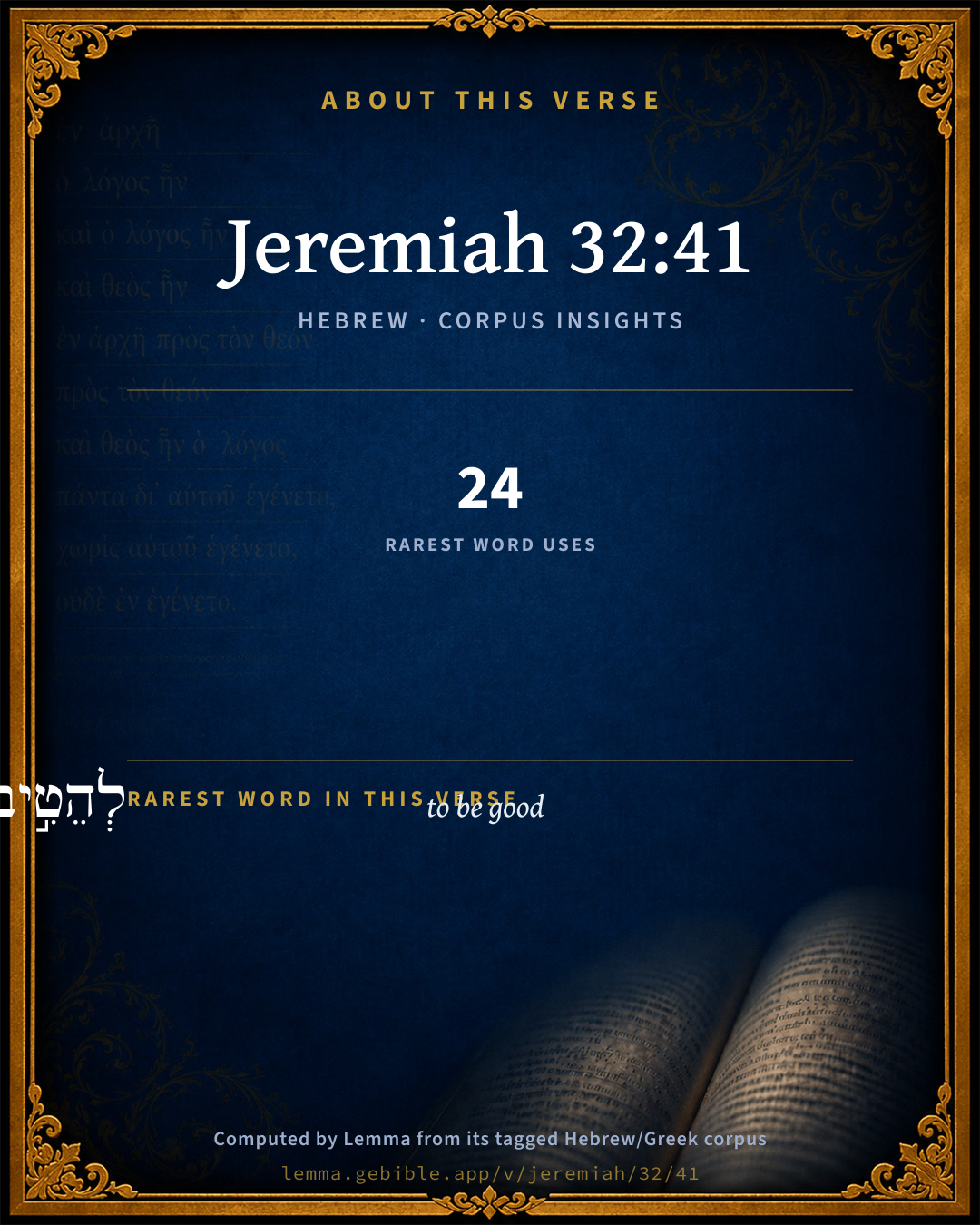
The rarest word here is לְהֵטִ֣יב to be good H2895 — appearing just 24 times in the whole Hebrew Bible.

Shared distinctive vocabulary

לְהֵטִ֣יב to be good H2895 occurs in 24 verses of the Hebrew Bible. Also found in:

Grammatical profile

  • 3 verbs
  • 6 nouns
  • 1 pronoun
  • 1 preposition
  • 1 particle

Verb forms

  • וְשַׂשְׂתִּ֥י Qal · Sequential Perfect
  • לְהֵטִ֣יב Hiphil · Infinitive Construct
  • וּנְטַעְתִּ֞ים Qal · Sequential Perfect

Repetition

A word recurs within this verse — often emphatic in Hebrew:

  • בְּכָל all H3605 ×2

Cross-references

9

Topical passages linked to Jeremiah 32:41 in the Treasury of Scripture Knowledge — connected by theme and wording, ordered by reader-vote popularity; previews shown in the World English Bible.

  • Jeremiah 24:6 For I will set my eyes on them for good, and I will bring them again to this land: and I will build them, and not pull them down; and I will plant them, and not pluck them up.
  • Zephaniah 3:17 Yahweh, your God, is in the midst of you, a mighty one who will save. He will rejoice over you with joy. He will rest in his love. He will rejoice over you with singing.
  • Isaiah 62:5 For as a young man marries a virgin, so shall your sons marry you; and as the bridegroom rejoices over the bride, so shall your God rejoice over you.
  • Amos 9:15 I will plant them on their land, And they will no more be plucked up out of their land which I have given them," says Yahweh your God.
  • Hosea 2:19–20 I will betroth you to me forever. Yes, I will betroth you to me in righteousness, in justice, in loving kindness, and in compassion.
  • Isaiah 65:19 I will rejoice in Jerusalem, and joy in my people; and there shall be heard in her no more the voice of weeping and the voice of crying.
  • Deuteronomy 30:9 Yahweh your God will make you plenteous in all the work of your hand, in the fruit of your body, and in the fruit of your cattle, and in the fruit of your ground, for good: for Yahweh will again rejoice over you for good, as he rejoiced over your fathers;
  • Jeremiah 18:9 At what instant I shall speak concerning a nation, and concerning a kingdom, to build and to plant it;
  • Jeremiah 31:28 It shall happen that, like as I have watched over them to pluck up and to break down and to overthrow and to destroy and to afflict, so will I watch over them to build and to plant, says Yahweh.

Cross-references courtesy of OpenBible.info (CC BY 4.0).

Hebrew and Greek witnesses Masoretic Hebrew ↔ Greek Septuagint

The same verse in the two great witnesses to the Old Testament, shown verse-for-verse.

These are two independent witnesses, not word-aligned to each other, and the Septuagint is shown in lemma (dictionary) form.

Hebrew Jeremiah 32:41 Masoretic · Westminster Leningrad Codex

וְשַׂשְׂתִּ֥י עֲלֵיהֶ֖ם לְהֵטִ֣יב אוֹתָ֑ם וּנְטַעְתִּ֞ים בָּאָ֤רֶץ הַזֹּאת֙ בֶּאֱמֶ֔ת בְּכָל לִבִּ֖י וּבְכָל נַפְשִֽׁי

Yes, I will rejoice over them to do them good, and I will plant them in this land assuredly with my whole heart and with my whole soul.

World English Bible · Public Domain

Greek LXX Structure differs

In the Septuagint, Jeremiah is about an eighth shorter than the Hebrew and arranges its material differently — the Oracles Against the Nations (Hebrew chapters 46–51) appear in the middle of the Greek book, after 25:13. Because the chapter and verse boundaries do not line up, a verse-for-verse comparison with the Hebrew is not shown.

A verse-for-verse comparison isn’t shown here because the chapters and verses don’t line up. Switch to the LXX edition with the MT / LXX toggle above to read the Greek directly.

Hebrew: Westminster Leningrad Codex (CC BY 4.0). Greek: Septuagint (public domain); English from a public-domain English Septuagint. How the Septuagint differs from the Hebrew →

Targum (Aramaic paraphrase)

1

The Targum is the ancient Jewish Aramaic paraphrase of the Hebrew Scriptures — an interpretive translation, not the Hebrew text itself. Onkelos (literal) and Pseudo-Jonathan (expansive) render the Torah, and Jonathan the Prophets. Coverage is partial: where no permissively-licensed English translation exists for a verse, only the Aramaic is shown. This is verse-level text, not a word-by-word alignment to the Hebrew.

  1. Targum Jonathan Prophets (Joshua–Malachi)
    וְיֶחְדֵי מֵימְרִי עֲלֵיהוֹן לְאֵיטָבָא לְהוֹן וַאֲקַיְמִינוּן בְּאַרְעָא הָדָא בִּקְשׁוֹט בְּמֵימְרִי וּבִרְעוּתִי:

    (no public-domain English translation for this verse)

    Targum Jonathan — Aramaic: “Mikraot Gedolot” (public domain). English: “Sefaria Community Translation” (CC0 1.0 (public-domain dedication)); “London "Chaldee Paraphrase," 1871” (public domain). Text via Sefaria.

Commentary

Notes on Jeremiah 32:41 from classic Christian and Jewish commentators (each source and its license shown beneath its notes). The classic Christian expositions comment on the surrounding passage and are grouped to its opening verse, so a note may address several verses; the Jewish commentaries on the Tanakh (Rashi and others) are per-verse, so they appear only where the commentator wrote on this verse.

Lemma curates 59 commentaries, every one of them public domain or Creative Commons licensed, each selected and text-cleaned for this edition rather than reprinted as found. About our sources →

John Gill's Exposition

And fields shall be bought in this land,.... After the return from the Babylonish captivity, which this respects; and of which the prophet's purchasing a field of his uncle's son was a pledge and token; in doing which, as a right thing, he is confirmed; as well as the cavils and objections of the Jews removed, who thought the destruction of the city, and such a practice, irreconcilable; and, moreover, this is mentioned as a pledge, earnest, and confirmation of the fulfilment of the above spiritual promises in Gospel times; for the people being returned at the end of the seventy years' captivity, and purchasing fields and vineyards, as was predicted, it might be strongly concluded, that since those temporal blessings promised were made good, spiritual ones would certainly be fulfilled; though some understand these words, in a spiritual sense, of the field of the church; for it is in the singular number, "a field shall be bought" (o); yea, "that field", emphatically, which was bought by the blood of Christ, and first planted in the land of Judea, as in Jer 32:41;

whereof ye say, it is desolate without man or beast; so wasted and destroyed by the enemy, that neither man nor beast are left, but both carried off by him; and therefore no hope of what is above promised:

it is given into the hand of the Chaldeans; they are become the possessors of it, and therefore it is all over with us as to buying and possessing fields and vineyards; but notwithstanding this diffidence and despair in the present view of things, it follows:

(o) "et vel tum emetur ager", Cocceius, Schmidt; "tum comparabitur ager", Junius & Tremellius.

John Gill's Exposition of the Whole Bible (1746–1763) — public domain (CC PDM 1.0). Text via the HelloAO Bible API.

Trapp's Complete Commentary

John Trapp

Jer 32:41 Yea, I will rejoice over them to do them good, and I will plant them in this land assuredly with my whole heart and with my whole soul.

Ver. 41. Yea, I will rejoice over them.] Volupe mihi erit; it shall be as great a pleasure to me to bless them, as it can be to them to obey me. See Jer 24:7 Psa 119:2; Psa 119:10.

John Trapp, A Commentary or Exposition upon All the Books of the Old and New Testament (1647–1656) — public domain. Text from a community e-Sword module.

The Biblical Illustrator

Joseph S. Exell

Jer_32:41

I will plant them in this land assuredly with My whole heart and with My whole soul

The whole-heartedness of God in blessing His people

I.

consider our text for instruction.

1. God blesses His people heartily. With My whole heart. Notice, in passing, that word assuredly; for it confirms the word as full of truth and certainty. He is slow to wrath, but He is swift to mercy, for He delighteth in it. When He deals out His grace to His people, then you see the loving God, for God is love; and you see the living God, for He blesses you with His whole soul.

2. He does this work of blessing His people thoughtfully, for it is added, and with My whole soul. Not only the affections of God, speaking after the manner of man, but the great mind and life of God is thrown into the work of saving and blessing His people. His essence, His soul, is here at home. The design argument, when brought to bear upon nature, proves the existence of God. Much more when that argument is brought to bear upon the works of grace do we see the Lord; for in the transactions of grace them is design in everything.

3. We notice, next, that if that be so, then He employs all His resources to bless His elect. The Lord our God--I speak as a man, and with deep reverence--is absorbed in doing good to His people: there is nothing that He is, there is nothing that He has, but what He will bring it to bear upon the design upon which He has set His whole heart and His whole soul. Behold ye, what God hath done for His people! He has given them His all: all the wisdom of His providence shall be theirs while here, and all the glory of His heaven hereafter. God has His abode in heaven; behold, He makes it the abode of His chosen for ever. Angels are His courtiers--they shall be ministering spirits to His elect. The throne of His Son they shall sit upon with Him. The victories of God shall furnish them with palms, and the delight of God shall find them harps. But stop, there is something more than all! It was little for God to give earth and heaven, but He must needs give His Son, the express image of His glory, His other self.

4. The Lord subordinates all other works to that of His love. Everything, whether of creation or destruction, mercy or judgment, shall work, like the wheels of some vast machinery, to produce good to those who are the people of the living God.

5. The Lord gives to His people and for His people without stint. When He feeds His children, though once they would have been thankful to eat the crumbs from His table, He sets them among princes, and gives them to eat of the kings meat. He lays eternity under contribution to provide for the needs, nay, for the desires, for the joys of His people.

6. Another point sets forth most plainly that the Lord blesses His people with His whole heart and with His whole soul, for He perseveres in it. Are you not surprised with the variety of His favours towards you? An old writer says that Gods flowers bloom double, for He sends two blessings where there seems but one; but I would say they are like the light: they are sevenfold, even as in every ray from the sun we have seven colours blended in harmony. What sevens and sevens of infinite love are contained in every beam of mercy that comes to the redeemed!

7. As the Lord Perseveres in His work, so He succeeds in it. God is determined to make something of His People, and He will.

8. God delights in all that He does for His own. We are happy when God blesses us, but not so happy as God is. Our God has all the instincts of motherhood and fatherhood blended in one; and when He looks upon His Church He calls her Hephzibah--My delight is in her. He does not rejoice in the works of His hands so much as in the works of His heart.

II. Consider the text with the evidence. In order to prove that God doth thus bless us with His whole heart and with His whole soul, I would remind you that the whole Trinity is engaged in the blessing of the chosen.

1. First comes the Father. It was He that chose us--chose us, not because He must choose us or none, but freely with His whole heart. Wisdom from her throne determined the way in which God would lead His People, and bless His people, and sanctify His people, and perfect His people.

2. In reference to the ever-blessed Son of God, whom we worship as most truly God, we have the same truth to state. He loved us ages before He came to earth am man.

3. I must not omit the Holy Spirit, to whom be all honour and glory. When we were mad with sin, and ravenous after the pleasures of it, He followed us, to check us in our headlong career, to beckon us to better things, to draw us thither, and to help us when we began to incline to the right. He gave us life, and light, and liberty.

III. Consider the inferences which flow from the text.

1. The first inference is one of consolation. Does God bless us with His whole heart and with His whole soul? Oh, then, how happy we ought to be!

2. Another inference, and I have done: it is one of exhortation. Let us love our God with our whole heart and with our whole soul. Trust Him for the past, the present, and the future; trust Him completely, implicitly, unhesitatingly. (C. H. Spurgeon.)

The enthusiasm of God

Who can but admire a man who speaks thus? Enthusiasm quickens life. It is salt and light for common days. It makes earth flash with heaven. But was it a man who said this? No. This voice came from heaven. Then of Cod. Well may Calvin annotate my text, saying, The words are indeed did some strong and radiant angel thus avow himself? No. This is the voice singular. God is telling His people the great things He purposes to do for them, and He declares He will accomplish all with His whole heart and with His whole soul. Here we are brought face to face with the kindling fact that God is a God of enthusiasm. In one sense, Calvins remark on the singularity of these words is very pertinent. But surveying them from another view-point, the Divine declaration is not singular. Enthusiasm is an impressive element of Bible theology. Scripture gives us peeps into Gods nature. Only peeps. The open vision would blind us. And assuredly we frequently behold in the Holy Book the outflashing of the Divine enthusiasm. Isaiah uses the wonderful phrase, The zeal of the God of hosts. It is Gods quenchless enthusiasm which is to establish in triumph the ever-increasing kingdom and peace of Emmanuel. This quality of God is one Isaiah delights in. Isaiah on the enthusiasm of God is a stimulating study. He says of a wonderful and apparently impossible deliverance of Gods people from their iron oppressor, The zeal of the Lord of hosts shall do this. Courage, sad-hearted and foe-encircled brother! The enthusiasm of God is pledged to thy deliverance! In another place the poet-theologian describes God as a warrior, and cries, He . . . was clad with zeal as a cloak. Grand is the vision of God as He appears in ruby-red robe of zeal. Ezekiel, his feet on earth, his soul floating amid the cherubim, represents Gods enthusiasm in its vengeful form when he declares how the wrath Divine shall bruise impenitent transgressors, and they shall know that I, the Lord, have spoken it in My zeal, when I have accomplished My fury in them If enthusiasm be a quality which Old Testament theology ascribes to God, it is also emphatically accredited to Him by the theology of the new covenant. It is revealed as an outstanding feature of Him to have seen whom is to have seen the Father. With My whole heart and with My whole soul, was the motto of His incarnate life. Holy enthusiasm was the temper of His words and deeds. The zeal of Thy house will eat me up. Thus our Lord fulfilled the scriptural ideal of enthusiasm as He fulfilled all scriptural ideals. God in Christ is always a God of enthusiasm. How intense He is! How He prays! The fervour of His prayers is never chilled. How He meditates! His inexplorable thoughts breathe themselves through eternity. The Christ of the New Testament is the Jehovah of the Old Testament, in white-hot enthusiasm, as in everything, august, and gentle, and lovely. Enthusiasm must surely be an essential of a true theology. One cannot conceive of an impassionate God. An apathetic God would depress the universe. An ancient Greek finely described enthusiasm as a God within. And such all grand enthusiasm is, and must be evermore. How attractive is our God by reason of His enthusiasm. Who would not love Him with his might who is ready to bless with His whole heart and with His whole soul? Such a God allures us. Who are they for whom God promises to labour so enthusiastically? Notice the repetitions them in this verse. Equally recurrent is the them in the previous verse. In verse 38 the them is indicated. It refers to My people. God will do wonderfully for His people. He prizes His people beyond compare. Nothing is too great for Him to do for those who are in His sight so lovely. And no enthusiasm is too lavish to expend upon their interests. Is there caprice in this wealthy enthusiasm over His people? By no means. Gods people represent character. And Gods enthusiasm for character is shown in His enthusiasm for His people. Gods enthusiasm is evoked by character. Our poor unworthy enthusiasms are often pitifully raise directed. The zeal of God never misses the true mark. God is enthusiastic to help men of character. See how in the neighbourhood of this text He rains golden showers of promises upon such. I will not turn away from them, to do them good (verse 40). I will rejoice over them to do them good (verse 41). I will plant them in this land (verse 41). I will bring upon them all the good that I have promised them (verse 42). And fields shall be bought in this land (verse 43). The enthusiasm of God runs forth in temporal helpfulness to men whose ways please Him. He cares even for fields which belong to His people. Lay tide to heart, burdened business man, if thou art one of Gods people! Consider this, depressed agriculturist, who art a man of God! God makes your interests His own interests. God is enthusiastic in respect of the creation and development of character. How abundantly that can be demonstrated from the context! I will give them one heart, and one way, that they may fear Me for ever, for the good of them, and of their children after them (verse 39). I will put My fear in their hearts, that they shall not depart from Me. What do these golden words portend? That with all His heart and with all His soul God will perfect the character of His people. The fact is, nothing in man creates such enthusiasm on Gods part as the instituting and enhancing of character. Your soul is that in you in which God is most interested, and He is interested in everything about you. He is enthusiastic in incomparable degree for your salvation. The supernatural rectification of the will and of the being which we commonly call conversion draws forth Gods intense enthusiasm. With His whole heart and with His whole soul He proposes to develop the good He has already created. He pines to perfect His servants. He has splendid ideals for them. He strongly yearns to make their to-morrows better than their yesterdays. There are those whose so-called enthusiasm is self-centred. Certain intense people are intensely selfish. Some have ineffectual enthusiasms. No altruism irradiates them. Nobody is anything bettered for them. They are fruitless fires. Not so the enthusiasm of God. Gods zeal is to help, to bless, to enrich men. To illumine what is dark in men. To raise what is low. To glorify what is sordid. Temporally and spiritually beneficent is the enthusiasm of God. He delights to help us. Nor can the strong years conquer His enthusiasm. In this, as in respect of all the qualities of the Divine character, we are to be imitators of God, as beloved children. An enthusiasm is contagious. Throbs thrill. The awful peril is that we imitate evil enthusiasms. Souls of men, be admonished against such devil-born enthusiasm. Gods enthusiasm is the true ideal for man. Be ye imitators of God. Be ours enthusiasm for holy living. What a rebuke to our tepidity is the enthusiasm of God! What is more remote from God than moral and spiritual coldness? Oh, this Divine enthusiasm is the crying need of modern religion! It is very instructive to study the Bible teaching concerning the enthusiasm of God. It is even more impressive on the negative than on the positive side. God has no spark of enthusiasm for much that man burns about. What discordance there often is between God and man! This is apparent in the objects of their respective enthusiasms. God has no enthusiasm for self-centredness. God has no enthusiasm for worldliness. No matter what form it assumes, He cares not for it. It is all vanity to Him. God has no enthusiasm for indifferency. Some are zealous for nothing but apathy. They have dead hearts, and there is no death so deadly as the death of the heart. Stoicism is not sanctity. God is quick with sympathy. The omissions from the revealed enthusiasms of God are intensely significant. Take heed lest thou art enthusiastic where thy God is not. A God who, with His whole heart and with His whole soul, seeks mans highest good, is a God who constrains our devotion. He attracts us. He captivates us. Were He a cold, unresponsive God, I should shrink from Him. But being an enthusiastic God, my heart is His. Here is a ground of trustfulness--the enthusiasm of God. Can I fear for the morrow when this God is mine? Here is a ground of hope--the enthusiasm of God. All shall always be well, seeing such a God is mine. Here is a ground of service--the enthusiasm of God. Too much one cannot do for such a God. When He declares, With My whole heart, and with My whole soul, He prefixes another delectable word, assuredly. The margin renders it in truth, or in stability. So the good Lord assures us of the perpetuity of His kindly enthusiasm. It will never fail His people. Whoever cools toward us, the enthusiastic God of grace will be faithful and fervent still (D. T. Young.)

The Biblical Illustrator, edited by Joseph S. Exell (c. 1880s–1900s) — public domain. Text from a community e-Sword module.

Tyndale Open Study Notes

Tyndale Open Resources

32:41 find joy: The Lord’s anger at seeing his people worship sex-idols and his grief in punishing them for breaching the old covenant would be gone. No longer would he uproot them (1:10); instead, it would be his delight to replant them.

Tyndale Open Study Notes — © Tyndale Open Resources, licensed CC BY-SA 4.0. Text via the HelloAO Bible API.

Jamieson, Fausset & Brown

Robert Jamieson, A. R. Fausset & David Brown

rejoice over them-- (Deu 30:9; Isa 62:5; Isa 65:19; Zep 3:17).

plant . . . assuredly--rather, "in stability," that is, permanently, for ever (Jer 24:6; Amo 9:15).

Jamieson, Fausset & Brown — Commentary Critical and Explanatory on the Whole Bible (1871) — public domain (CC PDM 1.0). Text via the HelloAO Bible API.

Adam Clarke's Commentary

Verse 41. Yea, I will rejoice over them to do them good] Nothing can please God better than our coming to him to receive the good which, with his whole heart and his whole soul, he is ready to impart. How exceedingly condescending are these words of God!

Adam Clarke's Commentary on the Bible (1810–1826) — public domain. Text from a community e-Sword/MySword module.

John Calvin's Commentaries

When God says that he would take pleasure in doing good to his people, he adopts the language of man, for fathers rejoice when they can do good to their children. God then, as the paternal love with which he regards his people could not have been otherwise expressed, made use of this similitude. Further, the contrast also ought to be noticed, even that God had rejoiced when he punished his people for their wickedness. For God delights in judgment as well as in mercy. God then for a time rejoiced when he punished the peopie; for as his judgment is right, he delights in it. But now he says that he would manifest his paternal affection, so as to take pleasure in doing them good.

He adds, I will plant them in this land He had indeed planted them, when, by Joshua, the possession of the land was given them, according to what is said in the 80th Psalm, where a similar expression is used, even that God had brought his vine out of Egypt, and planted it in the promised inheritance. (Psalm 80:8) But afterwards the people were plucked up by the roots. Hence the first possession of the land to the time of the exile was not, strictly speaking, a plantation, for the people did not then strike firm roots. God then promises here something new and unusual, when he speaks of a plantation. Nor is there a doubt but the perpetuity, of which mention has been made, is intended; for this plantation of the people depends on the covenant, and the covenant is not temporary as before the exile, but perpetual in its duration.

We now then understand what the Prophet means when he compares to a plantation the restoration of the people after their return from exile. We know, indeed, that the people from that time had not been banished, and that the Temple had ever stood, though the faithful had been pressed down with many troubles; but this was only a type of a plantation. We must therefore necessarily pass on to Christ, in order to have a complete fulfillment of this promise. The beginning, as we have said, and I am often compelled to repeat this, is to be taken from this return; but Christ is not to be excluded from that liberation which was like the morning star, before the sun of righteousness itself appeared in its own splendor. When Christians explain this passage and the like, they leave out the liberation of the people from Babylonish exile, as though these prophecies did not belong at all to that time; in this they are mistaken. And the Jews, who reject Christ, stop in that earthly deliverance. But the Prophets, as I have said, begin with the return of the people, but they set Christ also in the middle, that the faithful might know that that return was but a slight taste of the full grace, which was alone to be expected from Christ; for it was then, indeed, that God really planted his people.

Further, when the Jews were afterwards expelled from the land of Canaan, it was owing to their ingratitude; and it was a total abdication. In the meantime, however, God planted there his own vine until Jerusalem was extended and had its limits in the farthest parts of the earth: and we are said to be grafted in Christ and planted, when God adopts us into his Church; and hence that saying of Christ,

“Every tree which my Father hath not planted shall be rooted up.” (Matthew 15:13)

Let us then know that the Church was planted in Judea, for it remained to the time of Christ. And as Christ has pulled down the wall of partition, so that there is now no difference between Jews and Gentiles, God plants us now in the holy land, when he grafts us into the body of Christ.

He says, in truth, that is, faithfully, so as never to pull them up again. And he adds, with my whole heart and with my whole soul The words are indeed singular, for God transfers to himself the affections and feelings of men; but it is necessary that he should in a manner transform himself, that he may be understood by us; for unless he prattled, where would be found so much understanding as would reach the immense altitude of his wisdom? As then the mysteries with which he favors us are incomprehensible, it is necessary that he should accommodate himself to our limited capacities. By the whole heart, then, and the whole soul, he means that faithfulness and constancy which will ever endure until the faithful shall obtain eternal life. Integrity in man is called the whole heart, because there may be a double heart. It cannot, it is true, be for this reason applied to God or to his nature. But as I have already said, he says by a similitude that he would do this with the whole heart, because he will do it so perfectly that there will be nothing wanting to render salvation complete, and the same thing is also meant by truth; though some philosophize more refinedly as to this word, for by truth they understand the firmness or veracity of the promises, But we know that according to the usage of the Hebrew language, that truth means often what is solid and perpetual. He means then that the plantation would be so firm and solid, that there would be no danger that the people would ever be removed elsewhere, even because there would be a living root, as we have explained: the Church was fixed in Judea until the coming of Christ, who brought in the real accomplishment of this plantation; for when we are grafted into him, we already in a manner possess eternal life and are become the citizens of heaven.

John Calvin's Commentaries (1540-1563) — public domain. Text from the Calvin Translation Society English edition (1840s-50s) via the Christian Classics Ethereal Library (ccel.org). Calvin's coverage is partial (roughly two-thirds of the Bible); uncommented books and verses are honest gaps, never fabricated. The 19th-century editor's footnotes and remarks are omitted so the notes are faithfully Calvin's own voice.

Ellicott's Commentary for English Readers

(41) I will plant them in this land assuredly.—Literally, in truth, as in 1Sa_12:24, and elsewhere. By some interpreters the words have been referred to the stability of possession implied in the promise, but it is better to see in them an attestation of the faithfulness of the Promiser. In meaning, as in form, the word corresponds closely with the frequent “Amen,” “Verily, verily,” in our Lord’s teaching.

A Bible Commentary for English Readers, edited by Charles John Ellicott (1878–1897) — public domain. Text from a community e-Sword module.

The Cambridge Bible for Schools and Colleges

gen. ed. J. J. S. Perowne

41. I will plant them] See on Jer_24:6.

The Cambridge Bible for Schools and Colleges (gen. ed. J. J. S. Perowne; Cambridge University Press, 1878–1918) — public domain. Text from a community e-Sword module.

Haydock's Catholic Bible Commentary

Truth, like a tree which shall not be eradicated.

George Leo Haydock (1774–1849), Haydock's Catholic Family Bible and Commentary, 1859 edition — public domain. Excludes Psalms (Douay-Rheims chapter numbering differs from Protestant) and Deuterocanonical books (Catholic canon only).

Matthew Poole's English Annotations

I will not only do them good, but I will take pleasure and delight in doing them good; and I will certainly bring them to this land, and constantly and freely do them good when they shall be there.

Matthew Poole's English Annotations on the Holy Bible (1683–1685) — public domain. Text from a community e-Sword/MySword module.

Whedon's Commentary on the Bible

Daniel D. Whedon

41. With my whole heart — A loving and unlimited emphasis.

Daniel D. Whedon (gen. ed.), Commentary on the Old and New Testaments (1874–1909) — public domain. Text from a community e-Sword module.

The Pulpit Commentary

Assuredly; literally, with faith. fulness; i.e. with perfect sincerity, without an arriere pensee, as the next words explain it; comp. 1Sa_12:24 Isa_38:3 (Graf).

God rejoicing.

I GOD HAS JOY. He is not indifferent, nor is he morose; we are to think of him as the "blessed" God, i.e. as essentially happy. The brightness and beauty of the world are reflections from the blessedness of God. Because he is glad, nature is glad, flowers bloom, birds sing, young creatures bound with delight. Nothing is more sad in perversions of religion than the representations of God as a gloomy tyrant. Less terrible, but scarcely less false, are those monkish ideas which deny the tyranny but cherish the gloom of a sombre divinity more suited to chill, dark cloisters than to that glorious temple of nature in which the eternal presence dwells and manifests himself symbolically. These fragrant meadows, broad rolling seas of moorland heather, rich green forest cities of busy insect life, flashing ocean waves, and. the pure blue sky above, and all that is sweet and lovely in creation, swell one symphony of gladness, because the mighty Spirit that haunts them is himself overflowing with joy. Our God is a Sun. And if divinity is sunny, so should religion be. The happy God will rejoice in the happiness of his children. Innocent mirth, though forbidden by Puritan sourness, can be no offence to such a God. The typical citizens of his kingdom are little children; and what is so joyous as childhood?

II GOD FINDS JOY IN HIS CHILDREN. Here is the wonderful fact about the joy of God. He must have joy in his own purity and perfection. Then he has infinite resources at his command. The whole universe can be made to minister to his delight. All high and pure intelligences that form the choir of heaven aim at glorifying him. Yet he finds delight in such poor creatures as we are, in his fallen and erring children. How is this?

1. Because God is love. He loves all his children. Love finds delight in the loved; so God is compared to the bridegroom rejoicing over the bride. (Isa_62:5)

2. Because God is essentially blessed. The happy find sources of gladness in the most unlikely quarters, just as the cheeriest scenes cannot lift the load of sadness from those who are naturally mournful. God is so joyous that he finds joy even in us.

III GOD FINDS JOY IN BLESSING HIS CHILDREN. He rejoices over them to do them good. God"s joy is most unselfish. It is the greatest blessedness the blessedness of giving rather than that of receiving. It is the joy of sacrifice. God, being good, can find joy only in good; being merciful, can find none in harshness. He must punish the wicked, but he takes no delight in that. Like the shepherd who has recovered the lost sheep, like the woman who has found the lost money, like the father who has welcomed the wanderer home again safe and sound, God rejoices in the return of the penitent, till his joy overflows and is caught up by the angels about his throne. From this we may learn

(1) confidence if we return as penitents;

(2) assurance that all our life is safe in his hands;

(3) care not to grieve his Spirit;

(4) desire to live in communion with him.

IV GOD WILL CALL HIS CHILDREN TO SHARE IN HIS JOY. All joy is sympathetic. We call our friends and our neighbours to rejoice with us. But if we have special joy in any person we naturally desire this joy to be reciprocal. Christ desired his disciples to share his joy. (Joh_15:11) Joy is contagious. If we are with the happy and in sympathy with them, we naturally receive a share of their gladness. Whence comes the joy we anticipate in heaven? Escape from the evils of this life when God shall wipe away the tears from all eyes? Deliverance from sin and temptation? Reunion with the lost but not forgotten blessed dead? Opportunities for happy service? All these things and more; but these are not the sources of chief joy. That is to share the joy of God, to be "forever with the Lord."

The Pulpit Commentary (1880–1919), ed. H.D.M. Spence-Jones & Joseph S. Exell — public domain. Text from a community e-Sword module.

unfoldingWord translationNotes

Door43 World Missions Community

General Information:

Yahweh continues speaking.

doing good to them

Here "them" refers to the people of Israel.

I will faithfully plant them in this land

Yahweh speaks of having his people live in the land forever as if he were planting plants in a garden. AT: "I will permanently settle the Israelites in this land" (See: Metaphor)

with all my heart and all my life

Together, these two phrases form an idiomatic expression that refers to a person's entire being. AT: "with all that I am" or "wholeheartedly" (See: Doublet and Idiom)

I have brought all this great disaster on this people, so I will bring on them all the good things

"I have caused all these bad things to happen to this people, and now I will cause the good things to happen to them"

translationWords

joy

faithful

unfoldingWord translationNotes — © Distant Shores Media and the Door43 World Missions Community, licensed CC BY-SA 4.0. Source: git.door43.org/Door43/en_tn.

Lesson kit

Teaching starters — assembled from the data on this page, not authored interpretation. Every prompt links to the verse data it draws on. Edit before teaching.

Jeremiah, in the Prophets, opens this verse with 12 words (11 distinct Hebrew lemmas). Its most distinctive word is ṭôwb (“to be good”). A historical commentator’s framing appears above. Read the whole chapter for the surrounding context.

Discussion questions

  1. How does “to be good” (ṭôwb) shape what this verse is saying?
  2. How does Numbers 11:18, which shares the word «to be good», read alongside this verse?
  3. What does the repetition of “all” (2× in this one verse) do in this verse?
  4. The translations on this page render this verse differently — a whole-verse word diff, not a word-by-word alignment. What might account for the different wordings?
  5. «וְשַׂשְׂתִּ֥י» is a Qal Sequential Perfect verb. How does that grammatical form shape the action described?
  6. Compare how John Gill's Exposition and Trapp's Complete Commentary read this verse. Where do they agree or differ?

Things to notice

Reading settings

Reading text

Shown beneath each verse's original-language words.

Old Testament
Old Testament edition

Read the OT as the Masoretic Hebrew (MT) or the Greek Septuagint (LXX).

English shown for the Greek Septuagint (in the Hebrew ↔ Greek comparison).

Comparing translations? Open the Compare panel on any verse page to stack up to four side by side.