
Jeremiah 45:4

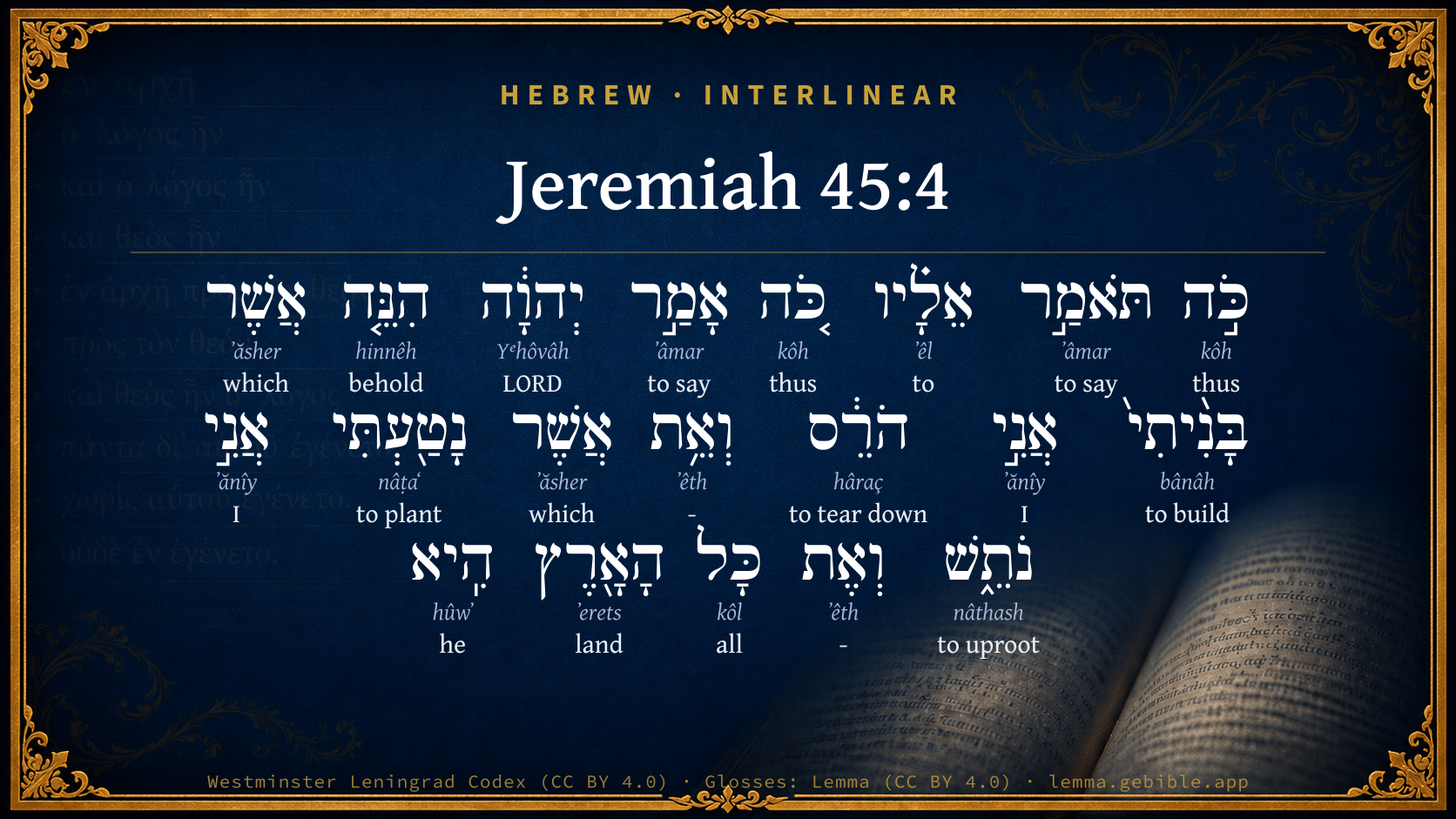
Hebrew (Westminster Leningrad Codex) Jeremiah 45:4 appears in the Hebrew Old Testament. The text above is from the Westminster Leningrad Codex. Each word links to its Strong’s number, a concise gloss, and parsing drawn from the Open Scriptures Hebrew Bible morphology. Click any word for its full Brown-Driver-Briggs (BDB) entry.
Download image
Cite this verse

Jeremiah 45:4 (World English Bible). Public Domain. Lemma interlinear Bible study tool, https://lemma.gebible.app/v/jeremiah/45/4.

Show BibTeX & RIS
BibTeX
RIS
English Translation
Thus shall you tell him, Thus says Yahweh: Behold, that which I have built will I break down, and that which I have planted I will pluck up; and this in the whole land.
World English Bible · Public Domain
Download a study sheet

One document with this verse’s original text, its word-by-word gloss line, the meaning frame, cross-references with their text, attributed commentary, and full source and license credits — printable, and it pastes into notes with its structure intact.

This verse Autodidact and up

Study sheet (.html) Plain text (.txt)

A passage Seminary Student

Up to 50 verses in one chapter. A passage sheet keeps up to 6 commentary sources and 12 cross-references per verse, in the order this page ranks them, and says so on the sheet whenever that leaves anything out. Ask for a single verse and you get the Autodidact verse sheet above.

Everything on this page stays free to read, with no account — the sheet is a download of what is already on screen, not access to it.

Want to remove ads? Support Godless Engineer
Compare translations 3

The same verse in 3 English versions, stacked beneath the original-language interlinear above. Click any original word for its lexicon entry.

Each is an independent rendering of the whole verse — the interlinear is not word-aligned to these translations.

Highlighted words mark where these versions differ — a whole-verse word diff, not a word-by-word alignment.

  • World English Bible Public Domain
    Thus shall you tell him, Thus says Yahweh: Behold, that which I have built will I break down, and that which I have planted I will pluck up; and this in the whole land.
  • King James Version Public Domain
    Thus shalt thou say unto him, The LORD saith thus; Behold, that which I have built will I break down, and that which I have planted I will pluck up, even this whole land.
  • unfoldingWord Literal Text CC BY-SA 4.0
    This is what you must say to him: ‘Yahweh says this: See, what I built, I am now tearing down. What I planted, I am now pulling up—I will do this throughout all the earth.

unfoldingWord Literal Text — © unfoldingWord, licensed CC BY-SA 4.0. Word-aligned USFM3 via Door43 (git.door43.org/unfoldingWord/en_ult).

Versions to compare (up to 4)

3 of 4 selected

Show all 18 translations

Every available English version of this verse, each an independent rendering of the whole verse.

  • World English Bible Public Domain
    Thus shall you tell him, Thus says Yahweh: Behold, that which I have built will I break down, and that which I have planted I will pluck up; and this in the whole land.
  • Berean Standard Bible Public Domain
    Thus Jeremiah was to say to Baruch: “This is what the LORD says: Throughout the land I will demolish what I have built and uproot what I have planted.
  • Majority Standard Bible Public Domain
    Thus Jeremiah was to say to Baruch: “This is what the LORD says: Throughout the land I will demolish what I have built and uproot what I have planted.
  • King James Version Public Domain
    Thus shalt thou say unto him, The LORD saith thus; Behold, that which I have built will I break down, and that which I have planted I will pluck up, even this whole land.
  • American Standard Version (1901) Public Domain
    Thus shalt thou say unto him, Thus saith Jehovah: Behold, that which I have built will I break down, and that which I have planted I will pluck up; and this in the whole land.
  • Revised Version (1885) Public Domain
    Thus shalt thou say unto him, Thus saith the LORD: Behold, that which I have built will I break down, and that which I have planted I will pluck up; and this in the whole land.
  • Geneva Bible (1599) Public Domain
    Thus shalt thou say vnto him, The Lord sayeth thus, Behold, that which I haue built, will I destroy, and that which I haue planted, will I plucke vp, euen this whole lande.
  • Douay-Rheims (1899) Public Domain
    Thus saith the Lord: Thus shalt thou say to him: Behold, them whom I have built, I do destroy: and them whom I have planted, I do pluck up, and all this land.
  • Young's Literal Translation Public Domain
    Thus dost thou say unto him: Thus said Jehovah: Lo, that which I have built I am throwing down, and that which I have planted I am plucking up, even the whole land itself.
  • Literal Standard Version CC BY-SA 4.0
    Thus you say to him, Thus said YHWH: Behold, that which I have built I am throwing down, and that which I have planted I am plucking up, even the whole land itself.
  • Unlocked Literal Bible CC BY-SA 4.0
    This is what you must say to him: 'Yahweh says this: See, what I built, I am now tearing down. What I planted, I am now pulling up—I will do this throughout all the earth.
  • unfoldingWord Literal Text CC BY-SA 4.0
    This is what you must say to him: ‘Yahweh says this: See, what I built, I am now tearing down. What I planted, I am now pulling up—I will do this throughout all the earth.
  • Darby Bible Public Domain
    Thus shalt thou say unto him, Thus saith Jehovah: Behold, what I have built do I overthrow, and what I have planted I pluck up, even this whole land.
  • World Messianic Bible Public Domain
    “You shall tell him, the LORD says: ‘Behold, that which I have built, I will break down, and that which I have planted I will pluck up; and this in the whole land.
  • Webster's Bible Public Domain
    Thus shalt thou say to him, The LORD saith thus; Behold, that which I have built I will break down, and that which I have planted I will pluck up, even this whole land.
  • Free Bible Version CC BY-SA 4.0
    This is what Jeremiah was told to say to Baruch: This is what the Lord says: Across the whole country I'm going to tear down what I have built and uproot what I have planted.
  • Bible in Basic English Public Domain
    This is what you are to say to him: The Lord has said, Truly, the building which I put up will be broken down, and that which was planted by me will be uprooted, and this through all the land;
  • JPS Tanakh (1917) Public Domain
    Thus shalt thou say unto him: Thus saith the LORD: Behold, that which I have built will I break down, and that which I have planted I will pluck up; and this in the whole land.

Literal Standard Version (2020), Covenant Press — licensed CC BY-SA 4.0. Text via the HelloAO Bible API (eBible.org). Unlocked Literal Bible (unfoldingWord) — licensed CC BY-SA 4.0. Text via the HelloAO Bible API (eBible.org). unfoldingWord Literal Text — © unfoldingWord, licensed CC BY-SA 4.0. Word-aligned USFM3 via Door43 (git.door43.org/unfoldingWord/en_ult). Free Bible Version, Dr. Jonathan Gallagher — licensed CC BY-SA 4.0. Text via the HelloAO Bible API (eBible.org).

Word by word

More ways to search: Search by grammar → Find every occurrence → Compare this word →

Practice this passage: Drill this verse → Learn its vocabulary →

נֹתֵ֑שׁ
nâthash
H5428
“uprooting”
Verb, Qal, Participle Active, Masculine, Singular, Absolute
Part of Speech
Verb
Stem
Qal
Form
Participle Active
Gender
Masculine
Number
Singular
State
Absolute
Full BDB Definition

Origin: a primitive root

TWOT: 1451

to pull up, expel, root out, pluck up - (Qal) to pull or pluck up - (Niphal) to be plucked up - (Hophal) to be plucked up
  1. כֹּ֣ה kôh H3541 “thus” Adverb
  2. תֹּאמַ֣ר ʼâmar H559 “to say” Verb, Qal, Imperfect, 2nd Person, Masculine, Singular
  3. אֵלָ֗יו ʼêl H413 “to · him” Preposition + Suffix, Personal, 3rd Person, Masculine, Singular
  4. כֹּ֚ה kôh H3541 “thus” Adverb
  5. אָמַ֣ר ʼâmar H559 “to say” Verb, Qal, Perfect, 3rd Person, Masculine, Singular
  6. יְהוָ֔ה Yᵉhôvâh H3068 “LORD” Noun, Proper
  7. הִנֵּ֤ה hinnêh H2009 “behold” Particle, Demonstrative
  8. אֲשֶׁר ʼăsher H834 “which” Particle, Relative
  9. בָּנִ֨יתִי֙ bânâh H1129 “to build” Verb, Qal, Perfect, 1st Person, Common, Singular
  10. אֲנִ֣י ʼănîy H589 “I” Pronoun, Personal, 1st Person, Common, Singular
  11. הֹרֵ֔ס hâraç H2040 “tearing down” Verb, Qal, Participle Active, Masculine, Singular, Absolute
  12. וְאֵ֥ת ʼêth H853 “and · -” Conjunction + Particle, Direct Object
  13. אֲשֶׁר ʼăsher H834 “which” Particle, Relative
  14. נָטַ֖עְתִּי nâṭaʻ H5193 “to plant” Verb, Qal, Perfect, 1st Person, Common, Singular
  15. אֲנִ֣י ʼănîy H589 “I” Pronoun, Personal, 1st Person, Common, Singular
  16. וְאֶת ʼêth H853 “and · -” Conjunction + Particle, Direct Object
  17. כָּל kôl H3605 “all of” Noun, Common, Masculine, Singular, Construct
  18. הָאָ֖רֶץ ʼerets H776 “the · land” Particle, Definite Article + Noun, Common, Both, Singular, Absolute
  19. הִֽיא hûwʼ H1931 “he” Pronoun, Personal, 3rd Person, Feminine, Singular

About this verse

These counts appear in no published source. They are computed here, from the morphology-tagged text and Lemma’s own curated glosses. What Lemma adds →

20
words
15
distinct lemmas
Prophets
section

Notable vocabulary

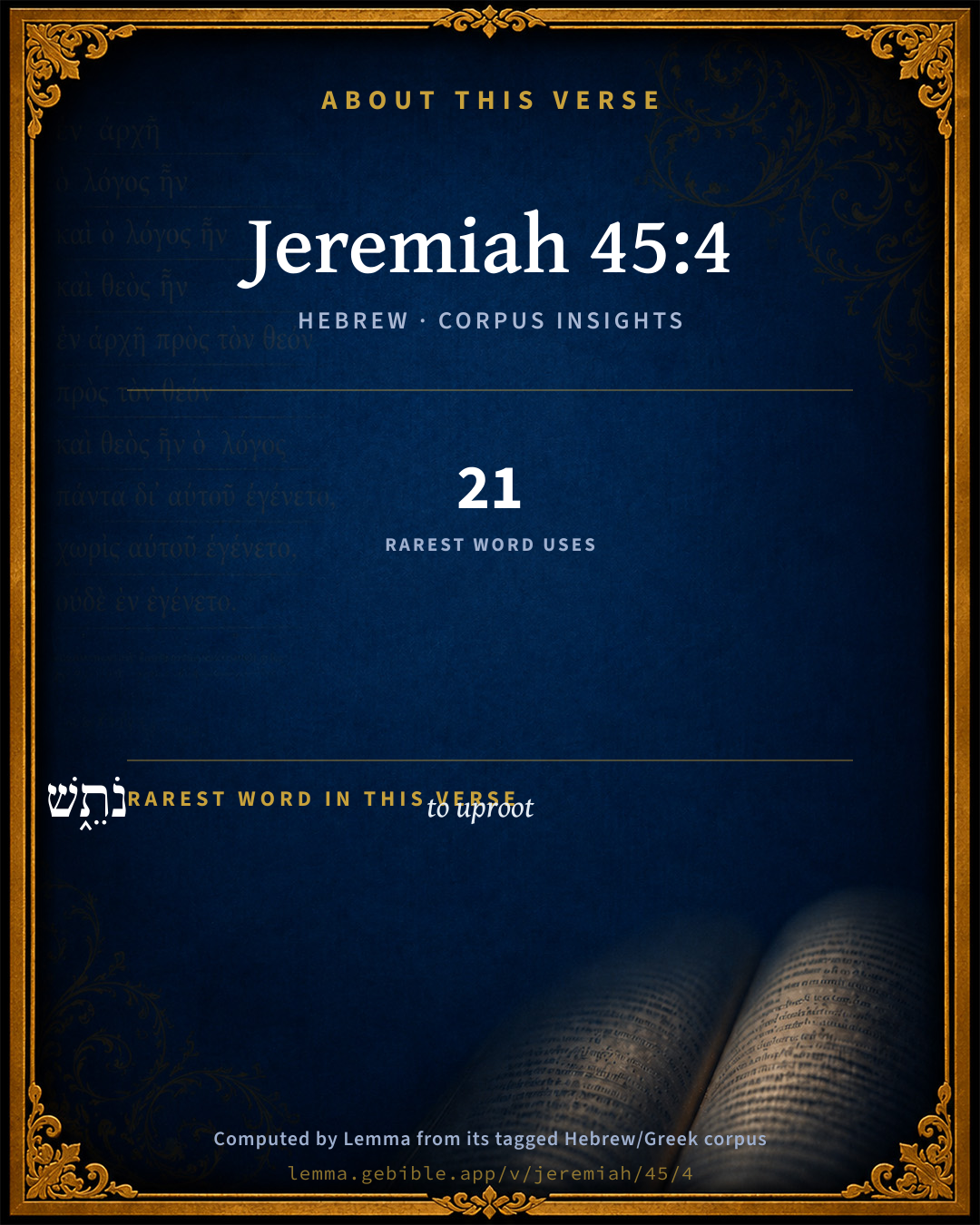
The rarest word here is נֹתֵ֑שׁ to uproot H5428 — appearing just 21 times in the whole Hebrew Bible.

Shared distinctive vocabulary

נֹתֵ֑שׁ to uproot H5428 occurs in 19 verses of the Hebrew Bible. Also found in:

Grammatical profile

  • 6 verbs
  • 3 nouns
  • 3 pronouns
  • 1 preposition
  • 2 adverbs
  • 5 particles

Verb forms

  • תֹּאמַ֣ר Qal · Imperfect
  • אָמַ֣ר Qal · Perfect
  • בָּנִ֨יתִי֙ Qal · Perfect
  • הֹרֵ֔ס Qal · Participle Active
  • נָטַ֖עְתִּי Qal · Perfect
  • נֹתֵ֑שׁ Qal · Participle Active

Repetition

Words recur within this verse — often emphatic in Hebrew:

  • כֹּ֣ה thus H3541 ×2
  • תֹּאמַ֣ר to say H559 ×2
  • אֲשֶׁר which H834 ×2
  • אֲנִ֣י I H589 ×2

Cross-references

7

Topical passages linked to Jeremiah 45:4 in the Treasury of Scripture Knowledge — connected by theme and wording, ordered by reader-vote popularity; previews shown in the World English Bible.

  • Jeremiah 1:10 behold, I have this day set you over the nations and over the kingdoms, to pluck up and to break down and to destroy and to overthrow, to build and to plant.
  • Jeremiah 18:7–10 At what instant I shall speak concerning a nation, and concerning a kingdom, to pluck up and to break down and to destroy it;
  • Jeremiah 31:28 It shall happen that, like as I have watched over them to pluck up and to break down and to overthrow and to destroy and to afflict, so will I watch over them to build and to plant, says Yahweh.
  • Genesis 6:6–7 Yahweh was sorry that he had made man on the earth, and it grieved him in his heart.
  • Psalms 80:8–16 You brought a vine out of Egypt. You drove out the nations, and planted it.
  • Isaiah 5:2–7 He dug it up, Gathered out its stones, Planted it with the choicest vine, Built a tower in its midst, And also cut out a winepress therein. He looked for it to yield grapes, But it yielded wild grapes.
  • Jeremiah 11:17 For Yahweh of Hosts, who planted you, has pronounced evil against you, because of the evil of the house of Israel and of the house of Judah, which they have worked for themselves in provoking me to anger by offering incense to Baal.

Cross-references courtesy of OpenBible.info (CC BY 4.0).

Hebrew and Greek witnesses Masoretic Hebrew ↔ Greek Septuagint

The same verse in the two great witnesses to the Old Testament, shown verse-for-verse.

These are two independent witnesses, not word-aligned to each other, and the Septuagint is shown in lemma (dictionary) form.

Hebrew Jeremiah 45:4 Masoretic · Westminster Leningrad Codex

כֹּ֣ה תֹּאמַ֣ר אֵלָ֗יו כֹּ֚ה אָמַ֣ר יְהוָ֔ה הִנֵּ֤ה אֲשֶׁר בָּנִ֨יתִי֙ אֲנִ֣י הֹרֵ֔ס וְאֵ֥ת אֲשֶׁר נָטַ֖עְתִּי אֲנִ֣י נֹתֵ֑שׁ וְאֶת כָּל הָאָ֖רֶץ הִֽיא

Thus shall you tell him, Thus says Yahweh: Behold, that which I have built will I break down, and that which I have planted I will pluck up; and this in the whole land.

World English Bible · Public Domain

Greek LXX Structure differs

In the Septuagint, Jeremiah is about an eighth shorter than the Hebrew and arranges its material differently — the Oracles Against the Nations (Hebrew chapters 46–51) appear in the middle of the Greek book, after 25:13. Because the chapter and verse boundaries do not line up, a verse-for-verse comparison with the Hebrew is not shown.

A verse-for-verse comparison isn’t shown here because the chapters and verses don’t line up. Switch to the LXX edition with the MT / LXX toggle above to read the Greek directly.

On this verse, The Cambridge Bible for Schools and Colleges discusses the Septuagint’s reading. Read the note in Commentary ↓

Hebrew: Westminster Leningrad Codex (CC BY 4.0). Greek: Septuagint (public domain); English from a public-domain English Septuagint. How the Septuagint differs from the Hebrew →

Targum (Aramaic paraphrase)

1

The Targum is the ancient Jewish Aramaic paraphrase of the Hebrew Scriptures — an interpretive translation, not the Hebrew text itself. Onkelos (literal) and Pseudo-Jonathan (expansive) render the Torah, and Jonathan the Prophets. Coverage is partial: where no permissively-licensed English translation exists for a verse, only the Aramaic is shown. This is verse-level text, not a word-by-word alignment to the Hebrew.

  1. Targum Jonathan Prophets (Joshua–Malachi)
    כִּדְנַן אֲמַר יְיָ הָא דִי בְנֵיתִי אֲנָא אֱפַגַר וְיַת דִי קַיֵמִית אֱנָא אֱטַלְטֵיל וְיַת כָּל אַרְעָא דְיִשְׂרָאֵל דִילִי הִיא:

    (no public-domain English translation for this verse)

    Targum Jonathan — Aramaic: “Mikraot Gedolot” (public domain). English: “Sefaria Community Translation” (CC0 1.0 (public-domain dedication)); “London "Chaldee Paraphrase," 1871” (public domain). Text via Sefaria.

Commentary

Notes on Jeremiah 45:4 from classic Christian and Jewish commentators (each source and its license shown beneath its notes). The classic Christian expositions comment on the surrounding passage and are grouped to its opening verse, so a note may address several verses; the Jewish commentaries on the Tanakh (Rashi and others) are per-verse, so they appear only where the commentator wrote on this verse.

Lemma curates 59 commentaries, every one of them public domain or Creative Commons licensed, each selected and text-cleaned for this edition rather than reprinted as found. About our sources →

Trapp's Complete Commentary

John Trapp

Jer 45:4 Thus shalt thou say unto him, The LORD saith thus; Behold, [that] which I have built will I break down, and that which I have planted I will pluck up, even this whole land.

Ver. 4. Behold, that which I have built, &c.] A metaphor, as is before noted, ab architectura et agricultura. I am turning all upside down, and wouldst thou only go free and untouched of the common calamity? It is no whit likely; thou must share with the rest.

John Trapp, A Commentary or Exposition upon All the Books of the Old and New Testament (1647–1656) — public domain. Text from a community e-Sword module.

Geneva Bible (1599)

Geneva Bible translators

Meaning, that God might destroy this people, because he had planted them.

Geneva Bible (1599) marginal notes — public domain. Text via Bolls.life.

Jamieson, Fausset & Brown

Robert Jamieson, A. R. Fausset & David Brown

that which I have built . . . planted I will pluck up-- (Isa 5:5). This whole nation (the Jews) which I founded and planted with such extraordinary care and favor, I will overthrow.

Jamieson, Fausset & Brown — Commentary Critical and Explanatory on the Whole Bible (1871) — public domain (CC PDM 1.0). Text via the HelloAO Bible API.

Adam Clarke's Commentary

Verse 4. Behold, that which I have built] I most certainly will fulfil all those threatenings contained in the roll thou hast written; for I will destroy this whole land.

Adam Clarke's Commentary on the Bible (1810–1826) — public domain. Text from a community e-Sword/MySword module.

John Calvin's Commentaries

He afterwards adds, Thus shalt thou say to him, etc. Here the Prophet shews that he was not roused against Baruch through any private displeasure, but that he had only conveyed to him God’s message. Behold, what I have built I pull down, and what I have planted I root up. Here it is evident that the cause of the reproof was, that Baruch loved himself too much, and wished to evade dangers when God ordered him to engage in the conflict. Jeremiah sets forth what would be to the whole people. The comparison shews what I have stated, that Baruch, disregarding the public safety, was too cautious, and was thus timid and tender as to his own life. This is the reason why God mentions the whole people, as though he had said, “Dost thou wish to be deemed of more importance than the whole people? Is thy life of more value than the wellbeing of the whole community?” It was a disgrace to Baruch to prefer himself to the whole people, and even to the Temple and the worship of God. When, therefore, the severity of God was now ready to fall on the whole people, though Baruch might have endangered his life a hundred times, yet he ought not to have made so much account of his life. Then the Prophet shews here that Baruch was too delicate as to himself; and because he was blinded by the love of himself, he did not consider the public safety of the people, nor did he regard the Temple and the holy land.

These metaphors of building and planting often occur in Scripture, I shall not therefore dwell on them here. But we must observe, that though God be the creator of the whole world, yet the people of Israel were peculiarly his work, and also the land of Israel. For God had consecrated that land to himself that he might be served in it, and had adopted the people. Hence he often compares that people to a vineyard.

“O my vineyard, I have planted thee.” (Jeremiah 2:21; Isaiah 5:1-7.)

I will not multiply quotations, for in a thing so easy it would be a foolish ostentation to heap together many texts. God, then, had built his people, because they dwelt there as in their own habitations, and the land was called his rest He had also planted his people. We may remark, in short, that the building mentioned here and also the plantation, refer to those special favors which God had bestowed on that people. For though he had planted the whole world and all nations, yet the people of Israel was especially his planting, as it is said by Isaiah,

“The planting of the Lord is for glory,”

that is, this people had been planted, that God through them might manifest his own glory. (Isaiah 61:3)

Let us come now to what is here declared; he says, I pull down what I have built, I root up what I have planted; as though he had said, “I have hitherto adorned this people with singular endowments; for I chose them as a heritage to myself, it is a holy race, it is a priestly kingdom, I dwell in the midst of them, I have undertaken the care of defending them, I am their Father, they are to me not only as a son, but also as a first-born; and titan this land is holy, because I have set my name in it: I have therefore built and planted this people and this land; but now, he says, I am pulling down and rooting up.”

John Calvin's Commentaries (1540-1563) — public domain. Text from the Calvin Translation Society English edition (1840s-50s) via the Christian Classics Ethereal Library (ccel.org). Calvin's coverage is partial (roughly two-thirds of the Bible); uncommented books and verses are honest gaps, never fabricated. The 19th-century editor's footnotes and remarks are omitted so the notes are faithfully Calvin's own voice.

The Cambridge Bible for Schools and Colleges

gen. ed. J. J. S. Perowne

4. Thus … him] omit as a gloss. Baruch himself, not the prophet, is still addressed.

Behold, that which I have built, etc.] Baruch is pained at the calamities in which his country is involved, but let him be sure that the Lord, in bringing Himself to overthrow His cherished people, can only be thus acting because no other course is possible (see introd. note).

and this … land] probably a gloss (LXX omit). If the clause stands, the reference is to the overthrow of kingdoms by Nebuchadnezzar.

The Cambridge Bible for Schools and Colleges (gen. ed. J. J. S. Perowne; Cambridge University Press, 1878–1918) — public domain. Text from a community e-Sword module.

John Gill's Exposition

Seekest thou great things for thyself? seek them not,.... Riches and wealth honour and esteem, peace and prosperity; these were not to be sought after and expected, when the whole nation would be involved in such a general calamity. Baruch perhaps expected that his reading the roll to princes would have been a means of preferring him at court, of advancing him to some post or office, in which he might have acquired wealth, and got applause, and lived in peace and plenty all his days; but this was not to be looked for; when, if he observed, the very roll he wrote and read contained in it prophecies of the general ruin of the nation. The Jews restrain this to the gift of prophecy they suppose Baruch sought after, which was not to be enjoyed out of the land of Canaan:

for, behold, I will bring evil upon all flesh; not upon every individual person in the world; but upon all the inhabitants of Judea, who should either die by the sword or by famine, or by pestilence, or be carried captive, or be in some distress or another:

but thy life will I give unto thee for a prey in all places whither thou goest; suggesting that he should be obliged to quit his native place and country, and go from place to place; as he did, after the destruction of Jerusalem, along with the prophet; and even into Egypt with the Jews that went there; where his life would be in danger, and yet should be preserved; he should be snatched as a brand out of the burning, when Jerusalem was taken; and in other places, when exposed, though he should lose everything, yet not his life; which should be as dear to him as a rich spoil taken by the soldier, being a distinguishing mercy.

Next: Jeremiah Chapter 46

John Gill's Exposition of the Whole Bible (1746–1763) — public domain (CC PDM 1.0). Text via the HelloAO Bible API.

Albert Barnes' Notes on the Bible

land - Or, earth. Baruch’s lot was cast in one of those troublous times when God enters into judgment with all flesh Jer 45:5. It was not Judaea only but the whole known world that was thrown into turmoil by Nebuchadnezzars energy Jer 25:26.

Albert Barnes' Notes on the Bible (1834–1885) — public domain. Text from a community e-Sword/MySword module.

Whedon's Commentary on the Bible

Daniel D. Whedon

4. Built… break down — This announces God’s purpose and his right. His proprietorship is involved in that he is the builder, and out of this comes his right to destroy.

Even this whole land — Rather, whole earth. The original word is ambiguous, but the parallel all flesh in the following verse limits its import to that land.

Daniel D. Whedon (gen. ed.), Commentary on the Old and New Testaments (1874–1909) — public domain. Text from a community e-Sword module.

The Pulpit Commentary

That which I have built. (comp, Jer_1:10 and parallel passages) Even this whole land; rather, and that is the whole earth.

Divine destruction.

I GOD CAN DESTROY HIS OWN WORK. What he made he can unmake. People dogmatize about the indestructibility of matter, of atoms, of souls. How do we know they are indestructible? Is God"s omnipotence limited by the properties of his own works? But apart from all metaphysics, the complex world, being constructed, is plainly subject to destruction. It is monstrous to think the universe is a huge Frankenstein, able to escape from the power of its Maker.

II GOD HAS A RIGHT TO DESTROY HIS OWN WORK. There is no property so clearly belonging to a person as the work of his own hands. All things that exist were made by God, and all belong to him. What he gave us he has a right to withdraw. His gifts are loans, talents to be used for a season and then returned. No creature has a right to its own life before God. He freely gave it; he may withdraw it. Much less have we sinful creatures any such right.

III GOD WILL NOT DESTROY HIS OWN WORK WITHOUT GOOD REASON. A power is not necessarily always put forth nor a right in perpetual exercise. God does not act capriciously nor cruelly. He is the Creator rather than the Destroyer. He delights in creating because he loves his creatures. He takes no pleasure in destroying, but will only do it under urgent necessity.

IV NEVERTHELESS THERE ARE CIRCUMSTANCES UNDER WHICH GOD WILL DESTROY HIS OWN WORK. All things were good when they came from their Maker"s hands. But some have been corrupted. When a thing is hopelessly corrupt there is no reason for preserving it and much for destroying it. See this in earthly experience the Flood, the destruction of Jerusalem, and m greater judgments the wages of sin, death, and the final destruction of the world. Therefore let us not presume that any work or institution is eternal because it was established by the eternal God, that any possession of ours must be permanent because it came from him, or that our own life is safe because God breathed it into us.

The Pulpit Commentary (1880–1919), ed. H.D.M. Spence-Jones & Joseph S. Exell — public domain. Text from a community e-Sword module.

unfoldingWord translationNotes

Door43 World Missions Community

This is what you must say to him

Yahweh is telling Jeremiah what to say to Baruch.

what I built, I am now tearing down. What I planted, I am now pulling up

Both of these metaphors mean the same thing. Yahweh destroying the people of the nation of Judah is spoken of as if the nation were a building he would tear down or a plant that he will pull up. AT: "this nation is like a building that I built, but I am now tearing down. It is like a plant that I planted, but I am now pulling out of the ground" (See: Parallelism and Metaphor)

But are you hoping for great things for yourself?

Yahweh uses a question to state that he knows Baruch is hoping for others to treat him in a special way. AT: "I know you hope for great things for yourself." or "I know you hope others will honor you." (See: Rhetorical Question)

For see

"For understand" or "Be aware"

disaster is coming on all humanity

Causing disaster to happen is spoken of as if disaster were something that could travel and arrive at a place. AT: "I will cause all of humanity to experience disaster" (See: Metaphor)

this is Yahweh's declaration

Yahweh speaks of himself by name to express the certainty of what he is declaring. See how you translated this in Jeremiah 1:8. AT: "this is what Yahweh has declared" or "this is what I, Yahweh, have declared" (See: First, Second, or Third Person)

your life as your plunder everywhere you will go

Allowing Baruch to escape and remain alive is spoken of as if his life were plunder that he would take after a battle. AT: "but wherever you go, I will protect you and allow you to live" (See: Metaphor)

plunder

things stolen from a place by force

translationWords

earth

hope

declare

life

unfoldingWord translationNotes — © Distant Shores Media and the Door43 World Missions Community, licensed CC BY-SA 4.0. Source: git.door43.org/Door43/en_tn.

Rashi

Rabbi Shlomo Yitzchaki (Rashi)

and it is all the land that is being judged with this uprooting and tearing down.

Rashi on the Tanakh — English translations: “The Judaica Press complete Tanach with Rashi, translated by A. J. Rosenberg” (CC BY 4.0); “Pentateuch with Rashi's commentary by M. Rosenbaum and A.M. Silbermann, 1929-1934” (public domain); “The Metsudah Tanach series, Lakewood, N.J” (CC BY 4.0); and “The Book of Joshua, Metsudah Publications, 1997” (CC BY 4.0). Text via Sefaria.

Lesson kit

Teaching starters — assembled from the data on this page, not authored interpretation. Every prompt links to the verse data it draws on. Edit before teaching.

Jeremiah, in the Prophets, opens this verse with 20 words (15 distinct Hebrew lemmas). Its most distinctive word is nâthash (“to uproot”). A historical commentator’s framing appears above. Read the whole chapter for the surrounding context.

Discussion questions

  1. What does “to uproot” (nâthash) contribute to the verse as a whole?
  2. Deuteronomy 29:28 shares the word «to uproot» with this verse. How do the two illuminate each other?
  3. “thus” occurs 2× in this one verse. What is the effect of the repetition?
  4. These translations render this verse differently. What is at stake in choosing one wording over another?
  5. The verb «תֹּאמַ֣ר» is Qal Imperfect. How does its form color the action?
  6. Reading how Trapp's Complete Commentary and Geneva Bible (1599) read this verse, where do the two commentators agree and where do they part?

Things to notice

Reading settings

Reading text

Shown beneath each verse's original-language words.

Old Testament
Old Testament edition

Read the OT as the Masoretic Hebrew (MT) or the Greek Septuagint (LXX).

English shown for the Greek Septuagint (in the Hebrew ↔ Greek comparison).

Comparing translations? Open the Compare panel on any verse page to stack up to four side by side.