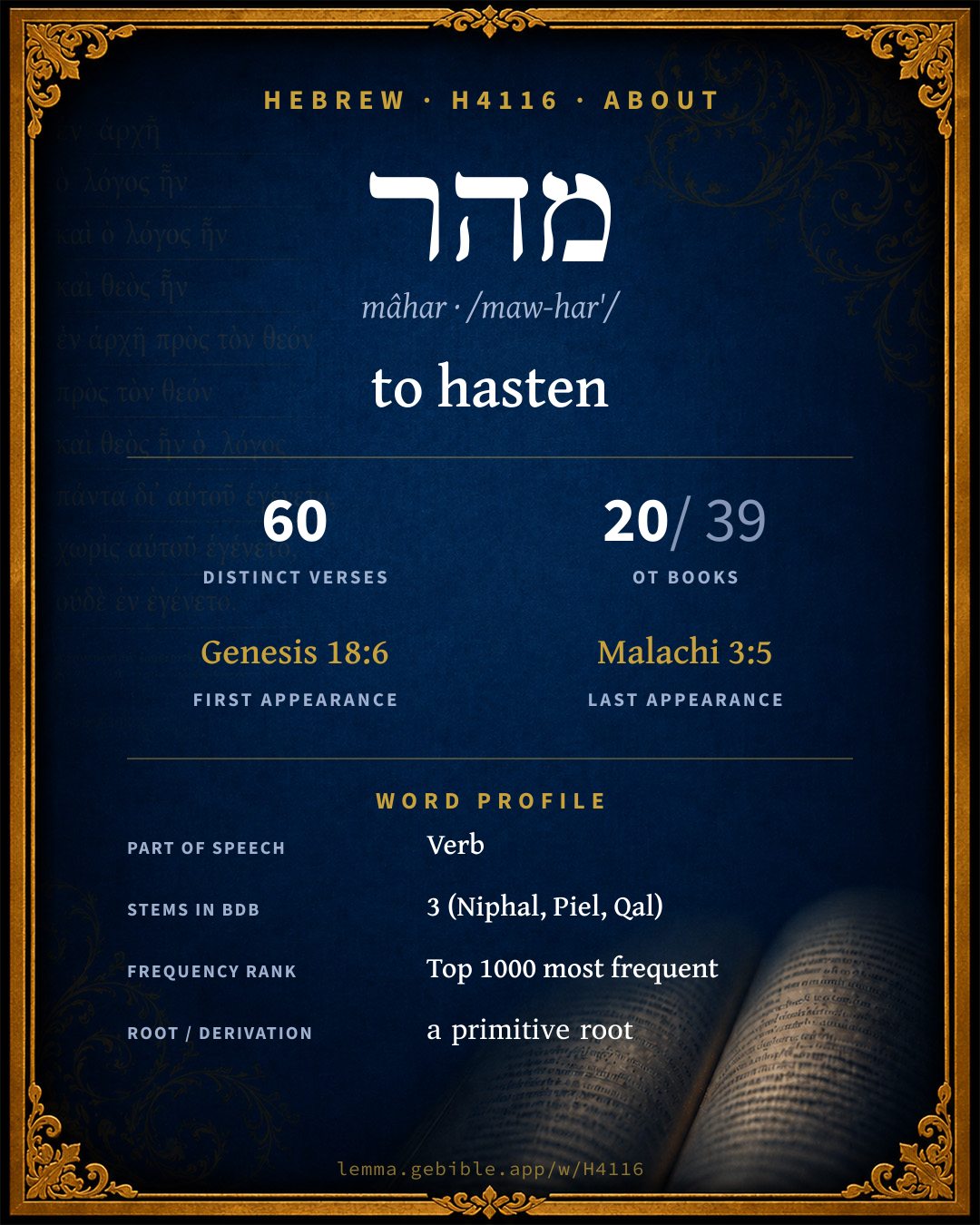
מָהַר
to hasten
‘to hasten’ is one of 3 main senses fuller range ↓
Full lexicon entry — Brown-Driver-Briggs (BDB)
From Brown-Driver-Briggs (BDB)
Where this word appears
See every Piel verb in the Hebrew Bible →
Grammar key — what these labels mean
Part of speech
- Verb
- An action or state-of-being word.
Stem
- Piel
- An intensive or resultative active stem. Here: ‘hasten’
- Niphal
- Usually the simple passive or reflexive of the Qal (“he was written”).
- Qal
- The basic, simple active stem — the plain form of the verb (“he wrote”).
Form
- Sequential Imperfect
- An imperfect with prefixed waw — the standard past-narrative form (waw-consecutive imperfect).
- Imperative
- A direct command (“write!”).
- Infinitive Construct
- A bound verbal noun, frequently with prepositions (“to write / in writing”).
- Perfect
- A completed action or state — Hebrew marks aspect (completeness) more than strict tense (“he wrote”).
- Imperfect
- An incomplete, ongoing, or future action (“he will / would write”).
- Participle Active
- A verbal adjective expressing ongoing or characteristic action (“writing / one who writes”).
- Sequential Perfect
- A perfect with prefixed waw continuing a preceding imperfect or command (waw-consecutive perfect).
- Jussive
- A third- or second-person volitional form expressing wish or command (“let him write”).
State
- Absolute
- The independent form of a noun, not bound to a following word.
- Construct
- A noun bound to a following noun in a possessive / “of” relationship (the construct chain).
Person
- 3rd Person
- The one spoken about (“he / she / it / they”).
- 2nd Person
- The one addressed (“you”).
Gender
- Masculine
- Grammatically masculine.
- Feminine
- Grammatically feminine.
- Common
- Either gender — not distinguished for this form.
Number
- Singular
- One.
- Plural
- More than one (in Hebrew, generally three or more).
Grammatical forms 27 distinct
- Verb, Piel, Sequential Imperfect, 3rd Person, Masculine, Singular 9 times (14%)
- Verb, Piel, Sequential Imperfect, 3rd Person, Feminine, Singular 8 times (13%)
- Verb, Piel, Sequential Imperfect, 3rd Person, Masculine, Plural 6 times (9%)
- Verb, Piel, Imperative, 2nd Person, Masculine, Singular 6 times (9%)
- Verb, Piel, Imperative, 2nd Person, Masculine, Plural 4 times (6%)
- Verb, Piel, Infinitive Construct 3 times (5%)
- Verb, Piel, Perfect, 3rd Person, Common, Plural 3 times (5%)
- Verb, Piel, Imperfect, 3rd Person, Masculine, Plural 3 times (5%)
+19 more forms (22 occurrences)
Parsed forms decoded from the imported morphology (morphhb / Westminster Leningrad Codex — WLC text public domain, morphhb tagging CC BY 4.0), counted across 64 parsed occurrences — not distinct verses.
Every verse where H4116 appears — 60 distinct verses across 20 books. Click any verse to open its interlinear word-by-word view. Verse text shown in the World English Bible for context — . Each verse’s Hebrew form is shown with its reference; the English is not keyword-highlighted, since the data carries no word-level English alignment. Use “Compare translations” on any verse to read it across multiple English versions. This concordance covers the Hebrew Bible; Septuagint (Greek Old Testament) occurrences are not indexed here.
Genesis 12 verses
- Genesis 18:6 וַ/יְמַהֵ֧ר מַהֲרִ֞י conj + Piel wimpf 3ms Piel impv 2fs Abraham hurried into the tent to Sarah, and said, "Quickly make ready three measures of fine meal, knead it, and make cakes."
- Genesis 18:7 וַ/יְמַהֵ֖ר conj + Piel wimpf 3ms Abraham ran to the herd, and fetched a tender and good calf, and gave it to the servant. He hurried to dress it.
- Genesis 19:22 מַהֵר֙ Piel impv 2ms Hurry, escape there, for I can't do anything until you get there." Therefore the name of the city was called Zoar.
- Genesis 24:18 וַ/תְּמַהֵ֗ר conj + Piel wimpf 3fs She said, "Drink, my lord." She hurried, and let down her pitcher on her hand, and gave him drink.
- Genesis 24:20 וַ/תְּמַהֵ֗ר conj + Piel wimpf 3fs She hurried, and emptied her pitcher into the trough, and ran again to the well to draw, and drew for all his camels.
- Genesis 24:46 וַ/תְּמַהֵ֗ר conj + Piel wimpf 3fs She hurried and let down her pitcher from her shoulder, and said, 'Drink, and I will also give your camels a drink.' So I drank, and she made the camels drink also.
- Genesis 27:20 מִהַ֥רְתָּ Piel pf 2ms Isaac said to his son, "How is it that you have found it so quickly, my son?" He said, "Because Yahweh your God gave me success."
- Genesis 41:32 וּ/מְמַהֵ֥ר conj + Piel ptcp.act ms The dream was doubled to Pharaoh, because the thing is established by God, and God will shortly bring it to pass.
- Genesis 43:30 וַ/יְמַהֵ֣ר conj + Piel wimpf 3ms Joseph made haste; for his heart yearned over his brother: and he sought a place to weep; and he entered into his room, and wept there.
- Genesis 44:11 וַֽ/יְמַהֲר֗וּ conj + Piel wimpf 3mp Then they hurried, and took down every man his sack to the ground, and opened every man his sack.
- Genesis 45:9 מַהֲרוּ֮ Piel impv 2mp Hurry, and go up to my father, and tell him, 'This is what your son Joseph says, "God has made me lord of all Egypt. Come down to me. Don't wait.
- Genesis 45:13 וּ/מִֽהַרְתֶּ֛ם conj + Piel wpf 2mp You shall tell my father of all my glory in Egypt, and of all that you have seen. You shall hurry and bring my father down here."
Exodus 4 verses
- Exodus 2:18 מִהַרְתֶּ֥ן Piel pf 2fp When they came to Reuel, their father, he said, "How is it that you have returned so early today?"
- Exodus 10:16 וַ/יְמַהֵ֣ר conj + Piel wimpf 3ms Then Pharaoh called for Moses and Aaron in haste, and he said, "I have sinned against Yahweh your God, and against you.
- Exodus 12:33 לְ/מַהֵ֖ר prep + Piel inf.cs The Egyptians were urgent with the people, to send them out of the land in haste, for they said, "We are all dead men."
- Exodus 34:8 וַ/יְמַהֵ֖ר conj + Piel wimpf 3ms Moses hurried and bowed his head toward the earth, and worshiped.
Joshua 3 verses
- Joshua 4:10 וַ/יְמַהֲר֥וּ conj + Piel wimpf 3mp For the priests who bore the ark stood in the midst of the Jordan, until everything was finished that Yahweh commanded Joshua to speak to the people, according to all that Moses commanded Joshua: and the people hurried and passed over.
- Joshua 8:14 וַֽ/יְמַהֲר֡וּ conj + Piel wimpf 3mp It happened, when the king of Ai saw it, that they hurried and rose up early, and the men of the city went out against Israel to battle, he and all his people, at the time appointed, before the Arabah; but he didn't know that there was an ambush against him behind the city.
- Joshua 8:19 וַֽ/יְמַהֲר֔וּ conj + Piel wimpf 3mp The ambush arose quickly out of their place, and they ran as soon as he had stretched out his hand, and entered into the city, and took it; and they hurried and set the city on fire.
Judges 2 verses
- Judges 9:48 מַהֲר֖וּ Piel impv 2mp Abimelech got him up to Mount Zalmon, he and all the people who were with him; and Abimelech took an axe in his hand, and cut down a bough from the trees, and took it up, and laid it on his shoulder: and he said to the people who were with him, What you have seen me do, make haste, and do as I have done.
- Judges 13:10 וַ/תְּמַהֵר֙ conj + Piel wimpf 3fs The woman made haste, and ran, and told her husband, and said to him, Behold, the man has appeared to me, who came to me the [other] day.
1 Samuel 10 verses
- 1 Samuel 4:14 מִהַ֔ר Piel pf 3ms When Eli heard the noise of the crying, he said, What means the noise of this tumult? The man hurried, and came and told Eli.
- 1 Samuel 9:12 מַהֵ֣ר Piel impv 2ms They answered them, and said, He is; behold, [he is] before you: make haste now, for he is come today into the city; for the people have a sacrifice today in the high place:
- 1 Samuel 17:48 וַ/יְמַהֵ֣ר conj + Piel wimpf 3ms It happened, when the Philistine arose, and came and drew near to meet David, that David hurried, and ran toward the army to meet the Philistine.
- 1 Samuel 23:27 מַהֲרָ֣/ה Piel impv 2ms + sfx dem But there came a messenger to Saul, saying, Haste you, and come; for the Philistines have made a raid on the land.
- 1 Samuel 25:18 וַ/תְּמַהֵ֣ר conj + Piel wimpf 3fs Then Abigail made haste, and took two hundred loaves, and two bottles of wine, and five sheep ready dressed, and five measures of parched grain, and one hundred clusters of raisins, and two hundred cakes of figs, and laid them on donkeys.
- 1 Samuel 25:23 וַ/תְּמַהֵ֕ר conj + Piel wimpf 3fs When Abigail saw David, she hurried, and alighted from her donkey, and fell before David on her face, and bowed herself to the ground.
- 1 Samuel 25:34 מִהַ֗רְתְּ Piel pf 2fs For in very deed, as Yahweh, the God of Israel, lives, who has withheld me from hurting you, except you had hurried and come to meet me, surely there wouldn't have been left to Nabal by the morning light so much as one man-child.
- 1 Samuel 25:42 וַ/תְּמַהֵ֞ר conj + Piel wimpf 3fs Abigail hurried, and arose, and rode on a donkey, with five ladies of hers who followed her; and she went after the messengers of David, and became his wife.
- 1 Samuel 28:20 וַ/יְמַהֵ֣ר conj + Piel wimpf 3ms Then Saul fell immediately his full length on the earth, and was sore afraid, because of the words of Samuel: and there was no strength in him; for he had eaten no bread all the day, nor all the night.
- 1 Samuel 28:24 וַ/תְּמַהֵ֖ר conj + Piel wimpf 3fs The woman had a fattened calf in the house; and she hurried, and killed it; and she took flour, and kneaded it, and did bake unleavened bread of it:
2 Samuel 2 verses
- 2 Samuel 15:14 מַהֲר֣וּ יְמַהֵ֤ר Piel impv 2mp Piel impf 3ms David said to all his servants who were with him at Jerusalem, Arise, and let us flee; for else none of us shall escape from Absalom: make speed to depart, lest he overtake us quickly, and bring down evil on us, and strike the city with the edge of the sword.
- 2 Samuel 19:16 וַ/יְמַהֵ֗ר conj + Piel wimpf 3ms Shimei the son of Gera, the Benjamite, who was of Bahurim, hurried and came down with the men of Judah to meet king David.
1 Kings 3 verses
- 1 Kings 20:33 וַֽ/יְמַהֲר֜וּ conj + Piel wimpf 3mp Now the men observed diligently, and hurried to catch whether it were his mind; and they said, Your brother Ben Hadad. Then he said, Go you, bring him. Then Ben Hadad came forth to him; and he caused him to come up into the chariot.
- 1 Kings 20:41 וַ/יְמַהֵ֕ר conj + Piel wimpf 3ms He hurried, and took the headband away from his eyes; and the king of Israel discerned him that he was of the prophets.
- 1 Kings 22:9 מַהֲרָ֖/ה Piel impv 2ms + sfx dem Then the king of Israel called an officer, and said, Get quickly Micaiah the son of Imlah.
2 Kings 1 verse
1 Chronicles 1 verse
2 Chronicles 2 verses
- 2 Chronicles 18:8 מַהֵ֖ר Piel impv 2ms Then the king of Israel called an officer, and said, Get quickly Micaiah the son of Imla.
- 2 Chronicles 24:5 תְּמַהֲר֣וּ מִֽהֲר֖וּ Piel impf 2mp Piel pf 3cp He gathered together the priests and the Levites, and said to them, Go out to the cities of Judah, and gather of all Israel money to repair the house of your God from year to year; and see that you hasten the matter. However the Levites didn't hurry.
Esther 2 verses
- Esther 5:5 מַהֲרוּ֙ Piel impv 2mp Then the king said, Cause Haman to make haste, that it may be done as Esther has said. So the king and Haman came to the banquet that Esther had prepared.
- Esther 6:10 מַ֠הֵר Piel impv 2ms Then the king said to Haman, Make haste, and take the clothing and the horse, as you have said, and do even so to Mordecai the Jew, who sits at the king's gate: let nothing fail of all that you have spoken.
Job 1 verse
Psalms 2 verses
Proverbs 3 verses
- Proverbs 1:16 וִֽ֝/ימַהֲר֗וּ conj + Piel impf 3mp For their feet run to evil. They hurry to shed blood.
- Proverbs 6:18 מְ֝מַהֲר֗וֹת Piel ptcp.act fp A heart that devises wicked schemes, Feet that are swift in running to mischief,
- Proverbs 7:23 כְּ/מַהֵ֣ר prep + Piel inf.cs Until an arrow strikes through his liver, As a bird hurries to the snare, And doesn't know that it will cost his life.
Ecclesiastes 1 verse
Isaiah 6 verses
- Isaiah 5:19 יְמַהֵ֧ר Piel impf 3ms Who say, "Let him make speed, let him hasten his work, that we may see it; And let the counsel of the Holy One of Israel draw near and come, That we may know it!"
- Isaiah 32:4 נִמְהָרִ֖ים תְּמַהֵ֖ר Niphal ptcp.act mp Piel impf 3fs The heart of the rash shall understand knowledge, and the tongue of the stammerers shall be ready to speak plainly.
- Isaiah 35:4 לְ/נִמְהֲרֵי prep + Niphal ptcp.act mp cs Tell those who are of a fearful heart, Be strong, don't be afraid: behold, your God will come [with] vengeance, [with] the recompense of God; he will come and save you.
- Isaiah 49:17 מִֽהֲר֖וּ Piel pf 3cp Your children make haste; your destroyers and those who made you waste shall go forth from you.
- Isaiah 51:14 מִהַ֥ר Piel pf 3ms The captive exile shall speedily be freed; and he shall not die [and go down] into the pit, neither shall his bread fail.
- Isaiah 59:7 וִֽ/ימַהֲר֔וּ conj + Piel impf 3mp Their feet run to evil, and they make haste to shed innocent blood: their thoughts are thoughts of iniquity; desolation and destruction are in their paths.
Jeremiah 2 verses
Nahum 1 verse
Habakkuk 1 verse
Malachi 1 verse
About this entry
At a glance — auto-summarized from this page’s data, not written by a person. Every figure links to its source below. This summary describes the numbers; it doesn’t interpret them.
“to hasten” is the headline sense of the Hebrew verb מהר (mâhar). Older and newer Bibles part ways — “haste” in the King James Version, “quickly” (Berean Standard Bible) and “hurried” (unfoldingWord Literal Text) in modern versions. See the renderings breakdown. It appears 60 verses across 20 books of the Hebrew Bible, among its moderately common vocabulary. Scripture first uses it in Genesis 18:6. Read the stem: it spans 3 stems, including Niphal and Piel. See the sense tree, 60-verse concordance, and the renderings breakdown below.
Gloss history
Strong's 1890 vs modern scholarship
About this word
Strong's H4116 catalogs a Hebrew word from the Hebrew Old Testament.
These counts are not copied from any lexicon or concordance. They are computed here, from the morphology-tagged Hebrew Old Testament. What Lemma adds →
- 60
- distinct verses
- The word appears in 60 distinct verses.
- 20 / 39
- OT books
- The word appears in 20 of 39 Old Testament books.
- #607
- by frequency
- Top 1000 most frequent Hebrew words (rank 607 of 8,640 Hebrew words by occurrence).
View all 60 occurrences in the concordance →
By section of the Old Testament
By traditional corpus
Conventional, traditional groupings — biblical authorship is debated, so this is a traditional corpus grouping, not an authorship claim. Each share is this word’s portion of its verses in that division of the Hebrew canon. Each figure is a share of the word’s 60 distinct verses.
- Prophets (Nevi'im) 32 verses · 53%
- Torah (Pentateuch) 16 verses · 27%
- Writings (Ketuvim) 12 verses · 20%
How translations render this word
Counts come from each version’s own published word-to-Strong’s tagging or interlinear alignment — an approximate guide to how each version renders this word, not a word-level alignment the data otherwise carries. Because each total is that version’s own tagged count, the per-version totals vary from one another and need not match the appearance or distinct-verse counts above. These counts may also differ from a printed concordance because Lemma counts each distinctly tagged rendering and does not collapse phrase taggings into a single head-word total. This is a fixed set of word-tagged versions (KJV, ASV, BSB, ULT) and does not change with the reading translation you choose elsewhere. Each version’s license is shown beside its name below (and on Sources).
BDB lists this Strong’s number as 2 distinct words (homographs). Each count above pools all of them and is not split by sense — see the Senses section below. A low-frequency rendering may belong to a different one of those words, not the primary meaning.
- King James Version†: Haste 5×, Hasted 5×, Made haste 4×
- American Standard Version†: Haste 5×, Hasted 4×, Made haste 4×
- Berean Standard Bible†: Quickly 14×, Hurried 7×, Hurry 5×
- unfoldingWord Literal Text†: Hurried 14×, Hurry 10×, And 8×
King James Version Public Domain
Renders H4116 across 64† tagged occurrences — most commonly:
Plus 32 renderings that appear only once — usually multi-word phrases or single function words the recovered tagging swept in, not distinct renderings.
American Standard Version Public Domain
Renders H4116 across 64† tagged occurrences — most commonly:
Plus other, less common renderings. Plus 26 renderings that appear only once — usually multi-word phrases or single function words the recovered tagging swept in, not distinct renderings.
Berean Standard Bible Public Domain
Renders H4116 across 65† tagged occurrences — most commonly:
Plus 27 renderings that appear only once — usually multi-word phrases or single function words the recovered tagging swept in, not distinct renderings.
unfoldingWord Literal Text CC BY-SA 4.0
Renders H4116 across 84† tagged occurrences — most commonly:
Plus 28 renderings that appear only once — usually multi-word phrases or single function words the recovered tagging swept in, not distinct renderings.
Senses in the full BDB
Hebrew verbs can shift meaning by stem (binyan): Qal is the basic action, Niphal is often passive or reflexive, Piel often intensifies or makes it factitive, and Hiphil is typically causative. The senses below are grouped under the stem BDB assigns to each.
What do BDB’s symbols mean?
BDB uses these scholarly abbreviations:
| Symbol | Meaning |
|---|---|
| 𝔊 | the Septuagint (the ancient Greek translation, LXX) |
| 𝔙 | the Vulgate (the Latin translation) |
| 𝔖 | the Syriac version (the Peshitta) |
| 𝔗 | the Targum (the Aramaic translation) |
| ψ | the Psalms |
| √ | root (the underlying root or stem) |
| ‖ | parallel passage (a synonymous or contrasted parallel) |
| † | the dagger: every passage where the word occurs is cited |
The 6 senses and sub-senses the full Brown-Driver-Briggs lexicon distinguishes for this word, in lexicon order (not ranked by frequency), with BDB’s own verbatim wording and sub-sense lettering. Shown in Hebrew script with BDB’s own scholarly abbreviations. The condensed entry is in the Lexicon Entry tab. See also the Forms in the corpus table below.
מהר I hasten (NH Pi., and deriv.
Niphal
- Pf. 3 fs. נִמְהָ֑רָה Jb 5:13; Pt. נִמְהָר Hb 1:6; pl. נִמְהָרִים Is 32:4; cstr. נִמְהֲרֵי Is 35:4;—be hurried = anxious, disturbed נִמְהֲרֵי־לֵב Is 35:4; hasty, precipitate, subj. עֵצָה Jb 5:13; so pt. as subst. Is 32:4; impetuous, of Chaldeans, Hb 1:6 (‖ מַר). e.g. Job 5:13
Piel
- Pf. מִהַר 1 S 4:14; Is 51:14; 3 fs. מִהֲרָה Je 48:16 etc.; Impf. יְמַהֵר Is 5:19 + 2 times; וַיְמַהֵר Gn 18:6 + 8 times (1 S 28:20 v. infr.); 3 fpl. תְּמַהֵרְנָה Je 9:17 etc.; Imv. ms. מַהֵר Gn 19:22 +; מַהֲרָה 1 S 23:27; 1 K 22:9, etc.; Inf. cstr. מַהֵר Pr 7:23 +; Pt. מְמַהֵר Gn 41:32; Mal 3:5 (on מַהֵר Zp 1:14 [1 S 23:22] cf. Kö i. 268, Schwally ZAW x. 1890, 176 vid. i. מַהֵר infra), fpl. מְמַהֲרוֹת Pr 6:18;— e.g. 1 Samuel 4:14
- 1. hasten, make haste, = go or come quickly Gn 18:6 1 S 9:12 (but del. 𝔊 We Dr Kit Bu HPS), Na 2:6; Is 49:17; 1 Ch 12:9; = go eagerly, (sq. Inf. of purpose) Pr 1:16; Is 59:7; Pt. = swift, prompt Mal 3:5; of bird Pr 7:23; fig. of calamity Is 5:19 (‖ חוּשׁ), Je 48:16, cf. מַהֵר שָׁלָל חָשׁ בַּז Is 8:1, 3, infr. e.g. Genesis 18:6
- 2. hasten + vb., (מ׳ having really adverbial force): sq. Inf. Gn 18:7 (מִהַר לַעֲשׂת); cf. 27:20; 41:32 (subj. God), Ex 2:18; 10:16; 12:33; 2 S 15:14; Is 32:4; 51:14; Pr 6:18; Ec 5:1; more often sq. vb. c. ו Gn 24:18, 20, 46; 44:11 (all J), 45:9, 13 (E), prob. 43:30 (J), also Ex 34:8 (J), Jos 4:10; 8:14, 19 (all JE), Ju 13:10; 1 S 4:14; 17:48; 23:27; 25:18, 23, 34(×2); 28:24; 2 S 15:14; 19:17; 1 K 20:33, 41; 2 K 9:13; Je 9:17; so even when act. is not wholly voluntary 1 S 28:20 (but read prob. וַיִּבָּהֵל 𝔊 We Dr Kit Bu); also, ו om., ψ 106:13; especially c. Imv. Gn 19:22 (J), Ju 9:48; Est 6:10; so also מַהֵר עֲנֵנִי ψ 69:18; 102:3; 143:7; cf. 79:8 (v. Olad loc.). e.g. Genesis 18:7
- 3. trans. hasten, = prepare quickly Gn 18:6; = bring quickly 1 K 22:9 = 2 Ch 18:8, Est 5:5; = do quickly 2 Ch 24:5(×2). e.g. Genesis 18:6
מהר II denom. acquire by paying purchase-price (Arabic مَهَرَ give a dowry, marry for a مَهْرٌ
Qal
- Pf. 3 pl. מָהָ֑רוּ ψ 16:4 usually obtain another in exchange (or, by paying a price, cf. Che), but text dub.; Impf. 3 ms. sf. + Inf. abs. מָהֹר יִמְהָרֶנָּה לוֹ לְאִשָּׁה Ex 22:15 (E). e.g. Psalms 16:4
Senses from the full Brown-Driver-Briggs lexicon (Brown, Driver, Briggs; Oxford 1906 — public domain), digitized via Sefaria, supplemented by the OpenScriptures HebrewLexicon (CC BY 4.0). Full attribution on Sources.
Word origin
I. vb. hasten (NH Pi., and deriv.; Arabic مَهَرَ be practised, skilled (with Assyrian mâru, send, order, govern, cf. ii. מהר); Ethiopic መሀረ train, teach; Syriac ܡܗܪ Pa. id.; cf. also Egypt. māhar, trained warrior Bondi 57);—
II. vb. denom. acquire by paying purchase-price (Arabic مَهَرَ give a dowry, marry for a مَهْرٌ; cf. GerberVerb. denom. 12 Buhl SS);—
— Brown-Driver-Briggs (Oxford 1906, public domain), digitized via Sefaria, supplemented by the OpenScriptures HebrewLexicon (CC BY 4.0). See Sources.
Origin: a primitive root
Jastrow Dictionary
A second Hebrew/Aramaic lexicon for comparison, covering Aramaic and post-biblical (Talmudic, Targumic, Midrashic) usage that the biblical-Hebrew BDB does not. Matched by lemma rather than by Strong’s number, so a lemma may carry more than one Jastrow headword (shown separately below), and the entries cover usage well beyond the Bible.
הַר
- mound, mountain; trnsf. eminent person. Midd. II, 1, a. fr. הַר הבית the Temple mount. Yeb. 17ᵃ (play on ה̇ר̇פ̇נ̇יא) ה̇ר̇ שהכל פ̇ונ̇ין בו a hill to which all turn (whose spurious descent prevents them from getting wives elsewhere); a. v. fr.—Ḥull. 39ᵇ (in Chald. diction) רישיך והר here is thy head and here the mountain (a colloquial phrase for compelling one to give up a bargain).—Ex. R. s. 28 (ref. to Ex. XIX, 3) בזכות הה׳ for the merit of the distinguished one (Abraham), ואין הה׳ אלא אבות har means the patriarchs (ref. to Mic. VI, 2). Snh. 107ᵃ ה׳ שבכם the most prominent of you; a. fr.—[For proper nouns composed with הר, v. respective determinants.]—Pl. הָרִים, הֲרָרִים. Tam. 32ᵃ, a. e. הָרֵי חושך, v. חו̇שֶׁךְ.—Snh. 24ᵃ עוקר הרי הרים uprooting the highest mountains (a figure for dialectical ingenuity). Y. Yeb. I, 3ᵃ bot. בין שני הֶהָ׳ וכ׳ between the two high mountains (great scholars). Ex. R. s. 15 ואין ה׳ אלא אבות, v. supra.—Ḥag. I, 8 כה׳ תלויין בשערה like mountains suspended on a hair (a slender Bible text for numerous Talmudic laws); a. v. fr. e.g. Exodus 19:3
מָהַר
- to exchange, buy. Denom. מוֹהַר.
- (cmp. חָלַף)
- 1. to hurry, be speedy. Sabb. 97ᵃ מְמַהֶרֶת לבוא וכ׳ comes quicker than &c. B. Kam. 93ᵃ מְמַהֲרִין לצועק וכ׳ he who cries for revenge will sooner be punished than he who is cried against. Sifré Deut. 277 מְמַהֵר אני ליפרע ע"י עני I (the Lord) will sooner take revenge when a poor man is wronged than when a rich man is; a. fr.
- 2. to expedite. Kidd. 31ᵇ מַהֲרוּנִי expedite me (on my journey).
מֹהַר
- , v. מוֹהַר
מָהִר
- preced. art.) quick, ready. Ab. V, 12 מ׳ לשמוע ומ׳ לאבד quick of perception and quick to forget. Ex. R. s. 11, beg.; a. e.
A Dictionary of the Targumim, the Talmud Babli and Yerushalmi, and the Midrashic Literature (Marcus Jastrow; London, Luzac, 1903) — Public Domain. Digitized via Sefaria. Digitized via Sefaria. Full attribution on Sources.
Forms in the corpus
The 57 distinct written forms H4116 takes in the Hebrew Bible, most frequent first — each parse links to that stem’s occurrences in the concordance. Hebrew forms include their vowel points and cantillation, so a single lemma takes many written forms.
Same root — word family
Other BDB entries built from the same root as H4116, grouped by Strong’s listed origin. These share a root / origin per the lexicon — not necessarily a shared meaning. Each links to that word’s own entry.
Derived from this word
Proper names from this root
People and places named from this root — a name, not an additional meaning of the word.
Compare all same-root words → Showing 4 of 5 — not the complete family. 1 of the same-root words is a proper name (a person or place). They share a root, not necessarily a meaning.
Septuagint verse parallels
This word appears in 57 verses that also exist in the Greek Old Testament (Septuagint), out of the 60 Hebrew verses it occurs in. You can read those verses in Greek by switching the Old Testament edition to the Septuagint.
Read these verses in the Septuagint
- Genesis 18:6
- Exodus 2:18
- Joshua 4:10
- Judges 9:48
- 1 Samuel 4:14
- 2 Samuel 15:14
- 1 Kings 22:9
- 2 Kings 9:13
- 1 Chronicles 12:8
- 2 Chronicles 18:8
- Esther 5:5
- Job 5:13
This is a verse-level parallel only — the same verses exist in both the Hebrew and Greek Old Testaments. No word-level Hebrew↔Greek correspondence is claimed: the data carries no such alignment, so no Greek word is shown as this Hebrew word’s translation. Coverage is not total — the Septuagint omits the deuterocanon and renumbers the Psalms, so some Hebrew verses have no direct Greek parallel.