Jeremiah 9:18

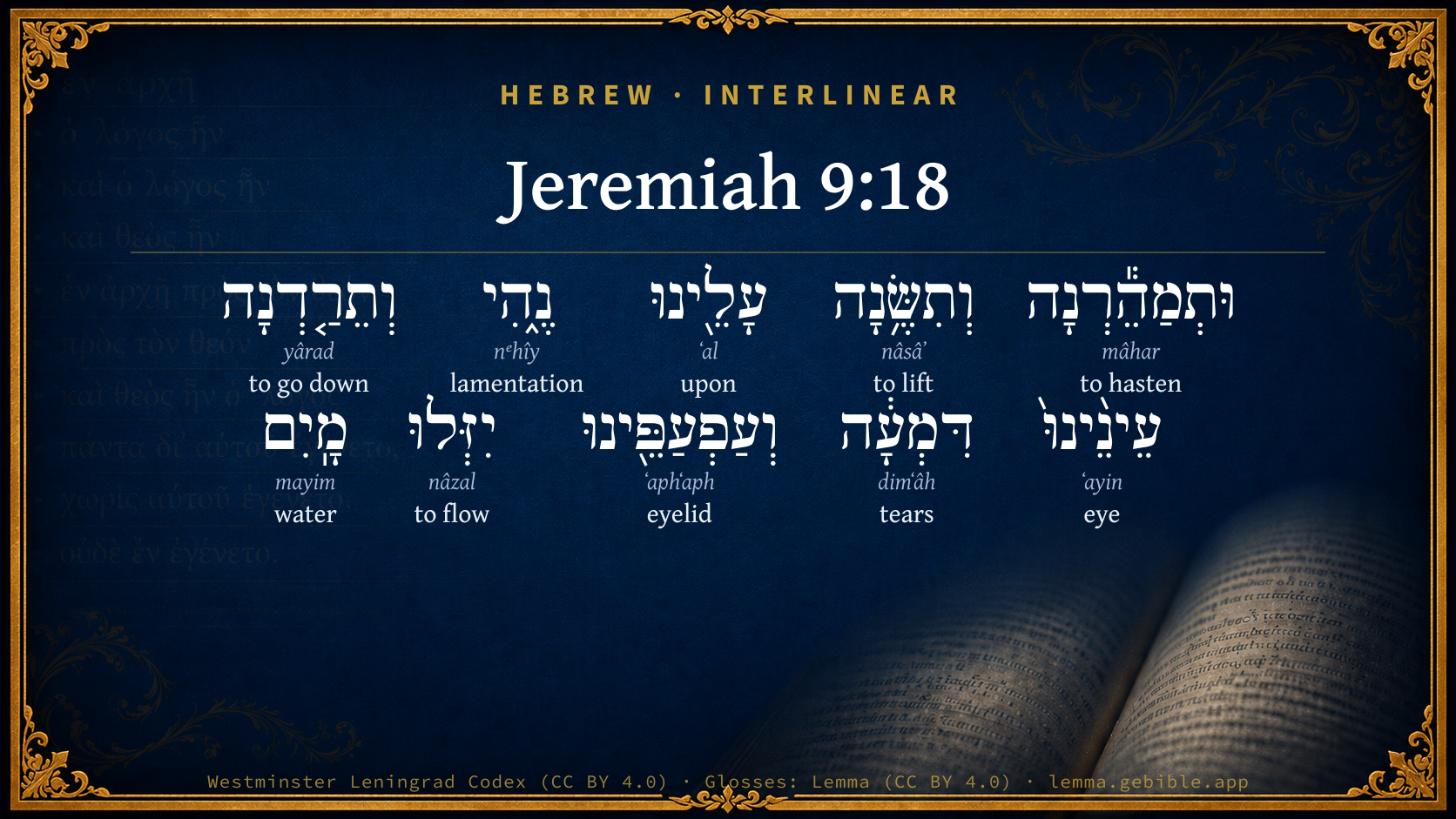
Hebrew (Westminster Leningrad Codex) Jeremiah 9:18 appears in the Hebrew Old Testament. The text above is from the Westminster Leningrad Codex. Each word links to its Strong’s number, a concise gloss, and parsing drawn from the Open Scriptures Hebrew Bible morphology. Click any word for its full Brown-Driver-Briggs (BDB) entry.
Download image
Cite this verse

Jeremiah 9:18 (World English Bible). Public Domain. Lemma interlinear Bible study tool, https://lemma.gebible.app/v/jeremiah/9/18.

Show BibTeX & RIS
BibTeX
RIS
English Translation
and let them make haste, and take up a wailing for us, that our eyes may run down with tears, and our eyelids gush out with waters.
World English Bible · Public Domain
Download a study sheet

One document with this verse’s original text, its word-by-word gloss line, the meaning frame, cross-references with their text, attributed commentary, and full source and license credits — printable, and it pastes into notes with its structure intact.

This verse Autodidact and up

Study sheet (.html) Plain text (.txt)

A passage Seminary Student

Up to 50 verses in one chapter. A passage sheet keeps up to 6 commentary sources and 12 cross-references per verse, in the order this page ranks them, and says so on the sheet whenever that leaves anything out. Ask for a single verse and you get the Autodidact verse sheet above.

Everything on this page stays free to read, with no account — the sheet is a download of what is already on screen, not access to it.

Want to remove ads? Support Godless Engineer
Compare translations 3

The same verse in 3 English versions, stacked beneath the original-language interlinear above. Click any original word for its lexicon entry.

Each is an independent rendering of the whole verse — the interlinear is not word-aligned to these translations.

Highlighted words mark where these versions differ — a whole-verse word diff, not a word-by-word alignment.

  • World English Bible Public Domain
    and let them make haste, and take up a wailing for us, that our eyes may run down with tears, and our eyelids gush out with waters.
  • King James Version Public Domain
    And let them make haste, and take up a wailing for us, that our eyes may run down with tears, and our eyelids gush out with waters.
  • unfoldingWord Literal Text CC BY-SA 4.0
    Let them hurry and take up a wailing for us, that our eyes may go down tears, and our eyelids flow water.

unfoldingWord Literal Text — © unfoldingWord, licensed CC BY-SA 4.0. Word-aligned USFM3 via Door43 (git.door43.org/unfoldingWord/en_ult).

Versions to compare (up to 4)

3 of 4 selected

Show all 18 translations

Every available English version of this verse, each an independent rendering of the whole verse.

  • World English Bible Public Domain
    and let them make haste, and take up a wailing for us, that our eyes may run down with tears, and our eyelids gush out with waters.
  • Berean Standard Bible Public Domain
    Let them come quickly and take up a lament over us, that our eyes may overflow with tears, and our eyelids may gush with water.
  • Majority Standard Bible Public Domain
    Let them come quickly and take up a lament over us, that our eyes may overflow with tears, and our eyelids may gush with water.
  • King James Version Public Domain
    And let them make haste, and take up a wailing for us, that our eyes may run down with tears, and our eyelids gush out with waters.
  • American Standard Version (1901) Public Domain
    and let them make haste, and take up a wailing for us, that our eyes may run down with tears, and our eyelids gush out with waters.
  • Revised Version (1885) Public Domain
    and let them make haste, and take up a wailing for us, that our eyes may run down with tears, and our eyelids gush out with waters.
  • Geneva Bible (1599) Public Domain
    And let them make haste, and let them take vp a lamentation for vs, that our eyes may cast out teares and our eye liddes gush out of water.
  • Douay-Rheims (1899) Public Domain
    Let them hasten and take up a lamentation for us: let our eyes shed tears, and our eyelids run down with waters.
  • Young's Literal Translation Public Domain
    And they hasten, and lift up for us a wailing. And run down our eyes do tears, And from our eyelids do waters flow.
  • Literal Standard Version CC BY-SA 4.0
    And they hurry, and lift up a wailing for us. And tears run down our eyes, || And waters flow from our eyelids.
  • Unlocked Literal Bible CC BY-SA 4.0
    Let them hurry and sing a mournful song over us, so our eyes may run with tears and our eyelids flow with water.
  • unfoldingWord Literal Text CC BY-SA 4.0
    Let them hurry and take up a wailing for us, that our eyes may go down tears, and our eyelids flow water.
  • Darby Bible Public Domain
    and let them make haste, and take up a wailing for us, that our eyes may run down with tears, and our eyelids pour forth waters.
  • World Messianic Bible Public Domain
    Let them make haste and take up a wailing for us, that our eyes may run down with tears and our eyelids gush out with waters.
  • Webster's Bible Public Domain
    And let them make haste, and take up a wailing for us, that our eyes may run down with tears, and our eyelids gush out with waters.
  • Free Bible Version CC BY-SA 4.0
    Have them come as quickly as possible, and sing a funeral song about us, so we can cry our eyes out, so our tears will flow like streams.
  • Bible in Basic English Public Domain
    Let them quickly make cries of sorrow for us, so that drops may be flowing from our eyes till they are streaming with water.
  • JPS Tanakh (1917) Public Domain
    (9-17) And let them make haste, and take up a wailing for us, that our eyes may run down with tears, and our eyelids gush out with waters.

Literal Standard Version (2020), Covenant Press — licensed CC BY-SA 4.0. Text via the HelloAO Bible API (eBible.org). Unlocked Literal Bible (unfoldingWord) — licensed CC BY-SA 4.0. Text via the HelloAO Bible API (eBible.org). unfoldingWord Literal Text — © unfoldingWord, licensed CC BY-SA 4.0. Word-aligned USFM3 via Door43 (git.door43.org/unfoldingWord/en_ult). Free Bible Version, Dr. Jonathan Gallagher — licensed CC BY-SA 4.0. Text via the HelloAO Bible API (eBible.org).

Word by word

More ways to search: Search by grammar → Find every occurrence → Compare this word →

Practice this passage: Drill this verse → Learn its vocabulary →

נֶ֑הִי
nᵉhîy
H5092
“lamentation”
Noun, Common, Masculine, Singular, Absolute
Part of Speech
Noun
Type
Common
Gender
Masculine
Number
Singular
State
Absolute
Full BDB Definition

Origin: from H5091

TWOT: 1311a

wailing, lamentation, mourning song - wailing - mourning song
  1. וּתְמַהֵ֕רְנָה mâhar H4116 “and · to hasten” Conjunction + Verb, Piel, Imperfect, 3rd Person, Feminine, Plural
  2. וְתִשֶּׂ֥נָה nâsâʼ H5375 “and · to lift” Conjunction + Verb, Qal, Imperfect, 3rd Person, Feminine, Plural
  3. עָלֵ֖ינוּ ʻal H5921 “upon · us” Preposition + Suffix, Personal, 1st Person, Common, Plural
  4. וְתֵרַ֤דְנָה yârad H3381 “and · to go down” Conjunction + Verb, Qal, Imperfect, 3rd Person, Feminine, Plural
  5. עֵינֵ֨ינוּ֙ ʻayin H5869 “eyes · our” Noun, Common, Both, Dual, Construct + Suffix, Personal, 1st Person, Common, Plural
  6. דִּמְעָ֔ה dimʻâh H1832 “tears” Noun, Common, Feminine, Singular, Absolute
  7. וְעַפְעַפֵּ֖ינוּ ʻaphʻaph H6079 “and · eyelids · our” Conjunction + Noun, Common, Masculine, Dual, Construct + Suffix, Personal, 1st Person, Common, Plural
  8. יִזְּלוּ nâzal H5140 “to flow” Verb, Qal, Imperfect, 3rd Person, Masculine, Plural
  9. מָֽיִם mayim H4325 “water(s)” Noun, Common, Masculine, Plural, Absolute

About this verse

These counts appear in no published source. They are computed here, from the morphology-tagged text and Lemma’s own curated glosses. What Lemma adds →

10
words
10
distinct lemmas
Prophets
section

Notable vocabulary

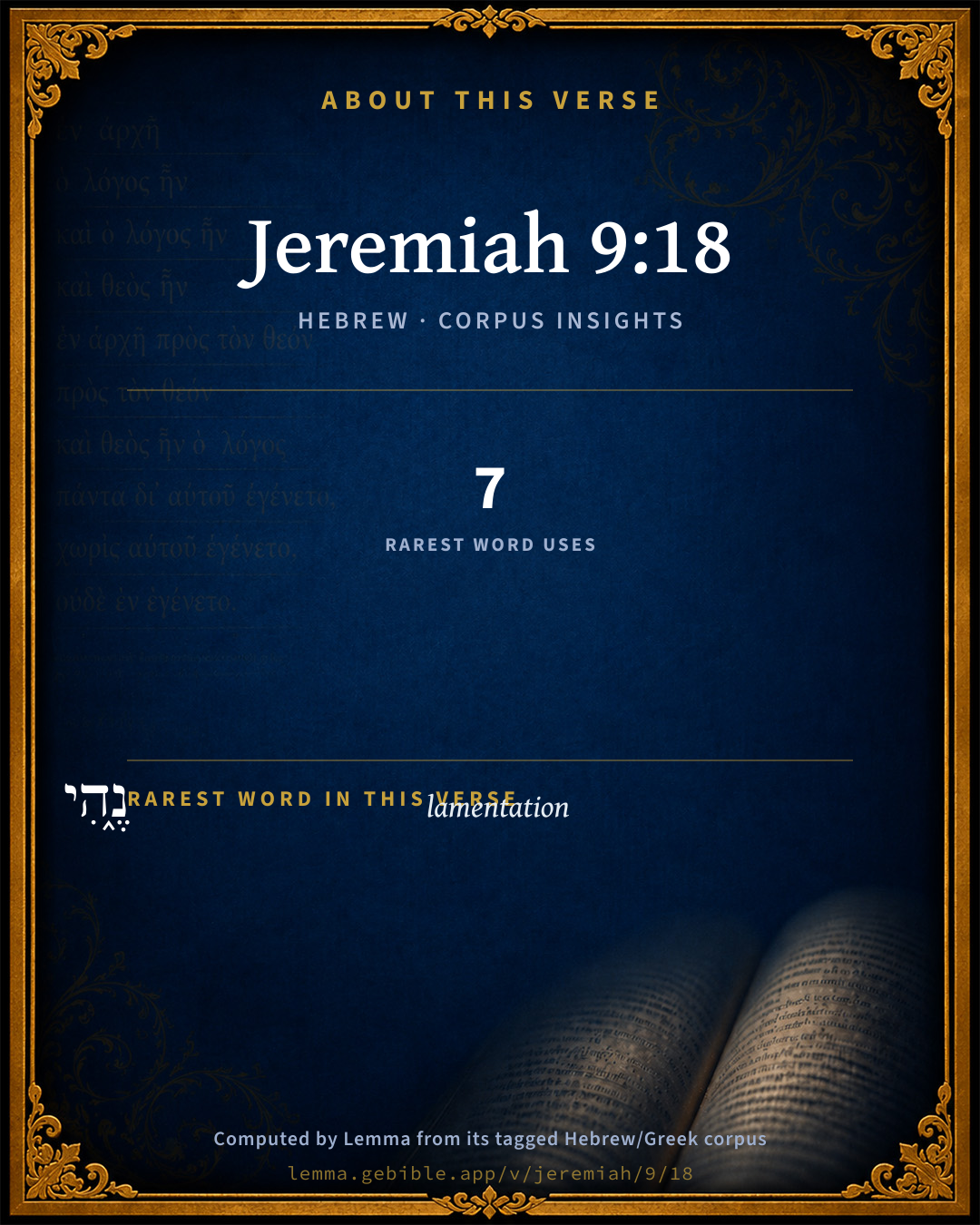
The rarest word here is נֶ֑הִי lamentation H5092 — appearing just 7 times in the whole Hebrew Bible.

Shared distinctive vocabulary

נֶ֑הִי lamentation H5092 occurs in 7 verses of the Hebrew Bible. Also found in:

Grammatical profile

  • 4 verbs
  • 5 nouns
  • 1 preposition

Verb forms

  • וּתְמַהֵ֕רְנָה Piel · Imperfect
  • וְתִשֶּׂ֥נָה Qal · Imperfect
  • וְתֵרַ֤דְנָה Qal · Imperfect
  • יִזְּלוּ Qal · Imperfect

Cross-references

11

Topical passages linked to Jeremiah 9:18 in the Treasury of Scripture Knowledge — connected by theme and wording, ordered by reader-vote popularity; previews shown in the World English Bible.

  • Jeremiah 9:1 Oh that my head were waters, and my eyes a spring of tears, that I might weep day and night for the slain of the daughter of my people!
  • Isaiah 22:4 Therefore said I, Look away from me, I will weep bitterly; don't labor to comfort me for the destruction of the daughter of my people.
  • Jeremiah 14:17 You shall say this word to them, Let my eyes run down with tears night and day, and let them not cease; for the virgin daughter of my people is broken with a great breach, with a very grievous wound.
  • Jeremiah 9:20 Yet hear the word of Yahweh, you women, and let your ear receive the word of his mouth; and teach your daughters wailing, and everyone her neighbor lamentation.
  • Jeremiah 6:26 Daughter of my people, gird you with sackcloth, and wallow yourself in ashes: make you mourning, as for an only son, most bitter lamentation; for the destroyer shall suddenly come on us.
  • Jeremiah 9:10 For the mountains will I take up a weeping and wailing, and for the pastures of the wilderness a lamentation, because they are burned up, so that none passes through; neither can men hear the voice of the cattle; both the birds of the sky and the animals are fled, they are gone.
  • Jeremiah 13:17 But if you will not hear it, my soul shall weep in secret for [your] pride; and my eye shall weep sore, and run down with tears, because Yahweh's flock is taken captive.
  • Lamentations 1:2 She weeps sore in the night, and her tears are on her cheeks; Among all her lovers she has none to comfort her: All her friends have dealt treacherously with her; they are become her enemies.
  • Lamentations 2:11 My eyes do fail with tears, my heart is troubled; My liver is poured on the earth, because of the destruction of the daughter of my people, Because the young children and the infants swoon in the streets of the city.
  • Lamentations 2:18 Their heart cried to the Lord: wall of the daughter of Zion, let tears run down like a river day and night; Give yourself no respite; don't let the apple of your eye cease.
  • Luke 19:41 When he drew near, he saw the city and wept over it,

Cross-references courtesy of OpenBible.info (CC BY 4.0).

Hebrew and Greek witnesses Masoretic Hebrew ↔ Greek Septuagint

The same verse in the two great witnesses to the Old Testament, shown verse-for-verse.

These are two independent witnesses, not word-aligned to each other, and the Septuagint is shown in lemma (dictionary) form.

Hebrew Jeremiah 9:18 Masoretic · Westminster Leningrad Codex

וּתְמַהֵ֕רְנָה וְתִשֶּׂ֥נָה עָלֵ֖ינוּ נֶ֑הִי וְתֵרַ֤דְנָה עֵינֵ֨ינוּ֙ דִּמְעָ֔ה וְעַפְעַפֵּ֖ינוּ יִזְּלוּ מָֽיִם

and let them make haste, and take up a wailing for us, that our eyes may run down with tears, and our eyelids gush out with waters.

World English Bible · Public Domain

Greek LXX Structure differs

In the Septuagint, Jeremiah is about an eighth shorter than the Hebrew and arranges its material differently — the Oracles Against the Nations (Hebrew chapters 46–51) appear in the middle of the Greek book, after 25:13. Because the chapter and verse boundaries do not line up, a verse-for-verse comparison with the Hebrew is not shown.

A verse-for-verse comparison isn’t shown here because the chapters and verses don’t line up. Switch to the LXX edition with the MT / LXX toggle above to read the Greek directly.

Hebrew: Westminster Leningrad Codex (CC BY 4.0). Greek: Septuagint (public domain); English from a public-domain English Septuagint. How the Septuagint differs from the Hebrew →

Targum (Aramaic paraphrase)

1

The Targum is the ancient Jewish Aramaic paraphrase of the Hebrew Scriptures — an interpretive translation, not the Hebrew text itself. Onkelos (literal) and Pseudo-Jonathan (expansive) render the Torah, and Jonathan the Prophets. Coverage is partial: where no permissively-licensed English translation exists for a verse, only the Aramaic is shown. This is verse-level text, not a word-by-word alignment to the Hebrew.

  1. Targum Jonathan Prophets (Joshua–Malachi)
    אֲרֵי קַל אִלְיָא אִשְׁתְּמַע מִצִיוֹן אֵכְדֵין אִתְבְּזֵיזְנָא בְּהֵיתְנָא לַחֲדָא אֲרֵי חֲרוּבַת אַרְעָא אֲרֵי צַדִיאָה בִּרְנְיָתָהָא:

    (no public-domain English translation for this verse)

    Targum Jonathan — Aramaic: “Mikraot Gedolot” (public domain). English: “Sefaria Community Translation” (CC0 1.0 (public-domain dedication)); “London "Chaldee Paraphrase," 1871” (public domain). Text via Sefaria.

Commentary

Notes on Jeremiah 9:18 from classic Christian and Jewish commentators (each source and its license shown beneath its notes). The classic Christian expositions comment on the surrounding passage and are grouped to its opening verse, so a note may address several verses; the Jewish commentaries on the Tanakh (Rashi and others) are per-verse, so they appear only where the commentator wrote on this verse.

Lemma curates 59 commentaries, every one of them public domain or Creative Commons licensed, each selected and text-cleaned for this edition rather than reprinted as found. About our sources →

Trapp's Complete Commentary

John Trapp

Jer 9:18 And let them make haste, and take up a wailing for us, that our eyes may run down with tears, and our eyelids gush out with waters.

Ver. 18. And let them make haste, and take up a wailing for us.] Of this vanity or affectation God approveth not, as neither he did of the Olympic games, of usury, of that custom at Corinth, {1Co 15:29} which yet he maketh his use of.

John Trapp, A Commentary or Exposition upon All the Books of the Old and New Testament (1647–1656) — public domain. Text from a community e-Sword module.

Keil & Delitzsch

C. F. Keil & F. Delitzsch

Jer 9:18 gives the reason why the mourning women are to be called: Loud lamentation is heard out of Zion. Ew. takes "out of Zion" of the Israelites carried away from their country - a view arbitrary in itself, and incompatible with Jer 9:20. "How are we spoiled!" cf. Jer 4:13; brought utterly to shame, because we have left the land, i.e., have been forced to leave it, and because they (the enemies) have thrown down our dwellings! השׁליך, cast down, overthrow, Job 18:7, cf. Eze 19:12, and of buildings, Dan 8:11. Kimchi and Hitz., again, take "our dwellings" as subject: our dwellings have cast us out, and appeal to Lev 18:25 : The land vomited out its inhabitants. But the figurative style in this passage does not justify us in adopting so unnatural a figure as this, that the dwellings cast out their occupants. Nor could the object be omitted in such a case. The passages, Isa 33:9; Mic 2:4, to which Hitz. appeals, are not analogous to the present one. The subject, not expressed, acc. to our view of the passage, is readily suggested by the context and the nature of the case. The "for" in Jer 9:19 gives a second reason for calling the mourning women together. They are to come not only to chant laments for the spoiling of Zion, but that they may train their daughters and other women in the art of dirge-singing, because the number of deaths will be so great that the existing number of mourning women will not be sufficient for the task about to fall on them. This thought is introduced by a command of God, in order to certify that this great harvest of death will without fail be gathered. אזנכם and בּנתיכם have masc. suffixes instead of feminine, the masc. being often thus used as the more general form; cf. Ew. 184, c. In the last clause the verb "teach" is to be supplied from the preceding context.

Keil & Delitzsch — Biblical Commentary on the Old Testament (1861–1891) — public domain (CC PDM 1.0). Text via the HelloAO Bible API. (Old Testament only.)

Tyndale Open Study Notes

Tyndale Open Resources

9:18-19 The mourners had to start their work immediately, mourning those who had already died and grieving for doomed Jerusalem. The mourners were to join the people of Jerusalem who had no homes and were forced to flee as refugees.

Tyndale Open Study Notes — © Tyndale Open Resources, licensed CC BY-SA 4.0. Text via the HelloAO Bible API.

Jamieson, Fausset & Brown

Robert Jamieson, A. R. Fausset & David Brown

(Jer 14:17).

Jamieson, Fausset & Brown — Commentary Critical and Explanatory on the Whole Bible (1871) — public domain (CC PDM 1.0). Text via the HelloAO Bible API.

John Calvin's Commentaries

Let them, he says, take up for us a wailing, and let our eyes come down to tears, and let our eyelids flow down into waters These are hyperbolical words, and yet they do not exceed the intensehess of the coming vengeance: for it was not in vain that he said at the begSnning of the chapter, “Who will make my head waters, and my eyes a fountain of tears?” As then the greatness of the calamity could be expressed by no words, the Prophet was constrained to adopt these hyperbolical expressions: Let them then take up for us a wailing, that our eyes may come down to tears: and this he said, because he saw that he was heard with dry eyes, and that the people disregarded what had been denounced:, when yet all ought to have been smitten with fear, from the least to the greatest. As then the Prophet saw that their contempt was so brutal, he says, that when lainenters came, there would then be the time for wailing, not indeed the seasonable time; but it is the same as though he had said, that the Jews would then find out how insensible they had been, in not having in due time considered the judgment of God. It follows —

John Calvin's Commentaries (1540-1563) — public domain. Text from the Calvin Translation Society English edition (1840s-50s) via the Christian Classics Ethereal Library (ccel.org). Calvin's coverage is partial (roughly two-thirds of the Bible); uncommented books and verses are honest gaps, never fabricated. The 19th-century editor's footnotes and remarks are omitted so the notes are faithfully Calvin's own voice.

Ellicott's Commentary for English Readers

(18) Take up a wailing for us.—There is in all such figures of speech an inevitable blending of metaphors. The mourners wail for the dead nation, and yet the members of the nation are sharers in the obsequies, and their eyes run down with tears.

A Bible Commentary for English Readers, edited by Charles John Ellicott (1878–1897) — public domain. Text from a community e-Sword module.

John Gill's Exposition

And let them make haste, and take up a wailing for us,.... Deliver out a mournful song, as the Arabic version; setting forth their miseries and distresses, and affecting their minds with them. The prophet puts himself among the people, as being a party concealed in their sufferings, and sympathizing with them, as well as to show the certainty of then and how soon they would be involved in them:

that our eyes may run down with tears, and our eyelids gush out with waters; or balls of the eye, as the Targum and Kimchi; these hyperbolical expressions are used to express the greatness of the calamity, and that no mourning was equal to it; see Jer 9:1.

John Gill's Exposition of the Whole Bible (1746–1763) — public domain (CC PDM 1.0). Text via the HelloAO Bible API.

Matthew Poole's English Annotations

Let them make haste: as by the calling for their artificial mourners he did intimate the greatness of the misery that was coming upon them, that with all, their art they could not sufficiently bewail it; so here, by making haste, he intimates the near approach of it, that it was even at the doors.

Take up a wailing for us; pitch upon some form of mourning that may be suitable to our condition.

Our eyelids gush out with waters: this and the former are each of them a hyperbolical expression, and yet are too little to bewail the greatness of the judgment, which suits with the prophet’s lamentation, Jer 9:1. The prophet would herein intimate that they that were so stupid as to hear the prophets denouncing their judgments with dry eyes, though he wished them to have been fountains of tears, shall now suddenly feel that they shall have cause enough to send for all the helps, not only real, but artificial, to stir up their mournings.

Matthew Poole's English Annotations on the Holy Bible (1683–1685) — public domain. Text from a community e-Sword/MySword module.

The Pulpit Commentary

That our eyes may run down, etc.; a justification of this artificial system-The piercing notes of the hired mourners are to relieve the sorrow of the afflicted by forcing for it a vent.

The Pulpit Commentary (1880–1919), ed. H.D.M. Spence-Jones & Joseph S. Exell — public domain. Text from a community e-Sword module.

Rashi

Rabbi Shlomo Yitzchaki (Rashi)

they have cast down our dwellings Heb. השליכו משכנותינו, [our dwellings] have cast out their inhabitants. We can also explain: For the enemies have cast our dwellings to the ground.

Rashi on the Tanakh — English translations: “The Judaica Press complete Tanach with Rashi, translated by A. J. Rosenberg” (CC BY 4.0); “Pentateuch with Rashi's commentary by M. Rosenbaum and A.M. Silbermann, 1929-1934” (public domain); “The Metsudah Tanach series, Lakewood, N.J” (CC BY 4.0); and “The Book of Joshua, Metsudah Publications, 1997” (CC BY 4.0). Text via Sefaria.

Lesson kit

Teaching starters — assembled from the data on this page, not authored interpretation. Every prompt links to the verse data it draws on. Edit before teaching.

Jeremiah, in the Prophets, opens this verse with 10 words (10 distinct Hebrew lemmas). Its most distinctive word is nᵉhîy (“lamentation”). A historical commentator’s framing appears above. Read the whole chapter for the surrounding context.

Discussion questions

  1. How does “lamentation” (nᵉhîy) shape what this verse is saying?
  2. How does Jeremiah 9:10, which shares the word «lamentation», read alongside this verse?
  3. These translations render this verse differently. What is at stake in choosing one wording over another?
  4. «וּתְמַהֵ֕רְנָה» is a Piel Imperfect verb. How does that grammatical form shape the action described?
  5. Compare how Trapp's Complete Commentary and Keil & Delitzsch read this verse. Where do they agree or differ?

Things to notice

Reading settings

Reading text

Shown beneath each verse's original-language words.

Old Testament
Old Testament edition

Read the OT as the Masoretic Hebrew (MT) or the Greek Septuagint (LXX).

English shown for the Greek Septuagint (in the Hebrew ↔ Greek comparison).

Comparing translations? Open the Compare panel on any verse page to stack up to four side by side.