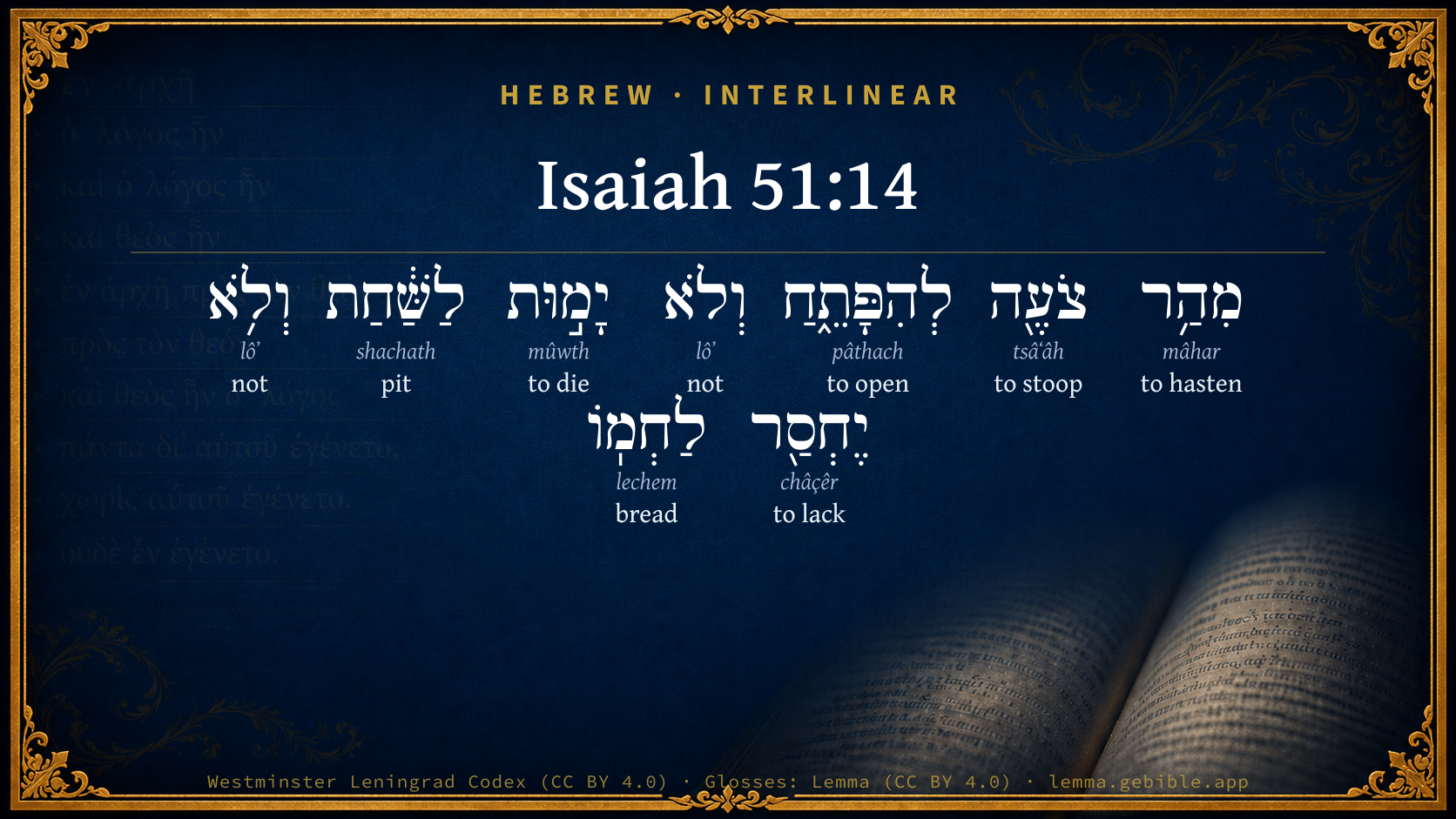
Isaiah 51:14

Hebrew (Westminster Leningrad Codex) Isaiah 51:14 appears in the Hebrew Old Testament. The text above is from the Westminster Leningrad Codex. Each word links to its Strong’s number, a concise gloss, and parsing drawn from the Open Scriptures Hebrew Bible morphology. Click any word for its full Brown-Driver-Briggs (BDB) entry.
Download image
Cite this verse

Isaiah 51:14 (World English Bible). Public Domain. Lemma interlinear Bible study tool, https://lemma.gebible.app/v/isaiah/51/14.

Show BibTeX & RIS
BibTeX
RIS
English Translation
The captive exile shall speedily be freed; and he shall not die [and go down] into the pit, neither shall his bread fail.
World English Bible · Public Domain
Highlights Full analysis ↓
Download a study sheet

One document with this verse’s original text, its word-by-word gloss line, the meaning frame, cross-references with their text, attributed commentary, and full source and license credits — printable, and it pastes into notes with its structure intact.

This verse Autodidact and up

Study sheet (.html) Plain text (.txt)

A passage Seminary Student

Up to 50 verses in one chapter. A passage sheet keeps up to 6 commentary sources and 12 cross-references per verse, in the order this page ranks them, and says so on the sheet whenever that leaves anything out. Ask for a single verse and you get the Autodidact verse sheet above.

Everything on this page stays free to read, with no account — the sheet is a download of what is already on screen, not access to it.

Want to remove ads? Support Godless Engineer
Compare translations 3

The same verse in 3 English versions, stacked beneath the original-language interlinear above. Click any original word for its lexicon entry.

Each is an independent rendering of the whole verse — the interlinear is not word-aligned to these translations.

Highlighted words mark where these versions differ — a whole-verse word diff, not a word-by-word alignment.

  • World English Bible Public Domain
    The captive exile shall speedily be freed; and he shall not die [and go down] into the pit, neither shall his bread fail.
  • King James Version Public Domain
    The captive exile hasteneth that he may be loosed, and that he should not die in the pit, nor that his bread should fail.
  • unfoldingWord Literal Text CC BY-SA 4.0
    The stooping one hastens to be opened, and he will not die in the pit, and he will not lack his bread.

unfoldingWord Literal Text — © unfoldingWord, licensed CC BY-SA 4.0. Word-aligned USFM3 via Door43 (git.door43.org/unfoldingWord/en_ult).

Versions to compare (up to 4)

3 of 4 selected

Show all 18 translations

Every available English version of this verse, each an independent rendering of the whole verse.

  • World English Bible Public Domain
    The captive exile shall speedily be freed; and he shall not die [and go down] into the pit, neither shall his bread fail.
  • Berean Standard Bible Public Domain
    The captive will soon be freed; he will not die in the dungeon, and his bread will not be lacking.
  • Majority Standard Bible Public Domain
    The captive will soon be freed; he will not die in the dungeon, and his bread will not be lacking.
  • King James Version Public Domain
    The captive exile hasteneth that he may be loosed, and that he should not die in the pit, nor that his bread should fail.
  • American Standard Version (1901) Public Domain
    The captive exile shall speedily be loosed; and he shall not die `and go down' into the pit, neither shall his bread fail.
  • Revised Version (1885) Public Domain
    The captive exile shall speedily be loosed; and he shall not die and go down into the pit, neither shall his bread fail.
  • Geneva Bible (1599) Public Domain
    The captiue hasteneth to be loosed, and that hee should not die in the pitte, nor that his bread should faile.
  • Douay-Rheims (1899) Public Domain
    He shall quickly come that is going to open unto you, and he shall not kill unto utter destruction, neither shall his bread fail.
  • Young's Literal Translation Public Domain
    Hastened hath a wanderer to be loosed, And he doth not die at the pit, And his bread is not lacking.
  • Literal Standard Version CC BY-SA 4.0
    A wanderer has hurried to be loosed, || And he does not die in the pit, || And his bread is not lacking.
  • Unlocked Literal Bible CC BY-SA 4.0
    The one who is bent down, Yahweh will hurry to release; he will not die and go down to the pit, nor will he lack bread.
  • unfoldingWord Literal Text CC BY-SA 4.0
    The stooping one hastens to be opened, and he will not die in the pit, and he will not lack his bread.
  • Darby Bible Public Domain
    He that is bowed down shall speedily be loosed, and he shall not die in the pit, nor shall his bread fail.
  • World Messianic Bible Public Domain
    The captive exile will speedily be freed. He will not die and go down into the pit. His bread won’t fail.
  • Webster's Bible Public Domain
    The captive exile hasteneth that he may be loosed, and that he should not die in the pit, nor that his bread should fail.
  • Free Bible Version CC BY-SA 4.0
    The prisoners that are bowed down will soon be set free. They're not going to die; they won't go on being hungry.
  • Bible in Basic English Public Domain
    The prisoner, bent under his chain, will quickly be made free, and will not go down into the underworld, and his bread will not come to an end.
  • JPS Tanakh (1917) Public Domain
    He that is bent down shall speedily be loosed; and he shall not go down dying into the pit, neither shall his bread fail.

Literal Standard Version (2020), Covenant Press — licensed CC BY-SA 4.0. Text via the HelloAO Bible API (eBible.org). Unlocked Literal Bible (unfoldingWord) — licensed CC BY-SA 4.0. Text via the HelloAO Bible API (eBible.org). unfoldingWord Literal Text — © unfoldingWord, licensed CC BY-SA 4.0. Word-aligned USFM3 via Door43 (git.door43.org/unfoldingWord/en_ult). Free Bible Version, Dr. Jonathan Gallagher — licensed CC BY-SA 4.0. Text via the HelloAO Bible API (eBible.org).

Word by word

More ways to search: Search by grammar → Find every occurrence → Compare this word →

Practice this passage: Drill this verse → Learn its vocabulary →

About this verse

These counts appear in no published source. They are computed here, from the morphology-tagged text and Lemma’s own curated glosses. What Lemma adds →

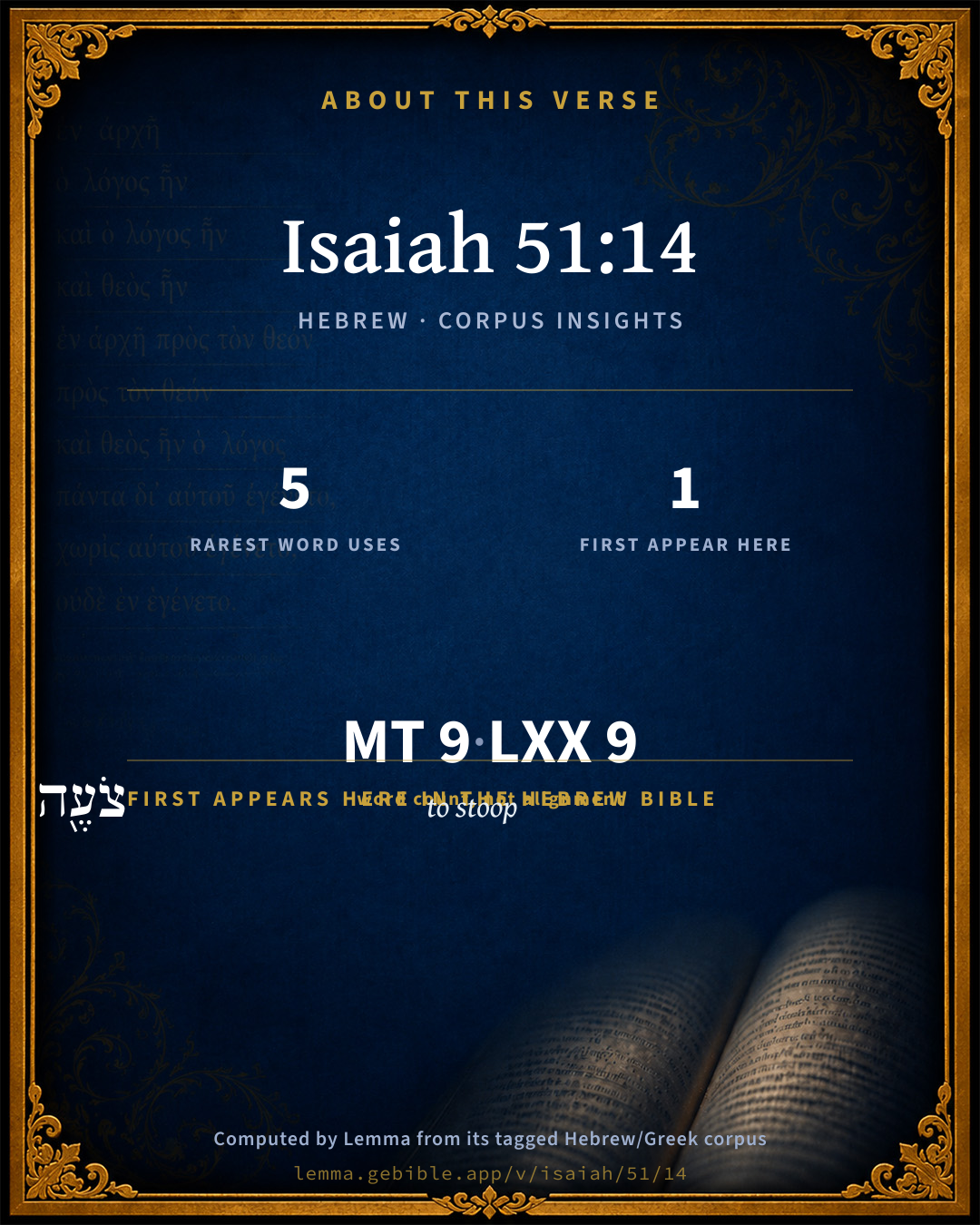
9
words
8
distinct lemmas
Prophets
section

Notable vocabulary

The rarest word here is צֹעֶ֖ה to stoop H6808 — appearing just 5 times in the whole Hebrew Bible.

First appearance in Scripture

This word makes its first canonical appearance in the Hebrew Bible here:

  • צֹעֶ֖ה to stoop H6808

Shared distinctive vocabulary

צֹעֶ֖ה to stoop H6808 occurs in 4 verses of the Hebrew Bible. Also found in:

Grammatical profile

  • 5 verbs
  • 2 nouns
  • 2 particles

Verb forms

  • מִהַ֥ר Piel · Perfect
  • צֹעֶ֖ה Qal · Participle Active
  • לְהִפָּתֵ֑חַ Niphal · Infinitive Construct
  • יָמ֣וּת Qal · Imperfect
  • יֶחְסַ֖ר Qal · Imperfect

Repetition

A word recurs within this verse — often emphatic in Hebrew:

  • וְלֹא not H3808 ×2

Hebrew & Septuagint length

In English translation the verse runs 23 words from the Hebrew and 10 from the Septuagint (LXX English) — the Septuagint runs noticeably shorter here. See the side-by-side →

A rough comparison of the two English renderings, which tokenize alike — not a word-level alignment.

Word counts can differ between the Hebrew and the Greek without any difference in meaning — e.g. the Hebrew direct-object marker אֵת has no separate Greek word, and Greek often adds the article ὁ.

In the original languages it is 9 Hebrew tokens and 9 Greek tokens — but the two are counted differently (Hebrew bundles its prefixes and suffixes into one token; the Greek is in lemma form), so that isn’t a like-for-like length.

Cross-references

9

Topical passages linked to Isaiah 51:14 in the Treasury of Scripture Knowledge — connected by theme and wording, ordered by reader-vote popularity; previews shown in the World English Bible.

  • Isaiah 48:20 Go you forth from Babylon, flee you from the Chaldeans; with a voice of singing declare you, tell this, utter it even to the end of the earth: say you, Yahweh has redeemed his servant Jacob.
  • Zechariah 9:11 As for you also, Because of the blood of your covenant, I have set free your prisoners from the pit in which is no water.
  • Isaiah 52:2 Shake yourself from the dust; arise, sit [on your throne], Jerusalem: loose yourself from the bonds of your neck, captive daughter of Zion.
  • Acts 12:7–8 And behold, an angel of the Lord stood by him, and a light shone in the cell. He struck Peter on the side, and woke him up, saying, "Stand up quickly!" His chains fell off from his hands.
  • Isaiah 49:10 They shall not hunger nor thirst; neither shall the heat nor sun strike them: for he who has mercy on them will lead them, even by springs of water will he guide them.
  • Ezra 1:5 Then rose up the heads of fathers' [houses] of Judah and Benjamin, and the priests, and the Levites, even all whose spirit God had stirred to go up to build the house of Yahweh which is in Jerusalem.
  • Jeremiah 38:6–13 Then took they Jeremiah, and cast him into the dungeon of Malchijah the king's son, that was in the court of the guard: and they let down Jeremiah with cords. In the dungeon there was no water, but mire; and Jeremiah sank in the mire.
  • Jeremiah 37:16 When Jeremiah was come into the dungeon-house, and into the cells, and Jeremiah had remained there many days;

Cross-references courtesy of OpenBible.info (CC BY 4.0).

Hebrew and Greek witnesses Masoretic Hebrew ↔ Greek Septuagint

The same verse in the two great witnesses to the Old Testament, shown verse-for-verse.

Here the Septuagint runs noticeably shorter than the Hebrew — LXX2012 (modern English Septuagint) 10 words vs World English Bible 23. A rough length comparison of the two English translations, not a word-level alignment — read both below.

These are two independent witnesses, not word-aligned to each other, and the Septuagint is shown in lemma (dictionary) form.

Hebrew Isaiah 51:14 Masoretic · Westminster Leningrad Codex

מִהַ֥ר צֹעֶ֖ה לְהִפָּתֵ֑חַ וְלֹא יָמ֣וּת לַשַּׁ֔חַת וְלֹ֥א יֶחְסַ֖ר לַחְמֽוֹ

The captive exile shall speedily be freed; and he shall not die [and go down] into the pit, neither shall his bread fail.

World English Bible · Public Domain

Greek LXX Isaiah 51:14 Septuagint · lemma form

ἐν γάρ ὁ σώζω σύ οὐ ἵστημι οὐδέ χρονίζω

For in your deliverance he shall not halt, nor wait;

LXX2012 (modern English Septuagint) · Public Domain

On this verse, The Cambridge Bible for Schools and Colleges discusses the Septuagint’s reading. Read the note in Commentary ↓

Hebrew: Westminster Leningrad Codex (CC BY 4.0). Greek: Septuagint (public domain); English from LXX2012 (modern English Septuagint) (Public Domain). How the Septuagint differs from the Hebrew →

Targum (Aramaic paraphrase)

1

The Targum is the ancient Jewish Aramaic paraphrase of the Hebrew Scriptures — an interpretive translation, not the Hebrew text itself. Onkelos (literal) and Pseudo-Jonathan (expansive) render the Torah, and Jonathan the Prophets. Coverage is partial: where no permissively-licensed English translation exists for a verse, only the Aramaic is shown. This is verse-level text, not a word-by-word alignment to the Hebrew.

  1. Targum Jonathan Prophets (Joshua–Malachi)
    מוֹחִי פּוּרְעֲנוּתָא לְאִתְגְלָאָה וְלָא יְמוּתוּן צַדִיקַיָא לְחַבֵּל וְלָא יַחְסְרוּן מְזוֹנֵיהוֹן:

    Vengeance hasteneth to be revealed, and the righteous shall not die in the pit, nor be in want of their food.

    Targum Jonathan — Aramaic: “Mikraot Gedolot” (public domain). English: “Sefaria Community Translation” (CC0 1.0 (public-domain dedication)); “London "Chaldee Paraphrase," 1871” (public domain). Text via Sefaria.

Commentary

Notes on Isaiah 51:14 from classic Christian and Jewish commentators (each source and its license shown beneath its notes). The classic Christian expositions comment on the surrounding passage and are grouped to its opening verse, so a note may address several verses; the Jewish commentaries on the Tanakh (Rashi and others) are per-verse, so they appear only where the commentator wrote on this verse.

Lemma curates 59 commentaries, every one of them public domain or Creative Commons licensed, each selected and text-cleaned for this edition rather than reprinted as found. About our sources →

Trapp's Complete Commentary

John Trapp

Isa 51:14 The captive exile hasteneth that he may be loosed, and that he should not die in the pit, nor that his bread should fail.

Ver. 14. The captive exile hasteneth that he may be loosed,] i.e., Deliverance is even at the next door by; or, it is a description, saith Diodate, of the believers’ readiness in answering with the motion of their hearts to God’s calling and deliverance.

John Trapp, A Commentary or Exposition upon All the Books of the Old and New Testament (1647–1656) — public domain. Text from a community e-Sword module.

Joseph Benson's Commentary

Isa 51:14-16. The captive exile hasteneth that he may be loosed — From his captivity, and may return to his own country from which he is banished. And that he should not die in the pit — Die a prisoner, through the inconveniences and hardships of his confinement; nor that his bread should fail — The bread or provision allowed to keep him alive in prison. The general sense of the verse is, God is not slack, as you think, but makes haste to fulfil his promise, and rescue his captive and oppressed people from all their oppressions and miseries. And I have put my words in thy mouth — These great and glorious promises, which are in thy mouth, are not the vain words of man, a weak, inconstant, and unfaithful creature, but the words of the almighty, unchangeable, and faithful God; and therefore they shall be infallibly accomplished. This is spoken by God to his church and people, whom he addresses, both in the foregoing and following verses. For God’s word is frequently said to be put into the mouths, not only of the prophets, but also of the people, as Isa 59:21; Deu 30:14. And have covered thee, &c. — Have protected thee by my almighty power. That I may plant the heavens — Bishop Lowth reads, To stretch out the heavens: and lay the foundations of the earth — I have given thee, O my church, these promises, and this protection in all thy calamities, to assure thee of my care and kindness to thee, and that I will reform thee in a most glorious manner, and bring thee unto that perfect and blessed estate which is reserved for the days of the Messiah, which, in the language of Scripture, is termed the making of new heavens and a new earth, Isa 65:17; and Isa 66:22. And say unto Zion, Thou art my people — That I may own thee for my people, in a more illustrious manner than I have done.

Joseph Benson's Commentary on the Old and New Testaments (1811–1818) — public domain. Text from a community e-Sword module.

The Preacher's Complete Homiletical Commentary

Joseph S. Exell (gen. ed.)

THE CAPTIVE SEEKING DELIVERANCE

Isa_51:14-15. The captive exile hasteneth, &c. [1581]

[1581] Before developing either of the outlines here reproduced, attention should be given to Delitzsch’s translation of these verses.

I. A DESCRIPTION OF THE WRETCHED CONDITION OF THE SINNER—AN EXILE.

1. His captivity.

(1.) Judicial;

(2.) practical;

(3.) circumstantial.

2. His impending destruction.

II. THE EAGER DESIRE OF THE EXILE FOR DELIVERANCE.

(1.) He uses every probable means for it.

(2.) There appears to him a good prospect of deliverance.

III. THE PROVISION MADE FOR THE CAPTIVE EXILE.

(1.) The Gospel is a revelation of mercy.

(2.) A dispensation of power.

(3.) The effectual means of a sinner’s deliverance from sin.—T. Lessey.

The captive. I. His condition—captive—in the pit. II. His fears—destitution—destruction. III. His encouragement—deliverance is at hand. IV. His assurance—the Word—the power of God.—J. Lyth, D.D.: Homiletical Treasury, Isaiah, p. 70.

COMMISSIONED, ENDOWED, AND PRESERVED

(Wicklyffe Quincentenary.) [1584]

[1584] We find a signal verification of this promise in the career of John Wicklyffe, the quincentenary of whose death affords a fitting occasion for reverting to the times in which he lived, and the task he was selected to perform. He was employed in a work which may fitly be described as “planting the heavens.” The imagery is drawn from fixing the stakes of a tent, and we may well say that the Reformation supplied a new spiritual canopy to the world. Men’s outlook into the invisible became clearer; the heavens brightened overhead, as the clouds of ignorance, spiritual tyranny, and human mediation were dispersed, and the Sun of righteousness poured His unobstructed rays upon the earth. No less appropriately may we speak of the Reformation as “laying the foundations of the earth.” The Romish system had no firm basis; men were building on loose material, and the rubbish had to be swept away before a secure foundation could be obtained. The truth of the Gospel was overlaid with fictions and corruptions, till the Reformers dug through it to the solid rock. Wicklyffe was among the first to set to work with the pickaxe and spade. Again, of this Reformer we may say that “God put His words into his mouth.” This was the source and secret of his power. At Oxford he read and studied the Latin Bible, and, in later life, made the first complete translation of it into English. Very remarkable, too, is the way in which God preserved him through persecution and sickness till his work was completed. He was suffered to live to the end of his days, and after his death his spirit lived in his writings. He gave the Scriptures to the people in their mother tongue, and no earthly power could recall that precious gift.

Let us not forget that this promise belongs to all who love and serve the Lord. We have all a mission somewhere in helping forward the new creation. God hath put His words in your mouth—words of truth and power, of life and love. He has covered you in the shadow of His hand. You are secure in the discharge of your commission. What a wondrous purpose you are chosen to subserve! Who shall frustrate God’s work? Shall we not gladly yield ourselves as instruments in making this earth once more a paradise of beauty and holiness?—William Guthrie, M.A.

Isa_51:16. And I have put My words in thy mouth, and I have covered thee, &c.

Great words these, to be spoken by God to men! We need have no hesitation in appropriating for ourselves the comfort and encouragement they convey, for, though addressed to Israel and referring to the work to be accomplished by their Messiah, we have each a Divine mission to fulfil as servants and followers of Christ, and ours are the promises by which He was sustained.

God here declares what is His great design—“to plant,” &c. The language is clearly figurative, and denotes the new creation. At Isa_51:13 reference is made to the first creation, and this is used in the text as an image of the second—spiritual creation. There are many points of similarity between the two. Both alike are works of Divine power, wrought by the word of God’s mouth (Gen_1:3; Jas_1:18). In both there is the operation of the Holy Spirit (Gen_1:2; Joh_3:5). In the new creation the peace, holiness, and love, which were lost by the Fall, are restored, and the object of all God’s dealings with our sinful race through long centuries is to create them anew, and restore them to His favour and image. Like the first creation, the new is a gradual process, advancing from age to age.

1. In this work God employs His servants. When it is said “that I may plant,” &c., it is obvious that it is through Israel the work is to be done (1Co_3:9). What an honour that He should call us to His service, and use us as instruments in realising. His great designs. Here is a thought to make us brave and diligent. Let us make our work God’s and God’s work ours, devoting our energies to the furtherance of His kingdom. Every other aim that engages our time and talents is trifling compared with this. If a man feels that his uppermost wish is to promote the Redeemer’s reign, he is ennobled, sanctifying all his endeavours by throwing into them a lofty purpose, and making all his activities converge upon the advancement of the truth. No man will ever do anything great and enduring who does not thus ally himself with God. Let a man say,—“This work, at which I am toiling, is not after all my work but God’s,” and in that lies the secret of strenuous labour and patience amid discouragement. Oh the honour, the dignity, the peace of being consciously a worker together with God! That is to dwell in a region high above the fretting cares and sordid aims of the ordinary world. While others are wailing their hopeless dirges, you are singing your hymns of faith and hope.

2. For this work God arms His servants. “I have put My words in thy mouth.” This is the weapon which we are to wield (1Th_2:13). He is fully furnished into whose mouth God puts His word, who wields the sword of the Spirit. How feeble is man’s word, the word of even the mightiest of men. It falls as powerless as King Canute’s order to the flowing tide, bidding it retire from his royal feet as he sat upon the shore. But behind God’s word there is the omnipotence of Him whose word it is. Let us have faith in God’s words, in their power to subdue human hearts. It is because we often utter them as if they were our own words that they are robbed of their power. It is because we listen to them as man’s words that we despise them. This is all we need for the spiritual conquest of the world—to have God’s words put in our mouth. With this weapon wisely used we shall overcome the giants of ignorance, Superstition, and unbelief. The men of Reformation times were courageous, because they had a firm faith in God’s word, and what the Church needs to-day is a revival of that unquestioning faith in God’s message as a power to plant the spiritual heavens and lay anew the foundations of the earth, to carry peace to the troubled and comfort to the disconsolate, to disarm hostility, break down prejudices and bear down opposition, and guide the seeking soul to the Cross.

3. For this work and in it God preserves His servants. “I have covered thee in the shadow of Mine hand.” He who undertakes God’s work may expect to encounter opposition from the world, which is opposed to God’s loving purpose. Israel had a Divine mission to fulfil, and the nation is represented in Isa_51:12-13 as cowering before their oppressors. But what encouragement God gives them: “I, even I, am He that comforteth you,” &c. God overrules the doings and designs of evil men for the overwhelming of their own cause. With His protection there is no occasion for fear. Our mistake is that we “forget the Lord our Maker,” while we are surrounded by oppressors; like Peter sinking in fear, while he looks at the tossing waves and withdraws his eye from his Master’s form. Could we keep our eye steadily fixed on Him, no oppressor should alarm us. With Him as our Comforter, who shall be our tormentor? Moses was reluctant to undertake the task with which God charged him at the bush. But his excuses are overruled. “Certainly I will be with thee.” In carrying out his commission his life was frequently in danger, but “God covered him in the shadow of His hand” (Heb_11:27). “Man is immortal till his work is done.” Paul, too, was “in deaths oft,” but what says God to him in his extremity? (Act_18:9-10). So, too, with Martin Luther. What a marvellous history of preservation! But for the wars in which Charles V. was engaged the Reformer would have been crushed, and the Reformation, for a time at least, frustrated. Believer, you have a gracious and omnipotent Preserver. In contending for the truth, in encountering shame and reproach, in meeting hindrances in the way of your God-given task, remember that the shadow of God’s own hand is over you, and you shall not quail before your adversaries.—William Guthrie, M.A.

The Preacher's Complete Homiletical Commentary (gen. ed. Joseph S. Exell; Funk & Wagnalls, c. 1892) — public domain (pre-1929). A full-Bible homiletical/sermon-outline anthology covering 65 of 66 books (2 John is absent from the source module). Text from a community e-Sword module.

Tyndale Open Study Notes

Tyndale Open Resources

51:14 The Exile brought such brutal conditions as imprisonment, starvation, and death.

Tyndale Open Study Notes — © Tyndale Open Resources, licensed CC BY-SA 4.0. Text via the HelloAO Bible API.

Geneva Bible (1599)

Geneva Bible translators

He comforteth them by the short time of their banishment: for in seventy years they were restored, and the greatest empire of the world destroyed.

Geneva Bible (1599) marginal notes — public domain. Text via Bolls.life.

Jamieson, Fausset & Brown

Robert Jamieson, A. R. Fausset & David Brown

captive exile--literally, one bowed down as a captive (Isa 10:4) [MAURER]. The scene is primarily Babylon, and the time near the close of the captivity. Secondarily, and antitypically, the mystical Babylon, the last enemy of Israel and the Church, in which they have long suffered, but from which they are to be gloriously delivered.

pit--such as were many of the ancient dungeons (compare Jer 38:6, Jer 38:11, Jer 38:13; Gen 37:20).

nor . . . bread . . . fail-- (Isa 33:16; Jer 37:21).

Jamieson, Fausset & Brown — Commentary Critical and Explanatory on the Whole Bible (1871) — public domain (CC PDM 1.0). Text via the HelloAO Bible API.

Adam Clarke's Commentary

Verse 14. The captive exile hasteneth that he may be loosed - "He marcheth on with speed, who cometh to set free the captive"] Cyrus, if understood of the temporal redemption from the captivity of Babylon; in the spiritual sense, the Messiah, who comes to open the prison to them that are bound.

Adam Clarke's Commentary on the Bible (1810–1826) — public domain. Text from a community e-Sword/MySword module.

Ellicott's Commentary for English Readers

(14) The captive exile.—Literally, he that is bowed down, i.e., bound in fetters. The “pit,” as in the case of Jeremiah (Jer_38:6), is the underground dungeon, in which the prisoner was too often left to starve.

A Bible Commentary for English Readers, edited by Charles John Ellicott (1878–1897) — public domain. Text from a community e-Sword module.

The Cambridge Bible for Schools and Colleges

gen. ed. J. J. S. Perowne

14. The received text is probably best rendered as follows: Speedily shall the crouching (prisoner) be set free, and he shall not die (and go down) to the pit, nor shall his bread fail (see R.V.); Israel in exile being compared to a prisoner in danger of death through starvation. The image reminds us of Jeremiah in the dungeon (Isa_38:9-10). The verse is full of obscurities, and its connexion with what precedes is of the loosest kind. The LXX. gives what is obviously a conjectural rendering, and it is not unlikely that the Hebr. represents another attempt to restore an illegible text.

The Cambridge Bible for Schools and Colleges (gen. ed. J. J. S. Perowne; Cambridge University Press, 1878–1918) — public domain. Text from a community e-Sword module.

John Gill's Exposition

The captive exile hasteneth that he may be loosed,.... The time hastens on, or God will hasten the time, for the release either of the captive Jews in literal Babylon, or of his people in mystical Babylon; or they that are in exile and captivity, as soon as ever opportunity offers for their release, will take it, and make no delay: though some understand the words by way of complaint, as if the persons spoken of were impatient, and could not wait the proper time of their deliverance:

and that he should not die in the pit; in captivity, which was like a pit or grave:

nor that his bread should fail: while in the pit or prison, or on his way home. Musculus interprets all this of Pharaoh, whom he supposes to be the oppressor in the preceding verse, and renders the words,

who hastened going to open, lest he should die in the destruction; who, when he saw the firstborn slain, hastened to open and let Israel go, and was urgent upon them to be gone immediately, lest he and all his people should perish in that calamity:

nor did his bread fail; the bread of the people delivered out of Egypt, so he understands it, but were provided with bread from heaven, all the while they were in the wilderness; and yet this instance of divine power and goodness was greatly forgotten in later times. Jerome applies the whole to Christ, who should quickly come; going and treading down his enemies; opening the way of victory; saving those that are converted, and giving the bread of doctrine to them: but the words are a promise to exiles and prisoners for the sake of Christ and his Gospel, that they should be quickly loosed and set free, and not die in prison, nor want bread, neither corporeal nor spiritual.

John Gill's Exposition of the Whole Bible (1746–1763) — public domain (CC PDM 1.0). Text via the HelloAO Bible API.

Albert Barnes' Notes on the Bible

The captive exile - Lowth renders this, evidently very improperly, ‘He marcheth on with speed who cometh to set the captive free;’ and supposes that it refers to Cyrus, if understood of the temporal redemption from the captivity at Babylon; in the spiritual sense, to the Messiah. But the meaning evidently is, that the exile who had been so long as it were enchained in Babylon, was about to be set free, and that the time was very near when the captivity was to end. The prisoner should not die there, but should be conducted again to his own land. The word used here, and rendered ‘captive exile’ (צעה tso‛eh from צעה tsâ‛âh), means properly ‘that which is turned on one side,’ or inclined, as, e. g., a vessel for pouring Jer 48:12. Then it means that which is inclined, bent, or bowed down as a captive in bonds. The Chaldee renders this, ‘Vengeance shall be quickly revealed, and the just shall not die in corruption, and their food shall not fail.’ Aben Ezra renders it, ‘Bound.’ The idea is, that they who were bowed down under bondage and oppression in Babylon, should very soon be released. This is one of the numerous passages which show that the scene of the prophetic vision is Babylon, and the time near the close of the captivity, and that the design of the prophet is to comfort them there, and to afford them the assurance that they would soon be released.

And that he should not die in the pit - That is, in Babylon, represented as a prison, or a pit. The nation would be restored to their own land. Prisoners were often confined in a deep pit or cavern, and hence, the word is synonymous with prison. The following extract from Pax. ton will illustrate this. ‘The Athenians, and particularly the tribe of Hippothoontis, frequently condemned offenders to the pit. It was a dark, noisome hole, and had sharp spikes at the top, that no criminal might escape; and others at the bottom, to pierce and torment those unhappy persons who were thrown in. Similar to this place was the Lacedemonian Καιαδας Kaiadas, into which Aristomenes the Messenian being cast, made his escape in a very surprising manner.’ Compare also Gen 37:20; Num 16:30; Psa 9:15; Psa 28:1; Psa 30:3, Psa 30:9; Psa 40:2; Psa 55:23; Psa 119:85; Psa 140:10; Jer 37:21; Zec 9:11.

Nor that his bread should fail - His needs shall be supplied until he is released.

Albert Barnes' Notes on the Bible (1834–1885) — public domain. Text from a community e-Sword/MySword module.

Haydock's Catholic Bible Commentary

Fail. Cyrus shall quickly restore the Jews to their country. He shall not lay waste the provinces, like many conquerors.

George Leo Haydock (1774–1849), Haydock's Catholic Family Bible and Commentary, 1859 edition — public domain. Excludes Psalms (Douay-Rheims chapter numbering differs from Protestant) and Deuterocanonical books (Catholic canon only).

Matthew Poole's English Annotations

God is not slack, as you think, but maketh haste to fulfil his promise, and to rescue his captive and oppressed people from all their oppressions and miseries.

Matthew Poole's English Annotations on the Holy Bible (1683–1685) — public domain. Text from a community e-Sword/MySword module.

Whedon's Commentary on the Bible

Daniel D. Whedon

14-16. The captive exile — One bowed down under the burden of captivity, which may be general, but more likely is here local, the captivity in Babylon.

Hasteneth… loosed — Set free. He is weary of the situation, Babylon is to him the pit, a prison. Possibly some were in a literal “pit,” the dungeon, its floor filled with spikes to pierce the “captive” when let into it. (See Barnes, in loco, quoting Paxton.) The exile longs not to die in the pit or of starvation. The promise affirms that of neither shall he die. The command is, Believe this — believe it on the ground of God’s almightiness.

That divided the sea — The Red Sea. He led Israel through on dry ground.

The Lord of hosts — Leader of the armies of heaven — the angels of heaven.

I have put my words in thy mouth — Jehovah committed to Israel his servant, (or to his servant springing out of Israel,) his “law and judgment,” or the eternal principles of the true religion. See Isa_49:2, where it is said, He hath made his mouth a sharp sword, recalling Heb_4:12. For thoroughly preaching the cutting truths of God’s religion the wrath of man is aroused. But against this he says, I have covered thee in the shadow of mine hand. He protects his truth by shielding Zion from harm, in order to plant the heavens, and lay the foundations of the earth. That is, forming the moral heavens, etc., and giving to Zion the greatest spiritual scope and rule over the hearts of men.

Daniel D. Whedon (gen. ed.), Commentary on the Old and New Testaments (1874–1909) — public domain. Text from a community e-Sword module.

The Pulpit Commentary

The captive exile hasteneth that he may be loosed; rather, he that is bent down hasteneth to be released; i.e. such of the exiles as were cramped and bent by fetters, or by the stocks, would speedily, on the fall of Babylon, obtain their release. They would not "die unto the pit," i.e. so as to belong to the pit and to be east into it, but would live and have a sufficiency of sustenance.

The Pulpit Commentary (1880–1919), ed. H.D.M. Spence-Jones & Joseph S. Exell — public domain. Text from a community e-Sword module.

J. A. Alexander on Isaiah

Joseph Addison Alexander

“He hastens bowing to be loosed, and he shall not die in the pit, and his bread shall not fail.” The essential idea is that of liberation, but with some obscurity in the expression. The modern lexicographers appear to be agreed that the radical meaning of the verb here translated ‘bowing’ is that of ‘bending, either backward (as in Isa 63:1) or downward (as in Jer 48:12)’. The latest versions accordingly explain it as a poetical description of the prisoner bowed down under chains. With still more exactness it may be translated as a participle qualifying the indefinite subject of the verb at the beginning. There is however no objection to the usual construction of the word as a noun; the sense remains the same in either case. The next clause is sometimes taken as an indirect subjunctive proposition, ‘that he may not die’; but it is best to make it a direct affirmation that ‘he shall not’. The general sense is still that the captive shall not perish in captivity. This general promise is then rendered more specific by the assurance that he shall not starve to death, which seems to be the only sense that can be put upon the last clause.

Joseph Addison Alexander, The Prophecies of Isaiah (1846–1847; New York: Scribner, 1870–1878) — public domain. Text from a community e-Sword module.

unfoldingWord translationNotes

Door43 World Missions Community

General Information:

Yahweh continues speaking to the people of Israel.

The one who is bent down

This refers to the people of Israel who are slaves of the Babylonians. This phrase describes how they work. AT: "The slave" (See: Metonymy)

the pit

This refers to Sheol. AT: "the pit of Sheol" or "the grave" (See: Metonymy)

nor will he lack bread

Here "bread" represents food in general. This can be written in positive form. AT: "nor will he be without food" (See: Synecdoche)

who churns up the sea

This speaks of Yahweh causing the sea to move and the waves to rise and fall as if he were stirring the sea as one stirs the contents of a bowl with a large spoon. AT: "who causes the sea to churn" or "who makes the sea move up and down" (See: Metaphor)

its waves roar

A roar is a powerful, loud sound made by something that is alive, such as a bear or lion. Here the waves are described as making this powerful sound. AT: "its waves crash loudly" (See: Personification)

Yahweh of hosts

See how you translated this name for Yahweh in Isaiah 1:9.

translationWords

Yahweh

die

pit

bread

God

Yahweh of hosts

name

unfoldingWord translationNotes — © Distant Shores Media and the Door43 World Missions Community, licensed CC BY-SA 4.0. Source: git.door43.org/Door43/en_tn.

Rashi

Rabbi Shlomo Yitzchaki (Rashi)

What must be poured out hastened to be opened Heb. מִהַר צֹעֶה לְהִפָּתֵחַ. Even if his stools are hard, and he must be opened by walking in order to move the bowels in order that he not die by destruction, and once he hastens to open up, he requires much food, for, if his bread is lacking, even he will die.

צֹעֶה An expression of a thing prepared to be poured, as he says concerning Moab, whom the prophet compared to wine (Jer. 48:11): “Who rests on his dregs and was not poured from vessel to vessel.” And he says there (v. 12), “And I will send pourers (צֹעִים) upon him and they shall pour him out (וְצֵעֻהוּ), and they shall empty his vessels.” [This is an illustration of the weakness of man. Consequently, there is no need to fear him.] Another explanation is: מִהַר צֹעֶה That enemy who oppresses you, who is now with girded loins, girded with strength, shall hasten to be opened up and to become weak.

צֹעֶה Girded. Comp. (infra 63:1) “Girded (צֹעֶה) with the greatness of His strength.”

and he shall not die i.e., the one delivered into his hand [shall not die] of destruction. But the first interpretation is a Midrash Aggadah in Pesikta Rabbathi (34:5).

Rashi on the Tanakh — English translations: “The Judaica Press complete Tanach with Rashi, translated by A. J. Rosenberg” (CC BY 4.0); “Pentateuch with Rashi's commentary by M. Rosenbaum and A.M. Silbermann, 1929-1934” (public domain); “The Metsudah Tanach series, Lakewood, N.J” (CC BY 4.0); and “The Book of Joshua, Metsudah Publications, 1997” (CC BY 4.0). Text via Sefaria.

Ibn Ezra

Rabbi Abraham ibn Ezra

צועה The captive exile. Comp. צועים oppressors. וצעוהו and they shall oppress them (Jer. 48:2). The literal meaning of the word, though a participle active, is bound; he who is oppressed, and is in distress, is, as it were, bound. This meaning of the word is proved by the words which follow: that he may be loosed.

And that he should not die. The prophet is meant.

Nor that his bread should fail, as was the case with Micaiah and Jeremiah, who received but scanty food (1 Kings 22:27; Jer. xxxvii.)

Ibn Ezra on the Tanakh — English translations: “Sefaria Community Translation” (CC0 1.0 (public-domain dedication)); “Yalkut, Sifsei Chachomim Chumash, Metsudah Publications, 2009” (CC BY 4.0); and “Commentary of Ibn Ezra on Isaiah - trans. by M. Friedlander, 1873” (public domain). Text via Sefaria.

Lesson kit

Teaching starters — assembled from the data on this page, not authored interpretation. Every prompt links to the verse data it draws on. Edit before teaching.

Isaiah, in the Prophets, opens this verse with 9 words (8 distinct Hebrew lemmas). Its most distinctive word is tsâʻâh (“to stoop”). The Greek Septuagint runs shorter here. A historical commentator’s framing appears above. Read the whole chapter for the surrounding context.

Discussion questions

  1. The word tsâʻâh carries the sense “to stoop.” How does it shape the verse?
  2. The word “to stoop” first appears here in Scripture. What is being introduced at this debut?
  3. Isaiah 63:1 shares the word «to stoop» with this verse. How do the two illuminate each other?
  4. “not” occurs 2× in this one verse. What is the effect of the repetition?
  5. Compared with the Hebrew, the Septuagint runs shorter here. What questions does that raise?
  6. The translations on this page render this verse differently — a whole-verse word diff, not a word-by-word alignment. What might account for the different wordings?
  7. The verb «מִהַ֥ר» is Piel Perfect. How does its form color the action?
  8. Reading how Trapp's Complete Commentary and Joseph Benson's Commentary read this verse, where do the two commentators agree and where do they part?

Things to notice

Reading settings

Reading text

Shown beneath each verse's original-language words.

Old Testament
Old Testament edition

Read the OT as the Masoretic Hebrew (MT) or the Greek Septuagint (LXX).

English shown for the Greek Septuagint (in the Hebrew ↔ Greek comparison).

Comparing translations? Open the Compare panel on any verse page to stack up to four side by side.