
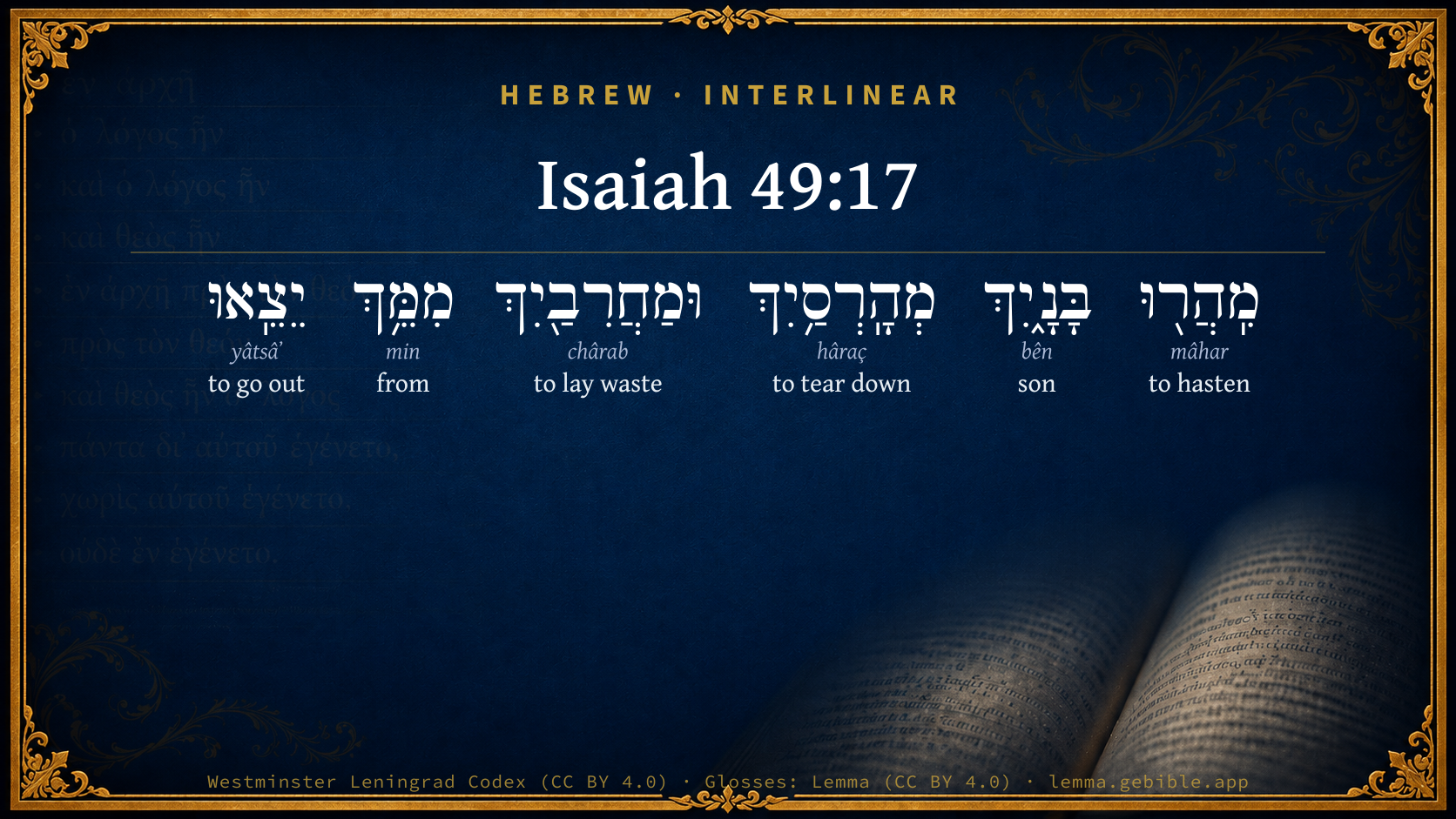
Isaiah 49:17

Hebrew (Westminster Leningrad Codex) Isaiah 49:17 appears in the Hebrew Old Testament. The text above is from the Westminster Leningrad Codex. Each word links to its Strong’s number, a concise gloss, and parsing drawn from the Open Scriptures Hebrew Bible morphology. Click any word for its full Brown-Driver-Briggs (BDB) entry.
Download image
Cite this verse

Isaiah 49:17 (World English Bible). Public Domain. Lemma interlinear Bible study tool, https://lemma.gebible.app/v/isaiah/49/17.

Show BibTeX & RIS
BibTeX
RIS
English Translation
Your children make haste; your destroyers and those who made you waste shall go forth from you.
World English Bible · Public Domain
Download a study sheet

One document with this verse’s original text, its word-by-word gloss line, the meaning frame, cross-references with their text, attributed commentary, and full source and license credits — printable, and it pastes into notes with its structure intact.

This verse Autodidact and up

Study sheet (.html) Plain text (.txt)

A passage Seminary Student

Up to 50 verses in one chapter. A passage sheet keeps up to 6 commentary sources and 12 cross-references per verse, in the order this page ranks them, and says so on the sheet whenever that leaves anything out. Ask for a single verse and you get the Autodidact verse sheet above.

Everything on this page stays free to read, with no account — the sheet is a download of what is already on screen, not access to it.

Want to remove ads? Support Godless Engineer
Compare translations 3

The same verse in 3 English versions, stacked beneath the original-language interlinear above. Click any original word for its lexicon entry.

Each is an independent rendering of the whole verse — the interlinear is not word-aligned to these translations.

Highlighted words mark where these versions differ — a whole-verse word diff, not a word-by-word alignment.

  • World English Bible Public Domain
    Your children make haste; your destroyers and those who made you waste shall go forth from you.
  • King James Version Public Domain
    Thy children shall make haste; thy destroyers and they that made thee waste shall go forth of thee.
  • unfoldingWord Literal Text CC BY-SA 4.0
    Your sons hurry; the ones having torn you down and the ones having desolated you will go out from you.

unfoldingWord Literal Text — © unfoldingWord, licensed CC BY-SA 4.0. Word-aligned USFM3 via Door43 (git.door43.org/unfoldingWord/en_ult).

Versions to compare (up to 4)

3 of 4 selected

Show all 18 translations

Every available English version of this verse, each an independent rendering of the whole verse.

  • World English Bible Public Domain
    Your children make haste; your destroyers and those who made you waste shall go forth from you.
  • Berean Standard Bible Public Domain
    Your builders hasten back; your destroyers and wreckers depart from you.
  • Majority Standard Bible Public Domain
    Your builders hasten back; your destroyers and wreckers depart from you.
  • King James Version Public Domain
    Thy children shall make haste; thy destroyers and they that made thee waste shall go forth of thee.
  • American Standard Version (1901) Public Domain
    Thy children make haste; thy destroyers and they that made thee waste shall go forth from thee.
  • Revised Version (1885) Public Domain
    Thy children make haste; thy destroyers and they that made thee waste shall go forth of thee.
  • Geneva Bible (1599) Public Domain
    Thy builders make haste: thy destroiers and they that made thee waste, are departed from thee.
  • Douay-Rheims (1899) Public Domain
    Thy builders are come: they that destroy thee and make thee waste shall go out of thee.
  • Young's Literal Translation Public Domain
    Hastened have those building thee, Those destroying thee, and laying thee waste, go out from thee.
  • Literal Standard Version CC BY-SA 4.0
    Those building you have hurried, || Those destroying you, and laying you waste, go out from you.
  • Unlocked Literal Bible CC BY-SA 4.0
    Your children are hurrying back, while those who destroyed you are going away.
  • unfoldingWord Literal Text CC BY-SA 4.0
    Your sons hurry; the ones having torn you down and the ones having desolated you will go out from you.
  • Darby Bible Public Domain
    Thy sons shall make haste; thy destroyers and they that laid thee waste shall go forth from thee.
  • World Messianic Bible Public Domain
    Your children hurry. Your destroyers and those who devastated you will leave you.
  • Webster's Bible Public Domain
    Thy children shall make haste; thy destroyers and they that made thee waste, shall go forth from thee.
  • Free Bible Version CC BY-SA 4.0
    Soon your children will come running back. Your destroyers, those that devastated your land, will be gone.
  • Bible in Basic English Public Domain
    Your builders are coming quickly; your haters and those who made you waste will go out of you.
  • JPS Tanakh (1917) Public Domain
    Thy children make haste; thy destroyers and they that made thee waste shall go forth from thee.

Literal Standard Version (2020), Covenant Press — licensed CC BY-SA 4.0. Text via the HelloAO Bible API (eBible.org). Unlocked Literal Bible (unfoldingWord) — licensed CC BY-SA 4.0. Text via the HelloAO Bible API (eBible.org). unfoldingWord Literal Text — © unfoldingWord, licensed CC BY-SA 4.0. Word-aligned USFM3 via Door43 (git.door43.org/unfoldingWord/en_ult). Free Bible Version, Dr. Jonathan Gallagher — licensed CC BY-SA 4.0. Text via the HelloAO Bible API (eBible.org).

Word by word

More ways to search: Search by grammar → Find every occurrence → Compare this word →

Practice this passage: Drill this verse → Learn its vocabulary →

וּמַחֲרִבַ֖יִךְ
chârab
H2717
“and · laying waste · you”
Conjunction + Verb, Hiphil, Participle Active, Masculine, Plural, Construct + Suffix, Personal, 2nd Person, Feminine, Singular
Part of Speech
Conjunction + Verb
Stem
Hiphil
Form
Participle Active
Gender
Masculine
Number
Plural
State
Construct
Full BDB Definition

Origin: a primitive root

TWOT: 731 , 732

to be waste, lay waste, make desolate, be desolate, be in ruins - (Qal) to be waste, be desolate - (Niphal) - to be made desolate - desolate (participle) - (Hiphil) to lay waste, make desolate - (Hophal) to be laid waste - to be dry, be dried up - (Qal) to be dried, be dried up - (Pual) to be dried - (Hiphil) to dry up - (Hophal) to be dried up - to attack, smite down, slay, fight
  1. מִֽהֲר֖וּ mâhar H4116 “to hasten” Verb, Piel, Perfect, 3rd Person, Common, Plural
  2. בָּנָ֑יִךְ bên H1121 “sons · your” Noun, Common, Masculine, Plural, Construct + Suffix, Personal, 2nd Person, Feminine, Singular
  3. מְהָֽרְסַ֥יִךְ hâraç H2040 “tearing down · you” Verb, Piel, Participle Active, Masculine, Plural, Construct + Suffix, Personal, 2nd Person, Feminine, Singular
  4. מִמֵּ֥ךְ min H4480 “from · you” Preposition + Suffix, Personal, 2nd Person, Feminine, Singular
  5. יֵצֵֽאוּ yâtsâʼ H3318 “to go out” Verb, Qal, Imperfect, 3rd Person, Masculine, Plural

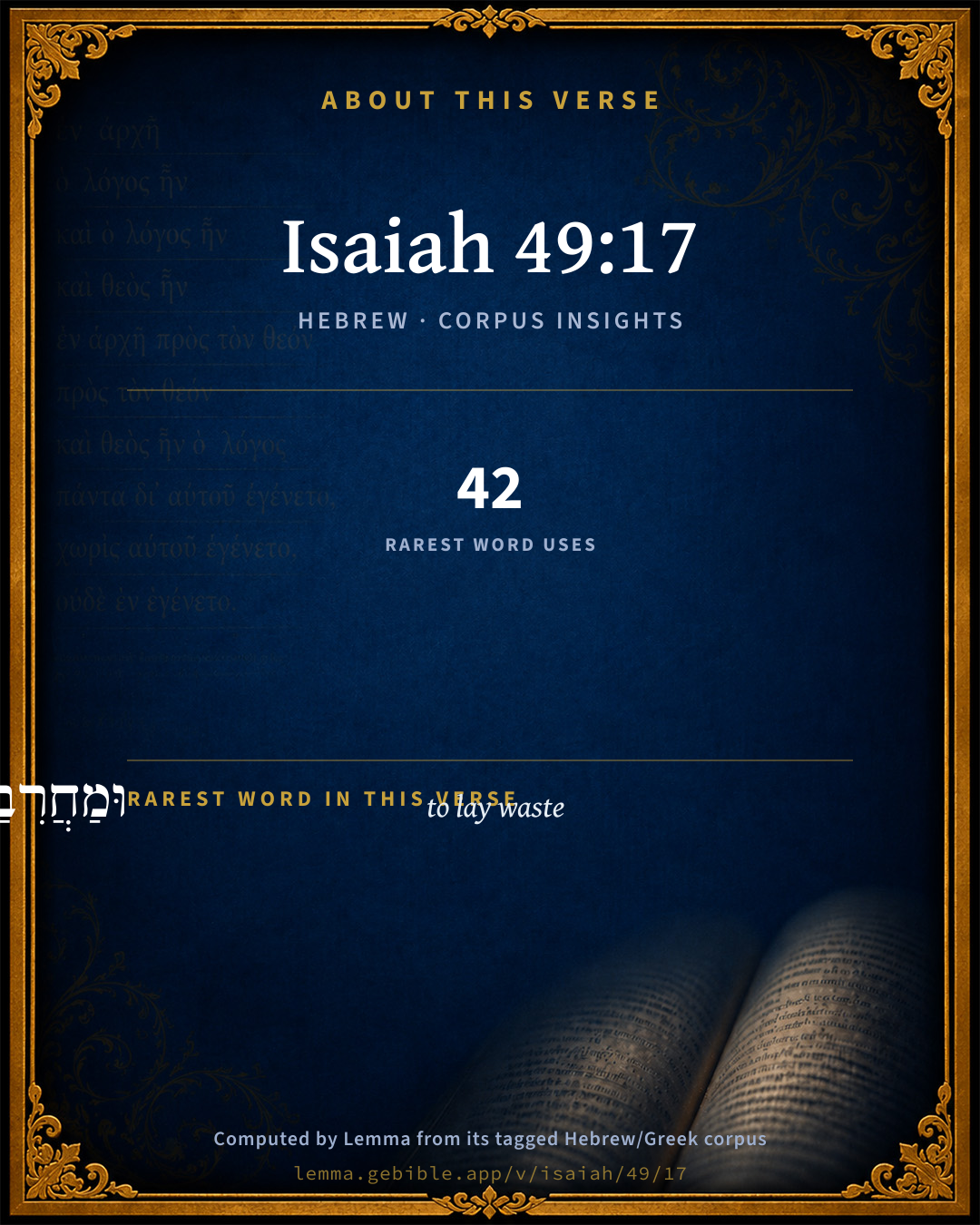
About this verse

These counts appear in no published source. They are computed here, from the morphology-tagged text and Lemma’s own curated glosses. What Lemma adds →

6
words
6
distinct lemmas
Prophets
section

Shared distinctive vocabulary

וּמַחֲרִבַ֖יִךְ to lay waste H2717 occurs in 38 verses of the Hebrew Bible. Also found in:

Grammatical profile

  • 4 verbs
  • 1 noun
  • 1 preposition

Verb forms

  • מִֽהֲר֖וּ Piel · Perfect
  • מְהָֽרְסַ֥יִךְ Piel · Participle Active
  • וּמַחֲרִבַ֖יִךְ Hiphil · Participle Active
  • יֵצֵֽאוּ Qal · Imperfect

Hebrew & Septuagint length

In English translation the verse runs 17 words from the Hebrew and 24 from the Septuagint (LXX English) — the Septuagint runs noticeably longer here. See the side-by-side →

A rough comparison of the two English renderings, which tokenize alike — not a word-level alignment.

Word counts can differ between the Hebrew and the Greek without any difference in meaning — e.g. the Hebrew direct-object marker אֵת has no separate Greek word, and Greek often adds the article ὁ.

Cross-references

10

Topical passages linked to Isaiah 49:17 in the Treasury of Scripture Knowledge — connected by theme and wording, ordered by reader-vote popularity; previews shown in the World English Bible.

  • Isaiah 51:13 and have forgotten Yahweh your Maker, who stretched forth the heavens, and laid the foundations of the earth; and fear continually all the day because of the fury of the oppressor, when he makes ready to destroy? and where is the fury of the oppressor?
  • Isaiah 62:5 For as a young man marries a virgin, so shall your sons marry you; and as the bridegroom rejoices over the bride, so shall your God rejoice over you.
  • Isaiah 51:22–23 Thus says your Lord Yahweh, and your God who pleads the cause of his people, Behold, I have taken out of your hand the cup of staggering, even the bowl of the cup of my wrath; you shall no more drink it again:
  • Ezekiel 28:24 There shall be no more a pricking brier to the house of Israel, nor a hurting thorn of any that are round about them, that did despite to them; and they shall know that I am the Lord Yahweh.
  • Ezra 1:5 Then rose up the heads of fathers' [houses] of Judah and Benjamin, and the priests, and the Levites, even all whose spirit God had stirred to go up to build the house of Yahweh which is in Jerusalem.
  • Nehemiah 2:4–9 Then the king said to me, For what do you make request? So I prayed to the God of heaven.
  • Isaiah 10:6 I will send him against a profane nation, and against the people of my wrath will I give him a charge, to take the spoil, and to take the prey, and to tread them down like the mire of the streets.
  • Isaiah 49:19 For, as for your waste and your desolate places, and your land that has been destroyed, surely now shall you be too small for the inhabitants, and those who swallowed you up shall be far away.
  • Isaiah 51:18–20 There is none to guide her among all the sons whom she has brought forth; neither is there any who takes her by the hand among all the sons who she has brought up.
  • Nehemiah 2:17 Then said I to them, You see the evil case that we are in, how Jerusalem lies waste, and the gates of it are burned with fire: come, and let us build up the wall of Jerusalem, that we be no more a reproach.

Cross-references courtesy of OpenBible.info (CC BY 4.0).

Hebrew and Greek witnesses Masoretic Hebrew ↔ Greek Septuagint

The same verse in the two great witnesses to the Old Testament, shown verse-for-verse.

Here the Septuagint runs noticeably longer than the Hebrew — LXX2012 (modern English Septuagint) 24 words vs World English Bible 17. A rough length comparison of the two English translations, not a word-level alignment — read both below.

These are two independent witnesses, not word-aligned to each other, and the Septuagint is shown in lemma (dictionary) form.

Hebrew Isaiah 49:17 Masoretic · Westminster Leningrad Codex

מִֽהֲר֖וּ בָּנָ֑יִךְ מְהָֽרְסַ֥יִךְ וּמַחֲרִבַ֖יִךְ מִמֵּ֥ךְ יֵצֵֽאוּ

Your children make haste; your destroyers and those who made you waste shall go forth from you.

World English Bible · Public Domain

Greek LXX Isaiah 49:17 Septuagint · lemma form

καί ταχύς οἰκοδομέω ὑπό ὅς κατααἱρέω καί ὁ ἐρημόω σύ ἐκ σύ ἐκἔρχομαι

And you shall soon be built by those by whom you were destroyed, and they that made you desolate shall go forth of you.

LXX2012 (modern English Septuagint) · Public Domain

On this verse, Adam Clarke's Commentary discusses the Septuagint’s reading. Read the note in Commentary ↓

Hebrew: Westminster Leningrad Codex (CC BY 4.0). Greek: Septuagint (public domain); English from LXX2012 (modern English Septuagint) (Public Domain). How the Septuagint differs from the Hebrew →

Targum (Aramaic paraphrase)

1

The Targum is the ancient Jewish Aramaic paraphrase of the Hebrew Scriptures — an interpretive translation, not the Hebrew text itself. Onkelos (literal) and Pseudo-Jonathan (expansive) render the Torah, and Jonathan the Prophets. Coverage is partial: where no permissively-licensed English translation exists for a verse, only the Aramaic is shown. This is verse-level text, not a word-by-word alignment to the Hebrew.

  1. Targum Jonathan Prophets (Joshua–Malachi)
    יוֹחוּן בְנַיְכִי חָרְבָתַיִךְ מְפַגְרָךְ וּמְחַרְבָּךְ מִנִיךְ יִגְלוֹן:

    Those that shall build thy desolate places shall make haste, thy destroyers and they that made thee waste, shall go forth of thee.

    Targum Jonathan — Aramaic: “Mikraot Gedolot” (public domain). English: “Sefaria Community Translation” (CC0 1.0 (public-domain dedication)); “London "Chaldee Paraphrase," 1871” (public domain). Text via Sefaria.

Commentary

Notes on Isaiah 49:17 from classic Christian and Jewish commentators (each source and its license shown beneath its notes). The classic Christian expositions comment on the surrounding passage and are grouped to its opening verse, so a note may address several verses; the Jewish commentaries on the Tanakh (Rashi and others) are per-verse, so they appear only where the commentator wrote on this verse.

Lemma curates 59 commentaries, every one of them public domain or Creative Commons licensed, each selected and text-cleaned for this edition rather than reprinted as found. About our sources →

Trapp's Complete Commentary

John Trapp

Isa 49:17 Thy children shall make haste; thy destroyers and they that made thee waste shall go forth of thee.

Ver. 17. Thy children shall make haste.] People shall come in amain to the Church. Nescit tarda molimina Spiritus Sancti gratia. God can make a nation to conceive and bring forth in a day. {Isa 66:8} How quickly was the gospel divulged and darted all the world over, as the beams of the sun! so in the late blessed Reformation begun by Luther.

And they that made thee waste.] Tyrants and heretics shall be cashiered. {as Zec 13:2} Fiat, fiat. Let it happen, let it happen.

John Trapp, A Commentary or Exposition upon All the Books of the Old and New Testament (1647–1656) — public domain. Text from a community e-Sword module.

Joseph Benson's Commentary

Isa 49:17. Thy children — Or, as some, with equal propriety, render בנין, thy builders; which rendering is favoured by the next clause, where the destroyers are opposed to them, but the following verse favours the former interpretation: the sense, however, is the same, for the church’s children are her builders; shall make haste — To repair thy ruins and desolations, and build thee up. Thy destroyers, &c., shall go forth of thee — Shall be separated and driven from thee, and so shall neither hinder nor annoy thee. But this rendering, shall go forth of thee, says Bishop Lowth, “is very flat, after their zeal had been expressed by their being her builders: and as the opposition is kept up in one part of the sentence, one has reason to expect it in the other.” He, therefore, renders ממן יצאו, shall proceed, spring, or issue, from thee; namely, as thy children, and reads the whole verse thus: They that destroy thee shall soon become thy builders; and they that laid thee waste shall become thine offspring: the accession of the Gentiles to the church of God being properly considered as an addition made to the number of the family and children of Zion.

Joseph Benson's Commentary on the Old and New Testaments (1811–1818) — public domain. Text from a community e-Sword module.

Geneva Bible (1599)

Geneva Bible translators

I have continual care to build thee up again, and to destroy thine enemies.

Geneva Bible (1599) marginal notes — public domain. Text via Bolls.life.

Jamieson, Fausset & Brown

Robert Jamieson, A. R. Fausset & David Brown

Thy children--Israel (Isa 49:20-21; Isa 43:6). JEROME reads, for "Thy children," "Thy builders"; they that destroyed thee shall hasten to build thee.

haste--to rebuild thy desolate capital.

shall go forth--Thy destroyers shall leave Judea to Israel in undisturbed possession.

Jamieson, Fausset & Brown — Commentary Critical and Explanatory on the Whole Bible (1871) — public domain (CC PDM 1.0). Text via the HelloAO Bible API.

Adam Clarke's Commentary

Verse 17. Thy children shall make haste - "They that destroyed thee shall soon become thy builders"] Auctor Vulgatae pro בניך banayich, videtur legisse בוניך bonayich, unde vertit, structores tui; cui et Septuaginta fere consentiunt, qui verterunt ωκοδομηθης, aedificata es, prout in Plantiniana editione habetur; in Vaticana sive Romana legitur, οικοδομηθηση, aedificaberis. Hisce etiam Targum Jonathanis aliquatenus consentit, ubi, et aedificabunt. Confer infra Esai. liv. 13, ad quem locum rabbini quoque notarunt en tractatu Talmudico Berachot, c. ix., quod non legendum sit בניך banayich, id est, filii tui; sed בוניך bonayich, aedificatores tui. Confer not. ad librum Prec. Jud. part ii., p. 226, ut et D Wagenseil Sot. p. 253, n. 9. "The author of the Vulgate appears to have read בוניך bonayich for בניך banayich, as he translates it by structures tui, 'thy builders.' The Septuagint is almost the same with the Vulgate, having ωκοδομηθης, art built, as in the Plantin edition: but the Vatican or Roman copy reads οικοδομηθηση, thou shalt be built. To these readings the Targum of Jonathan has some sort of correspondence, translating et aedificabunt, 'and they shall build.' See chap. liv. 13; on which place the rabbins also remark, in the Talmudic tract Berachoth, c. 9, that we should not read בניך banayich, thy sons, but בוניך bonayich, thy builders. See the note in Prae. Jud. part ii., p. 226, and also D. Wagenseil, Sot. p. 253, n. 9." See also Breithaupt. not. ad Jarchi in loc.; and the note on this place in De Sac. Poes. Hebr. Praelect. xxxi. Instead of בוניך or בניך bonayich, thy builders, several MSS. read בניך baneycha, thy sons. So also the Syriac: see the above note.

Shall go forth of thee - "Shall become thine offspring."] ממך יצאו mimmech yetseu, shall proceed, spring, issue, from thee, as thy children. The phrase is frequently used in this sense: see Isa 11:1; Mic 5:2; Na 1:11. The accession of the Gentiles to the Church of God is considered as an addition made to the number of the family and children of Sion: see Isa 49:21-22, and Isa 60:4. The common rendering, "shall go forth of thee, or depart from thee," is very flat, after their zeal had been expressed by "shall become thy builders:" and as the opposition is kept up in one part of the sentence, one has reason to expect it in the other, which should be parallel to it.

Adam Clarke's Commentary on the Bible (1810–1826) — public domain. Text from a community e-Sword/MySword module.

Ellicott's Commentary for English Readers

(17) Thy children shall make haste.—A various reading adopted by the LXX., Targum, and Vulg., gives thy builders. They rush to their work of restoration; the destroyers and ravagers go forth.

A Bible Commentary for English Readers, edited by Charles John Ellicott (1878–1897) — public domain. Text from a community e-Sword module.

The Cambridge Bible for Schools and Colleges

gen. ed. J. J. S. Perowne

17, 18. Already in vision the prophet sees the return of the exiles and calls on Zion to welcome her sons.

Instead of Thy children the chief ancient Versions, and the important Babylonian Codex have “Thy builders” (בֹּנַיִךְ for בָּנַיךְ), a sense which is recommended both by the antithesis to “thy destroyers” &c., and the connexion with the previous verse. Yet it is doubtful if the reading on the whole is preferable to that of the received text. The latter at least is true to the fundamental image of the passage, which appears again in Isa_49:20 f.

For shall make haste read in the present tense (as R.V.) make haste.

thy destroyers &c.] The expressions almost suggest that Jerusalem was still occupied by Chaldæan troops.

The Cambridge Bible for Schools and Colleges (gen. ed. J. J. S. Perowne; Cambridge University Press, 1878–1918) — public domain. Text from a community e-Sword module.

John Gill's Exposition

Thy children shall make haste,.... Regenerate persons, young converts, such as are born again of incorruptible seed by the word; these shall flock to the church,

as doves to the windows; join themselves to her, and submit to Gospel ordinances, and

make haste, and delay not, to keep the Lord's commandments; which is no small pleasure, joy, and comfort to the church of God. Some render it, "thy builders" (m) "shall make haste"; Gospel ministers, who are wise masterbuilders under Christ; these shall come with all readiness and cheerfulness, and build in the temple, the church of God, and rebuild her walls, and repair her breaches:

thy destroyers and they that made thee waste, shall go forth of thee; tyrants and persecutors of the church shall cease, and be no more; and false teachers, that corrupt the minds of men, subvert their faith, and destroy their souls, as antichrist and his ministers, shall be drove out of the church, and destroyed by Christ, the Head of it; see Rev 11:18.

(m) "structores vel aedificatores tui", Munster, Montanus, Calvin, Tigurine version.

John Gill's Exposition of the Whole Bible (1746–1763) — public domain (CC PDM 1.0). Text via the HelloAO Bible API.

Albert Barnes' Notes on the Bible

Thy children - The children of Zion - the true people of God. But there is here considerable variety in the interpretation. The Hebrew of the present text is בניך bânâyı̂k (“thy sons”). But Jerome reads it, Structores tui - ‘Thy builders;’ as if it were בונין. The Septuagint renders it, ‘Thou shalt be speedily built (ταχὺ οἰκοδομηθήσῃ tachu oikodomēthēsē) by those by whom thou hast been destroyed.’ The Chaldee renders it, ‘Those that rebuild thy waste places shall hasten.’ The Syriac reads it, ‘Thy sons;’ and the Arabic, ‘Thou shalt be rebuilt by those by whom thou hast been destroyed.’ But there is no good authority for changing the present Hebrew text. nor is it necessary. The sense probably is, the descendants of those who dwelt in Zion, who are now in exile, shall hasten to rebuild the wastes of the desolate capital, and restore its ruins. And may it not mean, that in the great work under the Messiah, of restoring the nation to the worship of God, and of spreading the true religion, God would make use of those who dwelt in Zion; that is, of the Jews, as his ambassadors?

They that made thee waste - Language drawn from the destruction of Jerusalen. The sense is, that they would seek no longer to retain possession, but would permit its former inhabitants to return, and engage in repairing its ruins.

Albert Barnes' Notes on the Bible (1834–1885) — public domain. Text from a community e-Sword/MySword module.

Haydock's Catholic Bible Commentary

Of thee. Sanballat, &c., shall yield to Zorobabel, Nehemias, &c.

George Leo Haydock (1774–1849), Haydock's Catholic Family Bible and Commentary, 1859 edition — public domain. Excludes Psalms (Douay-Rheims chapter numbering differs from Protestant) and Deuterocanonical books (Catholic canon only).

Matthew Poole's English Annotations

Thy children; or, as others render it, thy builders; which is favoured by the next clause, where the destroyers are opposed to them. Howsoever, the sense is the same; for her children were her builders, as we read in Ezra and Nehemiah.

Shall go forth of thee; shall be separated and driven from among thee, and so shall neither hinder nor annoy thee.

Matthew Poole's English Annotations on the Holy Bible (1683–1685) — public domain. Text from a community e-Sword/MySword module.

Whedon's Commentary on the Bible

Daniel D. Whedon

17, 18. Thy children shall make haste, etc. — The glorious renewal of Zion, by the return of her children to God and his worship, bursts on the prophet’s vision, filling him with gladness, while her enemies flee with as much of haste as repentant Israel returns.

Clothe thee with them all, as with an ornament — Behold! from all around backsliding members are returning! and, God’s oath for it, they all of them shall be as “an ornament,” or as beautiful clothing, which Zion shall put on in token of her reconciliation and her joy. So is the Church always, when pure, spiritually bedecked.

Daniel D. Whedon (gen. ed.), Commentary on the Old and New Testaments (1874–1909) — public domain. Text from a community e-Sword module.

The Pulpit Commentary

Thy children shall make haste; i.e. "thy exiled children shall hasten, when the appointed time comes, to return to Zion, and rebuild its temple and towers and walls." At the same time, thy destroyers and they that have made thee waste, who are regarded as still carrying on their devastations, shall leave thee and go forth of thee.

The Pulpit Commentary (1880–1919), ed. H.D.M. Spence-Jones & Joseph S. Exell — public domain. Text from a community e-Sword module.

Keil & Delitzsch

C. F. Keil & F. Delitzsch

It is this fact of a renewed glorification which presents itself afresh to the prophet's mind. "Thy children make haste, thy destroyers and masters draw out from thee. Lift up thine eyes round about, and see: all these assemble themselves together, and come to thee. As truly as I live, saith Jehovah, thou wilt put them all on like jewellery, and gird them round thee like a bride." The pointing adopted by the lxx, Targ., Jer. and Saad., is בּניך. The antithesis favours this reading; but בּניך suits Isa 49:18, Isa 49:19 better; and the thought that Zion's children come and restore her fallen walls, follows of itself from the very antithesis: her children come; and those who destroyed their maternal home, and made it a desolate ruin, have to depart from both city and land. Zion is to lift up her eyes, that have been cast down till now, yea, to lift them up round about; for on all sides those whom she thought she had lost are coming in dense crowds לך (cf., לא = לו with אליו, Isa 49:5), to her, i.e., henceforth to belong to her again. Jehovah pledges His life (chai 'ănı̄, ζῶν ἐγώ, Ewald, 329, a) that a time of glory is coming for Zion and her children. כּי in the affirmative sense, springing out of the confirmative after an affirming oath, equivalent to אם־לא elsewhere (e.g., Isa 5:9). The population which Zion recovers once more, will be to her like the ornaments which a woman puts on, like the ornamental girdle (Isa 3:20) which a bride fastens round her wedding dress.

Keil & Delitzsch — Biblical Commentary on the Old Testament (1861–1891) — public domain (CC PDM 1.0). Text via the HelloAO Bible API. (Old Testament only.)

J. A. Alexander on Isaiah

Joseph Addison Alexander

“Thy sons hasten (to thee); thy destroyers and thy wasters shall go out from thee.” This is the proof that God had not forsaken her. The true construction, as in many other cases, seems to be that which represents the process as begun but not complete. Already had her sons begun to hasten to her, and ere long her enemies should be entirely departed. The natural interpretation of the last clause is that which understands it as containing simply an emphatic contrast between friends and foes, the latter taking their departure, and the former coming into possession.

Joseph Addison Alexander, The Prophecies of Isaiah (1846–1847; New York: Scribner, 1870–1878) — public domain. Text from a community e-Sword module.

Rashi

Rabbi Shlomo Yitzchaki (Rashi)

Your sons have hastened to return.

Rashi on the Tanakh — English translations: “The Judaica Press complete Tanach with Rashi, translated by A. J. Rosenberg” (CC BY 4.0); “Pentateuch with Rashi's commentary by M. Rosenbaum and A.M. Silbermann, 1929-1934” (public domain); “The Metsudah Tanach series, Lakewood, N.J” (CC BY 4.0); and “The Book of Joshua, Metsudah Publications, 1997” (CC BY 4.0). Text via Sefaria.

Ibn Ezra

Rabbi Abraham ibn Ezra

Thy children, etc. Thy children have come, and all thy destroyers shall go away from thee.

Ibn Ezra on the Tanakh — English translations: “Sefaria Community Translation” (CC0 1.0 (public-domain dedication)); “Yalkut, Sifsei Chachomim Chumash, Metsudah Publications, 2009” (CC BY 4.0); and “Commentary of Ibn Ezra on Isaiah - trans. by M. Friedlander, 1873” (public domain). Text via Sefaria.

Lesson kit

Teaching starters — assembled from the data on this page, not authored interpretation. Every prompt links to the verse data it draws on. Edit before teaching.

Isaiah, in the Prophets, opens this verse with 6 words (6 distinct Hebrew lemmas). Its most distinctive word is chârab (“to lay waste”). The Greek Septuagint runs longer here. A historical commentator’s framing appears above. Read the whole chapter for the surrounding context.

Discussion questions

  1. What does “to lay waste” (chârab) contribute to the verse as a whole?
  2. Genesis 8:13 shares the word «to lay waste» with this verse. How do the two illuminate each other?
  3. Compared with the Hebrew, the Septuagint runs longer here. What questions does that raise?
  4. These translations render this verse differently. What is at stake in choosing one wording over another?
  5. The verb «מִֽהֲר֖וּ» is Piel Perfect. How does its form color the action?
  6. Reading how Trapp's Complete Commentary and Joseph Benson's Commentary read this verse, where do the two commentators agree and where do they part?

Things to notice

Reading settings

Reading text

Shown beneath each verse's original-language words.

Old Testament
Old Testament edition

Read the OT as the Masoretic Hebrew (MT) or the Greek Septuagint (LXX).

English shown for the Greek Septuagint (in the Hebrew ↔ Greek comparison).

Comparing translations? Open the Compare panel on any verse page to stack up to four side by side.