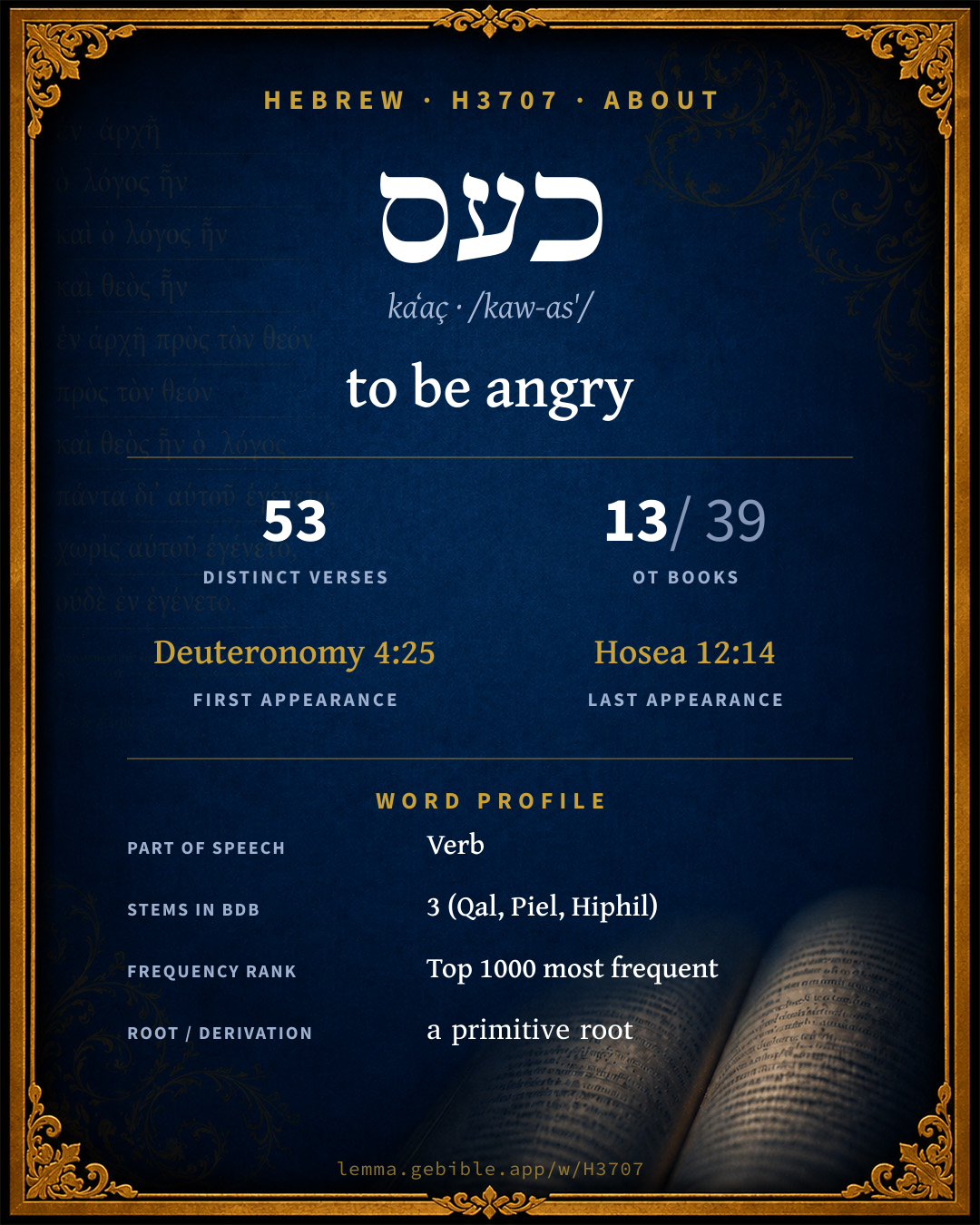
כָּעַס
to be angry
also: be vexed, be indignant, be wroth, be grieved fuller range ↓
Full lexicon entry — Brown-Driver-Briggs (BDB)
From Brown-Driver-Briggs (BDB)
Where this word appears
See every Hiphil verb in the Hebrew Bible →
Grammar key — what these labels mean
Part of speech
- Verb
- An action or state-of-being word.
Stem
- Hiphil
- The causative active stem (“he caused / brought about”). Here: ‘vex’
- Qal
- The basic, simple active stem — the plain form of the verb (“he wrote”). Here: ‘be vexed’
- Piel
- An intensive or resultative active stem.
Form
- Infinitive Construct
- A bound verbal noun, frequently with prepositions (“to write / in writing”).
- Participle Active
- A verbal adjective expressing ongoing or characteristic action (“writing / one who writes”).
- Sequential Imperfect
- An imperfect with prefixed waw — the standard past-narrative form (waw-consecutive imperfect).
- Sequential Perfect
- A perfect with prefixed waw continuing a preceding imperfect or command (waw-consecutive perfect).
- Perfect
- A completed action or state — Hebrew marks aspect (completeness) more than strict tense (“he wrote”).
- Imperfect
- An incomplete, ongoing, or future action (“he will / would write”).
State
- Absolute
- The independent form of a noun, not bound to a following word.
Person
- 3rd Person
- The one spoken about (“he / she / it / they”).
- 1st Person
- The speaker (“I / we”).
- 2nd Person
- The one addressed (“you”).
Gender
- Masculine
- Grammatically masculine.
- Common
- Either gender — not distinguished for this form.
- Feminine
- Grammatically feminine.
Number
- Plural
- More than one (in Hebrew, generally three or more).
- Singular
- One.
Grammatical forms 18 distinct
- Verb, Hiphil, Infinitive Construct 25 times (45%)
- Verb, Hiphil, Participle Active, Masculine, Plural, Absolute 5 times (9%)
- Verb, Hiphil, Sequential Imperfect, 3rd Person, Masculine, Plural 3 times (5%)
- Verb, Hiphil, Perfect, 3rd Person, Common, Plural 3 times (5%)
- Verb, Hiphil, Perfect, 3rd Person, Masculine, Singular 3 times (5%)
- Verb, Hiphil, Sequential Imperfect, 3rd Person, Masculine, Singular 2 times (4%)
- Verb, Qal, Sequential Perfect, 3rd Person, Masculine, Singular 2 times (4%)
- Verb, Qal, Sequential Imperfect, 3rd Person, Masculine, Singular 2 times (4%)
+10 more forms (10 occurrences)
Parsed forms decoded from the imported morphology (morphhb / Westminster Leningrad Codex — WLC text public domain, morphhb tagging CC BY 4.0), counted across 55 parsed occurrences — not distinct verses.
Every verse where H3707 appears — 53 distinct verses across 13 books. Click any verse to open its interlinear word-by-word view. Verse text shown in the World English Bible for context — . Each verse’s Hebrew form is shown with its reference; the English is not keyword-highlighted, since the data carries no word-level English alignment. Use “Compare translations” on any verse to read it across multiple English versions. This concordance covers the Hebrew Bible; Septuagint (Greek Old Testament) occurrences are not indexed here.
Deuteronomy 5 verses
- Deuteronomy 4:25 לְ/הַכְעִיסֽ/וֹ prep + Hiphil inf.cs + sfx pers 3ms When you shall father children, and children's children, and you shall have been long in the land, and shall corrupt yourselves, and make an engraved image in the form of anything, and shall do that which is evil in the sight of Yahweh your God, to provoke him to anger;
- Deuteronomy 9:18 לְ/הַכְעִיסֽ/וֹ prep + Hiphil inf.cs + sfx pers 3ms I fell down before Yahweh, as at the first, forty days and forty nights; I did neither eat bread nor drink water; because of all your sin which you sinned, in doing that which was evil in the sight of Yahweh, to provoke him to anger.
- Deuteronomy 31:29 לְ/הַכְעִיס֖/וֹ prep + Hiphil inf.cs + sfx pers 3ms For I know that after my death you will utterly corrupt yourselves, and turn aside from the way which I have commanded you; and evil will happen to you in the latter days; because you will do that which is evil in the sight of Yahweh, to provoke him to anger through the work of your hands.
- Deuteronomy 32:16 יַכְעִיסֻֽ/הוּ Hiphil impf 3mp + sfx pers 3ms They moved him to jealousy with strange [gods]; With abominations provoked they him to anger.
- Deuteronomy 32:21 כִּעֲס֖וּ/נִי אַכְעִיסֵֽ/ם Piel pf 3cp + sfx pers 1cs Hiphil impf 1cs + sfx pers 3mp They have moved me to jealousy with that which is not God; They have provoked me to anger with their vanities: I will move them to jealousy with those who are not a people; I will provoke them to anger with a foolish nation.
Judges 1 verse
1 Samuel 2 verses
- 1 Samuel 1:6 וְ/כִֽעֲסַ֤תָּ/ה conj + Piel pf 3fs + sfx pers 3fs Her rival provoked her sore, to make her fret, because Yahweh had shut up her womb.
- 1 Samuel 1:7 תַּכְעִסֶ֑/נָּה Hiphil impf 3fs + sfx pers 3fs [as] he did so year by year, when she went up to the house of Yahweh, so she provoked her; therefore she wept, and did not eat.
1 Kings 10 verses
- 1 Kings 14:9 לְ/הַכְעִיסֵ֔/נִי prep + Hiphil inf.cs + sfx pers 1cs but have done evil above all who were before you, and have gone and made you other gods, and molten images, to provoke me to anger, and have cast me behind your back:
- 1 Kings 14:15 מַכְעִיסִ֖ים Hiphil ptcp.act mp For Yahweh will strike Israel, as a reed is shaken in the water; and he will root up Israel out of this good land which he gave to their fathers, and will scatter them beyond the River, because they have made their Asherim, provoking Yahweh to anger.
- 1 Kings 15:30 הִכְעִ֔יס Hiphil pf 3ms for the sins of Jeroboam which he sinned, and with which he made Israel to sin, because of his provocation with which he provoked Yahweh, the God of Israel, to anger.
- 1 Kings 16:2 לְ/הַכְעִיסֵ֖/נִי prep + Hiphil inf.cs + sfx pers 1cs Because I exalted you out of the dust, and made you prince over my people Israel, and you have walked in the way of Jeroboam, and have made my people Israel to sin, to provoke me to anger with their sins;
- 1 Kings 16:7 לְ/הַכְעִיס/וֹ֙ prep + Hiphil inf.cs + sfx pers 3ms Moreover by the prophet Jehu the son of Hanani came the word of Yahweh against Baasha, and against his house, both because of all the evil that he did in the sight of Yahweh, to provoke him to anger with the work of his hands, in being like the house of Jeroboam, and because he struck him.
- 1 Kings 16:13 לְ/הַכְעִ֗יס prep + Hiphil inf.cs for all the sins of Baasha, and the sins of Elah his son, which they sinned, and with which they made Israel to sin, to provoke Yahweh, the God of Israel, to anger with their vanities.
- 1 Kings 16:26 לְ/הַכְעִ֗יס prep + Hiphil inf.cs For he walked in all the way of Jeroboam the son of Nebat, and in his sins with which he made Israel to sin, to provoke Yahweh, the God of Israel, to anger with their vanities.
- 1 Kings 16:33 לְ/הַכְעִיס֙ prep + Hiphil inf.cs Ahab made the Asherah; and Ahab did yet more to provoke Yahweh, the God of Israel, to anger than all the kings of Israel who were before him.
- 1 Kings 21:22 הִכְעַ֔סְתָּ Hiphil pf 2ms and I will make your house like the house of Jeroboam the son of Nebat, and like the house of Baasha the son of Ahijah for the provocation with which you have provoked me to anger, and have made Israel to sin.
- 1 Kings 22:53 וַ/יַּכְעֵ֗ס conj + Hiphil wimpf 3ms He served Baal, and worshiped him, and provoked to anger Yahweh, the God of Israel, according to all that his father had done.
2 Kings 7 verses
- 2 Kings 17:11 לְ/הַכְעִ֖יס prep + Hiphil inf.cs and there they burnt incense in all the high places, as did the nations whom Yahweh carried away before them; and they worked wicked things to provoke Yahweh to anger;
- 2 Kings 17:17 לְ/הַכְעִיסֽ/וֹ prep + Hiphil inf.cs + sfx pers 3ms They caused their sons and their daughters to pass through the fire, and used divination and enchantments, and sold themselves to do that which was evil in the sight of Yahweh, to provoke him to anger.
- 2 Kings 21:6 לְ/הַכְעִֽיס prep + Hiphil inf.cs He made his son to pass through the fire, and practiced sorcery, and used enchantments, and dealt with those who had familiar spirits, and with wizards: he worked much evil in the sight of Yahweh, to provoke him to anger.
- 2 Kings 21:15 מַכְעִסִ֖ים Hiphil ptcp.act mp because they have done that which is evil in my sight, and have provoked me to anger, since the day their fathers came forth out of Egypt, even to this day.
- 2 Kings 22:17 הַכְעִיסֵ֔/נִי Hiphil inf.cs + sfx pers 1cs Because they have forsaken me, and have burned incense to other gods, that they might provoke me to anger with all the work of their hands, therefore my wrath shall be kindled against this place, and it shall not be quenched.
- 2 Kings 23:19 לְ/הַכְעִ֔יס prep + Hiphil inf.cs All the houses also of the high places that were in the cities of Samaria, which the kings of Israel had made to provoke [Yahweh] to anger, Josiah took away, and did to them according to all the acts that he had done in Bethel.
- 2 Kings 23:26 הִכְעִיס֖/וֹ Hiphil pf 3ms + sfx pers 3ms Notwithstanding, Yahweh didn't turn from the fierceness of his great wrath, with which his anger was kindled against Judah, because of all the provocation with which Manasseh had provoked him.
2 Chronicles 4 verses
- 2 Chronicles 16:10 וַ/יִּכְעַ֨ס conj + Qal wimpf 3ms Then Asa was angry with the seer, and put him in the prison-house; for he was in a rage with him because of this thing. Asa oppressed some of the people at the same time.
- 2 Chronicles 28:25 וַ/יַּכְעֵ֕ס conj + Hiphil wimpf 3ms In every city of Judah he made high places to burn incense to other gods, and provoked to anger Yahweh, the God of his fathers.
- 2 Chronicles 33:6 לְ/הַכְעִיסֽ/וֹ prep + Hiphil inf.cs + sfx pers 3ms He also made his children to pass through the fire in the valley of the son of Hinnom; and he practiced sorcery, and used enchantments, and practiced sorcery, and dealt with those who had familiar spirits, and with wizards: he worked much evil in the sight of Yahweh, to provoke him to anger.
- 2 Chronicles 34:25 הַכְעִיסֵ֔/נִי Hiphil inf.cs + sfx pers 1cs Because they have forsaken me, and have burned incense to other gods, that they might provoke me to anger with all the works of their hands; therefore is my wrath poured out on this place, and it shall not be quenched.
Nehemiah 2 verses
- Nehemiah 4:1 וַ/יִּכְעַ֖ס conj + Qal wimpf 3ms But it happened that when Sanballat heard that we were building the wall, he was angry, and took great indignation, and mocked the Jews.
- Nehemiah 4:5 הִכְעִ֖יסוּ Hiphil pf 3cp and don't cover their iniquity, and don't let their sin be blotted out from before you; for they have provoked [you] to anger before the builders.
Psalms 3 verses
- Psalms 78:58 וַ/יַּכְעִיס֥וּ/הוּ conj + Hiphil wimpf 3mp + sfx pers 3ms For they provoked him to anger with their high places, And moved him to jealousy with their engraved images.
- Psalms 106:29 וַ֭/יַּכְעִיסוּ conj + Hiphil wimpf 3mp Thus they provoked him to anger with their deeds. The plague broke in on them.
- Psalms 112:10 וְ/כָעָ֗ס conj + Qal wpf 3ms The wicked will see it, and be grieved. He shall gnash with his teeth, and melt away. The desire of the wicked will perish.
Ecclesiastes 2 verses
Isaiah 1 verse
Jeremiah 11 verses
- Jeremiah 7:18 הַכְעִסֵֽ/נִי Hiphil inf.cs + sfx pers 1cs The children gather wood, and the fathers kindle the fire, and the women knead the dough, to make cakes to the queen of the sky, and to pour out drink-offerings to other gods, that they may provoke me to anger.
- Jeremiah 7:19 מַכְעִסִ֖ים Hiphil ptcp.act mp Do they provoke me to anger? says Yahweh; [do they] not [provoke] themselves, to the confusion of their own faces?
- Jeremiah 8:19 הִכְעִס֛וּ/נִי Hiphil pf 3cp + sfx pers 1cs Behold, the voice of the cry of the daughter of my people from a land that is very far off: isn't Yahweh in Zion? Isn't her King in her? Why have they provoked me to anger with their engraved images, and with foreign vanities?
- Jeremiah 11:17 לְ/הַכְעִסֵ֖/נִי prep + Hiphil inf.cs + sfx pers 1cs For Yahweh of Hosts, who planted you, has pronounced evil against you, because of the evil of the house of Israel and of the house of Judah, which they have worked for themselves in provoking me to anger by offering incense to Baal.
- Jeremiah 25:6 תַכְעִ֤יסוּ Hiphil impf 2mp and don't go after other gods to serve them or worship them, and don't provoke me to anger with the work of your hands; and I will do you no harm.
- Jeremiah 25:7 הכעסו/ני הַכְעִיסֵ֛/נִי Hiphil pf 3cp + sfx pers 1cs Hiphil inf.cs + sfx pers 1cs Yet you have not listened to me, says Yahweh; that you may provoke me to anger with the work of your hands to your own hurt.
- Jeremiah 32:29 הַכְעִסֵֽ/נִי Hiphil inf.cs + sfx pers 1cs and the Chaldeans, who fight against this city, shall come and set this city on fire, and burn it, with the houses, on whose roofs they have offered incense to Baal, and poured out drink-offerings to other gods, to provoke me to anger.
- Jeremiah 32:30 מַכְעִסִ֥ים Hiphil ptcp.act mp For the children of Israel and the children of Judah have done only that which was evil in my sight from their youth; for the children of Israel have only provoked me to anger with the work of their hands, says Yahweh.
- Jeremiah 32:32 לְ/הַכְעִסֵ֔/נִי prep + Hiphil inf.cs + sfx pers 1cs because of all the evil of the children of Israel and of the children of Judah, which they have done to provoke me to anger, they, their kings, their princes, their priests, and their prophets, and the men of Judah, and the inhabitants of Jerusalem.
- Jeremiah 44:3 לְ/הַכְעִסֵ֔/נִי prep + Hiphil inf.cs + sfx pers 1cs because of their wickedness which they have committed to provoke me to anger, in that they went to burn incense, [and] to serve other gods, that they didn't know, neither they, nor you, nor your fathers.
- Jeremiah 44:8 לְ/הַכְעִסֵ֨/נִי֙ prep + Hiphil inf.cs + sfx pers 1cs in that you provoke me to anger with the works of your hands, burning incense to other gods in the land of Egypt, where you are gone to sojourn; that you may be cut off, and that you may be a curse and a reproach among all the nations of the earth?
Ezekiel 4 verses
- Ezekiel 8:17 לְ/הַכְעִיסֵ֔/נִי prep + Hiphil inf.cs + sfx pers 1cs Then he said to me, Have you seen [this], son of man? Is it a light thing to the house of Judah that they commit the abominations which they commit here? for they have filled the land with violence, and have turned again to provoke me to anger: and, behold, they put the branch to their nose.
- Ezekiel 16:26 לְ/הַכְעִיסֵֽ/נִי prep + Hiphil inf.cs + sfx pers 1cs You have also committed sexual immorality with the Egyptians, your neighbors, great of flesh; and have multiplied your prostitution, to provoke me to anger.
- Ezekiel 16:42 אֶכְעַ֖ס Qal impf 1cs So will I cause my wrath toward you to rest, and my jealousy shall depart from you, and I will be quiet, and will be no more angry.
- Ezekiel 32:9 וְ/הִ֨כְעַסְתִּ֔י conj + Hiphil wpf 1cs I will also vex the hearts of many peoples, when I shall bring your destruction among the nations, into the countries which you have not known.
Hosea 1 verse
About this entry
At a glance — auto-summarized from this page’s data, not written by a person. Every figure links to its source below. This summary describes the numbers; it doesn’t interpret them.
כעס — transliterated kaʻaç — is a Hebrew verb carrying the sense “to be angry.” It first appears in Deuteronomy 4:25. With 53 verses in 13 books, it is a moderately common word in the Hebrew Bible. The verb spans 3 stems, from Qal to Piel. From the same root come כעס. Each statement above links to its evidence; the full detail follows below.
Gloss history
Strong's 1890 vs modern scholarship
About this word
Strong's H3707 catalogs a Hebrew word from the Hebrew Old Testament.
These counts are not copied from any lexicon or concordance. They are computed here, from the morphology-tagged Hebrew Old Testament. What Lemma adds →
- 53
- distinct verses
- The word appears in 53 distinct verses.
- 13 / 39
- OT books
- The word appears in 13 of 39 Old Testament books.
- #686
- by frequency
- Top 1000 most frequent Hebrew words (rank 686 of 8,640 Hebrew words by occurrence).
View all 53 occurrences in the concordance →
By section of the Old Testament
By traditional corpus
Conventional, traditional groupings — biblical authorship is debated, so this is a traditional corpus grouping, not an authorship claim. Each share is this word’s portion of its verses in that division of the Hebrew canon. Each figure is a share of the word’s 53 distinct verses.
- Prophets (Nevi'im) 37 verses · 70%
- Writings (Ketuvim) 11 verses · 21%
- Torah (Pentateuch) 5 verses · 9%
How translations render this word
Counts come from each version’s own published word-to-Strong’s tagging or interlinear alignment — an approximate guide to how each version renders this word, not a word-level alignment the data otherwise carries. Because each total is that version’s own tagged count, the per-version totals vary from one another and need not match the appearance or distinct-verse counts above. These counts may also differ from a printed concordance because Lemma counts each distinctly tagged rendering and does not collapse phrase taggings into a single head-word total. This is a fixed set of word-tagged versions (KJV, ASV, BSB, ULT) and does not change with the reading translation you choose elsewhere. Each version’s license is shown beside its name below (and on Sources).
- King James Version: Anger 8×, Provoke me to anger 7×, Provoke him to anger 6×
- American Standard Version: Anger 7×, Provoke him to anger 7×, Provoke me to anger 6×
- Berean Standard Bible: Provoke me to anger 7×, Provoking him to anger 6×, Provoking 5×
- unfoldingWord Literal Text: Anger 5×, Provoking 5×, Angry 4×
King James Version Public Domain
Renders H3707 across 54 tagged occurrences — most commonly:
Plus 27 renderings that appear only once — usually multi-word phrases or single function words the recovered tagging swept in, not distinct renderings.
American Standard Version Public Domain
Renders H3707 across 54 tagged occurrences — most commonly:
Plus 30 renderings that appear only once — usually multi-word phrases or single function words the recovered tagging swept in, not distinct renderings.
Berean Standard Bible Public Domain
Renders H3707 across 53 tagged occurrences — most commonly:
Plus 23 renderings that appear only once — usually multi-word phrases or single function words the recovered tagging swept in, not distinct renderings.
unfoldingWord Literal Text CC BY-SA 4.0
Renders H3707 across 66 tagged occurrences — most commonly:
Plus 32 renderings that appear only once — usually multi-word phrases or single function words the recovered tagging swept in, not distinct renderings.
7 senses and sub-senses in the full BDB
Hebrew verbs can shift meaning by stem (binyan): Qal is the basic action, Niphal is often passive or reflexive, Piel often intensifies or makes it factitive, and Hiphil is typically causative. The senses below are grouped under the stem BDB assigns to each.
What do BDB’s symbols mean?
BDB uses these scholarly abbreviations:
| Symbol | Meaning |
|---|---|
| 𝔊 | the Septuagint (the ancient Greek translation, LXX) |
| 𝔙 | the Vulgate (the Latin translation) |
| 𝔖 | the Syriac version (the Peshitta) |
| 𝔗 | the Targum (the Aramaic translation) |
| ψ | the Psalms |
| √ | root (the underlying root or stem) |
| ‖ | parallel passage (a synonymous or contrasted parallel) |
| † | the dagger: every passage where the word occurs is cited |
The 7 senses and sub-senses the full Brown-Driver-Briggs lexicon distinguishes for this word, in lexicon order (not ranked by frequency), with BDB’s own verbatim wording and sub-sense lettering. Shown in Hebrew script with BDB’s own scholarly abbreviations. The condensed entry is in the Lexicon Entry tab. See also the Forms in the corpus table below.
Qal
- Pf. כ׳ ψ 112:10 Ec 5:16; Impf. וַיִּכְעַס Ne 3:33 2 Ch 16:10; 1 s. אֶכְעַס Ez 16:42; Inf. לִכְעוֹס Ec 7:9.— e.g. Psalms 112:10
- 1. be vexed, indignant ψ 112:10 Ne 3:33 Ec 5:16. e.g. Psalms 112:10
- 2. be angry Ez 16:42 Ec 7:9, c. אֶל pers. 2 Ch 16:10. e.g. Ezekiel 16:42
Piel
- Pf. 3 fs. sf. כִּעֲסַתָּה 1 S 1:6; 3 mpl. sf. כִּעֲסוּנִי Dt 32:21 angered (בְּהַבְלֵיהֶם). e.g. 1 Samuel 1:6
Hiphil
- Pf. הִכְעִיס Ho 12:15 1 K 15:30; sf. הִכְעִיסוֹ 2 K 23:26 + 4 times Pf.; הַכְעִסֵו֯נִי Je 25:7; (scribal error for תַּכְעִיסוּני according to SS); Impf. וַיַּכְעֵס 1 K 22:54 2 Ch 28:25; 3 fs. sf. תַּכְעִיסֶנָּה 1 S 1:7 + 6 times Impf.; Inf. cstr. הַכְעִיס 1 K 16:13 + 5 times; sf. הַכְעִ(י)סֵנִי Je 7:18 + 11 times, + 6 times sfs.; Pt. pl. מַכְעִיסִים Je 7:19 + 4 times— e.g. Hosea 12:15
- 1. vex, c. acc. pers. 1 S 1:7 Ez 32:9. e.g. 1 Samuel 1:7
- 2. vex, provoke to anger, especially of provoking Yahweh by worship of other gods Ju 2:12 1 K 14:9, 15; 16:33; 22:54 2 K 17:11; 23:19 2 Ch 28:25 Ne 3:37 Je 7:18, 19; 11:17; 32:29, 32; 44:3 Ez 8:17; 16:26 Is 65:3 Ho 12:15; c. בּ instr. בְּתוֹעֵבֹת Dt 32:16; בְּגוֹי נָבָל Dt 32:21 1 K 16:13, 26; בחטאתם 1 K 16:2; במעשׂ(י) יד(יו) Dt 31:29 1 K 16:7 Je 25:6, 7; 32:30; 44:8; בכל מעשׂ(ה) ידיהם 2 K 22:17 = 2 Ch 34:25; בבמות ψ 78:58; בפסיליהם Je 8:19; במעלליהם ψ 106:29; cf. the phrases עשׂה הרע(ה) בעיני י׳ להכעיס(ו) do the evil in the eyes of Yahweh to provoke (him) to anger Dt 4:25; 9:18; 31:29 1 K 16:7 2 K 17:17; 21:6 = 2 Ch 33:6; so מכעסים 2 K 21:15 Je 32:30; כעס(ים) אשׁר הכעיס 1 K 15:30; 21:22 2 K 23:26.—The phrase is characteristic of D Je and the compiler of Kings; see DrIntr. 191; Dt 4:25 HolzEinl. Hex. 287. e.g. Judges 2:12
Senses from the full Brown-Driver-Briggs lexicon (Brown, Driver, Briggs; Oxford 1906 — public domain), digitized via Sefaria, supplemented by the OpenScriptures HebrewLexicon (CC BY 4.0). Full attribution on Sources.
Word origin
vb. be vexed, angry (NH כָּעַס, Aramaic כְּעַס (not Syriac));—
— Brown-Driver-Briggs (Oxford 1906, public domain), digitized via Sefaria, supplemented by the OpenScriptures HebrewLexicon (CC BY 4.0). See Sources.
Origin: a primitive root
Jastrow Dictionary
A second Hebrew/Aramaic lexicon for comparison, covering Aramaic and post-biblical (Talmudic, Targumic, Midrashic) usage that the biblical-Hebrew BDB does not. Matched by lemma rather than by Strong’s number, so a lemma may carry more than one Jastrow headword (shown separately below), and the entries cover usage well beyond the Bible.
כָּעַס
- (b. h.) [to be dark, hot, cmp. חמץ,]
- 1. to be angry, displeased. Ber. 61ᵇ top, v. כָּבֵד III. Tem. 16ᵃ (play on עַכְסָה) כל … כּוֹעֵס על וכ׳ whoever saw her became displeased with his own wife. Ned. 22ᵃ, a. fr. כל הכועס whoever allows himself to be carried away by his wrath. Ex. R. s. 45 מטרונה שכָּעֲסָה על וכ׳ a matron (queen) that was angry with the king’s daughter; a. fr.—Part. pass. כָּעוּס, f. כְּעוּסָה; pl. כְּעוּסִים, כְּעוּסוֹת. Ib. כשיהיו פניך כ׳ וכ׳ when thou shalt be angry, I shall conciliate thee &c.; (Tanḥ. Ki Thissa 27 כשאהיה אני בכעס); a. e.—V. כָּעוּס.—
- *2. to grow hot in the stomach, to ferment, swell. Gitt. 70ᵃ לכשתִּכְעוֹס תעמוד על מליאה Ar. (ed. מילואך) when it (the food) swells, it will just fill the capacity of thy stomach.
- to provoke to anger. Deut. R. s. 3. שהם עתידים להַכְעִיס אותי that they are going to provoke me (through idolatry). Ab. V, 2 היו מַכְעִיסִין וכ׳ were constantly provoking (the Lord). Snh. 27ᵃ, a. fr. להַכְעִיס in a spirit of defiance, v. מוּמָר; a. fr.—Imper. אַכְעִיס (for הכעיס). Ruth R. end (ref. to Ps. IV, 5) ארגיז יצרך … א׳ יצרך ולא תחטא let thy tempter rage, but sin not; but the Rabbis say, arouse thy (good) inclination to indignation, and thou shalt not sin. [Midr. Till. to Ps. l. c. אַכְחֵישׁ … ואל יחטיאך weaken thy tempter (by ascetics) &c.; Yalk. Ps. 627;—Pesik. Shubah, p. 158ᵃ אכופס, corr. acc.] e.g. Psalms 4:5
כְּעַס
- Targ. Ps. CXII, 10.—Y. Ber. VII, 11ᵇ bot. שמע … מלכא וכ׳ King Jannai heard of it and became angry; Gen. R. s. 91; a. fr.—[Targ. Y. Gen. XXXVIII, 15 כְּעִיסַת אפין angry-looking, morose (h. text כסתה פניה); prob. a. corrupt. of כַּסִּיאַת, and רחים, at the end of the sentence, to be read חכים; cmp. Gen. R. s. 85].
- to provoke to anger; א׳ (עובדא) קדם to act provokingly, defiantly against. Targ. Y. II, Deut. XXXII, 19. Ib. 21.—Esth. R. introd. מדאַכְעֲסוּ … עובדיהון וכ׳ when the beloved children (Israel) defied &c.; (Yalk. Esth. 1044; Yalk. Job 920 ארגיזו).
כַּעַס
- preced.) anger, grief. Tosef. Yeb. VI, 6 היה לה כ׳ מבעלה if she had been living on bad terms with her husband; Yeb. 42ᵇ; Keth. 60ᵇ בבית בעלה; Erub. 47ᵃ עם ב׳. Ex. R. s. 45 כשאהיה בכ׳ וכ׳, v. כָּעַס. Ab. IV, 18 אל … בשעת כּעֲסוֹ do not try to pacify thy neighbor while he is excited. Sifré Num. 157, v. כְּלָל; a. fr.
A Dictionary of the Targumim, the Talmud Babli and Yerushalmi, and the Midrashic Literature (Marcus Jastrow; London, Luzac, 1903) — Public Domain. Digitized via Sefaria. Digitized via Sefaria. Full attribution on Sources.
Forms in the corpus
The 46 distinct written forms H3707 takes in the Hebrew Bible, most frequent first — each parse links to that stem’s occurrences in the concordance. Hebrew forms include their vowel points and cantillation, so a single lemma takes many written forms.
Same root — word family
Other BDB entries built from the same root as H3707, grouped by Strong’s listed origin. These share a root / origin per the lexicon — not necessarily a shared meaning. Each links to that word’s own entry.
Derived from this word
Compare all same-root words → They share a root, not necessarily a meaning.
Septuagint verse parallels
This word appears in 45 verses that also exist in the Greek Old Testament (Septuagint), out of the 53 Hebrew verses it occurs in. You can read those verses in Greek by switching the Old Testament edition to the Septuagint.
Read these verses in the Septuagint
- Deuteronomy 4:25
- Judges 2:12
- 1 Samuel 1:6
- 1 Kings 14:9
- 2 Kings 17:11
- 2 Chronicles 16:10
- Psalms 106:29
- Ecclesiastes 5:17
- Isaiah 65:3
- Jeremiah 7:18
- Ezekiel 8:17
- Hosea 12:14
This is a verse-level parallel only — the same verses exist in both the Hebrew and Greek Old Testaments. No word-level Hebrew↔Greek correspondence is claimed: the data carries no such alignment, so no Greek word is shown as this Hebrew word’s translation. Coverage is not total — the Septuagint omits the deuterocanon and renumbers the Psalms, so some Hebrew verses have no direct Greek parallel.