Ezekiel 32:9

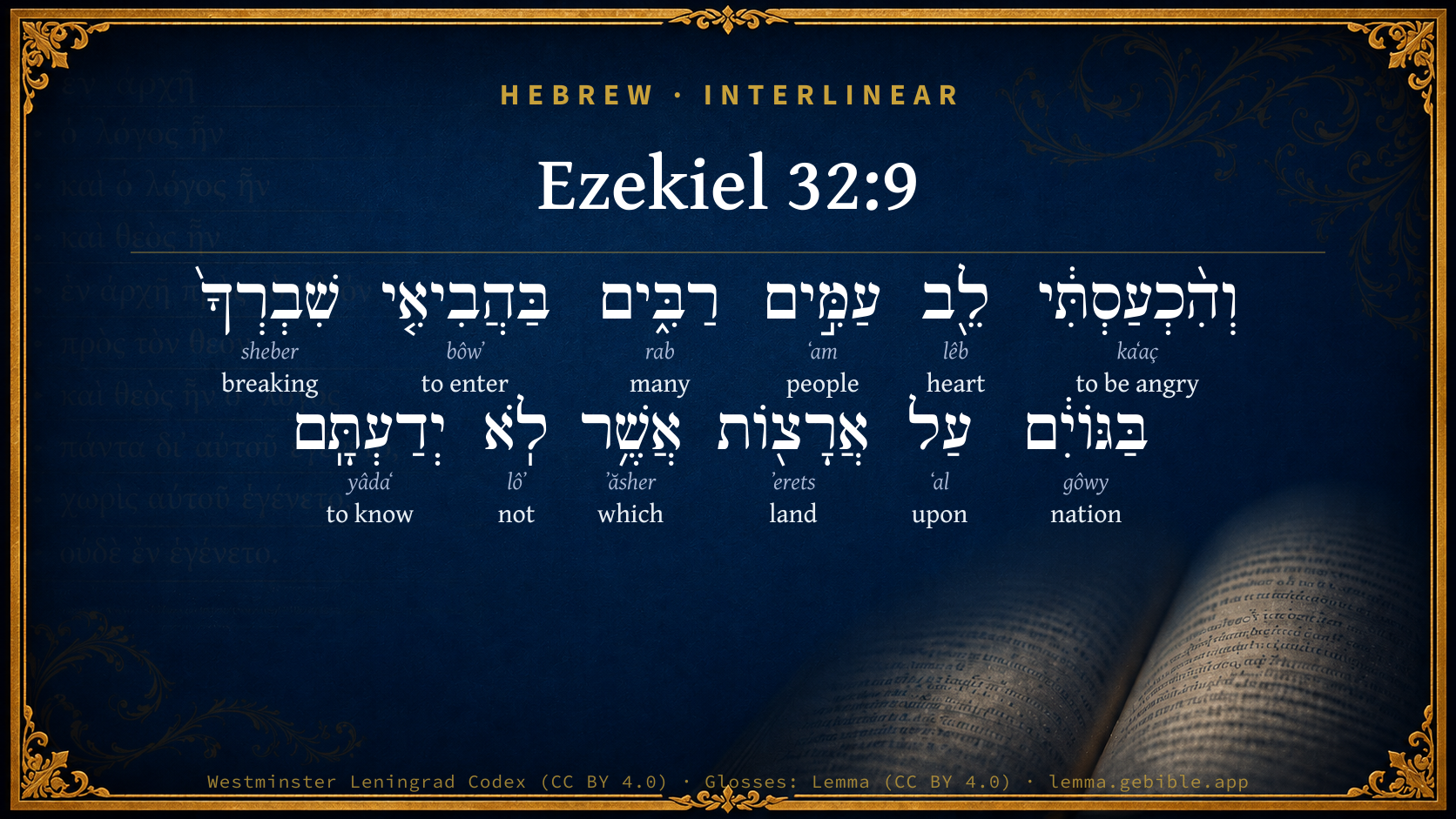
Hebrew (Westminster Leningrad Codex) Ezekiel 32:9 appears in the Hebrew Old Testament. The text above is from the Westminster Leningrad Codex. Each word links to its Strong’s number, a concise gloss, and parsing drawn from the Open Scriptures Hebrew Bible morphology. Click any word for its full Brown-Driver-Briggs (BDB) entry.
Download image
Cite this verse

Ezekiel 32:9 (World English Bible). Public Domain. Lemma interlinear Bible study tool, https://lemma.gebible.app/v/ezekiel/32/9.

Show BibTeX & RIS
BibTeX
RIS
English Translation
I will also vex the hearts of many peoples, when I shall bring your destruction among the nations, into the countries which you have not known.
World English Bible · Public Domain
Download a study sheet

One document with this verse’s original text, its word-by-word gloss line, the meaning frame, cross-references with their text, attributed commentary, and full source and license credits — printable, and it pastes into notes with its structure intact.

This verse Autodidact and up

Study sheet (.html) Plain text (.txt)

A passage Seminary Student

Up to 50 verses in one chapter. A passage sheet keeps up to 6 commentary sources and 12 cross-references per verse, in the order this page ranks them, and says so on the sheet whenever that leaves anything out. Ask for a single verse and you get the Autodidact verse sheet above.

Everything on this page stays free to read, with no account — the sheet is a download of what is already on screen, not access to it.

Want to remove ads? Support Godless Engineer
Compare translations 3

The same verse in 3 English versions, stacked beneath the original-language interlinear above. Click any original word for its lexicon entry.

Each is an independent rendering of the whole verse — the interlinear is not word-aligned to these translations.

Highlighted words mark where these versions differ — a whole-verse word diff, not a word-by-word alignment.

  • World English Bible Public Domain
    I will also vex the hearts of many peoples, when I shall bring your destruction among the nations, into the countries which you have not known.
  • King James Version Public Domain
    I will also vex the hearts of many people, when I shall bring thy destruction among the nations, into the countries which thou hast not known.
  • unfoldingWord Literal Text CC BY-SA 4.0
    So I will terrify the heart of many peoples in lands that you do not know, when I bring about your collapse among the nations, among lands that you have not known.

unfoldingWord Literal Text — © unfoldingWord, licensed CC BY-SA 4.0. Word-aligned USFM3 via Door43 (git.door43.org/unfoldingWord/en_ult).

Versions to compare (up to 4)

3 of 4 selected

Show all 18 translations

Every available English version of this verse, each an independent rendering of the whole verse.

  • World English Bible Public Domain
    I will also vex the hearts of many peoples, when I shall bring your destruction among the nations, into the countries which you have not known.
  • Berean Standard Bible Public Domain
    ‘I will trouble the hearts of many peoples, when I bring about your destruction among the nations, in countries you do not know.
  • Majority Standard Bible Public Domain
    ‘I will trouble the hearts of many peoples, when I bring about your destruction among the nations, in countries you do not know.
  • King James Version Public Domain
    I will also vex the hearts of many people, when I shall bring thy destruction among the nations, into the countries which thou hast not known.
  • American Standard Version (1901) Public Domain
    I will also vex the hearts of many peoples, when I shall bring thy destruction among the nations, into the countries which thou hast not known.
  • Revised Version (1885) Public Domain
    I will also vex the hearts of many peoples, when I shall bring thy destruction among the nations, into the countries which thou hast not known.
  • Geneva Bible (1599) Public Domain
    I will also trouble the heartes of many people, when I shall bring thy destruction among the nations and vpon the countries which thou hast not knowen.
  • Douay-Rheims (1899) Public Domain
    And I shall provoke to anger the heart of many people, when I shall have brought in thy destruction among the nations upon the lands, which thou knowest not.
  • Young's Literal Translation Public Domain
    And I have vexed the heart of many peoples, In My bringing in thy destruction among nations, Unto lands that thou hast not known.
  • Literal Standard Version CC BY-SA 4.0
    And I have distressed the heart of many peoples, || In My bringing in your destruction among nations, || To lands that you have not known.
  • Unlocked Literal Bible CC BY-SA 4.0
    So I will terrify the heart of many peoples in lands that you do not know, when I bring about your collapse among the nations, among lands that you have not known.
  • unfoldingWord Literal Text CC BY-SA 4.0
    So I will terrify the heart of many peoples in lands that you do not know, when I bring about your collapse among the nations, among lands that you have not known.
  • Darby Bible Public Domain
    And I will vex the heart of many peoples, when I bring [the news of] thy destruction among the nations, into the countries that thou hast not known.
  • World Messianic Bible Public Domain
    “I will also trouble the hearts of many peoples, when I bring your destruction among the nations, into the countries which you have not known.
  • Webster's Bible Public Domain
    I will also vex the hearts of many people, when I shall bring thy destruction among the nations, into the countries which thou hast not known.
  • Free Bible Version CC BY-SA 4.0
    When I destroy you I will make many people frightened, even in countries you don't know anything about.
  • Bible in Basic English Public Domain
    And the hearts of numbers of peoples will be troubled, when I send your prisoners among the nations, into a country which is strange to you.
  • JPS Tanakh (1917) Public Domain
    I will also vex the hearts of many peoples, when I shall bring thy destruction among the nations, into the countries which thou hast not known.

Literal Standard Version (2020), Covenant Press — licensed CC BY-SA 4.0. Text via the HelloAO Bible API (eBible.org). Unlocked Literal Bible (unfoldingWord) — licensed CC BY-SA 4.0. Text via the HelloAO Bible API (eBible.org). unfoldingWord Literal Text — © unfoldingWord, licensed CC BY-SA 4.0. Word-aligned USFM3 via Door43 (git.door43.org/unfoldingWord/en_ult). Free Bible Version, Dr. Jonathan Gallagher — licensed CC BY-SA 4.0. Text via the HelloAO Bible API (eBible.org).

Word by word

More ways to search: Search by grammar → Find every occurrence → Compare this word →

Practice this passage: Drill this verse → Learn its vocabulary →

שִׁבְרְךָ֙
sheber
H7667
“breaking · your”
Noun, Common, Masculine, Singular, Construct + Suffix, Personal, 2nd Person, Masculine, Singular
Part of Speech
Noun
Type
Common
Gender
Masculine
Number
Singular
State
Construct
Full BDB Definition

Origin: from H7665

TWOT: 2321a

breaking, fracture, crushing, breach, crash, ruin, shattering - breaking, fracture, shattering, crushing - crashing - breaking (of a dream), interpretation - quarries
  1. וְהִ֨כְעַסְתִּ֔י kaʻaç H3707 “and · to be angry” Conjunction + Verb, Hiphil, Sequential Perfect, 1st Person, Common, Singular
  2. לֵ֖ב lêb H3820 “heart of” Noun, Common, Masculine, Singular, Construct
  3. עַמִּ֣ים ʻam H5971 “peoples” Noun, Common, Masculine, Plural, Absolute
  4. רַבִּ֑ים rab H7227 “many” Adjective, Adjective, Masculine, Plural, Absolute
  5. בַּהֲבִיאִ֤י bôwʼ H935 “in/at · to enter · me” Preposition + Verb, Hiphil, Infinitive Construct + Suffix, Personal, 1st Person, Common, Singular
  6. בַּגּוֹיִ֔ם gôwy H1471 “in/at the · nations” Preposition, Determined + Noun, Common, Masculine, Plural, Absolute
  7. עַל ʻal H5921 “upon” Preposition
  8. אֲרָצ֖וֹת ʼerets H776 “lands” Noun, Common, Both, Plural, Absolute
  9. אֲשֶׁ֥ר ʼăsher H834 “which” Particle, Relative
  10. לֹֽא lôʼ H3808 “not” Particle, Negative
  11. יְדַעְתָּֽם yâdaʻ H3045 “to know · them” Verb, Qal, Perfect, 2nd Person, Masculine, Singular + Suffix, Personal, 3rd Person, Masculine, Plural

About this verse

These counts appear in no published source. They are computed here, from the morphology-tagged text and Lemma’s own curated glosses. What Lemma adds →

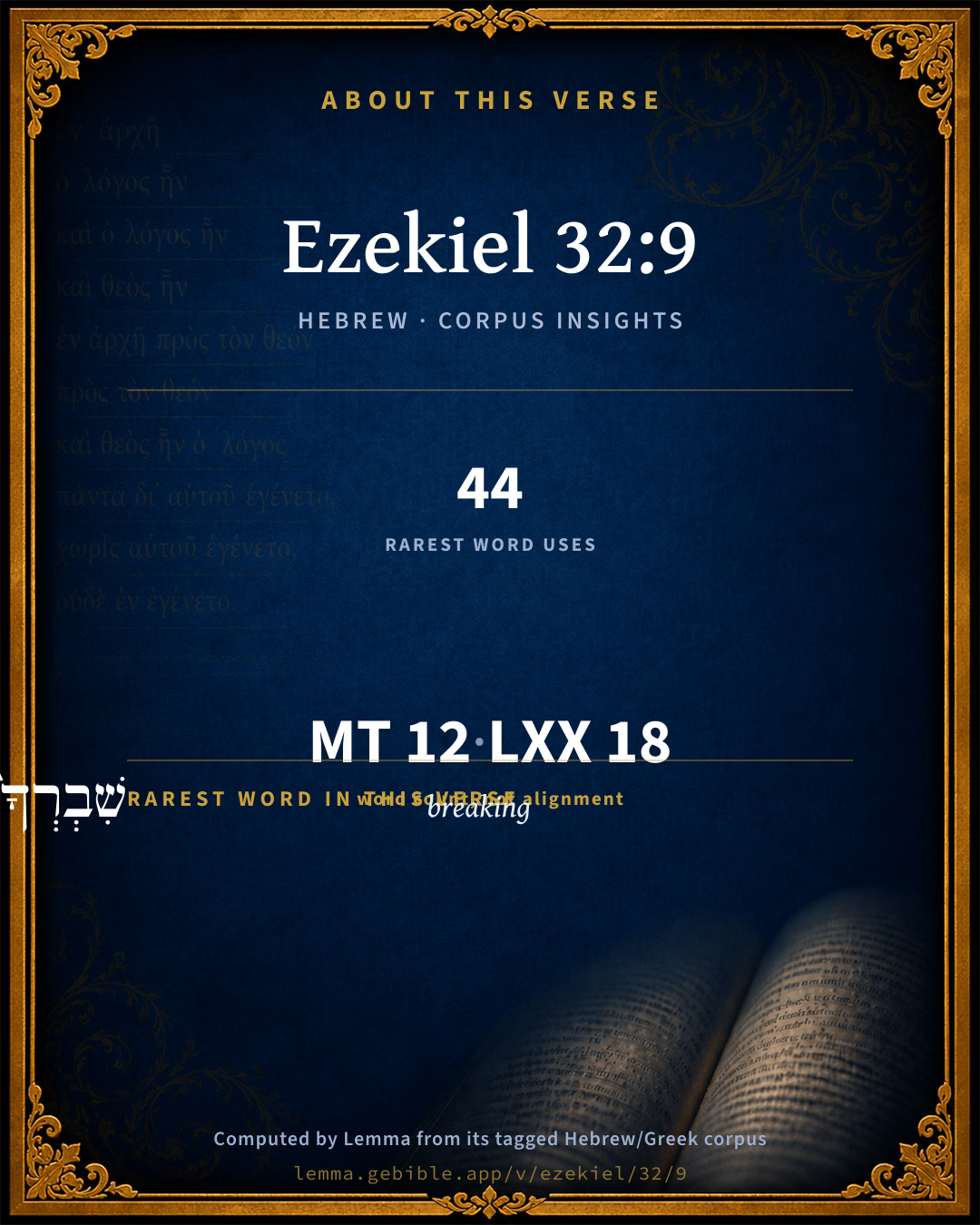
12
words
12
distinct lemmas
Prophets
section

Shared distinctive vocabulary

שִׁבְרְךָ֙ breaking H7667 occurs in 41 verses of the Hebrew Bible. Also found in:

Grammatical profile

  • 3 verbs
  • 5 nouns
  • 1 adjective
  • 1 preposition
  • 2 particles

Verb forms

  • וְהִ֨כְעַסְתִּ֔י Hiphil · Sequential Perfect
  • בַּהֲבִיאִ֤י Hiphil · Infinitive Construct
  • יְדַעְתָּֽם Qal · Perfect

Hebrew & Septuagint length

In English translation the verse runs 26 words from the Hebrew and 28 from the Septuagint (LXX English) — closely comparable.

A rough comparison of the two English renderings, which tokenize alike — not a word-level alignment.

Word counts can differ between the Hebrew and the Greek without any difference in meaning — e.g. the Hebrew direct-object marker אֵת has no separate Greek word, and Greek often adds the article ὁ.

In the original languages it is 12 Hebrew tokens and 18 Greek tokens — but the two are counted differently (Hebrew bundles its prefixes and suffixes into one token; the Greek is in lemma form), so that isn’t a like-for-like length.

Cross-references

6

Topical passages linked to Ezekiel 32:9 in the Treasury of Scripture Knowledge — connected by theme and wording, ordered by reader-vote popularity; previews shown in the World English Bible.

  • Revelation 18:10–15 standing far away for the fear of her torment, saying, 'Woe, woe, the great city, Babylon, the strong city! For your judgment has come in one hour.'
  • Jeremiah 25:15–25 For thus says Yahweh, the God of Israel, to me: take this cup of the wine of wrath at my hand, and cause all the nations, to whom I send you, to drink it.
  • Ezekiel 29:12 I will make the land of Egypt a desolation in the midst of the countries that are desolate; and her cities among the cities that are laid waste shall be a desolation forty years; and I will scatter the Egyptians among the nations, and will disperse them through the countries.
  • Ezekiel 30:23 I will scatter the Egyptians among the nations, and will disperse them through the countries.
  • Ezekiel 30:26 I will scatter the Egyptians among the nations, and disperse them through the countries; and they shall know that I am Yahweh.
  • Revelation 11:18 The nations were angry, and your wrath came, as did the time for the dead to be judged, and to give your bondservants the prophets, their reward, as well as to the saints, and those who fear your name, to the small and the great; and to destroy those who destroy the earth."

Cross-references courtesy of OpenBible.info (CC BY 4.0).

Hebrew and Greek witnesses Masoretic Hebrew ↔ Greek Septuagint

The same verse in the two great witnesses to the Old Testament, shown verse-for-verse.

These are two independent witnesses, not word-aligned to each other, and the Septuagint is shown in lemma (dictionary) form.

Hebrew Ezekiel 32:9 Masoretic · Westminster Leningrad Codex

וְהִ֨כְעַסְתִּ֔י לֵ֖ב עַמִּ֣ים רַבִּ֑ים בַּהֲבִיאִ֤י שִׁבְרְךָ֙ בַּגּוֹיִ֔ם עַל אֲרָצ֖וֹת אֲשֶׁ֥ר לֹֽא יְדַעְתָּֽם

I will also vex the hearts of many peoples, when I shall bring your destruction among the nations, into the countries which you have not known.

World English Bible · Public Domain

Greek LXX Ezekiel 32:9 Septuagint · lemma form

καί παραὀργίζω καρδία λαός πολύς ἡνίκα ἄν ἄγω αἰχμαλωσία σύ εἰς ὁ ἔθνος εἰς γῆ ὅς οὐ γιγνώσκω

And I will provoke to anger the heart of many people, when I shall lead you captive among the nations, to a land which you have not known.

LXX2012 (modern English Septuagint) · Public Domain

Hebrew: Westminster Leningrad Codex (CC BY 4.0). Greek: Septuagint (public domain); English from LXX2012 (modern English Septuagint) (Public Domain). How the Septuagint differs from the Hebrew →

Targum (Aramaic paraphrase)

1

The Targum is the ancient Jewish Aramaic paraphrase of the Hebrew Scriptures — an interpretive translation, not the Hebrew text itself. Onkelos (literal) and Pseudo-Jonathan (expansive) render the Torah, and Jonathan the Prophets. Coverage is partial: where no permissively-licensed English translation exists for a verse, only the Aramaic is shown. This is verse-level text, not a word-by-word alignment to the Hebrew.

  1. Targum Jonathan Prophets (Joshua–Malachi)
    וַאֲזִיעַ לֵב עַמְמִין סַגִיאִין בְּאַיְתָיוּתִי תְבִירֵי קְרָבָךְ לְבֵינֵי עַמְמַיָא לִמְדִינָן דְלָא יְדַעְתִּינוּן:

    (no public-domain English translation for this verse)

    Targum Jonathan — Aramaic: “Mikraot Gedolot” (public domain). English: “Sefaria Community Translation” (CC0 1.0 (public-domain dedication)); “London "Chaldee Paraphrase," 1871” (public domain). Text via Sefaria.

Commentary

Notes on Ezekiel 32:9 from classic Christian and Jewish commentators (each source and its license shown beneath its notes). The classic Christian expositions comment on the surrounding passage and are grouped to its opening verse, so a note may address several verses; the Jewish commentaries on the Tanakh (Rashi and others) are per-verse, so they appear only where the commentator wrote on this verse.

Lemma curates 59 commentaries, every one of them public domain or Creative Commons licensed, each selected and text-cleaned for this edition rather than reprinted as found. About our sources →

Trapp's Complete Commentary

John Trapp

Eze 32:9 I will also vex the hearts of many people, when I shall bring thy destruction among the nations, into the countries which thou hast not known.

Ver. 9. I will also vex.] Or, Grieve. See Ecc 7:3, where the same word signifieth anger and sorrow. Nebuchadnezzar’s growing greatness shall be a cut and a corrosive to them.

John Trapp, A Commentary or Exposition upon All the Books of the Old and New Testament (1647–1656) — public domain. Text from a community e-Sword module.

Tyndale Open Study Notes

Tyndale Open Resources

32:9-10 The surrounding nations and their kings would all be terrified at Egypt’s downfall, fearing for their own future.

Tyndale Open Study Notes — © Tyndale Open Resources, licensed CC BY-SA 4.0. Text via the HelloAO Bible API.

Jamieson, Fausset & Brown

Robert Jamieson, A. R. Fausset & David Brown

thy destruction--that is tidings of thy destruction (literally, "thy breakage") carried by captive and dispersed Egyptians "among the nations" [GROTIUS]; or, thy broken people, resembling one great fracture, the ruins of what they had been [FAIRBAIRN].

Jamieson, Fausset & Brown — Commentary Critical and Explanatory on the Whole Bible (1871) — public domain (CC PDM 1.0). Text via the HelloAO Bible API.

Adam Clarke's Commentary

Verse 9. I will also vex the hearts] Even the remote nations, who had no connexion with thee, shall be amazed at the judgments which have fallen upon thee.

Adam Clarke's Commentary on the Bible (1810–1826) — public domain. Text from a community e-Sword/MySword module.

Ellicott's Commentary for English Readers

(9) Vex the hearts.—The margin, provoke to grief, is better, as being less ambiguous. “Thy destruction” means, the news of thy destruction. As is more fully expressed in the following verse, the fall of Egypt should be such a striking instance of Divine judgment as to awaken fear in every nation that should hear of the catastrophe.

A Bible Commentary for English Readers, edited by Charles John Ellicott (1878–1897) — public domain. Text from a community e-Sword module.

The Cambridge Bible for Schools and Colleges

gen. ed. J. J. S. Perowne

9. vex the hearts] Or, trouble. The precise feeling is not grief, and certainly not anger (A. V. marg.); in Eze_32:10 it is dismay, and then terror for themselves. For people peoples.

bring thy destruction among] Hardly means “bring the news” of thy destruction; the destruction itself occurs among the nations, they observe it; cf. “brandish my sword before them,” Eze_32:10.

into the countries] unto countries. The effect of Pharaoh’s fall shall be felt by nations lying beyond the horizon of his knowledge; cf. Isa_55:5.

The Cambridge Bible for Schools and Colleges (gen. ed. J. J. S. Perowne; Cambridge University Press, 1878–1918) — public domain. Text from a community e-Sword module.

John Gill's Exposition

I will also vex the hearts of many people,.... With anger and grief, with fear and dread, with consternation and amazement:

when I shall bring thy destruction among the nations; or, "thy breach" (b); the news of it, the tidings of their destruction; which by one means or another should come to their ears, and fill them with concern and great anxiety of mind, so rich and powerful a kingdom being subdued, and the king of Babylon made so great thereby, and fearing they fall a prey unto him also. The Targum renders it,

"when I shall bring the broken of thy war;''

that is, the soldiers that should be wounded in battle, their limbs broke, and they taken captive, and brought among the nations, dismal spectacles to look at; and which should be brought

into countries, which thou hast not known; at a distance from Egypt, and which had no commerce nor communication with them, nor were their friends and allies; yet as their destruction would reach their ears, so it would affect their hearts, and fill them with vexation and grief; not so much on account of Egypt, as the growing power of Nebuchadnezzar, and the danger they were in of falling into his hands.

(b) "fractionem tuam", Piscator, Cocceius, Starckius.

John Gill's Exposition of the Whole Bible (1746–1763) — public domain (CC PDM 1.0). Text via the HelloAO Bible API.

Albert Barnes' Notes on the Bible

When I shall bring thy destruction - i. e., the news of thy destruction. The phenomena here mentioned are the accompaniments of “the day of the Lord” Joe 2:10; Luk 21:25 or the day of judgment. The fall of Pharaoh represents the fall of the world-power before the sovereignty of God.

Albert Barnes' Notes on the Bible (1834–1885) — public domain. Text from a community e-Sword/MySword module.

Haydock's Catholic Bible Commentary

Anger, as they will not know why I have treated thee so severely: or rather, they shall be afraid for themselves, ver. 10. (Calmet)

George Leo Haydock (1774–1849), Haydock's Catholic Family Bible and Commentary, 1859 edition — public domain. Excludes Psalms (Douay-Rheims chapter numbering differs from Protestant) and Deuterocanonical books (Catholic canon only).

Matthew Poole's English Annotations

Vex; it speaks a passion mixed and made up with grief for what is done, fear of the consequence of it, anger against him that did it, and an astonishment at the report, and it seizeth the heart and spirits of the hearers.

Many people, and great nations.

Thy destruction; either the fame of it, or the remainders that fled timely from thy destruction, or thy captives who after thou art destroyed are carried away, and the news of thy fall with them, or when the like ruin and destruction shall fall upon them. Which thou hast not known; such as were strangers to Egypt, and which Egypt had no commerce with, shall be troubled with apprehension what mischief may come upon the world from so mighty a conqueror, and by the accession of so great a kingdom and power as that of Egypt.

Matthew Poole's English Annotations on the Holy Bible (1683–1685) — public domain. Text from a community e-Sword/MySword module.

Whedon's Commentary on the Bible

Daniel D. Whedon

9, 10. Compare Eze_26:16; Eze_27:35.

Daniel D. Whedon (gen. ed.), Commentary on the Old and New Testaments (1874–1909) — public domain. Text from a community e-Sword module.

The Pulpit Commentary

I will also vex the hearts. The words intensify the bitterness of the downfall. The prophet passes out of the region of metaphors into that of facts. The fall of Egypt will cause pity among the nations. They shall simply be "vexed" in heart, terrified at the thought (Ver. 10) that the sword which had laid her low was "brandished" also against them.

Ver. 9 ("I will also vex the hearts of many peoples"). Vexation of heart.

I THE GREATEST DISTRESS IS THAT WHICH IS CAUSED BY VEXATION OF HEART. Terrible reverses of fortune may be endured, and the millionaire may become a beggar, and yet the deepest sorrows may not be reached; for there are men who have proved themselves superior to their circumstances, and who have been able to look with a serene countenance on the wreck of their fortunes, because they have been possessed of interior sources of happiness. Bodily sickness which produces acute physical pain does not induce the greatest real sufferings. Not only have martyrs learnt to triumph at the stake, but patient, obscure sufferers have acquired peace and even joy while their bodies have been racked with torment. But when the heart is sore vexed the most terrible Sorrow is felt. This may be endured amid external circumstances of affluence, and then those circumstances appear but as gilded vanities, mocking the bitter grief that lurks within. We live in our hearts, and if our hears be sore and sorrowful, our lives are darkened with a distress that no outer comforts can cheer.

II VEXATION OF HEART SPRINGS ESPECIALLY FROM LOSS AND DISAPPOINTMENT. We accustom ourselves to the usual, and do not grieve greatly over what we never had and never expected to possess. No man is much distressed at the thought that he is not a prince of the archangels. The simple peasant does not grieve because he is not the owner of a kingdom, as Alexander is said to have grieved because he could find no new worlds to conquer. The childless wife is not desolate as the mother whose baby has been snatched from her. The loss of the loved and the disappointment of cherished hopes are the greatest sources of vexation of heart. Now, we have all lost a great inheritance, we have missed our high Divine vocation. The sorrow of failure is at the root of the worst heartache. The old weary world groans without perceiving the cause of its anguish. Clearly something is wrong, for a good Creator would not have made a world for sorrow and disappointment. The great disillusion which at some time comes to every sanguine soul, and turns May into November, must have a cause. The world has suffered a great loss; it has met with a great disappointment. The first step is to have the courage to admit the fact, and not to be living in the optimism which the first touch of reality proves to be but a dream. The next is to discover the cause and to see that the loss is the loss of God, and the failure sin.

III CHRIST HAS COME TO CURE VEXATION OF HEART. He may not help us to retrieve broken fortunes. "To the poor the gospel is preached and yet they remain poor; he may not now restore health as he did during his earthly ministry. But he aims at the deepest trouble-he cures vexation of heart. To the laboring and heavy laden he gives rest. It is not his will that his people should go mourning all their days. The dim and faded life may be brightened and gladdened by the love of the great Savior. This is possible because Christ goes to the seat of the trouble, whereas most earthly comforters have only tried to smooth away the superficial symptoms. He finds the lost God. He restores man to his missed destiny. He slays the sin that is the worm at the root of the world"s life. He brings the heart-joy of life eternal in fellowship with God.

The Pulpit Commentary (1880–1919), ed. H.D.M. Spence-Jones & Joseph S. Exell — public domain. Text from a community e-Sword module.

John Wesley's Explanatory Notes

Thy destruction - The fame of it. Not known - Such as were strangers to Egypt, shall be troubled with apprehension of what mischief may come upon the world from so mighty a conqueror.

John Wesley, Explanatory Notes Upon the Whole Bible (1754–1765) — public domain. Text via the GEBible commentary corpus.

unfoldingWord translationNotes

Door43 World Missions Community

General Information:

Yahweh continues to speak to Pharaoh.

I will terrify the heart of many peoples

Here "heart" represents the people's emotions. AT: "I will make the hearts of many peoples afraid" or "I will cause many people to be terrified" (See: Metonymy)

in lands that you do not know

The way that Yahweh destroys Egypt will make afraid even people in lands that Pharaoh never knew about.

when I bring about your collapse among the nations

The nation of Egypt, symbolized by its king, is spoken of as if it were a building that was collapsing. AT: "when nations hear about the way I destroyed you" (See: Metaphor)

when I swing my sword

Here swinging a sword represents using the sword. AT: "when I use my sword" (See: Metonymy)

Every moment each one will tremble because of you

Here "tremble" is an action that people often do when they are very afraid. AT: "Every one of them will keep shaking because of their fear"

on the day of your downfall

The idea of falling down ("downfall") represents dying. AT: "when I destroy you" (See: Metaphor)

translationWords

terror

people group

nation

king

sword

unfoldingWord translationNotes — © Distant Shores Media and the Door43 World Missions Community, licensed CC BY-SA 4.0. Source: git.door43.org/Door43/en_tn.

Rashi

Rabbi Shlomo Yitzchaki (Rashi)

And I will vex the heart i.e., their heart will tremble and quake.

when I bring your ruin when I bring the ruin of your battles among the peoples.

Rashi on the Tanakh — English translations: “The Judaica Press complete Tanach with Rashi, translated by A. J. Rosenberg” (CC BY 4.0); “Pentateuch with Rashi's commentary by M. Rosenbaum and A.M. Silbermann, 1929-1934” (public domain); “The Metsudah Tanach series, Lakewood, N.J” (CC BY 4.0); and “The Book of Joshua, Metsudah Publications, 1997” (CC BY 4.0). Text via Sefaria.

Lesson kit

Teaching starters — assembled from the data on this page, not authored interpretation. Every prompt links to the verse data it draws on. Edit before teaching.

Ezekiel, in the Prophets, opens this verse with 12 words (12 distinct Hebrew lemmas). Its most distinctive word is sheber (“breaking”). A historical commentator’s framing appears above. Read the whole chapter for the surrounding context.

Discussion questions

  1. The word sheber carries the sense “breaking.” How does it shape the verse?
  2. How does Leviticus 21:19, which shares the word «breaking», read alongside this verse?
  3. These translations render this verse differently. What is at stake in choosing one wording over another?
  4. «וְהִ֨כְעַסְתִּ֔י» is a Hiphil Sequential Perfect verb. How does that grammatical form shape the action described?
  5. Compare how Trapp's Complete Commentary and Tyndale Open Study Notes read this verse. Where do they agree or differ?

Things to notice

Reading settings

Reading text

Shown beneath each verse's original-language words.

Old Testament
Old Testament edition

Read the OT as the Masoretic Hebrew (MT) or the Greek Septuagint (LXX).

English shown for the Greek Septuagint (in the Hebrew ↔ Greek comparison).

Comparing translations? Open the Compare panel on any verse page to stack up to four side by side.