
Jeremiah 32:30

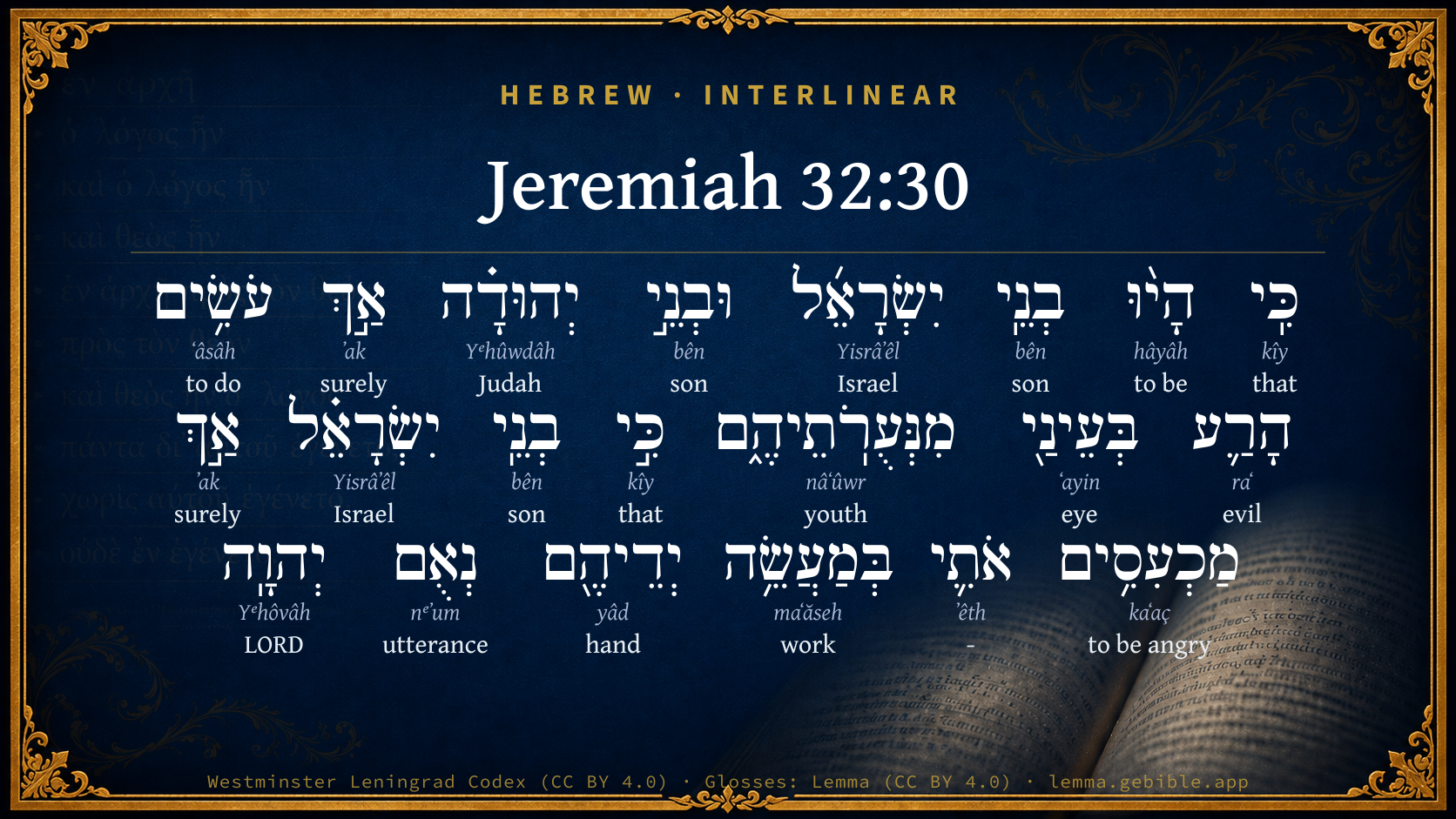
Hebrew (Westminster Leningrad Codex) Jeremiah 32:30 appears in the Hebrew Old Testament. The text above is from the Westminster Leningrad Codex. Each word links to its Strong’s number, a concise gloss, and parsing drawn from the Open Scriptures Hebrew Bible morphology. Click any word for its full Brown-Driver-Briggs (BDB) entry.
Download image
Cite this verse

Jeremiah 32:30 (World English Bible). Public Domain. Lemma interlinear Bible study tool, https://lemma.gebible.app/v/jeremiah/32/30.

Show BibTeX & RIS
BibTeX
RIS
English Translation
For the children of Israel and the children of Judah have done only that which was evil in my sight from their youth; for the children of Israel have only provoked me to anger with the work of their hands, says Yahweh.
World English Bible · Public Domain
Download a study sheet

One document with this verse’s original text, its word-by-word gloss line, the meaning frame, cross-references with their text, attributed commentary, and full source and license credits — printable, and it pastes into notes with its structure intact.

This verse Autodidact and up

Study sheet (.html) Plain text (.txt)

A passage Seminary Student

Up to 50 verses in one chapter. A passage sheet keeps up to 6 commentary sources and 12 cross-references per verse, in the order this page ranks them, and says so on the sheet whenever that leaves anything out. Ask for a single verse and you get the Autodidact verse sheet above.

Everything on this page stays free to read, with no account — the sheet is a download of what is already on screen, not access to it.

Want to remove ads? Support Godless Engineer
Compare translations 3

The same verse in 3 English versions, stacked beneath the original-language interlinear above. Click any original word for its lexicon entry.

Each is an independent rendering of the whole verse — the interlinear is not word-aligned to these translations.

Highlighted words mark where these versions differ — a whole-verse word diff, not a word-by-word alignment.

  • World English Bible Public Domain
    For the children of Israel and the children of Judah have done only that which was evil in my sight from their youth; for the children of Israel have only provoked me to anger with the work of their hands, says Yahweh.
  • King James Version Public Domain
    For the children of Israel and the children of Judah have only done evil before me from their youth: for the children of Israel have only provoked me to anger with the work of their hands, saith the LORD.
  • unfoldingWord Literal Text CC BY-SA 4.0
    For the people of Israel and Judah have certainly been people who have been doing evil before my eyes since their youth. The people of Israel have certainly offended me with the practices of their hands—this is Yahweh’s declaration.

unfoldingWord Literal Text — © unfoldingWord, licensed CC BY-SA 4.0. Word-aligned USFM3 via Door43 (git.door43.org/unfoldingWord/en_ult).

Versions to compare (up to 4)

3 of 4 selected

Show all 18 translations

Every available English version of this verse, each an independent rendering of the whole verse.

  • World English Bible Public Domain
    For the children of Israel and the children of Judah have done only that which was evil in my sight from their youth; for the children of Israel have only provoked me to anger with the work of their hands, says Yahweh.
  • Berean Standard Bible Public Domain
    For the children of Israel and of Judah have done nothing but evil in My sight from their youth; indeed, they have done nothing but provoke Me to anger by the work of their hands, declares the LORD.
  • Majority Standard Bible Public Domain
    For the children of Israel and of Judah have done nothing but evil in My sight from their youth; indeed, they have done nothing but provoke Me to anger by the work of their hands, declares the LORD.
  • King James Version Public Domain
    For the children of Israel and the children of Judah have only done evil before me from their youth: for the children of Israel have only provoked me to anger with the work of their hands, saith the LORD.
  • American Standard Version (1901) Public Domain
    For the children of Israel and the children of Judah have done only that which was evil in my sight from their youth; for the children of Israel have only provoked me to anger with the work of their hands, saith Jehovah.
  • Revised Version (1885) Public Domain
    For the children of Israel and the children of Judah have only done that which was evil in my sight from their youth: for the children of Israel have only provoked me to anger with the work of their hands, saith the LORD.
  • Geneva Bible (1599) Public Domain
    For the children of Israel, and the children of Iudah haue surely done euill before me from their youth: for the children of Israel haue surely prouoked me to anger with the workes of their hands, saith the Lord.
  • Douay-Rheims (1899) Public Domain
    For the children of Israel, and the children of Juda, have continually done evil in my eyes from their youth: the children of Israel who even till now provoke me with the work of their hands, saith the Lord.
  • Young's Literal Translation Public Domain
    For the sons of Israel and the sons of Judah have been only doing evil in Mine eyes, from their youth; for the sons of Israel are only provoking Me with the work of their hands -- an affirmation of Jehovah.
  • Literal Standard Version CC BY-SA 4.0
    For the sons of Israel and the sons of Judah have been doing only evil in My eyes from their youth; for the sons of Israel are surely provoking Me with the work of their hands,” a declaration of YHWH.
  • Unlocked Literal Bible CC BY-SA 4.0
    For the people of Israel and Judah have certainly been people who have been doing evil before my eyes since their youth. The people of Israel have certainly offended me with the practices of their hands—this is Yahweh's declaration.
  • unfoldingWord Literal Text CC BY-SA 4.0
    For the people of Israel and Judah have certainly been people who have been doing evil before my eyes since their youth. The people of Israel have certainly offended me with the practices of their hands—this is Yahweh’s declaration.
  • Darby Bible Public Domain
    For the children of Israel and the children of Judah have been doing only evil in my sight from their youth; for the children of Israel have only provoked me to anger with the work of their hands, saith Jehovah.
  • World Messianic Bible Public Domain
    “For the children of Israel and the children of Judah have done only that which was evil in my sight from their youth; for the children of Israel have only provoked me to anger with the work of their hands, says the LORD.
  • Webster's Bible Public Domain
    For the children of Israel and the children of Judah have done evil only before me from their youth: for the children of Israel have only provoked me to anger with the work of their hands, saith the LORD.
  • Free Bible Version CC BY-SA 4.0
    From their earliest days all the people of Israel and of Judah have ever done has been evil in my sight. In fact all they've ever done is to make me angry through their actions, declares the Lord.
  • Bible in Basic English Public Domain
    For the children of Israel and the children of Judah have done nothing but evil in my eyes from their earliest years: the children of Israel have only made me angry with the work of their hands, says the Lord.
  • JPS Tanakh (1917) Public Domain
    For the children of Israel and the children of Judah have only done that which was evil in My sight from their youth; for the children of Israel have only provoked Me with the work of their hands, saith the LORD.

Literal Standard Version (2020), Covenant Press — licensed CC BY-SA 4.0. Text via the HelloAO Bible API (eBible.org). Unlocked Literal Bible (unfoldingWord) — licensed CC BY-SA 4.0. Text via the HelloAO Bible API (eBible.org). unfoldingWord Literal Text — © unfoldingWord, licensed CC BY-SA 4.0. Word-aligned USFM3 via Door43 (git.door43.org/unfoldingWord/en_ult). Free Bible Version, Dr. Jonathan Gallagher — licensed CC BY-SA 4.0. Text via the HelloAO Bible API (eBible.org).

Word by word

More ways to search: Search by grammar → Find every occurrence → Compare this word →

Practice this passage: Drill this verse → Learn its vocabulary →

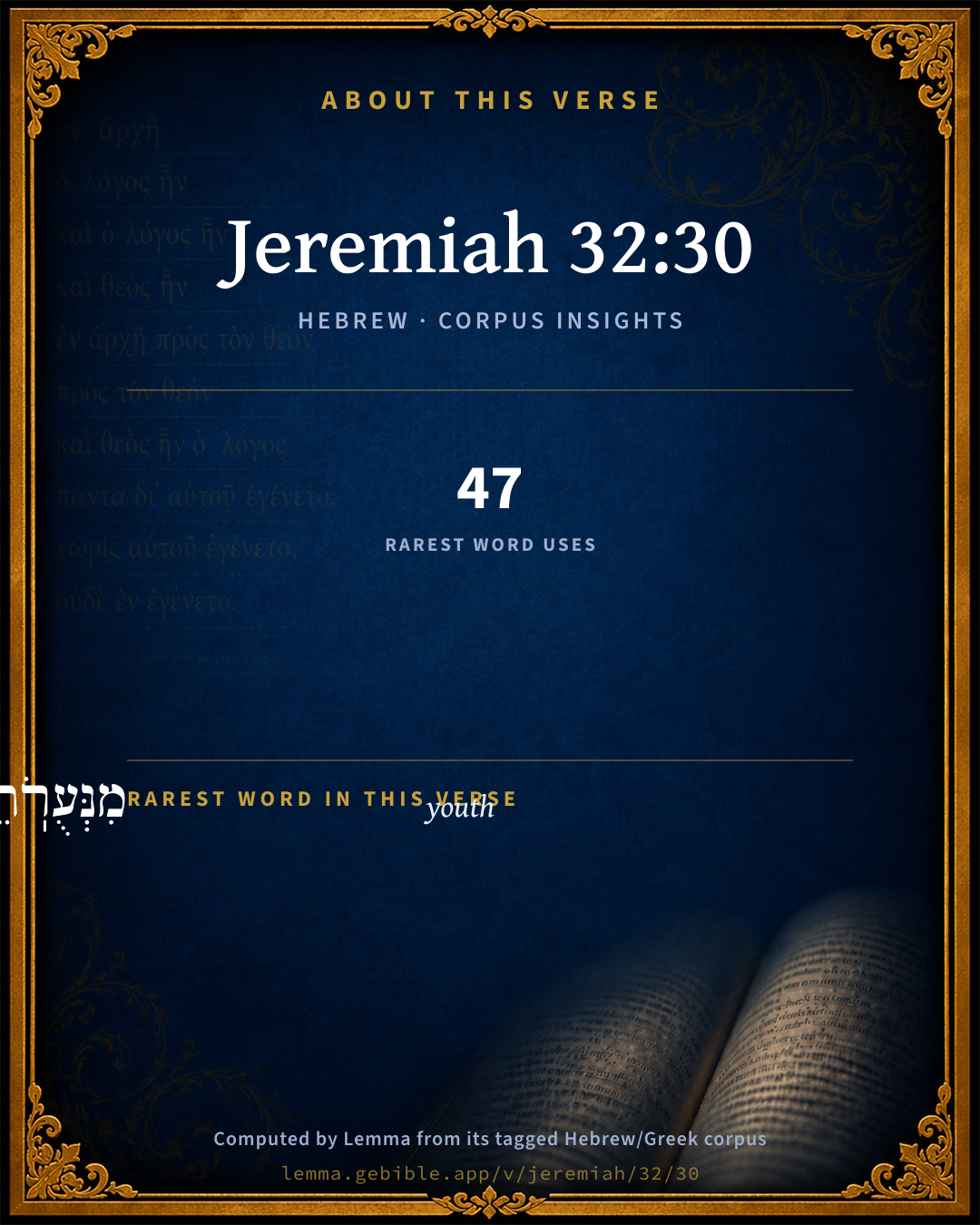
מִנְּעֻרֹֽתֵיהֶ֑ם
nâʻûwr
H5271
“from · youth · their”
Preposition + Noun, Common, Both, Plural, Construct + Suffix, Personal, 3rd Person, Masculine, Plural
Part of Speech
Preposition + Noun
Type
Common
Gender
Both
Number
Plural
State
Construct
Full BDB Definition

Origin: properly, pass. participle from H5288 as denominative

TWOT: 1389d , 1389e

youth, early life
  1. כִּֽי kîy H3588 “that” Conjunction
  2. הָי֨וּ hâyâh H1961 “to be” Verb, Qal, Perfect, 3rd Person, Common, Plural
  3. בְנֵֽי bên H1121 “sons of” Noun, Common, Masculine, Plural, Construct
  4. יִשְׂרָאֵ֜ל Yisrâʼêl H3478 “Israel” Noun, Proper
  5. וּבְנֵ֣י bên H1121 “and · sons of” Conjunction + Noun, Common, Masculine, Plural, Construct
  6. יְהוּדָ֗ה Yᵉhûwdâh H3063 “Judah” Noun, Proper
  7. אַ֣ךְ ʼak H389 “surely” Particle, Accusative
  8. עֹשִׂ֥ים ʻâsâh H6213 “doing” Verb, Qal, Participle Active, Masculine, Plural, Absolute
  9. הָרַ֛ע raʻ H7451 “the · evil” Particle, Definite Article + Adjective, Adjective, Masculine, Singular, Absolute
  10. בְּעֵינַ֖י ʻayin H5869 “in/at · eyes · my” Preposition + Noun, Common, Both, Dual, Construct + Suffix, Personal, 1st Person, Common, Singular
  11. כִּ֣י kîy H3588 “that” Conjunction
  12. בְנֵֽי bên H1121 “sons of” Noun, Common, Masculine, Plural, Construct
  13. יִשְׂרָאֵ֗ל Yisrâʼêl H3478 “Israel” Noun, Proper
  14. אַ֣ךְ ʼak H389 “surely” Particle, Accusative
  15. מַכְעִסִ֥ים kaʻaç H3707 “being angry” Verb, Hiphil, Participle Active, Masculine, Plural, Absolute
  16. אֹתִ֛י ʼêth H853 “- · me” Particle, Direct Object + Suffix, Personal, 1st Person, Common, Singular
  17. בְּמַעֲשֵׂ֥ה maʻăseh H4639 “in/at · work of” Preposition + Noun, Common, Masculine, Singular, Construct
  18. יְדֵיהֶ֖ם yâd H3027 “hands · their” Noun, Common, Both, Dual, Construct + Suffix, Personal, 3rd Person, Masculine, Plural
  19. נְאֻם nᵉʼum H5002 “utterance of” Noun, Common, Masculine, Singular, Construct
  20. יְהוָֽה Yᵉhôvâh H3068 “LORD” Noun, Proper

About this verse

These counts appear in no published source. They are computed here, from the morphology-tagged text and Lemma’s own curated glosses. What Lemma adds →

21
words
16
distinct lemmas
Prophets
section

Shared distinctive vocabulary

מִנְּעֻרֹֽתֵיהֶ֑ם youth H5271 occurs in 46 verses of the Hebrew Bible. Also found in:

Grammatical profile

  • 3 verbs
  • 12 nouns
  • 1 adjective
  • 2 conjunctions
  • 3 particles

Verb forms

  • הָי֨וּ Qal · Perfect
  • עֹשִׂ֥ים Qal · Participle Active
  • מַכְעִסִ֥ים Hiphil · Participle Active

Repetition

Words recur within this verse — often emphatic in Hebrew:

  • בְנֵֽי son H1121 ×3
  • יִשְׂרָאֵ֜ל Israel H3478 ×2
  • אַ֣ךְ surely H389 ×2
  • כִּֽי that H3588 ×2

Cross-references

19

Topical passages linked to Jeremiah 32:30 in the Treasury of Scripture Knowledge — connected by theme and wording, ordered by reader-vote popularity; previews shown in the World English Bible.

  • Jeremiah 7:22–26 For I didn't speak to your fathers, nor command them in the day that I brought them out of the land of Egypt, concerning burnt offerings or sacrifices:
  • Genesis 8:21 Yahweh smelled the sweet savor. Yahweh said in his heart, "I will not again curse the ground any more for man's sake, because the imagination of man's heart is evil from his youth; neither will I ever again strike everything living, as I have done.
  • Deuteronomy 9:7–12 Remember, don't forget, how you provoked Yahweh your God to wrath in the wilderness: from the day that you went forth out of the land of Egypt, until you came to this place, you have been rebellious against Yahweh.
  • Isaiah 63:10 But they rebelled, and grieved his holy Spirit: therefore he was turned to be their enemy, [and] himself fought against them.
  • Jeremiah 2:7 I brought you into a plentiful land, to eat the fruit of it and the goodness of it; but when you entered, you defiled my land, and made my heritage an abomination.
  • Jeremiah 3:25 Let us lie down in our shame, and let our confusion cover us; for we have sinned against Yahweh our God, we and our fathers, from our youth even to this day; and we have not obeyed the voice of Yahweh our God.
  • Jeremiah 22:21 I spoke to you in your prosperity; but you said, I will not hear. This has been your manner from your youth, that you didn't obey my voice.
  • Jeremiah 25:7 Yet you have not listened to me, says Yahweh; that you may provoke me to anger with the work of your hands to your own hurt.
  • Deuteronomy 9:22–24 At Taberah, and at Massah, and at Kibroth-hattaavah, you provoked Yahweh to wrath.
  • 2 Kings 17:9–20 The children of Israel did secretly things that were not right against Yahweh their God: and they built them high places in all their cities, from the tower of the watchmen to the fortified city;
  • Nehemiah 9:16–37 But they and our fathers dealt proudly and hardened their neck, and didn't listen to your commandments,
  • Psalms 106:6–7 We have sinned with our fathers. We have committed iniquity. We have done wickedly.
  • Jeremiah 8:19 Behold, the voice of the cry of the daughter of my people from a land that is very far off: isn't Yahweh in Zion? Isn't her King in her? Why have they provoked me to anger with their engraved images, and with foreign vanities?
  • Ezekiel 16:15–22 But you did trust in your beauty, and played the prostitute because of your renown, and poured out your prostitution on everyone who passed by; his it was.
  • Ezekiel 20:8 But they rebelled against me, and would not listen to me; they did not every man cast away the abominations of their eyes, neither did they forsake the idols of Egypt. Then I said I would pour out my wrath on them, to accomplish my anger against them in the midst of the land of Egypt.
  • Ezekiel 20:28 For when I had brought them into the land, which I swore to give to them, then they saw every high hill, and every thick tree, and they offered there their sacrifices, and there they presented the provocation of their offering; there also they made their sweet savor, and they poured out there their drink-offerings.
  • Ezekiel 23:3 and they played the prostitute in Egypt; they played the prostitute in their youth; there were their breasts pressed, and there was handled the bosom of their virginity.
  • Ezekiel 23:43–44 Then said I of her who was old in adulteries, Now will they play the prostitute with her, and she [with them].
  • Acts 7:51–53 "You stiff-necked and uncircumcised in heart and ears, you always resist the Holy Spirit! As your fathers did, so you do.

Cross-references courtesy of OpenBible.info (CC BY 4.0).

Hebrew and Greek witnesses Masoretic Hebrew ↔ Greek Septuagint

The same verse in the two great witnesses to the Old Testament, shown verse-for-verse.

These are two independent witnesses, not word-aligned to each other, and the Septuagint is shown in lemma (dictionary) form.

Hebrew Jeremiah 32:30 Masoretic · Westminster Leningrad Codex

כִּֽי הָי֨וּ בְנֵֽי יִשְׂרָאֵ֜ל וּבְנֵ֣י יְהוּדָ֗ה אַ֣ךְ עֹשִׂ֥ים הָרַ֛ע בְּעֵינַ֖י מִנְּעֻרֹֽתֵיהֶ֑ם כִּ֣י בְנֵֽי יִשְׂרָאֵ֗ל אַ֣ךְ מַכְעִסִ֥ים אֹתִ֛י בְּמַעֲשֵׂ֥ה יְדֵיהֶ֖ם נְאֻם יְהוָֽה

For the children of Israel and the children of Judah have done only that which was evil in my sight from their youth; for the children of Israel have only provoked me to anger with the work of their hands, says Yahweh.

World English Bible · Public Domain

Greek LXX Structure differs

In the Septuagint, Jeremiah is about an eighth shorter than the Hebrew and arranges its material differently — the Oracles Against the Nations (Hebrew chapters 46–51) appear in the middle of the Greek book, after 25:13. Because the chapter and verse boundaries do not line up, a verse-for-verse comparison with the Hebrew is not shown.

A verse-for-verse comparison isn’t shown here because the chapters and verses don’t line up. Switch to the LXX edition with the MT / LXX toggle above to read the Greek directly.

On this verse, The Cambridge Bible for Schools and Colleges discusses the Septuagint’s reading. Read the note in Commentary ↓

Hebrew: Westminster Leningrad Codex (CC BY 4.0). Greek: Septuagint (public domain); English from a public-domain English Septuagint. How the Septuagint differs from the Hebrew →

Targum (Aramaic paraphrase)

1

The Targum is the ancient Jewish Aramaic paraphrase of the Hebrew Scriptures — an interpretive translation, not the Hebrew text itself. Onkelos (literal) and Pseudo-Jonathan (expansive) render the Torah, and Jonathan the Prophets. Coverage is partial: where no permissively-licensed English translation exists for a verse, only the Aramaic is shown. This is verse-level text, not a word-by-word alignment to the Hebrew.

  1. Targum Jonathan Prophets (Joshua–Malachi)
    אֲרֵי הֲווֹ בְּנֵי יִשְׂרָאֵל וּבְנֵי יְהוּדָה בְּרַם עָבְדִין דְבִישׁ קָדָמַי מִזְעוֹרֵיהוֹן אֲרֵי בְנֵי יִשְׂרָאֵל בְּרַם מַרְגְזִין קָדָמַי בְּעוֹבָדֵי יְדֵיהוֹן אֲמַר יְיָ:

    (no public-domain English translation for this verse)

    Targum Jonathan — Aramaic: “Mikraot Gedolot” (public domain). English: “Sefaria Community Translation” (CC0 1.0 (public-domain dedication)); “London "Chaldee Paraphrase," 1871” (public domain). Text via Sefaria.

Commentary

Notes on Jeremiah 32:30 from classic Christian and Jewish commentators (each source and its license shown beneath its notes). The classic Christian expositions comment on the surrounding passage and are grouped to its opening verse, so a note may address several verses; the Jewish commentaries on the Tanakh (Rashi and others) are per-verse, so they appear only where the commentator wrote on this verse.

Lemma curates 59 commentaries, every one of them public domain or Creative Commons licensed, each selected and text-cleaned for this edition rather than reprinted as found. About our sources →

Trapp's Complete Commentary

John Trapp

Jer 32:30 For the children of Israel and the children of Judah have only done evil before me from their youth: for the children of Israel have only provoked me to anger with the work of their hands, saith the LORD.

Ver. 30. Have only done evil before me.] Have made it their whole practice to provoke me, like as Jer 32:23 they are said to have "done nothing of all that God commanded them to do," so cross grained they were, and "to every good work reprobate."

John Trapp, A Commentary or Exposition upon All the Books of the Old and New Testament (1647–1656) — public domain. Text from a community e-Sword module.

Tyndale Open Study Notes

Tyndale Open Resources

32:30-35 The Lord continued to affirm his plans, recounting that Israel and Judah had done evil, had turned their backs on the Lord, and had stirred up his anger against their sin.

32:30 The people of Israel (the northern tribes) and Judah (the southern tribes) had worshiped idols for centuries, since their earliest days, contrary to God’s ancient covenant with them. The Lord was infuriated by these evil deeds.

Tyndale Open Study Notes — © Tyndale Open Resources, licensed CC BY-SA 4.0. Text via the HelloAO Bible API.

Geneva Bible (1599)

Geneva Bible translators

From the time that I brought them out of Egypt, and made them my people, and called them my firstborn.

Geneva Bible (1599) marginal notes — public domain. Text via Bolls.life.

Jamieson, Fausset & Brown

Robert Jamieson, A. R. Fausset & David Brown

have . . . done--literally, "have been doing"; implying continuous action.

only . . . evil . . . only provoked me--They have been doing nothing else but evil; their sole aim seems to have been to provoke Me.

their youth--the time when they were in the wilderness, having just before come into national existence.

Jamieson, Fausset & Brown — Commentary Critical and Explanatory on the Whole Bible (1871) — public domain (CC PDM 1.0). Text via the HelloAO Bible API.

Adam Clarke's Commentary

Verse 30. For the children of Israel and the children of Judah have only done evil] They have all been transgressors from their earliest history.

For the children of Israel] The ten tribes.

Have only provoked me to anger with the work of their hands] They have been sinners beyond all others, being excessive idolaters. Their hands have formed the objects of their worship.

Adam Clarke's Commentary on the Bible (1810–1826) — public domain. Text from a community e-Sword/MySword module.

John Calvin's Commentaries

He amplifies the sin of the people, that they never departed from their vices. And he mentions the ten tribes, and also the tribe of Judah. The ten tribes, we know, had departed from the pure worship of God, when as yet true religion continued at Jerusalem. By mentioning then the children of Judah, he no doubt aggravated their guilt, intimating that they had fallen together with the Israelites, while yet they had for a time been preserved. The Israelites had become degenerated, afterwards the whole seed of Abraham became implicated in the same defection, so that they forsook the true worship of God. But afterwards he mentions only the children of Israel, but he includes also the tribe of Judah. For it ought to be observed, that when Scripture connects Israel with Judah, Israel then means the ten tribes, and that for the sake of honor or reproach the house of Judah is referred to separately; from the kingdom of Israel; but that when Israel is alone mentioned, it includes generally all the children of Abraham without exception. So it is in this place, when he says that the children of Israel and the children of Judah had done nothing but provoked God. Afterwards he mentions only Israel, and includes the twelve tribes.

But he says that the children of Israel and of Judah had only provoked him from their youth The particle אך ak, is sometimes taken as an affinnative, and sometimes as an adversative, but, or nevertheless; and this latter sense would be suitable, were the context to allow it. I am inclined to agree with those who render it “only;” and the Prophet seems to have removed all ambiguity, for he not only says, that they had done, but that they had been doing evil, which is a mode of speaking that intimates a continued action; they had then been doing evil, that is, they never ceased. And he confirms this declaration by saying אך, ak, only, that is, their purpose had been nothing else, or all their study has been no other than to provoke me without end and measure. We hence see that every ground of complaint is taken away from the Jews, because God, by long forbearance, had deferred his vengeance, for he might have punished them many ages before. As then they had never ceased to provoke God, the rigor shewn to them could not have appeared too much, for he had, in his goodness, invited them to repentance, but with no effect.

And from their youth here is not to be understood of individuals, but is to be extended to the whole people; and so youth is to be taken for the time of their redemption, as we shall hereafter see. For the Church was in a manner then born, and in the desert, when they had been recently brought to the light, for God had delivered them from the darkness of death. In their very childhood they began to provoke God; from that time they had always been perverse in their wickedness.

The meaning then is, that the people of Israel had been of such a perverse disposition that it became necessary at length to punish them severely, for they ceased not to add evils to evils. And the particle אך ak, shews their aggravated guilt, because they applied their whole minds to provoke God, and had been ingenious in devising superstitions, by which they polluted the worship of God: They have then, he says, been only doing evil

And he adds, with the work of their hands This explanation is added, because the Israelites might have raised a clamor, and asked what that evil was. God had indeed shewn sufficiently that it availed them nothing to seek evasions, for he had made himself their judge when he said, before my eyes; for by these words the Prophets intimate that a right judgment cannot be formed of men’s works by themselves, for willing or unwilling, they must stand or fall according to the judgment of God. Whenever then God declares that men have sinned before his eyes, he means that it is in vain for them to seek subterfuges, by alleging their good intentions, as they are wont commonly to say, because with him is the authority to judge. But this truth he confirms, when he says, that they had provoked him by the work of their hands By the work of their hands the Prophet means the superstitions will tell the people had invented for themselves. And we must ever bear in mind the contrast between God’s commands and the works of our hands, for whatever we obtrude on God besides his Law is the work of our hands; but obedience is better than sacrifice. Then God here expressly condemns all the inventions of men, as though he had said, that however men may delight in their own superstitions, they are yet impious and detestable, for it is not lawful to devise anything. For God having given us his Law, has left nothing for us to do, except to follow what he has commanded; and when we turn aside and add something of our own, we do nothing but what is sacrilegious. It now follows —

John Calvin's Commentaries (1540-1563) — public domain. Text from the Calvin Translation Society English edition (1840s-50s) via the Christian Classics Ethereal Library (ccel.org). Calvin's coverage is partial (roughly two-thirds of the Bible); uncommented books and verses are honest gaps, never fabricated. The 19th-century editor's footnotes and remarks are omitted so the notes are faithfully Calvin's own voice.

Ellicott's Commentary for English Readers

(30) The children of Israel have only provoked me to anger . . .—The words “the children of Israel” are apparently taken with a different range of extension in the two clauses—(1) for the northern kingdom, as contrasted with Judah; and (2) for the collective unity of Israel before, and perhaps also after, the division of the monarchy. The latter words of the verse reproduce Deu_31:29.

A Bible Commentary for English Readers, edited by Charles John Ellicott (1878–1897) — public domain. Text from a community e-Sword module.

The Cambridge Bible for Schools and Colleges

gen. ed. J. J. S. Perowne

30. from their youth] from their earliest times; cp. Hos_11:1. In Jer_2:2 the Exodus time is spoken of as the youth of Israel.

for the children … the Lord] omitted in LXX and probably a gloss, for otherwise why should its reference, in spite of the preceding clause, be confined to the Northern tribes? “Israel” can hardly be used in the wide and restricted senses in the same v.

The Cambridge Bible for Schools and Colleges (gen. ed. J. J. S. Perowne; Cambridge University Press, 1878–1918) — public domain. Text from a community e-Sword module.

John Gill's Exposition

For this city hath been tame as a provocation of mine anger and of my fury,.... Or, "upon mine anger, and upon my fury this city was to me" (h); that is, it was upon his heart, and in his mind and purpose, being provoked to anger and wrath by their sins, to have destroyed it long ago, though he had deferred it to this time; the inhabitants of this city had been always a provoking people to him; and he had thought to have poured out his wrath and fury upon them:

from the day they built it, even unto this day: when built and inhabited by the idolatrous Canaanites; possessed by the Jebusites; rebuilt by David; beautified with the temple and other stately buildings by Solomon, who was drawn it, to idolatry by his wives. It is a tradition of the Jews, mentioned both by Jarchi and Kimchi, that the same day that the foundation of the temple was laid, Solomon married Pharaoh's daughter; and which was the foundation of his idolatry; and which was more or less practised in every reign afterwards, to this time; and which so provoked the Lord, that he took up this resolution early, though he did not put it in execution; expressed as follows:

that I should remove it from before my face; as a man does that which is nauseous and abominable to him; meaning the removing the inhabitants of it into other lands, or causing them to go into captivity; so the Targum.

(h) "super naso meo, et super ira mea fuit mihi civitas haec", Montanus; "in furore meo, et in ira mea", Pagninus, Vatablus.

John Gill's Exposition of the Whole Bible (1746–1763) — public domain (CC PDM 1.0). Text via the HelloAO Bible API.

Haydock's Catholic Bible Commentary

Continually, (Symmachus) "moreover," (Aquila) or "alone," (Septuagint and Theodoret) ver. 23. (Haydock)

George Leo Haydock (1774–1849), Haydock's Catholic Family Bible and Commentary, 1859 edition — public domain. Excludes Psalms (Douay-Rheims chapter numbering differs from Protestant) and Deuterocanonical books (Catholic canon only).

Matthew Poole's English Annotations

If they had offended me only by some particular single acts, or by some few omissions, or but for a small time, I might have been judged too severe upon them; but from the time they first began to be a nation they have made it their business, course, and trade, passing from one idolatry to another, &c.

Matthew Poole's English Annotations on the Holy Bible (1683–1685) — public domain. Text from a community e-Sword/MySword module.

Whedon's Commentary on the Bible

Daniel D. Whedon

30. Children of Israel — Israel is mentioned here for two reasons: 1) The name is generic, and so suggests the whole sweep of Jewish history, even from the time when they came forth from Egypt; 2) The fate of Israel would serve as an illustrative example of what awaited Judah.

Daniel D. Whedon (gen. ed.), Commentary on the Old and New Testaments (1874–1909) — public domain. Text from a community e-Sword module.

The Pulpit Commentary

From their youth. (see on Jer_3:24, 25 22:21) The children of Israel, in the first half of the verse, must have a narrower sense than in the second half. The fall of Jerusalem is the climax of the series of punishments which the two separated and yet (in God"s sight) united portions of the people of Israel have had to undergo.

The Pulpit Commentary (1880–1919), ed. H.D.M. Spence-Jones & Joseph S. Exell — public domain. Text from a community e-Sword module.

Lesson kit

Teaching starters — assembled from the data on this page, not authored interpretation. Every prompt links to the verse data it draws on. Edit before teaching.

Jeremiah, in the Prophets, opens this verse with 21 words (16 distinct Hebrew lemmas). Its most distinctive word is nâʻûwr (“youth”). A historical commentator’s framing appears above. Read the whole chapter for the surrounding context.

Discussion questions

  1. What does “youth” (nâʻûwr) contribute to the verse as a whole?
  2. How does Genesis 8:21, which shares the word «youth», read alongside this verse?
  3. What does the repetition of “son” (3× in this one verse) do in this verse?
  4. These translations render this verse differently; the difference is in the English rendering, not the original. What questions does that raise?
  5. «הָי֨וּ» is a Qal Perfect verb. How does that grammatical form shape the action described?
  6. Compare how Trapp's Complete Commentary and Tyndale Open Study Notes read this verse. Where do they agree or differ?

Things to notice

Reading settings

Reading text

Shown beneath each verse's original-language words.

Old Testament
Old Testament edition

Read the OT as the Masoretic Hebrew (MT) or the Greek Septuagint (LXX).

English shown for the Greek Septuagint (in the Hebrew ↔ Greek comparison).

Comparing translations? Open the Compare panel on any verse page to stack up to four side by side.