Jeremiah 25:7

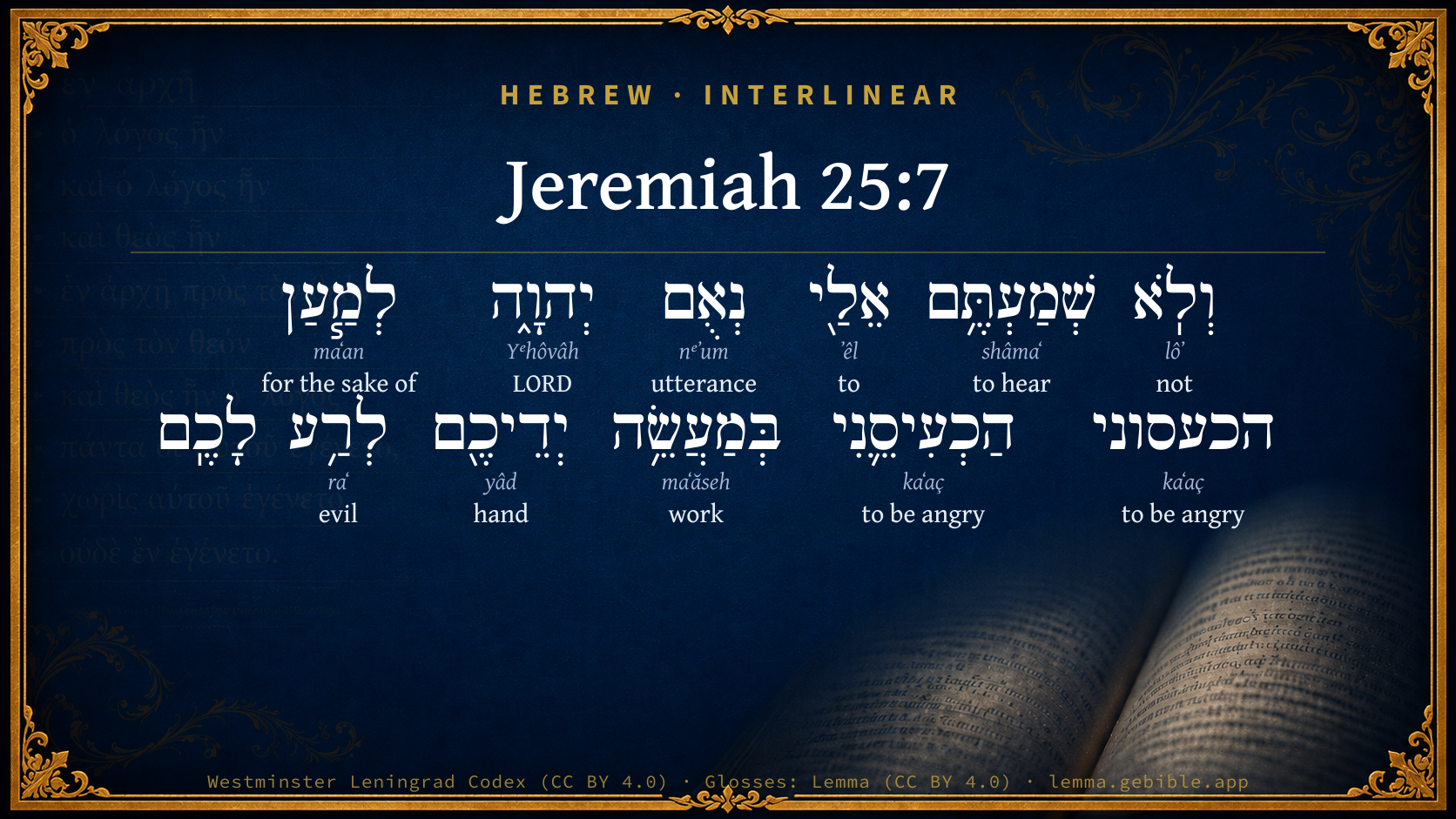
Hebrew (Westminster Leningrad Codex) Jeremiah 25:7 appears in the Hebrew Old Testament. The text above is from the Westminster Leningrad Codex. Each word links to its Strong’s number, a concise gloss, and parsing drawn from the Open Scriptures Hebrew Bible morphology. Click any word for its full Brown-Driver-Briggs (BDB) entry.
Download image
Cite this verse

Jeremiah 25:7 (World English Bible). Public Domain. Lemma interlinear Bible study tool, https://lemma.gebible.app/v/jeremiah/25/7.

Show BibTeX & RIS
BibTeX
RIS
English Translation
Yet you have not listened to me, says Yahweh; that you may provoke me to anger with the work of your hands to your own hurt.
World English Bible · Public Domain
Download a study sheet

One document with this verse’s original text, its word-by-word gloss line, the meaning frame, cross-references with their text, attributed commentary, and full source and license credits — printable, and it pastes into notes with its structure intact.

This verse Autodidact and up

Study sheet (.html) Plain text (.txt)

A passage Seminary Student

Up to 50 verses in one chapter. A passage sheet keeps up to 6 commentary sources and 12 cross-references per verse, in the order this page ranks them, and says so on the sheet whenever that leaves anything out. Ask for a single verse and you get the Autodidact verse sheet above.

Everything on this page stays free to read, with no account — the sheet is a download of what is already on screen, not access to it.

Want to remove ads? Support Godless Engineer
Compare translations 3

The same verse in 3 English versions, stacked beneath the original-language interlinear above. Click any original word for its lexicon entry.

Each is an independent rendering of the whole verse — the interlinear is not word-aligned to these translations.

Highlighted words mark where these versions differ — a whole-verse word diff, not a word-by-word alignment.

  • World English Bible Public Domain
    Yet you have not listened to me, says Yahweh; that you may provoke me to anger with the work of your hands to your own hurt.
  • King James Version Public Domain
    Yet ye have not hearkened unto me, saith the LORD; that ye might provoke me to anger with the works of your hands to your own hurt.
  • unfoldingWord Literal Text CC BY-SA 4.0
    Yet you have not listened to me”—the declaration of Yahweh—“so as to provoke me to anger with the work of your hands, to harm.

unfoldingWord Literal Text — © unfoldingWord, licensed CC BY-SA 4.0. Word-aligned USFM3 via Door43 (git.door43.org/unfoldingWord/en_ult).

Versions to compare (up to 4)

3 of 4 selected

Show all 18 translations

Every available English version of this verse, each an independent rendering of the whole verse.

  • World English Bible Public Domain
    Yet you have not listened to me, says Yahweh; that you may provoke me to anger with the work of your hands to your own hurt.
  • Berean Standard Bible Public Domain
    ‘But to your own harm, you have not listened to Me,’ declares the LORD, ‘so you have provoked Me to anger with the works of your hands.’
  • Majority Standard Bible Public Domain
    ‘But to your own harm, you have not listened to Me,’ declares the LORD, ‘so you have provoked Me to anger with the works of your hands.’
  • King James Version Public Domain
    Yet ye have not hearkened unto me, saith the LORD; that ye might provoke me to anger with the works of your hands to your own hurt.
  • American Standard Version (1901) Public Domain
    Yet ye have not hearkened unto me, saith Jehovah; that ye may provoke me to anger with the work of your hands to your own hurt.
  • Revised Version (1885) Public Domain
    Yet ye have not hearkened unto me, saith the LORD; that ye might provoke me to anger with the work of your hands to your own hurt.
  • Geneva Bible (1599) Public Domain
    Neuerthelesse ye would not heare me, saith the Lord, but haue prouoked mee to anger with the workes of your hands to your owne hurt.
  • Douay-Rheims (1899) Public Domain
    And you have not heard me, saith the Lord, that you might provoke me to anger with the works of your hands, to your own hurt.
  • Young's Literal Translation Public Domain
    And ye have not hearkened unto Me -- an affirmation of Jehovah -- so as to provoke Me to anger with the work of your hands for evil to you.
  • Literal Standard Version CC BY-SA 4.0
    and you have not listened to Me,” a declaration of YHWH, “so as to provoke Me to anger with the work of your hands for evil to you.
  • Unlocked Literal Bible CC BY-SA 4.0
    But you have not listened to me—this is Yahweh's declaration—so you have provoked me with the work of your hands to do harm to you.
  • unfoldingWord Literal Text CC BY-SA 4.0
    Yet you have not listened to me”—the declaration of Yahweh—“so as to provoke me to anger with the work of your hands, to harm.
  • Darby Bible Public Domain
    But ye have not hearkened unto me, saith Jehovah; that ye might provoke me to anger with the work of your hands, to your own hurt.
  • World Messianic Bible Public Domain
    “Yet you have not listened to me,” says the LORD, “that you may provoke me to anger with the work of your hands to your own hurt.”
  • Webster's Bible Public Domain
    Yet ye have not hearkened to me, saith the LORD; that ye might provoke me to anger with the works of your hands to your own hurt.
  • Free Bible Version CC BY-SA 4.0
    But you've hurt yourselves by not listening to me, declares the Lord, because you angered me by making idols.
  • Bible in Basic English Public Domain
    But you have not given ear to me, says the Lord; so that you have made me angry with the work of your hands, causing evil to yourselves.
  • JPS Tanakh (1917) Public Domain
    Yet ye have not hearkened unto Me, saith the LORD; that ye might provoke Me with the work of your hands to your own hurt.

Literal Standard Version (2020), Covenant Press — licensed CC BY-SA 4.0. Text via the HelloAO Bible API (eBible.org). Unlocked Literal Bible (unfoldingWord) — licensed CC BY-SA 4.0. Text via the HelloAO Bible API (eBible.org). unfoldingWord Literal Text — © unfoldingWord, licensed CC BY-SA 4.0. Word-aligned USFM3 via Door43 (git.door43.org/unfoldingWord/en_ult). Free Bible Version, Dr. Jonathan Gallagher — licensed CC BY-SA 4.0. Text via the HelloAO Bible API (eBible.org).

Word by word

More ways to search: Search by grammar → Find every occurrence → Compare this word →

Practice this passage: Drill this verse → Learn its vocabulary →

הכעסוני
kaʻaç
H3707
“to be angry · me”
Verb, Hiphil, Perfect, 3rd Person, Common, Plural + Suffix, Personal, 1st Person, Common, Singular
Part of Speech
Verb
Stem
Hiphil
Form
Perfect
Person
3rd Person
Gender
Common
Number
Plural
Full BDB Definition

Origin: a primitive root

TWOT: 1016

to be angry, be vexed, be indignant, be wroth, be grieved, provoke to anger and wrath - (Qal) - to be vexed, be indignant - to be angry - (Piel) to provoke to anger - (Hiphil) - to vex - to vex, provoke to anger
  1. וְלֹֽא lôʼ H3808 “and · not” Conjunction + Particle, Negative
  2. שְׁמַעְתֶּ֥ם shâmaʻ H8085 “to hear” Verb, Qal, Perfect, 2nd Person, Masculine, Plural
  3. אֵלַ֖י ʼêl H413 “to · me” Preposition + Suffix, Personal, 1st Person, Common, Singular
  4. נְאֻם nᵉʼum H5002 “utterance of” Noun, Common, Masculine, Singular, Construct
  5. יְהוָ֑ה Yᵉhôvâh H3068 “LORD” Noun, Proper
  6. לְמַ֧עַן maʻan H4616 “for the sake of” Preposition
  7. הַכְעִיסֵ֛נִי kaʻaç H3707 “to be angry · me” Verb, Hiphil, Infinitive Construct + Suffix, Personal, 1st Person, Common, Singular
  8. בְּמַעֲשֵׂ֥ה maʻăseh H4639 “in/at · work of” Preposition + Noun, Common, Masculine, Singular, Construct
  9. יְדֵיכֶ֖ם yâd H3027 “hands · your” Noun, Common, Both, Dual, Construct + Suffix, Personal, 2nd Person, Masculine, Plural
  10. לְרַ֥ע raʻ H7451 “to/for · evil” Preposition + Adjective, Adjective, Masculine, Singular, Absolute

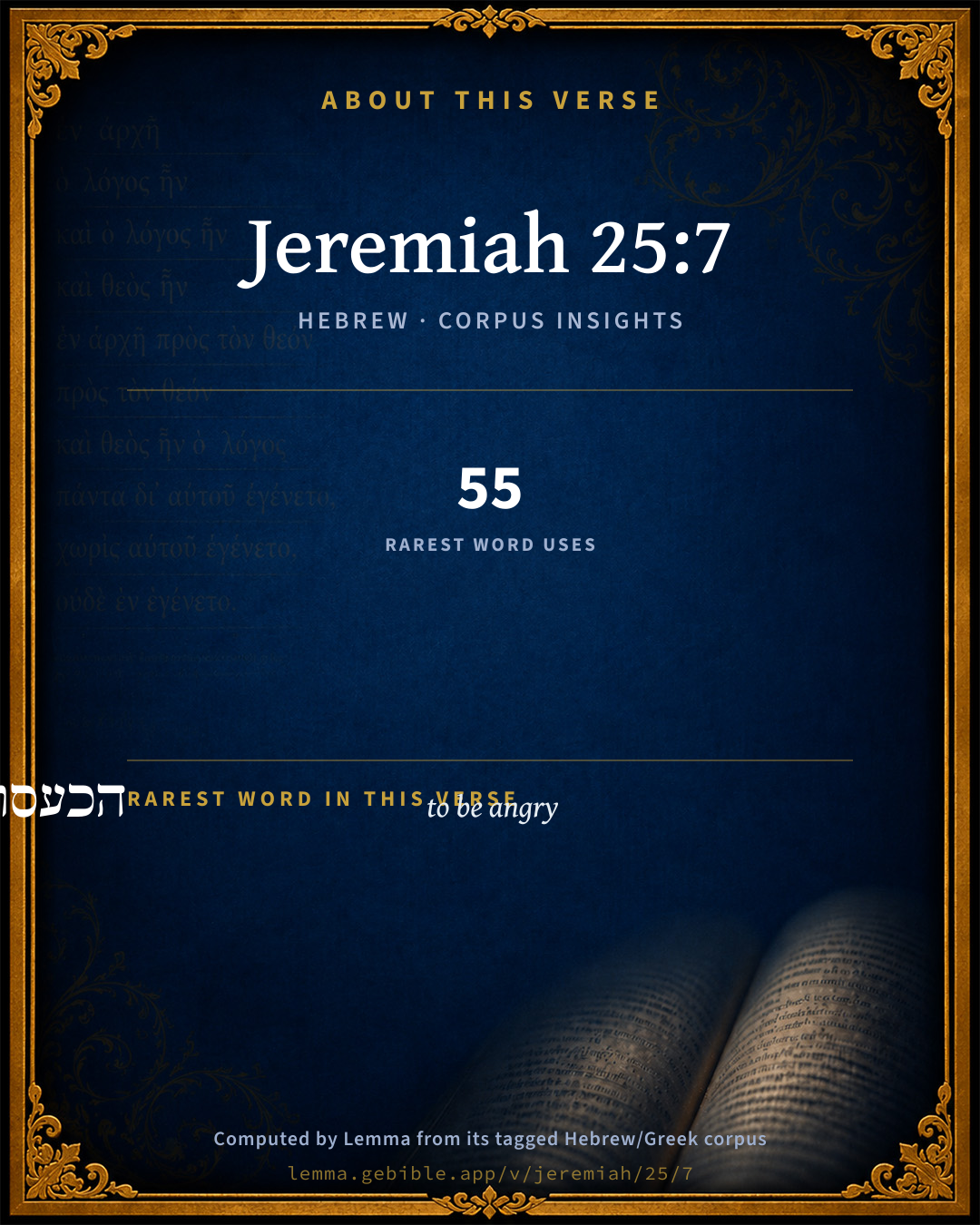
About this verse

These counts appear in no published source. They are computed here, from the morphology-tagged text and Lemma’s own curated glosses. What Lemma adds →

12
words
10
distinct lemmas
Prophets
section

Shared distinctive vocabulary

הכעסוני to be angry H3707 occurs in 53 verses of the Hebrew Bible. Also found in:

Grammatical profile

  • 3 verbs
  • 4 nouns
  • 1 adjective
  • 3 prepositions
  • 1 particle

Verb forms

  • שְׁמַעְתֶּ֥ם Qal · Perfect
  • הכעסוני Hiphil · Perfect
  • הַכְעִיסֵ֛נִי Hiphil · Infinitive Construct

Repetition

A word recurs within this verse — often emphatic in Hebrew:

  • הכעסוני to be angry H3707 ×2

Cross-references

7

Topical passages linked to Jeremiah 25:7 in the Treasury of Scripture Knowledge — connected by theme and wording, ordered by reader-vote popularity; previews shown in the World English Bible.

  • 2 Kings 21:15 because they have done that which is evil in my sight, and have provoked me to anger, since the day their fathers came forth out of Egypt, even to this day.
  • Proverbs 8:36 But he who sins against me wrongs his own soul. All those who hate me love death."
  • Deuteronomy 32:21 They have moved me to jealousy with that which is not God; They have provoked me to anger with their vanities: I will move them to jealousy with those who are not a people; I will provoke them to anger with a foolish nation.
  • 2 Kings 17:17 They caused their sons and their daughters to pass through the fire, and used divination and enchantments, and sold themselves to do that which was evil in the sight of Yahweh, to provoke him to anger.
  • Nehemiah 9:26 Nevertheless they were disobedient, and rebelled against you, and cast your law behind their back, and killed your prophets that testified against them to turn them again to you, and they committed awful blasphemies.
  • Jeremiah 7:18–19 The children gather wood, and the fathers kindle the fire, and the women knead the dough, to make cakes to the queen of the sky, and to pour out drink-offerings to other gods, that they may provoke me to anger.
  • Jeremiah 32:30–33 For the children of Israel and the children of Judah have done only that which was evil in my sight from their youth; for the children of Israel have only provoked me to anger with the work of their hands, says Yahweh.

Cross-references courtesy of OpenBible.info (CC BY 4.0).

Hebrew and Greek witnesses Masoretic Hebrew ↔ Greek Septuagint

The same verse in the two great witnesses to the Old Testament, shown verse-for-verse.

These are two independent witnesses, not word-aligned to each other, and the Septuagint is shown in lemma (dictionary) form.

Hebrew Jeremiah 25:7 Masoretic · Westminster Leningrad Codex

וְלֹֽא שְׁמַעְתֶּ֥ם אֵלַ֖י נְאֻם יְהוָ֑ה לְמַ֧עַן הכעסוני הַכְעִיסֵ֛נִי בְּמַעֲשֵׂ֥ה יְדֵיכֶ֖ם לְרַ֥ע לָכֶֽם

Yet you have not listened to me, says Yahweh; that you may provoke me to anger with the work of your hands to your own hurt.

World English Bible · Public Domain

Greek LXX Structure differs

In the Septuagint, Jeremiah is about an eighth shorter than the Hebrew and arranges its material differently — the Oracles Against the Nations (Hebrew chapters 46–51) appear in the middle of the Greek book, after 25:13. Because the chapter and verse boundaries do not line up, a verse-for-verse comparison with the Hebrew is not shown.

A verse-for-verse comparison isn’t shown here because the chapters and verses don’t line up. Switch to the LXX edition with the MT / LXX toggle above to read the Greek directly.

Hebrew: Westminster Leningrad Codex (CC BY 4.0). Greek: Septuagint (public domain); English from a public-domain English Septuagint. How the Septuagint differs from the Hebrew →

Targum (Aramaic paraphrase)

1

The Targum is the ancient Jewish Aramaic paraphrase of the Hebrew Scriptures — an interpretive translation, not the Hebrew text itself. Onkelos (literal) and Pseudo-Jonathan (expansive) render the Torah, and Jonathan the Prophets. Coverage is partial: where no permissively-licensed English translation exists for a verse, only the Aramaic is shown. This is verse-level text, not a word-by-word alignment to the Hebrew.

  1. Targum Jonathan Prophets (Joshua–Malachi)
    וְלָא קַבֵּילְתּוּן לְמֵימְרִי אֲמַר יְיָ בְּדִיל דְלָא לְאַרְגָזָא קָדָמַי בְּעוֹבָדֵי יְדֵיכוֹן לְאַבְאָשָׁא לְכוֹן:

    (no public-domain English translation for this verse)

    Targum Jonathan — Aramaic: “Mikraot Gedolot” (public domain). English: “Sefaria Community Translation” (CC0 1.0 (public-domain dedication)); “London "Chaldee Paraphrase," 1871” (public domain). Text via Sefaria.

Commentary

Notes on Jeremiah 25:7 from classic Christian and Jewish commentators (each source and its license shown beneath its notes). The classic Christian expositions comment on the surrounding passage and are grouped to its opening verse, so a note may address several verses; the Jewish commentaries on the Tanakh (Rashi and others) are per-verse, so they appear only where the commentator wrote on this verse.

Lemma curates 59 commentaries, every one of them public domain or Creative Commons licensed, each selected and text-cleaned for this edition rather than reprinted as found. About our sources →

Trapp's Complete Commentary

John Trapp

Jer 25:7 Yet ye have not hearkened unto me, saith the LORD; that ye might provoke me to anger with the works of your hands to your own hurt.

Ver. 7. That ye might provoke me.] See Jer 7:17-18.

John Trapp, A Commentary or Exposition upon All the Books of the Old and New Testament (1647–1656) — public domain. Text from a community e-Sword module.

Tyndale Open Study Notes

Tyndale Open Resources

25:7-9 The people had not listened to the Lord’s decrees to turn from their evil ways; instead, they kept worshiping idols. So the Lord would completely destroy them.

Tyndale Open Study Notes — © Tyndale Open Resources, licensed CC BY-SA 4.0. Text via the HelloAO Bible API.

Jamieson, Fausset & Brown

Robert Jamieson, A. R. Fausset & David Brown

Though ye provoke Me to anger (Deu 32:21), yet it is not I, but yourselves, whom ye thereby hurt (Pro 8:36; Pro 20:2).

Jamieson, Fausset & Brown — Commentary Critical and Explanatory on the Whole Bible (1871) — public domain (CC PDM 1.0). Text via the HelloAO Bible API.

Adam Clarke's Commentary

Verse 7. That ye might provoke] Ye would not hearken; but chose to provoke me with anger.

Adam Clarke's Commentary on the Bible (1810–1826) — public domain. Text from a community e-Sword/MySword module.

John Calvin's Commentaries

He proves what he had said before, that the Jews had been wholly disobedient, though God had kindly offered and shewed that he would be reconciled to them, provided they turned from the heart to him. The fact that this message was not received by the Jews, was an evidence of extreme and irreclaimable obstinacy. And he enhances their guilt by saying, that ye might provoke me; for he intimates that they were led away to evil by a voluntary purpose, as though they wished to provoke God. The Prophet, then, by saying that ye might provoke me, accuses them of deliberate wickedness. It, indeed, often happens that men go astray through ignorance, and do not attend because no one warns them; but since God had so many times exhorted the Jews to repent, no other opinion could have been formed of them, but that they designedly wished, not only to despise God, but also to provoke him to the contest.

And this is what we ought carefully to notice, for whosoever has been taught the will of God, unless he obeys, he cannot escape the charge of a voluntary obstinacy, as he has resolved, as it were, to carry on war with God. Though the ungodly do not confess this, yet the fact is evident; and God, who is a righteous judge, has declared that they who despised the prophetic doctrine were so regarded.

And he says, for evil to you, in order that they might know that God did not plead his own cause because he stood in need of their service, but that he cared for their welfare. For there is to be understood here an implied contrast, as though the Prophet had said, “What loss has God suffered by your perverseness? Ye have, indeed, tried to deprive him of his glory, for ye have adorned your idols by spoils taken from him; but it is not in men’s power to subtract anything from the rights of God; he remains ever perfect: then it only turns out to your ruin when ye are rebellious. When, therefore, God now reproves you, he does not maintain his own right, as though he received any gain or loss from you; but it is an evidence of his mercy, because he would not have you to perish, though he sees that you are led into destruction by an insane impulse.” It afterwards follows, —

John Calvin's Commentaries (1540-1563) — public domain. Text from the Calvin Translation Society English edition (1840s-50s) via the Christian Classics Ethereal Library (ccel.org). Calvin's coverage is partial (roughly two-thirds of the Bible); uncommented books and verses are honest gaps, never fabricated. The 19th-century editor's footnotes and remarks are omitted so the notes are faithfully Calvin's own voice.

The Cambridge Bible for Schools and Colleges

gen. ed. J. J. S. Perowne

7. unto me] i.e. Jeremiah.

saith the Lord] The words were inserted through the same error which led to the insertion of Jer_25:4.

that ye might … own hurt] The gloss was suggested by the similar language of Jer_25:6.

work of your hands] idols. Cp. Jer_10:3; Jer_10:9, Jer_32:30; Deu_31:29.

The Cambridge Bible for Schools and Colleges (gen. ed. J. J. S. Perowne; Cambridge University Press, 1878–1918) — public domain. Text from a community e-Sword module.

John Gill's Exposition

Yet ye have not hearkened unto me, saith the Lord,.... Though it was he that spake unto them by his prophets; and though it was so much to their own good and advantage; and the neglect of him and his word were so much to their disadvantage, and even ruin:

that ye might provoke me to anger with the works of your hands, to your own hurt: which, though not signed to do either, yet eventually did both; both provoked the Lord, and brought destruction upon themselves; for whatever is against the glory of God is to the hurt of man; and whatever provokes him is pernicious to them in its consequences.

John Gill's Exposition of the Whole Bible (1746–1763) — public domain (CC PDM 1.0). Text via the HelloAO Bible API.

Matthew Poole's English Annotations

Ye heard me and other the Lord’s prophets thus speaking to you, but you did not obey and hearken. As if you had done it on purpose to incense me against you, who am of myself slow to wrath, and must be provoked to execute vindictive justice by men’s own wicked works; which do not otherwise affect or hurt me, but are to their hurt who do them.

Matthew Poole's English Annotations on the Holy Bible (1683–1685) — public domain. Text from a community e-Sword/MySword module.

The Pulpit Commentary

Vers. 7-11. Judgment plainly declared.

The agents of the visitation are more precisely defined than hitherto, and the leader of the invasion is actually named. The extent also of the region to be devastated, and the time the captivity is to last, viz. seventy years, are set forth.

I THIS TENDED TO HEIGHTEN THE MORAL CONSCIOUSNESS OF THE PEOPLE. A vague indefinite calamity or series of calamities would have failed to strike deeply enough into the conscience of the transgressors; whereas a precisely marked off and defined set of occurrences could not be misunderstood.

1. The nearness and inevitable character of the judgment are thereby realized.

2. It is seen to be imposed by the moral government of God. "My servant." God permits, nay, appoints, Nebuchadnezzar.

II IT PRESENTED THE PERIOD OF CALAMITY AS PART OF AN ORDERED WHOLE, WITH A DEFINITE OVERCOME AND OBJECT. Great as the trial would be, it was nevertheless a measured and therefore a bearable one. There need be no wild abandonment to despair. The believer could possess his soul in patience. The allurements of heathenism would lose much of their power. A quiet, reverent, and repentant study of the meaning of the dispensation would be encouraged; and in this way it would act as discipline for the future. We can never be certain as to the limits of our trials; but we have the assurance that our Savior, who has a fellow-feeling with his people, will not impose anything above what we are able to bear. And through the revelation of spirituality in the gospel, and the greater spiritualization of our hopes and aims through its teaching, we are able with greater calmness to contemplate our "light affliction, which is but for a moment.

III THE PROPHECY WAS THEREBY PROVED TO BE GENUINE, AND THE PROVIDENCE OF GOD REVEALED BEYOND DISPUTE. As if conscious of this, Jeremiah for the first time calls himself "the prophet," when he has fairly committed himself to exact dates and personages. It would be open to the survivors of that predicted dispensation to denounce him an impostor, and to discredit the practice of prophesying. But the seer was certain; and the verdict of history confirms his forecast, and demonstrates that it was no ex post facto fabrication, but real Divine foreknowledge of events yet future. M.

The Pulpit Commentary (1880–1919), ed. H.D.M. Spence-Jones & Joseph S. Exell — public domain. Text from a community e-Sword module.

unfoldingWord translationNotes

Door43 World Missions Community

this is Yahweh's declaration

Yahweh speaks of himself by name to express the certainty of what he is declaring. See how you translated this in Jeremiah 1:8. AT: "this is what Yahweh has declared" or "this is what I, Yahweh, have declared" (See: First, Second, or Third Person)

you have provoked me with the work of your hands to do harm to you

See how you translated a similar phrase in Jeremiah 25:6. Possible meanings for the phrase "the work of your hands" are 1) it is a reference to the idols that the people have made with their hands. AT: "you have provoked me to harm you because of the idols that you have made with your hands" or 2) It is an idiom that refers to the actions of a person, with the word "hands" being a synecdoche that represents the person who does those actions. AT: "you have provoked me to harm you because of the things that you do" (See: Assumed Knowledge and Implicit Information and Synecdoche and Idiom)

to do harm to you

"so that I do harm to you"

Yahweh of hosts says this

Jeremiah often uses these words to introduce an important message from Yahweh. See how you translated this in Jeremiah 6:6.

see

"look" or "listen" or "pay attention to what i am about to tell you"

bring them against this land

The idiom to "bring ... against this land" means that they will attack the people who live in the land. AT: "bring them to attack this land" (See: Idiom)

I will set them apart for destruction

The idiom "set ... apart for destruction" means to destroy something completely. AT: "I will destroy them completely" (See: Idiom)

I will turn them into a horror

The word "horror" may be translated with a verbal phrase. AT: "I will turn them into something that horrifies people" (See: Abstract Nouns)

an object for hissing

The word "hissing" refers to a sound that shows strong disapproval and can be translated with a verbal phrase. AT: "an object at which people will hiss"

translationWords

Yahweh of hosts

send

command

nation

horror

desolate

unfoldingWord translationNotes — © Distant Shores Media and the Door43 World Missions Community, licensed CC BY-SA 4.0. Source: git.door43.org/Door43/en_tn.

Lesson kit

Teaching starters — assembled from the data on this page, not authored interpretation. Every prompt links to the verse data it draws on. Edit before teaching.

Jeremiah, in the Prophets, opens this verse with 12 words (10 distinct Hebrew lemmas). Its most distinctive word is kaʻaç (“to be angry”). A historical commentator’s framing appears above. Read the whole chapter for the surrounding context.

Discussion questions

  1. What does “to be angry” (kaʻaç) contribute to the verse as a whole?
  2. How does Deuteronomy 4:25, which shares the word «to be angry», read alongside this verse?
  3. What does the repetition of “to be angry” (2× in this one verse) do in this verse?
  4. The translations on this page render this verse differently — a whole-verse word diff, not a word-by-word alignment. What might account for the different wordings?
  5. «שְׁמַעְתֶּ֥ם» is a Qal Perfect verb. How does that grammatical form shape the action described?
  6. Compare how Trapp's Complete Commentary and Tyndale Open Study Notes read this verse. Where do they agree or differ?

Things to notice

Reading settings

Reading text

Shown beneath each verse's original-language words.

Old Testament
Old Testament edition

Read the OT as the Masoretic Hebrew (MT) or the Greek Septuagint (LXX).

English shown for the Greek Septuagint (in the Hebrew ↔ Greek comparison).

Comparing translations? Open the Compare panel on any verse page to stack up to four side by side.