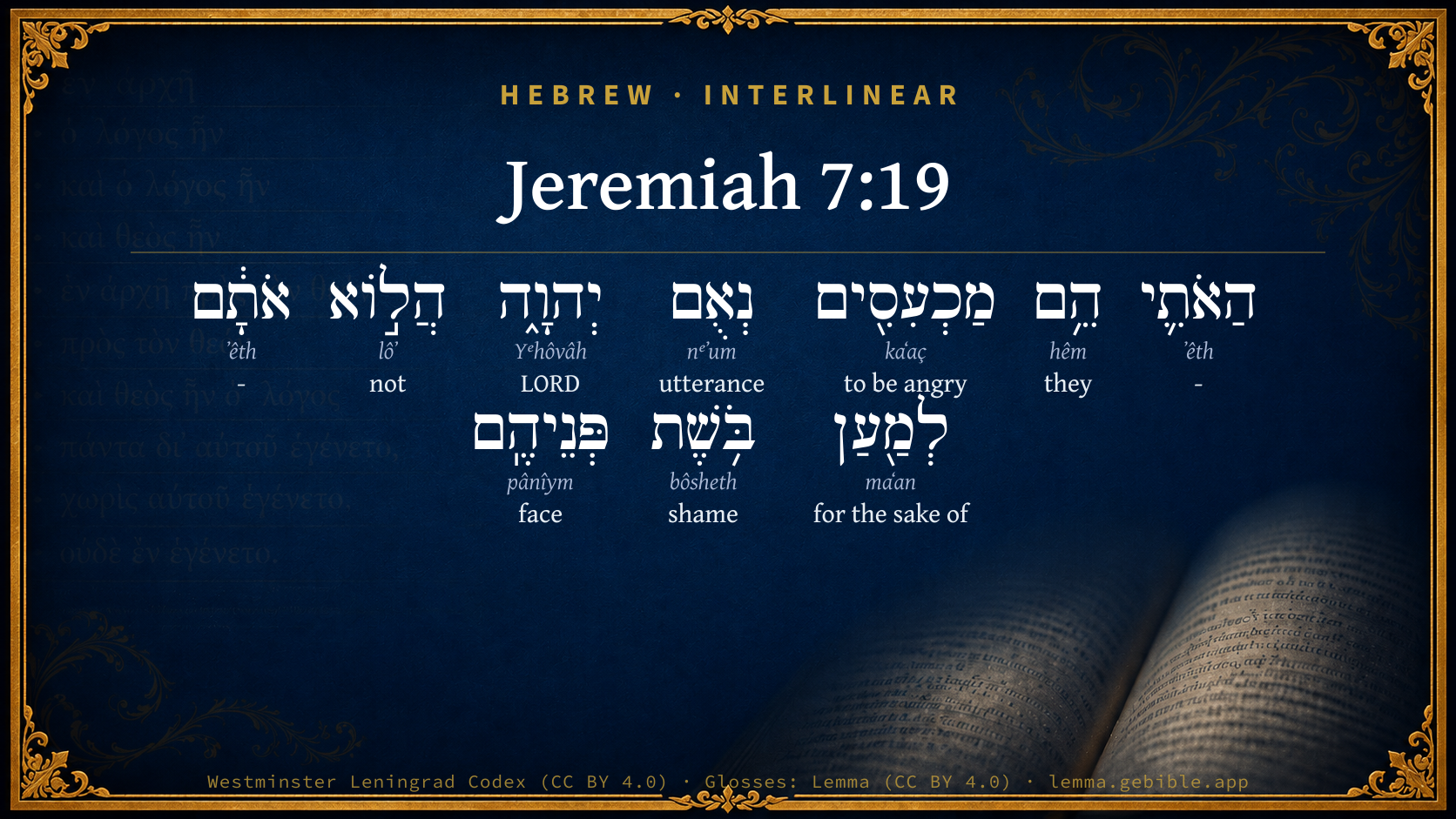
Jeremiah 7:19

Hebrew (Westminster Leningrad Codex) Jeremiah 7:19 appears in the Hebrew Old Testament. The text above is from the Westminster Leningrad Codex. Each word links to its Strong’s number, a concise gloss, and parsing drawn from the Open Scriptures Hebrew Bible morphology. Click any word for its full Brown-Driver-Briggs (BDB) entry.
Download image
Cite this verse

Jeremiah 7:19 (World English Bible). Public Domain. Lemma interlinear Bible study tool, https://lemma.gebible.app/v/jeremiah/7/19.

Show BibTeX & RIS
BibTeX
RIS
English Translation
Do they provoke me to anger? says Yahweh; [do they] not [provoke] themselves, to the confusion of their own faces?
World English Bible · Public Domain
Download a study sheet

One document with this verse’s original text, its word-by-word gloss line, the meaning frame, cross-references with their text, attributed commentary, and full source and license credits — printable, and it pastes into notes with its structure intact.

This verse Autodidact and up

Study sheet (.html) Plain text (.txt)

A passage Seminary Student

Up to 50 verses in one chapter. A passage sheet keeps up to 6 commentary sources and 12 cross-references per verse, in the order this page ranks them, and says so on the sheet whenever that leaves anything out. Ask for a single verse and you get the Autodidact verse sheet above.

Everything on this page stays free to read, with no account — the sheet is a download of what is already on screen, not access to it.

Want to remove ads? Support Godless Engineer
Compare translations 3

The same verse in 3 English versions, stacked beneath the original-language interlinear above. Click any original word for its lexicon entry.

Each is an independent rendering of the whole verse — the interlinear is not word-aligned to these translations.

Highlighted words mark where these versions differ — a whole-verse word diff, not a word-by-word alignment.

  • World English Bible Public Domain
    Do they provoke me to anger? says Yahweh; [do they] not [provoke] themselves, to the confusion of their own faces?
  • King James Version Public Domain
    Do they provoke me to anger? saith the LORD: do they not provoke themselves to the confusion of their own faces?
  • unfoldingWord Literal Text CC BY-SA 4.0
    Are they provoking me to anger?”—the declaration of Yahweh—“ not themselves, to the shame of their faces?

unfoldingWord Literal Text — © unfoldingWord, licensed CC BY-SA 4.0. Word-aligned USFM3 via Door43 (git.door43.org/unfoldingWord/en_ult).

Versions to compare (up to 4)

3 of 4 selected

Show all 18 translations

Every available English version of this verse, each an independent rendering of the whole verse.

  • World English Bible Public Domain
    Do they provoke me to anger? says Yahweh; [do they] not [provoke] themselves, to the confusion of their own faces?
  • Berean Standard Bible Public Domain
    But am I the One they are provoking? declares the LORD. Is it not themselves they spite, to their own shame?
  • Majority Standard Bible Public Domain
    But am I the One they are provoking? declares the LORD. Is it not themselves they spite, to their own shame?
  • King James Version Public Domain
    Do they provoke me to anger? saith the LORD: do they not provoke themselves to the confusion of their own faces?
  • American Standard Version (1901) Public Domain
    Do they provoke me to anger? saith Jehovah; `do they' not `provoke' themselves, to the confusion of their own faces?
  • Revised Version (1885) Public Domain
    Do they provoke me to anger? saith the LORD; do they not provoke themselves, to the confusion of their own faces?
  • Geneva Bible (1599) Public Domain
    Doe they prouoke me to anger, sayeth the Lord, and not themselues to the confusion of their owne faces?
  • Douay-Rheims (1899) Public Domain
    Do they provoke me to anger, saith the Lord? Is it not themselves, to the confusion of their contenance?
  • Young's Literal Translation Public Domain
    Me are they provoking to anger? an affirmation of Jehovah, Is it not themselves, For the shame of their own faces?
  • Literal Standard Version CC BY-SA 4.0
    Are they provoking Me to anger?” A declaration of YHWH, “Is it not themselves, || For the shame of their own faces?”
  • Unlocked Literal Bible CC BY-SA 4.0
    Are they truly provoking me?—this is Yahweh's declaration—is it not themselves whom they are provoking, so that shame is on them?
  • unfoldingWord Literal Text CC BY-SA 4.0
    Are they provoking me to anger?”—the declaration of Yahweh—“ not themselves, to the shame of their faces?
  • Darby Bible Public Domain
    Is it I whom they provoke to anger? saith Jehovah; is it not themselves, to the shame of their own face?
  • World Messianic Bible Public Domain
    Do they provoke me to anger?” says the LORD. “Don’t they provoke themselves, to the confusion of their own faces?”
  • Webster's Bible Public Domain
    Do they provoke me to anger? saith the LORD: do they not provoke themselves to the confusion of their own faces?
  • Free Bible Version CC BY-SA 4.0
    But is it really me they're hurting? declares the Lord. Aren't they really hurting themselves and bringing shame on themselves?
  • Bible in Basic English Public Domain
    Are they moving me to wrath? says the Lord; are they not moving themselves to their shame?
  • JPS Tanakh (1917) Public Domain
    Do they provoke Me? saith the LORD; do they not provoke themselves, to the confusion of their own faces?

Literal Standard Version (2020), Covenant Press — licensed CC BY-SA 4.0. Text via the HelloAO Bible API (eBible.org). Unlocked Literal Bible (unfoldingWord) — licensed CC BY-SA 4.0. Text via the HelloAO Bible API (eBible.org). unfoldingWord Literal Text — © unfoldingWord, licensed CC BY-SA 4.0. Word-aligned USFM3 via Door43 (git.door43.org/unfoldingWord/en_ult). Free Bible Version, Dr. Jonathan Gallagher — licensed CC BY-SA 4.0. Text via the HelloAO Bible API (eBible.org).

Word by word

More ways to search: Search by grammar → Find every occurrence → Compare this word →

Practice this passage: Drill this verse → Learn its vocabulary →

About this verse

These counts appear in no published source. They are computed here, from the morphology-tagged text and Lemma’s own curated glosses. What Lemma adds →

10
words
9
distinct lemmas
Prophets
section

Shared distinctive vocabulary

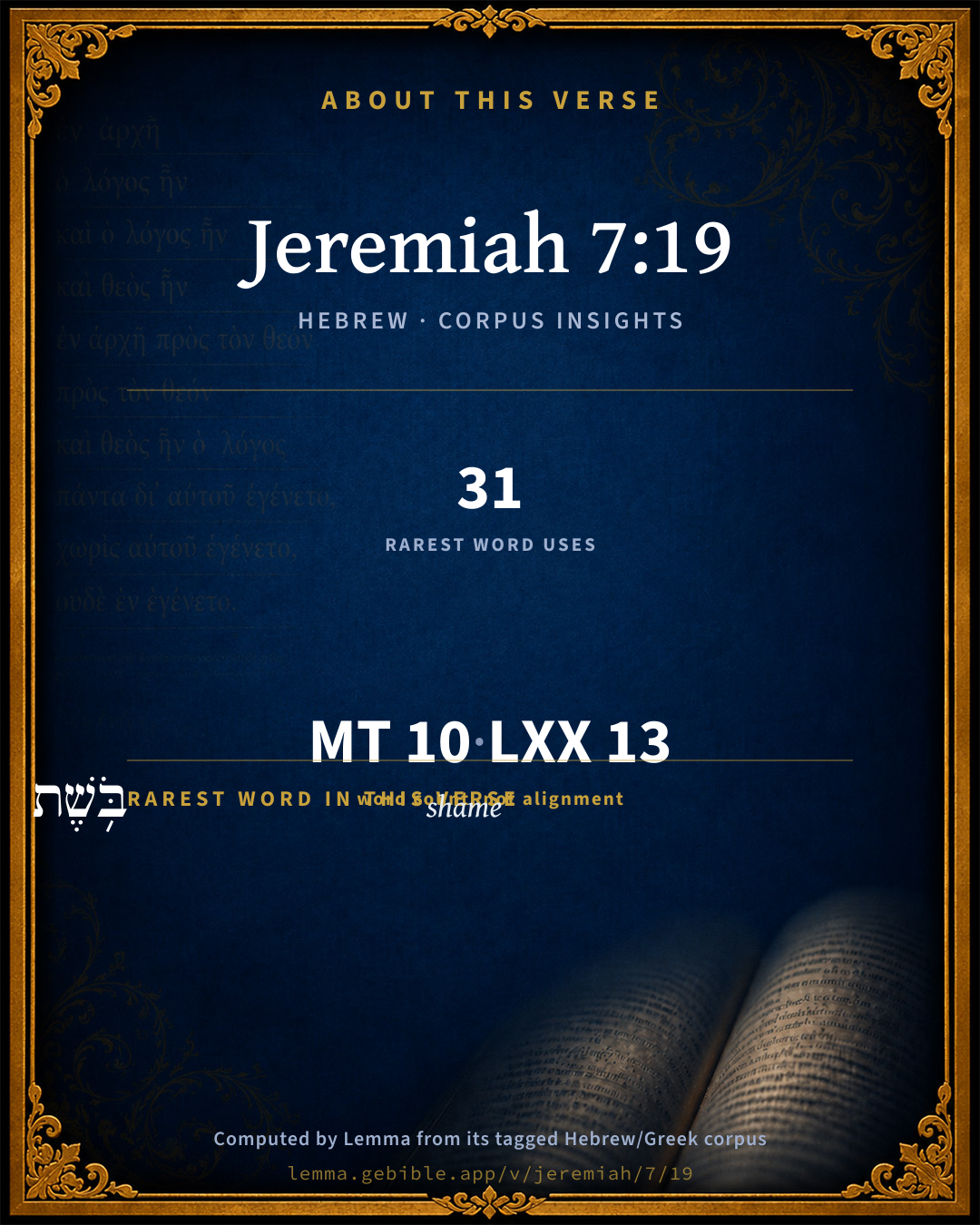
בֹּ֥שֶׁת shame H1322 occurs in 30 verses of the Hebrew Bible. Also found in:

Grammatical profile

  • 1 verb
  • 4 nouns
  • 1 pronoun
  • 1 preposition
  • 3 particles

Verb forms

  • מַכְעִסִ֖ים Hiphil · Participle Active

Hebrew & Septuagint length

In the original languages it is 10 Hebrew tokens and 13 Greek tokens — but the two are counted differently (Hebrew bundles its prefixes and suffixes into one token; the Greek is in lemma form), so that isn’t a like-for-like length.

Cross-references

14

Topical passages linked to Jeremiah 7:19 in the Treasury of Scripture Knowledge — connected by theme and wording, ordered by reader-vote popularity; previews shown in the World English Bible.

  • Job 35:6 If you have sinned, what effect do you have against him? If your transgressions are multiplied, what do you do to him?
  • Jeremiah 2:19 Your own wickedness shall correct you, and your backsliding shall reprove you: know therefore and see that it is an evil thing and a bitter, that you have forsaken Yahweh your God, and that my fear is not in you, says the Lord, Yahweh of Hosts.
  • Jeremiah 9:19 For a voice of wailing is heard out of Zion, How are we ruined! we are greatly confounded, because we have forsaken the land, because they have cast down our dwellings.
  • Jeremiah 20:11 But Yahweh is with me as an awesome mighty one: therefore my persecutors shall stumble, and they shall not prevail; they shall be utterly disappointed, because they have not dealt wisely, even with an everlasting dishonor which shall never be forgotten.
  • Ezekiel 8:17–18 Then he said to me, Have you seen [this], son of man? Is it a light thing to the house of Judah that they commit the abominations which they commit here? for they have filled the land with violence, and have turned again to provoke me to anger: and, behold, they put the branch to their nose.
  • Daniel 9:7–8 Lord, righteousness belongs to you, but to us confusion of face, as at this day; to the men of Judah, and to the inhabitants of Jerusalem, and to all Israel, who are near, and who are far off, through all the countries where you have driven them, because of their trespass that they have trespassed against you.
  • 1 Corinthians 10:22 Or do we provoke the Lord to jealousy? Are we stronger than he?
  • Deuteronomy 32:16 They moved him to jealousy with strange [gods]; With abominations provoked they him to anger.
  • Deuteronomy 32:21–22 They have moved me to jealousy with that which is not God; They have provoked me to anger with their vanities: I will move them to jealousy with those who are not a people; I will provoke them to anger with a foolish nation.
  • Ezra 9:7 Since the days of our fathers we have been exceeding guilty to this day; and for our iniquities have we, our kings, and our priests, been delivered into the hand of the kings of the lands, to the sword, to captivity, and to plunder, and to confusion of face, as it is this day.
  • Isaiah 1:20 But if you refuse and rebel, you shall be devoured with the sword; For the mouth of Yahweh has spoken it."
  • Isaiah 1:24 Therefore the Lord, Yahweh of Hosts, The Mighty One of Israel, says: "Ah, I will get relief from my adversaries, And avenge myself of my enemies;
  • Isaiah 45:16 They shall be disappointed, yes, confounded, all of them; they shall go into confusion together who are makers of idols.
  • Jeremiah 2:17 Haven't you procured this to yourself, in that you have forsaken Yahweh your God, when he led you by the way?

Cross-references courtesy of OpenBible.info (CC BY 4.0).

Hebrew and Greek witnesses Masoretic Hebrew ↔ Greek Septuagint

The same verse in the two great witnesses to the Old Testament, shown verse-for-verse.

These are two independent witnesses, not word-aligned to each other, and the Septuagint is shown in lemma (dictionary) form.

Hebrew Jeremiah 7:19 Masoretic · Westminster Leningrad Codex

הַאֹתִ֛י הֵ֥ם מַכְעִסִ֖ים נְאֻם יְהוָ֑ה הֲל֣וֹא אֹתָ֔ם לְמַ֖עַן בֹּ֥שֶׁת פְּנֵיהֶֽם

Do they provoke me to anger? says Yahweh; [do they] not [provoke] themselves, to the confusion of their own faces?

World English Bible · Public Domain

Greek LXX Structure differs

In the Septuagint, Jeremiah is about an eighth shorter than the Hebrew and arranges its material differently — the Oracles Against the Nations (Hebrew chapters 46–51) appear in the middle of the Greek book, after 25:13. Because the chapter and verse boundaries do not line up, a verse-for-verse comparison with the Hebrew is not shown.

A verse-for-verse comparison isn’t shown here because the chapters and verses don’t line up. Switch to the LXX edition with the MT / LXX toggle above to read the Greek directly.

Hebrew: Westminster Leningrad Codex (CC BY 4.0). Greek: Septuagint (public domain); English from a public-domain English Septuagint. How the Septuagint differs from the Hebrew →

Targum (Aramaic paraphrase)

1

The Targum is the ancient Jewish Aramaic paraphrase of the Hebrew Scriptures — an interpretive translation, not the Hebrew text itself. Onkelos (literal) and Pseudo-Jonathan (expansive) render the Torah, and Jonathan the Prophets. Coverage is partial: where no permissively-licensed English translation exists for a verse, only the Aramaic is shown. This is verse-level text, not a word-by-word alignment to the Hebrew.

  1. Targum Jonathan Prophets (Joshua–Malachi)
    הַמְדַמַי דִי קָדָמַי אִינוּן מְרַגְזִין אֲמַר יְיָ הֲלָא לְאַבְאָשָׁא לְהוֹן בְּדִיל דְיִבְהַּתוּן בְּעוֹבָדֵיהוֹן:

    (no public-domain English translation for this verse)

    Targum Jonathan — Aramaic: “Mikraot Gedolot” (public domain). English: “Sefaria Community Translation” (CC0 1.0 (public-domain dedication)); “London "Chaldee Paraphrase," 1871” (public domain). Text via Sefaria.

Commentary

Notes on Jeremiah 7:19 from classic Christian and Jewish commentators (each source and its license shown beneath its notes). The classic Christian expositions comment on the surrounding passage and are grouped to its opening verse, so a note may address several verses; the Jewish commentaries on the Tanakh (Rashi and others) are per-verse, so they appear only where the commentator wrote on this verse.

Lemma curates 59 commentaries, every one of them public domain or Creative Commons licensed, each selected and text-cleaned for this edition rather than reprinted as found. About our sources →

Trapp's Complete Commentary

John Trapp

Jer 7:19 Do they provoke me to anger? saith the LORD: [do they] not [provoke] themselves to the confusion of their own faces?

Ver. 19. Do they provoke me to anger?] i.e., Hurt they me by their provocations? or hope they to get the better of me, and to cause me to lay down the bucklers first? Surely, as Ulysses’s companions said to him, when he would needs provoke Polydamas, may we better say to such as provoke the Almighty,

“Sχετλιε, τιπτ δθελεις εριθεζεμεν αγριον ανδρα.”

Or as the wise man, "Contend not with him that is mightier than thou"; meddle with thy matchman.

John Trapp, A Commentary or Exposition upon All the Books of the Old and New Testament (1647–1656) — public domain. Text from a community e-Sword module.

Tyndale Open Study Notes

Tyndale Open Resources

7:19 God’s law was made for human benefit. Those who refused to follow his instructions hurt themselves (cp. Mark 2:27).

Tyndale Open Study Notes — © Tyndale Open Resources, licensed CC BY-SA 4.0. Text via the HelloAO Bible API.

Jamieson, Fausset & Brown

Robert Jamieson, A. R. Fausset & David Brown

Is it I that they provoke to anger? Is it not themselves? (Deu 32:16, Deu 32:21; Job 35:6, Job 35:8; Pro 8:36).

Jamieson, Fausset & Brown — Commentary Critical and Explanatory on the Whole Bible (1871) — public domain (CC PDM 1.0). Text via the HelloAO Bible API.

John Calvin's Commentaries

He then subjoins, Do they provoke me, and not rather to the shame of their own faces? God here intimates, that however reproachfully the Jews acted towards him, they yet brought no loss to him, for he stood in no need of their worship. Why then does he so severely threaten them? Because he had their sins in view: but yet he shews that he cared not for them nor their sacrifices, for he could without any loss be without them. Hence he says, that they sought their own ruin, and whatever they devised would fall on their own heads. They seek to provoke me; they shall know with whom they have to do.” It is like what is said by the Prophet Zechariah, “They shall know whom they have pierced: I indeed continue uninjured; and though they provoke me as much as they can, I yet despise all their wickedness, for they cannot reach me; they can neither hurt me nor take anything from me.” But he says, they provoke themselves, that is, their fury shall return on their own heads; and hence it shall be, that their faces shall be ashamed.

John Calvin's Commentaries (1540-1563) — public domain. Text from the Calvin Translation Society English edition (1840s-50s) via the Christian Classics Ethereal Library (ccel.org). Calvin's coverage is partial (roughly two-thirds of the Bible); uncommented books and verses are honest gaps, never fabricated. The 19th-century editor's footnotes and remarks are omitted so the notes are faithfully Calvin's own voice.

Ellicott's Commentary for English Readers

(19) Do they not provoke themselves . . .?—The interpolated words, though they complete the sense, mar the abrupt force of the Hebrew. Is it not themselves, to the confusion of their own faces?

A Bible Commentary for English Readers, edited by Charles John Ellicott (1878–1897) — public domain. Text from a community e-Sword module.

John Gill's Exposition

Do they provoke me to anger? saith the Lord,.... No: he cannot be provoked to anger as men are; anger does not fall upon him as it does on men; there is no such affection in God as there is in men; his Spirit cannot be irritated and provoked in the manner that the spirits of men may be; and though sin, and particularly idolatry, is disagreeable to him, contrary to his nature, and repugnant to his will; yet the damage arising from it is more to men themselves than to him; and though he sometimes does things which are like to what are done by men when they are angry, yet in reality there is no such perturbation in God as there is in men:

do they not provoke themselves to the confusion of their own faces? the greatest hurt that is done is done to themselves; they are the sufferers in the end; they bring ruin and destruction upon themselves; and therefore have great reason to be angry with themselves, since what they do issues in their own shame and confusion. The Targum is,

"do they think that they provoke me? saith the Lord; is it not for evil to themselves, that they may be confounded in their works?''

John Gill's Exposition of the Whole Bible (1746–1763) — public domain (CC PDM 1.0). Text via the HelloAO Bible API.

Albert Barnes' Notes on the Bible

Do they not provoke ... - literally, Is it not themselves (“that they provoke”) to the shame of their faces?

Albert Barnes' Notes on the Bible (1834–1885) — public domain. Text from a community e-Sword/MySword module.

Matthew Poole's English Annotations

Do they think to grieve me, and trouble my mind? They are deceived, I am without passion, and can be without their offerings. Will not they themselves feel the smart of it? Jer 7:6. Will they not procure anger to themselves, as an arrow falls on the head of him that shoots? 1Co 10:22; of the phrase see Jer 3:25.

Matthew Poole's English Annotations on the Holy Bible (1683–1685) — public domain. Text from a community e-Sword/MySword module.

The Pulpit Commentary

Do they provoke me, etc.? literally, Is it me that they provoke (or, vex)? Is it not themselves

The recoil of sin.

I THE RESULTS OF SIN ON OTHERS ARE TERRIBLE.

1. What may not be their deadly influence upon those with whom the sinner comes in contact? How hereditary, how contagious, how virulent, the poison of sin! As no man liveth unto himself, so also "no man dieth unto himself." If he die by reason of his sin, he ever drags down others into the same doom.

2. And their results Godward. It is said they "provoke him to anger;" "God is angry with the wicked every day;" "God is slow to anger, and of great mercy." But still sin is "the abominable thing that he hates." He will not tolerate it in his children, and hence, however severe the measures necessary to separate it and them, those measures will be taken. "Our God is a consuming fire." But

II THE RECOIL OF SIN ON THE SINNER HIMSELF IS TERRIBLE ALSO. It is described in the text.

1. It provokes him to anger. It is not alone the Lord whose anger is aroused, but the sinner"s anger also is provoked. As he looks back on the folly, the utter madness, of what he has done, how completely he has been deceived, what rage of remorse fills his soul! How he flogs himself with the lashings of his own self-upbraiding! What epithets of anger and contempt does he heap upon his own head! He is filled with the fruit of his own ways. And another of these bitter fruits is:

2. Confusion of face. He is ashamed, abashed, confounded, because of his sin. He is so

(1) before his own conscience, He cannot bear to think of himself. From the companionship of his own thoughts he flees as from a haunting ghost. Like a sheeted specter conscience seems to be pointing at him with its dread finger, its stony eyes ever glaring upon him, so that, turn which way he will, he cannot escape their gaze. He is ashamed of himself, covered with confusion of face before his own conscience. Oh, miserable, miserable wretch that he is!

(2) Before God. He cannot pray. He shuns the throne of grace. His iniquities have so "taken hold of him" that he cannot "look up." All joy, all confidence, all hope in God, have fled. He feels himself an outcast from the Divine presence; he would feel the eye of God upon him if he knelt down to pray, and that he cannot bear.

(3) Before man. He cannot forever conceal his sin and folly, and even when it is as yet undiscovered, he is conscious of this "confusion of face "in the presence of others. And when at length the sin is discovered, oh, what agony of shame and remorse then! Death is chosen rather than life, and men rush to the suicide"s grave as to a positive relief. "Anywhere, anywhere out of the world," which has become aware of their sin! Oh, this awful recoil of sin! "I believe that if the mental sufferings of such backsliders could be written and faithfully published, they would astound you, and be a more horrible story to read than all the torments of the Inquisition. What racks a man is stretched upon who has been unfaithful to his covenant with God! What fires have burned within the souls of those men who have been untrue to Christ and his cause! What dungeons, what grim and dark prisons underground, have saints of God lain in who have gone aside into by-path meadows instead of keeping to the King"s highway! He who sins must smart, especially if he be a child of God, for the Lord hath said of his people, "You only have I known of all the people of the earth, therefore I will punish you for your iniquities." Whoever may go unchastised, a child of God never shall" (Spurgeon).

III THE ALONE CURE FOR THIS CONFUSION OF FACE IS THE CONTRITE CONFESSION OF THAT WHICH HAS CAUSED IT. God"s word is passed that such confession shall avail; but let not him who has gone back from God think that the return will be as easy as the departure. It will not. David was never the same after his sin as he was before. Oh, it is dreadful to think of this recoil of sin, and how it staggers and wounds and weakens the soul for the whole life long. We slide back, gliding easily as over smooth ice. Not so do we return. Still, let the return be ever so difficult, the Lord bids us return, and he will heal all our backslidings. Oh, let us all go straight away to the cross of our Lord Jesus Christ, for fear we should be backsliders; for there is the surest standing-ground, there our footsteps never slip! And if we have thus sinned, and sin"s recoil is now terribly felt by us, then still go to the same cross; for our only hope of healing is there, and there alone. Come, let us to the Lord our God With contrite hearts return; Our God is gracious, nor will leave The penitent to mourn. C.

The Pulpit Commentary (1880–1919), ed. H.D.M. Spence-Jones & Joseph S. Exell — public domain. Text from a community e-Sword module.

Keil & Delitzsch

C. F. Keil & F. Delitzsch

But instead of vexing Him (Jahveh) they rather vex themselves, inasmuch as God causes the consequences of their idolatry to fall on their own head. אתם is used reflexively: se ipsos; cf. Ew. 314, c; Gesen. 124, 1, b. For the cause of the shame of their face, i.e., to prepare for themselves the shame of their face, to cover their face with shame; cf. Jer 3:25. - For (Jer 7:20) because of this idolatrous work, the wrath of the Lord will pour itself over the land in the consuming fire of war (cf. Jer 4:4 with Jer 5:17, Nah 1:6, etc.), so as to cut off men and beasts, trees and fruit.

Keil & Delitzsch — Biblical Commentary on the Old Testament (1861–1891) — public domain (CC PDM 1.0). Text via the HelloAO Bible API. (Old Testament only.)

Kretzmann's Popular Commentary

Paul E. Kretzmann

The Judgment Pronounced

v. 29. Cut off thine hair, O Jerusalem, shearing it off as the sign of the deepest mourning, Jerusalem here being considered a virgin consecrated to the Lord, and cast it away and take up a lamentation on high places, on account of the uncleanness and desecration of her guilt; for the Lord hath rejected and forsaken the generation of His wrath, the people against whom His indignation has been aroused, against whom His anger is burning.

v. 30. For the children of Judah have done evil in My sight, saith the Lord, things which are loathsome before His eyes; they have set their abominations, altars for the host of heaven and graven images of various idols, 2Ki 21:4-7, in the house which is called by My name to pollute it. Jer 32:34.

v. 31. And they have built the high places of Tophet, idolatrous altars with their sanctuaries at this point, which is in the Valley of the Son of Hinnom, southwest of Jerusalem, to burn their sons and their daughters in the fire, in the terrible child sacrifices made in honor of Moloch; which I commanded them not, neither came it into My heart, He had not even thought of permitting such abominations, much less of sanctioning them, His prohibition being strictly against such practices. Cf Deu 17:3; Deu 12:31.

v. 32. Therefore, behold, the days come, saith the Lord, that it shall no more be called, Tophet, nor the Valley of the Son of Hinnom, or Ben-hinnom, but the Valley of Slaughter, a name applied to it as the result of the great number of burials of Jews slaughtered in the siege of the city; for they shall bury in Tophet till there be no place, all available space being occupied by the graves of the fallen.

v. 33. And the carcasses of this people shall be meat for the fowls of the heaven, the birds of prey, particularly the buzzards, feeding on the unburied corpses, and for the beasts of the earth, and none shall fray them away, no person being present then to frighten them away from their loathsome repast.

v. 34. Then will I cause to cease from the cities of Judah and from the streets of Jerusalem the voice of mirth and the voice of gladness, the voice of the bridegroom and the voice of the bride, the reference being made to the joyous processions in the Orient in which the bride and the bridegroom are led through the streets, accompanied by bands of musicians and singers; for the land shall be desolate. So completely was the punishment of the Lord carried out upon reprobate Judah for having rejected Him and His mercy.

Paul E. Kretzmann, Popular Commentary of the Bible (1921–1924) — public domain. Text from a community e-Sword module.

unfoldingWord translationNotes

Door43 World Missions Community

Connecting Statement:

Yahweh continues to speak to Jeremiah about the people of Judah.

General Information:

In these verses, "they" and "themselves" refer to the people of Judah.

Are they truly provoking me?

This question expects a negative answer. It can be expressed as a statement. AT: "They are not really provoking me" (See: Rhetorical Question)

this is Yahweh's declaration

Yahweh speaks of himself as if he were another person so that Jeremiah and the people of Judah will listen carefully to what he says. See how you translated this in Jeremiah 1:8. AT: "this is what Yahweh has declared" or "this is what Yahweh has said" (See: Pronouns)

is it not themselves whom they are provoking, so that shame is on them?

This question expects a positive answer. It can be expressed as a statement. AT: "they are provoking themselves, so that shame is on them!" or "they are troubling and bringing shame on themselves!" (See: Rhetorical Question and Reflexive Pronouns)

shame is on them

The abstract noun "shame" can be translated using the verb "shamed." AT: "they are shamed" (See: Abstract Nouns)

See

This word is used here to draw someone's attention to what is said next. AT: "Listen" or "Pay attention to what I am about to tell you"

my anger and wrath will gush out onto this place

Yahweh speaks of his anger as if it were something that could be poured out. AT: "I will punish this place" (See: Idiom)

anger and wrath

These words mean basically the same thing and emphasize the intensity of Yahweh's anger. (See: Doublet)

gush out

"pour out"

It will burn and never be extinguished

Yahweh speaks of his anger as if it were a fire that could not be put out. AT: "No one will will be able to stop my anger" (See: Idiom)

never be extinguished

"never stop burning"

translationWords

shame

Lord Yahweh

anger

wrath

unfoldingWord translationNotes — © Distant Shores Media and the Door43 World Missions Community, licensed CC BY-SA 4.0. Source: git.door43.org/Door43/en_tn.

Lesson kit

Teaching starters — assembled from the data on this page, not authored interpretation. Every prompt links to the verse data it draws on. Edit before teaching.

Jeremiah, in the Prophets, opens this verse with 10 words (9 distinct Hebrew lemmas). Its most distinctive word is bôsheth (“shame”). A historical commentator’s framing appears above. Read the whole chapter for the surrounding context.

Discussion questions

  1. The word bôsheth carries the sense “shame.” How does it shape the verse?
  2. 1 Samuel 20:30 shares the word «shame» with this verse. How do the two illuminate each other?
  3. The translations on this page render this verse differently — a whole-verse word diff, not a word-by-word alignment. What might account for the different wordings?
  4. The verb «מַכְעִסִ֖ים» is Hiphil Participle Active. How does its form color the action?
  5. Reading how Trapp's Complete Commentary and Tyndale Open Study Notes read this verse, where do the two commentators agree and where do they part?

Things to notice

Reading settings

Reading text

Shown beneath each verse's original-language words.

Old Testament
Old Testament edition

Read the OT as the Masoretic Hebrew (MT) or the Greek Septuagint (LXX).

English shown for the Greek Septuagint (in the Hebrew ↔ Greek comparison).

Comparing translations? Open the Compare panel on any verse page to stack up to four side by side.