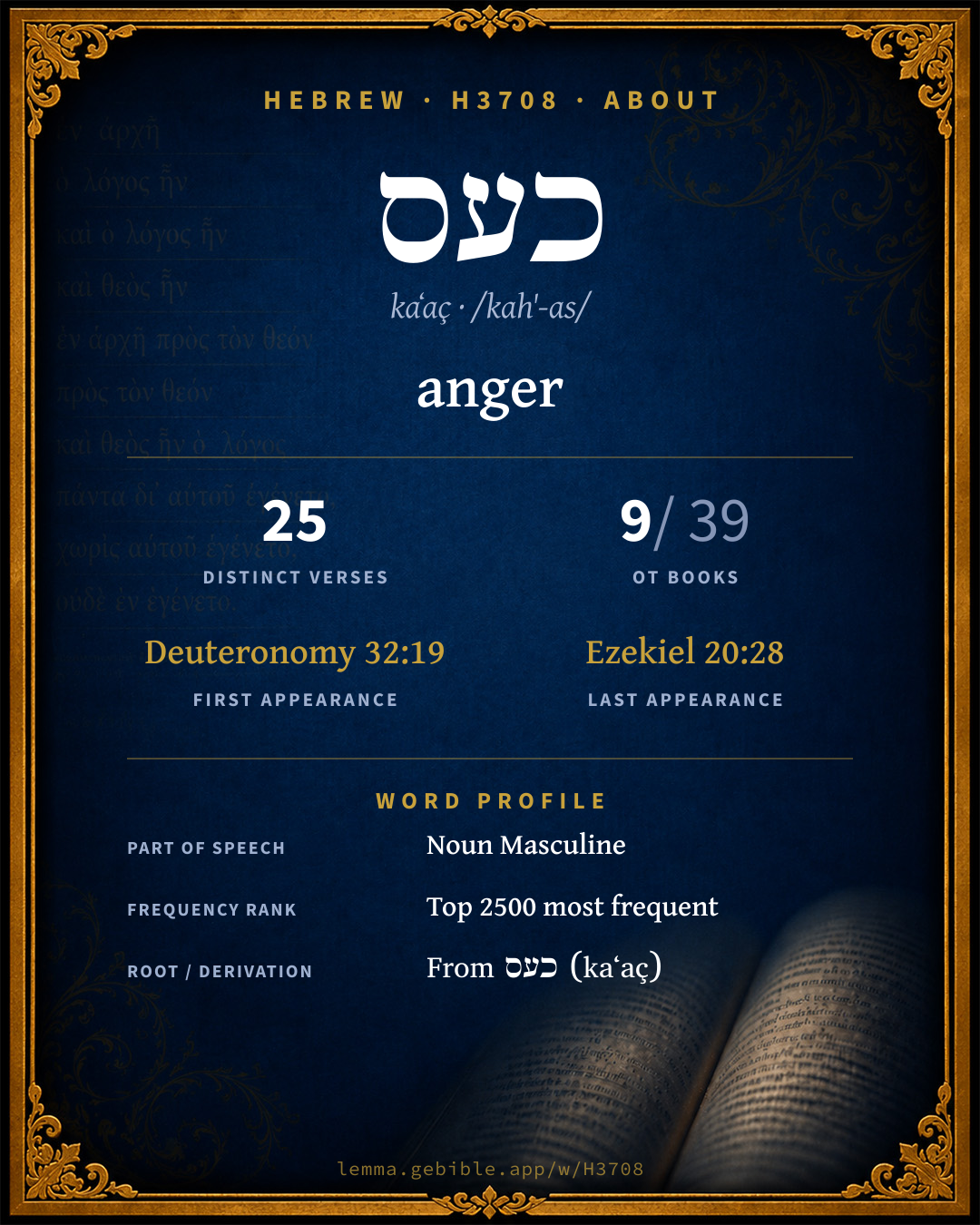
כַּ֫עַס
anger
also: vexation, provocation, grief fuller range ↓
Full lexicon entry — Brown-Driver-Briggs (BDB)
From Brown-Driver-Briggs (BDB)
Where this word appears
See every Absolute-state word in the Hebrew Bible →
Grammar key — what these labels mean
Part of speech
- Noun
- A naming word — a person, place, thing, or idea.
Noun type
- Common
- A common noun — a general class of person, place, or thing (“king,” “city,” “water”), not a specific name.
State
- Absolute
- The independent form of a noun, not bound to a following word.
- Construct
- A noun bound to a following noun in a possessive / “of” relationship (the construct chain).
Gender
- Masculine
- Grammatically masculine.
Number
- Singular
- One.
- Plural
- More than one (in Hebrew, generally three or more).
Grammatical forms
- Noun, Common, Masculine, Singular, Absolute 14 times (56%)
- Noun, Common, Masculine, Singular, Construct 10 times (40%)
- Noun, Common, Masculine, Plural, Absolute 1 time (4%)
Parsed forms decoded from the imported morphology (morphhb / Westminster Leningrad Codex — WLC text public domain, morphhb tagging CC BY 4.0), counted across 25 parsed occurrences — not distinct verses.
Every verse where H3708 appears — 25 distinct verses across 9 books. Click any verse to open its interlinear word-by-word view. Verse text shown in the World English Bible for context — . Each verse’s Hebrew form is shown with its reference; the English is not keyword-highlighted, since the data carries no word-level English alignment. Use “Compare translations” on any verse to read it across multiple English versions. This concordance covers the Hebrew Bible; Septuagint (Greek Old Testament) occurrences are not indexed here.
Deuteronomy 2 verses
- Deuteronomy 32:19 מִ/כַּ֥עַס prep + n c ms cs Yahweh saw [it], and abhorred [them], Because of the provocation of his sons and his daughters.
- Deuteronomy 32:27 כַּ֤עַס n c ms cs Were it not that I feared the provocation of the enemy, Lest their adversaries should judge wrongly, Lest they should say, Our hand is exalted, Yahweh has not done all this.
1 Samuel 2 verses
- 1 Samuel 1:6 כַּ֔עַס n c ms Her rival provoked her sore, to make her fret, because Yahweh had shut up her womb.
- 1 Samuel 1:16 וְ/כַעְסִ֖/י conj + n c ms cs + sfx pers 1cs Don't count your handmaid for a wicked woman; for out of the abundance of my complaint and my provocation have I spoken hitherto.
1 Kings 2 verses
- 1 Kings 15:30 בְּ/כַעְס֕/וֹ prep + n c ms cs + sfx pers 3ms for the sins of Jeroboam which he sinned, and with which he made Israel to sin, because of his provocation with which he provoked Yahweh, the God of Israel, to anger.
- 1 Kings 21:22 הַ/כַּ֨עַס֙ ptcl def.art + n c ms and I will make your house like the house of Jeroboam the son of Nebat, and like the house of Baasha the son of Ahijah for the provocation with which you have provoked me to anger, and have made Israel to sin.
2 Kings 1 verse
Job 4 verses
- Job 5:2 כָּ֑עַשׂ n c ms For resentment kills the foolish man, And jealousy kills the simple.
- Job 6:2 כַּעְשִׂ֑/י n c ms cs + sfx pers 1cs "Oh that my anguish were weighed, And all my calamity laid in the balances!
- Job 10:17 כַּֽ֭עַשְׂ/ךָ n c ms cs + sfx pers 2ms You renew your witnesses against me, And increase your indignation on me. Changes and warfare are with me.
- Job 17:7 מִ/כַּ֣עַשׂ prep + n c ms My eye also is dim by reason of sorrow. All my members are as a shadow.
Psalms 4 verses
- Psalms 6:7 מִ/כַּ֣עַס prep + n c ms My eye wastes away because of grief; It grows old because of all my adversaries.
- Psalms 10:14 וָ/כַ֨עַס conj + n c ms But you do see trouble and grief; You consider it to take it into your hand. You help the victim and the fatherless.
- Psalms 31:9 בְ/כַ֥עַס prep + n c ms Have mercy on me, Yahweh, for I am in distress. My eye, my soul, and my body waste away with grief.
- Psalms 85:4 כַּֽעַסְ/ךָ֣ n c ms cs + sfx pers 2ms Turn us, God of our salvation, And cause your indignation toward us to cease.
Proverbs 4 verses
- Proverbs 12:16 כַּעְס֑/וֹ n c ms cs + sfx pers 3ms A fool shows his annoyance the same day, But one who overlooks an insult is prudent.
- Proverbs 17:25 כַּ֣עַס n c ms A foolish son brings grief to his father, And bitterness to her who bore him.
- Proverbs 21:19 וָ/כָֽעַס conj + n c ms It is better to dwell in a desert land, Than with a contentious and fretful woman.
- Proverbs 27:3 וְ/כַ֥עַס conj + n c ms cs A stone is heavy, And sand is a burden; But a fool's provocation is heavier than both.
Ecclesiastes 5 verses
- Ecclesiastes 1:18 כָּ֑עַס n c ms For in much wisdom is much grief; and he who increases knowledge increases sorrow.
- Ecclesiastes 2:23 וָ/כַ֨עַס֙ conj + n c ms For all his days are sorrows, and his travail is grief; yes, even in the night his heart takes no rest. This also is vanity.
- Ecclesiastes 7:3 כַּ֖עַס n c ms Sorrow is better than laughter; for by the sadness of the face the heart is made good.
- Ecclesiastes 7:9 כַ֔עַס n c ms Don't be hasty in your spirit to be angry, for anger rests in the bosom of fools.
- Ecclesiastes 11:10 כַּ֨עַס֙ n c ms Therefore remove sorrow from your heart, And put away evil from your flesh; For youth and the dawn of life are vanity.
Ezekiel 1 verse
About this entry
At a glance — auto-summarized from this page’s data, not written by a person. Every figure links to its source below. This summary describes the numbers; it doesn’t interpret them.
“anger” is the headline sense of the Hebrew noun כעס (kaʻaç). Translators differ — “grief” in the King James Version, then “anger” (Berean Standard Bible), as the renderings breakdown shows. With 25 verses in 9 books, it is an uncommon word in the Hebrew Bible. First canonically at Deuteronomy 32:19, it enters the text early. Beyond “anger” it also covers “vexation”, “provocation”, and “grief” — see its full sense range. See the sense tree, 25-verse concordance, and the renderings breakdown below.
Gloss history
Strong's 1890 vs modern scholarship
About this word
Strong's H3708 catalogs a Hebrew word from the Hebrew Old Testament.
These counts are not copied from any lexicon or concordance. They are computed here, from the morphology-tagged Hebrew Old Testament. What Lemma adds →
- 25
- distinct verses
- The word appears in 25 distinct verses.
- 9 / 39
- OT books
- The word appears in 9 of 39 Old Testament books.
- #1,282
- by frequency
- Top 2500 most frequent Hebrew words (rank 1,282 of 8,640 Hebrew words by occurrence).
View all 25 occurrences in the concordance →
Most concentrated in
- Ecclesiastes 5 verses 20%
- Job 4 verses 16%
- Psalms 4 verses 16%
By section of the Old Testament
By traditional corpus
Conventional, traditional groupings — biblical authorship is debated, so this is a traditional corpus grouping, not an authorship claim. Each share is this word’s portion of its verses in that division of the Hebrew canon. Each figure is a share of the word’s 25 distinct verses.
- Writings (Ketuvim) 17 verses · 68%
- Prophets (Nevi'im) 6 verses · 24%
- Torah (Pentateuch) 2 verses · 8%
How translations render this word
Counts come from each version’s own published word-to-Strong’s tagging or interlinear alignment — an approximate guide to how each version renders this word, not a word-level alignment the data otherwise carries. Because each total is that version’s own tagged count, the per-version totals vary from one another and need not match the appearance or distinct-verse counts above. These counts may also differ from a printed concordance because Lemma counts each distinctly tagged rendering and does not collapse phrase taggings into a single head-word total. This is a fixed set of word-tagged versions (KJV, ASV, BSB, ULT) and does not change with the reading translation you choose elsewhere. Each version’s license is shown beside its name below (and on Sources).
BDB lists this Strong’s number as 2 distinct words (homographs). Each count above pools all of them and is not split by sense — see the Senses section below. A low-frequency rendering may belong to a different one of those words, not the primary meaning.
- King James Version†: Grief 6×, Wrath 4×, Provocation 3×
- American Standard Version†: Provocation 5×, 's vexation 2×, Sorrow 2×
- Berean Standard Bible†: Anger 5×, Grief 5×, Sorrow 5×
- unfoldingWord Literal Text†: Anger 6×, Provocation 4×, Grief 3×
King James Version Public Domain
Renders H3708 across 25† tagged occurrences — most commonly:
Plus 10 renderings that appear only once — usually multi-word phrases or single function words the recovered tagging swept in, not distinct renderings.
American Standard Version Public Domain
Renders H3708 across 25† tagged occurrences — most commonly:
Plus 14 renderings that appear only once — usually multi-word phrases or single function words the recovered tagging swept in, not distinct renderings.
Berean Standard Bible Public Domain
Renders H3708 across 26† tagged occurrences — most commonly:
Plus 11 renderings that appear only once — usually multi-word phrases or single function words the recovered tagging swept in, not distinct renderings.
unfoldingWord Literal Text CC BY-SA 4.0
Renders H3708 across 25† tagged occurrences — most commonly:
Plus 7 renderings that appear only once — usually multi-word phrases or single function words the recovered tagging swept in, not distinct renderings.
Senses in the full BDB
What do BDB’s symbols mean?
BDB uses these scholarly abbreviations:
| Symbol | Meaning |
|---|---|
| 𝔊 | the Septuagint (the ancient Greek translation, LXX) |
| 𝔙 | the Vulgate (the Latin translation) |
| 𝔖 | the Syriac version (the Peshitta) |
| 𝔗 | the Targum (the Aramaic translation) |
| ψ | the Psalms |
| √ | root (the underlying root or stem) |
| ‖ | parallel passage (a synonymous or contrasted parallel) |
| † | the dagger: every passage where the word occurs is cited |
The 5 senses and sub-senses the full Brown-Driver-Briggs lexicon distinguishes for this word, in lexicon order (not ranked by frequency), with BDB’s own verbatim wording and sub-sense lettering. Shown in Hebrew script with BDB’s own scholarly abbreviations. The condensed entry is in the Lexicon Entry tab. See also the Forms in the corpus table below.
כעס I vexation, anger
- 1. of men, especially caused by unmerited treatment, 1 S 1:6, 16 Pr 12:16; 17:25; 21:19; 27:3 Ec 7:9. e.g. 1 Samuel 1:6
- 2. vexation, anger of Yahweh (caused especially by worship of other gods) 1 K 15:30; 21:22 2 K 23:26; כ׳ עִמָּנוּ ψ 85:5 anger (of Yahweh) with us; כ׳ בָּנָיו Dt 32:19 anger against his sons, כ׳ אוֹיֵב v 27 anger against the enemy (both obj. gen. see Di; RV provocation of, cf. Dr); כ׳ קָרְבָּנָם Ez 20:28 provocation of their offering (so RV but Co del., rightly). e.g. 1 Kings 15:30
- 3. vexation, grief ψ 6:8; 10:14; 31:10 Ec 1:18; 2:23; 7:3; 11:10, also כעס 5:16 acc. Ew al. e.g. Psalms 6:8
כעס II (dialectic variation of כַּעַס, only in Jb)
- 1. vexation, grief of men Jb 5:2 (cf. Pr 12:16; 27:3), 6:2; 17:7. e.g. Job 5:2
- 2. vexation, anger, of God; c. כַּעַשְׂךָ עִמָּדִי Jb 10:17 thine anger with me. e.g. Job 10:17
Senses from the full Brown-Driver-Briggs lexicon (Brown, Driver, Briggs; Oxford 1906 — public domain), digitized via Sefaria, supplemented by the OpenScriptures HebrewLexicon (CC BY 4.0). Full attribution on Sources.
Word origin
I. n.m. vexation, anger;—כ׳ Dt 32:27 + 13 times; כָּ֑עַס Pr 21:19 Ec 1:18; sf. כַּעְסִי 1 S 1:16 כַּעַסְךָ ψ 85:5, כַּעְסוֹ Pr 12:16 1 K 15:30; pl. כְּעָסִים 2 K 23:26.—vexation:
I. n.m. (dialectic variation of כַּעַס, only in Jb);—כ׳ Jb 17:7, כָּ֑עָשׂ Jb 5:2; sf. כַּעְשִׂי Jb 6:2; כַּעַשְׂךָ Jb 10:17;—
— Brown-Driver-Briggs (Oxford 1906, public domain), digitized via Sefaria, supplemented by the OpenScriptures HebrewLexicon (CC BY 4.0). See Sources.
Derived from כעס (kaʻaç) (H3707) — to be angry.
Jastrow Dictionary
A second Hebrew/Aramaic lexicon for comparison, covering Aramaic and post-biblical (Talmudic, Targumic, Midrashic) usage that the biblical-Hebrew BDB does not. Matched by lemma rather than by Strong’s number, so a lemma may carry more than one Jastrow headword (shown separately below), and the entries cover usage well beyond the Bible.
כָּעַס
- (b. h.) [to be dark, hot, cmp. חמץ,]
- 1. to be angry, displeased. Ber. 61ᵇ top, v. כָּבֵד III. Tem. 16ᵃ (play on עַכְסָה) כל … כּוֹעֵס על וכ׳ whoever saw her became displeased with his own wife. Ned. 22ᵃ, a. fr. כל הכועס whoever allows himself to be carried away by his wrath. Ex. R. s. 45 מטרונה שכָּעֲסָה על וכ׳ a matron (queen) that was angry with the king’s daughter; a. fr.—Part. pass. כָּעוּס, f. כְּעוּסָה; pl. כְּעוּסִים, כְּעוּסוֹת. Ib. כשיהיו פניך כ׳ וכ׳ when thou shalt be angry, I shall conciliate thee &c.; (Tanḥ. Ki Thissa 27 כשאהיה אני בכעס); a. e.—V. כָּעוּס.—
- *2. to grow hot in the stomach, to ferment, swell. Gitt. 70ᵃ לכשתִּכְעוֹס תעמוד על מליאה Ar. (ed. מילואך) when it (the food) swells, it will just fill the capacity of thy stomach.
- to provoke to anger. Deut. R. s. 3. שהם עתידים להַכְעִיס אותי that they are going to provoke me (through idolatry). Ab. V, 2 היו מַכְעִיסִין וכ׳ were constantly provoking (the Lord). Snh. 27ᵃ, a. fr. להַכְעִיס in a spirit of defiance, v. מוּמָר; a. fr.—Imper. אַכְעִיס (for הכעיס). Ruth R. end (ref. to Ps. IV, 5) ארגיז יצרך … א׳ יצרך ולא תחטא let thy tempter rage, but sin not; but the Rabbis say, arouse thy (good) inclination to indignation, and thou shalt not sin. [Midr. Till. to Ps. l. c. אַכְחֵישׁ … ואל יחטיאך weaken thy tempter (by ascetics) &c.; Yalk. Ps. 627;—Pesik. Shubah, p. 158ᵃ אכופס, corr. acc.] e.g. Psalms 4:5
כְּעַס
- Targ. Ps. CXII, 10.—Y. Ber. VII, 11ᵇ bot. שמע … מלכא וכ׳ King Jannai heard of it and became angry; Gen. R. s. 91; a. fr.—[Targ. Y. Gen. XXXVIII, 15 כְּעִיסַת אפין angry-looking, morose (h. text כסתה פניה); prob. a. corrupt. of כַּסִּיאַת, and רחים, at the end of the sentence, to be read חכים; cmp. Gen. R. s. 85].
- to provoke to anger; א׳ (עובדא) קדם to act provokingly, defiantly against. Targ. Y. II, Deut. XXXII, 19. Ib. 21.—Esth. R. introd. מדאַכְעֲסוּ … עובדיהון וכ׳ when the beloved children (Israel) defied &c.; (Yalk. Esth. 1044; Yalk. Job 920 ארגיזו).
כַּעַס
- preced.) anger, grief. Tosef. Yeb. VI, 6 היה לה כ׳ מבעלה if she had been living on bad terms with her husband; Yeb. 42ᵇ; Keth. 60ᵇ בבית בעלה; Erub. 47ᵃ עם ב׳. Ex. R. s. 45 כשאהיה בכ׳ וכ׳, v. כָּעַס. Ab. IV, 18 אל … בשעת כּעֲסוֹ do not try to pacify thy neighbor while he is excited. Sifré Num. 157, v. כְּלָל; a. fr.
A Dictionary of the Targumim, the Talmud Babli and Yerushalmi, and the Midrashic Literature (Marcus Jastrow; London, Luzac, 1903) — Public Domain. Digitized via Sefaria. Digitized via Sefaria. Full attribution on Sources.
Forms in the corpus
The 24 distinct written forms H3708 takes in the Hebrew Bible, most frequent first — each parse links to that state’s occurrences in the concordance. Hebrew forms include their vowel points and cantillation, so a single lemma takes many written forms.
Septuagint verse parallels
This word appears in 24 verses that also exist in the Greek Old Testament (Septuagint), out of the 25 Hebrew verses it occurs in. You can read those verses in Greek by switching the Old Testament edition to the Septuagint.
Read these verses in the Septuagint
- Deuteronomy 32:19
- 1 Samuel 1:6
- 1 Kings 15:30
- 2 Kings 23:26
- Job 5:2
- Psalms 6:7
- Proverbs 12:16
- Ecclesiastes 1:18
- Ezekiel 20:28
This is a verse-level parallel only — the same verses exist in both the Hebrew and Greek Old Testaments. No word-level Hebrew↔Greek correspondence is claimed: the data carries no such alignment, so no Greek word is shown as this Hebrew word’s translation. Coverage is not total — the Septuagint omits the deuterocanon and renumbers the Psalms, so some Hebrew verses have no direct Greek parallel.