
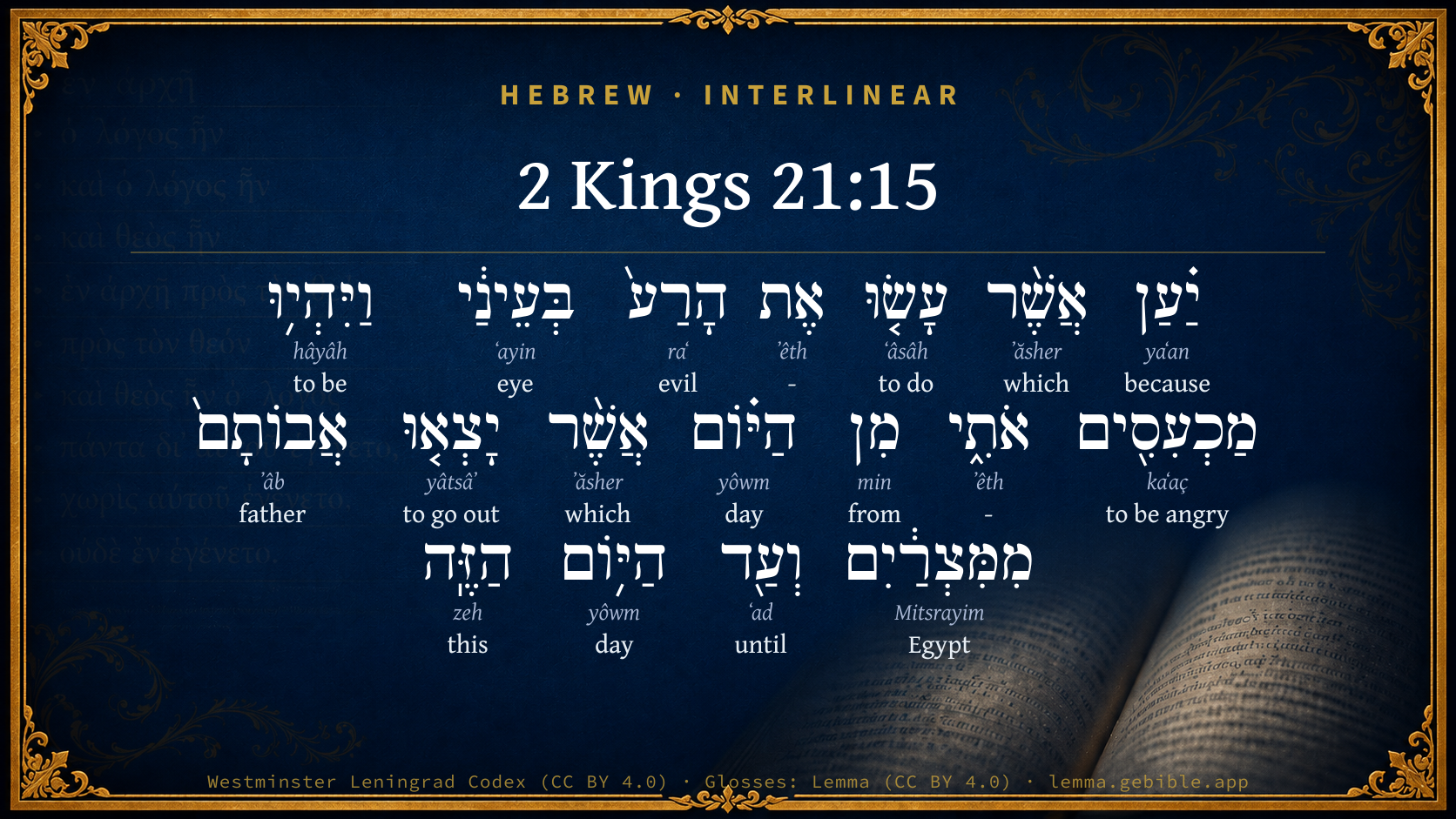
2 Kings 21:15

Hebrew (Westminster Leningrad Codex) 2 Kings 21:15 appears in the Hebrew Old Testament. The text above is from the Westminster Leningrad Codex. Each word links to its Strong’s number, a concise gloss, and parsing drawn from the Open Scriptures Hebrew Bible morphology. Click any word for its full Brown-Driver-Briggs (BDB) entry.
Download image
Cite this verse

2 Kings 21:15 (World English Bible). Public Domain. Lemma interlinear Bible study tool, https://lemma.gebible.app/v/2-kings/21/15.

Show BibTeX & RIS
BibTeX
RIS
English Translation
because they have done that which is evil in my sight, and have provoked me to anger, since the day their fathers came forth out of Egypt, even to this day.
World English Bible · Public Domain
Download a study sheet

One document with this verse’s original text, its word-by-word gloss line, the meaning frame, cross-references with their text, attributed commentary, and full source and license credits — printable, and it pastes into notes with its structure intact.

This verse Autodidact and up

Study sheet (.html) Plain text (.txt)

A passage Seminary Student

Up to 50 verses in one chapter. A passage sheet keeps up to 6 commentary sources and 12 cross-references per verse, in the order this page ranks them, and says so on the sheet whenever that leaves anything out. Ask for a single verse and you get the Autodidact verse sheet above.

Everything on this page stays free to read, with no account — the sheet is a download of what is already on screen, not access to it.

Want to remove ads? Support Godless Engineer
Compare translations 3

The same verse in 3 English versions, stacked beneath the original-language interlinear above. Click any original word for its lexicon entry.

Each is an independent rendering of the whole verse — the interlinear is not word-aligned to these translations.

Highlighted words mark where these versions differ — a whole-verse word diff, not a word-by-word alignment.

  • World English Bible Public Domain
    because they have done that which is evil in my sight, and have provoked me to anger, since the day their fathers came forth out of Egypt, even to this day.
  • King James Version Public Domain
    Because they have done that which was evil in my sight, and have provoked me to anger, since the day their fathers came forth out of Egypt, even unto this day.
  • unfoldingWord Literal Text CC BY-SA 4.0
    because they have done evil in my eyes and they have been making me angry from the day that their fathers came out from Egypt and to this day.’”

unfoldingWord Literal Text — © unfoldingWord, licensed CC BY-SA 4.0. Word-aligned USFM3 via Door43 (git.door43.org/unfoldingWord/en_ult).

Versions to compare (up to 4)

3 of 4 selected

Show all 18 translations

Every available English version of this verse, each an independent rendering of the whole verse.

  • World English Bible Public Domain
    because they have done that which is evil in my sight, and have provoked me to anger, since the day their fathers came forth out of Egypt, even to this day.
  • Berean Standard Bible Public Domain
    because they have done evil in My sight and have provoked Me to anger from the day their fathers came out of Egypt until this day.’”
  • Majority Standard Bible Public Domain
    because they have done evil in My sight and have provoked Me to anger from the day their fathers came out of Egypt until this day.’”
  • King James Version Public Domain
    Because they have done that which was evil in my sight, and have provoked me to anger, since the day their fathers came forth out of Egypt, even unto this day.
  • American Standard Version (1901) Public Domain
    because they have done that which is evil in my sight, and have provoked me to anger, since the day their fathers came forth out of Egypt, even unto this day.
  • Revised Version (1885) Public Domain
    because they have done that which is evil in my sight, and have provoked me to anger, since the day their fathers came forth out of Egypt, even unto this day.
  • Geneva Bible (1599) Public Domain
    Because they haue done euil in my sight, and haue prouoked mee to anger, since the time their fathers came out of Egypt vntill this day.
  • Douay-Rheims (1899) Public Domain
    Because they have done evil before me, and have continued to provoke me, from the day that their fathers came out of Egypt, even unto this day.
  • Young's Literal Translation Public Domain
    because that they have done the evil thing in Mine eyes, and are provoking Me to anger from the day that their fathers came out of Egypt, even unto this day.'
  • Literal Standard Version CC BY-SA 4.0
    because that they have done evil in My eyes, and are provoking Me to anger from the day that their fathers came out of Egypt, even to this day.”
  • Unlocked Literal Bible CC BY-SA 4.0
    because they have done what is evil in my sight, and have provoked me to anger, since the day their ancestors came out of Egypt, to this day.”
  • unfoldingWord Literal Text CC BY-SA 4.0
    because they have done evil in my eyes and they have been making me angry from the day that their fathers came out from Egypt and to this day.’”
  • Darby Bible Public Domain
    because they have done evil in my sight, and have provoked me to anger, since the day their fathers came forth out of Egypt even to this day.
  • World Messianic Bible Public Domain
    because they have done that which is evil in my sight, and have provoked me to anger since the day their fathers came out of Egypt, even to this day.’”
  • Webster's Bible Public Domain
    Because they have done that which was evil in my sight, and have provoked me to anger, since the day their fathers came out of Egypt, even to this day.
  • Free Bible Version CC BY-SA 4.0
    because they have done what is evil in my sight, and have made me angry from the day their fathers left Egypt until today.”
  • Bible in Basic English Public Domain
    Because they have done evil in my eyes, moving me to wrath, from the day when their fathers came out of Egypt till this day.
  • JPS Tanakh (1917) Public Domain
    because they have done that which is evil in My sight, and have provoked Me, since the day their fathers came forth out of Egypt, even unto this day.'

Literal Standard Version (2020), Covenant Press — licensed CC BY-SA 4.0. Text via the HelloAO Bible API (eBible.org). Unlocked Literal Bible (unfoldingWord) — licensed CC BY-SA 4.0. Text via the HelloAO Bible API (eBible.org). unfoldingWord Literal Text — © unfoldingWord, licensed CC BY-SA 4.0. Word-aligned USFM3 via Door43 (git.door43.org/unfoldingWord/en_ult). Free Bible Version, Dr. Jonathan Gallagher — licensed CC BY-SA 4.0. Text via the HelloAO Bible API (eBible.org).

Word by word

More ways to search: Search by grammar → Find every occurrence → Compare this word →

Practice this passage: Drill this verse → Learn its vocabulary →

מַכְעִסִ֖ים
kaʻaç
H3707
“being angry”
Verb, Hiphil, Participle Active, Masculine, Plural, Absolute
Part of Speech
Verb
Stem
Hiphil
Form
Participle Active
Gender
Masculine
Number
Plural
State
Absolute
Full BDB Definition

Origin: a primitive root

TWOT: 1016

to be angry, be vexed, be indignant, be wroth, be grieved, provoke to anger and wrath - (Qal) - to be vexed, be indignant - to be angry - (Piel) to provoke to anger - (Hiphil) - to vex - to vex, provoke to anger
  1. יַ֗עַן yaʻan H3282 “because” Conjunction
  2. אֲשֶׁ֨ר ʼăsher H834 “which” Particle, Relative
  3. עָשׂ֤וּ ʻâsâh H6213 “to do” Verb, Qal, Perfect, 3rd Person, Common, Plural
  4. אֶת ʼêth H853 “-” Particle, Direct Object
  5. הָרַע֙ raʻ H7451 “the · evil” Particle, Definite Article + Adjective, Adjective, Masculine, Singular, Absolute
  6. בְּעֵינַ֔י ʻayin H5869 “in/at · eyes · my” Preposition + Noun, Common, Both, Dual, Construct + Suffix, Personal, 1st Person, Common, Singular
  7. וַיִּהְי֥וּ hâyâh H1961 “and · to be” Conjunction + Verb, Qal, Sequential Imperfect, 3rd Person, Masculine, Plural
  8. אֹתִ֑י ʼêth H853 “- · me” Particle, Direct Object + Suffix, Personal, 1st Person, Common, Singular
  9. מִן min H4480 “from” Preposition
  10. הַיּ֗וֹם yôwm H3117 “the · day” Particle, Definite Article + Noun, Common, Masculine, Singular, Absolute
  11. אֲשֶׁ֨ר ʼăsher H834 “which” Particle, Relative
  12. יָצְא֤וּ yâtsâʼ H3318 “to go out” Verb, Qal, Perfect, 3rd Person, Common, Plural
  13. אֲבוֹתָם֙ ʼâb H1 “fathers · their” Noun, Common, Masculine, Plural, Construct + Suffix, Personal, 3rd Person, Masculine, Plural
  14. מִמִּצְרַ֔יִם Mitsrayim H4714 “from · Egypt” Preposition + Noun, Proper
  15. וְעַ֖ד ʻad H5704 “and · until” Conjunction + Preposition
  16. הַיּ֥וֹם yôwm H3117 “the · day” Particle, Definite Article + Noun, Common, Masculine, Singular, Absolute
  17. הַזֶּֽה zeh H2088 “the · this” Particle, Definite Article + Pronoun, Demonstrative, Masculine, Singular

About this verse

These counts appear in no published source. They are computed here, from the morphology-tagged text and Lemma’s own curated glosses. What Lemma adds →

18
words
15
distinct lemmas
Historical
section

Shared distinctive vocabulary

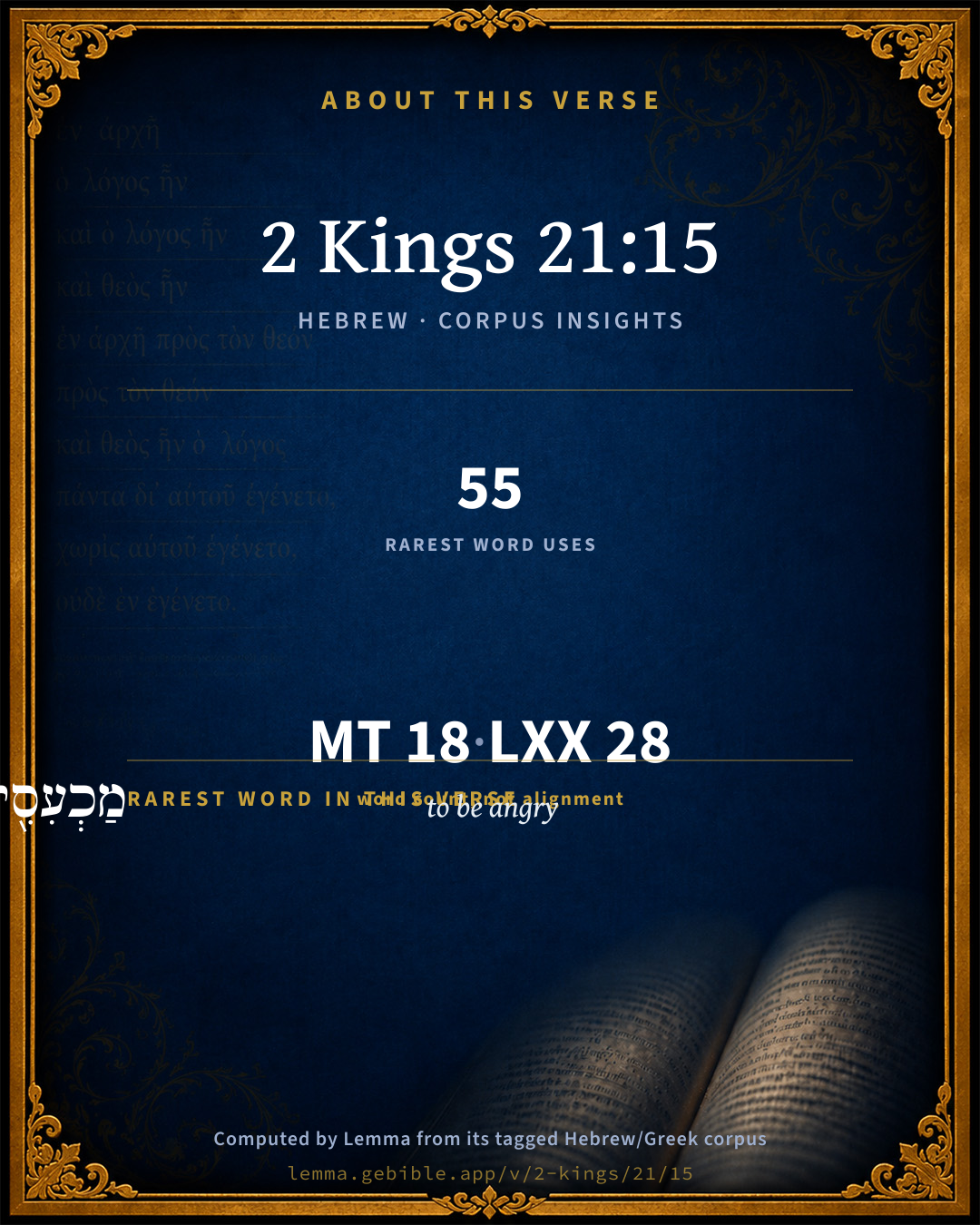
מַכְעִסִ֖ים to be angry H3707 occurs in 53 verses of the Hebrew Bible. Also found in:

Grammatical profile

  • 4 verbs
  • 5 nouns
  • 1 adjective
  • 1 pronoun
  • 2 prepositions
  • 1 conjunction
  • 4 particles

Verb forms

  • עָשׂ֤וּ Qal · Perfect
  • וַיִּהְי֥וּ Qal · Sequential Imperfect
  • מַכְעִסִ֖ים Hiphil · Participle Active
  • יָצְא֤וּ Qal · Perfect

Repetition

Words recur within this verse — often emphatic in Hebrew:

  • הַיּ֗וֹם day H3117 ×2
  • אֲשֶׁ֨ר which H834 ×2

Hebrew & Septuagint length

In English translation the verse runs 31 words from the Hebrew and 29 from the Septuagint (LXX English) — closely comparable.

A rough comparison of the two English renderings, which tokenize alike — not a word-level alignment.

Word counts can differ between the Hebrew and the Greek without any difference in meaning — e.g. the Hebrew direct-object marker אֵת has no separate Greek word, and Greek often adds the article ὁ.

In the original languages it is 18 Hebrew tokens and 28 Greek tokens — but the two are counted differently (Hebrew bundles its prefixes and suffixes into one token; the Greek is in lemma form), so that isn’t a like-for-like length.

Cross-references

13

Topical passages linked to 2 Kings 21:15 in the Treasury of Scripture Knowledge — connected by theme and wording, ordered by reader-vote popularity; previews shown in the World English Bible.

  • Deuteronomy 9:21 I took your sin, the calf which you had made, and burnt it with fire, and stamped it, grinding it very small, until it was as fine as dust: and I cast the dust of it into the brook that descended out of the mountain.
  • Deuteronomy 31:27 For I know your rebellion, and your stiff neck: behold, while I am yet alive with you this day, you have been rebellious against Yahweh; and how much more after my death?
  • Deuteronomy 31:29 For I know that after my death you will utterly corrupt yourselves, and turn aside from the way which I have commanded you; and evil will happen to you in the latter days; because you will do that which is evil in the sight of Yahweh, to provoke him to anger through the work of your hands.
  • Judges 2:11–13 The children of Israel did that which was evil in the sight of Yahweh, and served the Baals;
  • Psalms 106:34–40 They didn't destroy the peoples, As Yahweh commanded them,
  • Ezekiel 16:15–22 But you did trust in your beauty, and played the prostitute because of your renown, and poured out your prostitution on everyone who passed by; his it was.
  • Ezekiel 20:4 Will you judge them, son of man, will you judge them? Cause them to know the abominations of their fathers;
  • Ezekiel 20:13 But the house of Israel rebelled against me in the wilderness: they didn't walk in my statutes, and they rejected my ordinances, which if a man keep, he shall live in them; and my Sabbaths they greatly profaned. Then I said I would pour out my wrath on them in the wilderness, to consume them.
  • Ezekiel 20:21 But the children rebelled against me; they didn't walk in my statutes, neither kept my ordinances to do them, which if a man do, he shall live in them; they profaned my Sabbaths. Then I said I would pour out my wrath on them, to accomplish my anger against them in the wilderness.
  • Ezekiel 20:30 Therefore tell the house of Israel, Thus says the Lord Yahweh: Do you pollute yourselves after the manner of your fathers? and play you the prostitute after their abominations?
  • Ezekiel 23:3 and they played the prostitute in Egypt; they played the prostitute in their youth; there were their breasts pressed, and there was handled the bosom of their virginity.
  • Ezekiel 23:8–21 Neither has she left her prostitution since [the days of] Egypt; for in her youth they lay with her, and they handled the bosom of her virginity; and they poured out their prostitution on her.
  • Daniel 9:5–11 we have sinned, and have dealt perversely, and have done wickedly, and have rebelled, even turning aside from your precepts and from your ordinances;

Cross-references courtesy of OpenBible.info (CC BY 4.0).

Hebrew and Greek witnesses Masoretic Hebrew ↔ Greek Septuagint

The same verse in the two great witnesses to the Old Testament, shown verse-for-verse.

These are two independent witnesses, not word-aligned to each other, and the Septuagint is shown in lemma (dictionary) form.

Hebrew 2 Kings 21:15 Masoretic · Westminster Leningrad Codex

יַ֗עַן אֲשֶׁ֨ר עָשׂ֤וּ אֶת הָרַע֙ בְּעֵינַ֔י וַיִּהְי֥וּ מַכְעִסִ֖ים אֹתִ֑י מִן הַיּ֗וֹם אֲשֶׁ֨ר יָצְא֤וּ אֲבוֹתָם֙ מִמִּצְרַ֔יִם וְעַ֖ד הַיּ֥וֹם הַזֶּֽה

because they have done that which is evil in my sight, and have provoked me to anger, since the day their fathers came forth out of Egypt, even to this day.

World English Bible · Public Domain

Greek LXX 2 Kings 21:15 Septuagint · lemma form

ἀντί ὅς ὅσος ποιέω ὁ πονηρός ἐν ὀφθαλμός ἐγώ καί εἰμί παραὀργίζω ἐγώ ἀπό ὁ ἡμέρα ὅς ἐκἄγω ὁ πατήρ αὐτός ἐκ αἴγυπτος καί ἕως ὁ ἡμέρα οὗτος

forasmuch as they have done wickedly in my sight, and have provoked me from the day that I brought out their fathers out of Egypt, even until this day.

LXX2012 (modern English Septuagint) · Public Domain

On this verse, Ellicott's Commentary for English Readers discusses the Septuagint’s reading. Read the note in Commentary ↓

Hebrew: Westminster Leningrad Codex (CC BY 4.0). Greek: Septuagint (public domain); English from LXX2012 (modern English Septuagint) (Public Domain). How the Septuagint differs from the Hebrew →

Targum (Aramaic paraphrase)

1

The Targum is the ancient Jewish Aramaic paraphrase of the Hebrew Scriptures — an interpretive translation, not the Hebrew text itself. Onkelos (literal) and Pseudo-Jonathan (expansive) render the Torah, and Jonathan the Prophets. Coverage is partial: where no permissively-licensed English translation exists for a verse, only the Aramaic is shown. This is verse-level text, not a word-by-word alignment to the Hebrew.

  1. Targum Jonathan Prophets (Joshua–Malachi)
    חֲלַף דַעֲבַדוּ יַת דְבִישׁ קֳדָמַי וַהֲווֹ מַרְגְזִין קֳדָמַי מִן יוֹמָא דִנְפָקוּ אֲבָהַתְהוֹן מִמִצְרַיִם וְעַד יוֹמָא הָדֵין:

    (no public-domain English translation for this verse)

    Targum Jonathan — Aramaic: “Mikraot Gedolot” (public domain). English: “Sefaria Community Translation” (CC0 1.0 (public-domain dedication)); “London "Chaldee Paraphrase," 1871” (public domain). Text via Sefaria.

Commentary

Notes on 2 Kings 21:15 from classic Christian and Jewish commentators (each source and its license shown beneath its notes). The classic Christian expositions comment on the surrounding passage and are grouped to its opening verse, so a note may address several verses; the Jewish commentaries on the Tanakh (Rashi and others) are per-verse, so they appear only where the commentator wrote on this verse.

Lemma curates 59 commentaries, every one of them public domain or Creative Commons licensed, each selected and text-cleaned for this edition rather than reprinted as found. About our sources →

Trapp's Complete Commentary

John Trapp

2Ki 21:15 Because they have done [that which was] evil in my sight, and have provoked me to anger, since the day their fathers came forth out of Egypt, even unto this day.

Ver. 15. Since the day that their fathers, &c.] This hath been their custom from their youth. See it all along {Eze 20:1-49}

John Trapp, A Commentary or Exposition upon All the Books of the Old and New Testament (1647–1656) — public domain. Text from a community e-Sword module.

Ellicott's Commentary for English Readers

(15) Have provoked me.—Have been provoking; i.e., continually.

Their fathers came forth.—The LXX. has probably preserved the original reading: I brought forth their fathers.

A Bible Commentary for English Readers, edited by Charles John Ellicott (1878–1897) — public domain. Text from a community e-Sword module.

The Cambridge Bible for Schools and Colleges

gen. ed. J. J. S. Perowne

15. that which was [R.V. is] evil] As the words are God’s the present is the more appropriate tense.

The Cambridge Bible for Schools and Colleges (gen. ed. J. J. S. Perowne; Cambridge University Press, 1878–1918) — public domain. Text from a community e-Sword module.

John Gill's Exposition

Because they have done that which was evil in my sight,.... Committed idolatry:

and have provoked me to anger, since the day their fathers came forth out of Egypt, even to this day; being always prone to idolatry, so provoking to God, and which they were guilty of quickly after they came out of Egypt, in the worship of the golden calf, and had ever since at times been criminal this way; and now the measure of their iniquity being almost up, would be reckoned for together.

John Gill's Exposition of the Whole Bible (1746–1763) — public domain (CC PDM 1.0). Text via the HelloAO Bible API.

Matthew Poole's English Annotations

This sore judgment, though it was chiefly inflicted for the sins of Manasseh and his generation, yet had a respect unto all their former sins, the guilt whereof was upon this occasion revived. See Exo 32:31.

Matthew Poole's English Annotations on the Holy Bible (1683–1685) — public domain. Text from a community e-Sword/MySword module.

The Pulpit Commentary

Because they have done that which was evil in my sight. The chief sins of the people were the following: Altars for the worship of the host of heaven were erected upon almost every roof; (Zep_1:5) offerings of cakes were made in the very streets to Astarte; (Jer_7:18) the fire of Tophet a huge furnace in the valley of Hinnom was kept constantly burning, and the sacrifice of innocent children to the bloody sun-god, Moloch, was perpetual; (Jer_7:31 Eze_23:37) it was as common to swear by the name of Moloch as by that of Jehovah. (Zep_1:5) Lascivious rites were practiced. Close by the temple the unchaste priestesses of Venus had their habitations, and their wretched male attendants, the Galli of the classical writers, plied their trade. (2Ki_23:7) Cruelty and oppression increased among the upper classes; (Zep_3:1-3) the prophets were "light and treacherous persons;" the priests "polluted the sanctuary, and did violence to the Law". (Zep_2:1-3) "Spoiling and violence," "strife and contention;" were rife throughout the city. (Hab_1:3) Ewald sums up the state of things as follows: "The atmosphere of the age was poisoned from above; and the leaders of the people of every class, whose moral decline had already become a subject of lament in the preceding century, sank into an almost incredible degeneracy. The prophets, who ought to have been ever the most loyal guardians of the truth, were for the most part like dumb and greedy dogs; many of the priests allowed themselves to be seduced into offering heathen sacrifices; the judges and nobles paid little heed to the eternal right. Equivocation and hypocrisy spread among those who ought to have ministered most austerely to public truthfulness of life; while those who were engaged in commerce and trade sank into the harshest indifference to every higher aim, and thought only of the acquisition and enjoyment of wealth. So terrible was the demoralization which set in under Manasseh, that those who remained faithful to the ancient religion were either scoffed at as fools, or allowed to perish in cold contempt without any effort being made to save them, and were even derided after their death." And have provoked me to anger, since the day their fathers came forth out of Egypt, even unto this day. The moral and spiritual depravity of Judah, though it only came to a head in the time of Manasseh, had its roots in a long-distant past. As St. Stephen pointed out to the Sanhedrin Act_7:39-43 it began in the wilderness with the worship of the golden calf, and went on to the worship of the host of heaven, of Moloch, and of Remphan; it was shown markedly in the terrible sin of Peer; (Num_25:1-3) it stinted God"s hand when the nations had to be driven out from Canaan; (Jud 2:1-5) it provoked God"s anger greatly during the whole period of the Judges; (Jud 2:11-19) checked under David and Solomon, it broke out afresh on the accession of Rehoboam, (1Ki_14:22-24) and showed itself, more or less, under every subsequent king, culminating at last in that fearful condition of things which has been described above (see the comment on the first clause of this verse).

The Pulpit Commentary (1880–1919), ed. H.D.M. Spence-Jones & Joseph S. Exell — public domain. Text from a community e-Sword module.

John Wesley's Explanatory Notes

Since, &c. - This forejudgment, though it was chiefly inflicted for the sins of Manasseh and his generation, yet had a respect unto all their former sins.

John Wesley, Explanatory Notes Upon the Whole Bible (1754–1765) — public domain. Text via the GEBible commentary corpus.

Lesson kit

Teaching starters — assembled from the data on this page, not authored interpretation. Every prompt links to the verse data it draws on. Edit before teaching.

2 Kings, in the Historical, opens this verse with 18 words (15 distinct Hebrew lemmas). Its most distinctive word is kaʻaç (“to be angry”). A historical commentator’s framing appears above. Read the whole chapter for the surrounding context.

Discussion questions

  1. What does “to be angry” (kaʻaç) contribute to the verse as a whole?
  2. How does Deuteronomy 4:25, which shares the word «to be angry», read alongside this verse?
  3. What does the repetition of “day” (2× in this one verse) do in this verse?
  4. The translations on this page render this verse differently — a whole-verse word diff, not a word-by-word alignment. What might account for the different wordings?
  5. «עָשׂ֤וּ» is a Qal Perfect verb. How does that grammatical form shape the action described?
  6. Compare how Trapp's Complete Commentary and Ellicott's Commentary for English Readers read this verse. Where do they agree or differ?

Things to notice

Reading settings

Reading text

Shown beneath each verse's original-language words.

Old Testament
Old Testament edition

Read the OT as the Masoretic Hebrew (MT) or the Greek Septuagint (LXX).

English shown for the Greek Septuagint (in the Hebrew ↔ Greek comparison).

Comparing translations? Open the Compare panel on any verse page to stack up to four side by side.