
Psalms 106:29

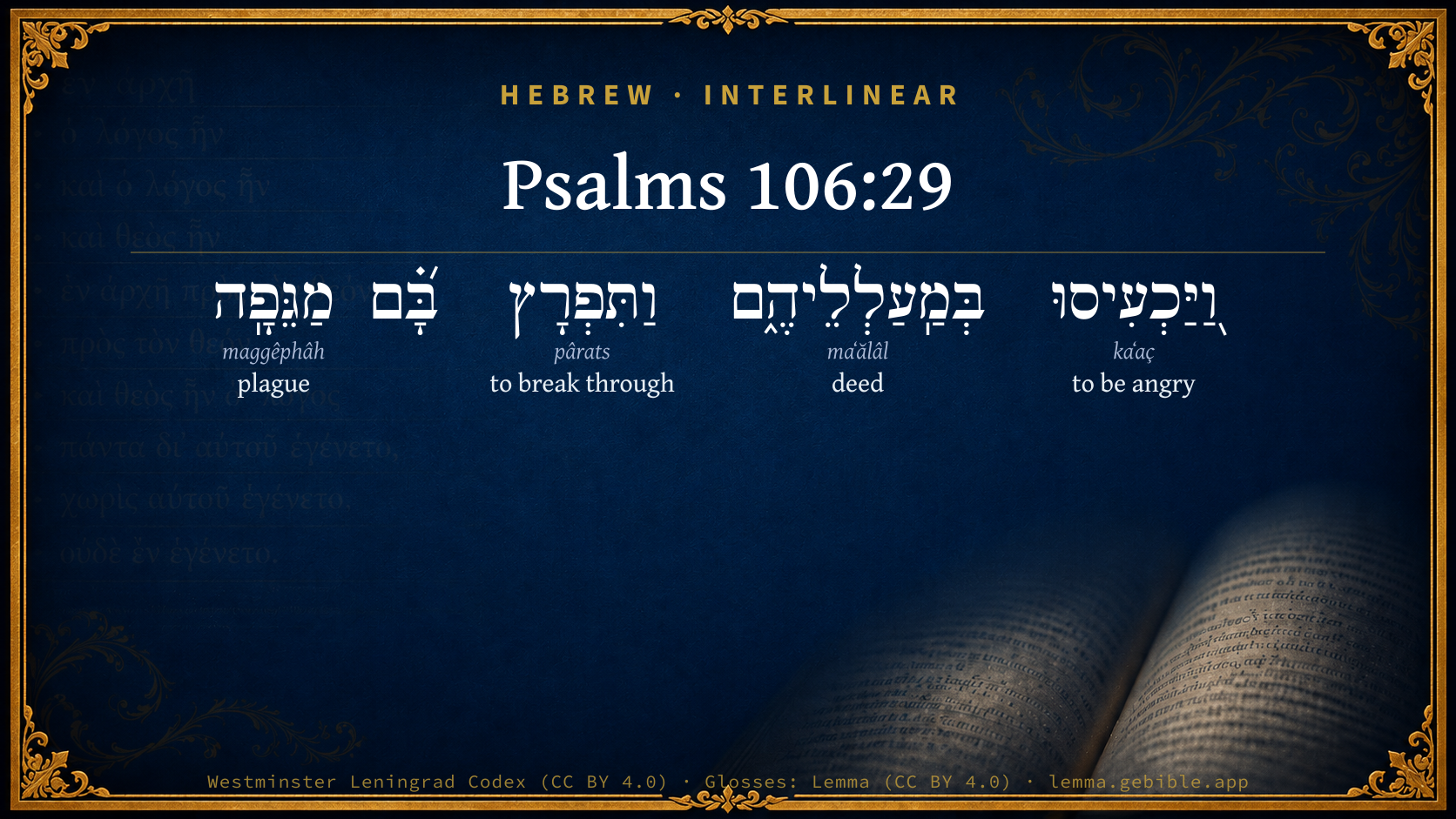
Hebrew (Westminster Leningrad Codex) Psalms 106:29 appears in the Hebrew Old Testament. The text above is from the Westminster Leningrad Codex. Each word links to its Strong’s number, a concise gloss, and parsing drawn from the Open Scriptures Hebrew Bible morphology. Click any word for its full Brown-Driver-Briggs (BDB) entry.
Download image
Cite this verse

Psalms 106:29 (World English Bible). Public Domain. Lemma interlinear Bible study tool, https://lemma.gebible.app/v/psalms/106/29.

Show BibTeX & RIS
BibTeX
RIS
English Translation
Thus they provoked him to anger with their deeds. The plague broke in on them.
World English Bible · Public Domain
Download a study sheet

One document with this verse’s original text, its word-by-word gloss line, the meaning frame, cross-references with their text, attributed commentary, and full source and license credits — printable, and it pastes into notes with its structure intact.

This verse Autodidact and up

Study sheet (.html) Plain text (.txt)

A passage Seminary Student

Up to 50 verses in one chapter. A passage sheet keeps up to 6 commentary sources and 12 cross-references per verse, in the order this page ranks them, and says so on the sheet whenever that leaves anything out. Ask for a single verse and you get the Autodidact verse sheet above.

Everything on this page stays free to read, with no account — the sheet is a download of what is already on screen, not access to it.

Want to remove ads? Support Godless Engineer
Compare translations 3

The same verse in 3 English versions, stacked beneath the original-language interlinear above. Click any original word for its lexicon entry.

Each is an independent rendering of the whole verse — the interlinear is not word-aligned to these translations.

Highlighted words mark where these versions differ — a whole-verse word diff, not a word-by-word alignment.

  • World English Bible Public Domain
    Thus they provoked him to anger with their deeds. The plague broke in on them.
  • King James Version Public Domain
    Thus they provoked him to anger with their inventions: and the plague brake in upon them.
  • unfoldingWord Literal Text CC BY-SA 4.0
    And they angered with their actions, and a plague broke out among them.

unfoldingWord Literal Text — © unfoldingWord, licensed CC BY-SA 4.0. Word-aligned USFM3 via Door43 (git.door43.org/unfoldingWord/en_ult).

Versions to compare (up to 4)

3 of 4 selected

Show all 18 translations

Every available English version of this verse, each an independent rendering of the whole verse.

  • World English Bible Public Domain
    Thus they provoked him to anger with their deeds. The plague broke in on them.
  • Berean Standard Bible Public Domain
    So they provoked the LORD to anger with their deeds, and a plague broke out among them.
  • Majority Standard Bible Public Domain
    So they provoked the LORD to anger with their deeds, and a plague broke out among them.
  • King James Version Public Domain
    Thus they provoked him to anger with their inventions: and the plague brake in upon them.
  • American Standard Version (1901) Public Domain
    Thus they provoked him to anger with their doings; And the plague brake in upon them.
  • Revised Version (1885) Public Domain
    Thus they provoked him to anger with their doings; and the plague brake in upon them.
  • Geneva Bible (1599) Public Domain
    Thus they prouoked him vnto anger with their owne inuentions, and the plague brake in vpon them.
  • Douay-Rheims (1899) Public Domain
    And they provoked him with their inventions: and destruction was multiplied among them.
  • Young's Literal Translation Public Domain
    And they provoke to anger by their actions, And a plague breaketh forth upon them,
  • Literal Standard Version CC BY-SA 4.0
    And they provoke to anger by their actions, || And a plague breaks forth on them,
  • Unlocked Literal Bible CC BY-SA 4.0
    They provoked him to anger with their actions, and a plague broke out among them.
  • unfoldingWord Literal Text CC BY-SA 4.0
    And they angered with their actions, and a plague broke out among them.
  • Darby Bible Public Domain
    And they provoked [him] to anger with their doings; and a plague broke out among them.
  • World Messianic Bible Public Domain
    Thus they provoked him to anger with their deeds. The plague broke in on them.
  • Webster's Bible Public Domain
    Thus they provoked him to anger with their inventions: and the plague broke in upon them.
  • Free Bible Version CC BY-SA 4.0
    They provoked the Lord by what they did, making him angry, so a plague broke out among them.
  • Bible in Basic English Public Domain
    So they made him angry by their behaviour; and he sent disease on them.
  • JPS Tanakh (1917) Public Domain
    Thus they provoked Him with their doings, and the plague broke in upon them.

Literal Standard Version (2020), Covenant Press — licensed CC BY-SA 4.0. Text via the HelloAO Bible API (eBible.org). Unlocked Literal Bible (unfoldingWord) — licensed CC BY-SA 4.0. Text via the HelloAO Bible API (eBible.org). unfoldingWord Literal Text — © unfoldingWord, licensed CC BY-SA 4.0. Word-aligned USFM3 via Door43 (git.door43.org/unfoldingWord/en_ult). Free Bible Version, Dr. Jonathan Gallagher — licensed CC BY-SA 4.0. Text via the HelloAO Bible API (eBible.org).

Word by word

More ways to search: Search by grammar → Find every occurrence → Compare this word →

Practice this passage: Drill this verse → Learn its vocabulary →

About this verse

These counts appear in no published source. They are computed here, from the morphology-tagged text and Lemma’s own curated glosses. What Lemma adds →

5
words
4
distinct lemmas
Wisdom
section

Shared distinctive vocabulary

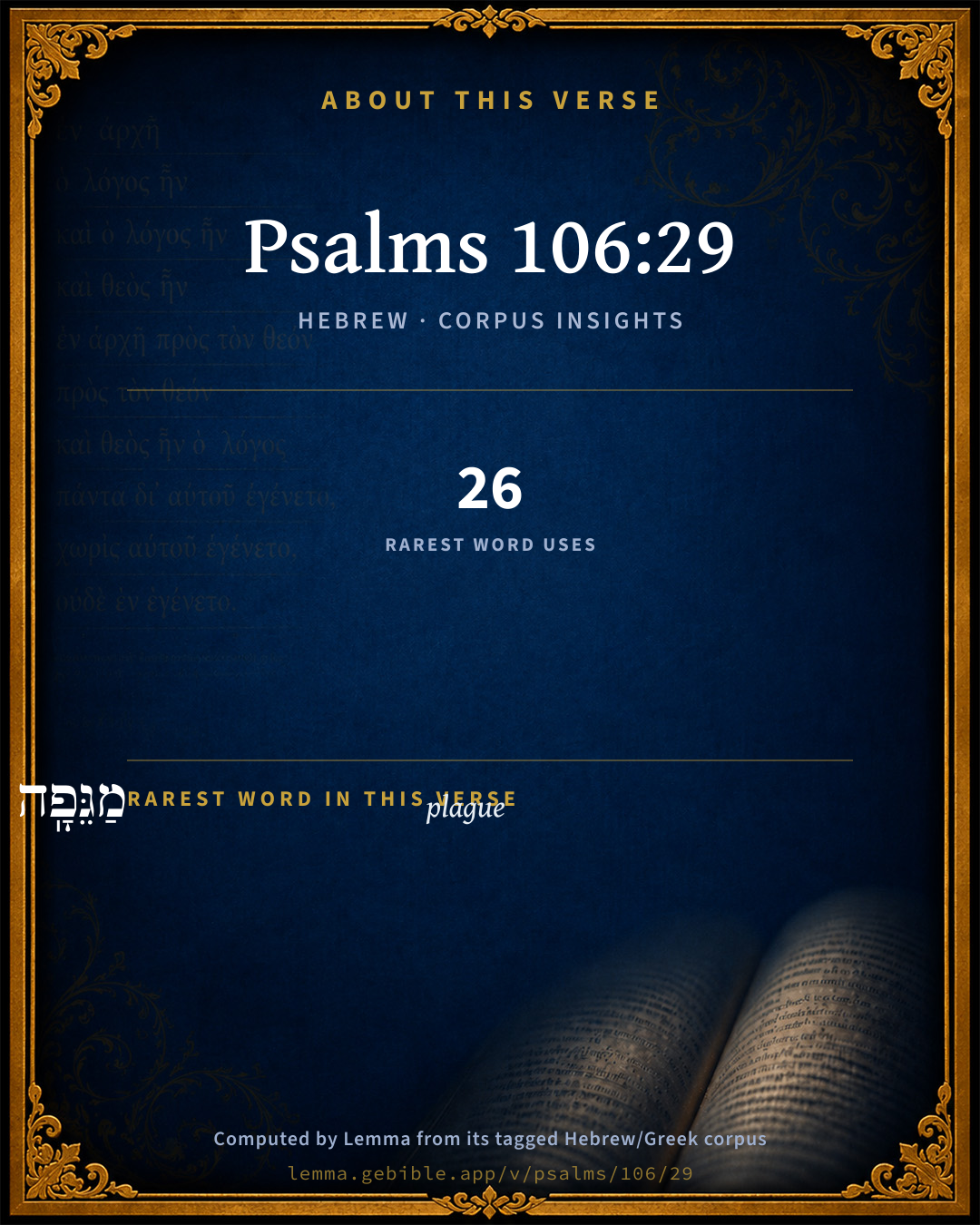
מַגֵּפָֽה plague H4046 occurs in 25 verses of the Hebrew Bible. Also found in:

Grammatical profile

  • 2 verbs
  • 2 nouns
  • 1 preposition

Verb forms

  • וַ֭יַּכְעִיסוּ Hiphil · Sequential Imperfect
  • וַתִּפְרָץ Qal · Sequential Imperfect

Hebrew & Septuagint length

In English translation the verse runs 15 words from the Hebrew and 6 from the Septuagint (LXX English) — closely comparable.

A rough comparison of the two English renderings, which tokenize alike — not a word-level alignment.

Word counts can differ between the Hebrew and the Greek without any difference in meaning — e.g. the Hebrew direct-object marker אֵת has no separate Greek word, and Greek often adds the article ὁ.

Cross-references

7

Topical passages linked to Psalms 106:29 in the Treasury of Scripture Knowledge — connected by theme and wording, ordered by reader-vote popularity; previews shown in the World English Bible.

  • 1 Corinthians 10:8 Neither let us commit sexual immorality, as some of them committed, and in one day twenty-three thousand fell.
  • Deuteronomy 32:16–21 They moved him to jealousy with strange [gods]; With abominations provoked they him to anger.
  • Numbers 25:9 Those who died by the plague were twenty-four thousand.
  • Psalms 99:8 You answered them, Yahweh our God. You are a God who forgave them, Although you took vengeance for their doings.
  • Psalms 106:39 Thus were they defiled with their works, And prostituted themselves in their deeds.
  • Ecclesiastes 7:29 Behold, this only have I found: that God made man upright; but they search for many schemes.
  • Romans 1:21–24 Because, knowing God, they didn't glorify him as God, neither gave thanks, but became vain in their reasoning, and their senseless heart was darkened.

Cross-references courtesy of OpenBible.info (CC BY 4.0).

Hebrew and Greek witnesses Masoretic Hebrew ↔ Greek Septuagint

The same verse in the two great witnesses to the Old Testament, shown verse-for-verse.

You’re reading Greek Psalm 105 (Hebrew Psalm 106). The Septuagint counts the superscription, so verse numbers can differ from the Hebrew — chapter-level alignment, not verse-by-verse. Numbering follows Rahlfs.

These are two independent witnesses, not word-aligned to each other, and the Septuagint is shown in lemma (dictionary) form.

Hebrew Psalms 106:29 Masoretic · Westminster Leningrad Codex

וַ֭יַּכְעִיסוּ בְּמַֽעַלְלֵיהֶ֑ם וַתִּפְרָץ בָּ֝֗ם מַגֵּפָֽה

Thus they provoked him to anger with their deeds. The plague broke in on them.

World English Bible · Public Domain

Greek LXX Greek Psalm 105:29 Septuagint · lemma form

καί παραὀξύνω αὐτός ἐν ὁ ἐπιτήδευμα αὐτός καί πληθύνω ἐν αὐτός ὁ πτῶσις

and destruction, was multiplied among them.

LXX2012 (modern English Septuagint) · Public Domain

Hebrew: Westminster Leningrad Codex (CC BY 4.0). Greek: Septuagint (public domain); English from LXX2012 (modern English Septuagint) (Public Domain). How the Septuagint differs from the Hebrew →

Commentary

Notes on Psalms 106:29 from classic Christian and Jewish commentators (each source and its license shown beneath its notes). The classic Christian expositions comment on the surrounding passage and are grouped to its opening verse, so a note may address several verses; the Jewish commentaries on the Tanakh (Rashi and others) are per-verse, so they appear only where the commentator wrote on this verse.

Lemma curates 59 commentaries, every one of them public domain or Creative Commons licensed, each selected and text-cleaned for this edition rather than reprinted as found. About our sources →

Trapp's Complete Commentary

John Trapp

Psa 106:29 Thus they provoked [him] to anger with their inventions: and the plague brake in upon them.

Ver. 29. Thus they provoked him] God cannot brook men’s devices in matters of religion; he will have no other worship than what himself hath appointed.

And the plague brake in upon them] As a deluge, or as an army, very impetuously, to the destroying of twenty-four thousand persons.

John Trapp, A Commentary or Exposition upon All the Books of the Old and New Testament (1647–1656) — public domain. Text from a community e-Sword module.

J. A. Alexander on Psalms

Joseph Addison Alexander

29. (Psa 106:29) And they provoked him by their crimes, and the plague broke out among them. The first verb means to excite both grief and indignation. Compare the use of the cognate noun in Psa 6:7, and of the verb itself in Psa 78:58. The word translated plague, like its English equivalent, has both a generic and specific meaning; that of a divine stroke or infliction in general, and that of a pestilential disease in particular. See Num 25:17-18.

Joseph Addison Alexander, The Psalms Translated and Explained (1850) — public domain. Text from a community e-Sword module.

Geneva Bible (1599)

Geneva Bible translators

Signifying that whatsoever man inventeth of himself to serve God by, is detestable, and provoketh his anger.

Geneva Bible (1599) marginal notes — public domain. Text via Bolls.life.

John Calvin's Commentaries

29. And they provoked God to anger. The prophet once more informs us, that they had been put upon their guard by another plague, in order that it might appear that God had always a strict regard for his own glory, in chastising the people; but as they were not bettered by these plagues, these chastisements were fruitless. Having formerly stated, that God’s wrath had been appeased by the prayers of Moses, he now says, that the plague had been arrested or ceased by means of the kind interposition of Phinehas. Some render the word פלל, pillel, to pray; but the other rendering, to execute justice, is more in accordance with the context; namely, that by his zeal in executing justice upon the profligates, he turned away God’s vengeance from the Israelites. He stood up therefore, that is, he rose up or interposed, when all others maintained a careless indifference. As the Jews were sensible that it was by the kind intervention of one man that the plague was now healed, their obstinacy was the less excusable in not even then ceasing to sin. We must not forget that all these things are addressed to us. For when God from time to time chastises us, and calls upon us to repent by setting before us the example of others, how few profit by his corrections! Moreover, it deserves to be noticed, that the plague ceased at the very time when Phinehas executed justice. From this we may learn, that the most effectual way to quench the fire of God’s anger, is when the sinner willingly sits in judgment upon himself for the punishment of his own transgressions; as Paul says, 1 Corinthians 11:31,

“If we would judge ourselves, verily we would not be judged of the Lord.”

And surely God confers no small honor upon us, in placing the punishment of our sins within our reach. At the same time, it must be observed, that on that occasion the plague ceased in consequence of the punishment of a single person, because the people then shrunk from the abominable wickedness to which they had been addicted.

John Calvin's Commentaries (1540-1563) — public domain. Text from the Calvin Translation Society English edition (1840s-50s) via the Christian Classics Ethereal Library (ccel.org). Calvin's coverage is partial (roughly two-thirds of the Bible); uncommented books and verses are honest gaps, never fabricated. The 19th-century editor's footnotes and remarks are omitted so the notes are faithfully Calvin's own voice.

The Cambridge Bible for Schools and Colleges

gen. ed. J. J. S. Perowne

29. And they provoked (him) to anger with their doings] Again a Deuteronomic expression. Cp. Deu_4:25; Deu_9:18; Deu_31:29; Deu_32:16; Deu_32:21. ‘Inventions’ of A.V. reproduces the Vulg. adinventionibus suis.

a plague] Lit. smiting; either the slaughter of the guilty Israelites which had been enjoined (Num_25:4-5), or, as the word commonly means (Num_16:48, &c.), a divinely inflicted pestilence.

The Cambridge Bible for Schools and Colleges (gen. ed. J. J. S. Perowne; Cambridge University Press, 1878–1918) — public domain. Text from a community e-Sword module.

John Gill's Exposition

Thus they provoked him to anger with their inventions,.... Sin is an invention of man's: when our first parents sinned, they found out many inventions; and their posterity ever since have been inventors of evil things; and man's invention is very quick at that work. All false doctrine and false worship are of men's finding out; all idolatrous practices are their inventions, and which are here intended; see Psa 106:39. And these are very provoking to God, who is jealous of his glory, and which is taken from him hereby; and even when he forgives such sins of men, he takes vengeance on their inventions, as in this case, Psa 99:8. For it follows:

and the plague brake in upon them: like an inundation of water, and carried off four and twenty thousand persons, Num 25:9.

John Gill's Exposition of the Whole Bible (1746–1763) — public domain (CC PDM 1.0). Text via the HelloAO Bible API.

Albert Barnes' Notes on the Bible

Thus they provoked him to anger with their inventions - The word rendered “inventions” means properly “works; deeds;” then it is used in the sense of “evil” deeds, crimes.

And the plague brake in upon them - See Num 25:8-9. No less than twenty-four thousand fell in the plague. Num 25:9.

Albert Barnes' Notes on the Bible (1834–1885) — public domain. Text from a community e-Sword/MySword module.

The Treasury of David

Charles H. Spurgeon

Ver. 29. Thus they provoked him to anger with their inventions: and the plague brake in upon them. Open licentiousness and avowed idolatry were too gross to be winked at. This time the offences clamoured for judgment, and the judgment came at once. Twenty-four thousand persons fell before a sudden and deadly disease which threatened to run through the whole camp. Their new sins brought on them a disease new to their tribes. When men invent sins God will not be slow to invent punishments. Their vices were a moral pest, and they were visited with a bodily pest: so the Lord meets like with its like.

Ver. 29. They provoked him to anger with their inventions. Note, that it is not said, with their deeds, but with their pursuits (studies). It is one thing simply to do a thing; it is quite another to pursue it earnestly night and day. The first may take place by chance, or through ignorance, or on account of some temptation, or violence, and that without the consent and against the inclination of the mind. But the latter is brought about in pursuance of a fixed purpose and design and by effort and forethought. We see, therefore, in this passage that the patience of God was at length provoked to anger and fury when the people sinned not merely once and again, but when the pursuit of sin grew and strengthened. Musculus.

Ver. 29. Their inventions. Their sins are here called by the name of "their inventions." And so, sure, they are; as no ways taught us by God, but of our own imagining or finding out. For, indeed, our inventions are the cause of all sins. And if we look well into it we shall find our inventions are so. By God's injunction we should all live, and his injunction is, "You shall not do every man what seems good in his own eyes" (or finds out in his own brains), but "whatsoever I command you, that shall you do." De 12:8. But we, setting light by that charge of his, out of the old disease of our father Adam ("ye shall be as gods, knowing good and evil"), think it a goodly matter to be witty, and to find out things ourselves to make to ourselves, to be authors, and inventors of somewhat, that so we may seem to be as wise as God, if not wiser; and to know what is for our turns, as well as he, if not better. It was Saul's fault. God bade him destroy Amalek altogether, and he would invent a better way, to save some (forsooth) for sacrifice, which God could not think of. And it was St. Peter's fault, when he persuaded Christ from his passion, and found out a better way (as he thought) than Christ could devise. Lancelot Andrewes.

Ver. 29. Brake in upon them. The image is that of a river which has burst its barriers; see Ex 19:24. The plague is the slaughter inflicted upon the people by command of Moses; Nu 25:4-5, 8-9, 18. "The Speaker's Commentary."

Psalms 106:30*

Charles H. Spurgeon's The Treasury of David (1869–1885) — public domain. Psalms only. Text from a community e-Sword/MySword module.

The Pulpit Commentary

Thus they provoked him to anger with their inventions; or, with their doings. And the plague; rather, a Plague. brake in upon them. The judicial slaughter inflicted by command of Moses (Num_25:4-8) is called here, as it is also in Num_25:8, Num_25:9, Num_25:18, "a plague."

The Pulpit Commentary (1880–1919), ed. H.D.M. Spence-Jones & Joseph S. Exell — public domain. Text from a community e-Sword module.

Lesson kit

Teaching starters — assembled from the data on this page, not authored interpretation. Every prompt links to the verse data it draws on. Edit before teaching.

Psalms, in the Wisdom, opens this verse with 5 words (4 distinct Hebrew lemmas). Its most distinctive word is maggêphâh (“plague”). A historical commentator’s framing appears above. Read the whole chapter for the surrounding context.

Discussion questions

  1. The word maggêphâh carries the sense “plague.” How does it shape the verse?
  2. Exodus 9:14 shares the word «plague» with this verse. How do the two illuminate each other?
  3. The translations on this page render this verse differently — a whole-verse word diff, not a word-by-word alignment. What might account for the different wordings?
  4. The verb «וַ֭יַּכְעִיסוּ» is Hiphil Sequential Imperfect. How does its form color the action?
  5. Reading how Trapp's Complete Commentary and J. A. Alexander on Psalms read this verse, where do the two commentators agree and where do they part?

Things to notice

Reading settings

Reading text

Shown beneath each verse's original-language words.

Old Testament
Old Testament edition

Read the OT as the Masoretic Hebrew (MT) or the Greek Septuagint (LXX).

English shown for the Greek Septuagint (in the Hebrew ↔ Greek comparison).

Comparing translations? Open the Compare panel on any verse page to stack up to four side by side.